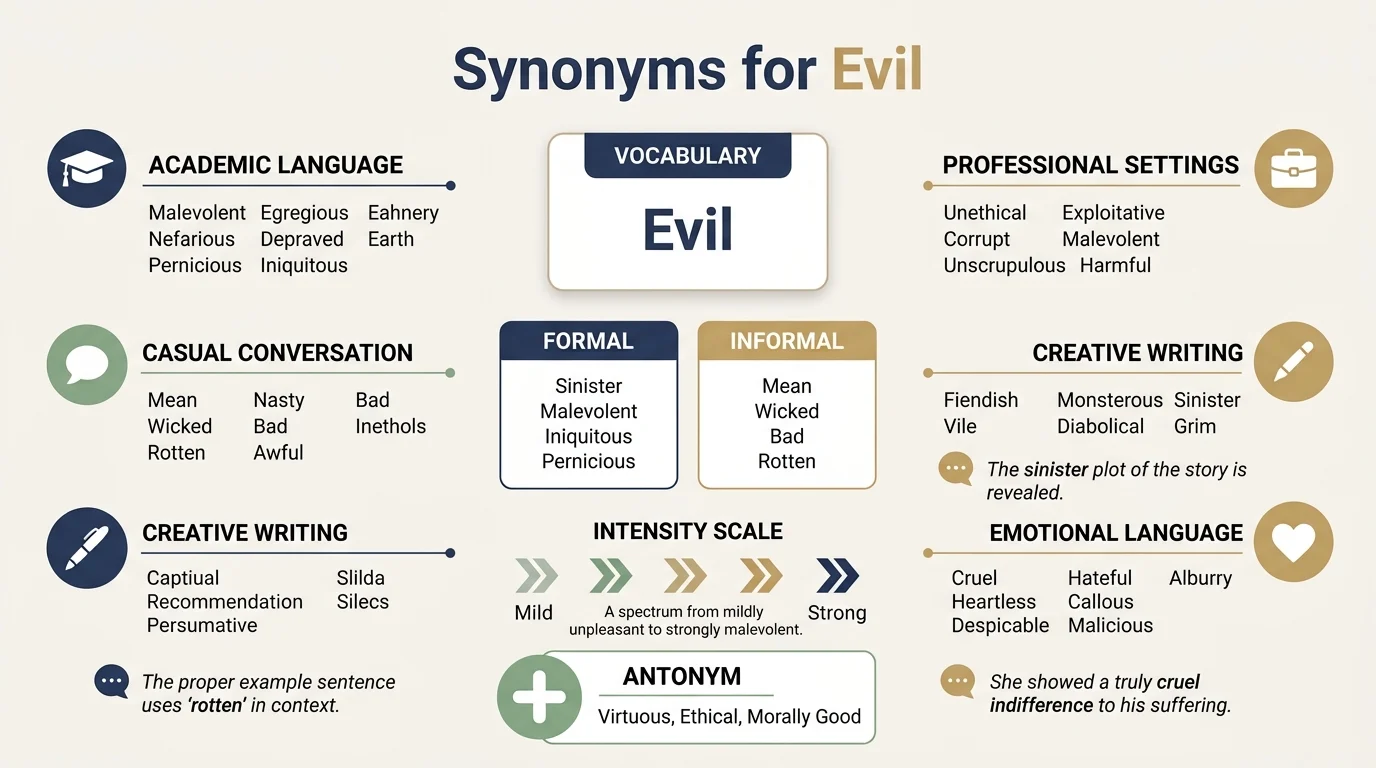
Have you ever found yourself using the word “evil” over and over again in your writing? Maybe you are describing a villain in a story, a difficult situation at work, or a character in a book report. Repeating the same word makes your writing feel flat and uninspired.
This guide will help you find the perfect synonym for evil in any situation. You will learn which words work best for formal essays, casual conversations, professional emails, and creative storytelling.
What Does “Evil” Mean?
Evil means profoundly immoral, wicked, or harmful. The best synonym depends on your context. For formal writing, choose “malevolent” or “nefarious.” casual conversation, try “bad” or “mean.” creative writing, use “sinister” or “diabolical.” For professional settings, “malicious” or “detrimental” work well. Each synonym carries its own shade of meaning and intensity.
Meaning, Tone and Context
- Simple definition: Evil refers to something deeply immoral, harmful, or wicked.
- Part of speech: Evil can function as an adjective or a noun.
- Tone: Evil has an intensely negative tone.
- Formality level: Evil is neutral and widely used across all formality levels.
- Common use cases: Describing villains, harmful actions, toxic situations, immoral behavior, and dangerous circumstances.
- Important word forms: Evil (adjective, noun), evilly (adverb), evilness (noun).
When and How to Use “Evil”
Evil works best when describing something truly immoral or harmful. It is a strong word that should be reserved for serious situations.
Professional context:
The company’s decision to hide the safety data felt genuinely evil to the employees.
Personal context:
She could not believe her best friend would spread such evil rumors about her.
Academic context:
The historian analyzed how evil regimes throughout history used propaganda to maintain control.
Emotional context:
The evil in his voice made her tremble with fear during the argument.
Creative context:
The forest seemed to pulse with an evil energy that made the travelers uneasy.
Social media context:
Some people use social media to spread evil messages and harmful content.
Another Word for “Evil”
The best single replacement depends entirely on your situation and audience.
Professional writing: Malicious
Academic writing: Malevolent
Casual conversation: Bad
Emotional writing: Vile
Creative writing: Sinister
Resume or workplace: Unethical
Social media captions: Toxic
Stronger meaning: Diabolical
Softer meaning: Unpleasant
When Not to Use “Evil”
Evil sounds too dramatic for minor misdeeds. It also feels too vague when you need a specific description.
Consider this weak sentence:
The customer service was evil.
This sentence lacks precision. A better alternative:
The customer service was dismissive and unhelpful.
Consider this overstatement:
My brother was evil for eating my leftovers.
A more accurate choice:
My brother was thoughtless for eating my leftovers.
Evil should be reserved for truly harmful or immoral actions, not everyday annoyances.
Words Commonly Confused With “Evil”
Wicked vs. Evil
Wicked suggests playful or mischievous wrongdoing. Evil implies deeper moral corruption. Wicked works for a clever villain. Evil works for a genocidal dictator.
Sinful vs. Evil
Sinful connects to religious or moral rules. Evil connects to universal harm and immorality. Sinful describes breaking religious laws. Evil describes causing profound suffering.
Malevolent vs. Evil
Malevolent specifically means having ill will toward others. Evil covers a broader range of immoral behavior. Malevolent focuses on intention. Evil focuses on the action and its consequences.
Corrupt vs. Evil
Corrupt refers to moral decay or dishonesty, often in systems. Evil refers to active harm and wickedness. Corrupt describes a broken system. Evil describes a person who actively causes harm.
Vicious vs. Evil
Vicious describes cruel and violent behavior. Evil describes profound immorality and harm. Vicious focuses on brutality. Evil focuses on moral wrongness.
Nefarious vs. Evil
Nefarious describes criminal or villainous acts. Evil describes fundamental moral wrongness. Nefarious works for criminal plots. Evil works for fundamental wickedness.
Best Synonym by Context for “Evil”
| Context | Best Synonym | Why It Works | Example |
|---|---|---|---|
| Formal writing | Malevolent | Sounds precise and academic | The malevolent forces threatened the stability of the region. |
| Academic writing | Nefarious | Conveys scholarly precision | The study examined nefarious practices in corporate governance. |
| Professional business | Malicious | Clear and direct | The malicious software destroyed company data. |
| Resume writing | Unethical | Professional and measured | I refused to participate in unethical business practices. |
| Casual conversation | Bad | Simple and natural | That was a really bad thing to do. |
| Creative writing | Sinister | Creates atmosphere and mood | A sinister figure lurked in the shadows. |
| Emotional tone | Vile | Conveys strong disgust | His vile comments made everyone uncomfortable. |
| Strong intensity | Diabolical | Suggests clever wickedness | The diabolical plan would have destroyed the city. |
| Soft moderate tone | Harmful | Focuses on impact not intent | The harmful effects of the policy lasted for years. |
| Social media captions | Toxic | Modern and relatable | Toxic people only bring drama to your life. |
Which Synonym Should You Choose?
Consider your audience first. Formal writing demands precise words like malevolent or nefarious. Casual conversations call for simpler words like bad or mean.
Think about intensity. Diabolical suggests extreme clever wickedness. Harmful focuses on consequences rather than intent.
Match the emotional tone. Vile conveys disgust and revulsion. Sinister creates an atmosphere of threat.
Consider professional impact. Unethical sounds measured and appropriate for workplace discussions. Malicious suggests intentional harm.
Always ask yourself what you are trying to communicate. Are you describing a person, an action, or a situation? The answer will guide your word choice.
Real Life Examples of “Evil” in Sentences
School context:
The students wrote essays about how evil characters are portrayed in classic literature.
Workplace context:
The manager’s evil tactics included stealing credit from junior employees.
Writing context:
Using the word evil too often makes your villain feel one dimensional and boring.
Conversation context:
People often call things evil when they really just find them unpleasant.
Social media context:
Spreading evil rumors online can ruin someone’s reputation permanently.
Email context:
The employee sent a formal complaint about the evil treatment she experienced.
Storytelling context:
The evil queen’s cruelty knew no bounds as she tormented the kingdom.
25 Synonyms for “Evil”
| Synonym | Simple Meaning | Best Used For | Example Sentence |
|---|---|---|---|
| Wicked | Morally wrong and bad | Creative writing and conversation | The wicked witch cast a terrible spell on the village. |
| Malevolent | Having ill will toward others | Academic and formal writing | The malevolent dictator oppressed his people for decades. |
| Nefarious | Criminal and villainous | Professional and academic contexts | The nefarious plot involved stealing company secrets. |
| Malicious | Intending to cause harm | Business and legal writing | The malicious email contained a dangerous virus. |
| Sinister | Threatening and ominous | Creative writing and description | The sinister mansion stood alone on the hilltop. |
| Vile | Extremely unpleasant and disgusting | Emotional and personal writing | His vile behavior at the party shocked everyone. |
| Diabolical | Cleverly wicked and evil | Creative and dramatic contexts | The diabolical genius outsmarted the heroes. |
| Corrupt | Dishonest and morally decayed | Political and business writing | The corrupt official accepted bribes for years. |
| Vicious | Cruel and violent | News and descriptive writing | The vicious attack left the community in shock. |
| Depraved | Morally corrupt and wicked | Formal and academic contexts | The depraved actions of the criminal were widely condemned. |
| Heinous | Shockingly evil and terrible | Legal and formal writing | The heinous crime received widespread media attention. |
| Atrocious | Horrifically wicked and bad | Descriptive and emotional writing | The atrocious conditions in the prison were exposed. |
| Devilish | Playfully or cleverly wicked | Lighthearted creative writing | The devilish grin on his face made everyone nervous. |
| Fiendish | Extremely cruel and unpleasant | Creative and descriptive contexts | The fiendish trap caught the unsuspecting travelers. |
| Iniquitous | Grossly unfair and morally wrong | Formal and academic writing | The iniquitous system favored the wealthy elite. |
| Pernicious | Having a harmful effect gradually | Professional and academic contexts | The pernicious influence of the group spread slowly. |
| Detrimental | Causing harm or damage | Professional and everyday use | The detrimental policies hurt small businesses. |
| Unethical | Not morally correct | Professional and workplace contexts | The unethical decision cost the company its reputation. |
| Immoral | Not following moral principles | General and academic contexts | The immoral practice was finally banned by law. |
| Wrong | Not right or acceptable | Casual conversation and writing | His wrong actions caused pain to many people. |
| Harmful | Causing damage or injury | Neutral and factual contexts | The harmful substance was removed from the product. |
| Noxious | Harmful and poisonous | Scientific and descriptive contexts | The noxious fumes from the factory sickened residents. |
| Hateful | Full of hatred and malice | Emotional and personal contexts | His hateful comments created a toxic environment. |
| Spiteful | Showing petty and malicious intent | Personal and descriptive contexts | The spiteful remark ruined their friendship. |
| Malign | Evil and harmful in nature | Formal and literary contexts | The malign influence of the group corrupted the youth. |
Synonym Groups and Usage Differences
Professional vs. Personal Synonyms
Professional settings demand words that sound measured and factual. Malicious and unethical work well in business contexts. Personal situations allow for more emotional words like vile and hateful. The difference lies in the audience and the formality of the situation.
Formal vs. Conversational Synonyms
Formal writing benefits from words like nefarious, malevolent, and iniquitous. These words sound precise and academic. Conversational settings call for simpler choices like bad, mean, or wrong. Using formal words in casual conversation sounds pretentious and unnatural.
Academic Synonyms
Academic writing values precision and specificity. Malevolent and nefarious appear frequently in scholarly work. These words convey complex ideas about morality and behavior. Pernicious and iniquitous also work well in academic contexts. They suggest systematic harm and moral corruption.
Professional and Business Synonyms
Business communication requires words that are clear and actionable. Malicious and unethical are direct and professional. Detrimental works well when describing harmful effects. These synonyms avoid emotional drama while still conveying seriousness.
Creative or Literary Synonyms
Creative writing thrives on vivid and atmospheric words. Sinister creates tension and threat. Diabolical suggests clever and elaborate wickedness. Depraved and heinous add weight to dark characters. These words help writers build immersive worlds and compelling villains.
Strongest vs. Weaker Synonyms
Intensity scale from mild to strongest:
Harmful, Wrong, Bad, Unethical, Malicious, Vicious, Malevolent, Heinous, Atrocious, Depraved, Diabolical
Emotional vs. Neutral Synonyms
Emotional synonyms like vile and hateful carry strong feelings. They convey disgust and personal revulsion. Neutral synonyms like detrimental and harmful focus on factual impact. They describe consequences without emotional judgment.
Antonyms of “Evil”
| Antonym | Meaning | Example Sentence |
|---|---|---|
| Good | Morally right and excellent | The good doctor treated everyone with kindness. |
| Virtuous | Having high moral standards | The virtuous leader inspired her entire community. |
| Kind | Friendly and considerate | His kind nature made him beloved by all. |
| Benevolent | Well meaning and kindly | The benevolent organization helped thousands of families. |
| Righteous | Morally right and just | The righteous judge made fair decisions for everyone. |
| Honest | Truthful and sincere | The honest merchant never cheated his customers. |
| Pure | Free from moral fault | Her pure heart guided her through difficult times. |
| Noble | Having excellent moral qualities | The noble knight protected the weak and innocent. |
| Just | Fair and morally right | The just ruling restored peace to the kingdom. |
| Ethical | Following moral principles | The ethical company refused to use child labor. |
| Moral | Concerned with principles of right and wrong | The moral choice was not always the easiest one. |
| Right | Morally correct and acceptable | He knew the right thing to do and did it. |
| Decent | Conforming to accepted standards of morality | The decent people in the town helped the victims. |
| Innocent | Not guilty of any wrongdoing | The innocent child trusted everyone she met. |
| Saintly | Very holy and virtuous | The saintly woman devoted her life to helping others. |
Comparison: Evil vs. Similar Words
Evil vs. Wicked
Main difference: Evil suggests profound moral corruption. Wicked implies mischievous or playful wrongdoing.
Which one is stronger: Evil is much stronger and more serious.
Which one is more formal: Evil is more formal and widely accepted.
Example for Evil: The evil dictator ordered the destruction of the village.
Example for Wicked: The wicked stepsister hid the glass slipper.
Evil vs. Sinister
Main difference: Evil describes moral wrongness. Sinister describes an ominous and threatening atmosphere.
Which one is stronger: Evil is stronger in terms of moral judgment.
Which one is more formal: Both are formal, but sinister is more descriptive.
Example for Evil: The evil organization planned to take over the world.
Example for Sinister: A sinister fog rolled in from the cemetery.
Evil vs. Malicious
Main difference: Evil is broad and general. Malicious specifically means intending to cause harm.
Which one is stronger: Evil carries a heavier moral weight.
Which one is more formal: Malicious is more formal and legal in tone.
Example for Evil: The evil empire crushed all opposition.
Example for Malicious: The malicious rumor destroyed her career.
Evil vs. Corrupt
Main difference: Evil refers to fundamental wickedness. Corrupt refers to moral decay, often in systems.
Which one is stronger: Evil is stronger and more absolute.
Which one is more formal: Both are formal but used in different contexts.
Example for Evil: The evil wizard plotted against the kingdom.
Example for Corrupt: The corrupt government official accepted bribes.
Evil vs. Vicious
Main difference: Evil describes moral wrongness. Vicious describes cruel and violent behavior.
Which one is stronger: Evil has a broader moral dimension.
Which one is more formal: Vicious is more commonly used in news and legal contexts.
Example for Evil: The evil tyrant ruled with absolute power.
Example for Vicious: The vicious dog attacked the mail carrier.
Evil vs. Heinous
Main difference: Evil is a general term. Heinous specifically describes shockingly evil acts.
Which one is stronger: Heinous often describes more specific and extreme acts.
Which one is more formal: Heinous is commonly used in legal and formal contexts.
Example for Evil: The evil man showed no remorse.
Example for Heinous: The heinous crime shocked the entire nation.
Common Phrases and Expressions with “Evil”
1. The lesser of two evils
Meaning: The less harmful option among two bad choices.
Example: Voting for the moderate candidate felt like choosing the lesser of two evils.
2. Evil eye
Meaning: A look that suggests malicious intent or bad luck.
Example: The old woman gave him the evil eye after he cut in line.
3. Necessary evil
Meaning: Something unpleasant that must be accepted.
Example: Paying taxes is a necessary evil for a functioning society.
4. Evil twin
Meaning: A person who looks like someone else but has a bad character.
Example: The movie featured the hero’s evil twin who wanted to destroy the city.
5. Pure evil
Meaning: Completely and utterly wicked.
Example: The villain in the story was portrayed as pure evil.
6. Evil deeds
Meaning: Immoral or harmful actions.
Example: The book detailed the evil deeds of the notorious gangster.
7. Evil spirit
Meaning: A malevolent supernatural being.
Example: The ancient ritual was meant to banish evil spirits from the house.
8. Evil genius
Meaning: Someone who uses intelligence for wicked purposes.
Example: The evil genius created a machine that could control minds.
Common Mistakes to Avoid
- Using evil when a more precise synonym is better
Avoid using evil for minor misdeeds. Use thoughtless or careless instead for small mistakes. - Confusing evil with a related word
Evil describes moral corruption. Vicious describes violent behavior. These words are not interchangeable. - Using a casual synonym in formal writing
Avoid using bad or mean in academic papers. Choose malevolent or nefarious instead. - Using an overly dramatic synonym for a simple situation
Do not call a minor disagreement heinous. Save strong words for serious situations. - Repeating the same word too often
Vary your word choice to keep writing engaging. Use different synonyms for evil throughout your text. - Choosing a synonym with the wrong emotional tone
Vile expresses disgust. Sinister creates atmosphere. Choose the emotion you want to convey. - Using slang in academic or professional writing
Avoid words like toxic or bad in formal contexts. Stick to proper synonyms like unethical or detrimental.
FAQs
1. What is the best synonym for evil?
The best synonym depends on context. Malevolent works for formal writing. Wicked works for creative writing. Bad works for casual conversation.
2. What is a formal synonym for evil?
Malevolent and nefarious are excellent formal synonyms for evil. They appear frequently in academic and professional writing.
3. What is an informal synonym for evil?
Bad and mean are common informal synonyms for evil. They work well in everyday conversation and casual writing.
4. What is another word for evil in professional writing?
Malicious and unethical are professional synonyms for evil. They sound clear and appropriate for workplace communication.
5. What is the difference between evil and wicked?
Evil suggests profound moral corruption. Wicked implies mischievous or playful wrongdoing. Evil is more serious and absolute.
6. What is the opposite of evil?
Good is the most direct opposite of evil. Virtuous, benevolent, and righteous are also strong antonyms.
Conclusion
Evil is a powerful word that describes profound moral wrongness. The best synonym depends on your context, audience, and desired intensity. Formal writing calls for malevolent or nefarious. Creative writing thrives on sinister or diabolical. Professional settings require malicious or unethical. Casual conversation works with bad or mean. Always consider the tone and situation before choosing your synonym.
A practical tip for vocabulary improvement: Keep a list of synonyms for common words like evil. Practice using different synonyms each day. This habit will expand your vocabulary and make your writing more precise and engaging.