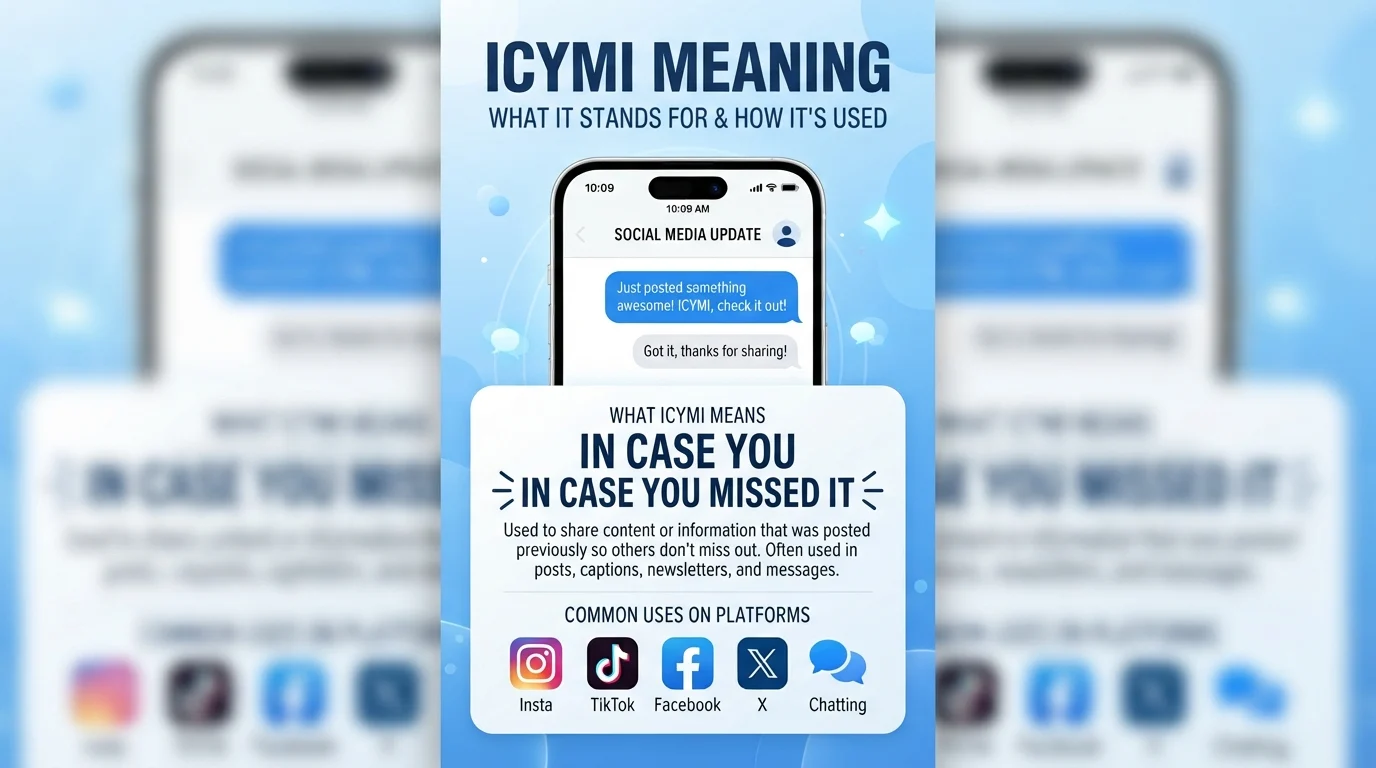
You may see ICYMI at the start of a post, message, or caption and wonder what those four letters mean. ICYMI means “in case you missed it.” People use it to point you toward something they think you may not have seen, such as an earlier message, news update, photo, announcement, or interesting post.
The phrase is usually neutral and helpful, although the exact tone depends on the wording around it. You’ll commonly see ICYMI in social media posts, group chats, emails, newsletters, and casual online conversations. Understanding the context makes it easy to tell whether someone is simply sharing an update or subtly reminding you about something.
What Does ICYMI Mean?
ICYMI stands for “in case you missed it.” It is an internet abbreviation used when someone wants to highlight information that was already shared or published.
| Detail | Explanation |
|---|---|
| Most Common Meaning | In case you missed it |
| Full Form | In Case You Missed It |
| Tone | Usually neutral, helpful, or casual |
| Common Use | Sharing an earlier update, post, announcement, or piece of information |
| Formal or Informal | Mostly informal, but sometimes used in professional digital communication |
For example:
“ICYMI, the meeting starts at 3 instead of 4.”
Here, the sender assumes the information may have been overlooked and is repeating it for convenience. They are not necessarily criticizing you for missing the original message.
The abbreviation can also introduce something that deserves renewed attention. A person might write “ICYMI: Our new video is live” or “ICYMI, here’s what happened yesterday.”
In each case, the basic idea remains the same: you may have missed this, so I’m bringing it back to your attention.
How ICYMI Is Used In Text
In text messages, ICYMI often works as a quick way to bring someone back to an earlier piece of information.
You might send it when a friend missed a group-chat update, forgot about an event, or did not see a message buried among several others.
For example:
“ICYMI, Sarah changed the dinner reservation to Friday.”
The abbreviation saves space and immediately signals that the following information has already been mentioned or is available somewhere else.
It can also appear when someone forwards a useful reminder:
“ICYMI, the teacher posted the exam topics this morning.”
The expression does not automatically mean the recipient was careless. Messages can get buried, notifications can be missed, and social feeds move quickly.
ICYMI On Social Media
Social media is one of the most common places to encounter the acronym. People often use ICYMI in captions, reposts, short updates, and comments when they want others to see something they may have overlooked.
On Instagram, a user might share an older post and write:
“ICYMI, these were some of my favorite photos from the trip.”
On TikTok, someone could use it while reposting an earlier clip:
“ICYMI, here’s the full recipe.”
On X or Facebook, it may introduce a previous announcement, major update, or popular post that deserves another look.
The meaning generally stays the same across these platforms. The difference is mostly in what follows the acronym.
How Context Changes The Meaning
ICYMI has a fairly stable definition, but its tone can change with context. Look at the surrounding message instead of interpreting the abbreviation by itself.
Consider these examples:
“ICYMI, we’re meeting at noon.”
This sounds like a simple reminder.
“ICYMI, I already sent you the file yesterday.”
This can sound slightly frustrated because the sender is pointing out that the information was previously provided.
“ICYMI 😂 this video is hilarious.”
The laughing emoji makes the message feel playful and casual.
“ICYMI, management posted a new policy.”
Here, the tone is informational and more professional.
The relationship between the people also matters. A close friend can use ICYMI casually, while the same wording from a coworker may sound more deliberate.
ICYMI In Different Online Contexts
The acronym is used across several digital spaces without a major change in its core meaning.
Text Messages
In texting, ICYMI usually introduces a reminder or information you may not have seen earlier.
“ICYMI, Mom wants us home by 8.”
Instagram And Facebook
People often use it when resurfacing an older post, announcement, photo, or update.
“ICYMI, our summer collection dropped yesterday.”
TikTok
On TikTok, ICYMI can introduce a repost, previous explanation, clip, or piece of content worth revisiting.
“ICYMI, part two is finally up.”
Group Chats And Community Chats
In busy chats, the acronym can help bring attention to an earlier message that got buried.
“ICYMI, the game is at Jake’s house tonight.”
Real Conversation Examples
Friends
Person A: “What time are we leaving?”
Person B: “ICYMI, we agreed on 7:30 in the group chat.”
Meaning: The second person is reminding their friend that the departure time was already discussed.
Classmates
Person A: “Did the professor post the assignment?”
Person B: “Yeah, ICYMI, it’s due Monday morning.”
Meaning: The abbreviation points the classmate toward an update they may have missed.
Social Media
Person A: “Wait, when did you upload this?”
Person B: “Yesterday! ICYMI, I posted three photos from the concert.”
Meaning: The speaker casually directs the person to an earlier post.
Is ICYMI Rude?
ICYMI is not inherently rude. In many conversations, it sounds practical and neutral because the sender is simply highlighting information.
However, wording can make it feel a little sharp.
For example:
“ICYMI, I told you this twice already.”
That message can sound annoyed because the writer is emphasizing a previous explanation.
By contrast:
“ICYMI 😊 here’s the schedule.”
This sounds friendly and helpful.
The punctuation, emoji, relationship, and surrounding words all influence how the message is received.
Is ICYMI Formal?
ICYMI is more common in informal and digital communication than in traditional formal writing.
You may see it in social media captions, workplace chats, newsletters, internal updates, or casual emails. However, spelling out the phrase is usually clearer in highly formal communication, especially when the audience may not know internet abbreviations.
For instance, a formal announcement might say:
“In case you missed the earlier update, the deadline has changed.”
That version communicates exactly the same idea without relying on an acronym.
How To Reply To ICYMI
Your response should match what the sender shared and the tone of the conversation.
Friendly Replies
- “Thanks, I missed that.”
- “Good catch, thanks!”
- “Yep, I just saw it.”
- “Thanks for the reminder.”
Funny Replies
- “Apparently I did miss it 😂”
- “My notifications betrayed me.”
- “Caught up at last!”
- “Okay, now I’m officially informed.”
Replies When You Are Confused
- “Missed what?”
- “Can you send it again?”
- “Which message are you referring to?”
These replies work because they directly address why ICYMI was used instead of forcing the conversation into an unrelated response.
When To Use ICYMI
ICYMI works well when you are talking with people who are familiar with online abbreviations. It fits naturally in casual texts, group chats, social posts, community discussions, and some workplace messaging.
It is particularly useful when information has already been shared but may have been overlooked.
You can also use it when resurfacing older content. For example, a creator might post an earlier video again and use ICYMI to signal that followers may have missed it the first time.
The main rule is simple: use it when you want to point someone toward information they may not have seen.
When To Avoid ICYMI
There is nothing inherently wrong with the acronym, but clearer wording can be better in situations where precision matters.
Consider writing the full phrase instead in job applications, formal academic work, official announcements, legal communication, or messages to people unfamiliar with internet slang.
You should also avoid relying on ICYMI when the underlying message is sensitive or potentially confusing. In those situations, a complete sentence usually leaves less room for misunderstanding.
Common Mistakes
| Common Mistake | Correct Understanding |
|---|---|
| Thinking ICYMI means something different on every platform | The core meaning generally remains “in case you missed it.” |
| Assuming ICYMI is automatically rude | Its tone depends on the surrounding wording and situation. |
| Treating it as a criticism | It can simply be a helpful reminder or a way to reshare information. |
Another common mistake is assuming the abbreviation refers only to social media. In reality, it can appear in texts, chats, digital newsletters, and other online communication.
Similar Slang And Abbreviations
Some abbreviations can seem similar because they help direct attention or provide additional information, but their functions differ.
| Term | Meaning | Main Difference |
|---|---|---|
| ICYMI | In case you missed it | Points to information that may have been overlooked |
| FYI | For your information | Shares information without implying it was previously missed |
| BTW | By the way | Introduces an additional or side point |
| PSA | Public service announcement | Highlights information intended for broader awareness |
| TL;DR | Too long; didn’t read | Gives or requests a short summary of longer content |
For example, FYI does not necessarily suggest that you missed anything. It can simply introduce information the sender wants you to know.
Origin And Popularity
The exact origin of the acronym is difficult to pin to one specific person or moment. It comes from the phrase “in case you missed it,” which is also commonly written in full.
The abbreviation became especially useful in digital communication because short labels make it easy to introduce reminders, reposts, and updates without writing the entire phrase every time.
Rather than treating ICYMI as a separate phrase with a different definition, think of it as a compact written form of an expression people already use naturally.
Quick Recap
- ICYMI means “in case you missed it.”
- It usually introduces information, a reminder, or content that may have been overlooked.
- Its meaning normally stays the same across texts and major social platforms.
- The tone can be friendly, neutral, playful, or slightly annoyed depending on context.
- When someone sends ICYMI, you can acknowledge the update, thank them, or ask them to resend it.
Frequently Asked Questions
What does ICYMI mean in text?
ICYMI means “in case you missed it,” and people use it to highlight previously shared information or content.
What does ICYMI stand for?
ICYMI stands for “in case you missed it,” a common abbreviation used in digital and casual communication.
Is ICYMI rude?
ICYMI is usually neutral, but it can sound annoyed when surrounding wording emphasizes that you missed previous information.
How should you reply to ICYMI?
You can thank the sender, acknowledge the update, joke about missing it, or ask them to resend the information.
Can ICYMI have different meanings?
ICYMI generally has one standard meaning, although its tone changes according to wording, context, relationship, and platform.
Final Thoughts
The ICYMI meaning is simple: “in case you missed it.” People use the abbreviation to resurface information, share reminders, or point you toward content you may not have seen.
Most of the time, ICYMI sounds neutral and helpful. Still, context matters because the same abbreviation can feel friendly, playful, or slightly irritated depending on the rest of the message.
When you use ICYMI, think about your audience and the setting. In casual digital conversations, it is a convenient shorthand. In formal situations, spelling out the phrase can make your message clearer.
2 thoughts on “ICYMI Meaning | Texting Shortcut You’ve Probably Seen but Missed in 2026”