Have you ever written an email, a social media caption, or an essay and found yourself using the word “proud” over and over again? You are not alone. Many writers and speakers rely on this single word to express a range of feelings, from deep satisfaction to smug arrogance.
This habit can make your communication feel flat and repetitive. The English language offers a rich vocabulary of alternatives that can add precision and color to your message. In this guide, we will explore over 50 synonyms for proud, helping you choose the right word for every situation, whether you are writing a professional report, a heartfelt letter, or a casual text.
What Does “Proud” Mean?
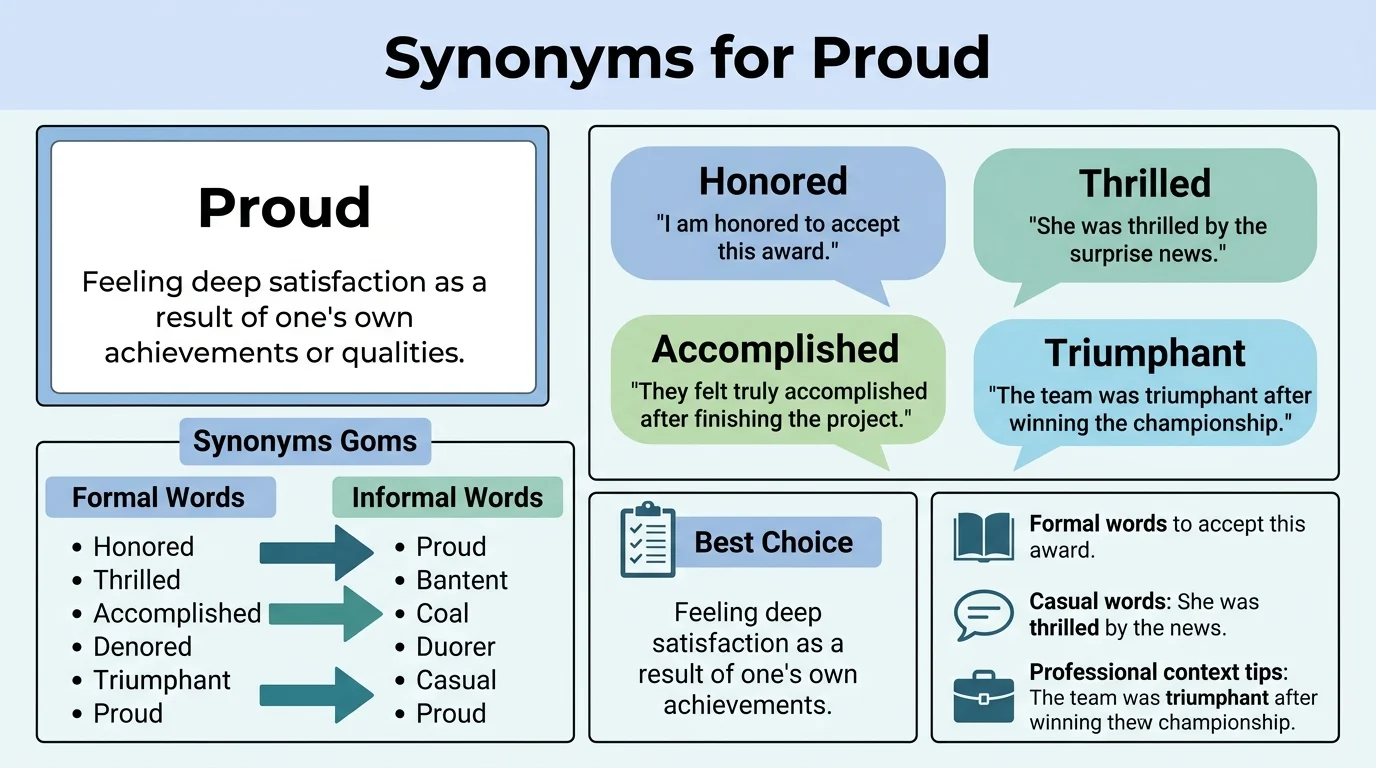
Proud is an adjective describing a feeling of deep pleasure or satisfaction from one’s own achievements, the achievements of those connected to you, or from qualities that you admire. The best synonym depends on your context. For formal writing, use “honored.” In professional settings, “accomplished” works well. For casual conversation, “thrilled” is a great fit.
Meaning, Tone and Context
Simple Definition
Proud means feeling pleased and satisfied about something you or someone connected to you has done, or about something you own or are connected to.
Part of Speech
Adjective. The related noun is “pride.” The adverb form is “proudly.”
Tone
The tone of “proud” can range from positive and neutral to negative depending on the context. It is most often used positively to express joy or satisfaction. However, it can also carry a negative tone when it implies arrogance or an inflated sense of self importance.
Formality Level
“Proud” is a neutral word and works well in both formal and informal settings. However, it is often considered too general for academic or high level professional writing where a more precise synonym might be preferred.
Common Use Cases
You will hear “proud” used in personal conversations, such as a parent expressing pride in a child. It is also common in professional contexts, like a manager praising an employee. You will see it in social media captions, speeches, and even in formal acknowledgments.
Important Word Forms
Noun: Pride. Opposite: Ashamed. Related form: Prideful (which often carries a more negative connotation of arrogance).
When and How to Use “Proud”
Using “proud” is appropriate when you want to express a genuine feeling of satisfaction. It is a versatile word, but it is important to consider whether a more specific word might better capture your exact emotion. In professional settings, saying “I am proud of the team’s work” is perfectly acceptable. In personal settings, “I am so proud of you” is a common and heartfelt expression. However, in creative writing, you might want to use a more descriptive word to paint a stronger picture for your reader.
1. Professional Context
My team and I are incredibly proud of the results we achieved this quarter.
2. Personal Context
My daughter gave a wonderful speech at her school, and I could not have been more proud of her courage.
3. Academic Writing
The researcher was proud of the study’s significant contribution to the field of neuroscience.
4. Emotional Context
She felt a deep, proud love for her grandmother, who had overcome so many obstacles.
5. Creative Writing
The old general stood tall, his proud gaze sweeping over the land he had fought to protect.
6. Social Media Caption
So proud of my best friend for finishing the marathon. You are an absolute inspiration.
7. Resume Writing
I am proud to have led a project that increased revenue by 20%.
Another Word for “Proud”
The best single replacement for “proud” depends entirely on the specific meaning you wish to convey. Here are direct suggestions for various contexts.
1. Professional Writing
Consider using “accomplished” or “pleased” to sound more objective and less emotionally charged.
2. Academic Writing
“Gratified” is a strong and precise word for academic contexts. It suggests a sense of satisfaction that is intellectual and well founded.
3. Casual Conversation
“Thrilled” is an excellent alternative. It conveys a high level of excitement and happiness that fits well in informal talk.
4. Emotional Writing
“Overjoyed” is a great choice when you want to express a very high degree of happiness associated with pride.
5. Creative Writing
“Majestic” or “glorious” can work well when describing something or someone with a grand, proud presence.
6. Resume or Workplace
“Honored” is perfect for a resume or when describing your feelings about a new position or achievement.
7. Social Media Captions
Stoked” is a modern, informal synonym that works well in very casual digital communication.
8. Stronger Meaning
“Triumphant” is a stronger word that implies pride stemming from a great victory or achievement.
9. Softer Meaning
Satisfied” is a more moderate synonym. It suggests a feeling of contentment without the intense emotional weight.
When Not to Use “Proud”
You should avoid using “proud” when the emotion you are describing is not positive or when you need to be more specific. For instance, “proud” sounds too vague when you want to describe a feeling of deep accomplishment that has been earned through significant struggle. In a resume, “proud” might feel too subjective. Instead of writing “I am proud of my sales record,” you could write “I achieved a record sales performance,” which is stronger and more direct.
Also, avoid “proud” when it might sound arrogant. If you are describing your own achievements in a formal cover letter, using “proud” repeatedly can make you seem self centered. A more precise synonym like “honored” or “pleased” is often better. Finally, do not use “proud” to describe a situation where you are not the person who did the work. For example, saying “I am proud of the company’s success” is fine, but if you are not a part of the company, “I am impressed by the company’s success” is more accurate.
Weak Example: I am proud to be a part of this team. (This is a bit vague.)
Strong Example: I am honored to be a part of this team and its accomplishments. (More precise and professional.)
Words Commonly Confused With “Proud”
Proud vs. Honored
“Proud” focuses on satisfaction from a personal connection or achievement. “Honored” suggests you feel privileged and respected. You feel “proud” of your child’s award, but you feel “honored” to be invited to give a keynote speech.
Proud vs. Arrogant
“Proud” can be a positive emotion, while “arrogant” is always negative. An arrogant person has an exaggerated sense of their own importance. A proud person simply feels satisfaction. A proud parent is loving; an arrogant parent might be boastful.
Proud vs. Pleased
“Pleased” is a more general and less intense word. It means you are satisfied or happy. You can be “pleased” with a meal, but you are “proud” of your child’s graduation. “Proud” implies a deeper emotional connection to an accomplishment.
Proud vs. Satisfied
“Satisfied” is about your own sense of fulfillment or contentment. often involves external validation or achievements. You are “satisfied” with your own work, but “proud” of a team achievement that you were part of.
Proud vs. Confident
“Confident” is about a belief in your own abilities. “Proud” is the feeling of satisfaction you get when those abilities lead to success. You are “confident” you can do the job, and you are “proud” when you do it well.
Proud vs. Smug
“Smug” is a negative word meaning excessively proud of yourself in a way that annoys other people. “Proud” is neutral. A “smug” grin shows self satisfaction that is off putting. A “proud” smile is warm and genuine.
Best Synonym by Context for “Proud”
| Context | Best Synonym | Why It Works | Example |
|---|---|---|---|
| Formal Writing | Honored | It conveys respect and a sense of privilege. | We are honored to have you as our guest. |
| Academic Writing | Gratified | It suggests a deep, intellectual satisfaction. | The professor was gratified by the student’s findings. |
| Professional/Business | Accomplished | It focuses on the result and capability. | She is an accomplished project manager. |
| Resume Writing | Instrumental | It shows you were a key player in a success. | I was instrumental in achieving record sales. |
| Casual Conversation | Thrilled | It expresses high energy and excitement. | I am thrilled with my new puppy. |
| Creative Writing | Majestic | It adds a sense of grandeur and dignity. | The majestic mountains stood against the sky. |
| Emotional Tone | Overjoyed | It conveys an intense level of happiness. | She was overjoyed by the surprise party. |
| Strong Intensity | Triumphant | It implies victory and conquest. | The triumphant team celebrated their win. |
| Soft/Moderate Tone | Pleased | It offers a simple, humble satisfaction. | I am pleased with the progress. |
| Social Media Caption | Stoked | It is modern, relatable, and full of energy. | So stoked to share this news with you all. |
| US Usage | Proud | The most common and neutral choice. | I am proud of my country. |
| UK Usage | Chuffed | A British colloquialism meaning pleased. | He was chuffed with his exam results. |
Which Synonym Should You Choose?
Choosing the right synonym requires you to think about your message and your audience. First, consider the formality of your setting. Are you writing a text to a friend or an email to a CEO? This will guide you between casual words like “stoked” and formal words like “honored.”
Next, think about the emotional intensity you want to convey. Are you “pleased” with a good cup of coffee, or are you “triumphant” after winning a championship? Match the intensity of the word to the situation. Then, consider the source of the pride. Are you proud of yourself, a colleague, or a family member? This can change the best word choice. For yourself, “accomplished” is great. For someone else, “proud of you” is a classic, but “I’m so impressed by you” can be even more meaningful.
Finally, think about the context of the sentence. In a resume, you want to sound objective and capable. Words like “instrumental” or “pivotal” are better than “proud.” In a personal letter, you can be more emotional and use words like “overjoyed” or “beaming.” The key is to make sure your word fits the tone, intensity, and setting perfectly.
Real Life Examples of “Proud” in Sentences
1. School Context
The principal was proud to announce the school’s top academic achievements for the year.
2. Workplace Context
Our manager is extremely proud of the innovative marketing campaign we launched last month.
3. Writing Context
The author felt a deep sense of pride as she held the first copy of her published novel.
4. Conversation Context
“I am so proud of you for standing up for what you believe in,” my friend told me.
5. Social Media Context
Proud moment. I finally finished building my new bookshelf.
6. Resume Context
I am proud to have been a key member of a team that received the company’s highest award.
7. Email Context
I am proud to announce the promotion of Sarah to Senior Director of Operations.
8. Storytelling Context
He walked down the aisle, his proud father watching him with tears in his eyes.
25 Synonyms for “Proud”
| Synonym | Simple Meaning | Best Used For | Example Sentence |
|---|---|---|---|
| Honored | Feeling privilege and respect. | Formal speeches and acknowledgments. | We are honored to serve our community. |
| Accomplished | Highly skilled and successful. | Resumes and professional bios. | She is an accomplished architect. |
| Gratified | Deeply satisfied and pleased. | Academic or intellectual settings. | The researchers were gratified by the results. |
| Thrilled | Extremely happy and excited. | Casual conversation and good news. | I am thrilled to hear about your engagement. |
| Overjoyed | Extremely happy and delighted. | Expressing strong personal happiness. | The grandparents were overjoyed to see their grandchildren. |
| Triumphant | Victorious and successful. | Describing a hard won victory. | The triumphant army returned home. |
| Majestic | Showing impressive beauty or dignity. | Creative and descriptive writing. | The majestic eagle soared over the valley. |
| Pleased | Happy and satisfied. | General, mild satisfaction. | The teacher was pleased with the class’ progress. |
| Satisfied | Content and fulfilled. | When personal expectations are met. | I am satisfied with my career choices. |
| Confident | Feeling sure of oneself. | Describing self belief and assurance. | She felt confident in her abilities. |
| Glorious | Having great beauty and splendor. | Creative or historical contexts. | The team’s victory was a glorious moment. |
| Delighted | Greatly pleased and happy. | A polite and warm response. | The host was delighted to see so many guests. |
| Elated | Full of high spirits and joy. | Describing a sudden surge of happiness. | The winner was elated by the news. |
| Exultant | Triumphantly happy. | Expressing great joy, often after a success. | The fans were exultant after the final whistle. |
| Self Respecting | Having a proper sense of dignity. | Describing a person’s character. | A self respecting individual would never cheat. |
| Imperial | Relating to an empire; magnificent. | Literary or historical contexts. | The imperial city was a sight to behold. |
| Imposing | Grand and impressive in appearance. | Describing a building or a person’s presence. | The imposing statue stood in the square. |
| Dignified | Having a composed and serious manner. | Formal settings and character descriptions. | The dignified leader addressed the nation. |
| Glowing | Showing warm praise or approval. | Describing a positive review or reaction. | She received a glowing performance review. |
| Swaggering | Having a confident and arrogant walk. | Describing negative, boastful behavior. | He had a swaggering attitude that annoyed everyone. |
| Boastful | Talking with excessive pride. | When someone is bragging. | His boastful comments were not well received. |
| Vainglorious | Excessive pride in one’s own abilities. | Highlighting vanity and ego. | The vainglorious actor demanded special treatment. |
| Snobbish | Having the character of a snob. | Describing someone who looks down on others. | Her snobbish behavior alienated her colleagues. |
| Gratifying | Giving pleasure or satisfaction. | Describing an action or result. | It was gratifying to see the project succeed. |
| Aggrandized | Made to seem greater or more powerful. | Describing a falsely elevated sense of self. | The politician aggrandized his own role in the peace talks. |
Synonym Groups and Usage Differences
Professional vs. Personal Synonyms
In professional settings, you want to sound objective and capable. Words like “accomplished,” “instrumental,” and “honored” are perfect. In personal settings, you can be more emotional and warm. Words like “overjoyed,” “beaming,” and “thrilled” are much better for expressing feelings about friends and family.
Formal vs. Conversational Synonyms
For formal writing such as reports, essays, or official correspondence, choose words like “gratified,” “honored,” or “dignified.” For conversational writing like texts, emails to friends, or social media, use words like “stoked,” “thrilled,” or “pleased.” The formality level sets the tone for the entire message.
Academic Synonyms
In academic writing, precision is key. “Gratified” implies a thoughtful satisfaction. “Exultant” suggests a triumphant joy. “Vainglorious” is a precise word for describing negative pride. These words show a sophisticated understanding of the language and are appropriate for scholarly work.
Professional and Business Synonyms
In business, you need words that convey professionalism and impact. “Accomplished” speaks to a person’s track record. “Honored” is polite and respectful. “Instrumental” shows that you were a key player. Avoid overly emotional words like “thrilled” in a formal business report, as they can sound unprofessional.
Creative or Literary Synonyms
Creative writers often need words that paint a picture or evoke a strong feeling. “Majestic,” “glorious,” and “imposing” are powerful words for descriptions. “Swaggering” and “exultant” are great for showing character actions. These synonyms add depth and color to your storytelling.
Slang or Modern Synonyms
Modern slang for proud includes “stoked,” “pumped,” and “hyped.” These are used in very casual settings like social media or conversations with close friends. They should never be used in professional or academic writing. They are acceptable in informal, digital communication where you want to express high energy and excitement.
Strongest vs. Weaker Synonyms
The emotional intensity of proud words varies greatly. On the weaker end, you have words like “satisfied” and “pleased.” In the middle, you have “proud” and “honored.” On the stronger end, you have “triumphant,” “overjoyed,” and “exultant.” Choose your word based on how much emotional weight the situation carries.
Emotional vs. Neutral Synonyms
Emotional synonyms like “overjoyed” and “thrilled” focus on feelings of happiness. Neutral synonyms like “satisfied” and “accomplished” are more factual and objective. If you are writing an emotional story, use the emotional words. If you are writing a performance review, use the neutral words.
Antonyms of “Proud”
| Antonym | Meaning | Example Sentence |
|---|---|---|
| Ashamed | Feeling embarrassed or guilty. | I am ashamed of my rude behavior. |
| Humble | Having a modest view of one’s own importance. | Despite her fame, she remained humble. |
| Modest | Unassuming in the estimation of one’s abilities. | He was modest about his incredible achievements. |
| Meek | Quiet, gentle, and easily imposed on. | The meek accountant sat in the back row. |
| Unassuming | Not pretentious or arrogant. | She was an unassuming genius. |
| Self Effacing | Not claiming attention for oneself. | His self effacing attitude made him popular. |
| Remorseful | Feeling deep regret for a wrong. | He was remorseful for the pain he had caused. |
| Contrite | Feeling or expressing remorse. | The contrite student apologized for the mistake. |
| Penitent | Feeling regret for one’s sins. | The penitent man sought forgiveness. |
| Apologetic | Expressing regret for a failure. | He gave an apologetic smile. |
| Humbled | Made to feel less important. | I was humbled by the generosity of the community. |
| Unpretentious | Not attempting to impress others. | They lived in an unpretentious house. |
| Sheepish | Showing a feeling of shame. | She gave a sheepish grin. |
| Obsequious | Obedient or attentive to an excessive degree. | The obsequious waiter was trying too hard. |
| Servile | Having or showing an excessive willingness to serve. | His servile behavior made everyone uncomfortable. |
Comparison: Proud vs. Similar Words
Proud vs. Arrogant
The main difference is that “proud” is a positive or neutral feeling of satisfaction, while “arrogant” is a negative display of self importance. “Proud” is about internal feeling; “arrogant” is about external behavior that irritates others. “Arrogant” is always a stronger and more negative word.
Example: I am proud of my presentation. His arrogant attitude cost him the promotion.
Proud vs. Honored
“Proud” is about your personal connection to an event or person. “Honored” is about being given a privilege or recognition from an external source. “Honored” is often considered more formal.
Example: I am proud of my team. I am honored to receive this award.
Proud vs. Smug
“Proud” can be expressed quietly and humbly. “Smug” implies a self satisfied, often irritating display of pride. “Smug” is always a negative term.
Example: She felt proud of her children. He wore a smug smile after winning the argument.
Proud vs. Confident
Confidence is a belief in yourself. Pride is the satisfaction you feel from an achievement. Confidence can exist without achievement. You can be confident before a test, but proud after passing it.
Example: I am confident in my abilities. I am proud of what I have achieved.
Proud vs. Pleased
“Pleased” is a general feeling of happiness and satisfaction. “Proud” is more specific and often relates to a personal or significant accomplishment. “Pleased” is less intense.
Example: I am pleased with the weather. I am proud of my daughter’s success.
Proud vs. Vain
“Vain” means having an excessively high opinion of your own appearance or abilities. It is a negative trait. “Proud” does not necessarily imply this excess. “Vain” is stronger and more critical.
Example: She is proud of her hard work. He is so vain that he checks his reflection constantly.
Common Phrases and Expressions with “Proud”
1. Proud as a Peacock
Meaning: Very proud, often in a way that is obvious and boastful.
Example: He strutted around the office, proud as a peacock after his promotion.
2. Proud Moment
Meaning: A specific time or event that makes you feel a deep sense of pride.
Example: Watching my son graduate was a very proud moment for our family.
3. Do Someone Proud
Meaning: To make someone feel proud by performing well or achieving something.
Example: Your wonderful performance in the play did your parents proud.
4. Proud Parent
Meaning: A mother or father who feels a strong sense of pride in their child.
Example: The proud parents watched their daughter receive her diploma.
5. Proud to Say
Meaning: A phrase used to introduce a statement of accomplishment or affiliation.
Example: I am proud to say that I have been with this company for ten years.
6. Too Proud to Ask
Meaning: Having so much pride or ego that you will not ask for help.
Example: He was too proud to ask for directions, even though he was clearly lost.
7. Pride and Joy
Meaning: A person or thing that is a source of great pride and happiness.
Example: Her vintage car is her pride and joy.
Common Mistakes to Avoid
1. Using “Proud” When You Mean “Honored”
Do not say “I am proud to be here” in a formal speech to a person of high status. “Honored” is more appropriate and shows respect. Save “proud” for personal connections.
2. Confusing “Proud” with “Arrogant”
Never describe yourself as “arrogant” to mean proud. “Arrogant” is a negative trait. If you want to describe your own positive feeling, use “proud” or “accomplished.”
3. Using Casual Synonyms in Formal Writing
Do not use “stoked” or “pumped” in an academic essay or professional email. These words are slang and will make you sound unprofessional. Stick to formal synonyms like “gratified.”
4. Using an Overly Dramatic Synonym for a Simple Situation
Do not say “I am triumphant about my sandwich.” “Triumphant” is for major victories. Use “pleased” or “satisfied” for everyday matters. Reserve strong words for significant events.
5. Repeating the Same Word
If you have already used “proud” in a sentence, find a synonym for the next sentence. Repetition makes your writing dull. Use this guide to find a more varied alternative.
6. Choosing a Synonym with the Wrong Emotional Tone
Saying “I am smug about your success” sounds rude. “Smug” has a negative, selfish tone. If you are happy for someone else, use a warm, positive word like “delighted.”
7. Using Slang in Academic or Professional Writing
Words like “chuffed” or “hyped” are not appropriate for formal contexts. Always consider your audience and choose a word that fits the professional or academic standard.
FAQs
1. What is the best synonym for proud?
The best synonym depends on context. “Honored” is excellent for formal situations, while “thrilled” works well for casual ones.
2. What is a formal synonym for proud?
“Gratified” and “honored” are the best formal synonyms for proud. They are precise, respectful, and appropriate for professional or academic writing.
3. What is an informal synonym for proud?
“Stoked” is a popular informal synonym. “Pumped” and “thrilled” also work well in casual conversation.
4. What is another word for proud in professional writing?
“Accomplished,” “instrumental,” and “honored” are great professional alternatives. These words sound objective and impressive.
5. What is the difference between proud and arrogant?
Proud is a positive feeling of satisfaction. Arrogant is a negative display of self importance. Arrogant behavior is often off putting to others.
6. What is the opposite of proud?
The most direct opposite of proud is “ashamed.” Other antonyms include humble, modest, and remorseful.
Conclusion
The word “proud” is a powerful and positive term, but it can be overused. By exploring the many synonyms for proud, you can add precision and variety to your vocabulary. Whether you need a formal word like “honored,” a professional word like “accomplished,” or a casual word like “thrilled,” there is a perfect choice for every situation. Remember to consider your tone, audience, and the specific emotion you want to express. A rich vocabulary not only makes your communication more interesting but also more effective. Start using these alternatives today and watch your writing and speaking come to life.