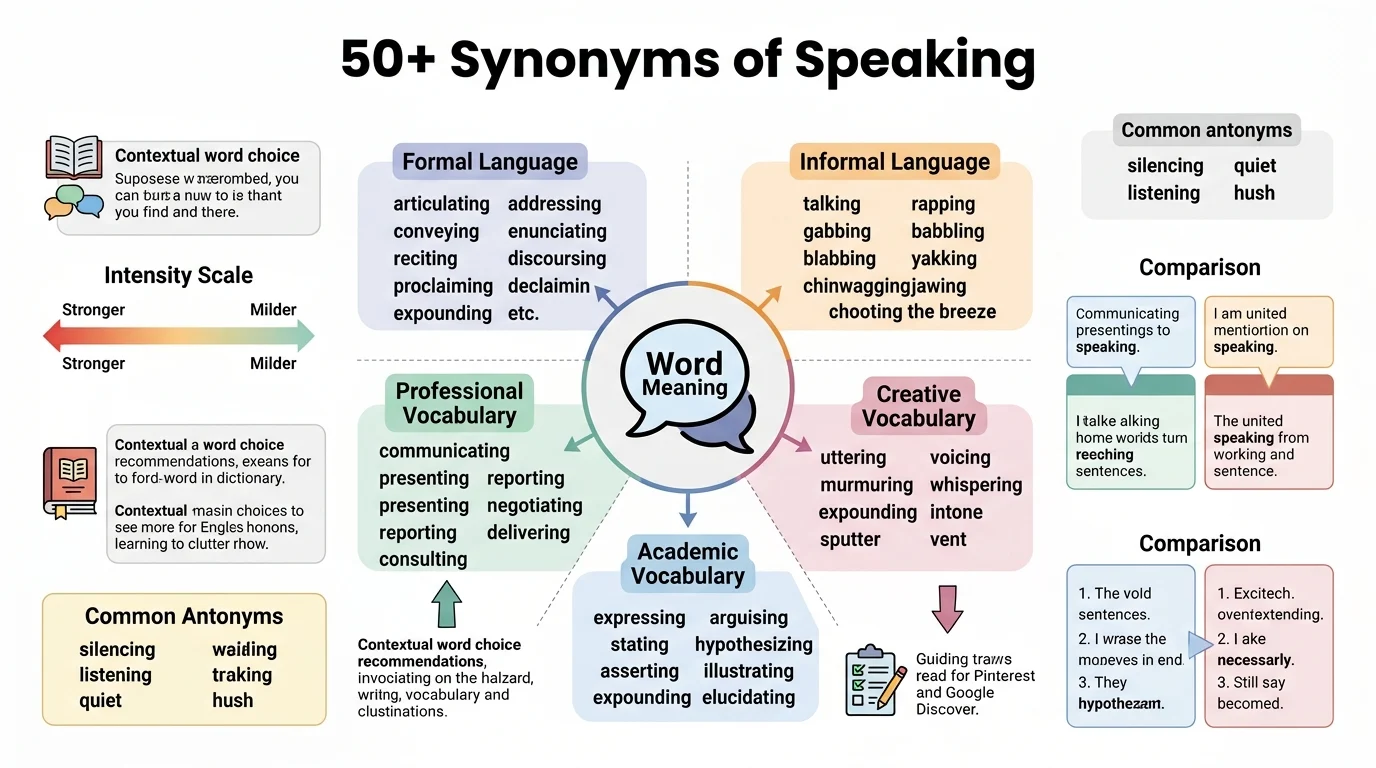
Have you ever written an email, an essay, or a social media caption and realized you used the word “speaking” three times in two sentences? It happens to everyone. You know there has to be a better word, but you cannot think of one in the moment. That is exactly why you need a practical guide to synonyms of speaking. Choosing the right alternative does more than just prevent repetition. It sharpens your message, adjusts your tone, and makes your communication more precise. Whether you are writing a business report, crafting a college essay, or simply trying to sound more natural in conversation, the right word makes all the difference.
What Are the Best Synonyms of “Speaking”?
Speaking means using your voice to express thoughts, ideas, or feelings. The best synonym depends on your context. For formal writing, choose “articulating” or “addressing.” For casual conversation, “talking” or “chatting” work well. In professional settings, “communicating” or “conveying” are strong choices. For emotional or creative writing, try “voicing” or “expressing.”
Meaning, Tone, and Context
Simple Definition
Speaking is the act of expressing thoughts, ideas, or information through verbal communication. It involves using your voice, tone, and sometimes nonverbal cues to convey meaning.
Part of Speech
Speaking can function as a noun, adjective, or verb form (present participle).
Overall Tone
Speaking is generally a neutral word. It does not carry strong positive or negative emotional weight on its own. The tone shifts depending on the context and the words you pair with it.
Formality Level
Speaking is neutral in formality. It works in almost any situation, from casual chats to formal presentations. However, in very formal academic or professional writing, more precise synonyms often sound stronger.
Common Uses
Native English speakers use speaking in many everyday situations. You hear it in conversations, meetings, presentations, and public events. It appears in phrases like “public speaking,” “speaking engagement,” and “generally speaking.” It is one of the most common verbs in the language.
Word Forms
- Noun: speaking (The speaking lasted for an hour.)
- Verb: speak, speaks, spoke, spoken (She spoke clearly.)
- Adjective: speaking (He has a speaking role in the play.)
- Adverb: (none common)
When and How to Use “Speaking”
Choose “speaking” when you need a simple, clear, and neutral word for verbal communication. It works in almost any context, but it is not always the most powerful or precise choice. Here are seven realistic examples showing how to use it effectively.
Professional Context
The CEO will be speaking at the annual shareholder meeting next Thursday.
Academic Context
The professor emphasized that speaking clearly is just as important as writing well in this course.
Workplace Context
I will be speaking with the client about the project timeline during our call tomorrow.
Personal Context
We were speaking for hours about our travel plans and all the places we want to visit.
Email Context
I look forward to speaking with you about the proposal when we meet next week.
Resume Context
Developed strong public speaking skills through regular presentations to cross-functional teams.
Social Media Context
Speaking from personal experience, this book completely changed how I think about productivity.
Best Synonyms of “Speaking”
No two synonyms are exactly the same. Each alternative carries a slightly different tone, level of formality, and emotional weight. Here are the best synonyms for specific situations.
Professional Writing
Choose “communicating.” It sounds polished and emphasizes the exchange of information. It works well in reports, memos, and professional correspondence.
Academic Writing
Choose “articulating.” This word suggests clarity and precision, which are highly valued in academic work.
Business Communication
Choose “conveying.” It implies delivering a message effectively, which is exactly what you want in business settings.
Casual Conversation
Choose “talking.” It feels natural, friendly, and unpretentious. It is the go-to word for everyday speech.
Emotional Writing
Choose “voicing.” It suggests expressing feelings or opinions that matter deeply to the speaker.
Creative Writing
Choose “uttering.” It adds a literary quality and emphasizes the act of producing words, often in a dramatic or meaningful way.
Resume Writing
Choose “presenting” or “addressing.” These words show confidence and leadership. They suggest you can command a room or handle important discussions.
Workplace Communication
Choose “discussing.” It implies a two-way exchange and collaborative problem-solving, which fits most workplace scenarios.
Stronger Meaning
Choose “declaring.” It adds force and certainty. Use it when someone makes a firm statement or announces something important.
Softer Meaning
Choose “mentioning.” It reduces the weight of the statement. Use it when you want to bring something up without making it the main focus.
When Not to Use “Speaking”
Sometimes “speaking” is not the best choice. Here are situations where you should reach for a more precise word.
When It Sounds Too General
If you are describing a formal address to a large audience, “speaking” feels vague. “Orating” or “delivering an address” sounds much more appropriate.
- Less effective: The president is speaking to the nation tonight.
- Stronger: The president is addressing the nation tonight.
When It Sounds Too Vague
If you are describing a two-way conversation, “speaking” does not capture the back-and-forth nature. “Conversing” or “dialoguing” works better.
- Less effective: They were speaking about the new policy.
- Stronger: They were discussing the new policy.
When It Sounds Too Formal
In a text message to a friend, “speaking” can feel stiff. “Talking” or “chatting” sounds more natural.
- Less effective: I am speaking with my brother right now.
- Stronger: I am talking to my brother right now.
When It Sounds Too Informal
In a formal research paper, “speaking” can feel too casual. “Articulating” or “expressing” sounds more academic.
- Less effective: The study examines how children learn speaking.
- Stronger: The study examines how children learn to articulate their thoughts.
When It Sounds Too Weak
If you need to emphasize a strong opinion or demand, “speaking” lacks impact. “Declaring” or “proclaiming” adds the necessary force.
- Less effective: She was speaking her opposition to the plan.
- Stronger: She was declaring her opposition to the plan.
When It Sounds Outdated
“Speaking” is never truly outdated, but in very modern, fast-paced writing, simpler verbs like “talking” often feel more current and direct.
Words Commonly Confused With “Speaking”
Speaking vs Talking
- Difference: “Speaking” often focuses on the person producing the words. “Talking” focuses on the interaction between people.
- When to Use Each: Use “speaking” for formal contexts or when emphasizing the act itself. Use “talking” for casual conversations.
- Example (Speaking): She is speaking at the conference tomorrow.
- Example (Talking): They are talking about their weekend plans.
Vs Saying
- Difference: “Speaking” refers to the general act of using your voice. “Saying” refers to the specific words or content being expressed.
- When to Use Each: Use “speaking” for the overall activity. Use “saying” when you want to quote or report exact words.
- Example (Speaking): He was speaking for over an hour.
- Example (Saying): He was saying that the project was behind schedule.
Speaking vs Telling
- Difference: “Speaking” does not require a listener. “Telling” requires a listener and often involves giving information or instructions.
- When to Use Each: Use “speaking” for general verbal activity. Use “telling” when someone is communicating something specific to another person.
- Example (Speaking): The baby is speaking in short sentences now.
- Example (Telling): She is telling the children a story.
Speaking vs Communicating
- Difference: “Speaking” is a specific type of verbal communication. “Communicating” is broader and includes writing, body language, and other forms.
- When to Use Each: Use “speaking” for vocal expression. Use “communicating” when you want to emphasize the successful transfer of information.
- Example (Speaking): He is speaking in Spanish.
- Example (Communicating): They are communicating effectively through email and phone calls.
Vs Conversing
- Difference: “Speaking” can be one-way. “Conversing” is always two-way and implies an exchange between people.
- When to Use Each: Use “speaking” for monologues or one-sided communication. Use “conversing” for dialogues and discussions.
- Example (Speaking): The professor is speaking to the class.
- Example (Conversing): The colleagues are conversing about the new strategy.
Speaking vs Uttering
- Difference: “Speaking” is general. “Uttering” emphasizes the physical act of producing sounds or words, often with effort or significance.
- When to Use Each: Use “speaking” for everyday communication. Use “uttering” in literary or dramatic contexts.
- Example (Speaking): She is speaking quietly.
- Example (Uttering): He was barely uttering a word throughout the meeting.
Best Synonyms of “Speaking” by Context
| Context | Best Synonym | Why It Works | Example |
|---|---|---|---|
| Formal writing | Articulating | Emphasizes clarity and precision | The report articulates the company’s long-term vision. |
| Academic writing | Expressing | Conveys ideas or thoughts in a structured way | The study expresses the need for further research. |
| Professional communication | Conveying | Highlights effective message delivery | The memo conveys the new policy changes clearly. |
| Business emails | Discussing | Suggests collaboration and exchange | I would like to discuss the proposal with you. |
| Resume writing | Presenting | Shows confidence and leadership | Presented quarterly results to senior executives. |
| Workplace communication | Addressing | Implies direct engagement with a topic | The manager addressed the team’s concerns. |
| Casual conversation | Talking | Sounds natural and friendly | We were talking about our favorite movies. |
| Everyday speaking | Chatting | Feels light and informal | We were chatting over coffee. |
| Creative writing | Uttering | Adds literary and dramatic quality | She uttered a quiet prayer before the performance. |
| Storytelling | Voicing | Gives characters emotional depth | He voiced his deepest fears to his closest friend. |
| Emotional writing | Declaring | Adds force and certainty | She declared her love for him in front of everyone. |
| Strong emphasis | Proclaiming | Suggests a public or official announcement | The mayor proclaimed the day a city holiday. |
| Mild tone | Mentioning | Reduces the weight of the statement | He mentioned the issue briefly at the end. |
| Social media captions | Sharing | Feels personal and engaging | Sharing my thoughts on this amazing book. |
| American English | Talking | The most common casual choice | Let’s talk about it later. |
How to Choose the Best Synonym of “Speaking”
Choosing the right synonym does not have to be complicated. Ask yourself these questions.
What is your meaning? Are you describing a one-way presentation or a two-way conversation? If it is one-way, words like “addressing” or “presenting” work well. If it is two-way, choose “discussing” or “conversing.”
What is your tone? Do you want to sound formal, casual, emotional, or neutral? Formal situations call for “articulating” or “conveying.” Casual situations call for “talking” or “chatting.”
Who is your audience? Are you writing for a professor, a boss, a friend, or the general public? Your audience determines the level of formality you need.
How much emotional strength do you need? If you want to sound powerful and certain, choose “declaring” or “proclaiming.” If you want to sound gentle and understated, choose “mentioning” or “noting.”
What is your writing purpose? Are you trying to inform, persuade, entertain, or connect? Each purpose benefits from a different synonym.
Does it sound natural? Read your sentence out loud. If the synonym feels awkward or forced, try a different one. The best word is the one that sounds most natural in context.
Real Life Examples of “Speaking”
School
The teacher asked the students to practice speaking in front of the class to build their confidence.
College
During the seminar, the professor encouraged speaking as a way to clarify complex theories.
Workplace
The team leader emphasized that speaking honestly about challenges leads to better solutions.
Business
The keynote speaker will be speaking about innovation and the future of the industry.
Email
I appreciate you speaking with me about the partnership opportunity.
Resume
Delivered engaging presentations and public speaking sessions for audiences of up to 200 people.
Conversation
We were speaking for hours, and I did not even notice the time passing.
Storytelling
The old man was speaking in a low, gravelly voice that commanded attention.
Blogging
Speaking as someone who has tried every productivity method, this one actually works.
Social Media
Speaking from the heart, this community has changed my life in ways I never expected.
18 Best Synonyms of “Speaking”
| Synonym | Simple Meaning | Best Used For | Example Sentence |
|---|---|---|---|
| Talking | Using voice in casual conversation | Everyday, informal contexts | We were talking about our plans for the weekend. |
| Articulating | Expressing ideas clearly and precisely | Academic and formal writing | The professor is articulating the main arguments of the theory. |
| Addressing | Speaking formally to a group or audience | Professional and public settings | The CEO is addressing the employees at the town hall. |
| Conveying | Communicating a message or idea effectively | Business and professional communication | The report is conveying the urgency of the situation. |
| Discussing | Engaging in a two-way exchange of ideas | Meetings and collaborative settings | We are discussing the budget for the upcoming quarter. |
| Chatting | Talking in a light, informal, and friendly way | Casual conversations and social media | We were chatting about our favorite TV shows. |
| Conversing | Having a formal or thoughtful conversation | Academic and professional dialogues | The experts were conversing about climate change solutions. |
| Voicing | Expressing opinions, feelings, or concerns | Emotional and personal writing | She is voicing her concerns about the new policy. |
| Declaring | Making a formal or emphatic statement | Strong statements and announcements | He is declaring his support for the new initiative. |
| Uttering | Producing sounds or words, often with effort | Creative and literary writing | She uttered a quiet sigh of relief. |
| Presenting | Delivering information to an audience | Resumes, meetings, and presentations | He is presenting the findings to the board. |
| Orating | Speaking in a formal, eloquent, and persuasive way | Public speaking and formal speeches | The politician is orating about the need for change. |
| Expressing | Conveying thoughts, ideas, or emotions | General communication and writing | The poem expresses the author’s deepest feelings. |
| Stating | Saying something clearly and formally | Official statements and reports | The report states the facts clearly. |
| Announcing | Making a public or official declaration | News, events, and formal communications | The manager is announcing the new team structure. |
| Mentioning | Referring to something briefly or casually | Light or incidental references | She mentioned the idea in passing. |
| Communicating | Exchanging information through speaking or writing | Broad professional and personal contexts | They are communicating effectively about the project. |
| Enunciating | Pronouncing words clearly and distinctly | Speech training and formal speaking | The coach is enunciating each word for the students. |
Synonyms of “Speaking” by Usage
Professional vs Personal Synonyms
In professional settings, choose words like “communicating,” “conveying,” or “addressing.” These sound polished and competent. In personal settings, choose “talking,” “chatting,” or “discussing.” These sound warm and relatable.
Formal vs Conversational Synonyms
For formal writing, such as reports, essays, and business presentations, use “articulating,” “stating,” or “presenting.” For casual conversations, texting, and social media, use “talking,” “chatting,” or “mentioning.”
Academic Synonyms
In academic writing, precision is key. “Articulating” emphasizes clarity. “Expressing” conveys ideas in a structured way. “Stating” presents facts formally. These words sound authoritative and demonstrate a strong command of language.
Professional and Business Synonyms
For resumes, interviews, and meetings, choose “presenting,” “addressing,” or “conveying.” These words show confidence and leadership. They suggest you can handle important communications with ease.
Creative and Literary Synonyms
For storytelling, fiction, and poetry, choose “uttering,” “voicing,” or “orating.” These words add emotion, imagery, and dramatic weight. They help bring characters and scenes to life.
Slang or Modern Synonyms
Modern slang like “shooting the breeze” or “gabbing” can work in very casual contexts. However, these are not synonyms of “speaking” in a formal sense. Use them only with close friends or in informal writing. Avoid them in professional or academic settings.
Strongest to Mildest Synonyms
| Intensity | Synonyms |
|---|---|
| Mild | Mentioning, noting, referring |
| Moderate | Talking, conversing, discussing, chatting |
| Strong | Addressing, presenting, declaring, stating |
| Very Strong | Proclaiming, orating, enunciating, articulating |
Emotional vs Neutral Synonyms
Emotional Synonyms: “Voicing” and “declaring” express strong feelings or opinions. They add passion and conviction to your writing.
Neutral Synonyms: “Talking,” “stating,” and “communicating” simply convey information without adding emotional weight. They are safe choices for most professional and academic contexts.
Antonyms of “Speaking”
| Antonym | Meaning | Example Sentence |
|---|---|---|
| Silence | Complete absence of sound | The silence in the room was deafening. |
| Listening | Paying attention to sound | She was listening carefully to the instructions. |
| Hearing | Perceiving sound with the ears | He is hearing the music from the other room. |
| Muteness | Inability or refusal to speak | His muteness was a result of the traumatic event. |
| Quiet | Making little or no noise | The library was quiet and peaceful. |
| Stillness | Absence of movement or sound | The stillness of the morning was broken by a bird. |
| Speechlessness | Being unable to speak, often from shock | She was speechless after hearing the news. |
| Writing | Expressing ideas through written words | He is writing a letter to his friend. |
| Reading | Interpreting written or printed text | She is reading a book in the park. |
| Observing | Watching carefully | They were observing the experiment in silence. |
| Reflecting | Thinking deeply or carefully | He is reflecting on his past mistakes. |
| Pondering | Considering something deeply | She is pondering the meaning of life. |
| Contemplating | Looking at or thinking about something thoughtfully | He is contemplating his future. |
| Meditating | Focusing the mind for relaxation or spiritual purposes | She is meditating in the garden. |
| Withholding | Refusing to give or share information | He is withholding the details of the plan. |
Comparison: “Speaking” vs Similar Words
Vs Talking
- Main Difference: Speaking often emphasizes the action itself. Talking emphasizes the interaction between people.
- Which Is Stronger? Speaking can feel more formal and deliberate.
- Which Is More Formal? Speaking is more formal.
- When to Use Each: Use speaking for presentations and formal contexts. Use talking for casual conversations.
- Speaking: The ambassador is speaking at the UN General Assembly.
- Talking: The friends are talking about their vacation plans.
Speaking vs Saying
- Main Difference: Speaking is the general act of using your voice. Saying refers to the specific words or content being expressed.
- Which Is Stronger? Saying can feel more direct because it focuses on the message.
- Which Is More Formal? Speaking is generally more formal.
- When to Use Each: Use speaking for the overall activity. Use saying when you want to quote or report exact words.
- Speaking: He was speaking for over an hour.
- Saying: He was saying that the project was behind schedule.
Vs Telling
- Main Difference: Speaking does not require a listener. Telling requires a listener and often involves giving information or instructions.
- Which Is Stronger? Telling can feel more active and directive.
- Which Is More Formal? Speaking is more formal in most contexts.
- When to Use Each: Use speaking for general verbal activity. Use telling when someone is communicating something specific to another person.
- Speaking: The baby is speaking in short sentences now.
- Telling: She is telling the children a story.
Speaking vs Communicating
- Main Difference: Speaking is a specific type of verbal communication. Communicating is broader and includes writing, body language, and other forms.
- Which Is Stronger? Communicating emphasizes the successful transfer of information.
- Which Is More Formal? Communicating is often used in professional contexts.
- When to Use Each: Use speaking for vocal expression. Use communicating when you want to emphasize the broader exchange of information.
- Speaking: He is speaking in Spanish.
- Communicating: They are communicating effectively through email and phone calls.
Vs Conversing
- Main Difference: Speaking can be one-way. Conversing is always two-way and implies an exchange between people.
- Which Is Stronger? Conversing implies a more thoughtful and equal exchange.
- Which Is More Formal? Conversing is more formal than casual speaking.
- When to Use Each: Use speaking for monologues or one-sided communication. Use conversing for dialogues and discussions.
- Speaking: The professor is speaking to the class.
- Conversing: The colleagues are conversing about the new strategy.
Speaking vs Uttering
- Main Difference: Speaking is general. Uttering emphasizes the physical act of producing sounds or words, often with effort or significance.
- Which Is Stronger? Uttering can feel more dramatic and intentional.
- Which Is More Formal? Uttering is more literary than formal.
- When to Use Each: Use speaking for everyday communication. Use uttering in literary or dramatic contexts.
- Speaking: She is speaking quietly.
- Uttering: He was barely uttering a word throughout the meeting.
Common Phrases and Expressions with “Speaking”
Generally speaking
- Meaning: Used to introduce a statement that is true in most cases but not always.
- Example: Generally speaking, people are more productive in the morning.
Public speaking
- Meaning: The act of speaking to a group of people in a formal setting.
- Example: She has a fear of public speaking, but she is working on it.
engagement
- Meaning: A scheduled event where someone gives a speech or presentation.
- Example: He has several speaking engagements on his schedule this month.
Speaking of
- Meaning: Used to introduce a related topic that has just been mentioned.
- Example: Speaking of vacations, have you booked your trip yet?
From experience
- Meaning: Sharing knowledge or advice based on personal experience.
- Example: Speaking from experience, I can tell you that preparation is key.
On speaking terms
- Meaning: Having a friendly enough relationship to talk to someone.
- Example: They are not on speaking terms after their argument.
Frankly speaking
- Meaning: Used to introduce an honest or direct opinion.
- Example: Frankly speaking, I think we need to reconsider our strategy.
Common Mistakes to Avoid
Choosing a Vague Synonym Instead of a Precise One
- Incorrect: The manager is speaking about the new policy.
- Better: The manager is addressing the new policy.
- Why: “Addressing” is more precise and implies a formal, direct engagement with the topic.
Confusing Speaking with a Similar Word
- Incorrect: She is saying to her friend on the phone.
- Better: She is talking to her friend on the phone.
- Why: “Talking” implies a two-way conversation, which is what happens on a phone call.
Using an Informal Synonym in Formal Writing
- Incorrect: The study examines how children learn chatting.
- Better: The study examines how children learn to articulate their thoughts.
- Why: “Chatting” is too casual for academic writing. “Articulating” is more appropriate.
Selecting an Overly Dramatic Synonym
- Incorrect: I am declaring that I will have the salad for lunch.
- Better: I am saying that I will have the salad for lunch.
- Why: “Declaring” is too strong for a simple statement about lunch. “Saying” is more natural.
Repeating the Same Word Too Often
- Incorrect: She is speaking to the team. She is speaking about the project. She is speaking with confidence.
- Better: She is addressing the team. She is discussing the project. She is speaking with confidence.
- Why: Varying your word choice makes your writing more engaging and professional.
Choosing a Synonym with the Wrong Emotional Tone
- Incorrect: He was uttering his love for her in a quiet voice.
- Better: He was expressing his love for her in a quiet voice.
- Why: “Uttering” can sound mechanical or reluctant. “Expressing” conveys genuine emotion.
Using Slang in Academic or Professional Writing
- Incorrect: The CEO was gabbing about the new strategy.
- Better: The CEO was discussing the new strategy.
- Why: “Gabbing” is too informal and casual for a professional context. “Discussing” is appropriate.
Frequently Asked Questions
1. What are the best synonyms of “speaking”?
The best synonyms depend on your context. Formal writing, use “articulating” or “addressing.” For casual conversation, use “talking” or “chatting.” For professional settings, use “communicating” or “conveying.”
2. What are the best formal synonyms of “speaking”?
The best formal synonyms include “articulating,” “addressing,” “conveying,” “stating,” and “presenting.” These words are suitable for academic papers, business reports, and professional presentations.
3. What are common informal synonyms of “speaking”?
Common informal synonyms include “talking,” “chatting,” “gabbing,” and “shooting the breeze.” These words are best for casual conversations with friends and family.
4. What is another word for “speaking” in professional writing?
In professional writing, choose “communicating,” “conveying,” or “addressing.” These words sound polished and demonstrate strong communication skills.
5. What is the difference between “speaking” and “talking”?
“Speaking” often focuses on the person producing the words and is more formal. “Talking” focuses on the interaction between people and is more casual.
6. What is the opposite of “speaking”?
The opposite of speaking is “silence” or “listening.” Other antonyms include “muteness,” “quiet,” and “stillness.” These words describe the absence of verbal communication.
Conclusion
Speaking is the act of expressing thoughts and ideas through verbal communication. It is a neutral and versatile word that works in many contexts. However, choosing the right synonym can make your writing clearer, more powerful, and more engaging. Formal writing, choose “articulating” or “addressing.” For casual conversation, choose “talking” or “chatting.” Professional settings, choose “communicating” or “conveying.” For emotional or creative writing, choose “voicing” or “uttering.” No single synonym works perfectly in every situation. The best choice always depends on your audience, tone, and purpose. The next time you write, take a moment to consider whether “speaking” is the best word or whether a stronger alternative would serve you better. A small vocabulary change can make a big difference in how your message is received.