Every essay writer knows the moment. The first point lands well, the second point matters even more, and the only bridge that comes to mind is moreover, again. The word is not wrong. Cambridge Dictionary labels it formal, and it does a precise job: it adds information, and it often adds a more important point. Still, a page that repeats one connector starts to sound mechanical.
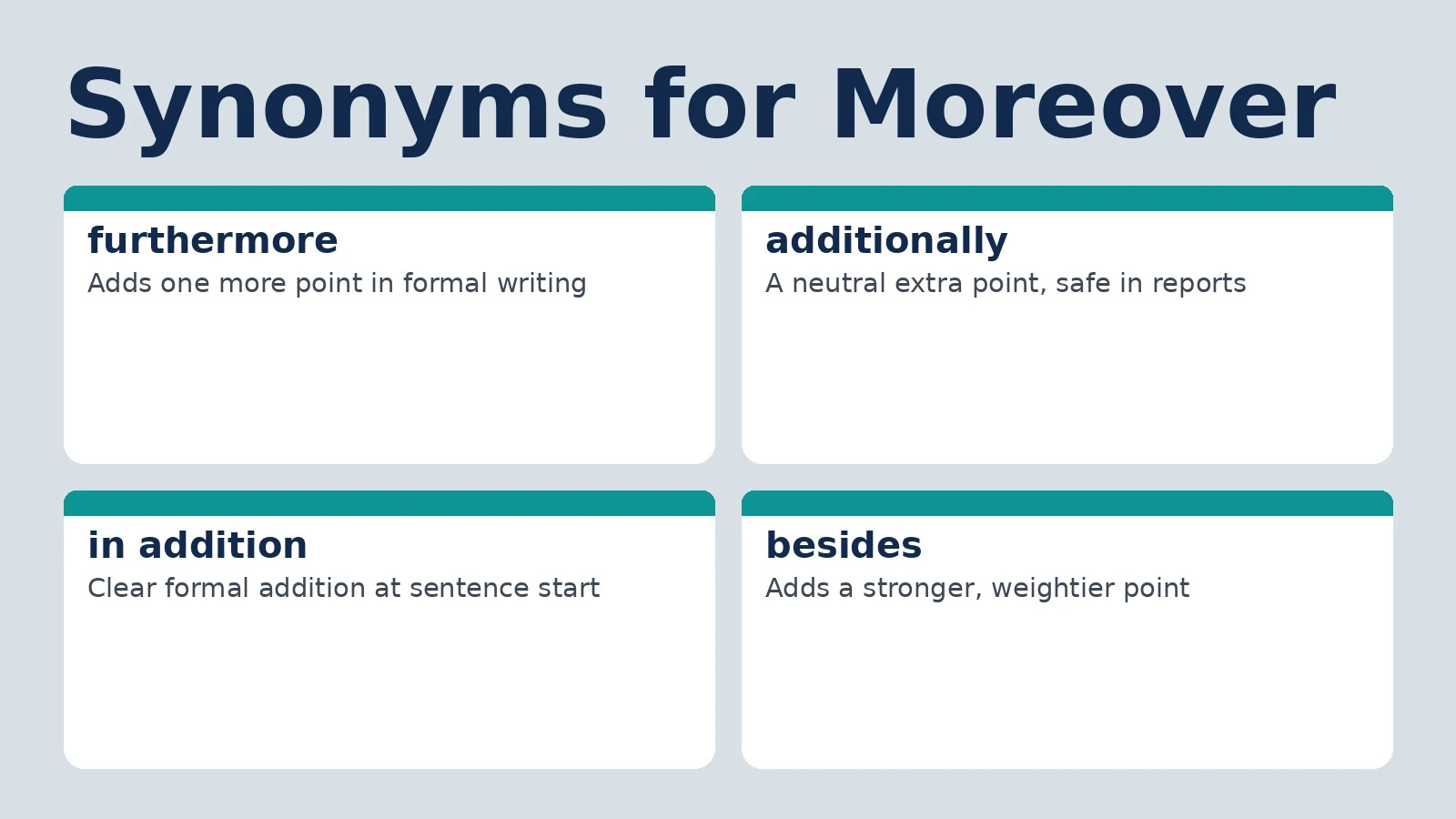
The strongest synonyms for moreover are furthermore, additionally, in addition and besides. After those come what is more for extra weight, in addition to for a point built on a noun, and likewise for a parallel idea. Each one does a slightly different job, and the wrong choice can quietly change your tone.
This guide groups the alternatives by function, not alphabet. You will see what each word adds, where it fits in a sentence, and how it sounds in essays, reports and IELTS answers. A quick table comes first, so you can grab a word and keep writing.
Quick Reference: Top Synonyms for Moreover
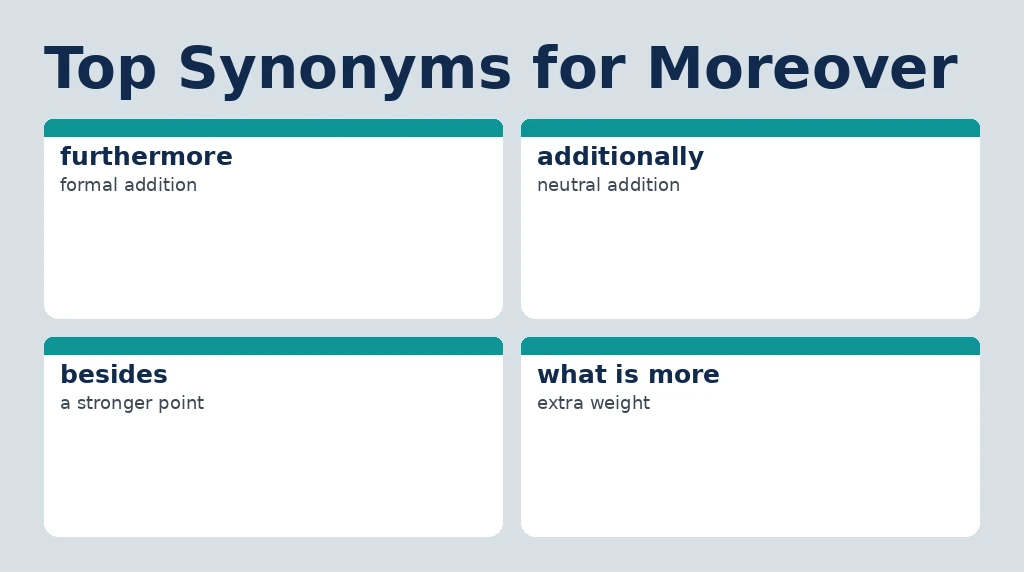
The table below gathers the working synonyms for moreover in one place. The meaning column keeps each gloss short, so you can scan fast. The last column tells you where the word earns its place.
| Word | Meaning in one line | Best for / tone |
|---|---|---|
| furthermore | adds one more supporting point | formal, essays and reports |
| additionally | adds an extra item or fact | formal to neutral, lists |
| in addition | adds a point in a clean, clear way | formal, all academic writing |
| besides | adds a point with extra weight | formal to neutral, persuasive |
| also | adds a simple extra point | neutral, the everyday default |
| further | adds a point in a compact form | formal, reports and legal writing |
| as well | adds a point at the end of a clause | neutral, speech and writing |
| too | adds a point with a very light touch | neutral to informal |
| what is more (what’s more) | adds a point that matters more | formal, persuasive writing |
| not to mention | adds a strong point held back for effect | persuasive, speech and essays |
| for good measure | adds something extra beyond the need | neutral, slightly playful |
| to boot | adds a bonus point on top | neutral, with an old fashioned flavor |
| into the bargain | adds a bonus point on top | neutral, common in British writing |
| on top of that | adds a point that piles onto the last | neutral to informal |
| over and above | adds beyond what was expected or required | formal, contracts and reports |
| likewise | adds a parallel point, in the same way | formal, comparisons |
| similarly | adds a matching case or pattern | academic, comparisons |
| in like manner | adds a parallel point, very formal | literary, legal flavor |
| correspondingly | adds a point that matches in parallel | formal, technical writing |
| by the same token | adds a point resting on the same reason | persuasive, argument |
| withal | adds a point, an old literary word | literary, archaic |
| again | adds one more consideration | formal, older style |
| yet | adds inside phrases such as yet another | formal, fixed patterns only |
| more | adds inside patterns such as one more point | formal, fixed patterns only |
| more than that | adds a stronger point in plain words | neutral, clear and direct |
| in addition to | adds a noun or a gerund, not a clause | formal, grammar dependent |
| as well as | joins a noun or a verb phrase | neutral, grammar dependent |
| plus | adds a point in casual speech | informal, speech only |
Two honest warnings belong with this table. First, a few entries work only inside set patterns, and the table marks them clearly. Second, no connector on this list adds contrast. When your next point pushes against the last one, you need a different family of words, and the antonyms section below covers it.
What Moreover Means and How It Works
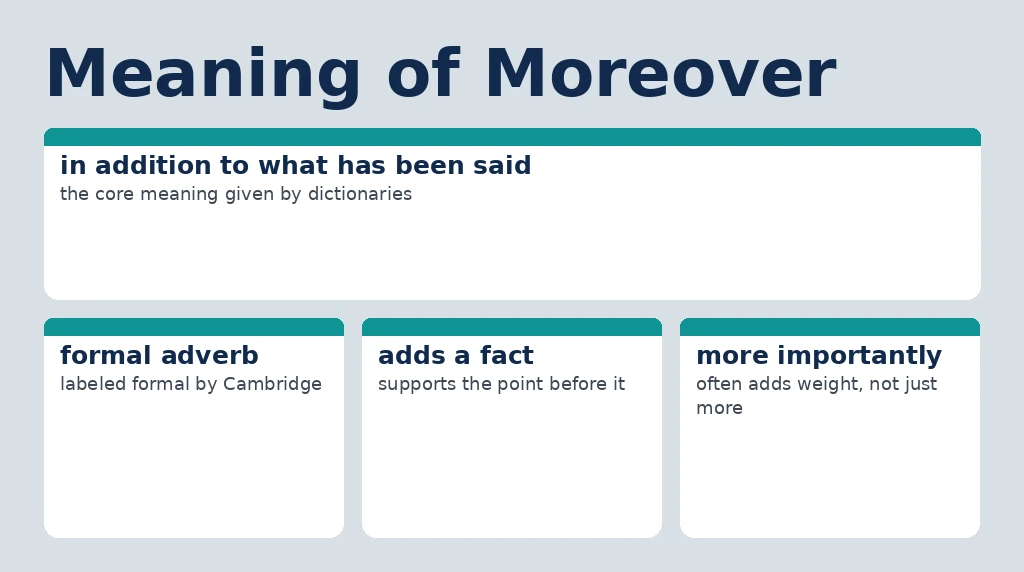
Dictionaries agree closely on this word, which makes it a safe anchor for the whole list. Merriam-Webster defines moreover as “in addition to what has been said.” Collins adds a useful detail about purpose: you use it to introduce information that adds to or supports the statement before it. Cambridge sharpens the point further. Its definition reads “also and more importantly,” which is why moreover often feels heavier than a plain also.
That extra weight is the word’s real identity. A writer who chooses moreover is rarely just stacking facts. The writer is quietly telling the reader that the next point deserves attention. Keep that in mind as you compare the synonyms, because the best replacement is the one that keeps the same weight.
The grammar in brief
Moreover is a conjunctive adverb, also called a linking adverb. It connects a new clause to the one before it, and it comments on how the two relate. Unlike a plain conjunction such as and, it does not glue two clauses into one grammatical unit. Each side stays a complete sentence in its own right.
This grammar explains the punctuation rules that follow. Because the connector starts a fresh move, it needs strong punctuation before it. Because it is an added comment, it takes a comma after it. Most errors with moreover are punctuation errors, not word choice errors.
Position and punctuation
At the start of a sentence, moreover takes a comma straight after it. Example: “The course is free. Moreover, it offers a certificate.” When you join two full clauses in one sentence, place a semicolon before the connector and a comma after it. Example: “The course is free; moreover, it offers a certificate.”
Moreover can also sit inside a sentence, usually after the subject. Collins notes that it works with a clause and does not sit at the very end of one. Formal prose uses this pattern often: “The plan, moreover, saves money.” A comma on each side marks the pause. Ending a clause with moreover sounds unfinished, so avoid that position.
A short history note
The word is older than most writers guess. Dictionary.com records it first in Middle English, between 1325 and 1375, built from more plus over. The shape explains the sense almost perfectly: more information, laid over what has already been said. Writers have used it in formal prose ever since.
Synonyms for Moreover That Add a Point
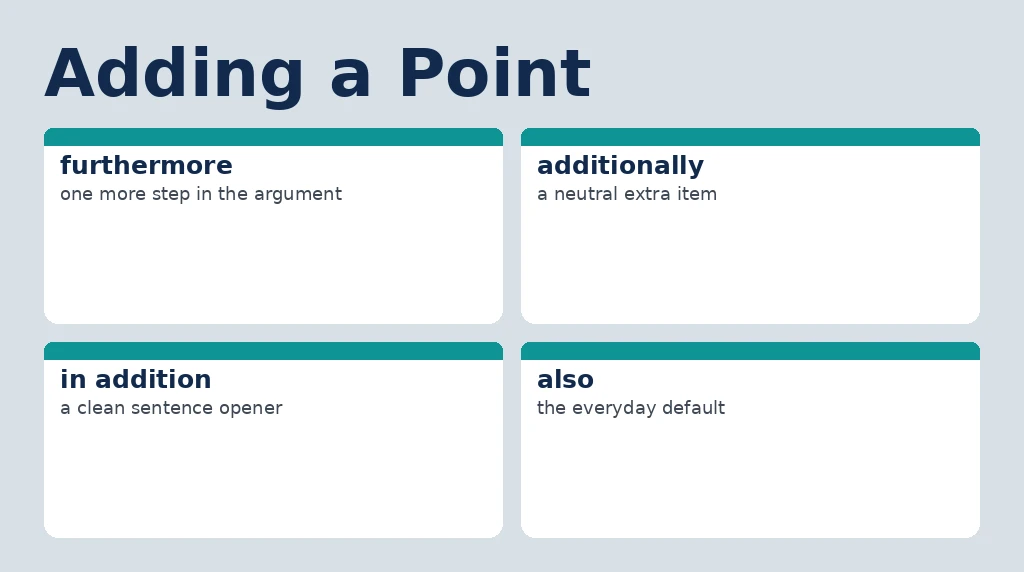
This group does the plain, honest work of addition. None of these words shouts. Each one simply tells the reader that another point of similar weight is coming, and that steady signal is exactly what most essays and reports need.
furthermore
Furthermore is the closest all purpose replacement. Merriam-Webster, Cambridge and Collins all list it beside moreover, and it suits the same formal settings. It tends to continue the line of argument you have already started, adding one more step in the same direction.
Example: “The library stays open until midnight during exams. Furthermore, it adds weekend hours in the final week.” The second fact extends the first, and furthermore marks that extension cleanly.
additionally
Additionally is the neutral workhorse of the group. It adds an item without grading its importance, which makes it ideal for reports, instructions and lists of findings. Readers barely notice it, and that invisibility is a strength when the facts should carry the page.
Example: “The treatment reduced pain in most patients. Additionally, it improved sleep quality for the same group.” Notice how the tone stays clinical. Additionally never argues; it simply adds.
in addition
In addition may be the clearest connector in English. It is formal enough for any essay, yet plain enough that no reader stumbles over it. Use it when you want the addition signaled with zero decoration.
Example: “Regular practice builds accuracy. In addition, it builds the stamina a long exam demands.” The phrase sits happily at the start of a sentence. It also survives being moved: “It builds, in addition, the stamina a long exam demands” is grammatical, though heavier.
further
Further works as a compact sentence opener in formal prose. Cambridge and Collins both list it for this sense, and legal and academic writers use it when space and tone are tight. Example: “Further, the committee wishes to note the cost of delay.” The single word does the same job as in addition, with a drier voice.
One caution belongs here. Further also measures distance and degree in other sentences, so context must make the additive sense obvious. At the start of a sentence, followed by a comma, the meaning is clear.
also, too and as well
These three are the everyday members of the family. Also is the neutral default across speech and writing, and our companion guide to synonyms for also shows how wide its own family runs. Too and as well usually close a clause instead of opening one: “The report covers costs. It covers staffing as well.”
Position is their main rule. Also often sits before the main verb: “The report also covers staffing.” Too and as well sound strained at the start of a formal sentence, so keep them for endings or for speech.
in addition to and as well as
These two look like connectors, but they behave like prepositions. In addition to must be followed by a noun or a gerund, never by a full clause. Write “In addition to the fee, applicants pay for materials,” not “In addition to, applicants pay for materials.” As well as joins phrases the same way: “She teaches biology as well as chemistry.”
Used well, both phrases let you add a point inside a sentence instead of starting a new one. That variety alone lifts an essay, because not every addition deserves its own sentence.
The informal option: plus
Plus opens sentences in relaxed speech and friendly writing: “The hotel is near the station. Plus, breakfast is included.” Thesaurus.com files it among the weaker matches for also, and that ranking feels right. Enjoy it in speech, messages and informal blogs. Keep it out of exam essays and formal reports, where examiners read it as a slip in register.
Synonyms for Moreover That Add a Stronger Point

Some additions are not equal partners. They arrive as the heavier fact, the deciding reason, or the bonus nobody expected. Moreover itself often does this job, remember the Cambridge gloss “more importantly.” The words in this group share that extra push.
besides
Besides is the strongest everyday member of this group. All four reference sources list it for moreover, and speakers use it when the added point should tip the balance. Example: “I do not want to sell the house. Besides, the market is weak right now.” The second sentence is not neutral information. It is another reason, offered with a shrug of finality.
Watch the spelling, though. Beside, without the s, means next to. That single letter changes the word completely, and the mistakes section returns to it.
what is more and what’s more
This phrase announces that the coming point outranks the last one. Cambridge lists what’s more for moreover, and Collins lists what is more in the same sense. The contracted form suits speech and lively articles. The full form suits essays and formal reports.
Example: “The vaccine is effective. What is more, it stays stable without deep freezing.” The phrase promises escalation, so spend it on a point that truly delivers. Using it for a trivial detail makes the writing sound inflated.
not to mention
Not to mention introduces a point so obvious or so strong that the writer pretends it hardly needs saying. Collins and Thesaurus.com both place it in this family. Example: “The role offers travel, training, and not to mention a salary above the market rate.” Strictly, the point is mentioned, of course. The little fiction adds emphasis and a touch of style, which is why speakers love it.
for good measure, to boot and into the bargain
These three idioms add something beyond the requirement. For good measure is Merriam-Webster’s listed phrase for an extra thrown in freely. Example: “She packed sandwiches, fruit, and, for good measure, a thermos of tea.”
To boot carries the same bonus sense with an older flavor: “He is kind, patient, and honest to boot.” Cambridge defines the phrase simply as “in addition.” Into the bargain, common in British writing, means the same: “The cottage has a garden and a garage into the bargain.” All three reward a positive list. They sound odd after bad news, so match them to welcome extras.
on top of that and over and above
On top of that piles a point onto a situation, good or bad. “The flight was delayed. On top of that, our luggage went to another city.” The phrase often carries mild complaint, which makes it flexible but informal.
Over and above works in the opposite register. It means beyond what was expected, required or already counted, and it thrives in contracts, budgets and formal reports. Example: “Over and above the grant, the school raised funds for the library.” Choose it when the extra amount or effort is measurable.
Likewise and the Similarity Connectors

This group needs an honest warning before the praise. Likewise is a genuine dictionary synonym for moreover; Merriam-Webster and Thesaurus.com both list it. Yet its first job is similarity, not addition. It adds a point that runs parallel to the previous one, in the same way or for the same reason.
likewise
Use likewise when the second point mirrors the first. Example: “The first chapter introduces the method. Likewise, the second chapter applies it to a case study.” The chapters are not just two facts in a row. They follow the same pattern, and likewise says so. When no parallel exists, reach back to furthermore or additionally instead.
similarly and in like manner
Similarly announces a matching case: “Sales fell in March. Similarly, orders slowed in April.” In like manner does the same job in a much more formal voice, the kind found in older legal and ceremonial writing. Both words add information, but the information is a resemblance. That is useful in comparison essays, data commentary and any paragraph built on patterns.
correspondingly
Correspondingly adds a point that matches the first in a measured, parallel way. It suits technical and academic writing, where two changes track each other. Example: “Costs rose across the region. Correspondingly, prices at the retail level climbed.” The word implies proportion and fit, so reserve it for changes that genuinely correspond.
by the same token
By the same token argues from the same grounds. Thesaurus.com lists it among the matches for moreover, and its flavor is logical rather than neutral. Example: “If practice improves accuracy, then by the same token it should improve speed.” The phrase tells the reader that one rule covers both points. It persuades more than it adds, so place it in argument, not in plain reporting.
Formal, Legal and Literary Alternatives

Formal writing keeps a few older tools that modern essays rarely touch. They are real synonyms, verified in the sources, but each carries a register warning. Use them knowingly, or not at all.
further in formal and legal prose
Beyond the plain opener sense covered earlier, further does quiet work throughout legal and official writing. Phrases such as “further to your letter” and “further information” belong to this world. The tone is dry, exact and institutional. In an essay, plain further at the start of a sentence is safe. In a business letter, it signals professional polish.
withal
Withal is the literary elder of the family. Collins marks it literary, and Merriam-Webster and Thesaurus.com both list it for moreover. It means in addition, or besides, and it survives in older texts and deliberate archaism. Example, in a historical novel’s voice: “He was poor, and withal proud.” In a student essay it would look like a costume. Enjoy recognizing it; rarely write it.
again
Again once served as a formal additive opener, and Merriam-Webster still lists it beside moreover. The pattern runs: “Again, the cost must be weighed against the risk.” Modern readers meet again mainly as a time word, so the additive sense can misfire. If you use it, the comma and the context must do heavy work. Most writers today are safer with furthermore.
yet and more in fixed patterns
Two listed synonyms survive only inside patterns. Yet adds inside phrases such as “yet another reason” and “yet more evidence”: “The audit found missing receipts and yet another unsigned form.” More works the same way: “One more point deserves attention.” Neither word opens a sentence as a free connector in modern prose. Treat them as ingredients, not as standalone swaps, and your writing stays accurate.
more than that
Cambridge lists more than that among the synonyms of moreover, and the phrase earns its place. It is plain, direct and slightly emphatic: “He apologized. More than that, he offered to repair the damage himself.” The second action outweighs the first, and the phrase says so without Latin weight. It suits clear modern prose that wants emphasis without formality.
Moreover vs Furthermore vs Additionally
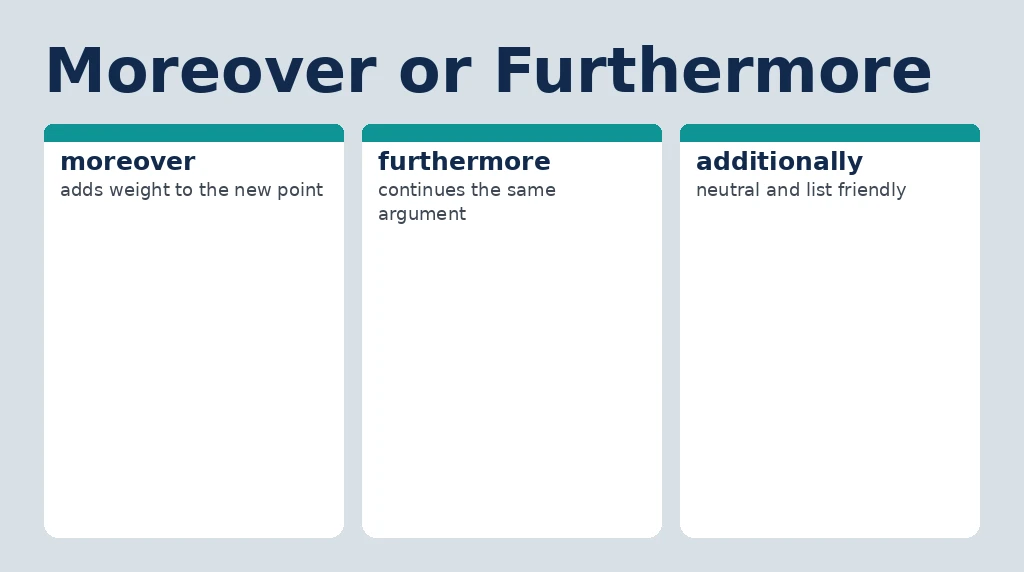
These three cause more hesitation than the rest of the list combined. The honest starting point is that dictionaries treat them as close synonyms. Merriam-Webster lists furthermore and additionally under moreover itself. No grammar rule bans any of them from any formal sentence. The differences live in emphasis and habit, and the table below states them as guidance, not law.
| Word | What it tends to signal | Feels most at home in |
|---|---|---|
| moreover | the new point carries extra weight | persuasive essays, arguments |
| furthermore | the argument continues in the same direction | essays, reports, formal letters |
| additionally | one more item of similar weight | reports, findings, structured lists |
Paired examples
Watch the same pair of facts change flavor with each connector. “The treatment is affordable. Moreover, it has almost no side effects.” Here the second fact feels like the stronger selling point, and moreover leans into that.
Swap one word and the temperature changes. “The treatment is affordable. Furthermore, it has almost no side effects.” Now the second fact simply continues the case, step by step. Neither sentence is wrong. The writer is choosing how hard the addition should push.
Additionally cools the sentence down further. “The treatment is affordable. Additionally, it has almost no side effects.” The tone becomes a report writer’s tone, where facts line up without commentary. For a deeper set of options on each word, see our guides to synonyms for furthermore and synonyms for additionally.
Practical guidance
Three habits serve most writers well. First, pick furthermore when you are extending an argument you have already built. Second, pick moreover when the added point should stand taller than the one before it. Third, pick additionally when you are adding items that all weigh about the same. When in doubt, additionally is the hardest to misuse, because it promises nothing beyond addition itself.
How to Choose the Right Synonym for Moreover
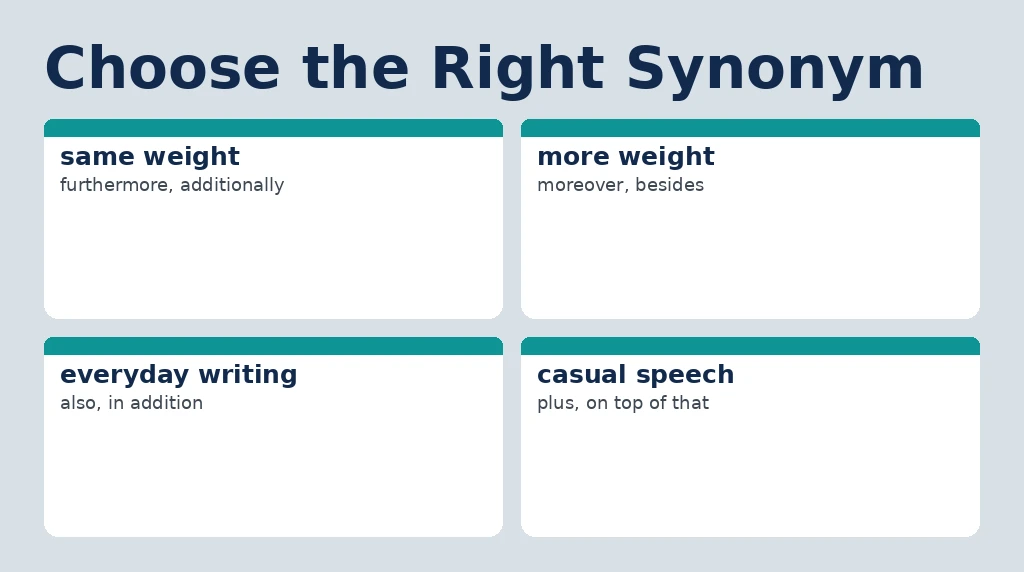
Choosing well is mostly a matter of asking what the new point does. Four short questions settle most cases, and each answer points to a small set of words.
Ask what job the point does
If the point simply adds information, stay with the neutral group: furthermore, additionally, in addition, also. If the point adds force, move to besides, what is more or not to mention. If the point adds a parallel case, likewise and similarly take over. Naming the job first makes the choice almost automatic.
Ask how formal the page is
Exam essays, reports and formal letters welcome furthermore, additionally and in addition without risk. Business writing tolerates besides and further. Speech and casual articles can carry plus, on top of that and what’s more. Literary pastiche alone can carry withal. A word that is correct but wrongly dressed still reads as an error.
Ask where the word will sit
Sentence openers do the heavy lifting: moreover, furthermore, additionally, in addition, besides, further. Clause endings belong to too and as well. Middle positions suit moreover and furthermore after a subject: “The policy, furthermore, protects tenants.” Phrases such as in addition to and as well as work inside the sentence and need a noun or gerund after them. Position eliminates half the list before taste even enters.
Ask what you used last time
Variety is the final test. A page that opens three paragraphs with the same connector sounds like a template. Rotate through two or three favorites instead of hunting for exotic words. Readers trust a writer whose connectors vary quietly, the way a speaker varies pace. Save the rare words for the one moment that deserves them.
Synonyms for Moreover in Essays and IELTS Writing
Most searches for this word start at a desk, with an essay open and a deadline near. This section translates the list into exam and classroom habits.
Patterns that work in essays
Body paragraphs carry the additions, so place your strongest connector at the paragraph’s second or third sentence. A reliable pattern runs like this: topic sentence, explanation, then “Moreover, …” with the added evidence. Example: “City cycling schemes cut traffic in the center. Moreover, they improve air quality for the residents who live there.”
A second pattern stacks two additions across a paragraph without repeating a word. Open with in addition, continue with furthermore, and close the point plainly. The reader feels accumulation, not repetition. Conclusions, by contrast, rarely need additive connectors at all. A conclusion gathers; it does not keep adding.
IELTS Writing Task 2
In IELTS, linking words are judged under Coherence and Cohesion, which carries 25 percent of the writing score. The Band 7 descriptor asks for a range of cohesive devices used appropriately, and addition words sit at the center of that range. Moreover, furthermore and in addition all appear in standard IELTS teaching lists for adding a supporting point in Task 2.
Use them with restraint. Two or three well placed additive connectors in a Task 2 essay look controlled. One in every sentence looks memorized, and examiners are trained to notice mechanical patterns. Guards matter too: keep the comma after the opener, keep each added point genuinely new, and never open a paragraph with moreover when the paragraph actually changes direction. For Task 1, where you describe data rather than argue, in addition and additionally usually serve better than the heavier moreover.
Reports and formal emails
Reports prefer the neutral spine of this list: additionally, in addition, further. Emails sit one step lower in formality, where in addition and also do most of the work. In both settings, one additive connector per paragraph is a sound default. The facts get the attention, and the connectors stay invisible, which is exactly their job.
Antonyms and Opposite-Direction Connectors
Connectors do not have strict dictionary antonyms, the way hot has cold. What they have is an opposite direction. Moreover builds the argument upward. The words below turn it, qualify it or push against it, and a balanced essay needs both families.
However is the most useful turn. It introduces a contrasting point while staying formal: “The plan is popular. However, it is expensive.” Nevertheless and nonetheless concede a point and then stand firm anyway: “The data is limited. Nevertheless, the trend is clear.”
Conversely reverses the relationship itself, which suits paired facts. On the other hand sets two views side by side for comparison. On the contrary corrects a wrong impression rather than merely contrasting: “He did not refuse. On the contrary, he volunteered.” In contrast compares two things directly, and instead swaps one option for another.
Knowing this family protects your logic. The commonest connector error in student writing is using an additive word where the thought has actually turned. If the new point argues against the old one, no synonym for moreover will save the sentence. Change the family, not just the word.
Common Mistakes and False Synonyms
Mistake 1: Confusing beside and besides
Beside means next to: “She sat beside me.” Besides means in addition: “Besides the cost, there is the delay.” The missing s is a small typo with a large effect, because beside turns your connector into a location. Proofread this pair every time.
Mistake 2: Stacking two connectors
“Moreover, in addition, the scheme saves money” says the same thing twice. Both phrases signal addition, so together they only add clutter. The same problem appears in “furthermore, additionally” and “but however.” One connector per junction is the rule. Redundancy of this kind is a known weakness in exam writing, where it makes sentences sound padded rather than developed.
Mistake 3: The comma splice
A conjunctive adverb cannot join two clauses with a comma alone. “The hotel was full, moreover, we stayed elsewhere” is a comma splice. Fix it with a semicolon, “The hotel was full; moreover, we stayed elsewhere,” or split the sentence in two. This single correction repairs a large share of connector errors.
Mistake 4: Trusting false friends
Several words travel near moreover without doing its job. Then, which Merriam-Webster lists in this neighborhood, mainly marks sequence: what happens next, not what adds weight. Either adds only inside negative sentences: “It is not cheap, and it is not fast either.” It cannot open a positive addition. In fact corrects or sharpens a claim rather than adding a parallel one. Each word is respectable. None is a free swap for moreover.
Mistake 5: Opening every paragraph the same way
Five paragraphs that each begin with moreover read like a form being filled in. The connector is formal, so repetition makes the stiffness worse. Rotate openers, move some additions inside sentences with in addition to, and let some points stand with no connector at all. Clean prose often needs no signpost where the logic is already obvious.
Frequently Asked Questions
What is the best synonym for moreover?
Furthermore is the closest all purpose synonym, and every major thesaurus lists it first among equals. Choose additionally for a neutral, report style addition, besides when the extra point should carry weight, and in addition when you want the clearest possible signal.
What is the difference between moreover and furthermore?
Dictionaries treat them as near synonyms, and no grammar rule separates them. In practice, furthermore tends to continue an argument in the same direction, while moreover often gives the added point extra importance. Cambridge defines moreover as “also and more importantly,” which captures that extra weight.
Is moreover a formal word?
Yes. Cambridge and Collins both label moreover formal, and it lives mainly in essays, reports, academic writing and formal letters. In everyday conversation, also, plus or on top of that usually sound more natural.
Can I start a sentence with moreover?
Yes, and that is its most common position. Place a comma after it: “Moreover, the results held across all age groups.” You can also place it after the subject in formal prose: “The results, moreover, held across all age groups.”
Does moreover need a semicolon before it?
Only when it joins two complete clauses inside one sentence: “The results were clear; moreover, they were consistent.” When moreover starts a new sentence after a full stop, no semicolon is needed. A comma alone between two full clauses creates a comma splice.
What can I use instead of moreover in IELTS writing?
Furthermore, additionally and in addition are the safest swaps in IELTS Task 2, where addition connectors support the Coherence and Cohesion score. Use two or three across an essay, place them accurately, and avoid repeating the same opener in every paragraph.
Is besides the same as beside?
No. Beside, without the final s, means next to something: “Sit beside me.” Besides means in addition, or another reason: “Besides the price, the location is wrong.” As a connector, you always want besides.
What is the opposite of moreover?
Connectors have no strict antonyms, but the opposite direction belongs to contrast words such as however, nevertheless, conversely and on the other hand. Use those when the new point turns against the previous one instead of adding to it.
Final Thoughts
Moreover earns its place in formal writing because it does two jobs at once: it adds a point, and it quietly ranks that point as important. Its synonyms divide the same work among themselves. Furthermore continues, additionally lists, besides persuades, likewise parallels, and the idioms add bonuses with a lighter touch.
Pick by job first, then by tone, then by position. That order will carry you through essays, reports and exams without a wrong step. When you want to check a shade of meaning before you commit to it, the Cambridge Dictionary entry for moreover shows the core group and a model sentence in seconds.