Do you ever catch yourself using the word “similar” over and over again in your emails, essays, or everyday conversations? You are not alone. Many people rely on this comfortable word without realizing how many precise alternatives exist.
Choosing the right synonym can transform your writing from repetitive to remarkable. Whether you are drafting a professional report, crafting a social media caption, or polishing a resume, the right word choice makes all the difference.
This guide will help you move beyond “similar” and discover richer, more accurate words for every situation. You will learn exactly which synonym fits your context, tone, and audience. Let us explore the full spectrum of words that mean similar and find the perfect match for your needs.
What Does “Similar” Mean?
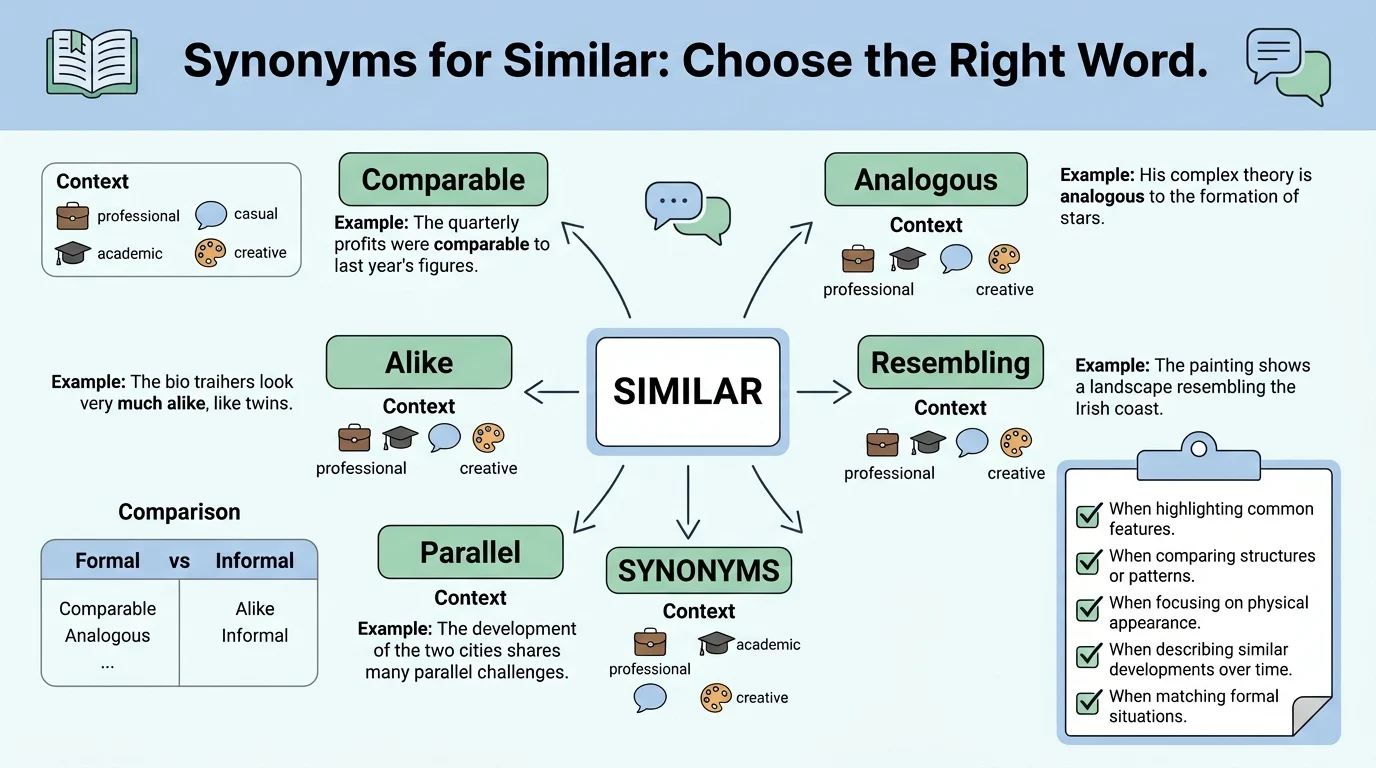
Similar means having characteristics in common without being identical. The best synonym depends entirely on your context. For formal writing, use “comparable.” For academic work, “analogous” works well. In casual conversation, “alike” feels natural. Creative writing benefits from “resembling,” while professional settings often prefer “parallel” or “corresponding.” Choose based on tone and precision.
Meaning, Tone and Context
Simple Definition
Similar describes two or more things that share qualities, features, or characteristics but are not exactly the same. The shared traits create a recognizable connection between the items being compared.
Part of Speech
Similar is an adjective. It modifies nouns to indicate comparison. The noun form is “similarity.” The adverb form is “similarly.”
Tone
Similar carries a neutral tone. It does not suggest positive or negative judgment. The word simply acknowledges shared characteristics without evaluation.
Formality Level
Similar is a middle level word. It works in both formal and informal situations. More formal options exist, and more casual options exist, but similar sits comfortably in the middle.
Common Use Cases
People use similar when comparing products, ideas, experiences, people, situations, and results. It appears frequently in academic writing, business communication, everyday conversation, and creative work.
Important Word Forms
Adjective: similar
Noun: similarity
Adverb: similarly
Opposite: different, dissimilar
When and How to Use “Similar”
You should use similar when you want to point out shared qualities between two or more things without implying they are exactly the same. The word works best when the similarities are obvious and do not need dramatic emphasis.
Here are examples across different contexts.
Professional Context
The two marketing strategies produced similar results, so we will adopt the more cost effective option.
Academic Context
Researchers found similar patterns in both studies, suggesting a consistent effect across different populations.
Personal Context
My sister and I have similar tastes in music, which makes road trips more enjoyable.
Emotional Context
We shared similar feelings about the movie, both leaving the theater with a sense of wonder.
Creative Context
The artist created similar textures in each painting, using the same brush technique across the collection.
Social Media Caption
Found a similar vibe at this new café compared to our favorite spot downtown.
Resume Context
Developed similar project management systems for three different departments.
Another Word for “Similar”
Choosing the right replacement depends on your specific situation. Here are the best single word alternatives for different contexts.
Professional Writing
Use “comparable” when discussing data, performance, or business metrics. This word suggests measurable likeness.
Academic Writing
Use “analogous” when drawing parallels between concepts, theories, or research findings.
Casual Conversation
Use “alike” when speaking naturally with friends, family, or colleagues in informal settings.
Emotional Writing
Use “resembling” when describing personal connections or experiences that evoke familiarity.
Creative Writing
Use “akin” to create a sophisticated, literary tone in fiction or poetry.
Resume or Workplace
Use “parallel” to describe similar roles, responsibilities, or achievements in your career.
Social Media Captions
Use “giving” or “vibes” in modern, casual social media contexts to suggest similarity.
Stronger Meaning
Use “identical” when the similarities are extremely close or nearly the same.
Softer Meaning
Use “comparable” to acknowledge some differences while highlighting shared traits.
When Not to Use “Similar”
Avoid using similar when you need to express exactness. If two things are exactly the same, use “identical” or “same” instead. Similar implies differences exist.
Do not use similar when the comparison is too vague. Sometimes a more specific word like “corresponding” or “equivalent” adds needed precision.
Weak Example
The two reports are similar in many ways.
Improved Example
The two reports contain corresponding findings in every section.
Another Weak Example
Her experience was similar to mine.
Improved Example
Her experience paralleled mine in terms of challenges and outcomes.
Avoid similar in formal academic writing when a more precise term like “analogous” would strengthen your argument. Also avoid it in creative writing when a vivid word like “echoing” would create better imagery.
Words Commonly Confused With “Similar”
Several words create confusion because they relate to similarity but carry different meanings. Understanding these differences will improve your word choice.
Similar vs. Same
Similar means sharing qualities but not being identical. Same means exactly alike in every way. Use “same” when no differences exist. Use “similar” when differences remain.
Similar vs. Alike
These words are nearly interchangeable. Alike is slightly more casual and often used after linking verbs. Similar can appear before nouns more comfortably.
Vs. Comparable
Comparable suggests that measurement or evaluation is possible. Similar simply acknowledges shared traits. Use comparable when discussing standards or metrics.
Similar vs. Analogous
Analogous indicates a functional or structural resemblance between different things. It implies deeper connections than simple similarity. Use analogous in academic or technical contexts.
Similar vs. Corresponding
Corresponding suggests a direct relationship or matching position. Use corresponding when items align in sequence, order, or function.
Similar vs. Resembling
Resembling focuses on visual or superficial likeness. Similar can apply to any type of characteristic. Use resembling for physical appearance or surface level traits.
Best Synonym by Context for “Similar”
| Context | Best Synonym | Why It Works | Example |
|---|---|---|---|
| Formal Writing | Comparable | Suggests measurable likeness suitable for reports | The quarterly figures are comparable across all regions. |
| Academic Writing | Analogous | Indicates structural or functional parallels | The two theories are analogous in their core assumptions. |
| Professional Business | Parallel | Suggests aligned processes or outcomes | Our departments developed parallel approaches to the problem. |
| Resume | Corresponding | Shows matching responsibilities or achievements | Managed corresponding budgets in two different divisions. |
| Casual Conversation | Alike | Natural and conversational | We think alike on most important issues. |
| Creative Writing | Akin | Literary and sophisticated | Their voices were akin in timbre and warmth. |
| Emotional Tone | Resembling | Creates personal connection | Her laughter was resembling her mother’s joyful sound. |
| Strong Intensity | Identical | Emphasizes near exactness | The test results were nearly identical. |
| Soft Moderate Tone | Comparable | Balances similarity with differences | The two products are comparable in quality. |
| Social Media Captions | Vibe | Modern, casual, culturally relevant | Getting similar vibes from this new artist. |
| Technical Writing | Homologous | Precise scientific and technical meaning | The structures are homologous across species. |
Which Synonym Should You Choose?
Choosing the right synonym starts with understanding your audience. Ask yourself who will read your words. A formal business report requires different vocabulary than a personal journal entry.
Consider the purpose of your writing. Are you trying to persuade, inform, entertain, or describe? Each goal benefits from different word choices. Persuasive writing often uses stronger synonyms. Descriptive writing benefits from more vivid options.
Think about emotional intensity. Do you need a neutral word like “comparable” or a warmer word like “resembling”? The emotional weight of your synonym shapes how readers perceive your message.
Examine your sentence structure. Some synonyms fit better in specific grammatical positions. “Alike” often appears after linking verbs. “Similar” works well before nouns.
Match the formality level to your situation. Academic papers demand precise, formal options. Social media posts allow modern, casual choices. Professional emails require balanced, respectful language.
Finally, trust your ear. Read your sentence aloud with each synonym option. Choose the word that sounds most natural and conveys your exact meaning.
Real Life Examples of “Similar” in Sentences
School Context
The history students presented similar arguments in their final papers, though each used different primary sources.
Workplace Context
Our team encountered similar challenges during the software rollout, but we developed creative solutions.
Writing Context
The author created similar atmospheric effects in both novels through careful word choice and pacing.
Conversation Context
We have similar views on remote work, so collaborating should be straightforward.
Social Media Context
Posting similar content to my regular feed but with a fresh twist for this campaign.
Resume Context
Led similar initiatives at three different organizations, each achieving measurable growth.
Email Context
I noticed similar concerns raised in the customer feedback, so I have addressed them in this update.
Storytelling Context
The character faced similar obstacles in each chapter, building a pattern of resilience.
15 Synonyms for “Similar”
| Synonym | Simple Meaning | Best Used For | Example Sentence |
|---|---|---|---|
| Alike | Sharing common traits | Casual conversation and personal writing | The twins are alike in appearance but differ in personality. |
| Comparable | Able to be measured against each other | Professional and analytical writing | The two job offers are comparable in salary and benefits. |
| Analogous | Sharing functional or structural parallels | Academic and technical writing | The nervous system is analogous to a complex electrical circuit. |
| Corresponding | Matching in position or function | Professional and organizational writing | Submit the corresponding documents for each application. |
| Parallel | Running alongside with similar features | Business and strategic writing | Both companies followed parallel growth trajectories. |
| Akin | Connected by shared qualities | Literary and descriptive writing | The new policy is akin to previous regulations. |
| Resembling | Having a similar appearance or nature | Visual and descriptive contexts | The sculpture resembles classical Greek artwork. |
| Homogeneous | Composed of similar elements | Scientific and technical writing | The sample was homogeneous in its chemical composition. |
| Uniform | Consistent and unvarying | Formal and professional contexts | The quality remained uniform across all production batches. |
| Matching | Corresponding exactly in some feature | Practical and everyday use | We found matching patterns in both data sets. |
| Equivalent | Equal in value or significance | Formal and academic writing | The two approaches are equivalent in effectiveness. |
| Cognate | Related through a common origin | Historical or linguistic contexts | English and German have many cognate words. |
| Consistent | Staying the same or compatible | Professional and analytical contexts | The results are consistent with previous findings. |
| Allied | Connected by shared qualities or purpose | Strategic and collaborative contexts | We need allied approaches to solve this problem. |
| Twin | Closely paired or matched | Creative and descriptive contexts | The two characters share twin motivations. |
Synonym Groups and Usage Differences
Professional vs. Personal Synonyms
Professional contexts require words that convey measurable or actionable similarity. “Comparable,” “parallel,” and “corresponding” work well in workplace settings. These words suggest that similarities can be evaluated or used for decision making.
Personal contexts allow warmer, more subjective words. “Alike,” “resembling,” and “twin” create emotional connections. These words suggest shared experiences or personal recognition rather than objective measurement.
Formal vs. Conversational Synonyms
Formal writing benefits from precise academic words like “analogous,” “equivalent,” and “homogeneous.” These words signal careful thought and scholarly attention. They belong in research papers, legal documents, and official communications.
Conversational writing welcomes simpler words like “alike,” “matching,” and “like.” These words sound natural in spoken language, personal emails, and informal messages. They create connection without sounding stiff or pretentious.
Academic Synonyms
Academic writing values precision and specificity. “Analogous” works when comparing theoretical frameworks. “Homogeneous” describes uniform groups or data sets. “Cognate” appears in linguistic and historical analysis. These words demonstrate scholarly vocabulary while maintaining clarity.
Professional and Business Synonyms
Business communication needs clear, action oriented language. “Comparable” helps with performance evaluations. “Parallel” describes aligned strategies. “Corresponding” shows matched processes. These words help professionals communicate efficiently in reports, presentations, and meetings.
Creative or Literary Synonyms
Creative writing thrives on vivid language. “Akin” adds literary sophistication. “Twin” creates imaginative connections. “Resembling” develops visual imagery. These words help writers paint pictures and evoke emotions. They add depth to descriptions and create memorable passages.
Slang or Modern Synonyms
Modern informal language offers fresh ways to express similarity. “Vibe” captures atmosphere and feeling. “Copy” suggests imitation. “Same energy” has become popular in online culture. These expressions work well in social media, casual texts, and creative projects. They should stay away from professional or academic writing.
Strongest vs. Weaker Synonyms
Intensity scale from weakest to strongest:
Weaker: alike, resembling
Moderate: comparable, corresponding
Stronger: parallel, analogous
Strongest: identical, equivalent, homogeneous
Choose your intensity level based on how closely the items match. Use weaker options for general observations. Use stronger options for precise or scientific comparisons.
Emotional vs. Neutral Synonyms
Emotional synonyms add feeling to your writing. “Resembling” can carry nostalgia. “Twin” suggests intimacy. “Akin” creates warmth. These words connect with readers on a personal level.
Neutral synonyms stay factual and objective. “Comparable” states a measurable fact. “Corresponding” describes a position. “Homogeneous” describes composition. These words work best in scientific, legal, or professional contexts where emotion would be inappropriate.
Antonyms of “Similar”
| Antonym | Meaning | Example Sentence |
|---|---|---|
| Different | Not alike in any way | The two proposals are completely different in their approach. |
| Dissimilar | Lacking shared characteristics | Their management styles are entirely dissimilar. |
| Opposite | Completely contrary | The results were opposite to what we expected. |
| Divergent | Moving apart in different directions | Our opinions diverged significantly during the discussion. |
| Distinct | Clearly different and separate | The two brands occupy distinct market positions. |
| Unrelated | Having no connection | These topics are unrelated to our current project. |
| Contrasting | Showing clear differences | The two colors create a contrasting effect. |
| Opposing | Standing against each other | We received opposing recommendations from the advisors. |
| Unalike | Not having similar features | The siblings are completely unalike in temperament. |
| Disparate | Essentially different and incomparable | These disparate issues require separate solutions. |
| Mismatched | Not fitting together | The components were mismatched and caused problems. |
| Heterogeneous | Composed of different elements | The group was heterogeneous in its professional backgrounds. |
| Incompatible | Not able to work together | Their working styles are incompatible. |
| Discordant | Lacking harmony or agreement | The two accounts gave discordant versions of events. |
| Inconsistent | Not staying the same | The data was inconsistent across multiple trials. |
Comparison: Similar vs. Similar Words
Similar vs. Alike
Main Difference
Alike is slightly more casual and typically follows a linking verb. Similar can appear before nouns more naturally. Both words mean basically the same thing.
Which One Is Stronger
Neither is inherently stronger. Similar may sound slightly more formal. Alike feels more natural in everyday speech.
Which One Is More Formal
Similar is more formal. Use it in professional writing. Alike works better in personal conversation.
Example Sentences
The two products are alike in functionality and design.
The two products have similar functionality and design.
Similar vs. Comparable
Main Difference
Comparable suggests that the items can be measured or evaluated against each other. Similar simply acknowledges shared traits. Comparable implies enough likeness to make comparison meaningful.
Which One Is Stronger
Comparable is slightly stronger. It implies a meaningful or useful similarity that can be quantified or assessed.
Which One Is More Formal
Comparable is more formal. It appears frequently in business reports, academic research, and professional analysis.
Example Sentences
The candidate has similar qualifications to our top applicant.
The candidate has comparable qualifications to our top applicant.
Similar vs. Analogous
Main Difference
Analogous suggests a deeper, structural resemblance between different things. Similar works for surface level or general likeness. Analogous indicates that the two things share a functional relationship.
Which One Is Stronger
Analogous is stronger and more specific. It indicates a meaningful parallel between systems, processes, or concepts.
Which One Is More Formal
Analogous is more formal and academic. It belongs in scholarly writing and technical discussions.
Example Sentences
The marketing strategy is similar to our previous campaign.
The marketing strategy is analogous to our previous campaign in its core structure.
Similar vs. Corresponding
Main Difference
Corresponding emphasizes position, order, or relationship. Similar emphasizes shared characteristics. Corresponding suggests matching in specific designated ways.
Which One Is Stronger
Corresponding is more specific and often stronger. It suggests direct matching or alignment.
Which One Is More Formal
Corresponding is more formal. It works well in professional and organizational contexts.
Example Sentences
The teams faced similar challenges during implementation.
The teams faced corresponding challenges at each phase of implementation.
Similar vs. Resembling
Main Difference
Resembling often focuses on visual or surface level likeness. Similar works for any type of characteristic. Resembling creates more vivid imagery.
Which One Is Stronger
Resembling can be stronger in descriptive contexts. It paints a clearer mental picture.
Which One Is More Formal
Resembling is moderately formal. It appears in literary and descriptive writing more often than in technical or academic work.
Example Sentences
Her style is similar to her mentor’s approach.
Her style is resembling her mentor’s approach in every detail.
Similar vs. Equivalent
Main Difference
Equivalent means equal in value, importance, or meaning. Similar means sharing qualities. Equivalent suggests interchangeability. Similar suggests comparison without exact equality.
Which One Is Stronger
Equivalent is much stronger. It implies near or actual equality in relevant aspects.
Which One Is More Formal
Equivalent is more formal. It appears in scientific, legal, and academic writing.
Example Sentences
The two methods produced similar outcomes.
The two methods produced equivalent outcomes in terms of accuracy.
Common Phrases and Expressions with “Similar”
1. Similar to
Meaning
Used to compare one thing with another that shares qualities.
Example Sentence
The new model is similar to the previous version in its core features.
2. Similar in nature
Meaning
Describes things that share fundamental characteristics.
Example Sentence
The two assignments were similar in nature, requiring research and analysis.
3. Strikingly similar
Meaning
Emphasizes an unusually close resemblance.
Example Sentence
The final products were strikingly similar, despite different approaches.
4. Vaguely similar
Meaning
Indicates a slight or uncertain resemblance.
Example Sentence
The design was vaguely similar to something I had seen before.
5. Similar circumstances
Meaning
Describes situations that share important features.
Example Sentence
We have encountered similar circumstances in other projects.
6. Similar results
Meaning
Used when outcomes or findings correspond.
Example Sentence
The research team achieved similar results in both trials.
7. Similar approach
Meaning
Describes comparable methods or strategies.
Example Sentence
Our team adopted a similar approach to solve the problem.
8. Similar background
Meaning
Refers to shared experiences, education, or upbringing.
Example Sentence
The candidates come from similar backgrounds in software engineering.
Common Mistakes to Avoid
1. Using Similar When You Mean Identical
Many writers use similar to describe things that are actually exactly the same. If no differences exist, use identical or same instead. Similar implies that differences remain.
Mistake
The two copies were similar in every way.
Correction
The two copies were identical in every way.
2. Confusing Similar with Different
Some writers accidentally use similar when they mean different. This happens when trying to express that things are not alike. Always check that your meaning matches your word.
Mistake
Our experiences were similar, which explains why we disagree.
Correction
Our experiences were different, which explains why we disagree.
3. Using a Casual Synonym in Formal Writing
Words like “alike” and “same energy” work well in casual contexts but weaken formal writing. Choose “comparable,” “analogous,” or “corresponding” for professional and academic work.
Mistake
The data sets are alike in their patterns.
Correction
The data sets are comparable in their statistical patterns.
4. Using an Overly Dramatic Synonym for Simple Situations
Words like “identical” or “equivalent” should not describe general or superficial similarities. Reserve strong synonyms for genuine cases of close resemblance or equal value.
Mistake
The menus at the restaurants were identical.
Correction
The menus at the restaurants were similar in their offerings.
5. Repeating Similar Too Often
Repeating any word weakens your writing. Find alternatives like “comparable,” “parallel,” or “corresponding” to add variety. Use a thesaurus but always check the exact meaning of each option.
6. Choosing a Synonym with the Wrong Emotional Tone
Some synonyms carry subtle emotional meanings. “Resembling” can feel warm or nostalgic. “Homogeneous” feels cold and clinical. Choose words that match the emotional tone of your writing.
7. Using Slang in Academic or Professional Writing
Modern expressions like “vibe” or “same energy” should stay in casual contexts. They lack the precision and formality required for professional communication. Stick to standard vocabulary for formal writing.
FAQs
1. What is the best synonym for similar?
The best synonym depends on your context. For formal writing, use comparable. Academic work, use analogous. For casual conversation, use alike.
2. What is a formal synonym for similar?
Comparable and analogous are strong formal options. Corresponding and parallel also work well in professional settings.
3. What is an informal synonym for similar?
Alike is the most natural informal option. Resembling and matching also work in casual contexts.
4. What is another word for similar in professional writing?
Parallel, corresponding, and comparable all work effectively in business and professional writing.
5. What is the difference between similar and analogous?
Analogous suggests deeper structural or functional parallels. Similar indicates general shared characteristics without implying deeper connections.
6. What is the opposite of similar?
Different is the most common opposite. Dissimilar, opposite, and divergent also express contrast effectively.
Conclusion
Similar is a useful word for describing shared qualities between people, ideas, products, or experiences. Its neutral tone and moderate formality make it adaptable to many situations. However, you have many excellent alternatives at your disposal. Professional contexts benefit from comparable or parallel. Academic writing gains precision from analogous or corresponding. Creative work comes alive with akin or resembling. Casual conversation flows naturally with alike or matching.
The key to strong writing is matching your word to your audience, purpose, and tone. Consider the emotional weight, formality level, and precision needed for each situation. Then choose the synonym that fits perfectly.
Remember to verify definitions using trusted dictionaries such as Cambridge, Oxford, Merriam Webster, Collins, or Britannica before publishing. These sources provide authoritative guidance on word meanings and usage.
Start expanding your vocabulary today. Replace one repetitive “similar” with a more precise alternative. Your readers will notice the difference, and your writing will gain clarity and impact. Practice choosing synonyms by context, and soon the right word will come naturally every time.