You just posted a picture of your new rescue puppy. The caption started strong, but by the third sentence you realized you had written “cute” four times. Your comment on a coworker’s baby photo also relied on the same tired word.
If you reach for “cute” for everything from a stylish jacket to a clever spreadsheet layout, your vocabulary is begging for a refresh. This guide gives you a practical, expert curated list of synonyms for cute so you can sound more precise, natural, and confident in any situation.
What Does Cute Mean?
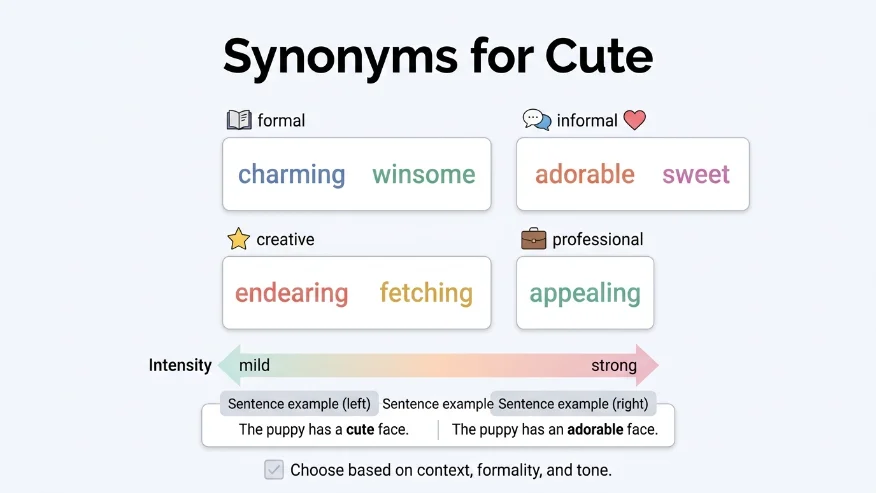
Cute describes someone or something attractive in an endearing, youthful, or charmingly small way. The best synonym for cute depends on context. For formal writing, choose charming or appealing. In casual conversation, adorable or sweet work best. For creative projects, try winsome or fetching.
Meaning, Tone and Context
Cute is an adjective that signals a specific kind of pleasant attractiveness. It often suggests smallness, playfulness, or a desire to protect or smile.
- Simple definition: Attractive or pretty in a youthful, charming, or endearing way
- Part of speech: Adjective (comparative: cuter, superlative: cutest)
- Tone: Usually positive and affectionate, but can sound condescending if used to describe an adult’s serious work or appearance
- Formality level: Informal to neutral; rarely appropriate in strict academic or serious business writing
- Common use cases: Describing babies, animals, small objects, playful fashion, quirky behaviors, and lighthearted social media content
- Important word forms: Noun (cuteness), adverb (cutely), opposite (ugly, unattractive)
When and How to Use “Cute”
Use cute when the subject has a light, youthful, or endearing appeal. It fits personal interactions, informal writing, and social media naturally. In professional or academic settings, a more precise synonym is almost always better.
Here are realistic examples labeled by context.
- Social media caption: This little café is hands down the cutest spot in the neighborhood.
- Personal text message: Your daughter’s giggle is so cute it made my whole day.
- Informal email to a friend: Saw the photos from your trip. That tiny seaside cottage looks incredibly cute.
- Describing a gesture: He left a handwritten note on my desk, which was a really cute thing to do.
- Fashion blog: The collection mixes cute pastel blazers with tailored trousers for a playful office look.
- Creative storytelling: Her cute habit of scrunching her nose when she laughed made everyone adore her.
- Product review: The new headphones have a cute compact design, but the sound quality is seriously impressive.
Another Word for “Cute”
The best single replacement for cute is often adorable when you mean heartwarming and lovable. For general attractiveness without the youthful edge, charming works beautifully.
Direct suggestions by situation:
- Professional writing: appealing, engaging, tasteful
- Academic writing: attractive in a restrained way, pleasant (use sparingly; often better to describe features factually)
- Casual conversation: adorable, sweet, lovely
- Emotional writing: endearing, heartwarming, lovable
- Creative writing: winsome, fetching, enchanting
- Resume or workplace use: personable, approachable, likeable (describing people); polished, smart, or sleek (describing things)
- Social media captions: adorable, stunning, precious, charming
- Stronger meaning: enchanting, irresistible, breathtaking
- Softer meaning: pleasant, sweet, agreeable
When Not to Use “Cute”
Cute becomes a weak word when precision matters. It can sound too vague, too casual, or even dismissive in serious contexts.
If you describe a business proposal as “cute,” it sounds condescending. Replacing it with “clever” or “well designed” shows respect. Calling a colleague’s presentation “cute” may undermine their professional effort. Using “polished” or “engaging” is far more appropriate.
In academic essays, writing “a cute outcome” is confusing. You probably mean a “pleasing result” or an “elegant solution.” On a resume, never describe your experience as “cute.” Instead, use “strong,” “notable,” or “valuable.”
Words Commonly Confused With “Cute”
These words often overlap with cute but carry different emphasis. Understanding the difference helps you choose the right word every time.
- Cute vs. Pretty: Pretty emphasizes delicate and pleasing appearance, often without the youthful smallness. A flower arrangement is pretty; a kitten is cute.
- Cute vs. Beautiful: Beautiful suggests a deeper, classic appeal. A stunning landscape is beautiful; a child’s handmade card is cute.
- Cute vs. Handsome: Handsome implies dignified and well proportioned attractiveness, mostly used for people. A well tailored suit looks handsome; a romper with polka dots looks cute.
- Cute vs. Gorgeous: Gorgeous means strikingly stunning and visually rich. A ball gown can be gorgeous; a casual sundress is more likely cute.
- Cute vs. Charming: Charming highlights personality based appeal, pleasant manner, or delightful character. A historic bookstore is charming; a tiny succulent plant is cute.
- Cute vs. Sweet: Sweet describes kindness, gentleness, and a pleasant emotional effect. A friend who brings you soup is sweet; the soup bowl may also be cute.
Best Synonym by Context for “Cute”
Use this table to quickly identify the right synonym based on where and how you are communicating.
| Context | Best Synonym | Why It Works | Example |
|---|---|---|---|
| Formal writing | Charming | Sophisticated yet warm; avoids childish tone | The hotel’s charming courtyard was the highlight of our stay. |
| Academic writing | Appealing | Objective and understated; suggests positive reception | The theory presents an appealing framework for further study. |
| Professional or business use | Engaging | Describes functional appeal without sounding unserious | We need an engaging visual design that still communicates trust. |
| Resume | Personable | Highlights likeable human qualities professionally | Described as personable and collaborative in client feedback. |
| Casual conversation | Adorable | Warm and natural; the go to substitute for cute in daily talk | Your puppy is absolutely adorable. |
| Creative writing | Winsome | Evokes innocent charm and pleasing liveliness | Her winsome smile could brighten any room in the novel. |
| Emotional tone | Endearing | Conveys heartfelt affection | His shy, endearing confession made everyone smile. |
| Strong intensity | Enchanting | Captures magnetic, almost magical appeal | The cottage garden was enchanting in the soft morning light. |
| Soft or moderate tone | Sweet | Gentle and low key; never overstates | That’s a sweet little note. Thanks for writing it. |
| Social media captions | Precious | Suggests something treasured and shareable | These precious moments deserve a permanent spot on the feed. |
| US usage | Cute | Most common and natural in American English | The diner is cute in that retro kind of way. |
| UK usage | Lovely | Often used in British English where Americans might say cute | What a lovely little teapot. |
Which Synonym Should You Choose?
Start by asking three questions. What are you describing: a person, an object, a behavior, or an idea? What is the level of formality required? Emotional weight do you want to carry?
If you are commenting on a baby photo with close friends, adorable or precious fits perfectly. For a LinkedIn article about office design, swap cute for appealing or tasteful. In a short story, let the character’s personality guide your choice: an enchanting garden feels different from a sweet little cottage.
Always match the intensity. Sweet and pleasant are light touches. Enchanting and irresistible carry strong admiration. Charming sits comfortably in the middle for most semi formal situations.
Real Life Examples of “Cute” in Sentences
School setting: The science fair poster with hand drawn frogs was the cutest entry, but the research behind it was seriously impressive.
Workplace email: The new intern created a highly engaging visual summary for the meeting. It made complex data feel surprisingly approachable.
Conversation: I love those earrings. They are simple but really charming.
Instagram story: Feeling cute in this vintage denim jacket.
Resume bullet: Known for a personable communication style that puts clients at ease.
Storytelling: In the middle of a tense scene, the author added an endearing detail about the detective’s mismatched socks.
Customer review: The laptop sleeve is adorable, but the padding could be thicker for travel.
25 Synonyms for “Cute”
This table provides 15 accurate synonyms with distinct meanings and natural examples.
| Synonym | Simple Meaning | Best Used For | Example Sentence |
|---|---|---|---|
| Adorable | Heartwarmingly attractive and lovable | Babies, pets, sweet gestures | The way he tilts his head is completely adorable. |
| Charming | Pleasantly attractive with a warm personality | People, places, manners | The guide had a charming way of telling local stories. |
| Sweet | Kind and pleasant, often more about personality | Gentle gestures, kind remarks | It was sweet of you to bring coffee for everyone. |
| Lovely | Beautiful in a graceful or enjoyable way | Scenery, objects, personalities | The garden looks absolutely lovely in June. |
| Pretty | Delicate and pleasing to look at | Physical appearance, decorations | She wore a pretty floral dress to the brunch. |
| Delightful | Highly pleasing and enjoyable | Experiences, surprises | The melody of the music box was truly delightful. |
| Endearing | Inspiring warmth and affection | Quirky habits, sincere behavior | His nervous laughter was the most endearing part of the speech. |
| Winsome | Attractive with innocent and cheerful charm | Literary descriptions, expressive faces | The protagonist’s winsome curiosity won over the villagers. |
| Appealing | Interesting and desirable | Designs, proposals, food presentations | The color palette makes the packaging very appealing. |
| Fetching | Attractive in a striking or noticeable way | Fashion, hairstyles | That hat is unexpectedly fetching on you. |
| Attractive | Pleasing to the senses or mind | General positive description | The deal looks financially attractive and low risk. |
| Engaging | Capturing interest and attention | Conversations, presentations | Her engaging storytelling style held the audience for an hour. |
| Pleasing | Giving a feeling of satisfaction | Overall pleasantness | The textures in the room created a pleasing aesthetic. |
| Lovable | Easy to love; inspiring affection | Pets, characters, kind people | The grumpy old man turned out to be surprisingly lovable. |
| Cherubic | Having a round, sweet, and innocent face | Describing children or angels in art | The cherubic toddler napped peacefully in the stroller. |
Synonym Groups and Usage Differences
Professional vs. Personal Synonyms
In personal settings, reach for adorable, sweet, or precious. These words carry emotional warmth and intimacy. In professional environments, stick with engaging, appealing, or personable. Describing a colleague as “personable” highlights their positive presence without sounding overly familiar. An “engaging” presentation means it held attention, while a “cute” presentation just sounds odd.
Formal vs. Conversational Synonyms
Formal writing demands charming, appealing, and tasteful. Conversational English thrives on cute, adorable, and sweet. For reports and essays, choose “the data presents an appealing pattern” over “a cute pattern.” In texts and casual emails, “Your cat is adorable” feels natural. Never force “winsome” into a WhatsApp message unless you are being humorous.
Academic Synonyms
Academic tone values precision and neutrality. Use appealing, notable, or pleasant sparingly, and always back them with explanation. Instead of “The hypothesis is cute,” write “The hypothesis offers an appealing starting point for analysis.” Avoid loaded terms like adorable or precious in research writing. They introduce subjectivity.
Professional and Business Synonyms
Emails, reviews, and presentations benefit from polished and credible vocabulary. Describing a product launch as “cute” can undermine its perceived value. Use smart, sleek, engaging, or tasteful. A resume describing “cute office decorations” sounds juvenile. “Designed a welcoming and visually engaging workspace” is professional and accurate.
Creative or Literary Synonyms
Creative writing opens space for winsome, enchanting, and fetching. These words add imagery, emotional depth, and a storytelling rhythm. A character can possess a “winsome smile,” while a setting feels “enchanting.” Such choices help your prose stand out and feel intentional.
Slang or Modern Synonyms
Terms like “cutesy” (overly cute, sometimes negative) and “adorbs” (playful slang for adorable) appear in captions and texts. “Cutesy” works to describe something that tries too hard. “Adorbs” is extremely casual. Use these only among friends or on fun social posts. Avoid them in any professional or academic context.
Strongest vs. Weaker Synonyms
Intensity scale from mild to strongest:
Mild: pleasant, sweet, appealing
Moderate: pretty, lovely, attractive
Strong: adorable, charming, delightful
Intense: enchanting, irresistible, breathtaking
Select the intensity that matches your genuine reaction. Reserve breathtaking for truly remarkable moments. Sweet fits small, kind gestures perfectly.
Emotional vs. Neutral Synonyms
Emotional synonyms like endearing, lovable, and precious carry affection and personal connection. Neutral synonyms like appealing, attractive, and pleasing describe positive qualities without deep emotional involvement. For a product review, “an attractive design” stays objective. For a letter to a close friend, “an endearing little tradition” warms the message.
Antonyms of “Cute”
This table lists 15 opposites that can help you describe the opposite effect.
| Antonym | Meaning | Example Sentence |
|---|---|---|
| Ugly | Unpleasant to look at | The abandoned building was ugly and crumbling. |
| Unattractive | Lacking appeal | The outdated interface made the app unattractive. |
| Repulsive | Causing strong dislike | The spoiled food had a repulsive odor. |
| Hideous | Extremely ugly | The accident left a hideous scar across the landscape. |
| Plain | Simple and without decoration | The dress was plain but elegantly cut. |
| Homely | Unattractive in a cozy or simple way | The homely furniture felt comfortable rather than stylish. |
| Grotesque | Distorted and unnatural in a disturbing way | The horror mask had a grotesque expression. |
| Unappealing | Not inviting or interesting | Gray walls made the room completely unappealing. |
| Unsightly | Visually unpleasant | The construction site was unsightly but temporary. |
| Monstrous | Shockingly ugly or huge | The monstrous statue dominated the tiny plaza. |
| Gross | Unpleasant and distasteful | Stepping in gum is a gross experience. |
| Displeasing | Causing dissatisfaction | The loud color combination was displeasing to visitors. |
| Unlovely | Not beautiful or pleasant | The storm left an unlovely mess in the garden. |
| Unpretty | Lacking typical prettiness | Her features were unpretty in the conventional sense but striking. |
| Unprepossessing | Not creating a favorable first impression | The unprepossessing storefront hid a wonderful bakery. |
Comparison: Cute vs. Similar Words
Cute vs. Pretty
Main difference: Cute emphasizes youthful, small, and endearing appeal; pretty emphasizes delicate and pleasing appearance.
Which one is stronger: Pretty can describe a broader range of beauty.
Which one is more formal: Pretty is slightly more neutral; cute is more casual.
Example for cute: The puppy’s clumsy steps were incredibly cute.
Example for pretty: The sunset painted the sky in pretty pastel shades.
Cute vs. Beautiful
Main difference: Beautiful conveys a deeper, more universal standard of attractiveness, while cute stays in the realm of charm and small scale appeal.
Which one is stronger: Beautiful is stronger and more formal.
Which one is more formal: Beautiful works in formal and literary contexts; cute does not.
Example for cute: The toddler’s outfit was cute with tiny embroidered stars.
Example for beautiful: The cathedral’s architecture is absolutely beautiful.
Cute vs. Charming
Main difference: Charming often involves personality, manner, or an old world appeal; cute focuses on visual or behavioral adorableness.
Which one is stronger: Both can be strong in different ways; charming feels more sophisticated.
Which one is more formal: Charming is more appropriate in semi formal and formal writing.
Example for cute: The bunny’s nose twitching was unbelievably cute.
Example for charming: The host was charming and made everyone feel at home.
Cute vs. Sweet
Main difference: Sweet refers to kindness and pleasant emotional quality, while cute refers to appearance or endearing behavior.
Which one is stronger: Neither is inherently stronger; sweet can be deeply emotional.
Which one is more formal: Sweet is slightly more flexible across contexts.
Example for cute: The miniature pumpkin decoration looked so cute.
Example for sweet: Her sweet message made a tough day much better.
Cute vs. Adorable
Main difference: Adorable intensifies the warmth and lovability. Almost everything adorable is cute, but not everything cute reaches the level of adorable.
Which one is stronger: Adorable is stronger and more heartfelt.
Which one is more formal: Neither is formal; both are personal and informal.
Example for cute: That beanie is cute.
Example for adorable: The way the baby clapped her hands was absolutely adorable.
Cute vs. Lovely
Main difference: Lovely often implies grace, warmth, and a broader sense of enjoyment, especially in UK English. Cute is narrower and more tied to youthful charm.
Which one is stronger: Lovely can feel more elegant.
Which one is more formal: Lovely is more acceptable in semi formal contexts.
Example for cute: The ceramic hedgehog figurine is cute.
Example for lovely: The violinist played a lovely melody that silenced the room.
Common Phrases and Expressions with “Cute”
These common expressions show how cute functions in everyday language.
- Cute as a button
Meaning: Extremely cute and charming, often used for small children or tiny objects.
Example sentence: Her new baby sister is as cute as a button in that strawberry onesie. - Cute overload
Meaning: An overwhelming amount of adorableness.
Example sentence: The video of puppies learning to howl gave me complete cute overload. - Cute couple
Meaning: A romantic pair that looks good together or acts adorably.
Example sentence: They are such a cute couple in their matching holiday pajamas. - Act cute
Meaning: To behave in a way meant to appear endearing or attract attention, sometimes artificially.
Example sentence: Don’t just act cute during the meeting; share your actual ideas. - Cute meet
Meaning: A term from romantic comedies describing an adorable first encounter between future partners.
Example sentence: Their cute meet involved spilled coffee and a forgotten umbrella. - Cute aggression
Meaning: The urge to squeeze, pinch, or tightly hug something because it is overwhelmingly cute.
Example sentence: Seeing that fluffy kitten triggered serious cute aggression. - Cute factor
Meaning: The quality or degree of adorableness something has.
Example sentence: The handmade bow increased the gift’s cute factor dramatically.
Common Mistakes to Avoid
Steer clear of these common errors to keep your vocabulary sharp and situation appropriate.
- Using cute in formal reports. Replacing cute with appealing or well designed maintains credibility.
- Calling an adult’s professional outfit cute. It can sound dismissive. Choose polished or stylish instead.
- Overusing cute in product reviews. Specific words like compact, sleek, or visually pleasing add more value for readers.
- Using adorable interchangeably with handsome. Calling a tuxedo adorable misses the mark. A tuxedo can be sharp or elegant.
- Choosing cutesy in academic writing. Cutesy is highly informal and often carries a negative, try hard connotation.
- Mixing up sweet and cute when describing personality. A person can be sweet and not physically cute. A gesture can be cute without being emotionally sweet.
- Assuming lovely means cute in US English. Lovely is understood but can feel slightly formal or British. Stick with cute or adorable for casual American conversation.
- Forcing slang like adorbs in a cover letter. This instantly damages your professional image. Reserve it for private messages.
FAQs
What is the best synonym for cute?
The best synonym depends on context. Adorable works in casual and emotional moments. Charming fits formal and semi formal situations naturally.
What is a formal synonym for cute?
Charming is the most adaptable formal synonym. Appealing and tasteful are also excellent choices for reports, essays, and professional descriptions.
What is an informal synonym for cute?
Adorable and sweet are the most common informal synonyms. Precious adds extra warmth in friendly conversation and social media captions.
What is another word for cute in professional writing?
Engaging, appealing, and tasteful replace cute in business emails, presentations, and resumes without losing a positive, approachable tone.
What is the difference between cute and pretty?
Cute suggests youthful, small, or endearing attractiveness. Pretty describes delicate and visually pleasing features without implying smallness or youthful charm.
What is the opposite of cute?
The most direct opposite is ugly or unattractive. In specific contexts, plain, unsightly, or unappealing may serve as more accurate antonyms.
Conclusion
Cute is a warm, versatile word for anything attractively youthful, small, or endearing. But knowing synonyms for cute turns a repetitive vocabulary into an expressive asset. Match your word to the situation charming for professional polish, adorable for personal warmth, winsome for creative flair.
One practical tip: every time you type cute, pause and ask if the subject is youthful, beautifully small, or simply pleasing. Choosing the precise synonym makes your communication stronger and more authentic.