Neurodivergent is one of those words that suddenly seems to be everywhere: in job adverts, school meetings and first-person essays. Yet many people meet it without a clear sense of what it actually covers.
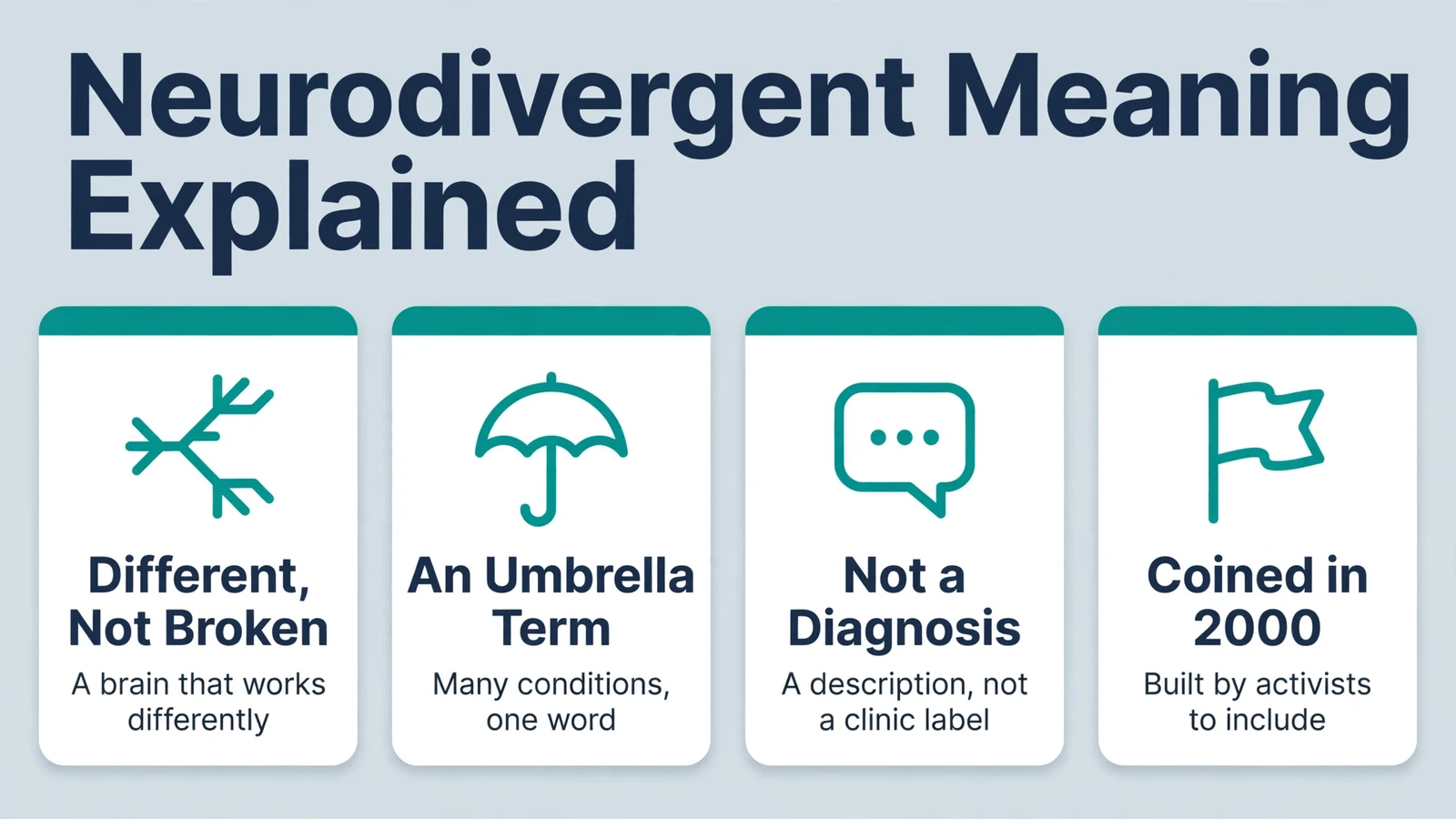
In plain terms, neurodivergent describes a person whose brain develops or works differently from what society treats as typical. The Cleveland Clinic calls it a nonmedical umbrella term for people whose brain differences give them a different mix of strengths and challenges. It is not a diagnosis, and it is not a synonym for autistic.
This guide explains the meaning carefully. It draws on dictionary definitions, clinical explainers and the word’s own short history, from an activist’s coinage in 2000 to everyday use today. It also shows how to use the word well.
What Does Neurodivergent Mean?
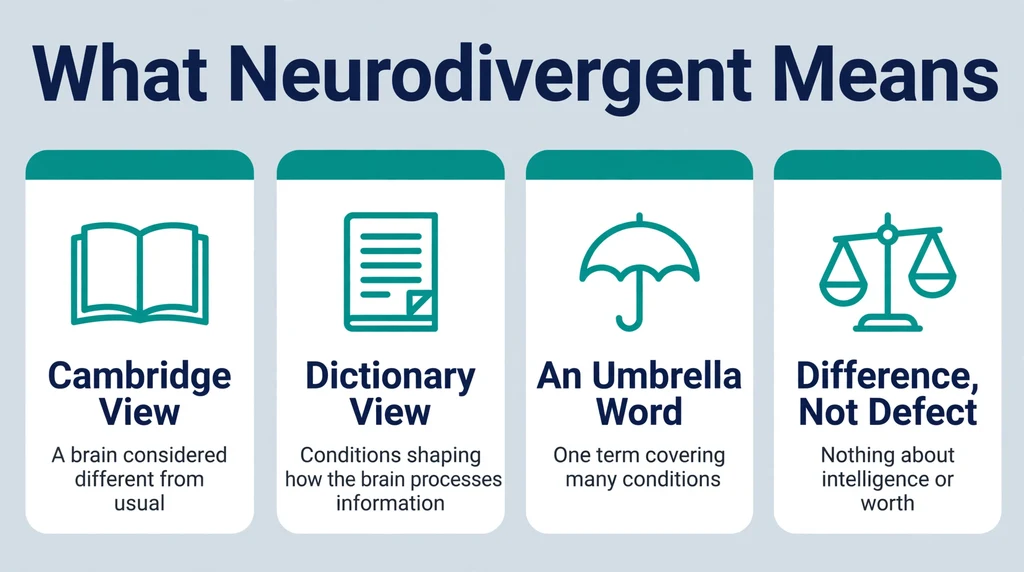
The Cambridge Dictionary defines neurodivergent as having or relating to a type of brain that is often considered different from what is usual. Its example points to the brain of someone who has autism. The definition is deliberately broad, because the word works as an umbrella.
Merriam-Webster gives a more clinical version. It defines the word as having or relating to a condition, such as autism, ADHD, dyslexia or obsessive-compulsive disorder, that affects how the brain processes information. Both dictionaries circle the same core idea. A neurodivergent person’s mind diverges from the expected pattern.
Three points in those definitions matter. First, the word describes difference, not defect. Second, it covers many conditions under one label. Third, it says nothing about intelligence. A neurodivergent person may have any level of intellectual ability.
The divergence itself can show up in many places. It may affect learning, attention, sensory processing, communication, movement or mood. As a result, two neurodivergent people can look very different from each other. That variety is built into the word.
Writers use the word in a few set patterns. It works as an adjective before a noun, as in neurodivergent students or a neurodivergent brain. It also stands alone, in phrases such as she is neurodivergent. Merriam-Webster even records it as a noun, with the plural neurodivergents, though the adjective remains the safer choice in formal writing.
Where the Word Comes From
Two Simple Parts
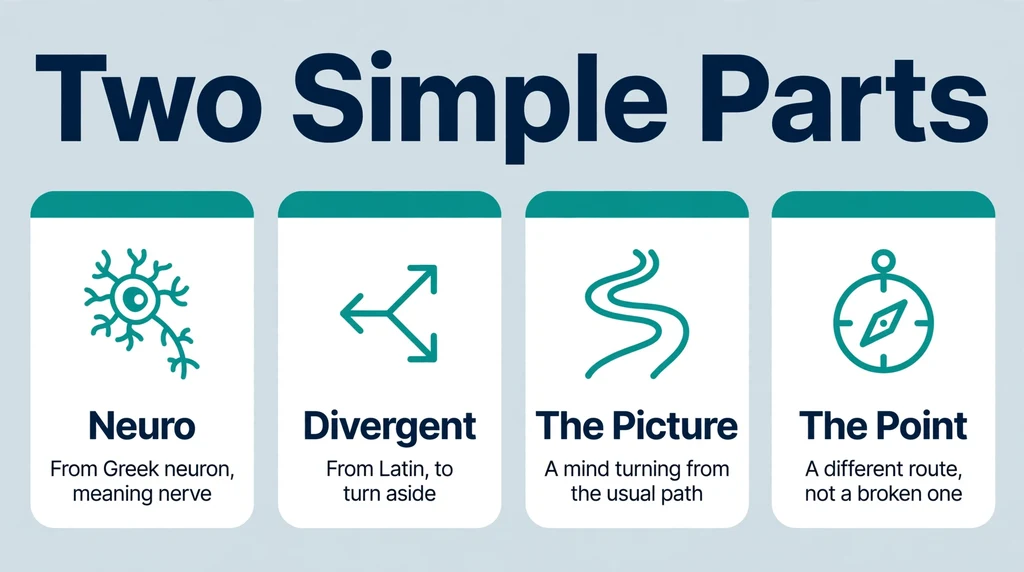
The word joins two simple parts. The first part, neuro, comes from the Greek word neuron, meaning nerve. In modern words it points to the brain and nervous system. The second part, divergent, comes from a Latin verb meaning to turn aside.
Merriam-Webster lists the etymology plainly as neuro plus divergent. Put together, the word pictures a mind that turns away from the usual path. It does not picture a mind that is broken. That built-in neutrality is one reason the word spread so well.
Notice, too, what the word quietly assumes. Divergent always raises a question: divergent from what? The answer is not a law of biology. It is the pattern set by the majority, and by the schools, offices and habits built around that majority. The word therefore points at a relationship, not just at a brain.
How to Say It and Its Word Family
Most speakers say the word as nyoor-oh-dy-VER-junt, with the stress on the third syllable. The noun form is neurodivergence, which names the state of being neurodivergent. A person with several kinds of divergence can be described as multiply neurodivergent.
Online, the word often shrinks to the initials ND. Writers use the abbreviation in profiles, forums and community spaces. In formal documents, the full word is clearer for readers meeting it the first time.
The wider family matters more, though. Neurodivergent belongs to a small set of related terms built in the same years. The next section separates those terms, because people mix them up constantly.
Neurodivergent, Neurotypical, and Neurodiverse: The Key Differences
Neurotypical: The Other Side of the Line
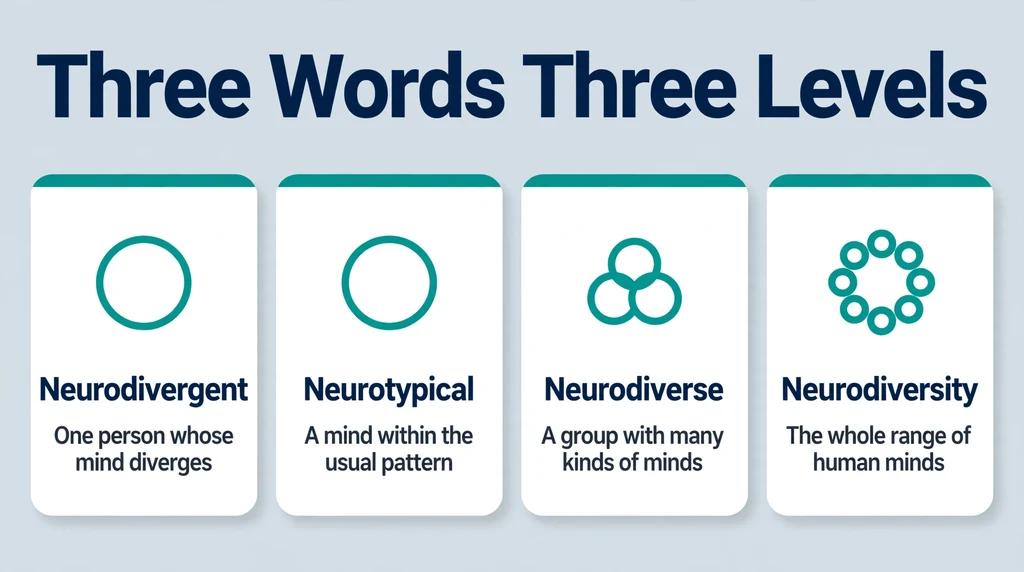
Neurotypical is the matching opposite. Scholar and writer Nick Walker defines it as having a style of mind that falls within the dominant social standards of normal. In everyday use, it simply means not neurodivergent.
The word typical here means statistically common. It does not mean better, healthier or more correct. It only marks the pattern that schools, offices and social rules were mostly designed around. Everyone else has to adapt to those settings, which is exactly the friction the vocabulary was built to describe.
A narrower cousin exists as well. Allistic means simply not autistic. Every autistic person is neurodivergent, but a person with ADHD alone is neurodivergent without being autistic, so they are allistic too. The distinction sounds fussy. In careful writing about autism specifically, it prevents real confusion.
Neurodiverse Describes Groups, Not People
Here is the distinction that trips up even careful writers. A person is neurodivergent, but a group is neurodiverse. A classroom, family or team is neurodiverse when its members have a mix of different kinds of minds.
Walker states the rule bluntly: there is no such thing as a neurodiverse individual. An individual can diverge, but an individual cannot be diverse. Diversity is a property of a collection, not of one person.
The Cambridge Dictionary quietly backs this up. It notes that calling one person neurodiverse is sometimes considered incorrect, because only groups of people can be diverse. People still use it that way in casual speech, but careful writing keeps the two words apart.
A quick correction shows the pattern. The phrase “a neurodiverse student” should read “a neurodivergent student”. By contrast, “a neurodiverse student body” is correct as it stands. One swap of a single word fixes most errors in drafts and job adverts.
Neurodiversity Is the Whole Picture
Neurodiversity is the biggest term of the three. It names the full range of human minds, neurotypical and neurodivergent together. Walker describes it as a biological fact, the natural variation in how human brains work.
The comparison with biodiversity is deliberate. A forest needs many species to stay resilient. Singer’s generation argued that human communities likewise contain many kinds of minds by design, not by accident. The analogy does not prove anything by itself. It does explain why the word diversity, rather than disorder, anchors the whole family of terms.
So every society is neurodiverse, because every society contains many kinds of minds. No single person, however, is neurodiversity. Keeping the three levels straight, person, group and whole species, makes the whole vocabulary easy to use correctly.
A Brief History of the Word

The 1990s: A New Idea Takes Shape
The story starts inside the autistic rights movement. In 1993, advocate Jim Sinclair gave a speech called “Don’t Mourn for Us”. It argued that autism is a way of being, not a shell hiding a normal person. That idea became a foundation stone for what followed.
By the middle of the decade, autistic activists were developing the idea together online. They gathered on the Independent Living mailing list, known as InLv. The phrase neurological diversity circulated there from about 1996. Journalist Harvey Blume, a list member, wrote about neurological pluralism in The New York Times in 1997.
Then, in 1998, the shorter word neurodiversity reached print twice. Blume used it in The Atlantic. Australian sociologist Judy Singer used it in her sociology honours thesis the same year. Singer is often called the person who coined the term. Recent scholarship, including work by Botha and colleagues in 2024, argues the credit belongs to the whole online community that built the idea together.
Singer’s own position helps explain the community roots. She has described herself as likely somewhere on the autistic spectrum. Her thesis grew directly out of those mailing list discussions, which included Blume himself. The word was a group product before it was ever a book credit.
2000: A Word for the Individual
Neurodiversity described the whole human range, but the movement still lacked a word for one person. Around 2000, activist Kassiane Asasumasu filled that gap. She coined neurodivergent and neurodivergence.
Her definition covered anyone whose mind works in ways that diverge from dominant social norms in multiple ways. The inclusive intent was the point. Asasumasu said the term should include people, not shut them out. It was never meant to be a prize for one diagnosis only.
The coiner spoke from inside the group she was naming. Asasumasu is autistic and describes herself as multiply neurodivergent. Her writing came from community organising, not from a clinic or a university department. That origin explains the word’s practical, welcoming tone.
She later described the word as specifically a tool of inclusion. That phrase captures its design. The umbrella was built wide on purpose, so that nobody had to win an argument about categories before joining the conversation.
Merriam-Webster records the first known use of neurodivergent in 2002. The word then travelled slowly through blogs, forums and advocacy writing. For its first decade, most people never met it at all.
The 2010s and 2020s: Into Everyday Speech
During the 2010s, the word moved from activist circles into universities and human resources departments. Researchers adopted it, and so did workplace inclusion programs. Psychologist Nancy Doyle used the related idea of neurominorities in a widely cited 2020 paper in the British Medical Bulletin.
The real surge came with the pandemic. NPR reported that searches for the word took off in June 2020, during widespread lockdowns. People were reassessing work, school and their own minds at home. Since then, the word has stayed in everyday use across media, medicine and social platforms.
Institutions have started writing the vocabulary down. Health services now publish language guides built on these definitions. An NHS trust in Belfast, for example, uses Walker’s terms in its guidance on neuro-affirmative language for staff. Words that began on a mailing list now shape official documents.
Which Conditions Count as Neurodivergent?
The Commonly Listed Conditions
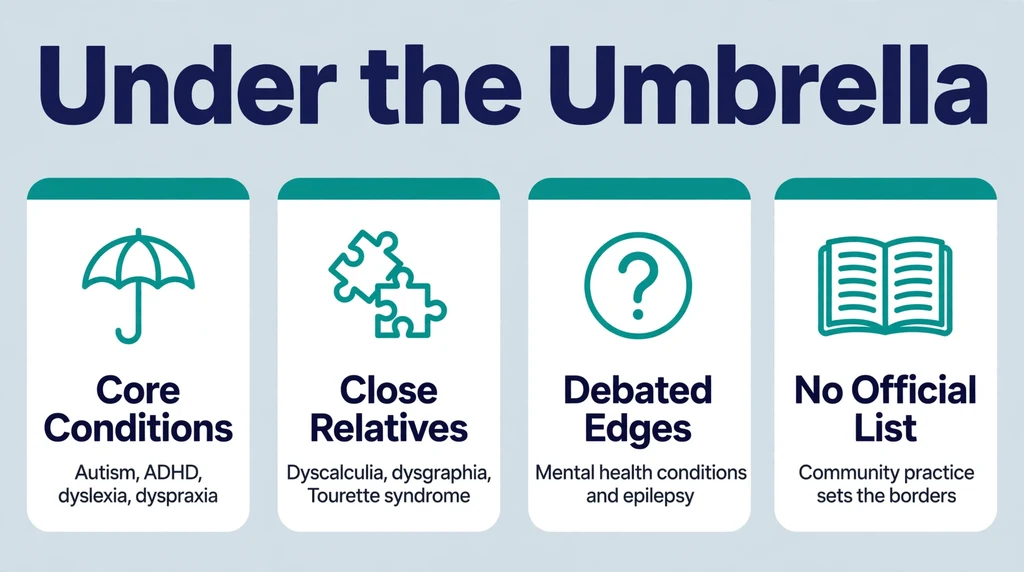
Because the term is an umbrella, it has no official membership list. Still, clinical explainers tend to name the same core group. The Cleveland Clinic lists autism spectrum disorder, ADHD, dyslexia and dyspraxia among the most common. It also includes intellectual disabilities and sensory processing disorders.
Other widely used lists add close relatives of those conditions. Dyscalculia affects number skills, and dysgraphia affects writing. Tourette syndrome involves involuntary tics. Developmental coordination disorder, the formal name behind dyspraxia, affects movement and coordination.
AuDHD shows how the umbrella handles overlap. The community coinage describes people who are both autistic and have ADHD. Many neurodivergent people hold more than one diagnosis. Others hold none, a point the next sections return to.
Overlap is the rule rather than the exception. Conditions on the list frequently appear together in the same person. Lists also vary slightly from source to source. The stable part is the shared centre, and that centre is what the word reliably means in practice.
The Debated Edges of the Umbrella
The borders of the umbrella are genuinely debated. Mental health conditions sit at the centre of that debate. Some writers include anxiety, depression, obsessive-compulsive disorder, bipolar disorder and schizophrenia. Others restrict the word to lifelong neurodevelopmental conditions only.
Asasumasu’s own list was broad. She explicitly included epileptic people and people with mental illnesses. She also named conditions such as multiple sclerosis and cerebral palsy. Some modern usage, however, normally excludes those physical neurological conditions. Both readings exist in print, so honest writers attribute the choice instead of hiding it.
Epilepsy is a useful test case. It appears in many community lists and in the coiner’s own words. Yet some clinical lists leave it out. The disagreement itself tells you something true about the word. Its edges are set by community practice, not by any medical authority.
For writers, the practical lesson is simple. When precision matters, name the specific condition instead of relying on the umbrella. The umbrella works best for talking about shared experience across conditions.
Born This Way, or Acquired Later?
Most core examples are lifelong. Autism, ADHD and dyslexia are present from early development, even when nobody spots them until adulthood. But the umbrella can also cover change that arrives later in life.
Walker includes neurodivergence produced by experiences that alter the brain. Doyle’s taxonomy has a matching category called acquired neurominority. It covers brain injury and neurological illness, and sometimes serious mental ill health. A person can therefore become neurodivergent, in this wider reading, after an accident or illness.
Not everyone accepts that wider reading. Some prefer to keep the word for developmental differences alone. Either way, the debate concerns the umbrella’s edge. Its centre, the developmental conditions, is agreed by nearly everyone.
The category of multiply neurodivergent bridges the two camps. It can describe someone born autistic who later acquires a brain injury. Their divergence then has both an innate and an acquired layer, and the vocabulary handles that without strain.
Neurodivergent Is Not a Diagnosis
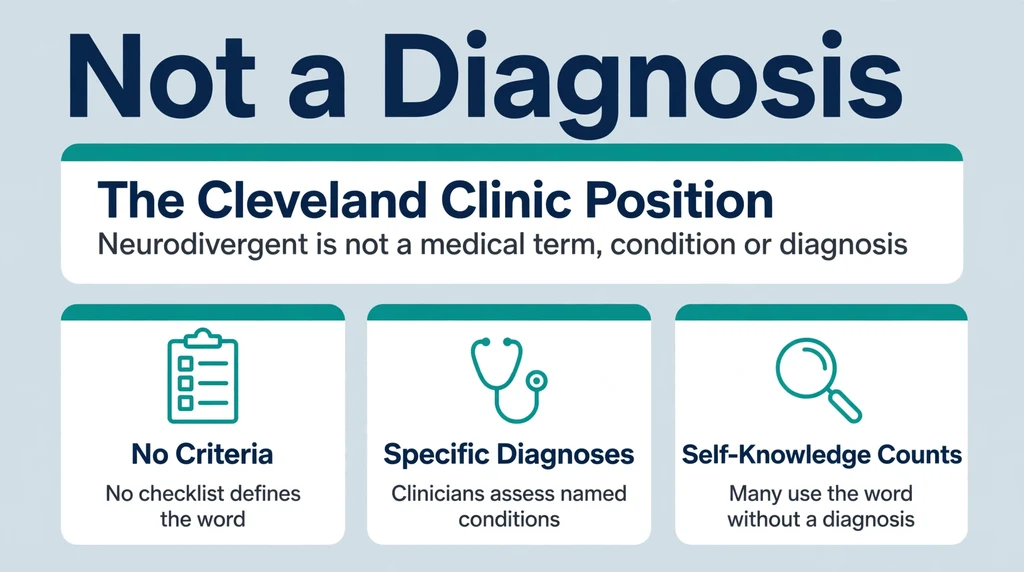
This point deserves its own section, because confusion here is common. The Cleveland Clinic states it directly: neurodivergent is not a medical term, condition or diagnosis. No doctor can diagnose you as neurodivergent. There are no medical criteria for it.
Diagnoses attach to specific conditions instead. A clinician can assess someone for autism, ADHD, dyslexia or another named condition. Each of those has its own criteria and its own process. Neurodivergent sits above them as a description, not inside the clinic as a label.
That is why self-identification plays a real role. Many adults recognise their own patterns long before any assessment, and waiting lists for assessment can run to years. Some people use the word with a formal diagnosis behind it. Others use it as the best available description of their experience, without one.
The word also cannot do a clinic’s job. It does not unlock medication, therapy or legal accommodations by itself. Those usually depend on specific diagnoses or documented needs. Used honestly, though, it often gives people the language to start asking sharper questions.
Clinicians themselves use the word more each year. A major clinic, Cleveland Clinic, explains neurodivergence to patients on its own health pages. The word lives in conversation and education. The chart, meanwhile, records the specific conditions it covers.
Finding Out Later in Life
Why Many Adults Are Missed
A large share of neurodivergent adults were children nobody flagged. Some did well at school, so nobody looked further. Others masked, as the section on masking below describes, and their effort hid the evidence.
Doyle’s research highlights one pattern in particular. Girls and women have historically been underdiagnosed. Their difficulties were often read as anxiety, depression or eating problems instead. The underlying neurodivergence then went unnamed for years, sometimes for decades.
Adults often start the search themselves. A child’s diagnosis can prompt a parent to recognise the same traits at home. Books, interviews and community writing give others the vocabulary first. The word neurodivergent frequently arrives before any appointment does.
What Changes After the Realisation
For many people, the discovery reorganises the past. School reports, lost jobs and social confusion acquire a new explanation. The change is often described as relief rather than grief. A pattern replaces a personal failing.
Practical changes follow as well. People request adjustments at work, or redesign their routines at home. Some pursue formal assessment, for the reasons the diagnosis section gives. Others stop there, content with a word that finally fits. Both responses are common, and the vocabulary supports each of them.
The Idea Behind the Word: Two Ways of Seeing Difference
The Neurodiversity Paradigm
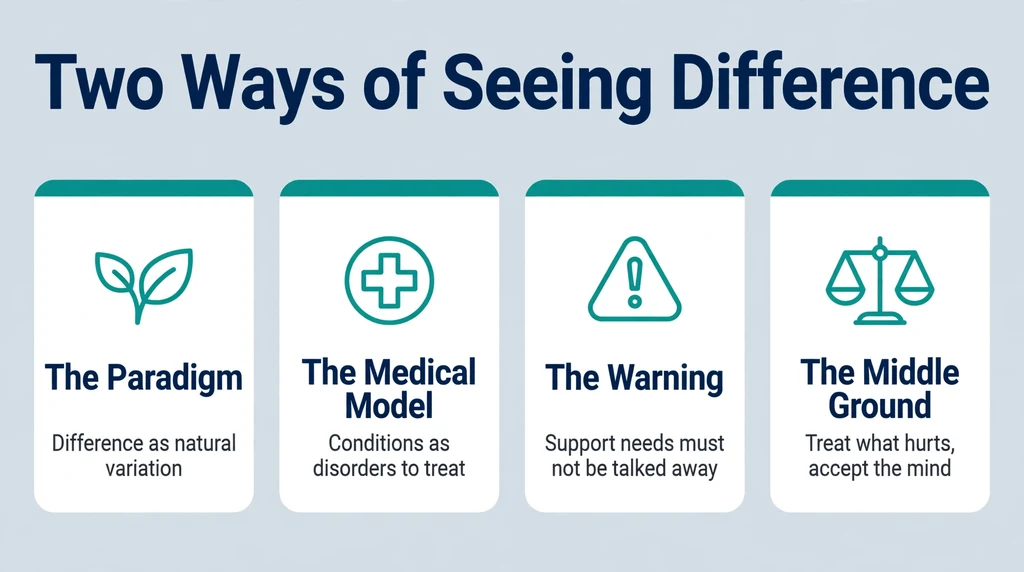
The word carries an idea with it. The neurodiversity paradigm holds that differences in brains are a natural part of human variation. Supporters often compare it with biodiversity. An ecosystem is healthier with many species, and a society contains many kinds of minds.
Under this view, much of the difficulty comes from a poor fit. A noisy open-plan office, a timed exam or an unwritten social rule can disable someone whose mind works differently. Change the setting, and the same person may do very well. The paradigm therefore pushes for acceptance and practical adjustments, not only treatment.
Singer framed the idea as a claim about social categories. In summaries of her work, neurodiversity sits alongside other forms of human difference that societies must learn to recognise. The point was political as well as scientific. Recognition changes what institutions feel obliged to provide.
The Medical Model and the Middle Ground
The older medical model reads the same facts differently. It treats conditions as disorders located inside the person. Its tools are diagnosis, treatment and, where possible, cure. For many people, those tools are genuinely valuable.
Critics of the paradigm raise a fair warning. Some conditions involve real suffering and high support needs, and those should not be talked away. The Cleveland Clinic notes this opposition, and it also notes the research finding that follows. People who learn the neurodiversity idea do not usually deny their struggles. Instead, they use the idea to adapt and to aim higher.
Many clinicians and families now work in the middle. They treat what needs treating, such as anxiety or sleep problems. At the same time, they accept the person’s basic way of thinking. The word neurodivergent fits that middle ground well.
The two vocabularies can even share one sentence. A person can say that their ADHD is a condition they treat, and that they are neurodivergent, without contradicting themselves. The first statement is medical. The second is about identity and fit.
What Being Neurodivergent Can Look Like
No single portrait fits, but some patterns recur. Psychologist Nancy Doyle describes spiky profiles, drawing on David Grant’s term. A spiky profile means large gaps between a person’s strongest and weakest abilities. Someone may write brilliantly yet struggle to organise a simple schedule.
Sensory experience often differs too. Sounds, lights, textures or smells can register far more intensely than they do for others. The Cleveland Clinic uses everyday design as an example, such as crosswalks that beep for people with vision problems. Small design choices can include people or shut them out.
Focus can swing in both directions. Some neurodivergent people scatter their attention under distraction. The same people may lock into deep, hours-long focus on a subject that grips them. Social communication styles differ as well, in eye contact, small talk and how directly someone speaks.
Strengths appear in the research too. The Cleveland Clinic notes that people with dyslexia are often better at picturing three-dimensional objects. That skill suits fields such as design, art and engineering. Difference cuts both ways, bringing costs in one setting and advantages in another.
The community has a saying for all this variety. If you have met one neurodivergent person, you have met one neurodivergent person. It adapts a line about autism that is commonly attributed to advocate Dr Stephen Shore. The point is simple: never assume two people under the umbrella are alike.
Masking and the Cost of Fitting In
Many neurodivergent people learn to hide their natural responses. The community calls this masking. It means suppressing traits, or copying expected behaviour, in order to pass as neurotypical.
Masking takes many small forms. Someone may force eye contact while it feels uncomfortable. Another person may rehearse conversations in advance and laugh on cue. Others hold in movements such as rocking or hand flapping, or swallow tics until they are alone.
Engineering and workplace guidance describes the cost plainly. Masking demands constant conscious effort. Held over a long day, it can drain energy and harm wellbeing and mental health. Many people describe arriving home exhausted from a performance nobody noticed.
Masking also explains a common misunderstanding. A person who masks well may not look neurodivergent to colleagues or teachers. Their difficulties then surface in private, where the effort stops. The word matters here, because it names the person and not only the moments when difference becomes visible.
Common Misconceptions About the Word
“It Just Means Autistic”
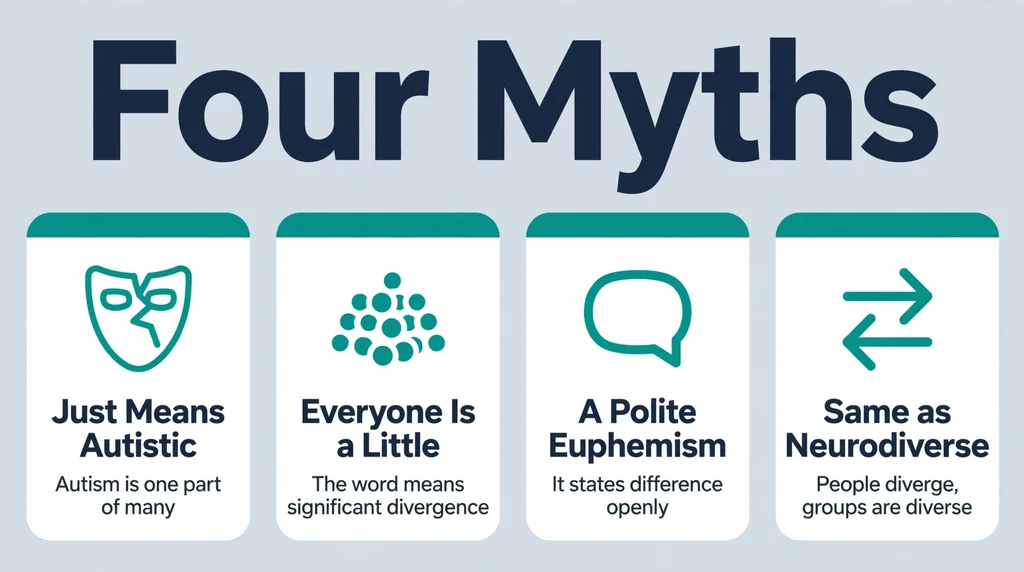
Autism is the most visible part of the umbrella, but it is only one part. ADHD, dyslexia, dyspraxia, Tourette syndrome and more sit under it too. Using neurodivergent as a coded word for autistic erases those people. It also misleads readers about what a sentence actually says.
The reverse mistake happens too. Readers may assume any neurodivergent person they meet must be autistic. That assumption leads to wrong guesses about their needs, their strengths and their history.
“Everyone Is a Little Bit Neurodivergent”
This claim sounds kind, but it blurs the word’s meaning. Neurodiversity includes everyone, because it names the whole human range. Neurodivergent is narrower. In Walker’s definition, it describes minds that diverge significantly from dominant norms. Ordinary bad days and personal quirks do not meet that bar, and saying so respects the people the word was built for.
A kinder version is available, and it happens to be accurate. Every mind is unique is true. That claim, however, belongs to neurodiversity, not to neurodivergence.
“It Is a Polite Euphemism for a Diagnosis”
Some readers suspect the word is just a softer label for a disorder. It is not. The term came from activists who wanted to describe difference without calling it damage. A diagnosis names a specific medical condition. Neurodivergent names a relationship between a mind and social expectations, which is a different claim entirely.
Euphemisms exist to hide uncomfortable facts. This word was designed to state its fact openly. That openness is why many people prefer it to vaguer labels.
“Neurodiverse and Neurodivergent Are Interchangeable”
They are not, as the comparison section showed. One person diverges; a group is diverse. Swapping them produces sentences that confuse careful readers and annoy many community members. The fix costs nothing. Use neurodivergent for individuals and neurodiverse for groups.
The commonest public error runs the other way. Job adverts often announce that they welcome neurodiverse candidates. The candidates they mean are neurodivergent. The advertiser’s own workforce, if mixed, is the neurodiverse thing in the sentence.
How to Use the Word Respectfully
Follow the Person’s Own Language
The safest rule is simple. Use the word for people who use it for themselves. Some people embrace it as an identity. Others prefer the name of their specific condition. A few dislike the term altogether, and their preference wins in conversation about them.
A related choice is identity-first versus person-first language. Many autistic people prefer identity-first wording, such as autistic person, because they see autism as part of who they are. Others prefer person with autism. Community guidance gives the same answer in both cases. Ask, or mirror the words the person already uses.
Avoid diagnosing people from the outside. Calling a colleague neurodivergent because they seem quirky is a guess dressed as a label. If the topic matters, talk about the need instead. Quieter space, written instructions and clearer deadlines help without any label at all.
One more habit is worth building. Describe support needs rather than ranking people. Labels such as high functioning and low functioning are widely criticised inside the community. They hide more than they reveal, because the same person can cope well in one setting and badly in another.
Sentences That Use It Well
Good usage is usually plain and specific. For example: “Our hiring team welcomes neurodivergent applicants and offers interview questions in advance.” The sentence names a real adjustment, not just a warm feeling.
A teacher might write: “This class includes neurodivergent students, so instructions go on the board as well as out loud.” Here the group word would also work, but neurodivergent students correctly describes the individuals. Compare that with: “Our school is proudly neurodiverse,” which correctly describes the whole community.
Notice what none of these sentences do. None uses the word as a compliment or an insult. None treats it as a diagnosis. Each one simply locates a person or group accurately, and then gets on with the practical point.
Health settings offer another model. A clinic might promise that neurodivergent patients can book longer appointments and receive written summaries afterwards. The sentence informs rather than decorates. Readers learn exactly what will happen, and trust builds from the detail.
Neurodivergent at School and Work
The word now does practical work in policy. Doyle’s 2020 review argued that workplaces should design for neurominorities, who make up a significant minority of staff. Her research put that share at roughly 15 to 20 percent of the population. Treat that figure as an informed estimate, not a headcount.
In practice, adjustments are often cheap and concrete. Employers offer written follow-ups after meetings, quieter desks, noise-cancelling headphones or flexible hours. Schools provide instructions in more than one format, extra processing time or calmer exam rooms. Some shops run sensory-friendly hours with lower lights and no background music.
Official guidance is catching up with the practice. The European Agency for Safety and Health at Work now discusses neurodiversity in its workplace materials. It repeats the same estimate of roughly one in five people. A movement’s vocabulary has become a planner’s number.
These changes share one logic. They alter the environment instead of demanding that one kind of mind imitate another. That is the neurodiversity idea doing its original job. It turns a vocabulary word into fairer rooms, timetables and expectations.
Frequently Asked Questions
What is the simple meaning of neurodivergent?
It means that a person’s brain works differently from what society considers typical. The difference may involve learning, attention, senses, communication or movement. It is a description of difference, not a judgment of worth.
Think of it as an umbrella rather than a single label. Many different conditions and profiles shelter under it. The word tells you the direction of the difference, away from the typical, without claiming every person under it is the same.
Is neurodivergent a medical term or a diagnosis?
No. The Cleveland Clinic is clear that neurodivergent is a nonmedical term. It is not a condition, and no clinician diagnoses it. Diagnoses apply to specific conditions, such as autism or ADHD, which sit under its umbrella.
What is the difference between neurodivergent and neurodiverse?
An individual is neurodivergent. A group is neurodiverse when its members have different kinds of minds. One person cannot be diverse, because diversity describes a mix. Neurodiversity, the third word, names the full range of human minds.
Which conditions are considered neurodivergent?
The commonly listed ones are autism, ADHD, dyslexia, dyspraxia and Tourette syndrome. Lists often add dyscalculia, dysgraphia, intellectual disabilities and sensory processing disorders. The edges are debated, especially around mental health conditions and epilepsy.
Can someone be neurodivergent without a diagnosis?
Yes. The term describes how a mind works, not a piece of paperwork. Many people use it through self-identification, sometimes while waiting for assessment. Formal diagnosis still matters for treatment and legal accommodations, which depend on named conditions.
Who coined the word neurodivergent?
Activist Kassiane Asasumasu coined neurodivergent and neurodivergence around 2000. She built them to be inclusive tools for anyone whose mind diverges from dominant norms. The older word neurodiversity had reached print two years earlier, in 1998.
Is it okay to call someone neurodivergent?
It is fine when the person uses the word for themselves. Mirror their language, and do not apply the label to someone who has not claimed it. If you are unsure, describe the practical need or preference instead of guessing at an identity.
How many people are neurodivergent?
Nobody has an exact count, because the term has no medical criteria. Psychologist Nancy Doyle estimated in 2020 that neurominorities form about 15 to 20 percent of the population. That widely repeated figure is an estimate built from the prevalence of the individual conditions.
Final Thoughts
Neurodivergent is a young word with a precise job. It describes a person whose mind diverges from social norms, without calling that mind broken. Used carefully, it separates the person from the group, the description from the diagnosis, and difference from defect.
The word also carries a short, traceable history. Activists built it in the 1990s, Asasumasu named it in 2000, and dictionaries and clinics now record it. If you want the clinical picture in more depth, the Cleveland Clinic’s overview of neurodivergence is a reliable next read. For everyday writing, the rule from this guide is enough: neurodivergent for people, neurodiverse for groups, and respect for the words people choose for themselves. Follow those three habits, and you are using the word the way its makers intended.