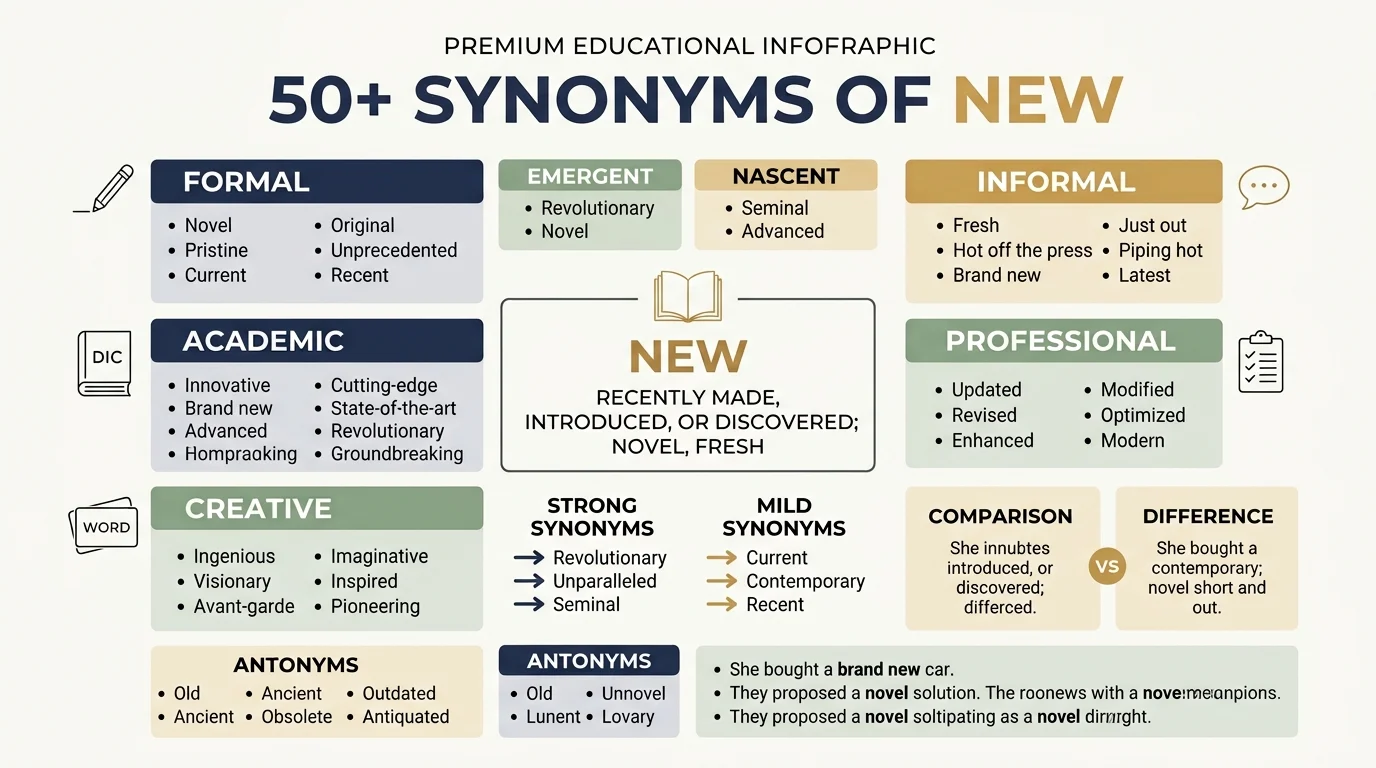
Have you ever written an email, essay, or social media post and realized you used the word “new” three times in two sentences? It happens to everyone. You want to describe something fresh, original, or recently created, but repeating the same word makes your writing feel flat and uninspired. Finding the right synonyms of new can transform your communication from repetitive to remarkable.
The word “new” is one of the most common adjectives in English. It describes anything that has recently come into existence, been discovered, or been acquired. While it works perfectly in many situations, relying on it too often weakens your writing. The best writers and speakers know that choosing precise synonyms makes their message clearer, more engaging, and more professional.
This guide will help you understand the meaning of “new,” explore its best synonyms, and learn exactly which word to use in every situation. Whether you are writing a resume, crafting a business email, working on an academic paper, or posting on social media, you will find the perfect alternative.
What Are the Best Synonyms of “New”?
“New” describes something recently created, discovered, or introduced. It is a neutral adjective with broad applications. Formal writing, use “novel” or “innovative.” For casual conversation, try “fresh” or “brand new.” For academic contexts, “original” or “recent” work well. Professional communication, “modern” or “cutting edge” are excellent choices.
Meaning, Tone, and Context
Simple Definition
New means something that has not existed before, has been recently made or discovered, or is different from what came before it.
Part of Speech
Adjective. It can also function as an adverb in informal expressions like “new improved.”
Overall Tone
Neutral. The word itself does not carry strong positive or negative emotional weight. Its tone depends entirely on the context in which you use it.
Formality Level
Semi formal. “New” is appropriate in almost any setting, from academic journals to casual text messages. It is widely accepted in professional, academic, and everyday communication.
Common Uses
Native English speakers use “new” in countless situations. They describe new products, new ideas, new employees, new experiences, new technologies, new approaches, new beginnings, and new opportunities. The word is versatile and universally understood.
Word Forms
- Noun: newness
- Adjective: new
- Adverb: newly
- Related form: newer (comparative), newest (superlative)
- Opposite: old, ancient, outdated, obsolete
When and How to Use “New”
Choose “new” when you want to communicate that something is recent or unfamiliar without adding extra emotional or stylistic emphasis. It is your default choice for neutral, clear communication.
Here are realistic examples showing how “new” works in different contexts.
Professional
Our team is excited to announce the new software update that will improve workflow efficiency.
Academic
The researcher presented a new theory that challenges long held assumptions in the field.
Workplace
We need to review the new company policies before the end of the week.
Personal
I am trying that new restaurant downtown for my birthday dinner.
Please find attached the new project timeline for your review and feedback.
Resume
Developed a new customer onboarding process that reduced setup time by 40 percent.
Social Media
Check out my new video about sustainable living tips for beginners.
Best Synonyms of “New”
No two synonyms are identical. Each word carries its own shade of meaning, emotional weight, and level of formality. Here are the best synonyms for specific contexts.
Professional Writing
Innovative is the best choice. It suggests that something is not just new but also original and creative. This word positions you as forward thinking and resourceful.
Academic Writing
Novel works perfectly. In academic contexts, “novel” describes research, theories, or approaches that introduce original ideas. It signals intellectual contribution.
Business Communication
Modern is ideal. It conveys that something is up to date and aligned with current standards, which matters greatly in business.
Casual Conversation
Fresh sounds natural and friendly. It describes something that feels clean, energizing, or pleasantly different.
Emotional Writing
Revolutionary adds dramatic emphasis. Use it when you want to express excitement or amazement about something that feels transformative.
Creative Writing
Original allows you to highlight uniqueness and authenticity. It works well in storytelling, poetry, and descriptive prose.
Resume Writing
Cutting edge demonstrates that you work with the latest methods or technologies. It makes you sound current and capable.
Workplace Communication
Updated is the most practical choice. It shows you are improving existing systems rather than completely reinventing them.
Stronger Meaning
Groundbreaking conveys that something is significant and unprecedented. This word carries impressive weight.
Softer Meaning
Recent keeps your statement neutral and factual. It simply indicates something happened not long ago.
When Not to Use “New”
Using “new” can sometimes make your writing sound vague or uninspired. Here are situations where you should choose a stronger alternative.
When the Word Sounds Too General
Saying “a new approach” does not tell your audience much. It lacks specificity and impact.
Better: innovative approach
Rewritten: Our team developed an innovative approach to customer retention.
When the Word Sounds Too Vague
“New ideas” could mean anything. Readers cannot visualize what makes these ideas valuable.
Better: original ideas
Rewritten: She presented original ideas that challenged conventional thinking.
When the Word Sounds Too Weak
Describing a major breakthrough as simply “new” undermines its significance.
Better: revolutionary
Rewritten: This revolutionary technology will transform how we generate clean energy.
When the Word Sounds Outdated
Using “new” to describe digital products can feel flat when you could use more exciting alternatives.
Better: cutting edge
Rewritten: Our cutting edge platform integrates artificial intelligence and machine learning.
When the Word Sounds Too Informal
In formal reports or academic papers, “new” may not carry enough intellectual weight.
Better: novel
Rewritten: The study proposes a novel framework for understanding behavioral economics.
Words Commonly Confused With “New”
New vs Novel
Difference: “New” simply means recently made or discovered. “Novel” suggests something is original and unlike anything that came before it.
When to Use It: Use “novel” in academic or intellectual contexts to emphasize uniqueness. Use “new” in everyday situations.
Example: The professor introduced a novel teaching method that surprised everyone.
New vs Fresh
Difference: “New” refers to existence or creation. “Fresh” implies a sense of energy, cleanliness, or renewal.
When to Use It: Use “fresh” when describing food, ideas, perspectives, or experiences that feel vibrant.
Example: We need a fresh perspective on this marketing campaign.
New vs Recent
Difference: “New” often implies something that did not exist before. “Recent” simply places something in the near past.
When to Use It: Use “recent” when you want to emphasize timing rather than newness itself.
Example: The recent changes to our policy have been well received.
New vs Modern
Difference: “New” describes the creation or discovery timeline. “Modern” refers to being up to date with current styles, methods, or thinking.
When to Use It: Use “modern” when describing design, technology, or approaches that align with contemporary standards.
Example: Their modern office design encourages collaboration and creativity.
New vs Innovative
Difference: “New” is neutral. “Innovative” carries a positive meaning and suggests creativity and improvement.
When to Use It: Use “innovative” when you want to praise something as creative and valuable.
Example: The company is known for its innovative approach to sustainable packaging.
New vs Original
Difference: “New” means different from what came before. “Original” emphasizes being the first of its kind and not derived from something else.
When to Use It: Use “original” when highlighting uniqueness or authenticity.
Example: Her original research opened new possibilities in cancer treatment.
Best Synonyms of “New” by Context
| Context | Best Synonym | Why It Works | Example |
|---|---|---|---|
| Formal writing | Novel | Signals originality and intellectual contribution | The study presents a novel interpretation of historical data |
| Academic writing | Original | Emphasizes unique research and fresh thinking | Her original findings challenged established theories |
| Professional communication | Innovative | Highlights creativity and practical value | Our innovative solution reduced costs by 30 percent |
| Business emails | Updated | Shows improvement without overpromising | Please review the updated proposal for our upcoming meeting |
| Resume writing | Cutting edge | Demonstrates current skills and knowledge | Implemented cutting edge analytics tools to drive growth |
| Workplace communication | Modern | Suggests alignment with current best practices | Our modern workflow has increased team productivity |
| Casual conversation | Fresh | Sounds natural and energetic | I love your fresh take on this topic |
| Everyday speaking | Brand new | Adds emphasis in informal settings | I just got a brand new phone |
| Creative writing | Original | Celebrates uniqueness and imagination | Her original voice sets her apart from other writers |
| Storytelling | Unprecedented | Creates dramatic impact | The unprecedented event changed everything |
| Emotional writing | Revolutionary | Conveys excitement and transformation | This revolutionary idea could change lives |
| Strong emphasis | Groundbreaking | Implies significant importance | Their groundbreaking research earned international recognition |
| Mild tone | Recent | Keeps statements factual and calm | The recent developments are encouraging |
| Social media captions | Newly released | Creates anticipation and interest | Check out our newly released collection |
| American English | Fresh | Widely used and easily understood | Let’s try a fresh approach |
| British English | New | Standard and universal across all English varieties | The new policy will take effect next month |
How to Choose the Best Synonym of “New”
Choosing the right synonym depends on several factors. Here is a practical decision guide.
Consider Your Meaning
Are you describing something recently created, something original, something improved, or something just discovered? Each situation calls for a different word.
Consider Your Tone
Do you want to sound neutral, excited, professional, creative, or dramatic? Your tone guides your synonym choice.
Consider Your Audience
Are you writing for academics, business professionals, friends, or the general public? Different audiences expect different vocabulary.
Consider Emotional Strength
Do you need mild language or strong emphasis? Match the intensity of your word to the importance of your message.
Consider Your Writing Purpose
Are you informing, persuading, entertaining, or instructing? Your purpose determines which synonym serves you best.
Consider Natural Usage
Does the synonym sound natural in your sentence? Read it aloud. If it feels forced, choose a different word.
The best synonym communicates your intended message with maximum clarity and minimum distraction. Choose the word that fits naturally and conveys exactly what you mean.
Real Life Examples of “New”
School Assignment
The student wrote a report on recent advancements in renewable energy technology.
Improved: The student wrote a report on groundbreaking advancements in renewable energy technology.
College Essay
My college experience introduced me to new ways of thinking about social justice.
Improved: My college experience introduced me to innovative ways of thinking about social justice.
Workplace
The new training program helped employees adapt to changing customer needs.
Improved: The updated training program helped employees adapt to changing customer needs.
Business
Our new strategy focuses on expanding into international markets.
Improved: Our modern strategy focuses on expanding into international markets.
I have attached the new version of the report for your feedback.
Improved: I have attached the revised version of the report for your feedback.
Resume
Created a new system for tracking project progress and team performance.
Improved: Developed an innovative system for tracking project progress and team performance.
Conversation
Have you seen the new coffee shop on Main Street?
Improved: Have you seen the fresh new coffee shop on Main Street?
Storytelling
The villagers discovered a new path through the forbidden forest.
Improved: The villagers discovered an uncharted path through the forbidden forest.
Blogging
Here are some new tips for improving your morning routine.
Improved: Here are some fresh tips for improving your morning routine.
Social Media
Obsessed with this new skincare product. It actually works.
Improved: Obsessed with this cutting edge skincare product. It actually works.
18 Best Synonyms of “New”
| Synonym | Simple Meaning | Best Used For | Example Sentence |
|---|---|---|---|
| Innovative | Introducing new ideas or methods | Professional and business contexts | The innovative design won multiple industry awards |
| Novel | New and original in an interesting way | Academic and intellectual writing | Her novel approach to therapy has gained widespread attention |
| Fresh | New and different, often with energy | Casual conversation and creative writing | We need some fresh ideas for the upcoming campaign |
| Original | Not copied, the first of its kind | Creative and academic contexts | His original research changed how we understand the disease |
| Modern | Up to date with current styles or methods | Business and design descriptions | Their modern facilities attract top talent |
| Cutting edge | At the forefront of progress | Technology and innovation contexts | This cutting edge software automates complex tasks |
| Recent | Having happened not long ago | Neutral, factual statements | The recent report highlights significant improvements |
| Updated | Made more current or improved | Workplace and technical writing | Please use the updated guidelines for your submission |
| Revolutionary | Completely new and transformative | Emotional and dramatic contexts | The revolutionary device changed lives worldwide |
| Groundbreaking | Making significant new discoveries | Research and major announcements | Their groundbreaking study offers new hope |
| Unprecedented | Never done or experienced before | Significant events and achievements | The unprecedented response exceeded all expectations |
| Contemporary | Belonging to the present time | Art, culture, and design discussions | Contemporary artists explore themes of identity |
| Current | Happening or existing now | News and timely information | The current policy does not address these concerns |
| Brand new | Completely unused or just made | Informal, emphatic statements | I bought a brand new car with all the features |
| Untested | Not yet tried or proven | Scientific and experimental contexts | The untested theory requires more research |
| Emerging | Coming into existence or prominence | Trends and developing situations | The emerging market offers significant opportunities |
| Nascent | Just beginning to develop | Professional and formal descriptions | The nascent industry shows enormous potential |
| Remodeled | Redesigned or refurbished | Real estate and renovation contexts | The remodeled kitchen adds value to the home |
Synonyms of “New” by Usage
Professional vs Personal Synonyms
In professional settings, choose words that convey competence and value. “Innovative,” “modern,” and “cutting edge” make you sound capable and forward thinking. They suggest that you bring something valuable to the table.
In personal settings, you can be more relaxed. “Fresh,” “brand new,” and “recent” sound natural and friendly. They communicate clearly without trying to impress.
Professional choice: The innovative software reduced processing time by half.
Personal choice: I just got a brand new laptop, and it is so fast.
Formal vs Conversational Synonyms
For formal writing such as reports, essays, and business presentations, use “novel,” “original,” and “unprecedented.” These words carry intellectual weight and sound authoritative.
For conversational writing such as emails to friends, texts, and social media posts, use “fresh,” “newly released,” and “updated.” These words feel approachable and natural.
Formal: The novel hypothesis contradicts previous assumptions.
Conversational: Have you seen the newly released episode yet?
Academic Synonyms
Academic writing demands precision and authority. “Novel,” “original,” and “untested” are excellent choices for research papers, dissertations, and scholarly articles.
“Novel” signals that your work contributes something new to your field. “Original” emphasizes that your findings are uniquely yours. “Untested” honestly acknowledges ideas that require further investigation.
Academic example: The study presents a novel framework for analyzing linguistic patterns.
Professional and Business Synonyms
In resumes, interviews, and business communication, use words that showcase your value. “Innovative,” “cutting edge,” and “modern” work exceptionally well.
“Innovative” suggests you bring creative solutions. “Cutting edge” shows you stay current with industry trends. “Modern” demonstrates that your skills and approaches align with contemporary standards.
Resume example: Developed innovative strategies that increased revenue by 25 percent.
Creative and Literary Synonyms
Creative writing benefits from expressive, imaginative language. “Fresh,” “original,” and “revolutionary” add texture and emotion to your work.
“Fresh” creates a sense of vitality and energy. “Original” celebrates uniqueness and authenticity. “Revolutionary” injects dramatic intensity into your narrative.
Creative example: Her original voice resonated with readers around the world.
Slang or Modern Synonyms
There are no widely accepted slang synonyms for “new” that are appropriate for serious writing. In casual contexts, “brand new” and “fresh” are the most common and widely understood.
Use “brand new” when you want to emphasize that something is completely unused or just purchased. Use “fresh” in social settings to describe new perspectives, ideas, or energy.
Avoid using informal synonyms in professional, academic, or formal writing.
Strongest to Mildest Synonyms
Here is an intensity scale to help you choose the right emotional weight.
Mild
- Recent
- Current
- Updated
- Remodeled
Moderate
- New
- Fresh
- Modern
- Contemporary
- Untested
Strong
- Innovative
- Original
- Cutting edge
- Emerging
- Nascent
Very Strong
- Revolutionary
- Groundbreaking
- Unprecedented
- Brand new
Choose mild synonyms for neutral facts. Moderate synonyms for regular communication. Choose strong synonyms for persuasive writing. Very strong synonyms only when your subject genuinely warrants dramatic emphasis.
Emotional vs Neutral Synonyms
Emotional Synonyms
These words express excitement, pride, or enthusiasm. They add feeling to your writing.
- Revolutionary
- Groundbreaking
- Unprecedented
- Cutting edge
- Brand new
Use these when you want to inspire, persuade, or celebrate something important. They work well in marketing, motivational writing, and personal storytelling.
Neutral Synonyms
These words simply communicate information without added emotion. They keep your writing objective and clear.
- Recent
- Current
- Updated
- Modern
- Contemporary
Use these in reports, business documents, academic papers, and any situation where you need to stay factual and professional.
Antonyms of “New”
| Antonym | Meaning | Example Sentence |
|---|---|---|
| Old | Existing for a long time | The old building requires significant repairs |
| Ancient | Very old from a distant past | Ancient ruins tell stories of lost civilizations |
| Outdated | No longer current or useful | The outdated software needs immediate replacement |
| Obsolete | No longer used because of newer options | These obsolete methods waste time and resources |
| Traditional | Existing in a long established form | Traditional approaches do not always solve modern problems |
| Conventional | Following accepted standards | The conventional wisdom may need revision |
| Past | Belonging to a previous time | Past experiences shape our present decisions |
| Historic | Important in history, not necessarily old | The historic landmark attracts thousands of visitors |
| Timeworn | Worn or damaged by age | The timeworn manuscript required careful restoration |
| Vintage | From the past, often valuable | The vintage car collection was worth millions |
| Classic | Considered excellent over time | Classic literature still influences modern writers |
| Established | Well known and proven over time | The established method remains the safest option |
| Familiar | Known from previous experience | The familiar route offered comfort and certainty |
| Known | Recognized or understood | The known variables were carefully controlled |
| Customary | According to established practice | Customary procedures must be followed |
Comparison: “New” vs Similar Words
New vs Fresh
Main Difference: “New” focuses on existence or creation. “Fresh” focuses on energy, vitality, or renewal.
Which Is Stronger? “Fresh” carries more positive energy.
Which Is More Formal? “New” is more formal and neutral.
When to Use Each: Use “new” for factual statements about existence. Use “fresh” to emphasize vitality and positive change.
Examples:
New: The company released a new version of its software.
Fresh: The team brought a fresh perspective to the project.
New vs Novel
Main Difference: “New” is general. “Novel” specifically suggests something original and interesting.
Which Is Stronger? “Novel” conveys greater intellectual significance.
Which Is More Formal? “Novel” is considerably more formal.
When to Use Each: Use “new” for everyday contexts. Use “novel” for academic, literary, or intellectual discussions.
Examples:
New: I bought a new book at the store.
Novel: The author proposed a novel interpretation of the poem.
New vs Original
Main Difference: “New” means different from before. “Original” means the first of its kind.
Which Is Stronger? “Original” emphasizes uniqueness more strongly.
Which Is More Formal? Both are appropriate, but “original” is more common in academic and creative contexts.
When to Use Each: Use “new” for general statements. Use “original” when highlighting uniqueness or authenticity.
Examples:
New: We are trying a new approach to marketing.
Original: Her original ideas set her apart from her peers.
New vs Modern
Main Difference: “New” refers to creation time. “Modern” refers to being up to date with current standards.
Which Is Stronger? “Modern” implies comprehensive currentness.
Which Is More Formal? “Modern” is slightly more formal.
When to Use Each: Use “new” for recent existence. Use “modern” for design, technology, and contemporary practices.
Examples:
New: The new policy takes effect next week.
Modern: Our modern office promotes collaboration and innovation.
New vs Innovative
Main Difference: “New” is neutral. “Innovative” is positive and implies creativity.
Which Is Stronger? “Innovative” carries much stronger positive meaning.
Which Is More Formal? “Innovative” is professional and commonly used in business.
When to Use Each: Use “new” for neutral statements. Use “innovative” when you want to praise creativity and progress.
Examples:
New: The company introduced a new product line.
Innovative: The innovative product solved a long standing problem.
New vs Recent
Main Difference: “New” implies not existing before. “Recent” simply places something in the near past.
Which Is Stronger? Neither is stronger; they serve different purposes.
Which Is More Formal? Both are equally appropriate.
When to Use Each: Use “new” when emphasizing existence. Use “recent” when emphasizing timing.
Examples:
New: The new discovery changed everything.
Recent: The recent discovery requires further investigation.
Common Phrases and Expressions with “New”
New and Improved
Meaning: Something that has been updated or enhanced from its previous version.
Example Sentence: The new and improved formula delivers better results with fewer side effects.
Brand New
Meaning: Completely unused, just made, or just purchased. Adds emphasis.
Example Sentence: I finally bought a brand new car after saving for three years.
New Lease on Life
Meaning: A fresh start or renewed energy and purpose.
Example Sentence: The new job gave her a new lease on life.
Out With the Old, In With the New
Meaning: Replacing outdated things with modern ones.
Example Sentence: The company decided it was time for out with the old, in with the new.
New Kid on the Block
Meaning: Someone who is new to a place, organization, or field.
Example Sentence: The new kid on the block impressed everyone with his fresh ideas.
New Blood
Meaning: New people who bring fresh ideas and energy to a group.
Example Sentence: We need new blood in the department to shake things up.
Ring in the New Year
Meaning: Celebrate the beginning of a new year.
Example Sentence: We plan to ring in the new year with family and friends.
Turn Over a New Leaf
Meaning: Start behaving in a better or different way.
Example Sentence: After the incident, he decided to turn over a new leaf.
Common Mistakes to Avoid
Choosing a Vague Synonym Instead of a Precise One
Incorrect: The company launched a new product.
Better: The company launched an innovative product.
Why: “Innovative” tells readers the product is creative and valuable. “New” only says it exists.
Confusing “New” With “Novel”
Incorrect: I bought a novel phone last week.
Better: I bought a new phone last week.
Why: “Novel” describes ideas or approaches, not physical items. Use “new” for everyday purchases.
Using an Informal Synonym in Formal Writing
Incorrect: The brand new research was published yesterday.
Better: The groundbreaking research was published yesterday.
Why: “Brand new” sounds casual and emphatic. Formal academic writing prefers “groundbreaking” or “novel.”
Selecting an Overly Dramatic Synonym
Incorrect: The revolutionary sandwich was quite good.
Better: The new sandwich was quite good.
Why: “Revolutionary” is too strong for a sandwich. Save dramatic words for genuinely important matters.
Repeating the Same Word Too Often
Incorrect: The new manager shared new ideas for the new project.
Better: The new manager shared fresh ideas for the upcoming project.
Why: Repeating “new” sounds repetitive and unpolished. Using varied synonyms improves flow.
Choosing a Synonym With the Wrong Emotional Tone
Incorrect: The recent tragedy was a new experience for everyone.
Better: The recent tragedy was a devastating experience for everyone.
Why: “New” sounds too neutral for a serious event. Choose words that match the emotional weight of the subject.
Using Slang in Academic Writing
Incorrect: The researcher found some brand new results.
Better: The researcher found original results.
Why: “Brand new” is too casual for academic contexts. Use “original” or “novel” instead.
Frequently Asked Questions
What are the best synonyms of “new”?
The best synonyms of “new” depend on your context.Professional writing, use “innovative.” For academic writing, use “novel.” For casual conversation, use “fresh.” Creative writing, use “original.”
What are the best formal synonyms of “new”?
The best formal synonyms include “novel,” “original,” “unprecedented,” and “groundbreaking.” These words carry intellectual weight and authority, making them suitable for academic papers, reports, and formal presentations.
What are common informal synonyms of “new”?
Common informal synonyms include “fresh,” “brand new,” and “updated.” These words work well in everyday conversation, personal emails, and social media posts where a casual tone is appropriate.
What is another word for “new” in professional writing?
In professional writing, “innovative” and “cutting edge” are excellent choices. They demonstrate creativity, progress, and current knowledge, which are highly valued in business and workplace communication.
What is the difference between “new” and “novel”?
The difference is that “new” simply means recently made or discovered, while “novel” means original and interesting in a way that is different from everything before. “Novel” is more formal and intellectual.
What is the opposite of “new”?
The opposite of “new” is “old.” Other antonyms include “ancient,” “outdated,” “obsolete,” “traditional,” and “conventional.” These words describe things that existed in the past or are no longer current.
Conclusion
The word “new” is a useful and versatile adjective that describes anything recently created, discovered, or introduced. It works in almost every context, from casual conversation to professional writing. However, relying on it too often can make your writing feel repetitive and vague.
The best writers know that choosing precise synonyms of new transforms ordinary sentences into powerful communication. “Innovative” and “cutting edge” suit professional contexts. “Novel” and “original” excel in academic writing. “Fresh” and “brand new” sound natural in everyday speech. Each synonym offers a unique shade of meaning that helps you communicate with clarity and impact.
Remember that no synonym works perfectly in every situation. Consider your audience, tone, and purpose before making your choice. Read your sentence aloud to ensure the word sounds natural and fits seamlessly.
A practical tip for improving your vocabulary is to keep a list of your favorite synonyms and practice using one new word each day. The more you experiment with different words, the more confident and skilled your writing will become.
Definitions, meanings, and usage recommendations should be verified with trusted language references before publication. Recommended sources include Cambridge Dictionary, Oxford English Dictionary, Merriam Webster, Collins Dictionary, and Britannica.