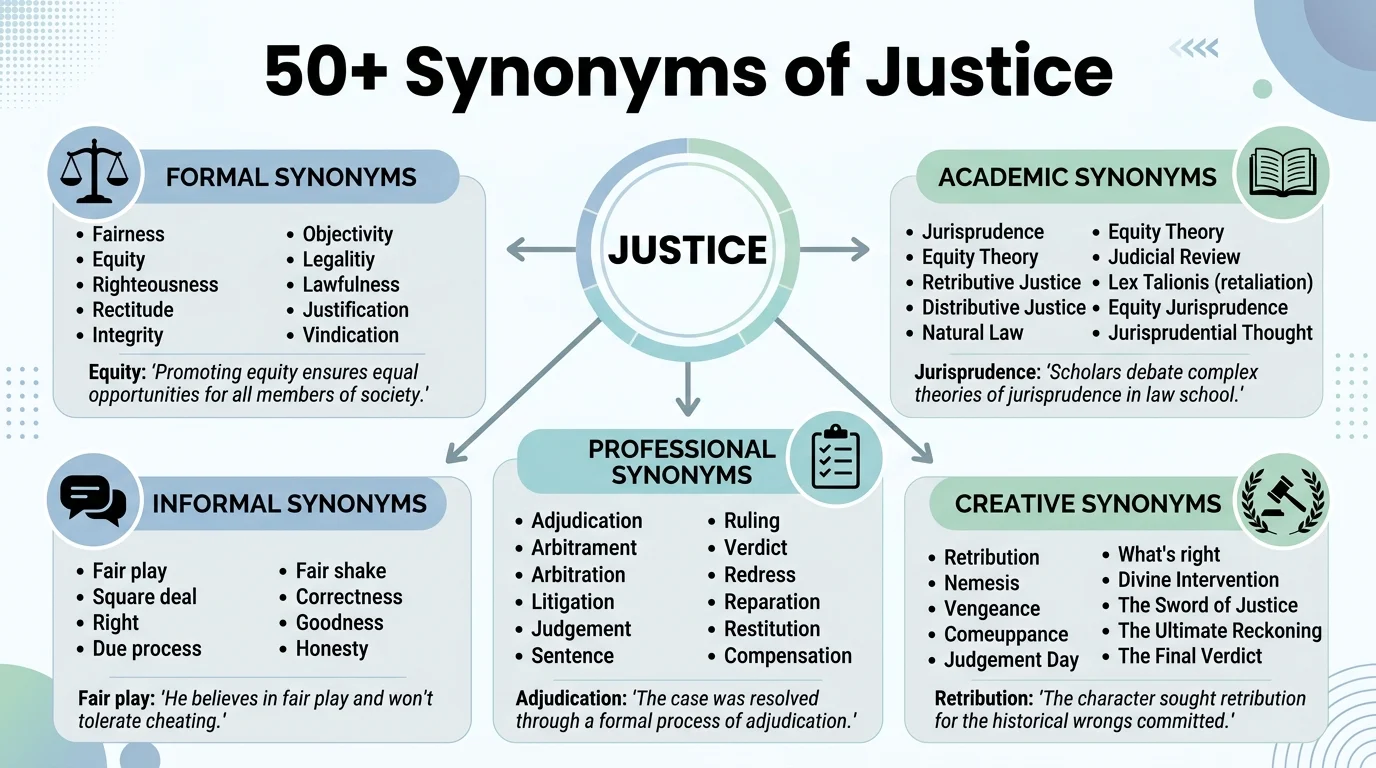
Have you ever been writing an important email, a college essay, or a professional report and found yourself using the word “justice” over and over again? You know what you want to say, but the word starts to feel repetitive and loses its impact. This happens to everyone. The good news is that English offers a rich vocabulary of alternatives. Choosing the right synonym of justice can transform your writing from ordinary to precise and powerful.
What Are the Best Synonyms of “Justice”?
Justice means fairness, moral rightness, and the fair treatment of people according to the law or ethical principles. The best synonyms depend on your context. For formal writing, use equity or impartiality. For casual conversation, fairness or fair play work well. In academic writing, rectitude and justness are excellent choices. For professional communication, integrity and honesty are strong options.
Meaning, Tone, and Context
Simple Definition
Justice is the quality of being fair, morally right, and reasonable in the way people are treated. It also refers to the legal system and the administration of law.
Part of Speech
Noun. (Example: “They demanded justice.”)
Overall Tone
Neutral to positive. Justice is generally viewed as a virtuous and desirable quality.
Formality Level
Semi-formal to formal. The word is commonly used in legal, academic, and professional contexts but is also understood in everyday conversation.
Common Uses
Native English speakers use “justice” in several ways:
- To describe fair treatment in society (“social justice”)
- To refer to the legal system (“criminal justice”)
- To express moral rightness (“the justice of their cause”)
- To describe a judge (“Justice Smith”)
Word Forms
- Noun: justice
- Adjective: just
- Adverb: justly
- Related noun: justness
- Opposite: injustice
When and How to Use “Justice”
Choose “justice” when you want to emphasize fairness, moral rightness, or the legal system. It is a versatile word that works in many contexts. Here are seven realistic examples.
Professional Context:
“The company’s commitment to social justice was evident in its hiring practices.”
Academic Context:
“The philosopher’s theory of justice has influenced modern political thought.”
Workplace Context:
“Our team believes in justice and equal opportunity for all employees.”
Personal Context:
“She has a strong sense of justice and always stands up for what is right.”
Email Context:
“I am writing to express my concerns about the lack of justice in the recent decision.”
Resume Context:
“Advocated for social justice and equity in community outreach programs.”
Social Media Context:
“Standing up for justice is not just a choice; it is a responsibility.”
Best Synonyms of “Justice”
No two synonyms are exactly identical. Each carries a slightly different shade of meaning, tone, and formality. Here is how to choose the best synonym for your specific situation.
Professional Writing
Equity is the best choice. It emphasizes fairness and impartiality in professional settings, especially in business and law.
Academic Writing
Rectitude is a strong choice. It conveys moral integrity and adherence to ethical principles, which is valued in scholarly work.
Business Communication
Integrity works well. It suggests honesty and strong moral principles, which are essential in business relationships.
Casual Conversation
Fairness is the most natural choice. It is simple, clear, and easily understood by everyone.
Emotional Writing
Righteousness adds emotional weight. It conveys a passionate commitment to what is morally right.
Creative Writing
Justness offers a literary and slightly formal tone that fits well in descriptive or narrative prose.
Resume Writing
Impartiality is a strong choice. It shows that you can make fair and unbiased decisions.
Workplace Communication
Fair play is a good option. It suggests honesty and respect in professional interactions.
Stronger Meaning
Righteousness conveys a powerful sense of moral conviction.
Softer Meaning
Fairness is milder and more neutral.
When Not to Use “Justice”
Sometimes “justice” is not the best word for your sentence.
When the Word Sounds Too General
If you are discussing a specific legal process, “justice” can be too broad.
- Less Effective: “The justice of the case was clear.”
- Better: “The legality of the case was clear.”
When the Word Sounds Too Vague
If you need to describe equal treatment in a specific context, “justice” may lack precision.
- Less Effective: “We need justice in the workplace.”
- Better: “We need equity in the workplace.”
When the Word Sounds Too Formal
In casual conversation, “justice” can feel stiff.
- Less Effective: “I just want justice for my team.”
- Better: “I just want fairness for my team.”
When the Word Sounds Too Weak
If you want to emphasize strong moral principles, “justice” may not be strong enough.
- Less Effective: “He acted with justice.”
- Better: “He acted with integrity.”
When the Word Is Outdated
In modern usage, some synonyms like “rectitude” are less common in everyday speech but still valuable in formal writing.
Words Commonly Confused With “Justice”
Justice vs Fairness
Difference: Justice is broader and includes moral rightness and legal principles. Fairness is more about equal treatment in specific situations.
When to Use It: Use “justice” for legal or moral contexts. Use “fairness” for everyday situations.
Example (Justice): “The court delivered justice.”
Example (Fairness): “The teacher showed fairness in grading.”
Justice vs Equity
Difference: Equity focuses on proportional fairness and giving people what they need. Justice is about overall moral and legal rightness.
When to Use It: Use “equity” when discussing resource distribution. Use “justice” for broader moral or legal issues.
Example (Equity): “The policy promotes equity in education.”
Example (Justice): “The victim sought justice.”
Justice vs Integrity
Difference: Integrity is about personal honesty and moral character. Justice is about fair treatment and legal principles.
When to Use It: Use “integrity” for personal qualities. Use “justice” for systems and treatment.
Example (Integrity): “She is known for her integrity.”
Example (Justice): “The system must ensure justice.”
Justice vs Righteousness
Difference: Righteousness has a stronger moral and sometimes religious connotation. Justice is more secular and legal.
When to Use It: Use “righteousness” for moral passion. Use “justice” for legal or societal fairness.
Example (Righteousness): “He spoke with righteousness.”
Example (Justice): “The law aims to provide justice.”
Justice vs Legality
Difference: Legality is about following the law. Justice is about moral rightness, which may sometimes conflict with the law.
When to Use It: Use “legality” for technical legal matters. Use “justice” for moral or ethical considerations.
Example (Legality): “The contract’s legality was questioned.”
Example (Justice): “The decision was made in the interest of justice.”
Best Synonyms of “Justice” by Context
| Context | Best Synonym | Why It Works | Example |
|---|---|---|---|
| Formal Writing | Equity | Emphasizes fairness and impartiality in official documents. | “The policy promotes equity for all citizens.” |
| Academic Writing | Rectitude | Conveys moral integrity and ethical principles. | “The study examines the rectitude of the legal framework.” |
| Professional Communication | Integrity | Highlights honesty and strong moral character. | “Our company values integrity in all dealings.” |
| Business Emails | Fairness | Clear and professional without being overly formal. | “We are committed to fairness in our hiring process.” |
| Resume Writing | Impartiality | Demonstrates unbiased decision-making skills. | “Ensured impartiality in all candidate evaluations.” |
| Workplace Communication | Fair Play | Suggests honesty and respect among colleagues. | “We believe in fair play and teamwork.” |
| Casual Conversation | Fairness | Simple, natural, and easily understood. | “I just want fairness for everyone.” |
| Everyday Speaking | Justness | A slightly formal but still conversational option. | “The justness of the decision was debated.” |
| Creative Writing | Righteousness | Adds emotional depth and moral conviction. | “He fought with righteousness and courage.” |
| Storytelling | Justice | The classic choice for narrative themes. | “The hero sought justice for his people.” |
| Emotional Writing | Righteousness | Conveys strong moral passion. | “Her righteousness inspired the crowd.” |
| Strong Emphasis | Righteousness | The most intense synonym for moral conviction. | “They demanded righteousness in the face of injustice.” |
| Mild Tone | Fairness | Neutral and gentle. | “A little fairness would go a long way.” |
| Social Media Captions | Justice | Short, impactful, and widely recognized. | “Justice for all. ✊” |
How to Choose the Best Synonym of “Justice”
Choosing the right word depends on your purpose, audience, and tone.
- Consider Your Audience. Are you writing for a formal or casual audience? Use “equity” or “rectitude” for formal settings. Use “fairness” for casual conversations.
- Think About Emotional Strength. Do you want to convey strong moral conviction? Choose “righteousness.” For a neutral tone, stick with “justice” or “fairness.”
- Match the Context. Legal and professional contexts often call for “justice,” “equity,” or “impartiality.” Personal and everyday contexts are better suited for “fairness” or “fair play.”
- Avoid Repetition. If you have already used “justice” several times, switch to a synonym like “equity” or “integrity” to keep your writing fresh.
- Prioritize Clarity. The best synonym is the one that communicates your message most clearly. If you are unsure, “fairness” is a safe and widely understood choice.
Real Life Examples of “Justice”
School Context:
“The student council promoted justice by ensuring every voice was heard.”
College Context:
“The professor’s lecture on social justice challenged our assumptions.”
Workplace Context:
“The manager’s commitment to justice created a positive work environment.”
Business Context:
“The company’s code of conduct emphasizes justice and ethical behavior.”
Email Context:
“I believe we need to address the issue of justice in our upcoming meeting.” (Better: “I believe we need to address the issue of equity in our upcoming meeting.”)
Resume Context:
“Worked to advance social justice through community organizing.” (Better: “Worked to advance social equity through community organizing.”)
Conversation Context:
“There’s no justice in this world sometimes.” (Better: “Sometimes there’s no fairness in this world.”)
Storytelling Context:
“The knight swore to bring justice to the kingdom.” (Better: “The knight swore to bring righteousness to the kingdom.”)
Blogging Context:
“Justice is not just a legal concept; it is a moral one.” (Better: “Fairness is not just a legal concept; it is a moral one.”)
Social Media Context:
“Stand up for justice.” (Better: “Stand up for fairness and equity.”)
18 Best Synonyms of “Justice”
Synonyms of “Justice” by Usage
Professional vs Personal Synonyms
In professional settings, words like equity, impartiality, and integrity are preferred. They convey a formal and serious tone. In personal conversations, fairness, fair play, and decency are more natural and approachable.
Formal vs Conversational Synonyms
For reports, essays, and business writing, choose rectitude, justness, or equity. For casual conversations, texting, and social media, fairness and fair play are better choices.
Academic Synonyms
In research and academic discussions, rectitude, morality, and egalitarianism are precise and authoritative. They demonstrate a sophisticated understanding of ethical and legal concepts.
Professional and Business Synonyms
For resumes, interviews, and client communication, integrity, impartiality, and objectivity are strong choices. They highlight your professional values and decision-making skills.
Creative and Literary Synonyms
For storytelling and descriptive writing, righteousness, virtue, and uprightness add emotion and imagery. They help create memorable characters and themes.
Slang or Modern Synonyms
There are no widely recognized slang synonyms for “justice.” The word itself is already common and accessible.
Strongest to Mildest Synonyms
Mild: Fairness, Decency
Moderate: Justice, Equity, Impartiality
Strong: Integrity, Rectitude, Uprightness
Very Strong: Righteousness, Virtue
Emotional vs Neutral Synonyms
Emotional Synonyms: Righteousness, Virtue, Integrity. These words convey strong feelings and moral conviction.
Neutral Synonyms: Fairness, Equity, Legality. These words simply communicate information without added emotion.
Recommendation: Use emotional synonyms when you want to inspire or persuade. Use neutral synonyms when you need to be objective and factual.
Antonyms of “Justice”
Comparison: “Justice” vs Similar Words
Justice vs Fairness
Main Difference: Justice is a broader concept that includes moral and legal principles. Fairness is more about equal treatment in specific situations.
Which Is Stronger? Justice is stronger and more comprehensive.
Which Is More Formal? Justice is more formal.
When to Use Each: Use justice for legal or moral contexts. Use fairness for everyday situations.
Examples:
- Justice: “The court delivered justice.”
- Fairness: “The teacher showed fairness in grading.”
Justice vs Equity
Main Difference: Equity focuses on proportional fairness and giving people what they need. Justice is about overall moral and legal rightness.
Which Is Stronger? Justice is broader and more encompassing.
Which Is More Formal? Both are formal, but equity is particularly common in professional and academic contexts.
When to Use Each: Use equity when discussing resource distribution. Use justice for broader moral or legal issues.
Examples:
- Equity: “The policy promotes equity in education.”
- Justice: “The victim sought justice.”
Justice vs Integrity
Main Difference: Integrity is about personal honesty and moral character. Justice is about fair treatment and legal principles.
Which Is Stronger? Both are strong, but integrity focuses on personal qualities.
Which Is More Formal? Both are formal.
When to Use Each: Use integrity for personal qualities. Use justice for systems and treatment.
Examples:
- Integrity: “She is known for her integrity.”
- Justice: “The system must ensure justice.”
Justice vs Righteousness
Main Difference: Righteousness has a stronger moral and sometimes religious connotation. Justice is more secular and legal.
Which Is Stronger? Righteousness is more intense emotionally.
Which Is More Formal? Both are formal, but righteousness is more literary.
When to Use Each: Use righteousness for moral passion. Use justice for legal or societal fairness.
Examples:
- Righteousness: “He spoke with righteousness.”
- Justice: “The law aims to provide justice.”
Justice vs Legality
Main Difference: Legality is about following the law. Justice is about moral rightness, which may sometimes conflict with the law.
Which Is Stronger? Justice is stronger in a moral sense.
Which Is More Formal? Legality is more technical.
When to Use Each: Use legality for technical legal matters. Use justice for moral or ethical considerations.
Examples:
- Legality: “The contract’s legality was questioned.”
- Justice: “The decision was made in the interest of justice.”
Justice vs Impartiality
Main Difference: Impartiality is specifically about not favoring any side. Justice is the broader principle of fairness and moral rightness.
Which Is Stronger? Justice is broader and more comprehensive.
Which Is More Formal? Both are formal.
When to Use Each: Use impartiality when emphasizing neutrality. Use justice for the overall concept of fairness.
Examples:
- Impartiality: “The referee’s impartiality was praised.”
- Justice: “The justice system must protect the innocent.”
Common Phrases and Expressions with “Justice”
| Phrase | Meaning | Example Sentence |
|---|---|---|
| Social justice | Fairness in society | “The organization fights for social justice.” |
| Criminal justice | The system of dealing with crime | “She works in the criminal justice system.” |
| Poetic justice | When good is rewarded and evil is punished | “It was poetic justice when he lost his job.” |
| Bring to justice | To arrest and punish someone for a crime | “The police are determined to bring the criminals to justice.” |
| Do justice to | To represent or treat something fairly | “The movie does justice to the book.” |
| Miscarriage of justice | A failure of the legal system | “The trial was a miscarriage of justice.” |
| Justice delayed is justice denied | Fairness is lost if it takes too long | “The case has dragged on for years; justice delayed is justice denied.” |
Common Mistakes to Avoid
Mistake 1: Choosing a Vague Synonym
Incorrect: “The justice of the situation was clear.”
Better: “The fairness of the situation was clear.”
Why: “Fairness” is more specific and natural in this context.
Mistake 2: Confusing Justice with Legality
Incorrect: “The justice of the contract was confirmed.”
Better: “The legality of the contract was confirmed.”
Why: Legality refers to the law, while justice refers to moral rightness.
Mistake 3: Using an Informal Synonym in Formal Writing
Incorrect: “The judge showed fair play in her decision.”
Better: “The judge showed impartiality in her decision.”
Why: “Fair play” is too casual for a formal legal context.
Mistake 4: Selecting an Overly Dramatic Synonym
Incorrect: “We need righteousness in the workplace.”
Better: “We need fairness in the workplace.”
Why: “Righteousness” is too emotional for a professional setting.
Mistake 5: Repeating the Same Word Too Often
Incorrect: “Justice is important. Justice is the foundation of our society. We must fight for justice.”
Better: “Justice is important. Fairness is the foundation of our society. We must fight for equity.”
Why: Using synonyms keeps your writing fresh and engaging.
Mistake 6: Choosing a Synonym with the Wrong Emotional Tone
Incorrect: “The report was praised for its righteousness.”
Better: “The report was praised for its objectivity.”
Why: “Righteousness” implies moral passion, while “objectivity” is neutral and factual.
Mistake 7: Using Slang in Academic Writing
Incorrect: “The study examined the fair play of the system.”
Better: “The study examined the impartiality of the system.”
Why: “Fair play” is too informal for academic work.
Frequently Asked Questions
1. What are the best synonyms of “justice”?
The best synonyms depend on your context. Formal writing, use equity or impartiality. For casual conversation, fairness or fair play work well. For emotional writing, righteousness is a strong choice.
2. What are the best formal synonyms of “justice”?
The best formal synonyms include equity, rectitude, impartiality, and integrity. These words convey a serious and professional tone suitable for academic, legal, and business contexts.
3. What are common informal synonyms of “justice”?
Common informal synonyms include fairness and fair play. These words are natural and easily understood in everyday conversations.
4. What is another word for “justice” in professional writing?
In professional writing, equity and integrity are excellent alternatives. They emphasize fairness and moral character, which are highly valued in the workplace.
5. What is the difference between “justice” and “fairness”?
Justice is a broader concept that includes moral and legal principles. Fairness is more about equal treatment in specific situations. Justice is often used in legal contexts, while fairness is used in everyday situations.
6. What is the opposite of “justice”?
The most direct opposite is injustice. Other antonyms include unfairness, inequity, partiality, and bias.
Conclusion
Justice is a powerful word that represents fairness, moral rightness, and the fair treatment of people. Whether you are writing a formal report, a casual email, or a creative story, choosing the right synonym of justice can make your writing more precise and impactful. Remember that no synonym works perfectly in every situation. Consider your audience, tone, and purpose. Formal writing, choose equity or rectitude. For casual conversation, choose fairness. For emotional impact, choose righteousness. By expanding your vocabulary and understanding the nuances of each word, you can communicate more effectively and confidently. Keep practicing, and soon you will find the perfect word for every situation.
2 thoughts on “50+ Synonyms of Justice | Meanings, Uses, Examples, and Best Alternatives”