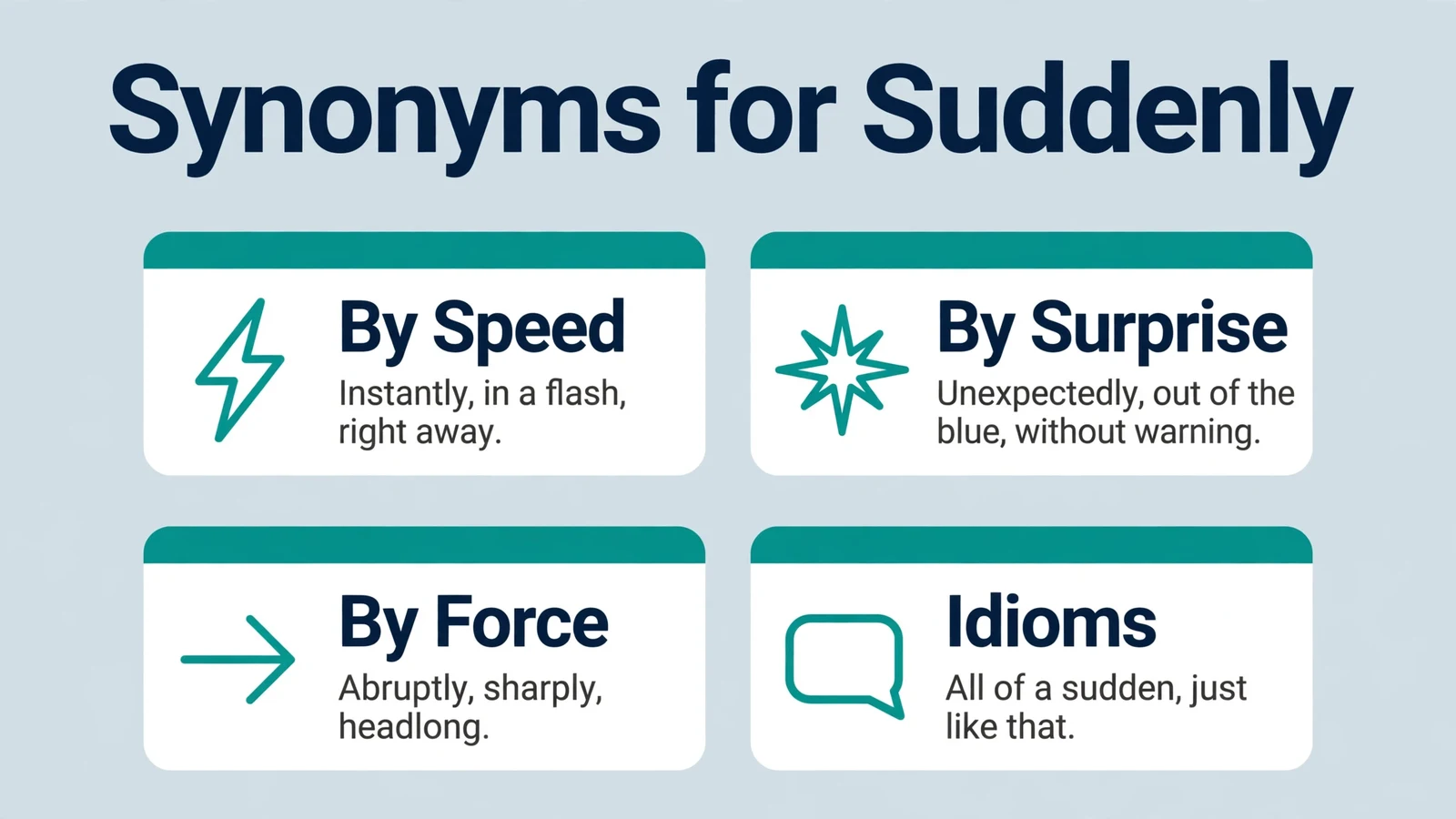
Every story writer knows the moment. The scene is calm, the hero is safe, and then something has to change in a single heartbeat. Most of us reach for the same word: suddenly. The fastest true synonyms for suddenly are abruptly (a sharp stop or turn), unexpectedly and out of the blue (no warning at all), instantly and in a flash (pure speed), and all of a sudden, the classic storytelling phrase.
Each one bends the sentence in a different direction, though. Some carry speed, some carry shock, and some carry force. This guide groups 55+ verified synonyms for suddenly by speed, by surprise and by force, with story-ready examples, idioms, formal options and the false friends that are not synonyms at all. By the end, you will know exactly which swap fits your scene.
Quick Reference: Top Synonyms for Suddenly
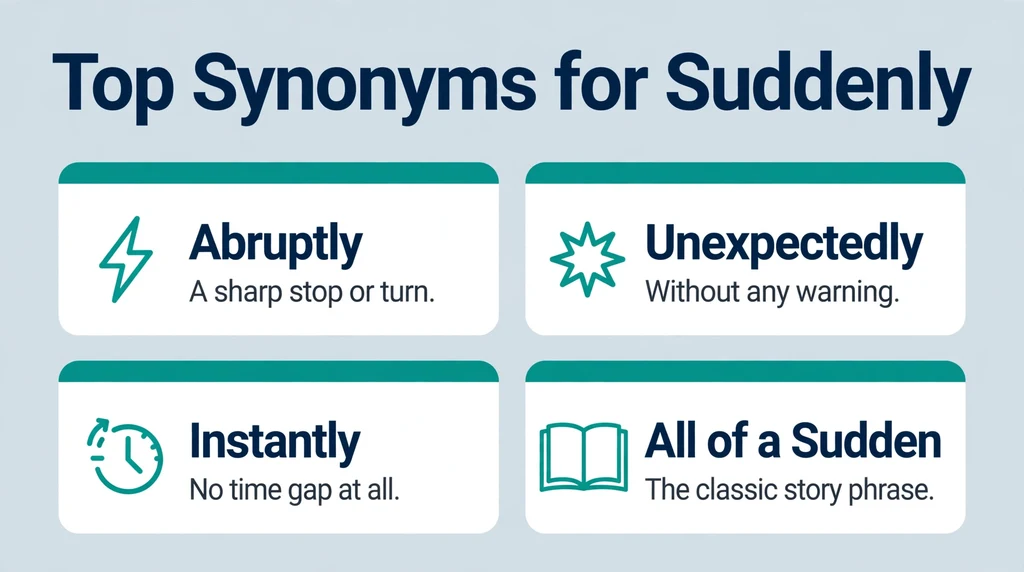
Short on time? This table holds the swaps writers reach for most. The grouped sections after it explain the shades of meaning, so you can pick with confidence instead of guessing.
Start With These Fourteen
| Word or phrase | Meaning in one line | Best for / tone |
|---|---|---|
| abruptly | with great suddenness; a sharp stop or turn | stops, endings; neutral |
| unexpectedly | without warning; not anticipated | surprises, twists; neutral |
| all of a sudden | suddenly, in the classic narrative phrase | story openings; neutral phrase |
| instantly | with no time gap at all | reactions, effects; neutral |
| out of the blue | completely unexpected, as if from nowhere | shocks, news, arrivals; informal phrase |
| without warning | with no sign beforehand | danger, weather, attacks; neutral phrase |
| in a flash | in an instant, almost too fast to see | action, flashes of insight; neutral phrase |
| immediately | at once, with no delay | orders, responses; neutral to formal |
| unanticipatedly | in a way nobody foresaw | reports, formal narration; formal |
| surprisingly | in a way that causes surprise | lighter twists; neutral |
| sharply | suddenly and forcefully, of direction or degree | turns, drops, rises; neutral |
| all at once | together and suddenly, in one moment | crowds, sounds, realisations; neutral phrase |
| in an instant | within a single moment | realisations, impacts; neutral phrase |
| instantaneously | in an instant, with zero delay | science, precise prose; formal |
More Top Swaps
| Word or phrase | Meaning in one line | Best for / tone |
|---|---|---|
| swiftly | quickly and smoothly | movement, responses; neutral to literary |
| rapidly | very fast, in quick succession | change, growth, spread; neutral |
| quickly | fast; the plain everyday swap | general use; neutral |
| promptly | without delay, right on time | replies, arrivals; formal-leaning |
| straightaway | immediately, without waiting | narration; neutral |
| right away | immediately, right now | dialogue; informal phrase |
| in the blink of an eye | faster than a blink | transformations, escapes; literary phrase |
| like a shot | as fast as a shot leaving a gun | someone darting off; informal phrase |
| unawares | without being prepared; caught off guard | being caught or attacked; literary |
| impetuously | with sudden impulse and impatience | rash decisions; literary |
| headlong | rushing with force and no forethought | falls, charges, plunges; literary |
| posthaste | with the greatest possible speed | urgent journeys; formal, old-fashioned |
| in a jiffy | in a very short time | light, friendly narration; informal phrase |
| just like that | instantly and effortlessly, with finality | magic, decisions, endings; informal phrase |
Synonyms for Suddenly by Speed
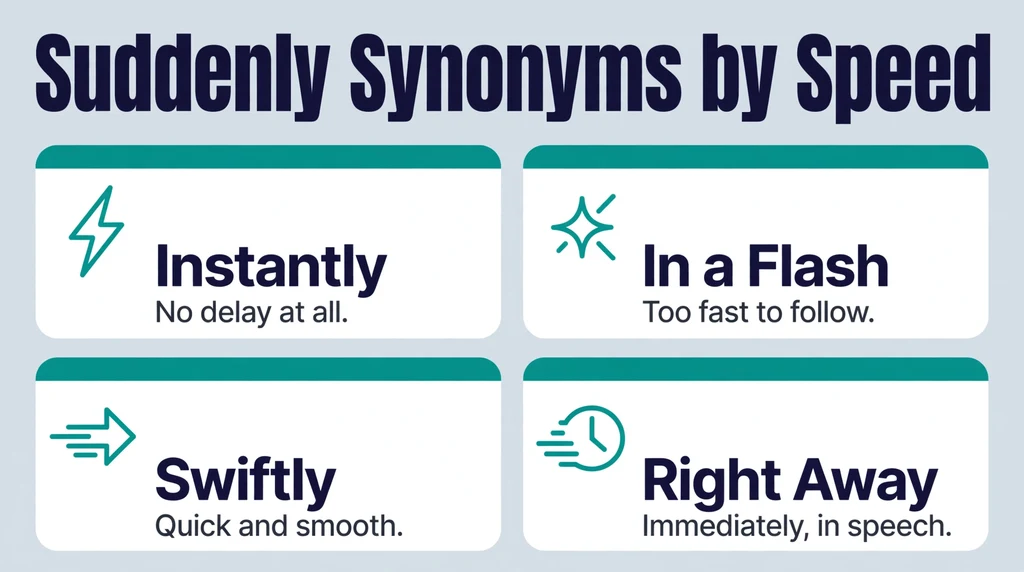
Speed synonyms answer one question: how fast did it happen? They say nothing about surprise on their own, so they suit action, reactions and cause-and-effect. A kettle boils instantly whether or not anyone is watching, and a letter answered promptly impresses precisely because nobody expected drama. For a fuller set of everyday speed words, see our guide to synonyms for quickly.
In a Single Instant
These words leave no gap at all between one moment and the next. Use them when the change feels instant to the character who lives it.
- instantly: with no delay at all; the moment one thing happens, the next follows. *The lights failed, and instantly the whole theatre went silent.*
- instantaneously: the formal twin of instantly, at home in science and technical writing. *The two particles reacted instantaneously.*
- in a flash: so fast it feels like a burst of light. *In a flash, she understood the whole trick.*
- in an instant: within one tiny moment; slightly softer than in a flash. *The mood in the room changed in an instant.*
- in the blink of an eye: a literary phrase for changes too fast to follow. *The camp was gone in the blink of an eye.*
- in a trice: an old-fashioned literary phrase meaning in a moment. *The sails were up in a trice.*
- like a flash: informal and vivid, mostly for movement. *He was out of the door like a flash.*
Fast, Prompt and Immediate
These words stress quickness rather than a single instant. They keep a scene moving without claiming the change was magical.
- immediately: at once, with nothing in between. *The guard immediately stepped forward.*
- quickly: the plainest swap of all; fast, simple, invisible. *She quickly hid the letter.*
- rapidly: fast and continuing, good for change that spreads. *The fire spread rapidly through the dry grass.*
- swiftly: quick and smooth, with a hint of grace. *The hawk dropped swiftly toward the field.*
- speedily: a slightly formal way to say quickly. *The matter was speedily settled.*
- fast: plain and direct as an adverb. *The rumour travelled fast.*
- promptly: without delay and right on time; it sounds reliable, not panicked. *He replied promptly, before noon.*
- hastily: fast because of hurry, often with carelessness close behind. *They hastily packed and left before dawn.*
- straightaway: immediately, without waiting for anything. *She recognised the voice straightaway.*
- straightway: the older, literary form of straightaway. *He straightway rose and followed her.*
- directly: in older and literary use, it can mean immediately. *She will come directly.*
Spoken and Informal Speed
These swaps sound like real speech, so they shine in dialogue and relaxed narration rather than in reports.
- right away: the natural spoken swap for immediately. *”Sit down right away,” the teacher said.*
- right off: immediately, from the very start. *I knew right off that something was wrong.*
- at once: immediately, or together in the same moment. *The crowd gasped at once.*
- in no time: informal; far faster than expected. *The news reached the village in no time.*
- in a jiffy: cheerful and informal; in a very short time. *I will have it mended in a jiffy.*
- on the double: informal and urgent, borrowed from military marching. *The crew returned on the double.*
- presto: playful; a change as if by magic. *He waved the cloth, and presto, the coin was gone.*
Synonyms for Suddenly by Surprise
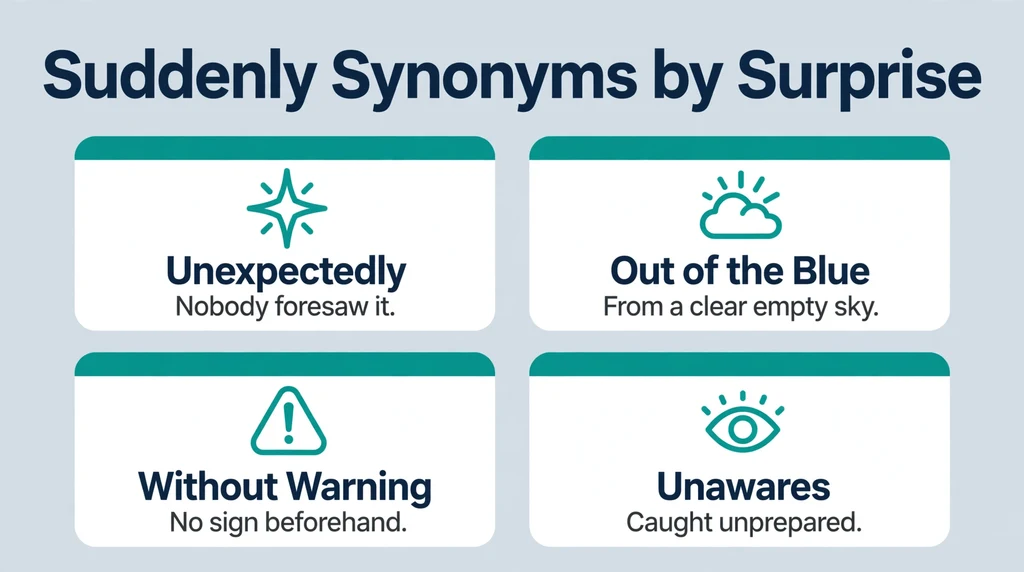
Surprise synonyms answer a different question: did anyone see it coming? Merriam-Webster’s thesaurus gives “without warning” as a whole separate sense of suddenly, and these words live there. For the emotion on the character’s face, see our guide to synonyms for shocked.
Notice how many of them describe the victim of the moment rather than the event itself. Unawares, aback and by surprise all point at a person caught unprepared. That makes surprise words ideal for scenes told close to a character’s skin, where the reader should feel ambushed too. When the camera pulls back and the narrator reports from a distance, the cooler words (unexpectedly, unanticipatedly) keep the tone steady.
Without Any Warning
- unexpectedly: the lead word for this sense; the event simply was not anticipated. *The trail ended unexpectedly at a cliff.*
- unanticipatedly: the formal, heavier version of unexpectedly. *The results shifted unanticipatedly in the final week.*
- without warning: plain, strong and factual; suits danger and disaster. *The wave struck without warning.*
- without notice: much like without warning, a little more official. *The road was closed without notice.*
- all at once: everything in the same moment, so nobody can prepare. *All at once, every window in the street lit up.*
- unawares: literary; it describes the person who is caught, not the event. *The storm took the sailors unawares.*
- unaware: an older adverb use of the adjective, mostly in set phrases. *It crept up on him unaware.*
Shock, Amazement and Caught Off Guard
- surprisingly: softer than unexpectedly; it adds the reaction, not just the fact. *The old engine started surprisingly easily.*
- amazingly: surprise with wonder mixed in. *Amazingly, the letter had survived the fire.*
- astoundingly: the strongest of the three; the surprise is almost disbelief. *Astoundingly, the bridge still stood.*
- aback: used almost only in “taken aback”, for a person stopped by surprise. *She was taken aback by the question.*
- by surprise: used in “caught by surprise” or “took us by surprise”. *The early frost caught the farmers by surprise.*
Idioms That Signal a Twist
Idioms are phrases, not single words, so they carry more colour and less formality. Labelled clearly here, they are the storyteller’s favourite tools for a turn in the plot.
- all of a sudden: the classic narrative phrase; warm, natural, universal. *All of a sudden, the music stopped.*
- out of the blue: informal; a surprise that seems to come from a clear, empty sky. *The job offer came out of the blue.*
- out of nowhere: for people and things that appear with no sign at all. *A dog ran out of nowhere into the road.*
- just like that: informal; instant, effortless, sometimes with a snap of finality. *And just like that, the argument was over.*
- lo and behold: humorous and old-fashioned; it announces a surprise with a smile. *Lo and behold, the key was in his own pocket.*
- on the spur of the moment: Collins lists it under suddenly, but be careful: it describes decisions made without planning, not events that strike. *They married on the spur of the moment.*
Synonyms for Suddenly by Force
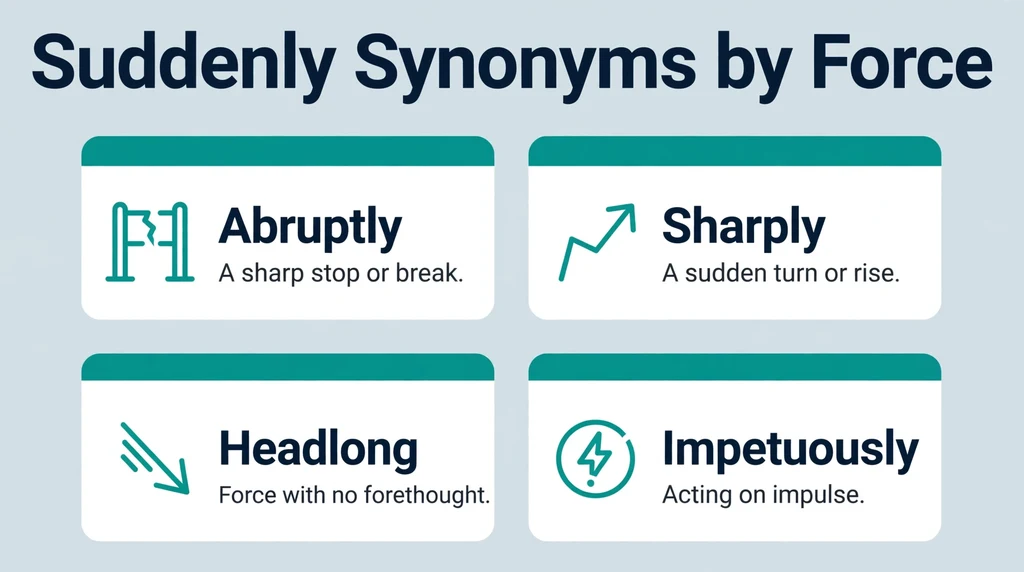
Force synonyms describe how the change lands. Merriam-Webster’s synonym chooser notes that sudden itself “stresses unexpectedness and sharpness or violence of action”. These words keep that edge.
Sharp Stops, Turns and Changes
- abruptly: the lead word in Merriam-Webster’s first sense, “with great suddenness”. It is the sharpest tool for stops, turns and endings. *The car stopped abruptly at the gate.*
- sharply: suddenly and forcefully, above all for changes of direction, degree or tone. *The path turned sharply uphill. Her voice rose sharply.*
- short: only in the set pattern “stop short” or “pull up short”, for a halt so sudden it jolts. *He stopped short when he saw the drop.*
Rush, Impulse and Recklessness
These words blame the speed. They imply the actor did not stop to think, which makes them perfect for flawed, hurried characters.
- impetuously: with extreme impatience or impulse; Merriam-Webster’s chooser ties the idea to acting on the feeling of the moment. *He spoke impetuously and regretted it for weeks.*
- impulsively: on a sudden urge, without weighing the result. *She impulsively bought the ticket.*
- rashly: too fast and too bold, with risk ignored. *Do not answer rashly in anger.*
- recklessly: with no care for danger or damage at all. *He drove recklessly through the flooded street.*
- headlong: rushing forward with force and no forethought; often physical. *The horse plunged headlong down the slope.*
- precipitately: the formal adverb from precipitate: thrown into action too early, without due deliberation. *The council acted precipitately and had to reverse the order.*
- snappily: informal; quickly and in a sharp, brisk manner. *The soldiers saluted snappily.*
- pronto: informal and borrowed from Spanish; right away, no excuses. *Get those forms signed, pronto.*
Synonyms for Suddenly by Scene: Weather, Arrivals and Sound
The same swap does not fit every scene. Here are the groups above, re-sorted for the three moments story writers describe most.
Weather Turning
Storms, fog and seasons change best with warning words and all-at-once phrases, because nature rarely knocks first.
- *Without warning, the hail began, hammering the roof.*
- *All at once, the wind dropped, and the sea went flat and strange.*
- *The frost came out of nowhere that October and took the whole harvest.*
One caution: weather that turns gradually builds dread instead, while weather that turns without warning delivers the shock. Pick the pressure your scene needs.
People Arriving and Leaving
Entrances love speed words and disappearing acts. Exits love abruptly, because a door closing is a full stop.
- *She arrived unanticipatedly, two days before the wedding.*
- *He was gone in a flash, before anyone could call his name.*
- *The visitor rose abruptly and left without a word.*
- *Lo and behold, the missing brother stood in the doorway, smiling.*
Sound Starting and Stopping
Sound is where sharply and abruptly earn their keep, because noises bend and break exactly like the events they mark.
- *The music stopped abruptly, and the dancers froze.*
- *A bell rang sharply in the empty corridor.*
- *All at once, every dog in the street began to bark.*
- *The engine coughed twice and fell silent, just like that.*
Danger and Accidents
Accident scenes need warning words first and speed words second, because the horror lives in the gap between them.
- *The rope snapped without warning, high above the gorge.*
- *Brakes screamed, and the bus stopped short of the barrier.*
- *Out of the blue, a tile slid from the roof and shattered beside her.*
- *He grabbed the rail in a flash as the deck tilted.*
Endings and Revelations
Endings break; revelations dawn. Abruptly and just like that close doors, while all at once and in an instant open them inside a character’s mind.
- *The letter ended abruptly, with no signature.*
- *And just like that, the house was empty again.*
- *In an instant, she saw the whole lie, start to finish.*
- *All at once, the portrait made sense: the ring, the date, the smile.*
How to Choose the Right Synonym for Suddenly
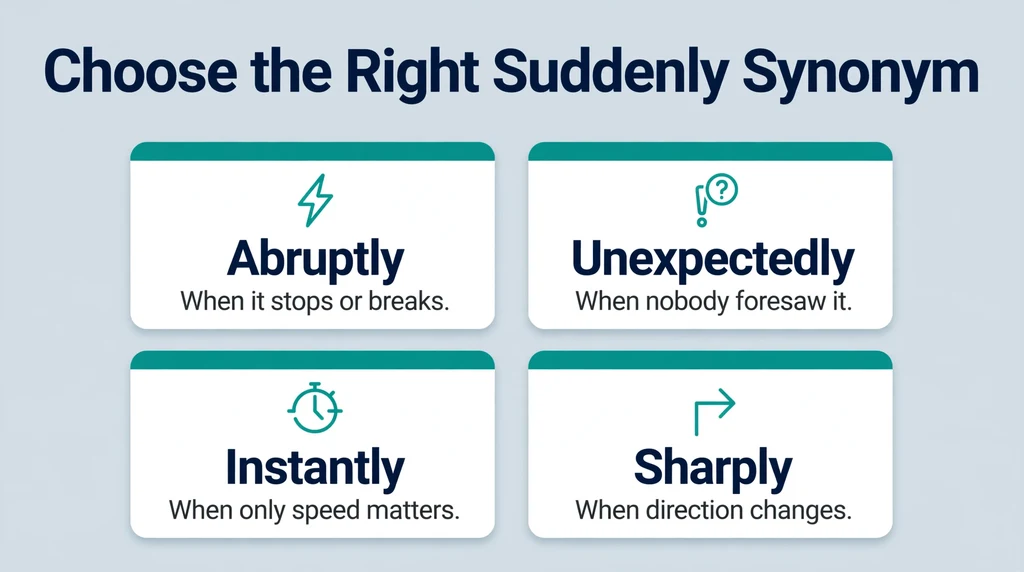
Four quick tests will pick the right word almost every time. Ask what your sentence really needs: speed, surprise, force, or a mix.
Register matters just as much as meaning. A word can be a true synonym and still be wrong for the page: presto in a police report, unanticipatedly in a text message, in a jiffy in a funeral speech. Before you swap, read the sentence aloud in the voice of the piece. If the word sounds like a different person speaking, it is the wrong synonym, however accurate the dictionary says it is.
Abruptly or Unexpectedly?
Choose abruptly when the manner is sharp, like a door slamming. Choose unexpectedly when the point is that nobody foresaw the event. *The meeting ended abruptly* (it stopped dead). *The meeting ended unexpectedly* (we thought it would run longer). Many scenes need the sharpness, so abruptly wins more often in action writing.
Instantly or Suddenly?
Instantly measures time only. It promises no gap, but it holds no surprise. A light that answers a switch comes on instantly, and nobody gasps. Suddenly adds the jolt. If your reader should feel the shock, reach for unexpectedly, abruptly or all of a sudden instead.
All of a Sudden or Out of the Blue?
All of a sudden is the neutral workhorse. It fits narration, essays and dialogue at almost any level of formality. Out of the blue is informal, and the surprise is total, like a phone call from a friend silent for ten years. Save it for real bolts from the blue, and keep it out of formal reports.
Sharply or Abruptly?
Use sharply when something changes direction, amount or tone: prices, voices, roads, temperatures. Use abruptly when something stops, starts or breaks off: conversations, journeys, music, lives. If it bends, think sharply. If it breaks, think abruptly.
In a Flash or Out of the Blue?
Both are phrases, but they point at different things. In a flash is about time: the event took almost no time at all. Out of the blue is about expectation: nobody had any reason to see it coming. A champion sprinter finishes in a flash, and nobody is surprised. A lottery win arrives out of the blue, even if the draw itself takes an hour.
Promptly or Immediately?
Immediately is the neutral choice: no gap, no judgement. Promptly adds good manners. It suggests the person responded as they should, on time and without fuss. *The ambulance arrived immediately* is a fact. *She answered promptly* quietly praises her. In formal writing, promptly often sounds warmer and more professional.
Suddenly in Story Writing: Openings, Twists and Overuse
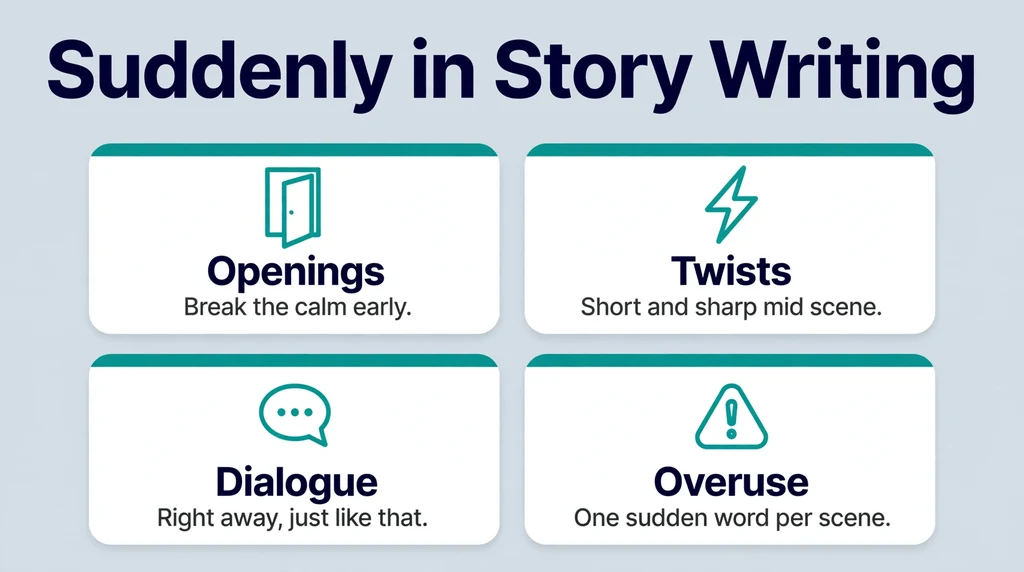
Suddenly is a spice, not a staple. Used once, it snaps a reader awake. Used on every page, it puts them to sleep, because a shock that arrives on schedule stops being a shock.
Strong Story Openings
An opening line can borrow suddenness without the word itself. Try an instant swap: *In a flash, the harbour lights went out, and the boat drifted in darkness.* Or lean on surprise: *Out of the blue, a stranger knocked and asked for her by a name she had not used in years.* Or use the classic: *All of a sudden, the wedding march stopped, and every guest turned around.* Each version promises the reader that the calm is over.
Twists in the Middle of a Scene
Mid-scene, shorter is stronger. A one-word interruption lands like a slap: *The letter ended abruptly, mid-sentence.* A phrase can slow time for one beat before the blow: *She reached the last step. Without warning, the lights died.* Vary the pattern, too. If the last twist came out of the blue, let the next one stop short or arrive in a flash. Fresh wording keeps the reflex alive.
The Overuse Problem in Student Writing
Teachers and editors flag the same habit again and again: suddenly at the start of every new paragraph, doing work the scene itself should do. If a wolf steps out of the trees, the reader feels the shock already. The word adds nothing, and it can even weaken the moment by announcing it first. A good rule is one sudden word per scene, chosen from different groups each time. Cut the rest, and let action, sound and reaction carry the surprise. The scene will feel faster, not slower. For pure pace, our list of synonyms for fast can help you vary the verbs around the moment, too.
Suddenly in Dialogue
Spoken English has its own sudden words, and they sound wrong in narration if you swap them carelessly. Characters say right away, just like that, out of nowhere and in no time. They rarely say unanticipatedly or instantaneously, unless the joke is that they sound like a textbook. Match the word to the mouth: *”He just vanished, right away, no note, nothing.”* A frightened character might also reach for lo and behold in bitter humour: *”And lo and behold, the fence was broken again.”* Dialogue is where informal phrases earn their place.
Three Flat Sentences, Rewritten
Watch how the group choice changes the feel of the same basic moment.
Flat: *Suddenly, the door opened.* With speed: *In a flash, the door flew open.* With surprise: *Out of nowhere, the door swung wide, though no one had touched it.* With force: *The door banged open, then stopped short against the wall.*
Flat: *Suddenly, she realised the truth.* Softer and smarter: *In an instant, she understood.* Or slower and heavier: *It came to her all at once, the whole pattern, clear as print.*
Flat: *Suddenly, the rain started.* With warning removed: *Without warning, the rain came down in sheets.* With scene and sound: *All at once, the gutters roared and the street turned to glass.*
Formal and Literary Synonyms for Suddenly
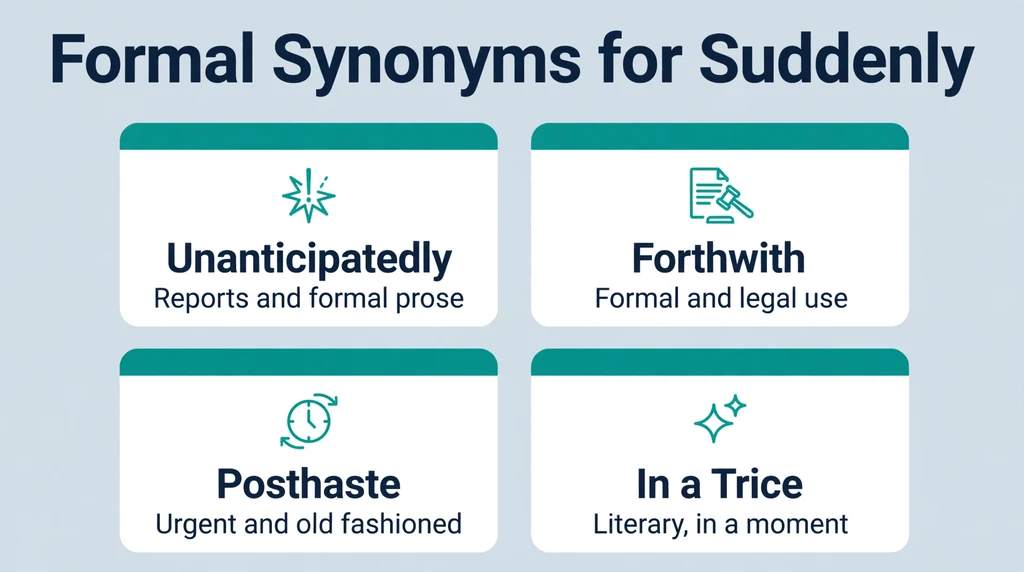
Formal writing still needs suddenness, but it needs it in a suit. These options keep the meaning and drop the drama.
- unanticipatedly: the heaviest formal option; fits reports and academic prose. *The policy unanticipatedly raised costs.*
- forthwith: formal and somewhat legal; immediately, without delay. *The order takes effect forthwith.*
- posthaste: with the greatest speed; formal and old-fashioned, good for urgent journeys in historical settings. *He rode posthaste to the capital.*
- instantaneously: precise and technical; the change takes no measurable time. *The signal switched instantaneously.*
- precipitately: formal, and it criticises: the action came too early and without due thought. *The board moved precipitately.*
- in a trice: literary rather than formal; a light, older phrase for a single moment. *The tent was struck in a trice.*
- unawares: literary; someone is caught unprepared. *Winter caught the valley unawares.*
- headlong: literary; force and rashness in one word. *The army rushed headlong into the pass.*
Suddenly in Essays and Reports
School and university essays sit between story and report, and the register rules are simple. Abruptly and unexpectedly are always safe: both are neutral, precise and common in academic prose. Instantly and immediately are fine when timing is the point, as in science write-ups. Avoid the informal phrases (out of the blue, in a jiffy, just like that), which sound like speech, and avoid repeating suddenly itself in every paragraph of an exam answer. Examiners reward variety, but they reward accuracy more: if the change was foreseen, expectedly and gradually are the honest choices, not a dramatic swap that bends the facts.
A quiet historical note: suddenly comes from sudden, which entered English from Anglo-French and traces back to the Latin subitus, “sudden”, from subire, “to come up” on someone. The surprise has been inside the word from the very start.
Antonyms of Suddenly
Sometimes the scene needs the opposite pressure: change that creeps instead of striking. Merriam-Webster’s antonyms for suddenly begin with slowly and gradually, and the rest of the family is just as useful.
- slowly: at a low speed; the plainest opposite. *The fog lifted slowly.*
- gradually: step by step, in small stages. *Gradually, the noise faded.*
- leisurely: without hurry, in a relaxed way. *They walked home leisurely.*
- sluggishly: slowly and heavily, with little energy. *The river ran sluggishly.*
- tardily: later than it should be; slowly and late. *Spring arrived tardily that year.*
- laggardly: trailing behind, slower than the rest. *The last cart came laggardly into the yard.*
- hesitantly: with pauses and doubt, the opposite of a clean break. *He spoke hesitantly.*
- expectedly: just as foreseen; Thesaurus.com lists it as an antonym. *And then, expectedly, the old car refused to start.*
Gradual phrases work the same way in sentences: bit by bit, little by little, in due course, over time. *Little by little, the house fell silent.*
Writers can even pair the two families for contrast inside one sentence: *The rumour spread gradually all winter, then exploded overnight.* The slow build makes the sudden turn land harder, which is why thrillers so often save their one big abruptly for the final act.
Common Mistakes: False Synonyms for Suddenly
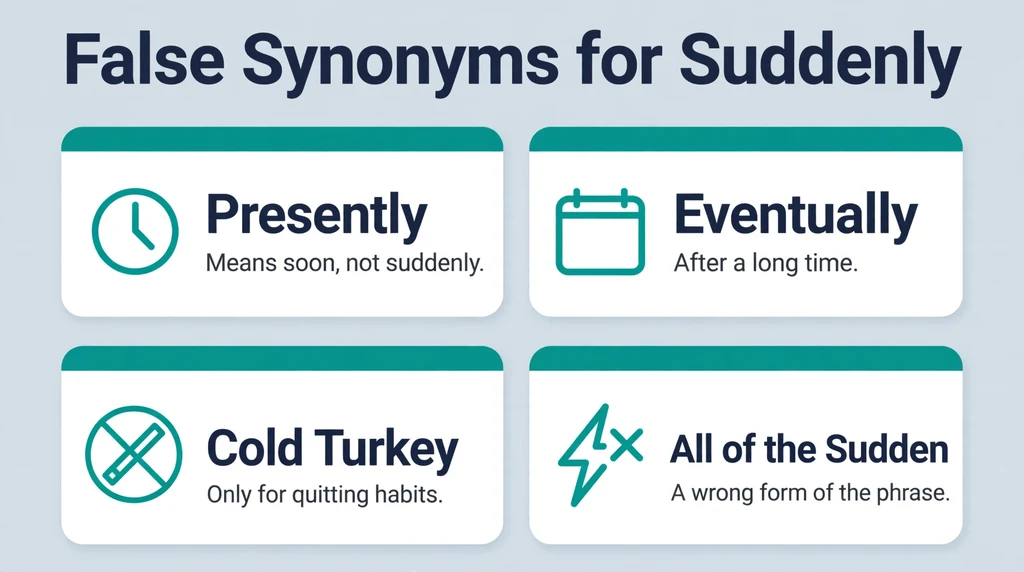
Some words sit in loose online lists for suddenly but do not actually mean it. Swapping them in will bend your sentence, or break it.
“All of the Sudden” and “All Over Sudden”
The standard phrase is all of a sudden. Merriam-Webster notes that sudden here is an old noun meaning an unexpected occurrence, and it calls “all over sudden” an eggcorn, a mishearing that feels right. Write all of a sudden, and your editor will relax.
Presently
Presently means soon, or, in current American use, at present. *The doctor will see you presently* promises a short wait, not a shock. It is a classic false friend in student essays.
Eventually
Eventually points the other way in time: after a long delay, in the end. *Eventually, the rain stopped* is almost an antonym of suddenly, so never use it as a swap.
Cold Turkey
Cold turkey means stopping a habit, above all smoking or drinking, abruptly and completely. *He quit cold turkey* works. *The rain stopped cold turkey* does not.
On the Spur of the Moment
This phrase describes a decision made without planning, not an event that happens to someone. *They decided on the spur of the moment to drive to the coast* is correct. *The storm arrived on the spur of the moment* is not.
Quick Finder: Which Synonym Do You Need?
Still torn between two or three options? Match your situation to a row, and take the first word that fits the voice of your piece.
| Your situation | Reach for | Avoid |
|---|---|---|
| A vehicle or machine stopping dead | abruptly, short (stop short) | in a jiffy |
| A character realising the truth | in an instant, all at once | pronto |
| Shocking news arriving | out of the blue, unexpectedly | speedily |
| A fast physical dash | like a shot, in a flash | unanticipatedly |
| A formal report of an unforeseen change | unanticipatedly, unexpectedly | just like that |
| A funny or magical reveal | presto, lo and behold | precipitately |
| A rash, regretted decision | impetuously, rashly | promptly |
| A change of price, tone or direction | sharply | unawares |
Frequently Asked Questions
What is the best synonym for suddenly?
Abruptly is the closest all-round swap, because it matches suddenly in both speed and sharpness. For pure surprise, unexpectedly is better. For a warm, natural story feel, all of a sudden is hard to beat.
What is a formal synonym for suddenly?
Unanticipatedly and forthwith are the most formal single words. Instantaneously suits technical writing, while promptly works well in polite business prose when the meaning is “without delay”.
Is “all of a sudden” correct?
Yes. All of a sudden is the standard, dictionary-approved phrase. “All of the sudden” and “all over sudden” are common errors that editors correct on sight.
What is the difference between suddenly and abruptly?
Suddenly stresses that something was unexpected. Abruptly stresses how it happened: sharply, with great suddenness, often stopping or changing course. A conversation can end abruptly at a planned time, with no surprise at all.
How many times should I use suddenly in a story?
There is no fixed number, but a sound working rule is once per scene at most. Rotate through speed, surprise and force synonyms instead, and let some twists arrive with no warning word at all.
What is the opposite of suddenly?
Gradually and slowly are the main antonyms. Leisurely, sluggishly and hesitantly cover slower, heavier or more doubtful movement, while expectedly covers the surprise side: the event was foreseen.
Can I start a sentence with a synonym for suddenly?
Yes, and it is a classic story move. “Out of the blue, the phone rang.” “In a flash, she was gone.” A sentence opener works best when what follows is short and sharp.
Is there a stronger word than suddenly?
For force, abruptly and sharply hit harder. For total surprise, out of the blue and astoundingly are stronger. The strongest choice depends on whether your scene needs speed, shock or impact.
Final Thoughts
Suddenly will always earn its place. It is short, clear and honest, and it has carried surprise in English stories for centuries. The trick is not to ban it, but to spend it well. Keep abruptly for the sharp breaks, unexpectedly and out of the blue for the moments nobody saw coming, and in a flash or instantly when only speed matters. Group by group, the 55+ swaps in this guide will keep your twists feeling fresh instead of routine. For the full dictionary treatment, including every related word and antonym, the Merriam-Webster Thesaurus entry for suddenly is the reference this guide was checked against. Now go and break some calm scenes.
One last habit worth building: keep a short personal list. Every writer’s scenes break in characteristic ways (doors, weather, news, feelings), and five trusted swaps per break will cover most drafts. Start with abruptly, unexpectedly, all of a sudden, in a flash and without warning, then let the groups above widen the bench as your style develops. A small, well-known toolkit beats a long list you never open.