Have you ever found yourself writing an essay, a professional email, or a social media post and realized you have used the word “republic” three times in two paragraphs? You are not alone. Many writers, students, and professionals struggle to find the right alternative when they need to describe a system of government, a political entity, or a nation without repeating the same term. Whether you are drafting a research paper, preparing a business presentation, or simply trying to improve your vocabulary, knowing the best synonyms of republic can transform your writing from repetitive to refined. Choosing the right synonym is not about showing off; it is about communicating with clarity, precision, and confidence. This guide will help you understand the meaning of republic, explore its best synonyms, and learn exactly which word to use in every situation.
What Are the Best Synonyms of “Republic”?
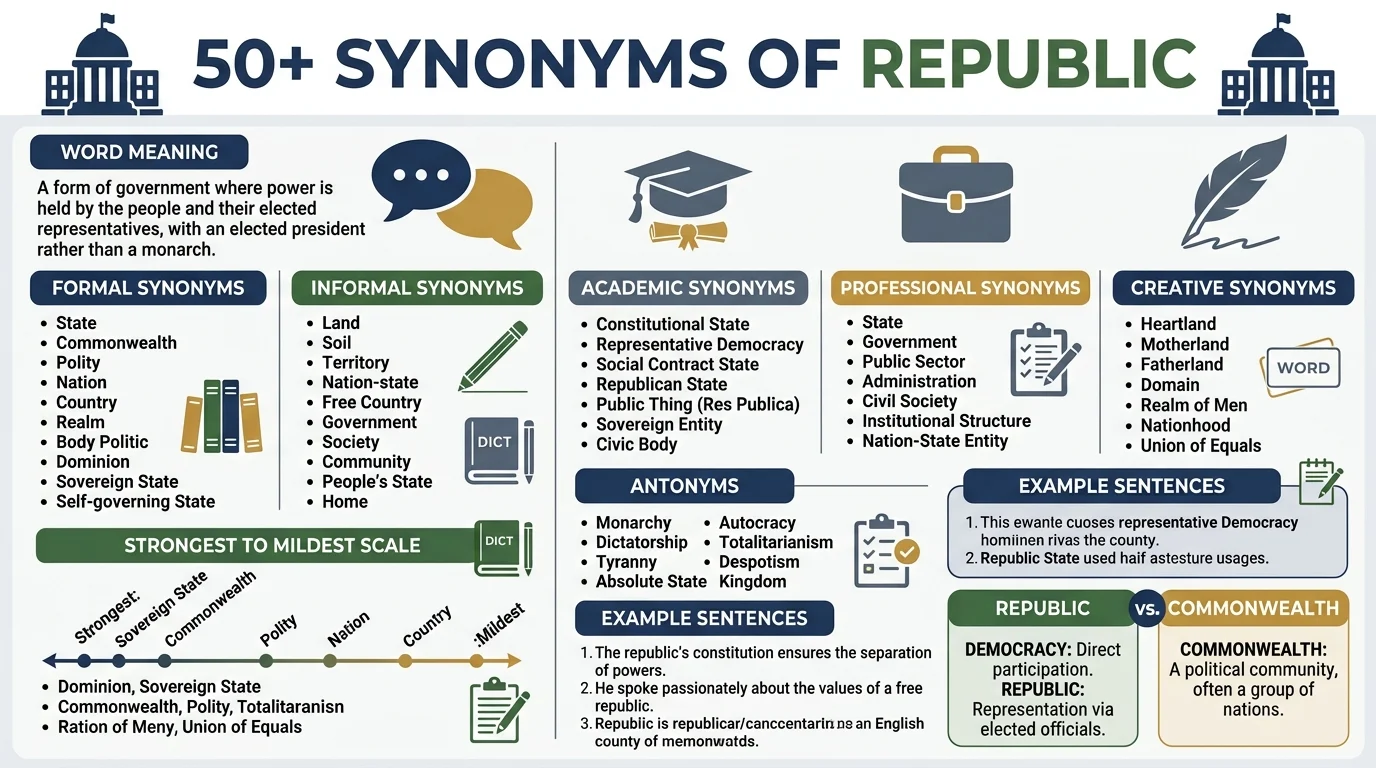
A republic is a form of government where power rests with citizens who elect representatives to govern on their behalf. The best synonyms depend on your context: use democracy for general references, commonwealth for historical or traditional contexts, representative government for academic writing, constitutional government for professional communication, and state or nation for casual conversation.
Meaning, Tone, and Context
Simple Definition
A republic is a country or political system governed by elected representatives and an elected leader, such as a president, rather than by a monarch. The supreme power in a republic rests with the people, who exercise it through their chosen representatives.
Part of Speech
Noun (countable). Plural: republics.
Overall Tone
Neutral. The word itself does not carry a positive or negative emotional charge. It simply describes a specific form of government.
Formality Level
Formal to semi-formal. “Republic” is appropriate in academic writing, professional communication, news reporting, and government contexts. It is less common in casual everyday conversation unless discussing politics or current events.
Common Uses
Native English speakers use “republic” most frequently in political discussions, history lessons, government documents, news articles, and academic writing. You will also encounter it in country names, such as the Republic of Ireland or the French Republic.
Word Forms
- Noun: republic
- Related adjective: republican
- Related noun (person): republican (one who supports a republican form of government)
- Related noun (system): republicanism
When and How to Use “Republic”
You should choose “republic” when you need a precise, formal term for a government where power comes from the people through elected representatives. It is the standard word for describing countries that are not monarchies.
Here are seven realistic examples showing how to use “republic” in different contexts.
Professional: The company operates in multiple jurisdictions, including several European republics with varying regulatory frameworks.
Academic: The Roman Republic lasted for nearly five centuries before transitioning to imperial rule.
Workplace: Our international team includes colleagues from both constitutional monarchies and republics.
Personal: When I traveled to the Republic of Ireland, I was struck by how proudly the locals spoke about their independent government.
Email: Please confirm whether our compliance protocols align with the legal standards of the Czech Republic.
Resume: Served as a policy analyst for the Ministry of Foreign Affairs of a Central Asian republic.
Social Media: Did you know that the United States is a republic, not a direct democracy? 🇺🇸
Best Synonyms of “Republic”
No synonym perfectly matches “republic” in every situation. Each alternative carries slightly different connotations, and the best choice depends on your audience, purpose, and tone.
- Professional writing: Constitutional government – This term emphasizes the rule of law and the structure of governance, making it ideal for business and policy documents.
- Academic writing: Representative democracy – This phrase is precise and widely used in political science to describe the system where citizens elect officials to make decisions on their behalf.
- Business communication: State – Simple, neutral, and widely understood, “state” works well in international business contexts.
- Casual conversation: Country or nation – These are the most natural choices for everyday speech.
- Emotional writing: Free state – This phrase carries a sense of liberty and independence.
- Creative writing: Commonwealth – With its historical and slightly formal tone, “commonwealth” adds a literary quality.
- Resume writing: Democratic state – This term signals political awareness and is appropriate for roles in government, policy, or international relations.
- Workplace communication: Government – Broad and accessible, “government” works well in internal communications.
- Stronger meaning: Sovereign state – Emphasizes independence and self-governance.
- Softer meaning: Polity – A more abstract and neutral term that describes any organized political community.
When Not to Use “Republic”
Using “republic” in the wrong context can make your writing sound awkward, overly formal, or simply inaccurate.
When the Word Sounds Too General
If you are discussing the specific structure of a government, “republic” may be too broad. For example, saying “the republic has a parliament” is fine, but if you need to emphasize the electoral process, use representative democracy instead.
Better synonym: Representative democracy
When the Word Sounds Too Vague
In creative writing or storytelling, “republic” can feel dry and clinical. If you are describing a fictional government, commonwealth or free state may create a more vivid impression.
Better synonym: Commonwealth
When the Word Sounds Too Formal
In casual conversation, texting, or social media, “republic” can seem stiff. Most people naturally say country or nation in everyday speech.
Better synonym: Country
When the Word Sounds Too Weak
If you need to emphasize the independence or sovereignty of a state, “republic” does not carry that weight on its own. Use sovereign state or independent nation instead.
Better synonym: Sovereign state
When the Word Sounds Outdated
In some contexts, particularly historical discussions, “republic” may feel anachronistic when referring to ancient governments. City-state or polity may be more appropriate.
Better synonym: Polity
Words Commonly Confused With “Republic”
Republic vs Democracy
Difference: While often used interchangeably, a republic specifically means a government without a monarch, whereas democracy emphasizes rule by the people. In practice, most modern republics are also representative democracies.
When to Use It: Use republic when emphasizing the absence of a monarchy. Use democracy when emphasizing popular participation.
Example (Republic): The United States is a constitutional republic.
Example (Democracy): The United States is a representative democracy.
Republic vs Commonwealth
Difference: “Commonwealth” historically meant the same as “republic” and is still used as a synonym in some contexts. However, today it often refers to a political community founded for the common good or to specific entities like the Commonwealth of Nations.
When to Use It: Use commonwealth for historical or traditional contexts, or when referring to specific political entities like the Commonwealth of Virginia.
Example (Republic): France is a republic.
Example (Commonwealth): Puerto Rico is a commonwealth of the United States.
Republic vs State
Difference: “State” is a broader term that can refer to any organized political entity, including monarchies, republics, and federated units within a country. “Republic” is more specific.
When to Use It: Use state when you need a general term for a political unit. Use republic when you need to specify the form of government.
Example (Republic): The republic was established in 1946.
Example (State): The state has the authority to regulate commerce.
Republic vs Nation
Difference: “Nation” refers to a group of people with a shared identity, culture, or history, whereas “republic” refers to a specific form of government. A nation may or may not have its own state or republic.
When to Use It: Use nation when emphasizing the people and their cultural identity. Use republic when emphasizing the governmental structure.
Example (Republic): The republic guarantees freedom of speech.
Example (Nation): The Cherokee Nation has its own government.
Republic vs Federation
Difference: A federation is a specific type of political union where power is divided between a central authority and constituent political units. A republic can be a federation, but not all federations are republics.
When to Use It: Use federation when describing a union of states or regions. Use republic for the overall form of government.
Example (Republic): Germany is a federal republic.
Example (Federation): The Russian Federation consists of numerous republics.
Best Synonyms of “Republic” by Context
| Context | Best Synonym | Why It Works | Example |
|---|---|---|---|
| Formal writing | Constitutional government | Emphasizes the legal and structural framework | The constitutional government guarantees fundamental rights. |
| Academic writing | Representative democracy | Precise political science terminology | Representative democracy requires an informed electorate. |
| Professional communication | State | Neutral and widely understood | The state has jurisdiction over this matter. |
| Business emails | Country | Clear and professional without being overly technical | Our offices are located in three different countries. |
| Resume writing | Democratic state | Signals political awareness and fits policy roles | Advised the democratic state on trade policy. |
| Workplace communication | Government | Accessible and appropriate for internal use | The government has issued new guidelines. |
| Casual conversation | Country | Natural and conversational | Which country has the oldest republic? |
| Everyday speaking | Nation | Simple and clear | The nation is preparing for elections. |
| Creative writing | Commonwealth | Adds a literary, historical tone | The commonwealth flourished under wise leadership. |
| Storytelling | Free state | Evokes a sense of liberty and independence | The free state rose from the ashes of tyranny. |
| Emotional writing | Republic (itself) | Neutral; use other words for emotional weight | (Use “free state” or “commonwealth” instead) |
| Strong emphasis | Sovereign state | Highlights independence and authority | The sovereign state refused foreign intervention. |
| Mild tone | Polity | Abstract and neutral | The polity evolved over centuries. |
| Social media captions | Country | Short, accessible, and shareable | Visiting a country with a rich republican history. |
| American English | Republic | Standard usage | The American republic was founded in 1776. |
| British English | Republic | Same usage, though “commonwealth” appears more often in British historical contexts | The Commonwealth is a voluntary association of nations. |
How to Choose the Best Synonym of “Republic”
Choosing the right synonym comes down to asking yourself a few simple questions.
What is your audience? If you are writing for academics or professionals, representative democracy or constitutional government will sound precise and authoritative. If you are writing for a general audience, country or nation is more accessible.
What is your tone? For formal writing, stick with republic or state. For creative or emotional writing, consider commonwealth or free state.
What are you emphasizing? If you want to highlight the absence of a monarch, republic is the best choice. If you want to emphasize popular participation, use democracy. If you want to stress independence, choose sovereign state.
How strong should the word feel? Polity and state are neutral. Commonwealth carries a slightly warmer, more traditional tone. Sovereign state is strong and assertive.
The best synonym is the one that communicates your intended message most clearly to your specific reader. There is no single “correct” alternative, only the right choice for your context.
Real Life Examples of “Republic”
These examples show how “republic” and its synonyms appear in real-world communication.
School: In our history class, we studied the Roman Republic and compared it to modern democratic states.
College: The political science professor explained that a republic is not the same as a direct democracy.
Workplace: Our international division has projects in several European republics.
Business: The company expanded into a new market in the Baltic republic.
Email: Please review the compliance requirements for the Republic of Korea.
Resume: Served as a liaison between the federal government and state-level republics.
Conversation: “Is the United States a republic or a democracy?” “Technically, it is both.”
Storytelling: The ancient republic fell when its leaders abandoned the principles of representation.
Blogging: Many people do not realize that a republic simply means a government without a king or queen.
Social Media: Fun fact: the word “republic” comes from the Latin res publica, meaning “public affair.” 🇺🇸
18 Best Synonyms of “Republic”
| Synonym | Simple Meaning | Best Used For | Example Sentence |
|---|---|---|---|
| Democracy | Government by the people | General political discussions | The country transitioned to a democracy after decades of authoritarian rule. |
| Commonwealth | A political community for the common good | Historical or traditional contexts | The commonwealth was founded on principles of shared governance. |
| Representative government | Government through elected officials | Academic and political science writing | Representative government ensures that citizens have a voice in decision-making. |
| Constitutional government | Government limited by a constitution | Legal and professional contexts | A constitutional government protects individual rights. |
| State | An organized political entity | General and professional use | The state has the authority to levy taxes. |
| Nation | A group with shared identity | Cultural and social contexts | The nation celebrated its independence day. |
| Country | A geographical and political unit | Casual and everyday conversation | Which country has the oldest continuous republic? |
| Federation | A union of states or regions | Describing federal systems | The federation consists of several autonomous republics. |
| Polity | An organized political community | Abstract or academic discussions | The polity evolved over many generations. |
| Sovereign state | An independent political entity | Emphasizing independence | The sovereign state refused to yield to external pressure. |
| Free state | A state with liberty and self-governance | Creative or emotional writing | The free state stood as a beacon of hope. |
| Democratic state | A state with democratic governance | Professional and policy writing | The democratic state invested heavily in education. |
| Elective government | Government by elected officials | Formal descriptions | The elective government represented the will of the people. |
| Popular government | Government by the people | Historical or rhetorical use | Popular government was the ideal of the Enlightenment. |
| Republic (itself) | A government without a monarch | Any context where precision is needed | The republic guarantees freedom of speech. |
| Parliamentary republic | A republic with a parliamentary system | Specific political descriptions | Germany is a parliamentary republic. |
| Federal republic | A republic with a federal structure | Specific political descriptions | The United States is a federal republic. |
| Crowned republic | A monarchy that functions like a republic | Rare or historical contexts | Some scholars describe the United Kingdom as a crowned republic. |
Synonyms of “Republic” by Usage
Professional vs Personal Synonyms
In professional settings, choose words that sound authoritative and precise. Constitutional government, state, and sovereign state work well in reports, presentations, and business communications. In personal conversations, country and nation are more natural and approachable. Save representative government for formal discussions with colleagues or clients.
Formal vs Conversational Synonyms
Formal writing favors constitutional government, representative democracy, and elective government. These terms appear in reports, essays, and presentations. Conversational English prefers country, nation, and simply government. Texting and social media call for the shortest, simplest options: country or state.
Academic Synonyms
Academics and researchers should use representative democracy, constitutional government, and polity. These terms are precise, widely recognized in political science, and convey authority. Representative government is the standard term in political theory and comparative politics.
Professional and Business Synonyms
For resumes, interviews, meetings, and client communications, choose state, sovereign state, or democratic state. These words sound professional without being overly technical. Constitutional government is appropriate for policy documents and legal contexts.
Creative and Literary Synonyms
Writers of fiction, poetry, and speeches can use commonwealth, free state, and polity to add depth and imagery. Commonwealth carries a historical, almost noble tone that works well in epic or traditional storytelling. Free state evokes liberty and resilience.
Slang or Modern Synonyms
There are no widely used slang synonyms for “republic.” The word is too formal and specific to have entered casual slang. In informal contexts, simply use country or nation.
Strongest to Mildest Synonyms
Mild: Polity, state, country, nation
Moderate: Commonwealth, democratic state, free state
Strong: Representative democracy, constitutional government, sovereign state
Very Strong: Popular government, elective government
The emotional intensity increases as the synonym emphasizes the people’s role and the legitimacy of the government.
Emotional vs Neutral Synonyms
Emotional Synonyms: Free state, commonwealth, popular government – These words carry positive connotations of liberty, shared purpose, and the will of the people. Use them in speeches, creative writing, and persuasive pieces.
Neutral Synonyms: State, country, nation, polity – These words simply describe political entities without adding emotional weight. Use them in reports, business communications, and academic writing where objectivity is important.
Antonyms of “Republic”
| Antonym | Meaning | Example Sentence |
|---|---|---|
| Monarchy | Government ruled by a king or queen | The monarchy has ruled the country for centuries. |
| Dictatorship | Government ruled by a single absolute ruler | The dictatorship suppressed all political opposition. |
| Autocracy | Government with unlimited power in one person | The autocracy disregarded the will of the people. |
| Tyranny | Oppressive and cruel government | The tyranny of the regime was widely condemned. |
| Despotism | Absolute power exercised cruelly | Despotism has no place in a modern society. |
| Totalitarianism | Government with total control over society | Totalitarianism eliminates all political opposition. |
| Authoritarianism | Government with strong central power | Authoritarianism restricts civil liberties. |
| Absolutism | Government with unrestricted power | Absolutism concentrates power in a single ruler. |
| Oligarchy | Government by a small elite group | The oligarchy controlled all major industries. |
| Theocracy | Government by religious leaders | The theocracy based its laws on religious texts. |
| Feudalism | A hierarchical system with lords and vassals | Feudalism dominated medieval Europe. |
| Empire | A large political unit ruled by an emperor | The empire expanded through conquest. |
| Kingdom | A country ruled by a king or queen | The kingdom was known for its strong monarchy. |
| Principality | A state ruled by a prince | The principality maintained its independence. |
| Sultanate | A state ruled by a sultan | The sultanate controlled trade routes in the region. |
Comparison: “Republic” vs Similar Words
Republic vs Democracy
Main Difference: A republic is defined by the absence of a monarch and the presence of elected representatives. Democracy emphasizes rule by the people, whether directly or through representatives. In modern usage, the two terms are largely interchangeable.
Which Is Stronger? Neither is inherently stronger. “Republic” emphasizes structure; “democracy” emphasizes participation.
Which Is More Formal? Both are formal, but “republic” is slightly more technical in political science.
When to Use Each: Use republic when you need to specify that there is no monarch. Use democracy when emphasizing popular participation.
Examples:
Republic: The Fifth Republic was established in 1958.
Democracy: The country embraces democracy as its core value.
Republic vs Commonwealth
Main Difference: Historically, “commonwealth” was the English translation of the Latin res publica, making it a direct synonym. Today, “commonwealth” often refers to specific political entities like the Commonwealth of Nations or the Commonwealth of Virginia.
Which Is Stronger? “Commonwealth” carries a slightly warmer, more traditional tone.
Which Is More Formal? Both are formal, but “commonwealth” is more old-fashioned.
When to Use Each: Use commonwealth for historical contexts or when referring to specific entities. Use republic for modern political descriptions.
Examples:
Republic: The republic guaranteed equal rights.
Commonwealth: The commonwealth was founded for the common good.
Republic vs State
Main Difference: “State” is broader and can refer to any organized political entity, including monarchies and federated units. “Republic” specifically denotes a government without a monarch.
Which Is Stronger? “Republic” is more specific and therefore stronger in political discussions.
Which Is More Formal? Both are formal, but “state” is more versatile.
When to Use Each: Use republic when you need to specify the form of government. Use state for general references to political entities.
Examples:
Republic: The republic was established after the revolution.
State: The state has the power to enforce laws.
Republic vs Nation
Main Difference: “Nation” refers to a people with shared identity, culture, or history. “Republic” refers to a form of government. A nation may not have its own state or republic.
Which Is Stronger? “Nation” can be emotionally stronger because it evokes cultural identity.
Which Is More Formal? Both are formal, but “nation” is more common in everyday speech.
When to Use Each: Use nation when emphasizing the people. Use republic when emphasizing the government.
Examples:
Republic: The republic guarantees freedom of speech.
Nation: The nation mourned the loss of its leader.
Republic vs Federation
Main Difference: A federation is a union of states or regions with a central government. A republic can be a federation, but not all federations are republics.
Which Is Stronger? Neither is inherently stronger. They describe different aspects of political organization.
Which Is More Formal? Both are formal.
When to Use Each: Use federation when describing a union. Use republic for the overall form of government.
Examples:
Republic: Germany is a federal republic.
Federation: The federation consists of sixteen states.
Republic vs Sovereign State
Main Difference: “Sovereign state” emphasizes independence and authority. “Republic” emphasizes the form of government without a monarch.
Which Is Stronger? “Sovereign state” is stronger because it highlights independence.
Which Is More Formal? Both are formal, but “sovereign state” is more authoritative.
When to Use Each: Use sovereign state when you need to emphasize independence. Use republic when describing the form of government.
Examples:
Republic: The republic joined the United Nations.
Sovereign state: The sovereign state refused foreign intervention.
Common Phrases and Expressions with “Republic”
Banana republic
Meaning: A small, politically unstable country that relies on a single export and is often corrupt.
Example Sentence: The critics called the regime a banana republic because of its corruption and instability.
Republic of letters
Meaning: The community of scholars, writers, and intellectuals who communicate through literary and academic work.
Example Sentence: She was well known throughout the republic of letters for her groundbreaking research.
Federal republic
Meaning: A republic with a federal system of government.
Example Sentence: The United States is a federal republic with power divided between the national and state governments.
Parliamentary republic
Meaning: A republic where the executive branch derives its legitimacy from the parliament.
Example Sentence: Germany is a parliamentary republic with a chancellor as the head of government.
Constitutional republic
Meaning: A republic governed by a constitution that limits the power of the government.
Example Sentence: A constitutional republic protects the rights of its citizens through the rule of law.
Democratic republic
Meaning: A republic that operates on democratic principles.
Example Sentence: The country declared itself a democratic republic after the fall of the monarchy.
Common Mistakes to Avoid
Choosing a Vague Synonym Instead of a Precise One
Incorrect: The nation is a country. (Too vague)
Better: The nation is a constitutional republic.
Why: “Country” is so broad that it does not communicate the form of government. “Constitutional republic” is precise and informative.
Confusing “Republic” with “Democracy”
Incorrect: The United States is a pure democracy.
Better: The United States is a representative democracy and a constitutional republic.
Why: The United States is not a direct democracy; it is a representative democracy. Using “republic” acknowledges this distinction.
Using an Informal Synonym in Formal Writing
Incorrect: The nation’s government is a country. (Too informal)
Better: The nation’s government is a republic.
Why: “Country” is too casual for formal writing about political systems.
Selecting an Overly Dramatic Synonym
Incorrect: The free state will decide its future. (Too dramatic for neutral contexts)
Better: The republic will decide its future.
Why: “Free state” has strong emotional connotations that may not be appropriate in neutral or professional writing.
Repeating the Same Word Too Often
Incorrect: The republic was founded in 1776. The republic has a constitution. The republic elects its leaders.
Better: The republic was founded in 1776. It has a constitution and elects its leaders.
Why: Varying your word choice and sentence structure improves readability.
Choosing a Synonym with the Wrong Emotional Tone
Incorrect: The commonwealth was established after the revolution. (Too traditional for a modern context)
Better: The republic was established after the revolution.
Why: “Commonwealth” has a historical, old-fashioned tone that may not fit a contemporary description.
Using Slang in Academic or Professional Writing
Incorrect: The country is a banana republic. (Too informal and derogatory)
Better: The country is an unstable republic with a weak economy.
Why: “Banana republic” is a slang term with negative connotations that is inappropriate for academic or professional writing.
Frequently Asked Questions
1. What are the best synonyms of “republic”?
The best synonyms depend on your context. General use, try democracy, commonwealth, or representative government. For formal writing, choose constitutional government or state. For casual conversation, use country or nation.
2. What are the best formal synonyms of “republic”?
Constitutional government, representative democracy, and sovereign state are excellent formal synonyms. They sound authoritative and precise in academic, legal, and professional contexts.
3. What are common informal synonyms of “republic”?
Country and nation are the most common informal synonyms. They are natural, accessible, and appropriate for everyday conversation, social media, and casual writing.
4. What is another word for “republic” in professional writing?
State and sovereign state work well in professional writing. They are neutral, widely understood, and appropriate for business communications, reports, and presentations.
5. What is the difference between “republic” and “democracy”?
A republic is a government without a monarch, while democracy emphasizes rule by the people. In modern usage, they are often interchangeable, but “republic” focuses on structure and “democracy” focuses on participation.
6. What is the opposite of “republic”?
The primary opposite is monarchy. Other opposites include dictatorship, autocracy, tyranny, and totalitarianism. These terms describe governments where power is not held by the people through elected representatives.
Conclusion
Understanding the meaning of republic is the first step toward using it and its synonyms effectively. A republic is a government without a monarch, where power rests with citizens who elect representatives to govern on their behalf. The best synonyms of republic include democracy, commonwealth, representative government, state, nation, and country, but no single synonym works perfectly in every situation. Your choice should depend on your audience, your tone, and what you want to emphasize. The next time you need an alternative to “republic,” consider whether you are writing formally or casually, emotionally or neutrally, and choose the word that communicates your message most clearly. A strong vocabulary is not about using the biggest words; it is about using the right words for the right moment.