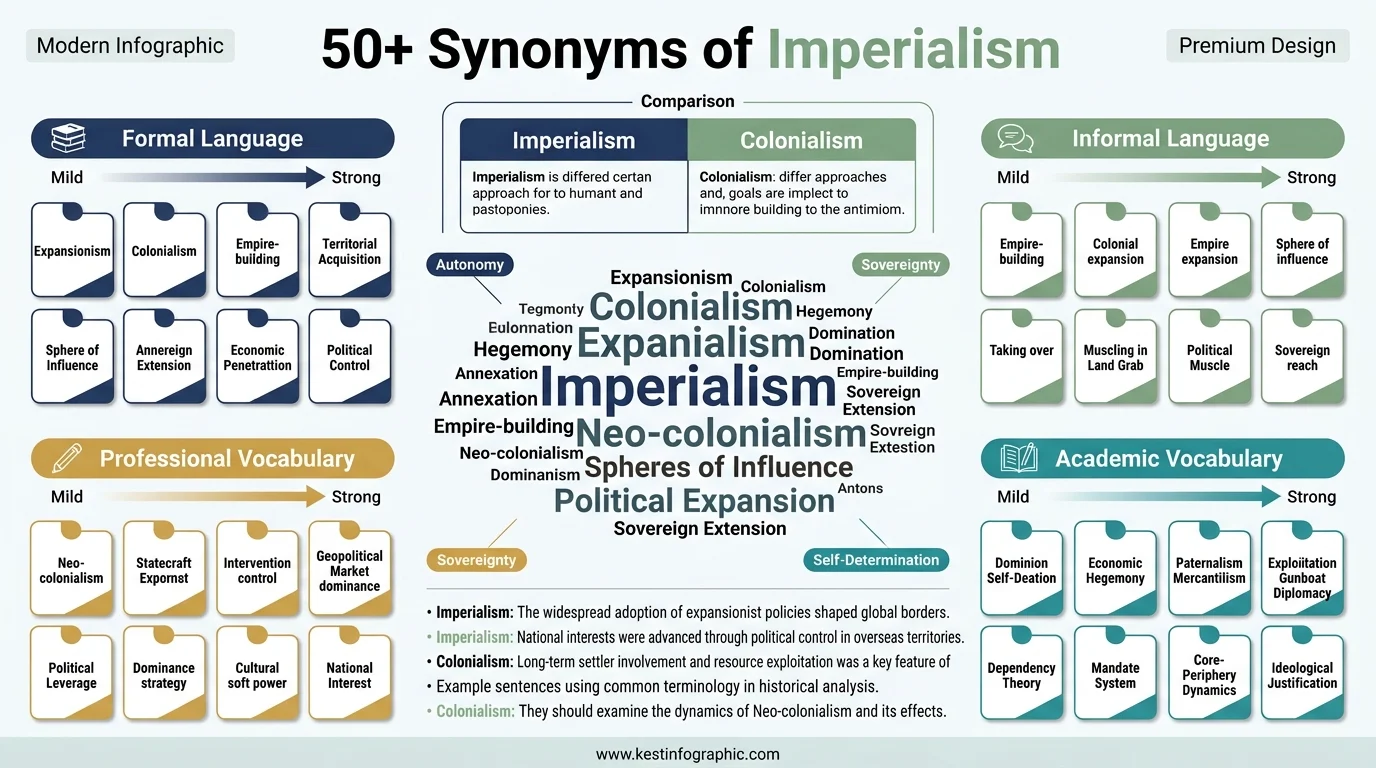
Have you ever found yourself writing about political systems, historical events, or global power dynamics and realized you keep using the same word over and over? Maybe you are working on an essay about world history, drafting a blog post about international relations, or preparing a presentation on global politics. Repeating the same term makes your writing feel flat and less precise. That is where understanding the synonyms of imperialism becomes essential. Choosing the right alternative helps you communicate more clearly, match the right tone, and avoid sounding repetitive. This guide will help you master every synonym of imperialism so you can write with confidence in any situation.
What Are the Best Synonyms of “Imperialism”?
Imperialism means the policy or practice of extending a nation’s power and influence over other countries, often through military force, economic control, or political dominance. The best synonyms depend on context. For formal writing, choose colonialism or hegemony. Academic work, use expansionism or dominance. For professional communication, influence or control work well. Creative writing, try empire-building or conquest.
Meaning, Tone, and Context
Simple Definition: Imperialism is the policy or practice by which a powerful nation extends its authority over other countries or territories, often through military force, economic pressure, or political manipulation.
Part of Speech: Noun
Overall Tone: Negative. Imperialism is almost always used critically to describe the domination of one nation over others. It implies an unequal relationship where the stronger power exploits or controls the weaker one.
Formality Level: Formal. This word belongs in serious discussions about history, politics, international relations, and economics. It is rarely used in casual conversation.
Common Uses: Native English speakers use imperialism most often in:
- Historical discussions about European empires, the Roman Empire, or colonial expansion
- Political analysis of modern superpower influence
- Academic writing about international relations
- Critiques of economic or cultural domination
Word Forms:
- Noun: imperialism
- Adjective: imperialistic
- Noun (person): imperialist
- Adverb: imperialistically
When and How to Use “Imperialism”
Choose imperialism when you need to describe systematic domination by one nation over others. It works best in formal, analytical contexts where you are discussing power structures, historical events, or political ideologies.
Here are seven realistic examples, each labeled by context.
Academic: “The 19th century witnessed unprecedented European imperialism across Africa and Asia.”
Professional: “Our report examines how economic imperialism affects developing nations’ trade policies.”
Workplace: “The board discussed concerns about cultural imperialism in the company’s global marketing strategy.”
Personal: “I have been reading about British imperialism in India and its lasting effects on the region.”
Email: “The professor’s lecture on American imperialism in the Pacific was eye-opening.”
Resume: “Conducted independent research on the economic effects of European imperialism in Southeast Asia.”
Social Media: “Many historians argue that modern economic policies reflect a new form of imperialism.”
Best Synonyms of “Imperialism”
No synonym perfectly matches imperialism in every situation. Each alternative carries its own shade of meaning, tone, and level of formality. Here are the best choices for specific contexts.
Professional Writing
Best: Control or influence
These words are neutral and direct. They describe the exercise of power without the heavy historical baggage of imperialism.
Academic Writing
Best: Hegemony or dominance
Hegemony refers specifically to leadership or dominance of one state over others, often through cultural or ideological means. It is the preferred term in political science and sociology.
Business Communication
Best: Expansion or market penetration
These words focus on commercial growth rather than political domination. They are more acceptable in corporate contexts.
Casual Conversation
Best: Power play or takeover
These informal alternatives communicate the idea of one entity dominating another without sounding overly academic.
Emotional Writing
Best: Oppression or exploitation
These words emphasize the human cost and injustice of imperial systems. They carry strong emotional weight.
Creative Writing
Best: Empire-building or conquest
These vivid alternatives work well in fiction, poetry, and narrative nonfiction. They evoke images of ambition and expansion.
Resume Writing
Best: Research focus or area of study
When describing your academic interests, use neutral phrasing that does not carry political connotations.
Workplace Communication
Best: Strategy or approach
These words describe plans and methods without the negative associations of imperialism.
Stronger Meaning
Best: Subjugation or domination
These words emphasize complete control and the suppression of others.
Softer Meaning
Best: Influence or presence
These words suggest power without the implication of force or exploitation.
When Not to Use “Imperialism”
Using imperialism in the wrong context can make you sound overly dramatic, political, or unclear. Here are situations where you should choose a different word.
When It Sounds Too Political
If you are discussing normal business expansion or cultural exchange, imperialism is too strong and carries negative connotations.
Incorrect: “Our company’s imperialism into new markets has been successful.”
Better: “Our company’s expansion into new markets has been successful.”
The word expansion is neutral and professional. It describes growth without implying exploitation or force.
When It Sounds Too Aggressive
If you are describing peaceful influence or cooperation, imperialism suggests hostility and domination.
Incorrect: “The university’s imperialism over local schools is concerning.”
Better: “The university’s influence over local schools is concerning.”
Influence describes the relationship without the aggressive overtones.
When It Sounds Too Vague
Imperialism can be too broad if you need to specify the type of control.
Incorrect: “We studied imperialism in our economics class.”
Better: “We studied economic dominance in our economics class.”
Economic dominance is more precise and clearly describes the focus of study.
When It Sounds Outdated
In modern discussions about cultural exchange or global cooperation, imperialism can feel anachronistic.
Incorrect: “American imperialism in global fashion is obvious.”
Better: “American cultural influence in global fashion is obvious.”
Cultural influence is the contemporary term for this phenomenon.
When It Sounds Too Strong
If you are describing a minor imbalance of power, imperialism overstates the situation.
Incorrect: “The larger school’s imperialism over the smaller one is unfair.”
Better: “The larger school’s dominance over the smaller one is unfair.”
Dominance describes the imbalance without the extreme connotations of imperialism.
Words Commonly Confused With “Imperialism”
Imperialism vs Colonialism
Difference: Imperialism is the broader policy of extending power and influence over other nations. Colonialism is the specific practice of establishing settlements and direct control over foreign territories. Colonialism is often a consequence of imperialism, but imperialism can exist without formal colonies.
When to Use Each: Use imperialism when discussing the general policy or ideology of domination. Use colonialism when referring to the actual settlement and administration of foreign lands.
Example (Imperialism): “British imperialism shaped global trade patterns for centuries.”
Example (Colonialism): “British colonialism in India involved direct administrative control.”
Imperialism vs Hegemony
Difference: Imperialism implies the active extension of power, often through force or coercion. Hegemony refers to dominance through cultural, economic, or ideological influence rather than direct military control.
When to Use Each: Use imperialism for forceful, active domination. Use hegemony for subtle, indirect influence.
Example (Imperialism): “The empire’s imperialism was enforced through military occupation.”
Example (Hegemony): “The nation’s cultural hegemony spread through media and education.”
Imperialism vs Expansionism
Difference: Imperialism focuses on political and economic control over other peoples. Expansionism simply means the policy of territorial or economic growth, without necessarily implying domination over others.
When to Use Each: Use imperialism when the expansion involves controlling other nations. Use expansionism when referring to general growth.
Example (Imperialism): “Japanese imperialism in the early 20th century involved military conquest.”
Example (Expansionism): “American expansionism in the 19th century pushed the frontier westward.”
Imperialism vs Nationalism
Difference: Imperialism is about extending power over other nations. Nationalism is about loyalty and devotion to one’s own nation. Nationalism can exist without imperialism.
When to Use Each: Use imperialism for external domination. Use nationalism for internal pride and unity.
Example (Imperialism): “European imperialism divided Africa among competing powers.”
Example (Nationalism): “Nationalism fueled resistance against colonial rule.”
Imperialism vs Jingoism
Difference: Imperialism is the actual policy of extending power. Jingoism is aggressive, patriotic rhetoric that supports such policies.
When to Use Each: Use imperialism for the policy itself. Use jingoism for the public attitude that supports it.
Example (Imperialism): “The government’s imperialism was justified through nationalist propaganda.”
Example (Jingoism): “The newspaper’s jingoism encouraged public support for the war.”
Imperialism vs Militarism
Difference: Imperialism is about extending political and economic control. Militarism is the belief that a country should maintain a strong military and use it aggressively. Militarism can be a tool of imperialism but is not the same thing.
When to Use Each: Use imperialism for the overall policy of domination. Use militarism when focusing specifically on military power.
Example (Imperialism): “Imperialism often relies on military force to maintain control.”
Example (Militarism): “The country’s militarism led to increased defense spending.”
Best Synonyms of “Imperialism” by Context
| Context | Best Synonym | Why It Works | Example |
|---|---|---|---|
| Formal writing | Hegemony | Precise academic term for dominance without settlement | “American hegemony shaped postwar international institutions.” |
| Academic writing | Colonialism | Specifically describes settlement and administration of colonies | “Colonialism disrupted indigenous social structures across Africa.” |
| Professional communication | Influence | Neutral term for power without negative connotations | “The company’s influence extends to multiple international markets.” |
| Business emails | Expansion | Describes growth positively and professionally | “Our expansion into European markets is progressing well.” |
| Resume writing | Research focus | Neutral phrasing for academic interests | “Research focus: European colonial systems and their global impact.” |
| Workplace communication | Strategy | Describes plans and approaches neutrally | “Our strategy for international growth emphasizes partnership.” |
| Casual conversation | Power play | Informal and easy to understand | “That move was a total power play by the larger country.” |
| Everyday speaking | Takeover | Simple, direct, and widely understood | “Some people see foreign investment as a quiet takeover.” |
| Creative writing | Empire-building | Vivid and evocative of ambition and conquest | “His empire-building consumed every resource in the region.” |
| Storytelling | Conquest | Dramatic and action-oriented | “The conquest of new territories changed the kingdom forever.” |
| Emotional writing | Oppression | Emphasizes suffering and injustice | “The oppression of colonized peoples lasted for generations.” |
| Strong emphasis | Subjugation | Conveys complete control and defeat | “The subjugation of the population was swift and brutal.” |
| Mild tone | Presence | Suggests influence without domination | “The nation’s presence in the region has grown over time.” |
| Social media captions | Global influence | Modern, relevant, and concise | “The country’s global influence is undeniable.” |
| American English | Imperialism | Standard US usage | “American imperialism is a common topic in history classes.” |
How to Choose the Best Synonym of “Imperialism”
Choosing the right synonym depends on several factors. Here is a practical decision guide.
Consider Your Audience: If you are writing for academics or professionals, use hegemony or colonialism. For general readers, use dominance or influence.
Consider Your Tone: If you want to criticize or condemn, use oppression or subjugation. If you want to remain neutral, use expansion or control.
Consider Your Purpose: If you are describing historical events, colonialism and imperialism are appropriate. If you are describing modern economic relationships, influence or hegemony work better.
Emotional Strength: Oppression and exploitation are strong and emotional. Presence and influence are mild and neutral.
Consider Formality: Hegemony and colonialism are formal. Power play and takeover are informal.
Consider Natural Sound: Always choose the word that sounds most natural in your sentence. Read your sentence aloud. If it feels awkward or forced, try a different synonym.
Real Life Examples of “Imperialism”
Here are realistic examples showing how imperialism and its synonyms appear in everyday situations.
School: “Our history teacher explained how European imperialism reshaped the map of Africa.”
Better: “Our history teacher explained how European colonial expansion reshaped the map of Africa.”
College: “The professor’s lecture on cultural imperialism challenged our assumptions about global media.”
Better: “The professor’s lecture on cultural dominance challenged our assumptions about global media.”
Workplace: “The international team discussed concerns about economic imperialism in developing countries.”
Better: “The international team discussed concerns about economic influence in developing countries.”
Business: “The CEO warned against corporate imperialism in our overseas offices.”
Better: “The CEO warned against aggressive expansion in our overseas offices.”
Email: “Attached is my paper on Russian imperialism in Eastern Europe.”
Better: “Attached is my paper on Russian dominance in Eastern Europe.”
Resume: “Researched the economic consequences of British imperialism in India.”
Better: “Researched the economic consequences of British colonial rule in India.”
Conversation: “Some people think American imperialism is still alive today.”
Better: “Some people think American global influence is still dominant today.”
Storytelling: “The emperor’s imperialism knew no bounds as he conquered kingdom after kingdom.”
Better: “The emperor’s hunger for conquest knew no bounds as he took kingdom after kingdom.”
Blogging: “Modern imperialism often takes the form of economic control rather than military force.”
Better: “Modern economic dominance often takes the form of market control rather than military force.”
Social Media: “The documentary exposed the hidden imperialism of international aid programs.”
Better: “The documentary exposed the hidden influence of international aid programs.”
18 Best Synonyms of “Imperialism”
| Synonym | Simple Meaning | Best Used For | Example Sentence |
|---|---|---|---|
| Colonialism | The practice of establishing colonies and settlements in foreign territories | Historical discussions, academic writing | “Colonialism fundamentally altered the political landscape of the continent.” |
| Hegemony | Dominance of one state or group over others, often through cultural or ideological means | Political science, international relations | “The nation’s cultural hegemony spread through films and music.” |
| Expansionism | The policy of territorial or economic growth | Neutral discussions of growth | “The country’s expansionism was driven by economic needs.” |
| Dominance | The state of being more powerful or influential than others | General writing, everyday use | “The region’s economic dominance was unchallenged for decades.” |
| Control | The power to influence or direct people’s behavior or events | Professional writing, neutral contexts | “The corporation exerted control over multiple international markets.” |
| Influence | The capacity to have an effect on someone or something | Mild descriptions of power | “European influence shaped the legal systems of many former colonies.” |
| Subjugation | The act of bringing someone or something under domination or control | Strong emphasis, emotional writing | “The subjugation of the native population lasted for centuries.” |
| Oppression | Prolonged cruel or unjust treatment or control | Emotional writing, social commentary | “The oppression of colonized peoples left deep scars.” |
| Exploitation | The action of treating someone unfairly to benefit from their work | Critical writing, economic discussions | “Economic exploitation was the primary motive for imperial expansion.” |
| Conquest | The act of defeating and taking control of a place or people | Creative writing, storytelling | “The conquest of new lands brought wealth and power to the empire.” |
| Empire-building | The process of creating or expanding an empire | Creative writing, descriptive prose | “His empire-building ambitions consumed the entire region.” |
| Jingoism | Extreme patriotism, especially in support of aggressive foreign policy | Political commentary, critical writing | “Jingoism fueled public support for the imperial adventure.” |
| Militarism | The belief in maintaining a strong military and using it aggressively | Discussions of military policy | “Militarism was a key component of the nation’s imperial strategy.” |
| Interventionism | The policy of interfering in other countries’ affairs | Modern political discussions | “American interventionism has been criticized by many historians.” |
| Neocolonialism | The use of economic, political, or cultural pressures to control former colonies | Contemporary discussions, critical writing | “Critics argue that neocolonialism continues through unfair trade agreements.” |
| Domination | The exercise of power or influence over someone or something | General writing, clear communication | “The domination of global markets by a few corporations is concerning.” |
| Imperial rule | Direct governance by an empire over foreign territories | Historical writing | “Imperial rule was often brutal and exploitative.” |
| Power projection | The ability of a state to exert influence beyond its borders | Military and political analysis | “The country’s power projection capabilities increased its global standing.” |
Synonyms of “Imperialism” by Usage
Professional vs Personal Synonyms
Professional synonyms work best in workplaces, reports, and business settings. They are neutral, direct, and avoid negative connotations.
- Expansion: Describes growth positively.
- Influence: Describes power without aggression.
- Control: Describes authority clearly.
- Strategy: Describes plans neutrally.
Personal synonyms sound more natural in everyday conversations and informal writing.
- Power play: Informal and clear.
- Takeover: Simple and direct.
- Bullying: Emphasizes unfairness.
- Pushing around: Conversational and vivid.
Formal vs Conversational Synonyms
Formal synonyms belong in reports, essays, presentations, and professional emails.
- Hegemony: The standard academic term.
- Colonialism: Precise historical term.
- Expansionism: Neutral policy term.
- Interventionism: Specific political term.
Conversational synonyms work in casual talk, texting, and social media.
- Power grab: Informal and clear.
- Land grab: Vivid and understandable.
- Taking over: Simple and direct.
- Calling the shots: Idiomatic and natural.
Academic Synonyms
These precise vocabulary choices are suitable for research, essays, reports, and academic discussions.
- Hegemony: The preferred term in political science for dominance through cultural or ideological means.
- Colonialism: The standard term for settlement and direct administration of colonies.
- Expansionism: A neutral term for territorial or economic growth.
- Imperialism itself: Still widely used in academic writing when the context demands it.
These words sound more authoritative because they are the accepted terminology in their respective fields.
Professional and Business Synonyms
These are the strongest choices for resumes, interviews, meetings, presentations, and client communication.
- Expansion: Positive and professional. Describes growth without negative connotations.
- Influence: Neutral and widely understood. Describes power politely.
- Presence: Mild and professional. Suggests involvement without domination.
- Strategy: Neutral and forward-looking. Describes plans and approaches.
These words fit professional settings because they are neutral, positive, or at least not overtly negative.
Creative and Literary Synonyms
These expressive alternatives are suitable for storytelling, fiction, poetry, descriptive writing, and speeches.
- Empire-building: Evokes ambition, grand plans, and expansion.
- Conquest: Dramatic and action-oriented. Suggests victory and control.
- Domination: Strong and vivid. Conveys absolute control.
- Subjugation: Powerful and evocative. Suggests defeat and suppression.
These words add emotion and imagery because they paint pictures in the reader’s mind.
Slang or Modern Synonyms
There is no widely used slang synonym for imperialism. The topic is too serious for casual slang. However, some informal expressions capture similar ideas.
- Power grab: Informal. Describes an attempt to seize control. Acceptable in casual conversation. Avoid in formal writing.
- Land grab: Informal. Describes territorial acquisition. Acceptable in casual discussion. Avoid in academic writing.
Strongest to Mildest Synonyms
This intensity scale arranges synonyms from mild to very strong.
Mild:
- Presence
- Influence
- Expansion
Moderate:
- Dominance
- Control
- Hegemony
Strong:
- Domination
- Colonialism
- Imperialism
Very Strong:
- Subjugation
- Oppression
- Conquest
- Exploitation
The emotional intensity increases as you move down the scale. Choose milder words for neutral descriptions. Choose stronger words when you want to emphasize injustice or suffering.
Emotional vs Neutral Synonyms
Emotional Synonyms express stronger feelings and often carry negative connotations.
- Oppression: Suggests cruelty and injustice.
- Exploitation: Suggests unfair treatment.
- Subjugation: Suggests defeat and suppression.
- Conquest: Suggests violence and victory.
Use these when you want to criticize or evoke sympathy.
Neutral Synonyms simply communicate information without adding emotion.
- Expansion: Describes growth neutrally.
- Influence: Describes power neutrally.
- Control: Describes authority neutrally.
- Presence: Describes involvement neutrally.
Use these when you want to remain objective and factual.
Antonyms of “Imperialism”
| Antonym | Meaning | Example Sentence |
|---|---|---|
| Self-determination | The right of a people to govern themselves | “The movement fought for self-determination and independence.” |
| Sovereignty | The authority of a state to govern itself | “The nation reclaimed its sovereignty after decades of colonial rule.” |
| Independence | Freedom from outside control | “Independence movements spread across the continent in the 1960s.” |
| Decolonization | The process of ending colonial rule | “Decolonization transformed the political map of Africa.” |
| Autonomy | The right to self-government | “The region was granted autonomy after years of struggle.” |
| Freedom | The state of being free from oppression | “The people finally achieved freedom from foreign domination.” |
| Liberation | The act of setting someone free from oppression | “Liberation came after years of armed resistance.” |
| Nationalism | Loyalty and devotion to one’s own nation | “Nationalism fueled the fight against imperial rule.” |
| Isolationism | The policy of avoiding involvement in other countries’ affairs | “Isolationism was the country’s response to foreign entanglements.” |
| Anti-imperialism | Opposition to imperialism | “Anti-imperialism was a unifying force among colonized peoples.” |
| Pacifism | The belief that war and violence are unjustifiable | “Pacifism offered an alternative to imperial aggression.” |
| Nonintervention | The policy of not interfering in other countries’ affairs | “Nonintervention was the guiding principle of the nation’s foreign policy.” |
| Equality | The state of being equal in status, rights, and opportunities | “Equality between nations was the goal of the new international order.” |
| Cooperation | The process of working together for mutual benefit | “Cooperation replaced conflict in the new relationship between states.” |
| Mutual respect | Showing regard for the rights and dignity of others | “Mutual respect formed the basis of the new diplomatic relationship.” |
Comparison: “Imperialism” vs Similar Words
Imperialism vs Colonialism
Main Difference: Imperialism is the broader policy of extending power over other nations. Colonialism is the specific practice of establishing settlements and direct control over foreign territories.
Which Is Stronger? Imperialism is broader. Colonialism is more specific.
Which Is More Formal? Both are formal, but colonialism is more precise in historical contexts.
When to Use Each: Use imperialism for general discussions of power extension. Use colonialism when referring specifically to settlement and direct administration.
Examples:
Imperialism: “European imperialism affected every continent.”
Colonialism: “British colonialism in India lasted nearly 200 years.”
Imperialism vs Hegemony
Main Difference: Imperialism implies active extension of power, often through force. Hegemony refers to dominance through cultural, economic, or ideological influence.
Which Is Stronger? Imperialism suggests more active and forceful control.
Which Is More Formal? Hegemony is more formal and academic.
When to Use Each: Use imperialism for forceful domination. Use hegemony for subtle influence.
Examples:
Imperialism: “The empire’s imperialism was enforced by military might.”
Hegemony: “American cultural hegemony spread through Hollywood films.”
Imperialism vs Expansionism
Main Difference: Imperialism focuses on political and economic control over other peoples. Expansionism simply means the policy of territorial or economic growth.
Which Is Stronger? Imperialism is stronger because it implies controlling others.
Which Is More Formal? Expansionism is neutral and professional.
When to Use Each: Use imperialism when the expansion involves controlling other nations. Use expansionism for general growth.
Examples:
Imperialism: “Japanese imperialism involved military conquest.”
Expansionism: “American expansionism pushed the frontier westward.”
Imperialism vs Nationalism
Main Difference: Imperialism is about extending power over other nations. Nationalism is about loyalty to one’s own nation.
Which Is Stronger? Imperialism is externally focused. Nationalism is internally focused.
Which Is More Formal? Both are formal terms in political science.
When to Use Each: Use imperialism for external domination. Use nationalism for internal unity and pride.
Examples:
Imperialism: “European imperialism divided Africa.”
Nationalism: “Nationalism fueled resistance against colonial rule.”
Imperialism vs Jingoism
Main Difference: Imperialism is the actual policy of extending power. Jingoism is aggressive patriotic rhetoric that supports such policies.
Which Is Stronger? Jingoism is more about attitude. Imperialism is about action.
Which Is More Formal? Imperialism is more formal and policy-oriented.
When to Use Each: Use imperialism for the policy itself. Use jingoism for the public attitude.
Examples:
Imperialism: “The government’s imperialism was justified through propaganda.”
Jingoism: “The newspaper’s jingoism encouraged support for the war.”
Imperialism vs Militarism
Main Difference: Imperialism is about extending political and economic control. Militarism is the belief in maintaining a strong military and using it aggressively.
Which Is Stronger? Both are strong, but imperialism is broader.
Which Is More Formal? Both are formal terms.
When to Use Each: Use imperialism for the overall policy. Use militarism when focusing on military power.
Examples:
Imperialism: “Imperialism often relies on military force.”
Militarism: “The country’s militarism led to increased defense spending.”
Common Phrases and Expressions with “Imperialism”
Cultural imperialism
Meaning: The imposition of one culture’s values, products, and ideas on another culture.
Example Sentence: “Many critics argue that global media represents a form of cultural imperialism.”
Economic imperialism
Meaning: The use of economic power to control or influence other countries.
Example Sentence: “Economic imperialism often takes the form of unfair trade agreements and debt dependency.”
American imperialism
Meaning: The influence of the United States on other countries through political, economic, or military means.
Example Sentence: “Debates about American imperialism have intensified in recent decades.”
British imperialism
Meaning: The historical expansion of the British Empire through colonization and control.
Example Sentence: “British imperialism left a lasting legacy in many parts of the world.”
Imperialism of free trade
Meaning: The use of free trade agreements to extend economic influence over other nations.
Example Sentence: “Some historians describe the 19th century as the imperialism of free trade.”
New imperialism
Meaning: The period of colonial expansion by European powers in the late 19th and early 20th centuries.
Example Sentence: “The new imperialism of the 1880s saw Europe divide Africa among competing powers.”
Common Mistakes to Avoid
1: Using “Imperialism” When “Colonialism” Is More Precise
Incorrect: “British imperialism in India involved direct administration.”
Better: “British colonialism in India involved direct administration.”
Colonialism is more precise when discussing settlement and administration. Imperialism is broader and includes influence without settlement.
2: Using “Imperialism” in Professional Business Writing
Incorrect: “Our company’s imperialism into Asian markets has been successful.”
Better: “Our company’s expansion into Asian markets has been successful.”
Imperialism carries negative political connotations. Expansion is neutral and professional.
3: Using “Imperialism” Casually
Incorrect: “My boss’s imperialism over the office is annoying.”
Better: “My boss’s dominance over the office is annoying.”
Imperialism is too formal and serious for casual workplace complaints. Dominance is more appropriate.
4: Confusing “Imperialism” with “Nationalism”
Incorrect: “The country’s imperialism led to unity among its people.”
Better: “The country’s nationalism led to unity among its people.”
Imperialism is about external domination. Nationalism is about internal unity.
5: Using “Imperialism” When “Influence” Is Sufficient
Incorrect: “The larger school’s imperialism over the smaller one is unfair.”
Better: “The larger school’s influence over the smaller one is unfair.”
Imperialism is too strong for describing minor imbalances of power.
6: Overusing “Imperialism” in Academic Writing
Incorrect: “Imperialism was a major factor. Imperialism affected trade. Imperialism changed politics.”
Better: “Imperialism was a major factor. Colonial expansion affected trade. Hegemony changed politics.”
Variety improves readability and demonstrates vocabulary range.
7: Using “Imperialism” When Discussing Modern Cultural Exchange
Incorrect: “The popularity of American movies is a form of imperialism.”
Better: “The popularity of American movies is a form of cultural influence.”
Cultural influence is the contemporary term. Imperialism sounds outdated and overly critical.
Frequently Asked Questions
1. What are the best synonyms of “imperialism”?
The best synonyms depend on context. Colonialism and hegemony are excellent for formal and academic writing. Expansion and influence work well in professional settings. Domination and control are clear and widely understood.
2. What are the best formal synonyms of “imperialism”?
The best formal synonyms are colonialism, hegemony, expansionism, and dominance. These words are precise, academic, and appropriate for serious discussions about history, politics, and international relations.
3. What are common informal synonyms of “imperialism”?
Common informal alternatives include power play, takeover, and land grab. These expressions are understandable in casual conversation but should be avoided in formal writing.
4. What is another word for “imperialism” in professional writing?
In professional writing, use expansion, influence, or presence. These words are neutral, positive, and free from the negative connotations of imperialism. They describe growth and power politely.
5. What is the difference between “imperialism” and “colonialism”?
Imperialism is the broader policy of extending power over other nations. Colonialism is the specific practice of establishing settlements and direct control over foreign territories. Colonialism is often a consequence of imperialism, but imperialism can exist without formal colonies.
6. What is the opposite of “imperialism”?
The opposite of imperialism includes self-determination, sovereignty, independence, and decolonization. These words represent the right of peoples to govern themselves without outside interference.
Conclusion
Imperialism means the policy or practice of extending a nation’s power and influence over other countries through force, economics, or politics. Understanding the synonyms of imperialism helps you write more clearly and choose the right word for every situation. No synonym works perfectly in every context. Colonialism and hegemony suit formal and academic writing. Expansion and influence fit professional settings. Domination and control are clear and direct. Oppression and subjugation carry emotional weight. The key is to consider your audience, tone, and purpose before choosing your word. A practical tip: when in doubt, choose the simplest word that communicates your meaning. Clarity always beats complexity.