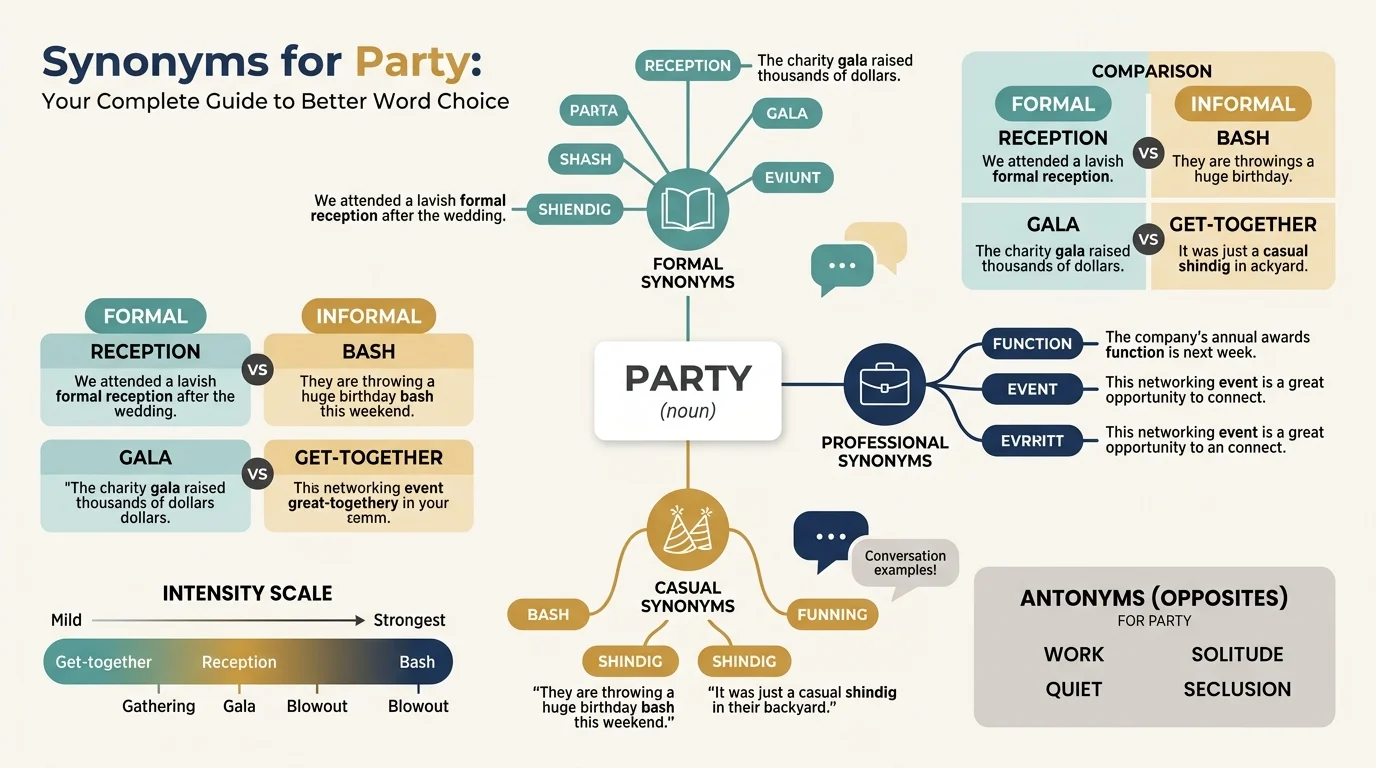
You are writing an important email, crafting a social media caption, or preparing a speech. You keep using the word “party” over and over. It feels repetitive and dull. Your message loses its impact because the same word appears too frequently. This happens to everyone. Finding the right synonyms for party can transform your writing from ordinary to outstanding.
Whether you are a student working on an essay, a professional drafting a report, or a job seeker polishing a resume, having a rich vocabulary gives you an edge. This guide will help you understand every nuance of the word party.
You will learn which synonym works best for every situation, from formal business settings to casual conversations with friends. Let us explore the many ways to express this common word with precision and style.
What Does “Party” Mean?
A party is a social gathering where people come together for celebration, enjoyment, or a specific purpose. The best synonyms for party depend on your context. Use “celebration” for joyful events, “gathering” for casual meetups, “reception” for formal occasions, “soiree” for elegant evenings, and “festival” for large public events. Each synonym carries a unique tone and level of formality.
Meaning, Tone and Context
The word “party” functions primarily as a noun, though it can also serve as a verb meaning to celebrate or enjoy oneself socially. Its tone is generally neutral but leans toward positive and celebratory. The formality level varies widely. In casual conversation, “party” feels natural and comfortable. In professional writing, it may seem too informal, depending on the context.
Simple definition: A party is an organized social event where people gather for enjoyment, celebration, or a shared purpose. This can range from a small birthday dinner to a large political organization.
Part of speech: Noun and verb.
Tone: Generally positive, celebratory, and social. However, it can be neutral when referring to a political party or a group involved in an activity.
Formality level: Ranges from informal to formal depending on context. A birthday party is casual. A diplomatic party or a party to a contract is formal.
Common use cases: Social events, celebrations, political groups, legal agreements, and group activities.
Important word forms: Partying (verb), partied (verb), partygoer (noun), partying (adjective).
When and How to Use “Party”
Understanding when to use “party” helps you choose the right word for the right moment. “Party” works best in casual and neutral contexts. It describes social events, political groups, or participants in an agreement. For formal writing, consider using more precise synonyms. For creative writing, explore more descriptive options.
Here are examples showing the word in different contexts.
Professional Context
The marketing team organized a party to celebrate the successful product launch.
Personal Context
We are planning a party for my grandmother’s 80th birthday next Saturday.
Academic Context
The study examined how political party affiliation influences voting behavior in local elections.
Emotional Context
After months of hard work, the party felt like a well deserved reward for everyone involved.
Creative Context
The garden party unfolded under strings of warm lights and the soft melody of a jazz trio.
Social Media Context
Throwback to that epic party last summer. Who is ready for round two?
Email Context
I hope you can join us for the farewell party we are hosting for Sarah on Friday evening.
Another Word for “Party”
Finding the perfect synonym depends entirely on your situation. Here are the best single word replacements categorized by context.
Professional writing: Reception, gathering, meeting, conference.
Academic writing: Assembly, convocation, symposium, caucus.
Casual conversation: Get together, bash, shindig, hangout.
Emotional writing: Celebration, festivity, jubilee, gala.
Creative writing: Soiree, fete, affair, carnival.
Resume or workplace: Event, function, networking gathering, team building activity.
Social media captions: Bash, blowout, rager, fest.
Stronger meaning: Extravaganza, blowout, spectacular.
Softer meaning: Get together, meetup, small gathering.
When Not to Use “Party”
Using “party” in the wrong context can make your writing feel vague or inappropriate. Avoid using “party” when you need precision, formality, or emotional depth.
Too vague for professional writing
Weak: We will host a party for our investors.
Better: We will host a reception for our investors.
Too casual for academic writing
Weak: The political party held a party for supporters.
Better: The political party held a convention for supporters.
Too weak for emotional writing
Weak: The party was meaningful to the community.
Better: The celebration brought the entire community together.
Too general for creative writing
Weak: The party was beautiful.
Better: The gala sparkled with elegance and charm.
Too informal for formal correspondence
Weak: Please attend the party at the ambassador’s residence.
Better: Please attend the reception at the ambassador’s residence.
Too broad for specific events
Weak: We are having a party for the new product.
Better: We are hosting a launch event for the new product.
Words Commonly Confused With “Party”
Several words relate to party but carry distinct meanings. Understanding these differences helps you choose the right word every time.
Party vs. Celebration
A party is a general social gathering. A celebration specifically marks a joyful occasion or achievement. Celebrations often involve rituals, traditions, or ceremonies. A party can exist without a specific reason.
Party vs. Gathering
A gathering is a broader term for any group of people coming together. A party implies enjoyment and social interaction. A gathering may be serious, such as a business meeting or a family reunion.
Party vs. Festival
A festival is a large public event, often with cultural or religious significance. Festivals typically last multiple days and include various activities. A party is usually smaller and more private.
Party vs. Reception
A reception is a formal social event, often following a ceremony. Receptions include weddings, official functions, and diplomatic events. A party can be formal or informal.
Party vs. Bash
A bash is an informal, energetic, and often loud party. This word suggests excitement and high energy. A party can be calm and quiet.
Party vs. Soiree
A soiree is an elegant evening gathering, typically with refined entertainment and conversation. This word suggests sophistication. A party can be casual and relaxed.
Best Synonym by Context for “Party”
This table shows the most appropriate synonym for each situation. Select the word that matches your tone, audience, and purpose.
| Context | Best Synonym | Why It Works | Example |
|---|---|---|---|
| Formal writing | Reception | Sounds official and respectful | The ambassador hosted a reception for visiting dignitaries. |
| Academic writing | Symposium | Emphasizes intellectual exchange | The symposium attracted scholars from twelve universities. |
| Professional business | Function | Sounds corporate and purposeful | The company function included a networking hour. |
| Resume writing | Event coordination | Highlights organizational skills | Coordinated events for up to five hundred attendees. |
| Casual conversation | Get together | Feels warm and natural | Let us have a get together this weekend. |
| Creative writing | Soiree | Adds elegance and atmosphere | The moonlit soiree enchanted every guest. |
| Emotional tone | Celebration | Conveys joy and significance | The celebration honored decades of dedicated service. |
| Strong intensity | Extravaganza | Suggests grandeur and spectacle | The holiday extravaganza featured fireworks and live music. |
| Soft or moderate | Gathering | Simple and neutral | We enjoyed a small gathering at the park. |
| Social media captions | Bash | Energetic and engaging | Throwing a bash for my birthday next week. |
| US usage | Party | Standard American English | We are having a party for the Super Bowl. |
| UK usage | Do | Common British casual term | Are you coming to the do on Saturday? |
Which Synonym Should You Choose?
Selecting the right synonym requires careful thought about your specific situation. Ask yourself these questions before making a choice.
What is your purpose? If you want to describe a joyful event, choose “celebration.” If you need to discuss a formal occasion, use “reception.” For a casual meetup, “get together” works perfectly.
Who is your audience? Professional colleagues expect formal language such as “function” or “event.” Friends appreciate casual words like “bash” or “hangout.” Academic readers prefer precise terms like “assembly” or “conference.”
What emotional intensity do you need? A “gala” suggests elegance and grandeur. A “gathering” feels neutral and simple. A “blowout” implies high energy and excess. Match the intensity to the occasion.
What is the sentence context? Consider the surrounding words. A “festival” pairs well with cultural activities. A “reception” fits after ceremonies. A “soiree” belongs in descriptions of elegant evenings.
What professional value does it add? On a resume, “event planning” sounds more professional than “party planning.” In business writing, “networking function” adds value that “party” lacks.
Real Life Examples of “Party” in Sentences
These examples show how synonyms for party can enhance your writing across different situations. Notice how each word changes the tone and precision of the sentence.
School Context
The student council organized a celebration for the school’s centennial anniversary.
Workplace Context
Our department hosted a networking reception for potential industry partners.
Writing Context
The author described the lavish soiree with vivid detail and sparkling dialogue.
Conversation Context
We should plan a get together soon to catch up properly.
Social Media Context
Throwback to that incredible bash from last summer.
Resume Context
Coordinated corporate events for teams of up to two hundred employees.
Email Context
Please RSVP for the farewell reception honoring Dr. Chen’s retirement.
Storytelling Context
The festival transformed the small town into a vibrant wonderland of music and color.
15 Synonyms for “Party”
This table provides fifteen accurate synonyms for party. Each word has a unique meaning and specific use case. Select the synonym that best matches your context and desired tone.
| Synonym | Simple Meaning | Best Used For | Example Sentence |
|---|---|---|---|
| Celebration | A joyful event marking something special | Happy occasions and milestones | The celebration continued well into the night. |
| Gathering | Any group of people assembled together | Casual and neutral contexts | We had a small gathering in the backyard. |
| Reception | A formal social event, often after a ceremony | Weddings, official functions, and corporate events | The wedding reception was held at a beautiful hotel. |
| Soiree | An elegant evening party | Sophisticated and formal social events | The soiree featured classical music and fine dining. |
| Festival | A large public event with entertainment and activities | Cultural events and community celebrations | The music festival attracted thousands of attendees. |
| Gala | A grand formal event with entertainment and dinner | Fundraisers, charity events, and high society occasions | The charity gala raised millions for medical research. |
| Bash | A lively, energetic, and often loud party | Informal celebrations with high energy | We threw a bash for my brother’s promotion. |
| Get together | An informal social meeting | Casual friend and family gatherings | Let us plan a get together for old times. |
| Function | A formal social or professional event | Business, corporate, and official occasions | The company function included a dinner and awards ceremony. |
| Shindig | A lively and informal party or dance | Fun, casual social events | The neighborhood shindig brought everyone together. |
| Blowout | A large, extravagant, and often expensive party | Big celebrations with lots of food, drink, and guests | The graduation blowout was the talk of the town. |
| Fete | A lavish celebration, often outdoors | Garden parties, community events, and festive occasions | The village fete featured games and local crafts. |
| Jubilee | A special anniversary celebration | Milestone anniversaries and historical commemorations | The jubilee marked fifty years of community service. |
| Carnival | A traveling fair with rides, games, and entertainment | Festive events with amusements and attractions | The carnival brought joy to children and adults alike. |
| Affair | A social event or gathering, often formal | Elegant or noteworthy social occasions | The diplomatic affair required formal attire. |
Synonym Groups and Usage Differences
Understanding synonym groups helps you navigate the subtle differences between similar words. This section organizes synonyms by usage category.
Professional vs. Personal Synonyms
Professional synonyms sound serious and purposeful. They work well in business writing, official documents, and workplace communication. “Reception,” “function,” and “event” fit this category. Personal synonyms feel warm and relaxed. “Get together,” “gathering,” and “bash” work best for friends and family.
Formal vs. Conversational Synonyms
Formal synonyms suit reports, essays, speeches, and professional correspondence. “Reception,” “soiree,” and “gala” convey sophistication and respect. Conversational synonyms match casual writing, texts, and friendly emails. “Shindig,” “bash,” and “get together” feel natural in everyday speech.
Academic Synonyms
Academic writing requires precise and measured language. “Symposium,” “conference,” and “assembly” suggest intellectual exchange and formal structure. “Convention” works for academic gatherings with formal agendas. “Colloquium” describes an academic meeting focused on discussion and presentation of research.
Professional and Business Synonyms
Business communication benefits from words that sound competent and organized. “Function” suggests a planned corporate event. “Networking gathering” emphasizes professional connections. “Seminar” and “workshop” describe educational business events. “Corporate event” covers all professional gatherings with a clear business purpose.
Creative or Literary Synonyms
Creative writing demands vivid and evocative language. “Soiree” paints a picture of elegance and refinement. “Fete” suggests festivity and charm. “Carnival” evokes color, excitement, and spectacle. “Extravaganza” implies grandeur and theatricality. These words add imagery and emotional depth to descriptions.
Slang or Modern Synonyms
Slang words add energy and informality to casual conversation. “Rager” describes an intense, wild party with loud music and many people. “Kickback” refers to a relaxed, low key social gathering. “Lit” describes an exciting and enjoyable party atmosphere. Use these words only in casual contexts. Avoid them in professional or academic writing.
Strongest vs. Weaker Synonyms
The intensity of a synonym affects the impression it creates. Here is an intensity scale from mild to strongest.
Mild: Gathering, get together, meetup.
Moderate: Party, celebration, festivity.
Strong: Bash, blowout, rager.
Strongest: Extravaganza, spectacular, blowout.
Choose the intensity that matches your event and audience.
Emotional vs. Neutral Synonyms
Emotional synonyms add feeling and significance to your writing. “Celebration” conveys joy and meaning. “Jubilee” suggests excitement and historical importance. “Festival” evokes community and cultural pride. Neutral synonyms stay factual and objective. “Gathering” describes people assembled without emotional weight. “Assembly” focuses on the group rather than the mood.
Antonyms of “Party”
This table shows fifteen antonyms for party. These words describe the opposite of social gatherings, celebration, and group activities.
| Antonym | Meaning | Example Sentence |
|---|---|---|
| Solitude | Being alone without company | She enjoyed the solitude of her mountain cabin. |
| Isolation | Separation from others | The patient endured isolation during recovery. |
| Seclusion | Privacy and withdrawal from society | The writer sought seclusion to complete her novel. |
| Loneliness | Sadness from being alone | His loneliness deepened after moving to a new city. |
| Boredom | Lack of interest or excitement | The long weekend brought nothing but boredom. |
| Solemnity | Seriousness and formality | The solemnity of the occasion silenced all chatter. |
| Mourning | Grief for someone who has died | The family remained in mourning for weeks. |
| Stillness | Quiet and lack of movement | The stillness of the library helped him concentrate. |
| Calm | Peacefulness without disturbance | She needed calm after the chaotic workweek. |
| Work | Productive activity rather than leisure | He focused on work instead of attending social events. |
| Hardship | Difficult and unpleasant circumstances | The community faced hardship during the drought. |
| Austerity | Sternness and lack of luxury | The monastic austerity discouraged social gatherings. |
| Desolation | Empty and deserted conditions | The desolation of the abandoned town was haunting. |
| Confinement | Restriction to a small space | The prisoner endured confinement in a tiny cell. |
| Silence | Complete absence of sound | The silence of the forest was broken by a bird song. |
Comparison: Party vs. Similar Words
Understanding the differences between party and similar words helps you choose the most precise term for your context.
Party vs. Celebration
The main difference lies in purpose. A party is a social event that may or may not have a specific reason. A celebration always honors something meaningful. Celebrations often include traditions such as cake, gifts, or ceremonies. Parties can be casual and spontaneous. Celebrations carry emotional weight and significance. Celebrations are stronger in emotional impact and formality. Both words work well in most contexts.
Example: We had a party on Saturday. (Simple social gathering)
Example: The celebration marked fifty years of marriage. (Meaningful occasion)
Party vs. Gathering
A gathering is the broader term for any group of people assembled. A gathering does not require enjoyment or entertainment. A party specifically involves social interaction and usually some form of entertainment. Gatherings can be serious, such as town hall meetings or academic conferences. Parties are generally lighthearted and enjoyable. Gatherings are more neutral in tone.
Example: The gathering discussed community safety concerns. (Serious)
Example: The party featured dancing and music. (Entertainment focused)
Party vs. Festival
A festival is a large public event with cultural or religious significance. Festivals often span multiple days and include parades, performances, and food vendors. A party is usually smaller, private, and shorter. Festivals are more formal in structure and organization. Festivals emphasize community participation and cultural traditions.
Example: The harvest festival attracted visitors from across the region.
Example: We hosted a small party for close friends.
Party vs. Reception
A reception is a formal event that follows a ceremony. Weddings, graduations, and official functions often include receptions. A party does not require a preceding ceremony. Receptions are more formal and structured. Parties allow for more casual interaction and spontaneous activity.
Example: The wedding reception included a sit down dinner and speeches.
Example: The after party continued with dancing until midnight.
Party vs. Bash
A bash is an informal, high energy, and often loud party. The word suggests excitement, large crowds, and sometimes rowdy behavior. A party can be calm and organized. Bash is much stronger in intensity and informality. Use bash for energetic celebrations with friends.
Example: The birthday bash featured a live band and dancing.
Example: The quiet dinner party was perfect for conversation.
Party vs. Soiree
A soiree is an elegant evening gathering with refined entertainment. The word implies sophistication, good conversation, and a cultured atmosphere. A party can be any type of social event. Soiree is more formal and refined. Soiree adds a touch of class and elegance.
Example: The literary soiree featured poetry readings and wine.
Example: The beach party included volleyball and barbecue.
Common Phrases and Expressions with “Party”
These common phrases use the word party in various contexts. Understanding them helps you communicate more naturally.
1. Party to an agreement
Meaning: A person or group involved in a legal contract or negotiation.
Example sentence: Both parties to the agreement signed the document willingly.
2. Political party
Meaning: An organized group with shared political beliefs seeking to influence government.
Example sentence: The political party proposed new legislation for education reform.
3. House party
Meaning: A social gathering held at a private residence.
Example sentence: The house party continued until the neighbors complained.
4. Party favor
Meaning: A small gift given to guests at a party.
Example sentence: Each guest received a party favor as a token of thanks.
5. Party line
Meaning: The official stance or policy of a political party.
Example sentence: The senator voted along the party line on the tax bill.
6. Party animal
Meaning: Someone who loves attending parties and social events.
Example sentence: My cousin is a party animal who never misses a celebration.
7. Warring parties
Meaning: Groups involved in a conflict or dispute.
Example sentence: The peace talks brought the warring parties together.
8. Party pooper
Meaning: Someone who spoils the fun at a social event.
Example sentence: Do not be a party pooper. Join us for the dance.
Common Mistakes to Avoid
Avoiding these common mistakes will improve your vocabulary choices and make your writing more effective.
1. Using “party” when a more precise synonym fits
Many writers default to “party” because it is the first word that comes to mind. This creates vague and repetitive writing. Instead, choose “reception” for formal events, “celebration” for meaningful occasions, and “bash” for informal gatherings.
2. Confusing “party” with “partying”
“Party” as a noun describes the event. “Partying” as a verb describes the activity of attending parties. Using “partying” in formal writing sounds casual and informal. Use “socializing” or “attending events” in professional contexts.
3. Using casual synonyms in formal writing
Words like “bash,” “shindig,” and “blowout” do not belong in business reports or academic essays. These words sound unprofessional and diminish your credibility. Save casual synonyms for friendly conversations and social media posts.
4. Using an overly dramatic synonym for a simple situation
Describing a small family dinner as an “extravaganza” exaggerates the event and sounds ridiculous. Match the synonym to the scale and significance of the actual event. A small get together does not require grand vocabulary.
5. Repeating the same synonym in the same paragraph
Variety keeps your writing interesting. Even a good synonym becomes dull when overused. Rotate between multiple appropriate synonyms to maintain reader engagement. A celebration can also be a festivity or a jubilee.
6. Choosing a synonym with the wrong emotional tone
“Gala” suggests elegance and high society. “Mourning” suggests grief and loss. Using “gala” for a funeral would be inappropriate and insensitive. Always consider the emotional context of your event.
7. Using slang in academic or professional writing
Words like “lit,” “rager,” and “kickback” belong in casual speech. They have no place in research papers, business proposals, or formal correspondence. Academic and professional writing requires standard, widely accepted vocabulary.
FAQs
1. What is the best synonym for party?
The best synonym depends on your context. Use “celebration” for joyful events, “gathering” for casual meetups, “reception” for formal occasions, and “soiree” for elegant evenings.
2. What is a formal synonym for party?
Formal synonyms include “reception,” “function,” “gala,” and “soiree.” These words suit official events, diplomatic functions, and high society occasions.
3. What is an informal synonym for party?
Informal synonyms include “bash,” “shindig,” “get together,” and “blowout.” These words work well in casual conversation and friendly invitations.
4. What is another word for party in professional writing?
Professional writing uses “function,” “event,” “reception,” and “corporate gathering.” These words sound competent and organized in business contexts.
5. What is the difference between party and celebration?
A party is a general social gathering. A celebration specifically honors a meaningful occasion, achievement, or milestone. Celebrations carry deeper emotional significance.
6. What is the opposite of party?
Antonyms include solitude, isolation, seclusion, boredom, and solemnity. These words describe being alone, serious, or without social activity.
Conclusion
The word party serves as a useful starting point, but your writing deserves more precision and variety. A celebration carries joy and meaning. A reception suggests elegance and formality. A gathering feels warm and simple. A bash brings energy and excitement. The best synonym for party depends entirely on your situation. Consider your audience, your purpose, and your desired tone. Choose words that match the scale and significance of your event. Remember that variety keeps your writing fresh and engaging. Rotate between appropriate synonyms to avoid repetition. With practice, selecting the perfect word becomes second nature. Your vocabulary will expand, and your communication will become more effective and impressive. Start using these synonyms today and transform your writing from ordinary to outstanding.