Have you ever found yourself writing about energy, light, or medical treatments and realized you keep using the same word over and over? Whether you are drafting a science report, composing a business email, or writing a creative piece, repeating the same term can make your writing feel dull and imprecise. This is exactly when exploring the synonyms of radiation becomes invaluable. The word “radiation” appears in physics textbooks, medical discussions, environmental reports, and everyday conversation. But using it in every situation can make your language feel repetitive or even technically inaccurate. Choosing the right synonym improves clarity, adjusts your tone, and helps you communicate with greater precision. This guide will help you understand the meaning of radiation, explore its best synonyms, and choose the perfect word for every writing situation.
What Are the Best Synonyms of “Radiation”?
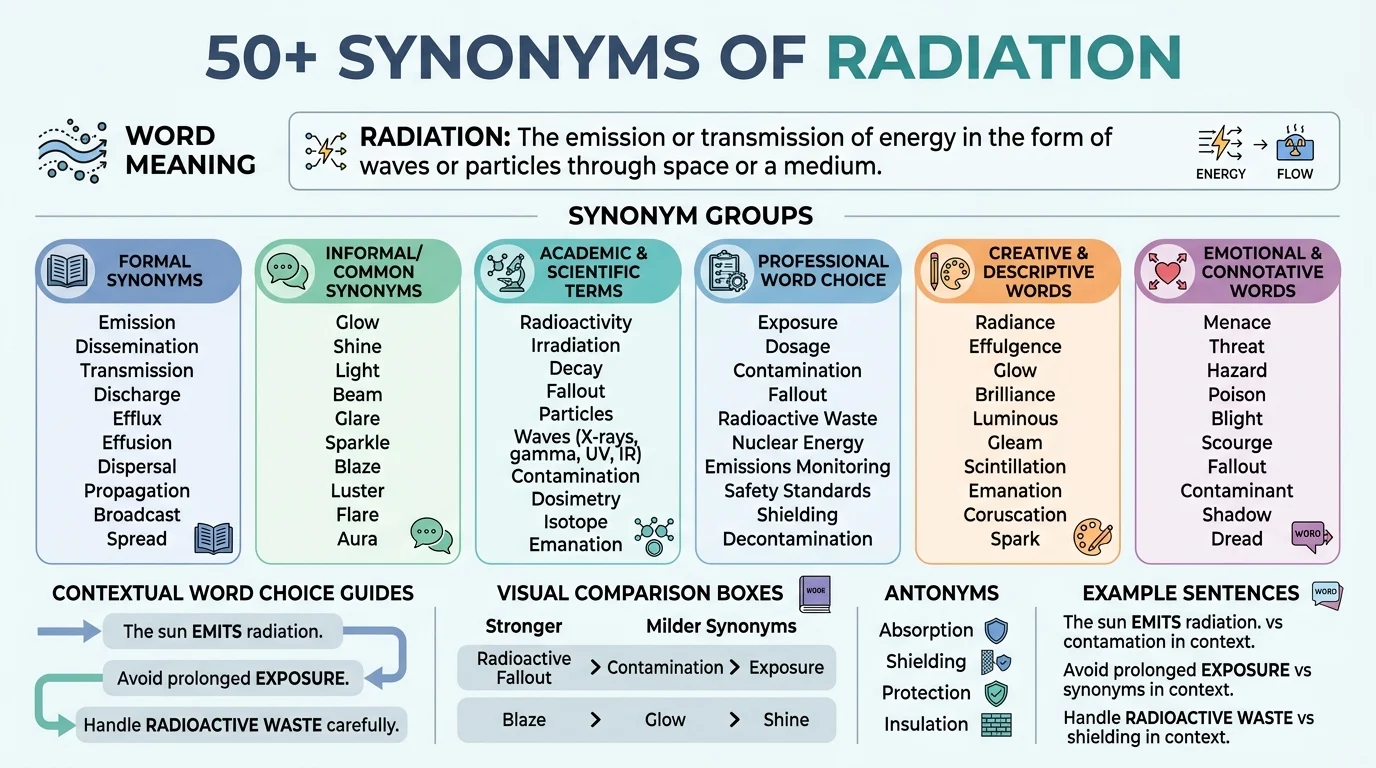
Radiation means the emission or transmission of energy in the form of waves or particles through space or a medium. The best synonyms depend on your context: use emission for formal scientific writing, rays for casual conversation, irradiation for academic and medical contexts, propagation for professional communication, radiance for emotional or creative writing, and beam for descriptive storytelling. Each synonym carries a distinct tone and level of formality.
Meaning, Tone, and Context
Simple Definition
Radiation is energy that travels in waves or as a stream of particles. It can come from natural sources like the sun or from human-made sources like X-ray machines and nuclear reactors.
Part of Speech
Noun. Related verb: radiate. Adjective: radiant or radiological.
Overall Tone
Neutral. The word itself does not carry a positive or negative emotional charge. However, the context often determines whether it feels dangerous (nuclear radiation), beneficial (solar radiation for life), or simply descriptive (heat radiating from a fire).
Formality Level
Neutral to semi-formal. “Radiation” is appropriate in academic writing, professional reports, and everyday conversation. It is not overly technical for general readers but remains precise enough for scientific discussions.
Common Uses
Native English speakers use “radiation” in several ways:
- Physics and science: describing energy transmission (electromagnetic radiation, solar radiation)
- Medicine: referring to cancer treatment (radiation therapy)
- Environmental discussions: talking about nuclear accidents or background radiation
- Everyday language: describing heat or light spreading from a source (the radiation of warmth from a fireplace)
- Biology: describing evolutionary processes (adaptive radiation)
Word Forms
| Form | Word |
|---|---|
| Noun | radiation |
| Verb | radiate |
| Adjective | radiant, radiological |
| Adverb | radiantly |
| Related noun | radioactivity, irradiance |
| Opposite concept | absorption, shielding |
When and How to Use “Radiation”
Choose “radiation” when you need a precise, scientifically accurate term for energy transmission. It works well in most contexts because it is widely understood and carries a neutral tone.
7 Realistic Examples
Professional (Scientific Report)
The instrument measures electromagnetic radiation across a wide spectrum of wavelengths.
Academic (Research Paper)
Exposure to high levels of ionizing radiation can cause significant damage to cellular DNA.
Workplace (Safety Memo)
All employees must wear dosimeters to monitor their radiation exposure in the laboratory.
Personal (Everyday Conversation)
The radiation from the fireplace kept the whole room warm on that cold winter night.
Email (Patient Communication)
Your oncologist will explain how radiation therapy fits into your overall treatment plan.
Resume (Healthcare Professional)
Administered radiation therapy to oncology patients while maintaining strict safety protocols.
Social Media (Science Communication)
Did you know that the sun’s radiation provides the energy that sustains almost all life on Earth?
Best Synonyms of “Radiation”
No synonym is identical to “radiation” in every situation. The right choice depends on your audience, purpose, and the specific meaning you want to convey.
Professional Writing
Emission – This synonym emphasizes the act of sending out energy or particles. It sounds precise and technical without being overly complex. Use it in scientific reports, engineering documents, and professional correspondence.
Academic Writing
Irradiation – This term is commonly used in physics, medicine, and materials science. It specifically refers to the exposure of something to radiation. It sounds authoritative and is preferred in research papers and academic journals.
Business Communication
Propagation – This word describes the transmission or spread of energy through a medium. It works well in technical business contexts, particularly in telecommunications and engineering.
Casual Conversation
Rays – Simple, familiar, and easy to understand. Use it when talking about sunlight, X-rays, or heat in everyday situations.
Emotional Writing
Radiance – This synonym carries a warm, glowing, often positive emotional tone. It is perfect for descriptive writing about light, beauty, or warmth.
Creative Writing
Beam – A focused, visual word that creates a clear image of a narrow stream of light or energy. Great for storytelling and descriptive passages.
Resume Writing
Radiological – As an adjective, this term signals expertise in radiation-related fields. It is particularly effective for healthcare, nuclear engineering, and environmental science roles.
Workplace Communication
Dissemination – When referring to the spread of information or energy, this formal synonym sounds professional and deliberate.
Stronger Meaning
Radioactivity – Use this when you specifically mean the emission of radiation from unstable atomic nuclei. It carries a stronger, more serious connotation.
Softer Meaning
Glow – A gentle, warm alternative that suggests soft light or heat without the technical or potentially alarming associations of “radiation.”
When Not to Use “Radiation”
When It Sounds Too General
Incorrect: The radiation from the candle was beautiful.
Better: The glow from the candle was beautiful.
Why: “Radiation” sounds overly technical and clinical for describing a candle’s light. “Glow” is warmer and more appropriate.
When It Sounds Too Vague
Incorrect: The device produces radiation.
Better: The device emits electromagnetic radiation in the microwave spectrum.
Why: The first sentence is vague and could refer to anything from heat to nuclear particles. Being specific improves clarity.
When It Sounds Too Formal
Incorrect: I felt the radiation of the sun on my skin.
Better: I felt the warmth of the sun on my skin.
Why: In casual conversation, “warmth” sounds more natural and less scientific.
When It Sounds Too Weak
Incorrect: The nuclear accident released radiation.
Better: The nuclear accident released dangerous radioactive particles.
Why: If you are discussing a serious nuclear incident, “radioactive particles” sounds more precise and appropriately alarming.
When It Sounds Outdated
“Radiation” itself is not outdated. However, using it as a blanket term when more specific vocabulary exists can make your writing seem imprecise. Choose ionizing radiation, electromagnetic radiation, or thermal radiation when accuracy matters.
Words Commonly Confused With “Radiation”
Radiation vs Emission
Difference: “Radiation” refers to the energy itself or the process of energy transmission. “Emission” refers specifically to the act of sending something out.
When to Use It: Use “emission” when you want to emphasize the release or discharge of energy, particles, or substances.
Example: The emission of greenhouse gases contributes to climate change.
Radiation vs Irradiation
Difference: “Radiation” is the energy or process. “Irradiation” is the act of exposing something to radiation.
When to Use It: Use “irradiation” in medical, scientific, or food processing contexts when something is being treated with radiation.
Example: The food undergoes irradiation to eliminate harmful bacteria.
Radiation vs Radioactivity
Difference: “Radiation” is the energy or particles emitted. “Radioactivity” is the property of certain substances to emit radiation spontaneously.
When to Use It: Use “radioactivity” when discussing the inherent quality of radioactive materials.
Example: The radioactivity of the sample was measured using a Geiger counter.
Radiation vs Propagation
Difference: “Radiation” emphasizes the emission of energy. “Propagation” emphasizes the transmission or spread of energy through a medium.
When to Use It: Use “propagation” in physics and engineering when discussing how waves travel.
Example: The propagation of sound waves through water differs from their propagation through air.
Radiation vs Diffusion
Difference: “Radiation” involves energy transmission through waves or particles. “Diffusion” involves the spreading of particles from an area of higher concentration to lower concentration.
When to Use It: Use “diffusion” when discussing the mixing or spreading of substances in fluids.
Example: The diffusion of perfume through the room was surprisingly fast.
Radiation vs Radiance
Difference: “Radiation” is a neutral scientific term. “Radiance” carries a positive, glowing, beautiful connotation.
When to Use It: Use “radiance” in creative writing, poetry, or descriptive passages about light and beauty.
Example: The radiance of the sunset painted the sky in shades of orange and pink.
Best Synonyms of “Radiation” by Context
| Context | Best Synonym | Why It Works | Example |
|---|---|---|---|
| Formal writing | Emission | Precise, technical, and widely accepted in scientific literature | The emission of gamma rays was recorded by the detector. |
| Academic writing | Irradiation | Specific to exposure and treatment contexts | The irradiation of the sample produced measurable changes. |
| Professional communication | Propagation | Emphasizes transmission through a medium | The propagation of radio waves depends on atmospheric conditions. |
| Business emails | Transmission | Clear and professional for technical discussions | Please verify the transmission of data through the fiber optic network. |
| Resume writing | Radiological | Signals expertise in radiation-related fields | Performed radiological safety assessments for medical facilities. |
| Workplace communication | Dissemination | Formal yet appropriate for energy or information spread | The dissemination of thermal energy throughout the building is efficient. |
| Casual conversation | Rays | Simple, familiar, and easy to understand | The sun’s rays felt warm on my face. |
| Everyday speaking | Heat/Light | Direct and natural for describing everyday experiences | The heat from the stove warmed the kitchen. |
| Creative writing | Beam | Visual and evocative for storytelling | A beam of light pierced through the darkness. |
| Storytelling | Gleam | Suggests a brief, bright flash of light | A gleam of light appeared on the horizon. |
| Emotional writing | Radiance | Warm, beautiful, and emotionally resonant | Her face glowed with the radiance of pure joy. |
| Strong emphasis | Radioactivity | Serious and scientifically precise for hazardous contexts | The radioactivity of the waste required special handling. |
| Mild tone | Glow | Gentle, warm, and non-threatening | The glow of the fire created a cozy atmosphere. |
| Social media captions | Energy | Broad, accessible, and engaging | Soaking up that solar energy on a perfect beach day! |
How to Choose the Best Synonym of “Radiation”
Choosing the right synonym starts with understanding your purpose. Ask yourself these questions:
What am I describing?
If you are describing the energy itself, use radiation or emission. You are describing the act of exposure, use irradiation. If you are describing the spread of energy, use propagation.
Who is my audience?
For scientists and academics, use emission, irradiation, or propagation. General readers, use rays, energy, or heat. For creative audiences, use radiance, beam, or glow.
What tone do I want?
For a neutral, factual tone, use radiation or emission. A warm, positive tone, use radiance or glow. For a serious or alarming tone, use radioactivity.
How strong should the word be?
Glow and light are mild. Emission and propagation are moderate. Radioactivity and ionizing radiation are strong.
Does it sound natural?
Read your sentence aloud. If the synonym feels forced or overly technical for the context, choose a simpler word. Clarity always beats complexity.
Real Life Examples of “Radiation”
School (Science Class)
Original: The sun gives off radiation.
Improved: The sun emits electromagnetic radiation across the visible and infrared spectrum.
Why: The improved version is more precise and demonstrates scientific vocabulary.
College (Physics Lab Report)
Original: We measured the radiation from the source.
Improved: We measured the gamma radiation emitted by the cobalt-60 source.
Why: Specifying the type of radiation and the source adds academic rigor.
Workplace (Safety Training)
Original: Workers must avoid radiation.
Improved: Workers must minimize their exposure to ionizing radiation by following all safety protocols.
Why: The improved version is clearer and more actionable.
Business (Technical Proposal)
Original: Our system reduces radiation.
Improved: Our shielding technology reduces harmful radiation emissions by 95 percent.
Why: The improved version includes a specific claim and sounds more professional.
Email (Medical Context)
Original: The doctor recommended radiation.
Improved: The oncologist recommended a six-week course of radiation therapy to target the tumor.
Why: The improved version provides essential details that the original lacks.
Resume (Healthcare)
Original: Worked with radiation patients.
Improved: Delivered precise radiation therapy to oncology patients while maintaining rigorous safety standards.
Why: The improved version sounds more accomplished and professional.
Conversation
Original: The microwave uses radiation.
Improved: The microwave uses electromagnetic radiation to heat food quickly.
Why: The improved version is slightly more informative without sounding overly technical.
Storytelling
Original: Light came from the lighthouse.
Improved: A powerful beam of light radiated from the lighthouse, cutting through the thick fog.
Why: The improved version creates a stronger visual image.
Blogging (Science Blog)
Original: Radiation is everywhere.
Improved: Background radiation from natural and human-made sources surrounds us every day.
Why: The improved version is more engaging and informative.
Social Media
Original: Enjoying the radiation!
Improved: Soaking up that golden sunlight! ☀️
Why: The improved version sounds more natural and uses accessible language.
18 Best Synonyms of “Radiation”
Synonyms of “Radiation” by Usage
Professional vs Personal Synonyms
| Professional | Personal |
|---|---|
| Emission | Rays |
| Propagation | Heat |
| Dissemination | Light |
| Transmission | Glow |
| Irradiation | Warmth |
Professional Recommendation: Use emission in reports and propagation in technical documents. These words sound authoritative and precise.
Personal Recommendation: Use rays or warmth in everyday conversation. These words sound natural and approachable.
Formal vs Conversational Synonyms
| Formal | Conversational |
|---|---|
| Emanation | Glow |
| Irradiation | Rays |
| Propagation | Heat |
| Radioactivity | Radiation (simplified) |
| Dissipation | Spread |
Formal contexts (reports, essays, presentations): Choose emission, irradiation, or propagation.
Conversational contexts (casual talks, texting): Choose rays, heat, or light.
Academic Synonyms
For research papers, essays, and academic discussions, choose these precise synonyms:
- Irradiation – Preferred in medical and materials science research
- Emission – Standard in physics and environmental science
- Propagation – Common in wave mechanics and telecommunications
- Ionizing radiation – Specific to high-energy radiation that ionizes atoms
- Electromagnetic radiation – Precise term for light, radio waves, and X-rays
These synonyms sound authoritative and demonstrate subject matter expertise.
Professional and Business Synonyms
For resumes, interviews, meetings, and client communication:
- Radiological – Use as an adjective to describe expertise or equipment
- Emission – Use in environmental reports and technical proposals
- Transmission – Use in telecommunications and engineering contexts
- Dissemination – Use when discussing the spread of information or energy
- Irradiation – Use in medical or food processing industries
Creative and Literary Synonyms
For storytelling, fiction, poetry, and descriptive writing:
- Radiance – Suggests beauty, warmth, and positive emotion
- Beam – Creates a strong visual image of focused light
- Gleam – Suggests a brief, bright flash
- Glow – Conveys warmth and softness
- Luminosity – A sophisticated term for brightness
- Effulgence – A poetic term for brilliant radiance
Slang or Modern Synonyms
“Radiation” does not have widely used slang equivalents. However, in informal contexts:
- Nuked – Informal term meaning exposed to radiation or heated in a microwave
- Zapped – Informal for being exposed to energy or radiation
Where acceptable: Casual conversation, informal writing, social media
Where avoided: Academic writing, professional reports, formal communication
Strongest to Mildest Synonyms
| Intensity | Synonym | Emotional Weight |
|---|---|---|
| Mild | Glow | Gentle, warm, safe |
| Mild | Light | Neutral, everyday |
| Mild | Warmth | Comforting, pleasant |
| Moderate | Emission | Neutral, technical |
| Moderate | Propagation | Neutral, scientific |
| Moderate | Rays | Familiar, accessible |
| Strong | Irradiation | Clinical, precise |
| Strong | Radioactivity | Serious, hazardous |
| Very Strong | Ionizing radiation | Dangerous, alarming |
Emotional vs Neutral Synonyms
Emotional Synonyms (express stronger feelings):
- Radiance – Warmth, beauty, positivity
- Glow – Comfort, coziness, gentle beauty
- Beam – Hope, guidance, clarity
- Gleam – Brief but striking beauty
Neutral Synonyms (simply communicate information):
- Emission – Factual, technical
- Propagation – Scientific, precise
- Transmission – Functional, clear
- Dissemination – Formal, informative
When to use emotional synonyms: Creative writing, storytelling, personal narratives, speeches
When to use neutral synonyms: Scientific reports, business documents, academic papers, technical writing
Antonyms of “Radiation”
While “radiation” does not have direct opposites, these terms represent contrasting concepts:
| Antonym | Meaning | Example Sentence |
|---|---|---|
| Absorption | The taking in of energy rather than emitting it | The absorption of light by the dark surface heated the material. |
| Shielding | Protection from radiation rather than exposure | The lead apron provided effective shielding during the X-ray. |
| Containment | Keeping something confined rather than spreading | The containment of radioactive materials is a top safety priority. |
| Concentration | Gathering in one place rather than spreading outward | The concentration of energy in a small area created intense heat. |
| Centralization | Bringing toward a center rather than radiating outward | The centralization of resources improved efficiency. |
| Stability | Not undergoing radioactive decay | The stability of the isotope made it safe for medical use. |
| Inertness | Lack of chemical or radioactive activity | The inertness of the material ensured it would not react. |
| Darkness | Absence of light or radiant energy | The darkness of the room was broken only by a single candle. |
| Opacity | Blocking the transmission of light or radiation | The opacity of the material prevented any light from passing through. |
| Dullness | Lack of brightness or radiance | The dullness of the cloudy day made everything look gray. |
| Stillness | Absence of movement or energy flow | The stillness of the air meant no heat was being circulated. |
| Coldness | Absence of thermal radiation | The coldness of the winter night was biting. |
| Fixation | Remaining in one place rather than spreading | The fixation of the dye prevented it from spreading in the fabric. |
| Consolidation | Combining into a solid mass | The consolidation of the soil prevented erosion. |
| Seclusion | Being isolated or cut off | The seclusion of the laboratory ensured no radiation escaped. |
Comparison: “Radiation” vs Similar Words
Radiation vs Emission
Main Difference: “Radiation” is the energy itself or the process. “Emission” is the act of sending something out.
Which Is Stronger? Neither is inherently stronger. “Radiation” often implies a broader concept, while “emission” is more specific to the release action.
Which Is More Formal? Both are formal. “Emission” is slightly more precise in environmental and industrial contexts.
When to Use Each:
- Use radiation when discussing the energy or process broadly.
- Use emission when emphasizing the release or discharge.
Examples:
- Radiation: The radiation from the sun sustains life on Earth.
- Emission: The emission of pollutants from factories must be reduced.
Radiation vs Irradiation
Main Difference: “Radiation” is the energy or process. “Irradiation” is the act of exposing something to radiation.
Which Is Stronger? “Irradiation” sounds more clinical and specific.
Which Is More Formal? Both are formal. “Irradiation” is more common in medical and scientific literature.
When to Use Each:
- Use radiation when describing the energy itself.
- Use irradiation when describing the treatment or exposure process.
Examples:
- Radiation: The patient received radiation therapy for six weeks.
- Irradiation: The irradiation of the food product extends its shelf life.
Radiation vs Radioactivity
Main Difference: “Radiation” is the emitted energy. “Radioactivity” is the property of substances that emit radiation.
Which Is Stronger? “Radioactivity” often carries a stronger, more serious connotation.
Which Is More Formal? Both are formal scientific terms.
When to Use Each:
- Use radiation when discussing the energy or particles.
- Use radioactivity when discussing the property of a material.
Examples:
- Radiation: The Geiger counter detected radiation in the area.
- Radioactivity: The radioactivity of the sample decreased over time.
Radiation vs Propagation
Main Difference: “Radiation” emphasizes emission from a source. “Propagation” emphasizes transmission through a medium.
Which Is Stronger? Neither. They describe different aspects of the same phenomenon.
Which Is More Formal? “Propagation” is more technical and common in physics and engineering.
When to Use Each:
- Use radiation when focusing on the source and emission.
- Use propagation when focusing on how energy travels.
Examples:
- Radiation: The antenna emits radiation in all directions.
- Propagation: The propagation of the signal was affected by the storm.
Radiation vs Diffusion
Main Difference: “Radiation” involves wave or particle transmission. “Diffusion” involves spreading from high to low concentration.
Which Is Stronger? Neither. They describe different physical processes.
Which Is More Formal? Both are formal scientific terms.
When to Use Each:
- Use radiation for energy transmission.
- Use diffusion for the spreading of particles in fluids.
Examples:
- Radiation: Thermal radiation from the heater warmed the room.
- Diffusion: The diffusion of the gas through the membrane was slow.
Radiation vs Radiance
Main Difference: “Radiation” is neutral and scientific. “Radiance” is positive, glowing, and often emotional.
Which Is Stronger? “Radiance” carries stronger emotional weight.
Which Is More Formal? “Radiation” is more formal in scientific contexts. “Radiance” is more common in literary and descriptive writing.
When to Use Each:
- Use radiation for factual, scientific descriptions.
- Use radiance for creative, emotional, or beautiful descriptions.
Examples:
- Radiation: The instrument measures solar radiation.
- Radiance: The radiance of her smile lit up the room.
Common Phrases and Expressions with “Radiation”
Common Mistakes to Avoid
1: Using “Radiation” When a More Specific Word Is Better
Incorrect: The radiation from the lamp was bright.
Better: The light from the lamp was bright.
Why: “Light” is more natural and specific for describing illumination from a lamp.
2: Confusing “Radiation” with “Radioactivity”
Incorrect: The radiation of the uranium sample was measured.
Better: The radioactivity of the uranium sample was measured.
Why: “Radioactivity” refers to the property of the material, not the energy it emits.
3: Using an Informal Synonym in Formal Writing
Incorrect: The glow from the nuclear reactor was monitored.
Better: The radiation from the nuclear reactor was monitored.
Why: “Glow” sounds too casual and imprecise for a technical safety context.
4: Choosing an Overly Dramatic Synonym
Incorrect: The deadly radioactivity from the microwave oven is concerning.
Better: The microwave radiation from the oven is within safety limits.
Why: “Deadly radioactivity” is alarmist and inaccurate for a household appliance.
5: Repeating “Radiation” Too Often
Incorrect: The study measured radiation. The radiation came from the sun. The radiation was intense.
Better: The study measured solar radiation. The emission originated from the sun. The intensity was significant.
Why: Varying your word choice makes writing more engaging and precise.
6: Using “Radiation” for Non-Energy Concepts
Incorrect: The radiation of information was slow.
Better: The dissemination of information was slow.
Why: “Dissemination” is the correct term for spreading information, not “radiation.”
7: Using Slang in Professional Contexts
Incorrect: The sample was nuked in the lab.
Better: The sample was irradiated in the lab.
Why: “Nuked” is informal slang and sounds unprofessional in scientific writing.
Frequently Asked Questions
1. What are the best synonyms of “radiation”?
The best synonyms depend on your context. Formal writing, use emission or propagation. Casual conversation, use rays or heat. For creative writing, use radiance or beam. For medical contexts, use irradiation.
2. What are the best formal synonyms of “radiation”?
The best formal synonyms include emission, propagation, irradiation, transmission, and dissemination. These words are precise, technical, and appropriate for academic papers, scientific reports, and professional documents.
3. What are common informal synonyms of “radiation”?
Common informal synonyms include rays, heat, light, glow, and warmth. These words are simple, familiar, and work well in everyday conversation, social media, and casual writing.
4. What is another word for “radiation” in professional writing?
In professional writing, emission is often the best choice for scientific and environmental contexts. Propagation works well in engineering and telecommunications. Transmission is suitable for technology and data contexts.
5. What is the difference between “radiation” and “radioactivity”?
Radiation refers to the energy or particles emitted. Radioactivity refers to the property of a substance that causes it to emit radiation. A radioactive material emits radiation, but the two terms are not interchangeable.
6. What is the opposite of “radiation”?
While “radiation” does not have a direct opposite, contrasting concepts include absorption (taking in energy), shielding (protecting from radiation), and containment (keeping energy confined).
Conclusion
Radiation is a versatile word that describes the emission or transmission of energy in the form of waves or particles. Its synonyms range from the formal and technical (emission, propagation, irradiation) to the conversational (rays, heat) and the creative (radiance, beam). No synonym works perfectly in every situation. The best choice depends on your audience, your purpose, and the tone you want to convey. Scientific accuracy, choose emission or propagation. For warmth and beauty, choose radiance or glow. For serious discussions of nuclear energy, choose radioactivity.
The next time you write about energy, light, or medical treatments, remember that exploring the synonyms of radiation can transform your writing from repetitive to refined. Choose the word that fits your context, and your readers will appreciate the clarity and precision.
Vocabulary tip: Keep a personal thesaurus of words you commonly use. Whenever you catch yourself repeating “radiation,” challenge yourself to use a more specific synonym. Over time, this habit will make your writing stronger and more varied.