You are writing a poem, crafting a speech, or polishing a piece of creative prose. You know the technique you want to use, but the word “alliteration” keeps appearing in your draft. Repeating the same term makes your writing feel repetitive and less engaging.
Understanding the synonyms of alliteration helps you describe this literary device with greater precision and variety. Whether you are a student analyzing poetry, a teacher explaining sound devices, or a writer looking to vary your vocabulary, choosing the right synonym improves clarity and demonstrates your command of language.
This guide explores every aspect of alliteration and its alternatives. You will learn the exact meaning, discover the best synonyms for every situation, understand the differences between similar terms, and gain practical recommendations for using these words confidently in your own writing.
What Are the Best Synonyms of “Alliteration”?
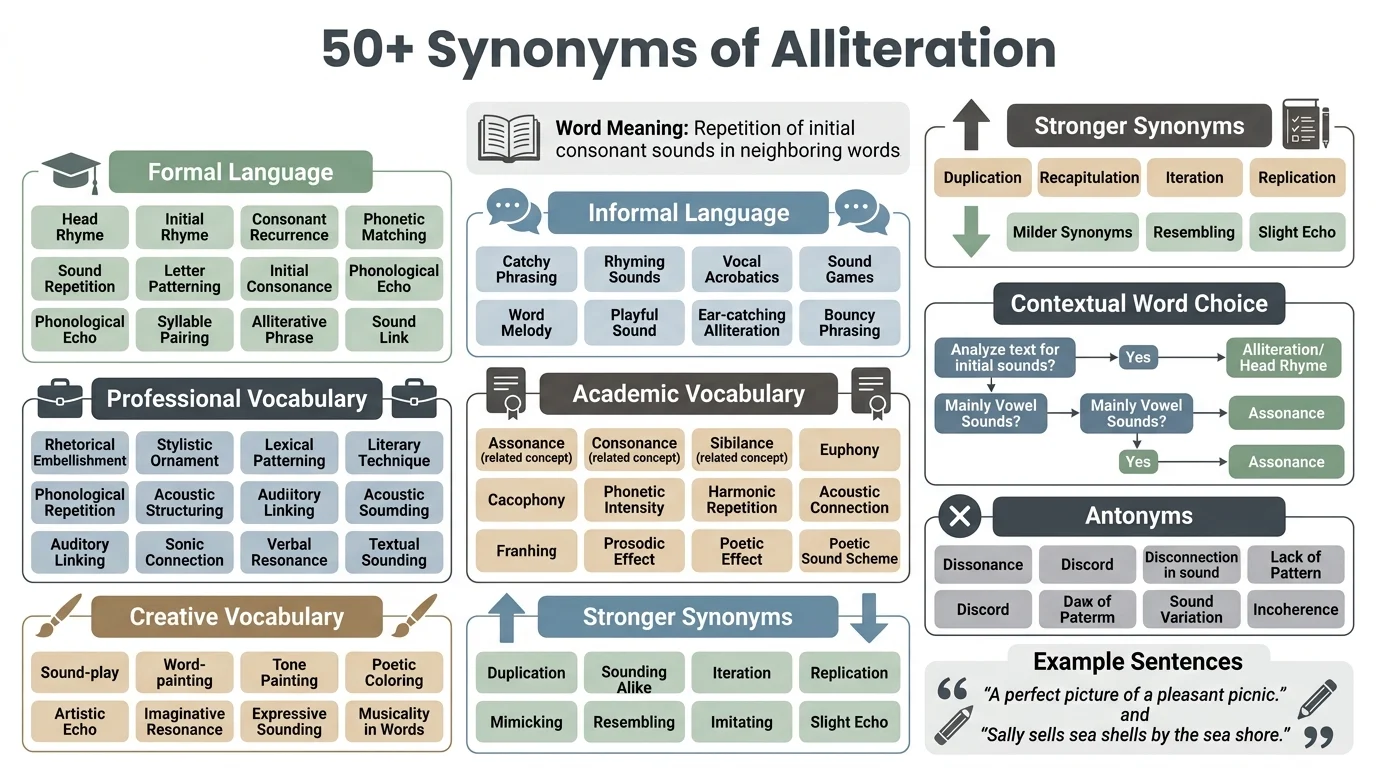
Alliteration is the repetition of initial consonant sounds in neighboring words, such as “wild and woolly”. For formal writing, use “initial rhyme” or “head rhyme.” Creative contexts, consider “sound repetition” or “consonant repetition.” For academic discussions, “beginning rhyme” works well. Choose based on your audience and purpose.
Meaning, Tone, and Context
Simple Definition
Alliteration is a literary device where two or more nearby words share the same initial consonant sound. The repeated sound creates rhythm, emphasis, and a musical quality in writing and speech. Common examples include “Peter Piper picked a peck of pickled peppers” and “pretty as a picture”.
Part of Speech
Noun (uncountable). The related adjective is “alliterative.” The verb form is “alliterate.”
Overall Tone
Neutral. Alliteration itself is a descriptive term for a specific sound pattern. The tone depends entirely on how you use it in context.
Formality Level
Semi-formal to neutral. The word appears in academic writing, literary analysis, casual conversation about writing, and classroom settings. It is neither overly technical nor informal.
Common Uses
Native English speakers use “alliteration” in several contexts:
- Literary analysis – discussing poetic techniques and sound devices
- Writing instruction – teaching students about stylistic elements
- Creative writing – describing one’s own use of sound patterns
- Advertising and branding – explaining why certain phrases are memorable
- Everyday conversation – pointing out catchy phrases or tongue twisters
Word Forms
| Form | Word |
|---|---|
| Noun | alliteration |
| Adjective | alliterative |
| Verb | alliterate |
| Adverb | alliteratively |
| Noun (person) | alliterator |
Opposite Form
There is no direct antonym for the noun “alliteration.” However, the adjective “non-alliterative” describes writing that does not use this device.
When and How to Use “Alliteration”
Choose “alliteration” when you need to name the specific technique of repeating initial consonant sounds. The word works in almost any context where you discuss sound patterns in language. Here are seven realistic examples.
Academic: “The poet’s use of alliteration in the opening stanza establishes a rhythmic foundation for the entire work.”
Professional: “Our marketing team incorporated alliteration into the tagline to make it more memorable for customers.”
Workplace: “During the presentation, she pointed out how alliteration made the company’s mission statement more impactful.”
Personal: “I noticed the alliteration in that song lyric and thought it was a clever touch.”
Email: “Could you review the alliteration in the draft? I want to make sure it enhances rather than distracts from the message.”
Resume: “Developed creative copy using alliteration and other rhetorical devices to increase brand recall.”
Social Media: “This brand uses alliteration so well. Their tagline sticks in your head immediately.”
Best Synonyms of “Alliteration”
No synonym is identical in every situation. Each alternative carries subtle differences in meaning, formality, and usage. Here are the best recommendations for specific contexts.
Professional writing: Initial rhyme – precise and academically accepted.
Academic writing: Head rhyme – commonly used in scholarly discussions of prosody.
Business communication: Sound repetition – clear and accessible to all audiences.
Casual conversation: Same-sound start – simple and easy to understand.
Emotional writing: Echo – suggests a haunting or resonant quality.
Creative writing: Consonant repetition – emphasizes the technical aspect.
Resume writing: Rhetorical device – demonstrates knowledge of persuasive techniques.
Workplace communication: Beginning rhyme – straightforward and professional.
Stronger meaning: Reiteration – emphasizes the repetitive nature.
Softer meaning: Sound pattern – neutral and less technical.
When Not to Use “Alliteration”
There are situations where “alliteration” is not the best choice.
When the word sounds too technical for your audience
If you are speaking to people unfamiliar with literary terms, “alliteration” might confuse them. Use “same starting sound” or “repeated beginning sounds” instead.
Original: “The alliteration in this slogan makes it catchy.”
Better: “The repeated starting sounds in this slogan make it catchy.”
When you want to emphasize vowel sounds instead of consonants
Alliteration specifically involves consonant sounds. If you are describing repeated vowel sounds, you need “assonance” instead.
Original: “The alliteration of the long ‘e’ sounds creates a smooth flow.”
Better: “The assonance of the long ‘e’ sounds creates a smooth flow.”
When you are describing repeated sounds anywhere in words, not just at the beginning
Alliteration is limited to initial sounds. For repeated consonant sounds anywhere in words, use “consonance”.
Original: “The alliteration of the ‘t’ sound in ‘battle’ and ‘little’ is effective.”
Better: “The consonance of the ‘t’ sound in ‘battle’ and ‘little’ is effective.”
When you are describing the general concept of repetition
If you simply mean something is repeated without specifying sound patterns, “repetition” or “reiteration” is more appropriate.
Original: “The alliteration of the chorus made the song feel repetitive.”
Better: “The repetition of the chorus made the song feel repetitive.”
When the word feels too formal for casual conversation
In everyday speech, simpler alternatives communicate more clearly.
Original: “I love the alliteration in that phrase.”
Better: “I love how those words start with the same sound.”
Words Commonly Confused With “Alliteration”
Alliteration vs Assonance
Difference: Alliteration repeats initial consonant sounds. Assonance repeats vowel sounds anywhere in words.
When to use it: Use “assonance” when describing repeated vowel sounds like “fleet feet sweep by sleeping geese.”
Example: “The assonance of the long ‘e’ sound gives the line a dreamy quality.”
Alliteration vs Consonance
Difference: Alliteration repeats initial consonant sounds. Consonance repeats consonant sounds anywhere in words, including middle and end positions.
When to use it: Use “consonance” when describing repeated consonant sounds that are not at the beginning, like “pitter-patter.”
Example: “The consonance of the ‘t’ and ‘r’ sounds creates a tapping rhythm.”
Alliteration vs Repetition
Difference: Alliteration is a specific type of sound repetition limited to initial consonants. Repetition is the broader term for any repeated element, including words, phrases, or sounds.
When to use it: Use “repetition” when discussing repeated words, phrases, or structures rather than just initial sounds.
Example: “The repetition of ‘nevermore’ throughout the poem creates a haunting effect.”
Alliteration vs Rhyme
Difference: Alliteration repeats initial sounds. Rhyme repeats ending sounds in words, typically at the end of lines in poetry.
When to use it: Use “rhyme” when describing matching end sounds like “cat” and “hat.”
Example: “The rhyme scheme of ABAB gives the poem a musical structure.”
Alliteration vs Echo
Difference: Alliteration is a specific technique. Echo is a more general term for any sound that repeats or resonates.
When to use it: Use “echo” for a poetic, less technical description of repeated sounds.
Example: “The echo of the ‘s’ sound throughout the stanza creates a whispering effect.”
Alliteration vs Jingle
Difference: Alliteration is a literary device. Jingle is a catchy, rhythmic phrase often used in advertising.
When to use it: Use “jingle” when describing memorable marketing phrases that may or may not use alliteration.
Example: “The jingle’s catchy rhythm made it impossible to forget.”
Best Synonyms of “Alliteration” by Context
| Context | Best Synonym | Why It Works | Example |
|---|---|---|---|
| Formal writing | Initial rhyme | Precise and scholarly | “The poet employed initial rhyme to unify the stanza.” |
| Academic writing | Head rhyme | Standard term in prosody | “Head rhyme appears frequently in Old English poetry.” |
| Professional communication | Beginning rhyme | Clear and professional | “The beginning rhyme in our tagline improves recall.” |
| Business emails | Sound repetition | Accessible to all readers | “Sound repetition makes the product name more memorable.” |
| Resume writing | Rhetorical device | Demonstrates communication skills | “Used rhetorical devices including alliteration in copywriting.” |
| Workplace communication | Consonant repetition | Technically accurate | “Consonant repetition strengthens the verbal identity.” |
| Casual conversation | Same starting sound | Simple and natural | “I like how those words have the same starting sound.” |
| Everyday speaking | Repeated beginning sounds | Easy to understand | “The repeated beginning sounds make it fun to say.” |
| Creative writing | Sound echo | Evocative and artistic | “The sound echo of ‘m’ creates a soft, melancholic mood.” |
| Storytelling | Initial sound repetition | Descriptive and clear | “Initial sound repetition gives the character’s name a memorable ring.” |
| Emotional writing | Resonant repetition | Suggests deeper meaning | “The resonant repetition of ‘h’ sounds evokes a sense of hush.” |
| Strong emphasis | Reiteration | Emphasizes the repeated nature | The reiteration of the consonant sound drives the point home.” |
| Mild tone | Sound pattern | Neutral and gentle | “The sound pattern adds a subtle musicality.” |
| Social media captions | Catchy sound start | Engaging and trendy | “That catchy sound start makes the brand pop.” |
| American English | Alliteration | Standard term | “Alliteration is a common device in American advertising.” |
How to Choose the Best Synonym of “Alliteration”
Choosing the right synonym depends on your audience, purpose, and the specific aspect of sound repetition you want to emphasize.
Consider your audience. If you are writing for literary scholars, use “initial rhyme” or “head rhyme.” If you are writing for a general audience, “sound repetition” or “beginning rhyme” works better.
Consider your purpose. Are you analyzing poetry formally? Use “head rhyme.” Are you explaining a concept to students? Use “beginning rhyme” or “same starting sound.”
Consider the emotional tone. “Echo” and “resonant repetition” add a poetic, emotional quality. “Sound repetition” and “beginning rhyme” remain neutral.
Consider the technical accuracy. If you are describing consonant sounds specifically, use “consonant repetition.” If you are discussing sound patterns more broadly, “sound repetition” is appropriate.
Consider natural usage. Choose the word that sounds most natural in your sentence. Sometimes “alliteration” itself is the best choice.
Real Life Examples of “Alliteration”
School
A teacher explains to the class: “The alliteration in ‘Peter Piper picked a peck of pickled peppers’ makes it a classic tongue twister.”
College
A student writes in an essay: “Shakespeare’s use of alliteration in this sonnet enhances the musical quality of the verse.”
Workplace
A marketing manager says: “We should use alliteration in the campaign tagline to make it more memorable.”
Business
A copywriter drafts: “The alliteration in ‘fresh, fast, friendly’ gives the brand a cohesive voice.”
An editor writes: “Please review the alliteration in the second paragraph. It feels a bit forced.”
Resume
A candidate lists: “Crafted compelling copy using alliteration and other stylistic devices to boost engagement.”
Conversation
Two friends discuss a song: “Did you notice the alliteration in that chorus? It really sticks in your head.”
Storytelling
A novelist reflects: “The alliteration of ‘dark and dreary’ sets the mood for the entire opening scene.”
Blogging
A blogger writes: “Using alliteration in your headlines can make them more clickable.”
Social Media
A user posts: “This brand’s alliteration game is strong. ‘Bold, bright, beautiful.'”
18 Best Synonyms of “Alliteration”
| Synonym | Simple Meaning | Best Used For | Example Sentence |
|---|---|---|---|
| Initial rhyme | Repetition of beginning sounds | Formal literary analysis | “The initial rhyme in the poem creates a powerful rhythmic effect.” |
| Head rhyme | Same as initial rhyme, academic term | Scholarly writing | “Head rhyme is a defining feature of Germanic poetry.” |
| Beginning rhyme | Simple, clear alternative | General and educational contexts | “The beginning rhyme makes the phrase easy to remember.” |
| Consonant repetition | Repeating consonant sounds at word starts | Technical discussions | “Consonant repetition gives the slogan its punch.” |
| Sound repetition | General term for repeated sounds | Accessible explanations | “Sound repetition adds musicality to the prose.” |
| Initial sound repetition | Precise description of the technique | Teaching and instruction | “Initial sound repetition is a basic poetic device.” |
| Same-sound start | Very casual alternative | Everyday conversation | “The same-sound start of those words is catchy.” |
| Echo | Repeated sound that resonates | Creative and poetic contexts | “The echo of the ‘s’ sound creates a soft, whispering effect.” |
| Reiteration | General repetition, stronger emphasis | Emphasizing the repetitive nature | “The reiteration of the consonant sound reinforces the theme.” |
| Sound pattern | Neutral description of sound arrangements | General discussions | “The sound pattern in this line is pleasing to the ear.” |
| Rhythmic repetition | Repetition that creates rhythm | Describing musical or poetic effects | “The rhythmic repetition of the ‘b’ sound drives the beat.” |
| Consonantal rhyme | Rhyme based on consonant sounds | Specialized discussions | “Consonantal rhyme gives Old English poetry its distinctive sound.” |
| Front rhyme | Rhyme at the beginning of words | Alternative to initial rhyme | “Front rhyme is common in children’s literature.” |
| Stave rhyme | Rhyme using same initial consonant | Historical or technical contexts | “Stave rhyme appears in traditional Germanic verse.” |
| Sound echo | Resonant repetition of sounds | Creative writing | “The sound echo of the ‘m’ and ‘n’ creates a humming quality.” |
| Alliterative repetition | Repetition that is alliterative | Describing alliterative effects | “The alliterative repetition in the passage draws attention to key words.” |
| Initial consonance | Consonance at word beginnings | Technical accuracy | “Initial consonance is the defining feature of alliteration.” |
| Beginning consonance | Consonant repetition at starts | Clear and accessible | “Beginning consonance makes tongue twisters challenging.” |
Synonyms of “Alliteration” by Usage
Professional vs Personal Synonyms
Professional settings favor precise terms like “initial rhyme,” “head rhyme,” and “consonant repetition.” These words demonstrate expertise and fit well in reports, presentations, and formal documents.
Personal conversations work better with simpler alternatives like “same starting sound,” “beginning rhyme,” and “sound repetition.” These terms communicate clearly without sounding overly academic.
Formal vs Conversational Synonyms
Formal writing (reports, essays, business documents): Use “initial rhyme,” “head rhyme,” or “consonant repetition.”
Conversational contexts (texting, casual speaking): Use “same-sound start,” “beginning rhyme,” or simply describe the effect.
Academic Synonyms
For research papers, essays, and academic discussions, choose precise vocabulary:
- Head rhyme – standard in prosody studies
- Initial rhyme – widely accepted in literary analysis
- Consonantal rhyme – used in specialized phonetic discussions
- Stave rhyme – appears in historical linguistic contexts
These terms sound authoritative and demonstrate familiarity with scholarly conventions.
Professional and Business Synonyms
For resumes, meetings, and client communication:
- Rhetorical device – shows communication expertise
- Sound repetition – accessible to all stakeholders
- Beginning rhyme – clear and professional
- Consonant repetition – technically accurate
These choices fit professional settings without sounding pretentious.
Creative and Literary Synonyms
For storytelling, poetry, and descriptive writing:
- Echo – adds emotional resonance
- Sound echo – evocative and artistic
- Rhythmic repetition – emphasizes musical quality
- Resonant repetition – suggests deeper meaning
These alternatives add imagery and emotion to your descriptions.
Slang or Modern Synonyms
There are no widely accepted slang terms for alliteration. In casual digital communication, people might say “same letter start” or “words that start the same.” Avoid these in formal writing.
Strongest to Mildest Synonyms
| Intensity | Synonym | Emotional Weight |
|---|---|---|
| Very Strong | Reiteration | Emphasizes forceful repetition |
| Strong | Consonantal rhyme | Technical and precise |
| Moderate | Initial rhyme | Neutral and formal |
| Moderate | Beginning rhyme | Clear and accessible |
| Mild | Sound pattern | Gentle and descriptive |
| Mild | Same-sound start | Casual and light |
Emotional vs Neutral Synonyms
Emotional synonyms (add feeling or resonance):
- Echo – suggests haunting or lingering quality
- Resonant repetition – implies deeper meaning
- Sound echo – evokes a sensory experience
Neutral synonyms (simply communicate information):
- Initial rhyme
- Head rhyme
- Beginning rhyme
- Sound repetition
- Consonant repetition
Use emotional synonyms in creative writing and neutral synonyms in academic or professional contexts.
Antonyms of “Alliteration”
| Antonym | Meaning | Example Sentence |
|---|---|---|
| Variety | Diversity of sounds, no repetition | “The variety of initial sounds in this passage prevents monotony.” |
| Dissimilarity | Lack of similarity in sounds | “The dissimilarity of the word beginnings creates a jarring effect.” |
| Divergence | Moving apart in sound patterns | “The divergence of consonant sounds makes the line feel disjointed.” |
| Unrelatedness | No connection between sounds | “The unrelatedness of the initial consonants gives the phrase a random quality.” |
| Non-alliterative | Not using alliteration | “The non-alliterative prose feels straightforward and unadorned.” |
| Irregularity | No consistent sound pattern | “The irregularity of the sound patterns makes the text hard to read aloud.” |
| Chaos | Complete lack of order in sounds | “The chaos of consonant sounds in this sentence is distracting.” |
| Randomness | No intentional sound repetition | “The randomness of the word choices makes the alliteration seem accidental.” |
| Inconsistency | No consistent sound pattern | “The inconsistency of the initial sounds weakens the rhythmic effect.” |
| Discordance | Harsh, clashing sounds | “The discordance of the consonants creates an uncomfortable reading experience.” |
| Disparity | Lack of similarity | “The disparity between the word beginnings makes the phrase feel uneven.” |
| Heterogeneity | Mixture of different sounds | “The heterogeneity of the initial consonants gives the text variety.” |
| Unevenness | Lack of smooth sound flow | “The unevenness of the sound patterns disrupts the reading rhythm.” |
| Disconnection | No connection between sounds | “The disconnection of the word beginnings makes the phrase feel choppy.” |
| Non-repetition | Absence of repetition | “The non-repetition of sounds in this passage creates a natural, conversational tone.” |
Comparison: “Alliteration” vs Similar Words
Alliteration vs Assonance
Main Difference: Alliteration repeats initial consonant sounds. Assonance repeats vowel sounds anywhere in words.
Which Is Stronger? Alliteration tends to be more noticeable and creates a stronger rhythmic effect.
Which Is More Formal? Both are formal literary terms, but “assonance” is slightly more specialized.
When to Use Each: Use alliteration for consonant sounds at word beginnings. Use assonance for vowel sounds.
Examples:
- Alliteration: “Peter Piper picked a peck of pickled peppers.”
- Assonance: “The rain in Spain stays mainly in the plain.”
Alliteration vs Consonance
Main Difference: Alliteration repeats initial consonant sounds. Consonance repeats consonant sounds anywhere in words.
Which Is Stronger? Alliteration is more noticeable because the repetition occurs at word beginnings.
Which Is More Formal? Both are formal terms, though “consonance” is often used in more technical discussions.
When to Use Each: Use alliteration for beginning sounds. Use consonance for repeated consonant sounds in any position.
Examples:
- Alliteration: “Wild and woolly.”
- Consonance: “Pitter-patter.”
Alliteration vs Rhyme
Main Difference: Alliteration repeats initial sounds. Rhyme repeats ending sounds, typically at the end of lines.
Which Is Stronger? Rhyme creates a more obvious and expected musical effect in poetry.
Which Is More Formal? Both are standard literary terms.
When to Use Each: Use alliteration for internal sound patterns. Use rhyme for end-of-line matching sounds.
Examples:
- Alliteration: “Dozens of dazzling diamonds.”
- Rhyme: “The cat in the hat sat on the mat.”
Alliteration vs Repetition
Main Difference: Alliteration is a specific type of sound repetition. Repetition is the broader category.
Which Is Stronger? Repetition of entire words or phrases can be more emphatic.
Which Is More Formal? Both are neutral.
When to Use Each: Use alliteration when describing initial consonant sounds. Use repetition for any repeated element.
Examples:
- Alliteration: “Big, bold, and beautiful.”
- Repetition: “Never, never, never give up.”
Alliteration vs Echo
Main Difference: Alliteration is a defined literary technique. Echo is a general term for any repeated or resonant sound.
Which Is Stronger? Echo suggests a more lingering, haunting quality.
Which Is More Formal? Alliteration is the formal term. Echo is more poetic.
When to Use Each: Use alliteration in technical analysis. Use echo in creative descriptions.
Examples:
- Alliteration: “The poem uses alliteration to create rhythm.”
- Echo: “The echo of the ‘s’ sound lingers in the reader’s mind.”
Alliteration vs Jingle
Main Difference: Alliteration is a sound device. Jingle is a catchy phrase, often used in advertising.
Which Is Stronger? Jingle suggests memorability and commercial appeal.
Which Is More Formal? Alliteration is formal. Jingle is informal and commercial.
When to Use Each: Use alliteration in literary contexts. Use jingle in marketing and advertising discussions.
Examples:
- Alliteration: “The alliteration in the slogan enhances recall.”
- Jingle: “The jingle’s catchy tune made the product famous.”
Common Phrases and Expressions with “Alliteration”
“Use alliteration”
Meaning: To employ the technique of repeating initial consonant sounds.
Example Sentence: “The copywriter decided to use alliteration in the headline to make it more memorable.”
“Alliterative phrase”
Meaning: A phrase that features repeated initial consonant sounds.
Example Sentence: “Pretty as a picture” is a well-known alliterative phrase.
“Alliterative effect”
Meaning: The rhythmic or musical impact created by alliteration.
Example Sentence: “The alliterative effect of the ‘b’ sound gives the line a booming quality.”
“Alliterative device”
Meaning: Alliteration as a tool or technique in writing.
Example Sentence: “Writers use the alliterative device to add musicality to their prose.”
“Alliterative style”
Meaning: A writing style characterized by frequent use of alliteration.
Example Sentence: “Old English poetry is known for its alliterative style.”
“Alliterative verse”
Meaning: Poetry that uses alliteration as a primary structural element.
Example Sentence: “Beowulf is a famous example of alliterative verse.”
Common Mistakes to Avoid
1: Using “alliteration” when you mean “assonance”
Incorrect: “The alliteration of the long ‘e’ sounds creates a smooth flow.”
Better: “The assonance of the long ‘e’ sounds creates a smooth flow.”
Why: Alliteration repeats consonant sounds, not vowel sounds.
2: Using “alliteration” when you mean “consonance”
Incorrect: “The alliteration of the ‘t’ sound in ‘bottle’ and ‘little’ is effective.”
Better: “The consonance of the ‘t’ sound in ‘bottle’ and ‘little’ is effective.”
Why: Alliteration only applies to sounds at the beginning of words.
3: Describing vowel repetition as alliteration
Incorrect: “The alliteration in ‘fleet feet sweep by sleeping geese’ is beautiful.”
Better: “The assonance in ‘fleet feet sweep by sleeping geese’ is beautiful.”
Why: This example features repeated vowel sounds, not initial consonants.
4: Using overly technical synonyms with general audiences
Incorrect: “The stave rhyme in this slogan makes it memorable.”
Better: “The beginning rhyme in this slogan makes it memorable.”
Why: “Stave rhyme” is too specialized for most readers.
5: Forgetting that alliteration is about sounds, not letters
Incorrect: “The alliteration of the letter ‘c’ in ‘city’ and ‘cat’ is effective.”
Better: “The alliteration of the ‘c’ sound in ‘city’ and ‘cat’ is effective.”
Why: Alliteration depends on pronunciation, not spelling. “City” and “cat” start with different consonant sounds (/s/ vs /k/).
6: Using alliteration when you mean general repetition
Incorrect: “The alliteration of the chorus made the song feel repetitive.”
Better: “The repetition of the chorus made the song feel repetitive.”
Why: Alliteration is a specific type of sound repetition, not general repetition.
7: Choosing a synonym with the wrong emotional tone
Incorrect: “The echo of the ‘b’ sound creates a formal academic tone.”
Better: “The repetition of the ‘b’ sound creates a formal academic tone.”
Why: “Echo” is poetic and emotional, not suitable for academic contexts.
Frequently Asked Questions
1. What are the best synonyms of alliteration?
The best synonyms of alliteration depend on your context. Formal writing, use “initial rhyme” or “head rhyme.” For general use, “beginning rhyme” and “sound repetition” work well. For creative contexts, consider “echo” or “sound echo.”
2. What are the best formal synonyms of alliteration?
The best formal synonyms of alliteration are “initial rhyme,” “head rhyme,” and “consonantal rhyme.” These terms appear in scholarly discussions of prosody and literary analysis. They demonstrate precision and familiarity with academic conventions.
3. What are common informal synonyms of alliteration?
Common informal synonyms of alliteration include “same starting sound,” “beginning rhyme,” and “repeated beginning sounds.” These alternatives are simple, clear, and work well in casual conversation or when explaining the concept to someone unfamiliar with literary terms.
4. What is another word for alliteration in professional writing?
In professional writing, another word for alliteration is “initial rhyme” or “consonant repetition.” These terms sound precise and authoritative. “Sound repetition” is also acceptable and accessible to broader audiences.
5. What is the difference between alliteration and assonance?
Alliteration repeats initial consonant sounds in neighboring words. Assonance repeats vowel sounds anywhere in words. For example, “wild and woolly” uses alliteration, while “fleet feet” uses assonance.
6. What is the opposite of alliteration?
There is no direct opposite of the noun “alliteration.” However, antonyms for the concept include “variety,” “dissimilarity,” and “divergence.” The adjective “non-alliterative” describes writing that does not use this device.
Conclusion
Alliteration is the repetition of initial consonant sounds in neighboring words, a versatile device that adds rhythm, musicality, and emphasis to language. The best synonym depends on your audience, purpose, and context. Formal writing, choose “initial rhyme” or “head rhyme.” For general use, “beginning rhyme” or “sound repetition” works well. For creative contexts, consider “echo” or “sound echo.”
No synonym works perfectly in every situation. Choose the word that communicates your intended meaning most clearly to your specific audience. Consider the tone, formality, and emotional weight of each alternative. The right choice demonstrates your command of language and enhances your writing.
One practical tip for vocabulary improvement: when you encounter a word like “alliteration” in your reading, pause and consider which synonym the author could have used instead. This habit builds your awareness of subtle meaning differences and expands your active vocabulary.
Definitions, meanings, and usage recommendations should be verified with trusted language references before publication. Recommended sources include Cambridge Dictionary, Oxford English Dictionary, Merriam Webster, Collins Dictionary, and Britannica.