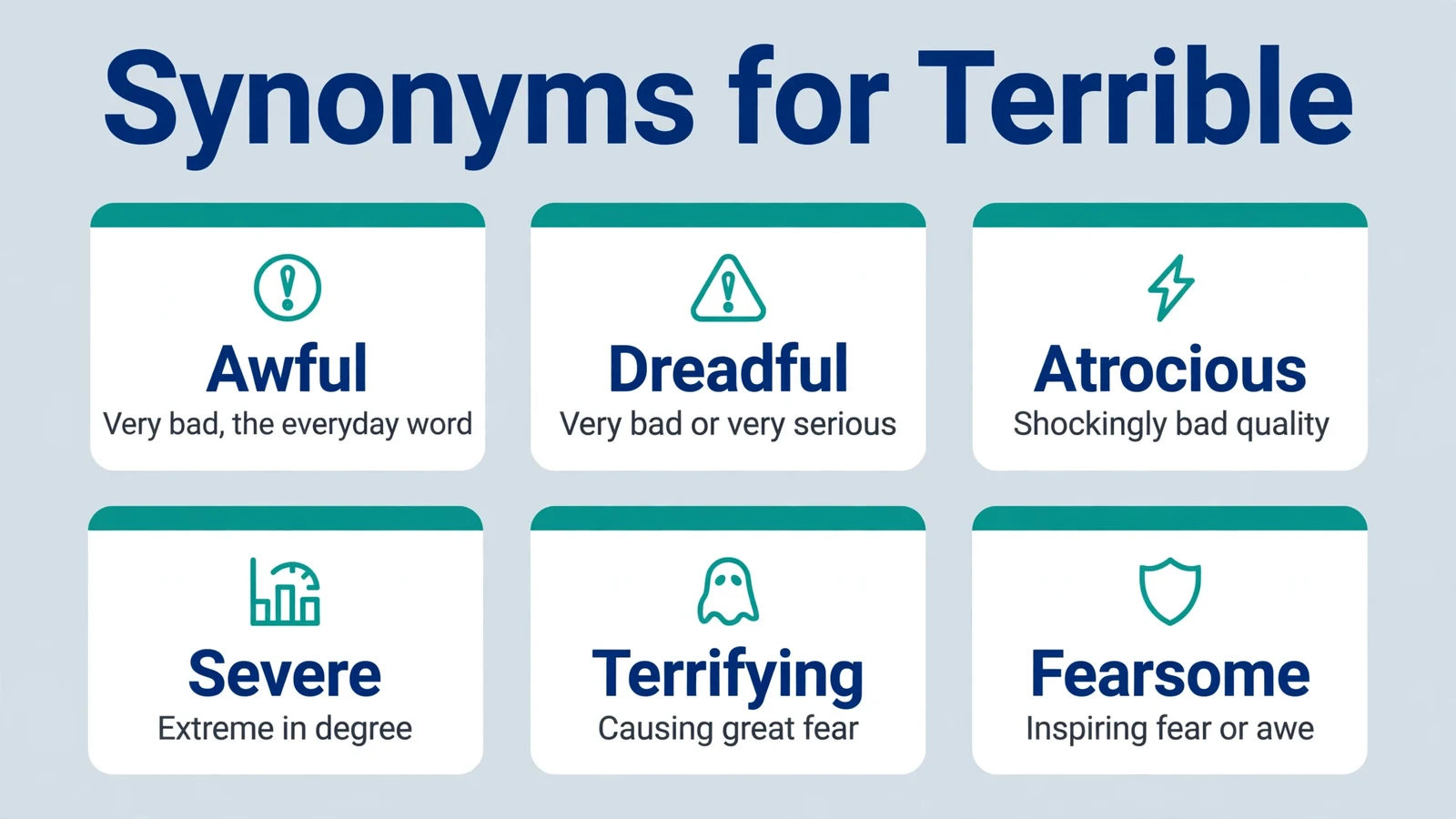
Terrible does a lot of heavy lifting in English, and that is exactly the problem. We use it for cold soup, bad movies, storms, headaches, and bad news, so the word has started to feel flat. The most useful synonyms for terrible include awful, horrible, dreadful, atrocious, appalling, abysmal, ghastly, severe, extreme, terrifying, and fearsome. Each one, however, fits a different kind of bad, and picking the wrong one can quietly change your meaning.
This guide groups more than 45 checked synonyms for terrible by sense, so you can match the word to the situation. Every entry was verified against major thesaurus sources, and each group explains the nuance in plain language. As a result, you get words you can trust, not a long list of near misses.
Top Synonyms for Terrible: Quick Reference
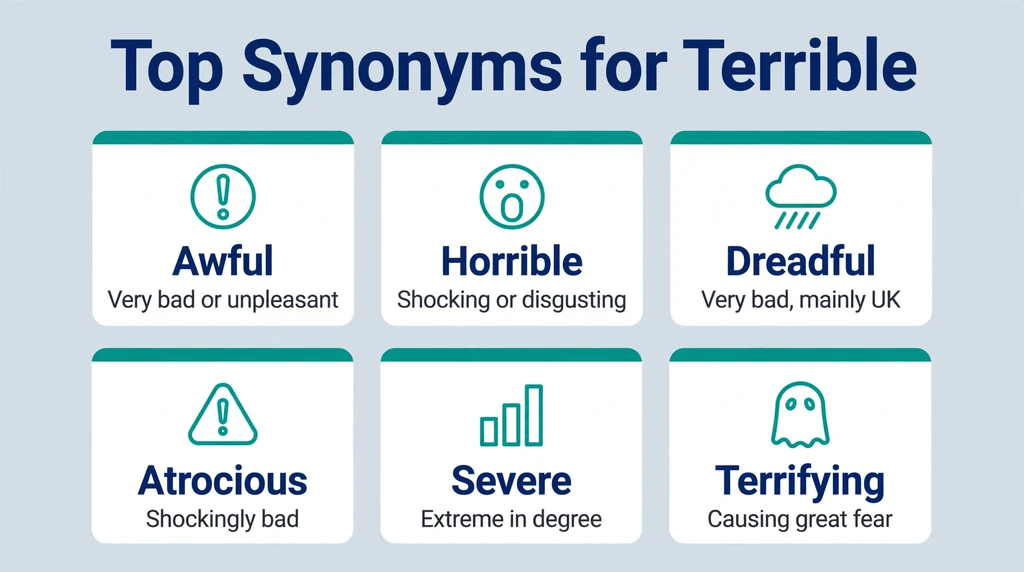
The table below gives you the fastest route to a better word. Scan the meaning column first, then check the tone column, because register matters as much as meaning here.
| Word | Meaning in one line | Best for / tone |
|---|---|---|
| awful | Very bad or unpleasant | Everyday, neutral |
| horrible | Shocking, disgusting, or very bad | Everyday, strong |
| dreadful | Very bad; also very serious | Everyday, mainly UK flavor |
| atrocious | Shockingly bad in quality or behavior | Strong, formal |
| appalling | So bad it shocks or dismays | Strong, formal |
| abysmal | Extremely bad, like a bottomless pit | Formal, quality |
| ghastly | Shocking, horrible, or deathly | Strong, dramatic |
| shocking | Very bad in a surprising way | Informal to neutral |
| bad | Simply not good | Plain, mild |
| poor | Low in quality | Neutral, quality |
| unpleasant | Not pleasant to experience | Mild, polite |
| severe | Very great in degree or force | Neutral, intensity |
| intense | Extreme in degree or strength | Neutral, intensity |
| extreme | Farthest from normal in degree | Neutral, intensity |
| serious | Grave and worrying in scale | Neutral, formal |
| desperate | Urgent and extreme | Formal, situations |
| terrifying | Causing great fear | Strong, fear |
| frightening | Making you feel afraid | Neutral, fear |
| fearsome | Inspiring fear or respect | Literary, fear |
| formidable | Powerful and hard to face | Formal, fear or respect |
| fearful | Causing fear (also means afraid) | Literary, fear |
| alarming | Causing worry or fear | Neutral, fear |
| horrific | Causing horror and shock | Strong, events |
| horrendous | Extremely bad or shocking | Strong, emphatic |
| gruesome | Grisly and repellent in detail | Strong, graphic |
| hideous | Extremely ugly or shocking | Strong, appearance |
| lousy | Bad, or feeling ill | Informal |
| rotten | Bad, spoiled, or unfair | Informal |
A quick warning before you dive in: the four senses of terrible pull in different directions. A synonym that praises your precision in one sense can sabotage you in another. That is why the sections below treat each sense on its own, with its own word list, its own examples, and its own traps. If you are in a hurry, match your sentence to a sense first, and the table above will do the rest.
What Does Terrible Mean?
Terrible is an adjective with four living senses, and the thesauri keep them apart for a reason. First, it means extremely bad in quality, as in a terrible movie or terrible handwriting. Second, it means severe or extreme in degree, as in a terrible pain or a terrible storm. Third, in its oldest sense, it means causing fear or dread. Fourth, people use it informally as an intensifier, as in a terrible flirt.
The word history explains the spread. Terrible comes from the Latin *terribilis*, from *terrere*, which means to frighten. So the fear sense came first, and the quality sense grew out of it over time. Today the balance has flipped: most speakers reach for terrible when something is simply very bad. Merriam-Webster still lists causing fear as a sense, though, so context decides which meaning a reader hears.
That is why a single flat list misleads. A word that works for a terrible smell may fail for a terrible storm, and a fear word may sound odd for a terrible essay. The groups below keep the senses separate, so each synonym lands where it belongs.
Here is the map in one place. Quality: the thing is badly made or badly done. Severity: the thing is extreme in degree, like pain or weather. Fear: the thing frightens people, the oldest meaning of all. Emphasis: the word only turns up the volume, as in a terrible gossip. Whenever you feel stuck, return to this map. Naming the sense takes five seconds, and it prevents the most common synonym mistakes in this whole family of words.
One more point matters for learners. Terrible is not slang, and it is not rude. It is a standard adjective that appears in newspapers, textbooks, and business reports. The slang in this area lives in a few of its synonyms, such as godawful, and those are flagged wherever they appear below.
Tone, however, still matters. Terrible is a blunt instrument, and it can sound like a verdict when it lands on a person. A terrible teacher, a terrible mother, a terrible friend: each one judges the whole role. Softer quality words, like poor or disappointing in spirit, criticize the work instead of the person. Skilled writers aim terrible at things, events, and results, and aim gentler words at people. That single habit removes most of the sting from negative writing.
Synonyms for Terrible That Mean Very Bad Quality
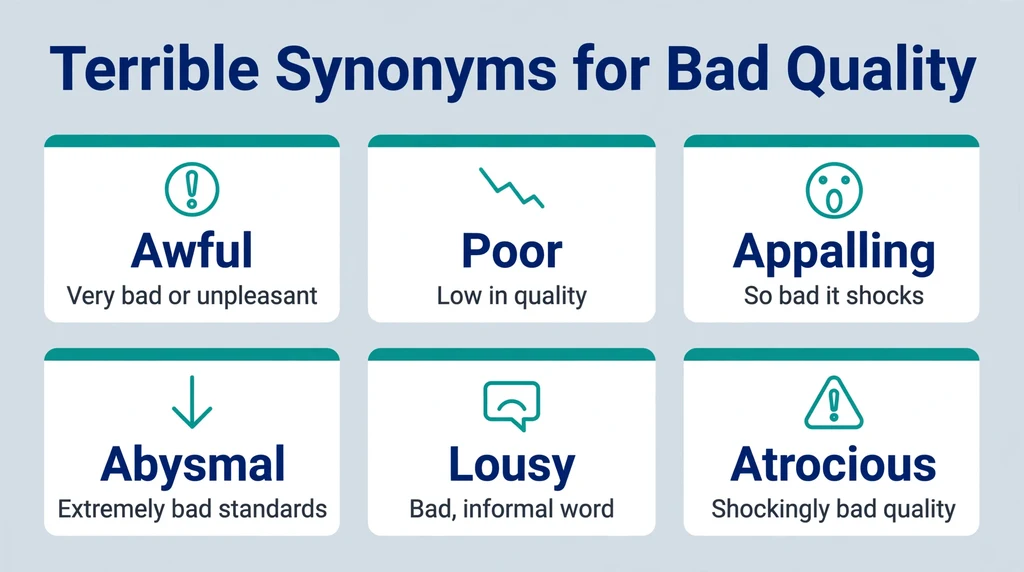
This is the sense most readers need. Your meal was cold, the service was slow, or the essay was weak, and terrible feels too vague. The words in this group all describe bad quality or a bad experience, but they differ in strength and tone.
The Everyday Core
Awful is the closest everyday match. It covers bad quality, bad feelings, and bad experiences, and it sounds natural almost anywhere. Horrible is a step stronger, because it adds shock or disgust to simple badness. Dreadful sits beside them and is especially common in British English, where it can describe weather, news, or behavior. For a fuller set of plain options at this level, see our guide to synonyms of bad.
Bad itself is the mildest choice, and sometimes mild is right. Poor targets quality specifically, so it suits work, health, and performance: poor results, poor soil, a poor connection. Unpleasant is the polite option, useful when you must criticize gently. Shocking adds surprise; Collins marks it informal in this sense, so it fits speech better than formal reports.
Choosing among the core three takes one second of thought. Awful is the default when nothing more specific comes to mind, and it never sounds wrong. Horrible earns its place when the thing shocks or disgusts you a little. Dreadful earns its place when the thing also feels heavy or sad, like dreadful news or a dreadful mistake. The differences are small, but readers register them, and small differences are what separate flat writing from sharp writing.
Stronger Words for Shock and Disgust
Some things are not just bad; they stun you. Atrocious is the heavyweight here, and it works for quality and behavior alike: atrocious spelling, an atrocious crime. Appalling stresses the dismay a thing causes, so it suits conditions and suffering. Horrific belongs to events that cause horror, especially accidents and attacks.
Horrendous is the emphatic all-rounder for traffic, costs, and behavior. Horrifying works the same way, with a slightly more active feel. Gruesome is narrower, because it points to grisly physical detail. Ghastly mixes shock with a deathly or sickly touch, and hideous targets extreme ugliness or a shocking act. Monstrous adds size or moral outrage, so it fits crimes and cruelty better than cold soup.
Choosing inside this shelf is mostly about the picture you want. Horrific freezes a single moment, like the instant of a crash. Horrendous stretches across a whole situation, like a week of horrendous weather. Appalling points at the reaction of witnesses, while atrocious points at the thing itself. None of these words fits a merely disappointing result, and that restraint is the point. Save the shelf for scenes that genuinely shock, and it will never let you down.
Formal Words With Moral Weight
A third shelf holds words that judge people and actions, not just quality. Abysmal pictures a bottomless pit, so it is perfect for records, results, and standards. Abhorrent means something inspires disgust or hatred, and it stays formal. Hateful, loathsome, and odious all describe people or acts that deserve contempt.
Obnoxious points to someone loudly unpleasant, while revolting and repulsive describe things that turn the stomach or the mind. Vile is short, strong, and old in flavor; it fits smells, acts, and language. Foul covers smells, weather, and dirty deeds alike. These words carry real force, so save them for things that earn them.
Words for Terrible Weather, Days and Experiences
Cambridge groups many of these words under bad weather, conditions, and situations, and that grouping is practical. Weather and days take a slightly different set than objects do. Dire fits forecasts and warnings: the predictions were dire. Grim fits realities and outlooks rather than objects. Horrendous is the commuter word, as in horrendous traffic. Atrocious conditions is a set phrase in reports, and ghastly suits a misunderstanding or a mistake that ruins a day.
People and behavior take their own slice of this group. Cambridge also lists terrible under a bad person or action, with awful and dreadful for deeds and treatment. A dreadful deed, an awful husband, a terrible liar: the pattern is a person plus a role, and the adjective judges the performance, not the soul. That is why these words sting in reviews and reports alike.
Example Sentences for the Quality Sense
- The hotel room was atrocious, with a broken shower and stained sheets.
- Her handwriting is abysmal, so the notes had to be typed again.
- We sat through an awful lecture that repeated the same point for an hour.
- The soup was poor, thin and almost tasteless.
- He told a lousy joke and the whole room went quiet.
- The committee called the delays appalling and demanded a new plan.
- It was a dreadful day for the markets, with every index falling.
- The smell from the drain was revolting, so we opened every window.
Synonyms for Terrible That Mean Severe or Intense
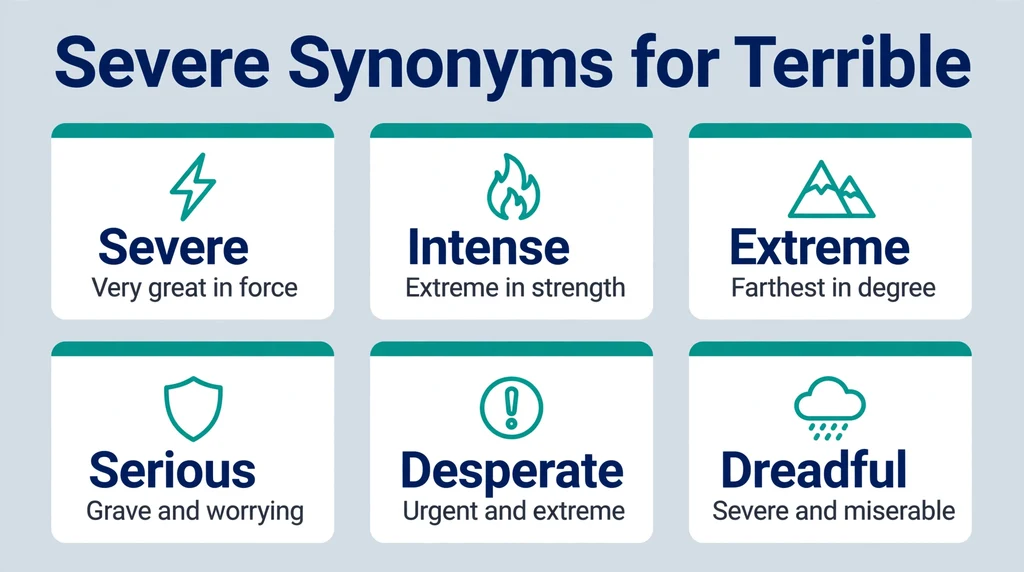
Sometimes terrible says nothing about quality at all. A terrible headache is not a low quality headache; it is an extreme one. Merriam-Webster gives this as a separate sense: extreme in degree, power, or effect. Collins does the same with its example of a terrible pain in the head and being in terrible trouble.
Scale nouns love this sense. A terrible loss, a terrible cost, a terrible waste, and a terrible amount all measure size rather than quality. Journalists lean on it because it is compact: one word carries the whole measurement. The risk is ambiguity, since a terrible loss can also mean a painful, upsetting loss. When the number matters, severe or extreme removes the doubt, and when the feeling matters, dreadful keeps it.
Severe is the safest replacement. It suits pain, weather, damage, and shortages, and it sounds precise rather than emotional. Intense focuses on strength or concentration, so it fits pain, heat, pressure, and feelings. Extreme marks the far end of a scale, as in extreme poverty or extreme caution. Each one keeps the scale idea and drops the complaint.
Serious adds worry: a serious problem needs attention now. Desperate goes further and signals urgency, as in desperate need or a desperate situation. Dreadful also appears in this sense in the sources, which is why a dreadful pain sounds both severe and miserable. When you write about storms, pain, or losses, reach for this group first. Words like awful would drag the sentence back toward quality, and that small shift can confuse your reader.
Terrible Pain, Terrible Storms, Terrible Trouble
Three collocations show the sense at work. With pain, the scale words rule: severe pain, intense pain, and extreme discomfort all report degree without judging quality. With weather, severe storms and extreme weather are the newsroom standards, because they measure force rather than complain about it. With trouble, serious and desperate take over: serious trouble warns, while desperate trouble begs for rescue.
Notice what changes when the sense is clear. A terrible loss in a match report means a heavy loss, not a badly played one. A terrible responsibility, in Merriam-Webster’s example, means a weighty one. Writers who miss the intensity sense often reach for quality words and accidentally insult the wrong thing. A severe storm is nobody’s fault; a terrible picnic might be.
Synonyms for Terrible That Mean Causing Fear
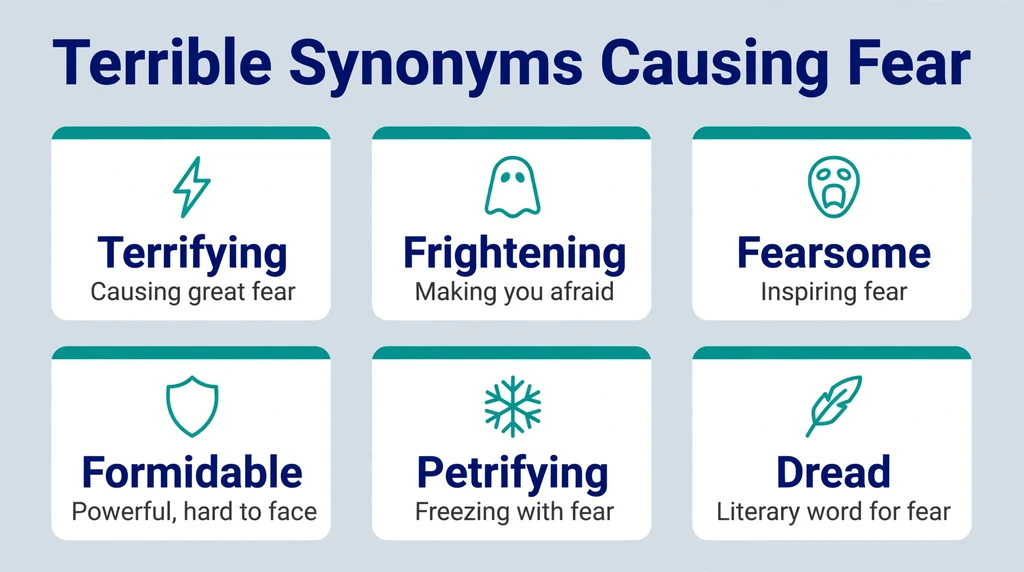
The fear sense is the oldest one, and honesty matters here: it is no longer the everyday meaning. You will meet it in literature, in history writing, and in fixed phrases like the terrible swift sword. Still, it is real, and the thesauri list it first for a reason. Merriam-Webster defines this sense as causing fear, with a terrible nightmare as the example.
Terrifying is the clearest modern choice, and it needs no explanation. Frightening is a touch milder and very flexible. Fearsome describes something that inspires fear, often mixed with respect, like a fearsome reputation. Formidable goes further toward respect: a formidable opponent is powerful and hard to beat, not simply scary. Merriam-Webster even gives terrible a sense of formidable in nature, with a terrible responsibility as the example.
Fearful can mean causing fear, although it more often means feeling afraid today, so context must carry it. Alarming causes worry rather than terror, and scary is the plain informal option. Dread, used as an adjective, is literary in flavor; Collins marks it literary. Petrifying and unspeakable close the group: one freezes you with fear, and the other describes horrors too bad for words. Use this group when fear is truly the point, not just badness.
The Fear Sense in Books and Set Phrases
History and fiction keep this sense alive. The Russian ruler Ivan the Terrible carries the old meaning in his name: he inspired terror, and no one is calling his workmanship poor. In the Cambridge American list, a terrible storm and the terrible roar of a lion show the same force-of-nature flavor. A terrible sound, a terrible roar, and a terrible cry all belong here rather than in the quality group.
Modern writers borrow this sense for effect. A fearsome reputation, a formidable challenge, and a terrifying ordeal all trade on fear, and readers feel the difference at once. If your sentence is about danger, dread, or awe, this group gives the sentence its chill. If it is about a badly cooked meal, it does not.
A few sentences show the range. The climbers faced a formidable wall of ice and turned back. A petrifying silence followed the scream in the hall. The old general had a fearsome temper that kept every aide careful. Notice how none of these sentences is about quality at all. Each one measures the fear a person, a sound, or a reputation can create, which is exactly where this word family began.
Terrible as an Informal Intensifier
English also uses terrible as a pure amplifier. Collins illustrates this sense with a telling example: she is such a terrible show-off. Nothing is bad about the showing off itself; terrible just turns the volume up. A terrible flirt, a terrible gossip, and a terrible liar all work the same way. The word names a habit and then exaggerates it.
The adverb terribly does this job even more often. Merriam-Webster defines terribly as to a great degree, with I am terribly sorry as its example. So terribly sorry, terribly important, and terribly expensive add emphasis without adding blame. In fact, terribly sorry is pure politeness, which shows how far the amplifier sense sits from the fear sense.
Look at the pattern across a few sentences. She is a terrible flirt, so every dinner party ends the same way. He is a terrible liar, and nobody checks his stories anymore. My grandfather was a terrible gossip who knew every street’s news. In each case, terrible measures the habit, not the harm. Swapping in awful keeps the pattern alive, as in an awful flirt, while a word like atrocious would break it completely. Amplifiers are picky about their partners.
Two related patterns deserve a quick note. Feeling terrible can mean feeling ill, and Collins lists words like poorly, rough, and lousy for that use. Feeling terrible about something can also mean feeling guilty or sorry. Neither pattern needs a synonym hunt; it needs the right phrase for the situation.
British English pushes the amplifier further. In the show-off sense, Collins lists right and proper as British informal partners, as in a right mess or a proper fool. American readers understand the pattern through terrible itself, so a terrible mess and a terrible fool need no translation. The lesson for writers is simple: when terrible sits before a person noun or a habit noun, read it as emphasis first and judgment second.
Terrible vs Horrible: How They Differ
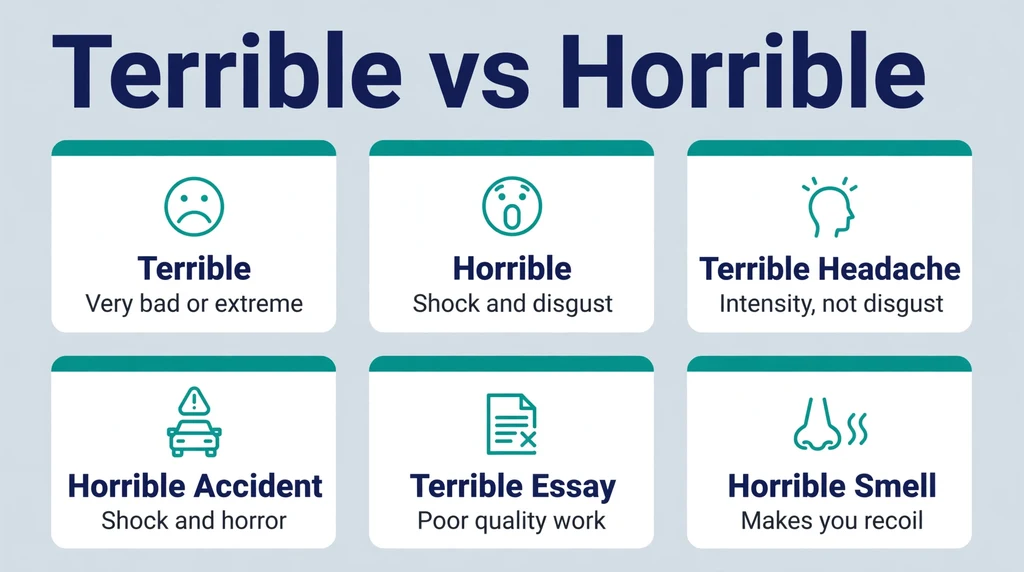
These two words overlap so much that writers swap them freely, yet the thesauri draw a real line. Merriam-Webster gives horrible four senses, and two of them lead with horror: extremely disturbing or repellent, and causing intense displeasure, disgust, or resentment. Its terrible entry is broader, because it adds the intensity sense and the plain low quality sense.
So the practical rule is this. Choose horrible when shock, horror, or disgust is the heart of the sentence: a horrible accident, a horrible smell, a horrible way to treat someone. Choose terrible when you mean very bad in general, very poor in quality, or extreme in degree. A terrible headache is intense, not disgusting, and a terrible essay is poor work, not a horror.
If you want the full family of shock and disgust words, our guide to synonyms for horrible goes deeper. In short, horrible judges how a thing makes you recoil, while terrible judges how bad or how extreme it is. That single question, recoil or degree, settles most cases.
| Question | Terrible | Horrible |
|---|---|---|
| Core feeling | Very bad or very extreme | Horror, shock, disgust |
| Low quality work | Yes: a terrible essay | Possible, but less common |
| Pure intensity | Yes: a terrible headache | No, it sounds like disgust |
| A shocking scene | Possible | Yes: a horrible accident |
| Everyday safety | Safe almost anywhere | Stronger, more emotional |
How to Choose the Right Synonym for Terrible
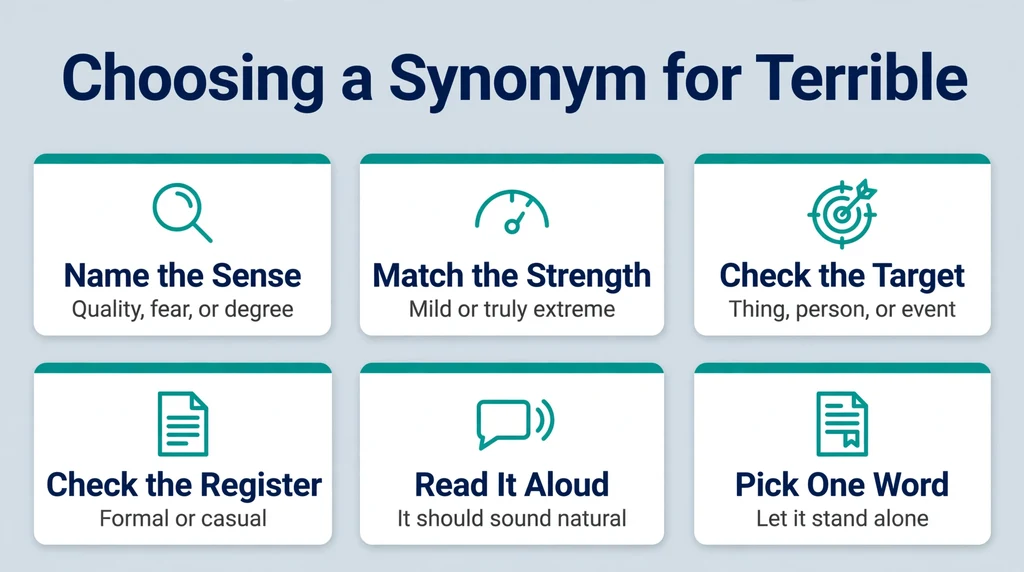
Start by naming the sense. Ask yourself one question: is the thing badly made, severe in degree, frightening, or just being exaggerated? That answer picks the group, and the group picks the word. Most weak choices come from skipping this step and grabbing the strongest word in sight.
Next, match the strength. Mild problems deserve mild words: the soup was poor, the delay was unpleasant. Middling problems take awful, horrible, or dreadful. Only true extremes earn atrocious, appalling, or abysmal. If every meal is atrocious, the word stops meaning anything, and your reader stops believing you.
Then check the target. Quality words fit things and work: an abysmal record, a lousy draft. Fear words fit threats and experiences: a terrifying climb, a fearsome dog. Moral words fit people and deeds: a hateful lie, an odious scheme. Finally, read the sentence aloud. The right synonym should sound like something a person would actually say, because even a correct word fails when it sounds borrowed from a costume drama.
Paired Examples: Vague vs Precise
- Vague: The food was terrible. Precise: The food was atrocious, cold in the middle and burnt at the edges.
- Vague: He had a terrible headache. Precise: He had an intense headache that light made worse.
- Vague: It was a terrible night. Precise: It was a terrifying night, with the storm shaking every window.
- Vague: Her exam results were terrible. Precise: Her exam results were abysmal, far below her usual standard.
- Vague: The traffic was terrible. Precise: The traffic was horrendous, and the trip took three hours.
- Vague: The news was terrible. Precise: The news was dreadful, and the room fell silent at once.
Each precise version tells the reader which kind of bad you mean. That is the whole skill: not a fancier word, but a clearer one.
A Quick Checklist Before You Swap
- Sense first: quality, severity, fear, or emphasis?
- Strength second: mild, middling, or truly extreme?
- Target third: a thing, a person, an event, or a feeling?
- Register fourth: report language or coffee language?
- Sound last: does the sentence still sound like you?
Run through those five questions and most swaps settle themselves. The checklist takes seconds, and it prevents the two classic errors: a slang word in a formal report, and a horror word in a sentence about degree.
Formal and Informal Synonyms for Terrible
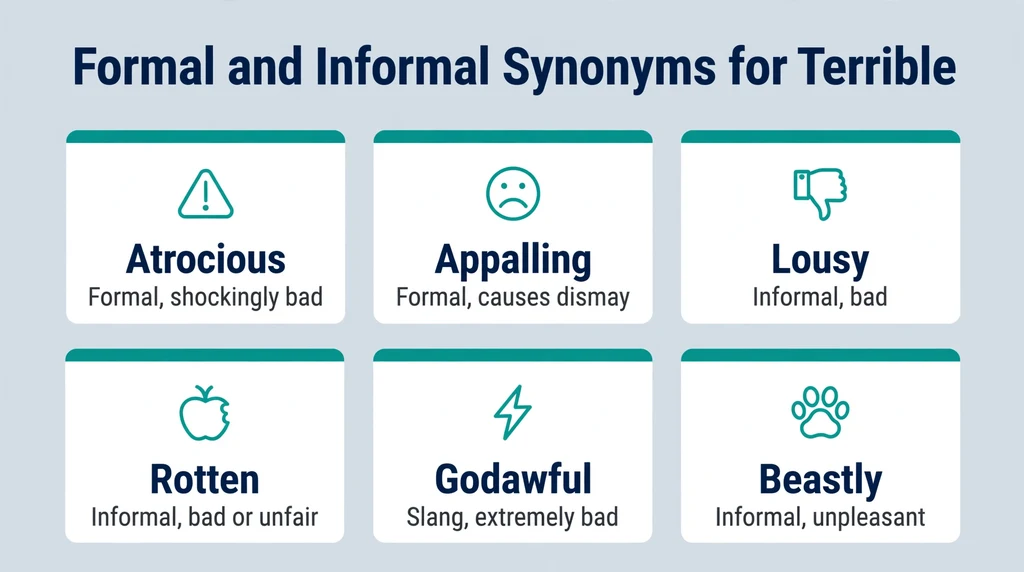
Register is where good writers separate themselves. In essays, reports, and reviews, formal choices sound measured and precise. Atrocious, appalling, abysmal, horrific, severe, extreme, serious, and formidable all sit comfortably in serious prose. They criticize without sounding like a complaint at the dinner table.
Stories and conversation allow the looser shelf. Lousy and rotten are informal, and both appear in the sources with informal labels. Beastly is informal too, and it has an old-fashioned British charm. Godawful is slang, so it belongs in dialogue or very casual writing. Horrid is marked old-fashioned informal by Cambridge, which makes it useful for period voices.
A simple test helps: would the word fit a news report? If yes, it is probably formal enough for school or work. If it sounds like something a friend says over coffee, keep it for speech and fiction. Mixing the shelves by accident is the fastest way to make a sentence sound off.
Watch the two shelves in action. A formal sentence: The report described conditions in the camp as appalling and demanded urgent aid. An informal one: We had a lousy hotel, a rotten breakfast, and a godawful flight home. Both sentences are clear, and both would sound wrong with their registers swapped. Formal writing also prefers severe and extreme for the intensity sense, while speech happily keeps terrible pain and terrible weather. Neither choice is better in the abstract; each one fits its setting.
Antonyms for Terrible
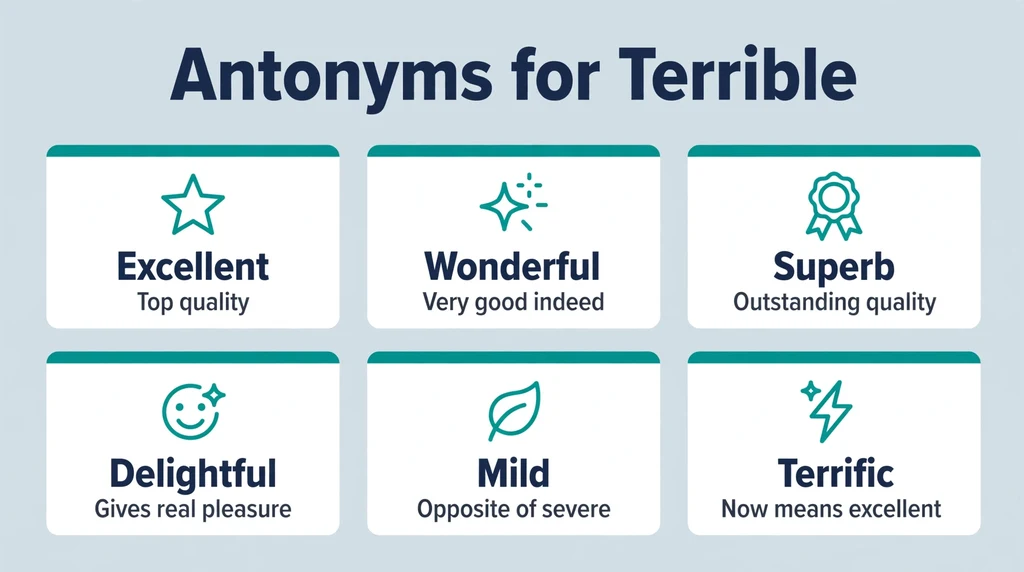
Every sense of terrible has a clean opposite. For bad quality, the opposites are good, great, excellent, wonderful, brilliant, superb, and fantastic. Collins lists most of these directly as opposites of terrible, and Cambridge gives good as the antonym in both of its terrible groups. For pleasant experiences, delightful, pleasant, and fine work well. For the intensity sense, mild is the natural opposite, as in a mild headache instead of a terrible one.
One opposite deserves a smile: terrific. It began life in the same fear family, yet today it means excellent, as Collins confirms by placing it among the opposites. Language flips words more often than we expect. If you want the positive shelf in full, browse our guide to synonyms of good for options at every strength.
Match the opposite to the sense, just as you matched the synonym. A superb meal answers a terrible one, and a delightful evening answers a dreadful one. A mild day answers a severe storm, and a gentle opponent answers a formidable one. Writers often forget the antonym half of the swap, then wonder why a positive sentence still feels lopsided. The sense map works in both directions, so use it both ways.
Words That Are Not True Synonyms for Terrible
A few words look like synonyms and behave like traps. Terrific is the famous one: it once meant terror causing, but now it praises. Calling a meal terrific tells your reader it was excellent, not awful. Awesome has flipped the same way. Older thesauri list it near terrible because it once meant inspiring awe or dread, yet today it means impressive and great.
Inconvenient is a different kind of trap. It is far too weak, because a terrible day is not merely an inconvenient one. Disgusting belongs to the horrible family; it names one reaction, not badness in general. Terror itself is a noun, so it cannot replace an adjective in a sentence. Finally, beware of stacking strength: words like atrocious lose their punch when writers use them for trivia. Save the biggest words for the biggest failures, and your writing will keep its credibility.
Two smaller traps deserve mention. First, dreadful spelled as dreadfull or dreadfuly slips into drafts often, so a quick search before publishing saves embarrassment. Second, piling terrible onto an already extreme word, as in a very terrible or most terrible disaster, usually weakens both words. Pick one strong word and let it stand alone. Clean strength beats doubled strength almost every time.
Frequently Asked Questions
What is the best synonym for terrible?
Awful is the closest all-purpose synonym, because it covers bad quality, bad experiences, and bad feelings. For stronger cases, writers often choose atrocious, appalling, or horrific.
What is a stronger word than terrible?
Atrocious and appalling are both stronger, and abysmal works well for results and standards. For frightening things, terrifying and horrific carry more force than terrible.
Is terrible a bad or rude word?
No. Terrible is a standard, polite adjective, and it appears in news, school, and business writing. Only slang options like godawful need care, and those belong in casual speech.
What is the difference between terrible and horrible?
Horrible leans toward horror, shock, and disgust, while terrible is broader. Terrible also covers extreme degree and low quality, so a terrible headache is intense rather than disgusting.
Can terrible ever mean something good?
No, terrible itself never means good in current English. The word that flipped is terrific, which once shared the fear sense but now means excellent.
What does terribly mean in terribly sorry?
Terribly is an intensifier there, and it means very or extremely. Merriam-Webster defines terribly as to a great degree, so terribly sorry simply means very sorry.
What is the opposite of terrible?
Common opposites include excellent, wonderful, great, superb, and delightful. For the intensity sense, mild is the fitting opposite, as in a mild pain.
Is awful the same as terrible?
Almost. Awful matches terrible in most everyday sentences, and both can describe quality or feelings. Awful also has an old sense of inspiring awe, but modern readers rarely hear it in that way anymore.
Final Thoughts
Terrible is a useful word, but it should not have to work alone. Once you separate bad quality from severity, and severity from fear, the right replacement usually picks itself. Keep awful and dreadful for everyday badness, severe and extreme for degree, and terrifying for real fear, and your sentences will say exactly what you mean.
For the full dictionary treatment of every sense, the Merriam-Webster Thesaurus entry for terrible is the reference this guide checked against. Pick one sentence you wrote this week, swap in a sharper synonym, and feel the difference for yourself. Small swaps like these are how a plain vocabulary quietly turns into a precise one, one honest word at a time.