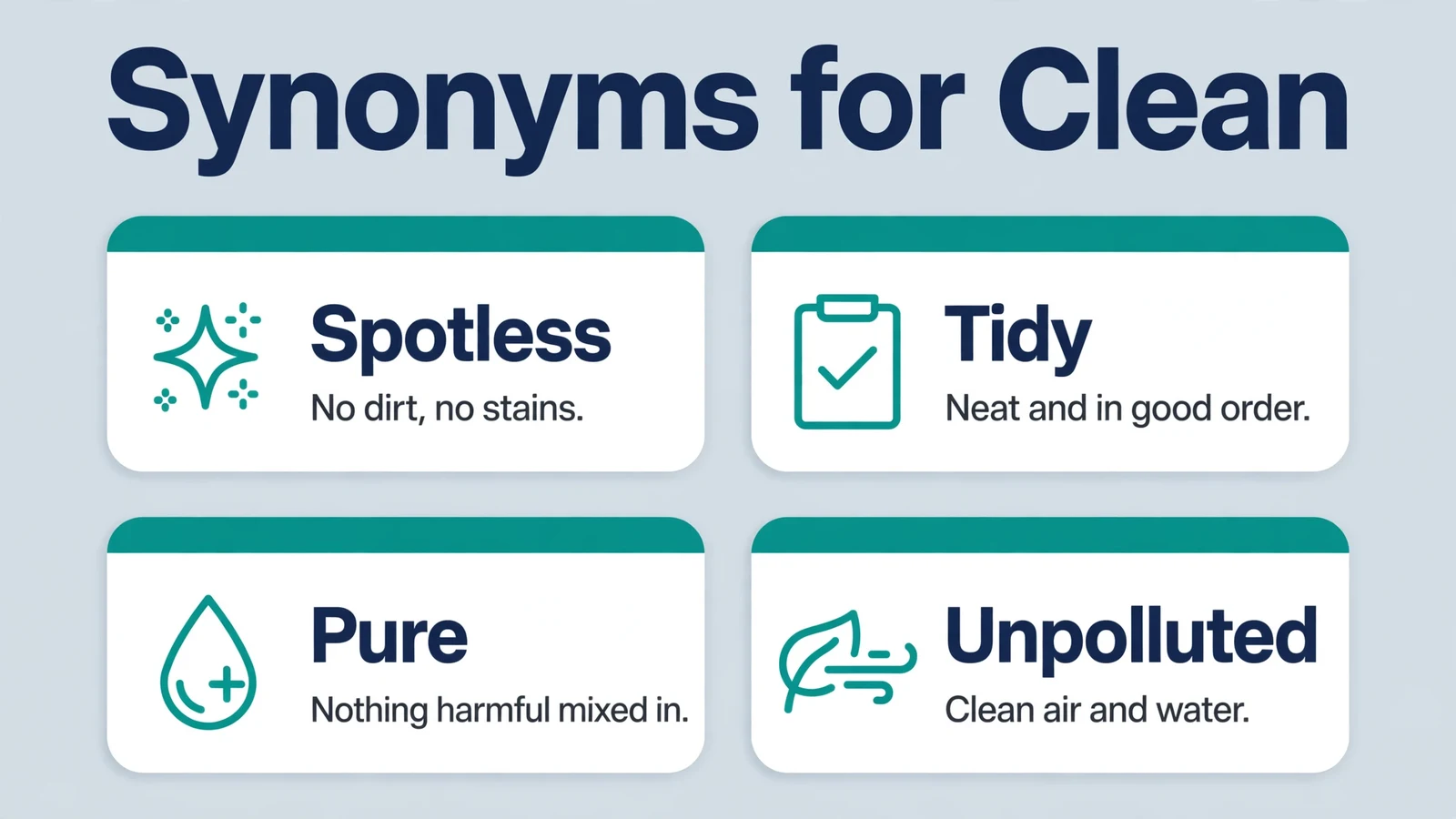
Clean looks like one of the simplest words in English, yet it does at least six different jobs. A clean shirt has no dirt on it. A clean desk is tidy and ordered. A clean joke offends nobody, and clean energy pollutes nothing. The most useful synonyms for clean include spotless, immaculate, pristine, neat, tidy, pure, hygienic, unpolluted, and the verbs wash, scrub and cleanse. Each one fits a different job, though, so the trick is matching the word to the sense you mean.
This guide groups more than 75 verified synonyms for clean by sense, from dirt and hygiene to morals, design and cleaning actions. Every word comes with a short meaning, and the key entries include example sentences. As a result, you can choose the exact term instead of repeating clean in every line.
Top Synonyms for Clean: Quick Reference
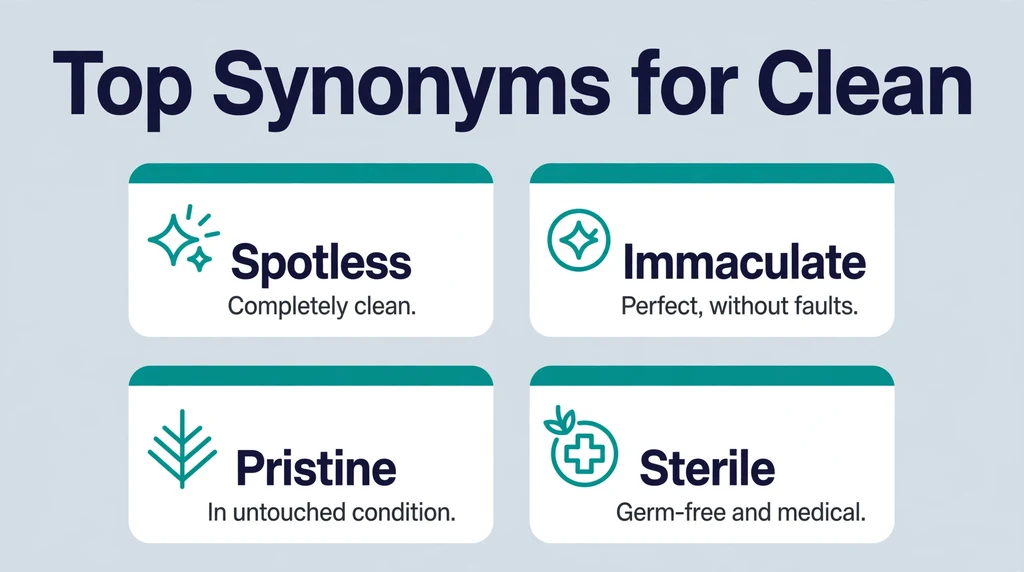
The table below covers the 28 synonyms readers reach for most often. Start here when you need one fast replacement. Later sections sort the full list into finer groups by sense.
| Word | Meaning in one line | Best for |
|---|---|---|
| Spotless | Completely free of marks or dirt | Strongest everyday choice |
| Immaculate | Perfectly clean, with no fault at all | Houses, clothes, formal praise |
| Pristine | Clean and in original, untouched condition | Places, nature, objects |
| Stainless | Without a single stain | Fabric, steel, reputations |
| Spick-and-span | Clean and neat, bright as new | Homes, informal tone |
| Squeaky-clean | Totally clean, beyond any doubt | Informal emphasis |
| Unsullied | Never dirtied or spoiled | Formal, literary tone |
| Unsoiled | Not made dirty | Formal writing |
| Unstained | With no stain left on it | Clothes, records |
| Unblemished | Without a mark or flaw | Surfaces, reputations |
| Untarnished | Still bright, not dulled or damaged | Metal, reputations |
| Pure | Free from anything harmful or mixed in | Air, water, ingredients |
| Hygienic | Clean in a way that protects health | Kitchens, clinics, food areas |
| Sanitary | Clean and safe from germs | Public places, facilities |
| Antiseptic | Clean and treated against germs | Medical settings |
| Sterile | Completely free of germs | Hospitals, laboratories |
| Sparkling | Shining with cleanliness | Bathrooms, glass, kitchens |
More Quick Picks: Order, Character and Completeness
| Word | Meaning in one line | Best for |
|---|---|---|
| Washed | Freshly cleaned with water | Clothes, dishes, hands |
| Laundered | Washed and ironed | Shirts, linen, formal wear |
| Neat | Tidy, ordered and pleasing to see | Rooms, work, handwriting |
| Tidy | Arranged in good order | Desks, rooms, shelves |
| Orderly | Well arranged and systematic | Spaces, files, queues |
| Wholesome | Morally good and healthy in effect | Fun, entertainment, habits |
| Virtuous | Morally upright and good | People, lives, formal tone |
| Decent | Proper and not offensive | Jokes, stories, behaviour |
| Thorough | Complete in every detail | Searches, checks, sweeps |
| Decisive | Final and settling the matter | Breaks, wins, endings |
| Unpolluted | Not contaminated in any way | Air, rivers, beaches |
One warning before you dive in: these words are not interchangeable. Sterile belongs in a hospital, not a living room. Tidy describes order, not hygiene. The grouped sections below explain each word in its proper place, so your sentence stays accurate as well as fresh.
What Does Clean Mean?
At its core, clean means free from dirt, marks or stains. Cambridge puts the everyday test simply: are these clothes clean? Merriam-Webster gives the same first sense, free from dirt or stain, and uses clean uniforms as its example. The word goes back to Old English claene, so English speakers have leaned on it for well over a thousand years.
The adjective covers six senses
That single core stretches a long way. First, clean means dirt-free, as in a clean towel. Second, it means tidy, as in a clean desk with nothing out of place. Third, it means morally pure or decent, as in clean living and clean jokes. Fourth, it means complete or thorough, as in a clean break or a clean sweep. Fifth, it means free from pollution, as in clean air. Sixth, in sport it means done by the rules, as in a clean tackle. Each sense takes its own synonyms, which is why one flat list would mislead you.
Clean is also a verb and an adverb
As a verb, clean means to remove dirt from something, and it takes its own rich set of synonyms, from wash to sterilize. As an adverb, it means completely or by the rules. Merriam-Webster gives the example of a thief who got clean away, and of a boxer who does not fight clean. This guide focuses on the adjective and the verb, because those are the senses writers replace most often.
One more sense deserves a brief, respectful mention. In informal use, clean can describe a person who no longer uses addictive drugs. Merriam-Webster defines this sense as free from drug addiction, with the example “has been clean for six months.” Dictionaries treat it as a plain factual term from recovery language, and this guide simply records it without a synonym list, since near words like sober carry extra meaning of their own.
Idioms built on clean
The word also anchors a set of everyday idioms, and each idiom leans on a different sense. A clean slate means a fresh start with past mistakes forgiven, so it borrows the blank, unstained sense. A clean bill of health means a person or an organization has been checked and found free of problems. Clean hands means innocence in a dispute: the person did nothing wrong. To come clean means to confess honestly at last. Knowing which sense powers each idiom explains why none of them accepts a synonym swap. A spotless slate or an immaculate bill of health would simply puzzle your reader.
Synonyms for Clean Meaning Free From Dirt
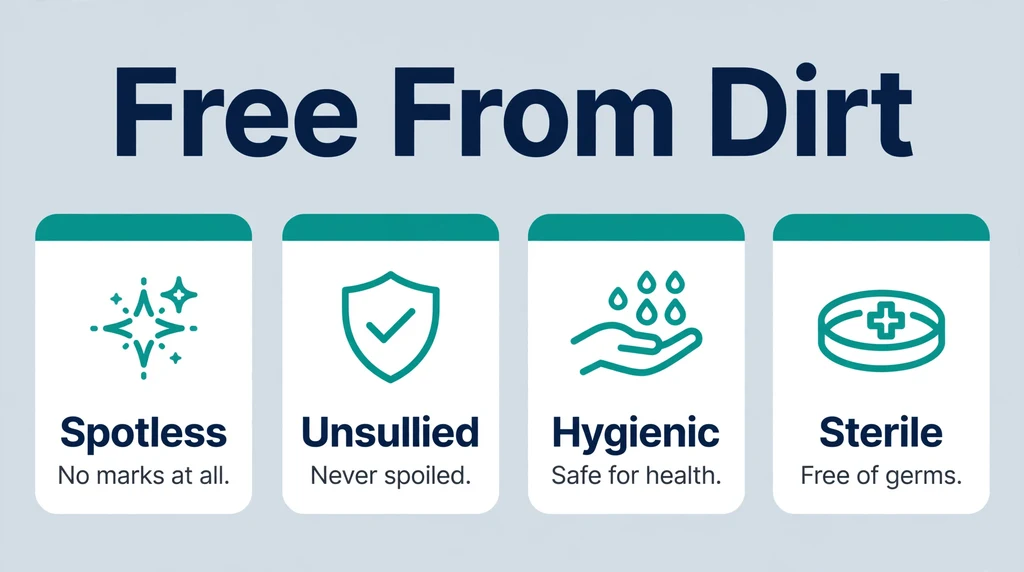
This is the sense most readers want: no dirt, no stains, no germs. The words below run from everyday strength to medical precision. All of them appear in the dirt-free lists of Merriam-Webster, Cambridge, Collins or Thesaurus.com.
The strongest everyday words
Spotless is the strongest common choice. It means completely free of marks, and it suits shirts, floors and hotel rooms. Immaculate goes one step further and adds faultlessness. Cambridge marks immaculate as an approving word, and people use it when a whole house looks perfect. Pristine adds the idea of original condition, so it fits untouched beaches and antique furniture. Stainless promises not one stain, which is why it suits white fabric and, figuratively, a stainless reputation. For a brighter, friendlier tone, spick-and-span describes a home that is clean, neat and shining, and squeaky-clean adds cheerful emphasis in informal writing.
Example: The hotel room was immaculate, with spotless sheets and a sparkling bathroom.
Formal and literary options
Formal writing often prefers the un- family. Unsoiled and unstained state plainly that nothing has dirtied the item. Unsullied sounds literary and often describes reputations or landscapes that were never spoiled. Unblemished means without a mark or flaw, and it moves easily from skin to records. Untarnished starts with metal that still shines and extends to names that keep their shine. Untainted fits things kept free from anything harmful or corrupting. Snowy appears in the thesaurus lists for its white brightness, and it works best for linen and landscapes rather than hygiene.
Example: She kept an unblemished record through twenty years of service.
Hygiene and germ-free words
When health is the point, choose a hygiene word. Hygienic means clean in a way that protects health, and it suits kitchens and food areas. Sanitary describes places and facilities that are safe from germs. Antiseptic goes further and means treated or protected against germs, a word at home in clinics. Sterile is the strongest of all: completely free of germs. Cambridge notes that sterile is common in technical language, so save it for medical tools and laboratories. Germ-free says the same thing in plainer words. Beyond those, purified and sterilized describe things that have been made clean by a process, while washed, laundered, cleansed and scrubbed describe the just-cleaned result. Impeccable, which Collins lists in this sense, adds the idea of faultless presentation.
Example: The clinic keeps every instrument sterile and every surface sanitary.
Words for clothes and laundry
Clothing has its own small shelf of clean words. Washed is the plain claim: the item has been through water and come out clean. Laundered sounds more finished, because laundering suggests washing plus ironing and folding. Hotels promise freshly laundered linen, not freshly washed linen, for exactly that reason. Cleansed appears on skincare and fabric care labels, where it sounds gentle and thorough at once. For the strongest praise, rental listings and hotels reach for spotless and immaculate, because guests judge a room first by its sheets and towels. A sparkling bathroom and gleaming white towels complete the picture, though sparkling describes the shine that cleanliness leaves behind rather than the washing itself.
Example: The rental promised laundered sheets, washed towels and a spotless kitchen.
Tidy and Orderly Synonyms for Clean
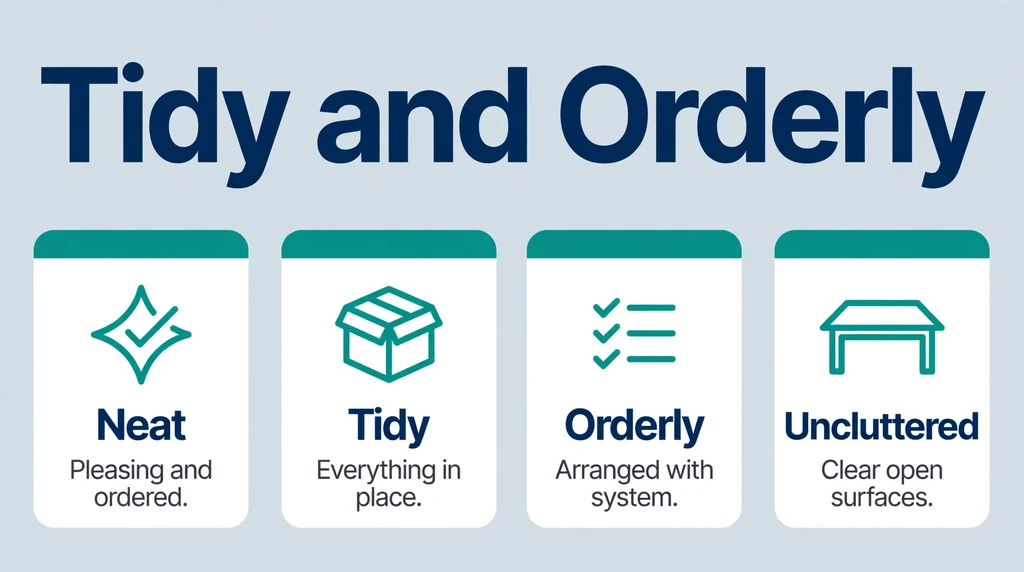
A room can be dirt-free yet chaotic, and a tidy room can still need a wash. This group is about order, not hygiene. Collins lists neat and tidy under clean in its design sense, and Thesaurus.com groups the same words for arranged spaces.
Neat is the leader here. It means arranged in a pleasing, orderly way, and it covers desks, handwriting and appearances. Tidy stresses that everything sits in its proper place. Orderly adds system, so it fits files, queues and routines. Trim describes something kept neat and in good shape, like a trim garden. Uncluttered names the quality readers praise most in modern rooms: clear surfaces with nothing extra competing for attention. Organized, listed by Merriam-Webster for the cleaned and ordered state, suits systems and storage more than surfaces.
Example: Her desk stayed neat all week, with tidy files and an uncluttered shelf.
Neat for people, work and writing
Neat travels further than rooms. A neat appearance means tidy clothes and a cared for look. Neat handwriting is easy to read because every letter sits in line. A neat solution in math or code solves the problem with nothing spare, which links neat back to the design sense. A neat summary covers the point in few words and leaves nothing dangling. In each case, neat praises economy: everything needed is present, and nothing extra gets in the way. That is why neat is the hardest working word in this whole group, and why writers reach for it when clean would sound too physical.
Clean lines and the design sense
Designers use clean in a related way: a clean design has no fuss, no clutter and nothing spare. For that look, elegant and simple lines do the heavy lifting, and Collins places neat, tidy, trim and elegant together under this sense. A clean layout feels calm because every element earns its place. Writers describing that calm, ordered beauty can also browse synonyms of beautiful for words that praise appearance directly. In this design sense, clean is about what has been left out as much as what remains.
Pure and Moral Synonyms for Clean
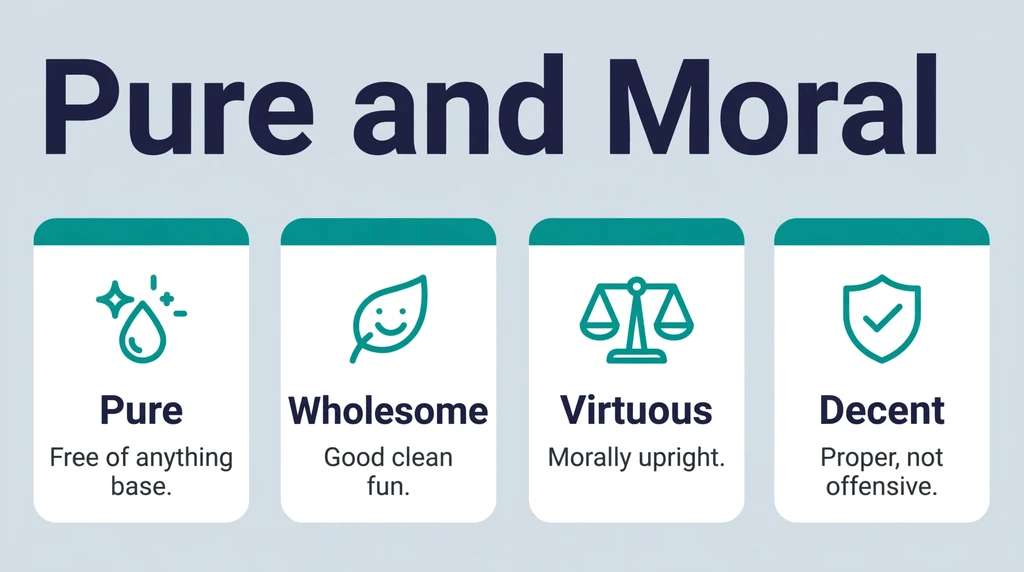
Clean also judges character and content. Merriam-Webster defines this sense as free from any trace of the coarse or indecent, and Collins describes it as free from dishonesty or corruption. The examples are familiar: clean living, clean jokes, a clean conscience.
Clean living and character
Pure leads this group, covering thoughts and lives kept free of anything base. Wholesome describes fun, habits and entertainment that are good for you in every way. Virtuous and upright praise people who live by strong moral standards, and both carry a formal tone. Moral itself works when the point is right conduct. Good is the plain everyday option, and Collins lists it directly in this sense; writers who need finer shades can compare the synonyms of good before choosing. Decent and respectable stress proper, socially approved behaviour. Undefiled is the formal, literary member of the group, suggesting purity that nothing has touched.
Example: The campfire songs stayed clean and wholesome for the youngest children.
Clean language and content
For jokes, songs and stories, the key words are decent, inoffensive in effect and family friendly in tone, though the thesaurus lists give the precise set: pure, modest and chaste for content that avoids anything coarse. Modest and chaste carry an old fashioned flavour today, so they suit historical or formal writing better than blogs. Merriam-Webster illustrates the sense with the songs allowed at a summer camp, a handy test: if the word would pass at camp, it belongs here. Innocent fits jokes and remarks that carry no hidden edge.
Example: He told a clean joke that had the whole table laughing.
A clean conscience
Two set phrases carry this moral sense into daily speech. A clean conscience means you can review your own actions without guilt, and people pair it with sleeping well for a reason. To have clean hands in a matter means you took no part in anything dishonest. News writing uses a third phrase, a clean image, for public figures whose reputations show no scandal. In all three phrases, the dirt being denied is moral, not physical. That is why the matching adjectives are unblemished, unsullied and untarnished, the same words that serve the dirt sense. English simply reuses its best purity words for both jobs.
A clean record and a fair game
Two smaller uses sit beside the moral group. A clean record means an unblemished history with nothing bad on file, and Thesaurus.com lists honest in this upright family. A clean driving licence is the everyday example. In sport, clean means by the rules: Merriam-Webster lists legal and fair for this sense and gives a clean check in hockey as its example. A clean tackle wins the ball without a foul, and a clean fight follows the rules from the first bell.
Synonyms for Clean Cuts, Breaks and Results
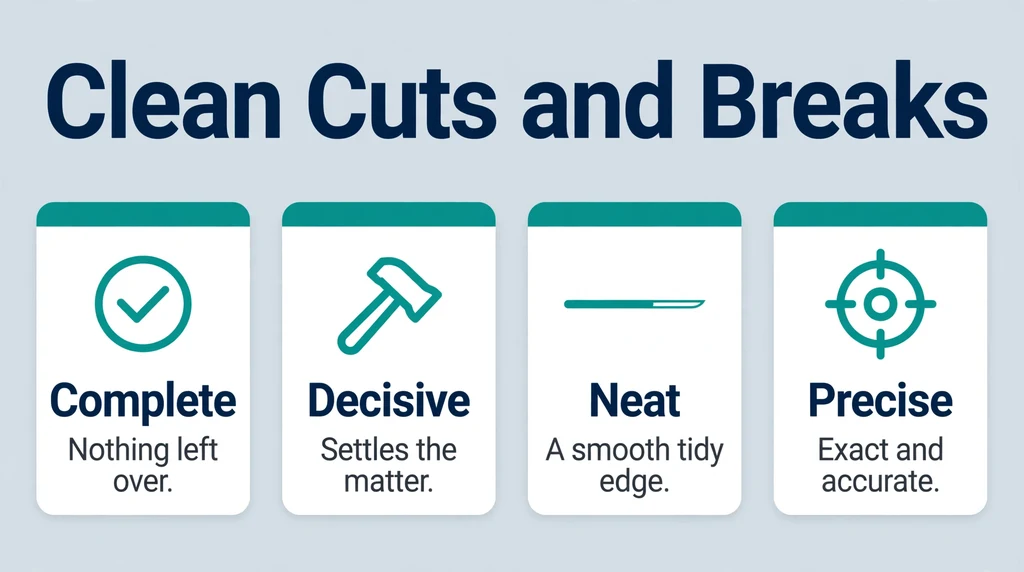
Sometimes clean has nothing to do with dirt at all. A clean cut is smooth and exact. A clean break is complete and final. Collins gives this sense its own entry, labelled thorough or complete, with the clean break as its example. Merriam-Webster agrees, listing clean as thorough in the phrase a clean sweep.
Complete and final words
Complete and entire stress that nothing is left over. Total and final add the sense of an ending that settles things. Thorough means done in every detail, which is why police make a clean sweep of an area. Decisive, which Collins lists here, fits breaks and victories that end all doubt. Conclusive in effect is the idea behind the group, even though writers usually reach for decisive instead.
Example: After ten years abroad, she made a clean break and started over.
Smooth and exact words
For cuts, lines and movements, the words change. Neat describes a cut with a tidy edge. Precise, listed by Thesaurus.com among the strongest words in this family, means exact and accurate. A surgeon makes a clean incision, a diver makes a clean entry, and a gymnast lands a clean routine with no wobble or error. In each case, clean praises smoothness and control rather than hygiene. Choose neat for edges, precise for accuracy, and flawless in tone only when the performance truly had no visible error.
Example: The knife made one neat, precise cut through the rope.
Clean wins, sweeps and sheets
Sport stretches this sense even further. A clean sweep means winning everything on offer, every game, seat or prize in the set. A clean sheet in soccer means the goalkeeper conceded no goals at all. A clean victory leaves no dispute about the result, which ties this group back to decisive and final. Commentators also praise a clean performance, meaning one without errors, penalties or stumbles. None of these uses involves soap. All of them share the same core idea: total, with nothing left over and nothing gone wrong. Once you see that core, the group stops looking like a list of exceptions and starts looking like one sense with many stages.
Clean Air, Water and Energy Synonyms
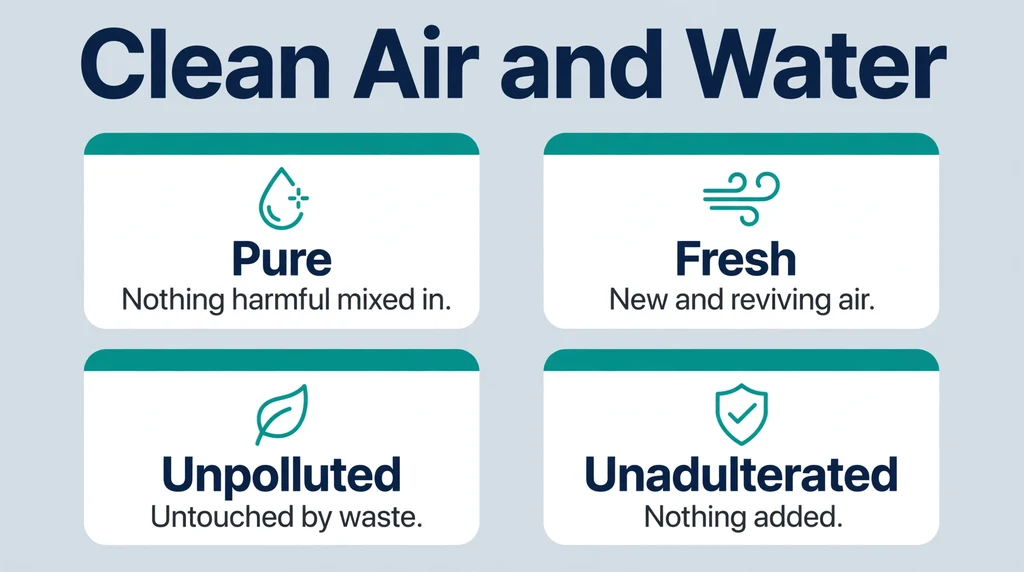
The environment gives clean another distinct sense: producing or containing little pollution. Collins labels this sense directly, describing clean water that keeps disease away. Cambridge makes the same point for air and water with no harmful substances in them.
Pure is the most versatile word here. Pure air, pure water and pure ingredients all promise that nothing harmful has been mixed in. Unpolluted is the precise choice for rivers, beaches and skies that no waste has touched. Fresh belongs to air that feels newly made, the first breath at the top of a hill. Writers chasing that feeling of newness can also check synonyms for new for the fresh start side of the idea. Unadulterated means nothing has been added or mixed in, so it suits food, drink and raw materials. Uncontaminated is the technical member of the group, common in lab and safety writing.
Example: After the storm, the morning air smelled fresh and pure.
For energy, writers say clean power, clean electricity and clean fuel. The honest point is that clean here means low pollution, and the precise adjectives still come from the group above: an unpolluted sky, pure water, fresh air. One common neighbour word, green, gets its own note in the mistakes section below, because the dictionaries treat it differently.
Clean water deserves its own note
Water claims are where precision matters most, because readers act on them. Pure water promises water with nothing harmful mixed in, and bottlers and filter makers choose it for that strength. Clean water is the broader public health phrase, used for supplies that are safe to drink and wash in. Collins reaches for exactly this example, noting that disease is not a problem where clean water is available. Unpolluted water describes a river or lake in its natural state, before any question of treatment arises. Choosing between the three tells the reader where the cleanliness comes from: nature, treatment, or simple safety.
Clean as a Verb: Washing, Scrubbing and Tidying
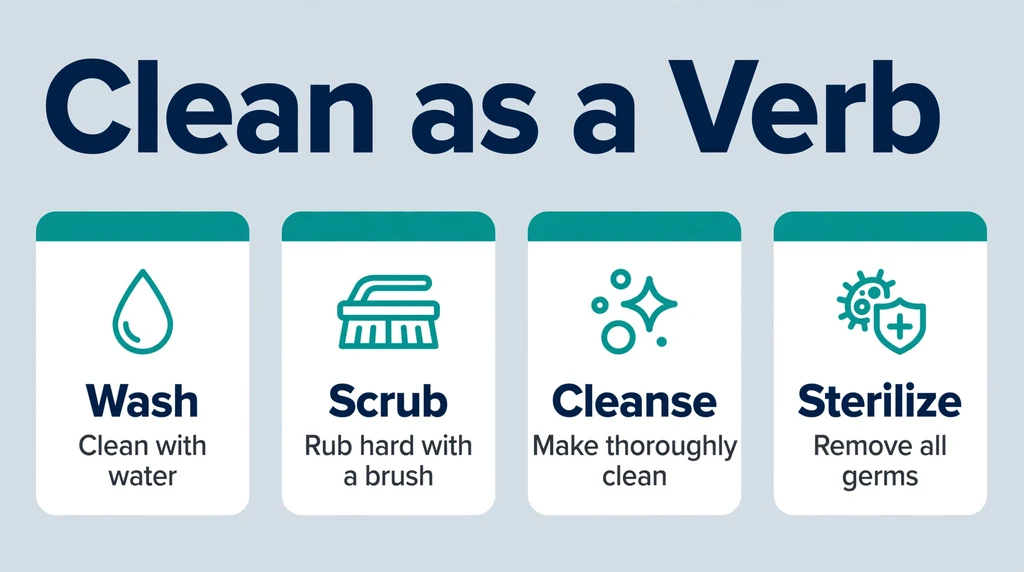
As a verb, clean means to remove dirt from something. Cambridge splits its verb lists into cleaning something and making something clean, and both groups are rich. The right verb depends on the tool, the surface and the effort involved.
Everyday cleaning verbs
Wash is the general verb, used with water for hands, dishes, cars and clothes. Wipe means to clean with a cloth using light pressure, and wipe down covers tables and counters. Scrub adds hard rubbing, usually with a brush, for pots and floors that need force. Rinse means to wash with clean water only, often after soap. Mop and sweep belong to floors, one wet and one dry. Sponge means to clean with a wet sponge, gently. Dust removes the dry film from furniture. Vacuum handles carpets and rugs, and brush off removes loose dirt from clothes with a few strokes. Launder is the formal verb for washing clothes and linen, while scour means scrubbing hard until a surface shines.
Example: She washed the dishes, wiped the counters and mopped the floor.
Making something clean and safe
A second verb group is about removing germs and harmful substances. Cleanse means to make something thoroughly clean, and it suits skin, wounds and, in formal writing, the body. Disinfect means to destroy germs with a chemical or heat. Sanitize means to make something safe and hygienic, a word kitchens and clinics use daily. Sterilize is the strongest: to free something completely from germs, as labs do with equipment. Purify means to remove harmful or unwanted substances, and it suits air and water. Decontaminate is the technical verb for removing dangerous substances after an accident or exposure.
Example: Nurses disinfect the surfaces, then sterilize the instruments.
Clean up and clean out
Two phrasal verbs deserve their own space. Clean up means to make a place neat and orderly by removing mess, and Merriam-Webster defines its entry exactly that way. Its closest partners are tidy up and straighten up. You clean up after a party, after cooking, after yourself. Clean out means to empty and clean the inside of something: Cambridge illustrates it with a weekend spent cleaning out kitchen cabinets. You clean out drawers, garages, fridges and cupboards, removing everything first and keeping only what earns its place back.
Example: We cleaned up the kitchen, then cleaned out the pantry.
Verb pairs that are easy to confuse
Three pairs cause most of the mistakes in this group. Wash needs water; clean does not, which is why you dry-clean a suit and wipe a shelf. Cleanse sounds deeper than clean, so writers save it for skin, wounds and rituals, and it can sound odd for a car. Sanitize and sterilize differ in degree: sanitizing lowers germs to a safe level, while sterilizing aims to remove them completely. A restaurant sanitizes its boards. A hospital sterilizes its instruments. Swapping the pair either overclaims or underclaims, and careful readers notice.
How to Choose the Right Synonym for Clean
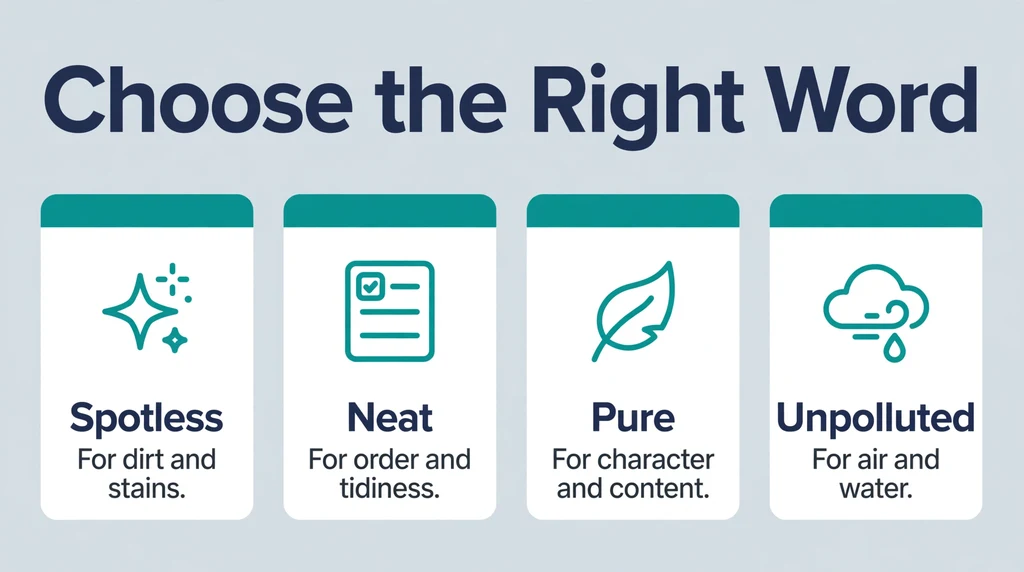
Four quick questions will point you to the right word almost every time. First, what kind of clean do you mean: dirt-free, tidy, moral or pollution-free? Second, how strong is the claim? Third, what tone does the sentence need? Fourth, is clean acting as an adjective or as a verb?
Match the strength
For ordinary dirt-free praise, spotless is strong and safe. For perfection, step up to immaculate or pristine. For health and safety, switch families entirely and use hygienic or sanitary. Reserve sterile for real germ-free settings, because readers picture operating theatres when they meet it. Compare the pair: “The kitchen was spotless” promises a beautiful room. “The kitchen was sterile” sounds like nobody cooks there.
Match the sense, not just the sound
The most common error is crossing senses. A tidy desk can still be dusty, and a sterile desk can still be cluttered. A pure heart says nothing about housekeeping, and a clean joke says nothing about soap. Before you swap the word, name the sense in your head. Then pick from that group only. Paired examples help: “She keeps a clean kitchen” talks about hygiene. “She keeps a tidy kitchen” talks about order. Both sentences praise the cook, yet they praise different habits.
Worked examples
Watch the swap change the meaning. “The nurse kept the wound clean” is about hygiene, so sterile or disinfected in effect belongs nearby, not tidy. “He gave a clean answer” means a direct, complete answer, so decisive is the cousin, not spotless. “They moved into a clean apartment” usually promises dirt-free, while “a tidy apartment” promises order. “The band released a clean version of the song” means the lyrics lost their coarse words, so decent and family friendly frame the sense. Naming the job first makes every one of these choices feel obvious.
Match the tone
Formal reports prefer sanitary, unblemished and complete. Friendly writing prefers spick-and-span, squeaky-clean and tidy. Literary prose can carry unsullied and undefiled, while everyday speech rarely does. When you write for a wide audience, the middle shelf is safest: spotless, neat, pure and fresh rarely sound wrong.
Antonyms for Clean
The opposites split by sense, just as the synonyms do. For dirt, the antonyms are dirty, filthy, soiled, stained and unwashed. Collins lists soiled, dirty and filthy together as the direct opposites of the washed sense, and Cambridge adds stained for marked surfaces. Filthy is the strongest of the set and carries disgust with it.
For order, the opposites are messy, untidy, cluttered in effect and disorderly. For air and water, the opposite is polluted. For character and content, English reaches for dirty again, as in a dirty joke or dirty dealing, and for corrupt when the subject is honesty in office. Using the sense matched opposite keeps your contrast sharp: a room moves from tidy to messy, while water moves from pure to polluted.
Words That Are Not True Synonyms for Clean
A few popular swaps bend the meaning, and honest writers should know them. This section is the accuracy check for the whole guide.
Green is the biggest trap. People say clean energy and green energy almost interchangeably, yet none of the four thesaurus sources behind this guide lists green as a synonym of clean. Green means environmentally friendly in a broad sense, covering everything from recycling to packaging. Clean makes the narrower claim of little or no pollution. The words are neighbours, not twins, so swap them only when the broader claim is really what you mean.
Tidy is not a hygiene word. It promises order only, as the choose section showed. Sterile overshoots in the other direction: it promises the total absence of germs, which no kitchen or classroom can claim. White and bright appear in older thesaurus lists because clean things often look bright, yet they describe colour, not cleanliness. A white shirt can be filthy. Finally, sober is not a strict synonym for the recovery sense of clean. Recovery writers use the pair “clean and sober” because the words add different things: clean means no longer using, while sober describes the maintained lifestyle that follows.
Frequently Asked Questions
What is the strongest synonym for clean?
Spotless is the strongest everyday synonym, and immaculate is stronger still. Spotless means no marks at all. Immaculate adds faultlessness, which makes it the word for whole houses, uniforms and formal praise.
What is a fancy or formal word for clean?
Immaculate and pristine are the classic formal choices. For literary writing, unsullied and undefiled sound elevated. In hygiene contexts, sanitary is the formal option that reports and inspectors prefer.
Is tidy the same as clean?
No. Tidy means arranged in good order, while clean means free from dirt. A desk can be tidy but dusty, or scrubbed clean but covered in piles of paper. Good writing keeps the two ideas apart.
What is another word for clean air?
Pure is the most common choice, and Cambridge uses pure mountain air as its example. Fresh suits air that feels new and reviving. Unpolluted is the precise word when the point is the absence of contamination.
What are synonyms for the verb clean?
The everyday set is wash, wipe, scrub, rinse, mop, sweep and dust. For removing germs, use cleanse, disinfect, sanitize, sterilize or purify. Clean up means tidying a place, and clean out means emptying and cleaning the inside of something.
What does clean mean in a clean break?
It means complete and decisive, with nothing left hanging. Collins gives the clean break as the example of its thorough or complete sense. The same family covers a clean sweep and a clean cut, where the point is totality or smoothness, not dirt.
What is the opposite of clean?
Dirty is the general opposite. Filthy is stronger for dirt, messy and untidy oppose the order sense, and polluted opposes the air and water sense. Choose the opposite that matches the sense you used.
Is green a synonym for clean?
Not in the dictionaries used for this guide. Green means environmentally friendly in a broad sense, while clean claims little or no pollution. Writers treat them as close neighbours, and careful writing keeps the narrower claim accurate.
Final Thoughts
Clean earns its place in almost every paragraph because it can praise a shirt, a desk, a joke, a record and a river in the same breath. The cost of that flexibility is precision: each sense has its own best words. Reach for spotless and immaculate for dirt, neat and tidy for order, pure and wholesome for character, unpolluted and fresh for the environment, and wash, scrub or sterilize when clean becomes an action. For the full dictionary entry behind this guide, see the Merriam-Webster Thesaurus entry for clean, which maps every sense in detail. Choose by sense first, and your writing will stay as clean as the word promises.