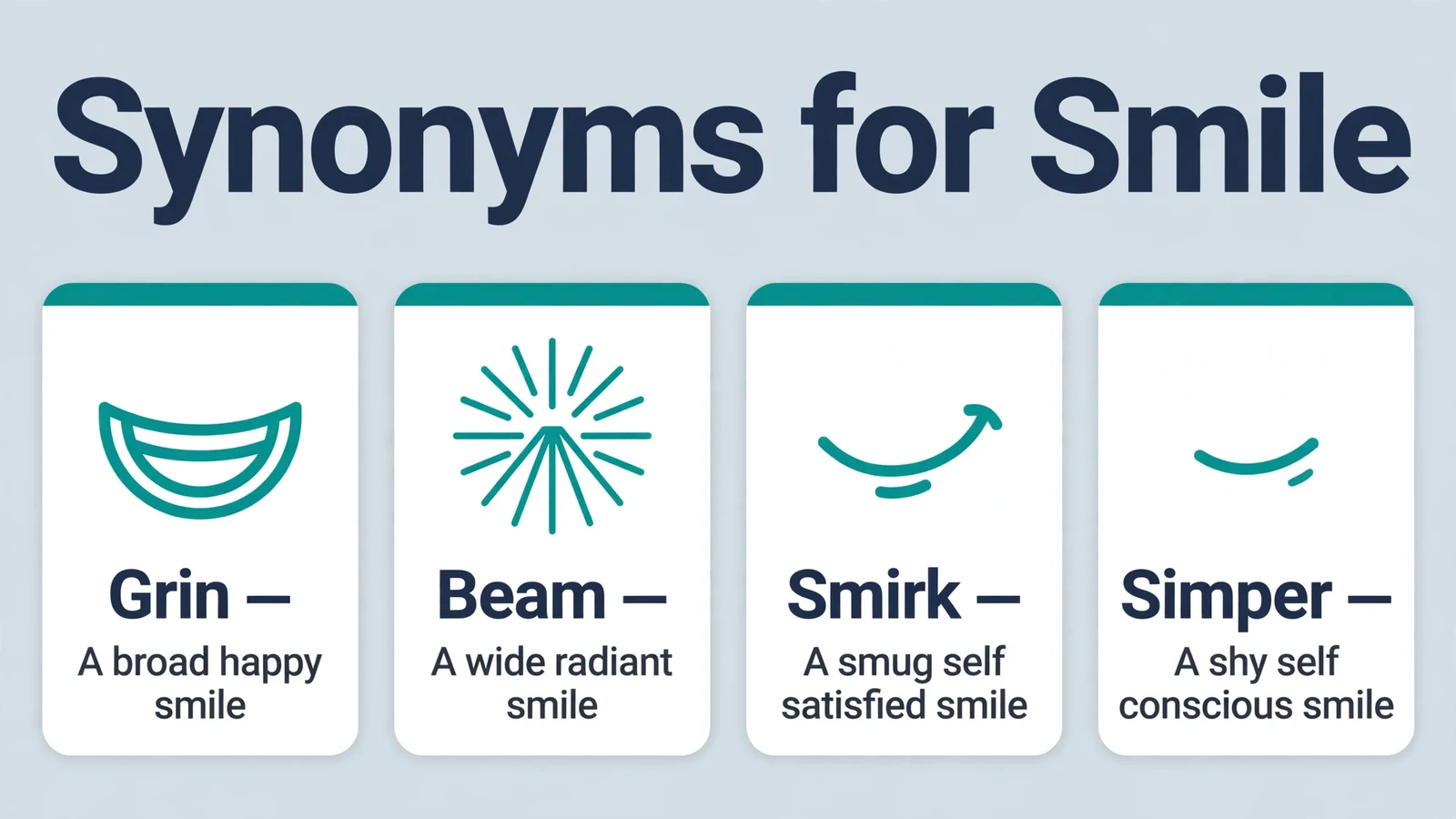
She smiled. He smiled back. By the third smile in a story, the word has gone flat, and readers stop picturing anything at all. The good news is that English keeps a whole shelf of smile words, and each one paints a different face. The closest synonyms for smile are grin and beam for a happy face, simper for a shy one, and smirk for a self-satisfied one that is not friendly at all.
This guide sorts nineteen smile words and phrases by emotion, by honesty, and by size. Every word below was checked against real thesaurus entries, and each one comes with a plain meaning and a short example. The traps are marked clearly too, since a few famous smile words are not friendly at all. By the end, you will know exactly which smile your sentence needs.
Top Synonyms for Smile at a Glance
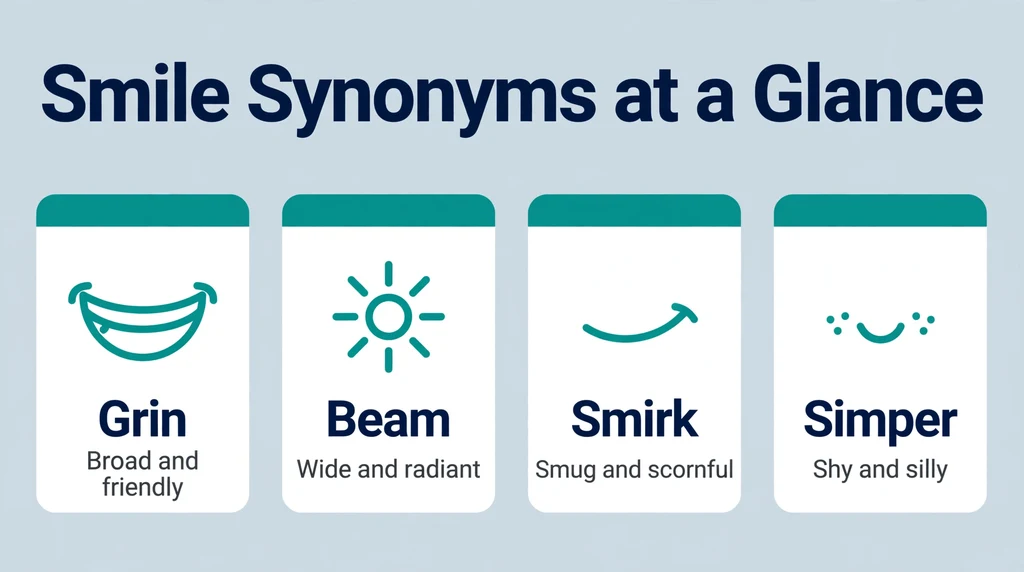
Start with this quick table if you need a word right now. It lists all nineteen alternatives covered in this guide, with a one-line meaning and the tone each word carries. The sections after the table slow down and explain the differences in full.
| Word | Meaning in one line | Best for / tone |
|---|---|---|
| grin | A broad smile, often showing the teeth | Happy, friendly, playful |
| beam | A wide, radiant smile full of pleasure | Joyful, proud, warm |
| laugh | A smile that spills into audible amusement | Amused, delighted |
| grin from ear to ear | The widest possible happy grin | Overjoyed, informal |
| be all smiles | Smiling constantly, clearly delighted | Cheerful, informal |
| crack a smile | A small smile that escapes despite yourself | Reluctant, wry |
| simper | A silly, self-conscious, or flattering smile | Shy, disapproving |
| smirk | A smug, self-satisfied smile | Arrogant, scornful |
| sneer | A contemptuous curl of the lip | Cruel, dismissive |
| snicker | A quiet, half-hidden laugh | Mocking, amused |
| snigger | A quiet laugh, chiefly British twin of snicker | Mocking, amused |
| scoff | Scorn shown in words or a look | Dismissive, rude |
| snort | A scornful sound forced through the nose | Contemptuous |
| chuckle | A soft, quiet laugh | Warmly amused |
| giggle | A light, repeated laugh | Silly, nervous, young |
| chortle | A cheerful, gleeful laugh | Delighted, hearty |
| titter | A short, nervous, restrained laugh | Embarrassed, polite |
| cackle | A loud, harsh laugh | Noisy, witch-like |
| guffaw | A loud burst of unrestrained laughter | Boisterous, hearty |
How to Read the Tone Column
The tone column is the part of the table worth memorizing. Two words can match in size and still clash in feeling, and tone is usually the reason. A grin and a smirk cover the same amount of face, yet one invites people closer and the other pushes them away.
When you scan the table for a scene, start with the tone that matches your character’s intention. Then check the size against the intensity scale later in this guide. Writers who choose in that order, feeling first and size second, rarely pick a word that fights the moment.
Notice how the list changes character halfway down. The top half belongs to friendly faces, while the middle rows carry pride, scorn, or nerves. Keeping that split in mind will protect your writing from the most common smile mistake, which the later sections explain in detail.
Synonyms for Smile by Emotion
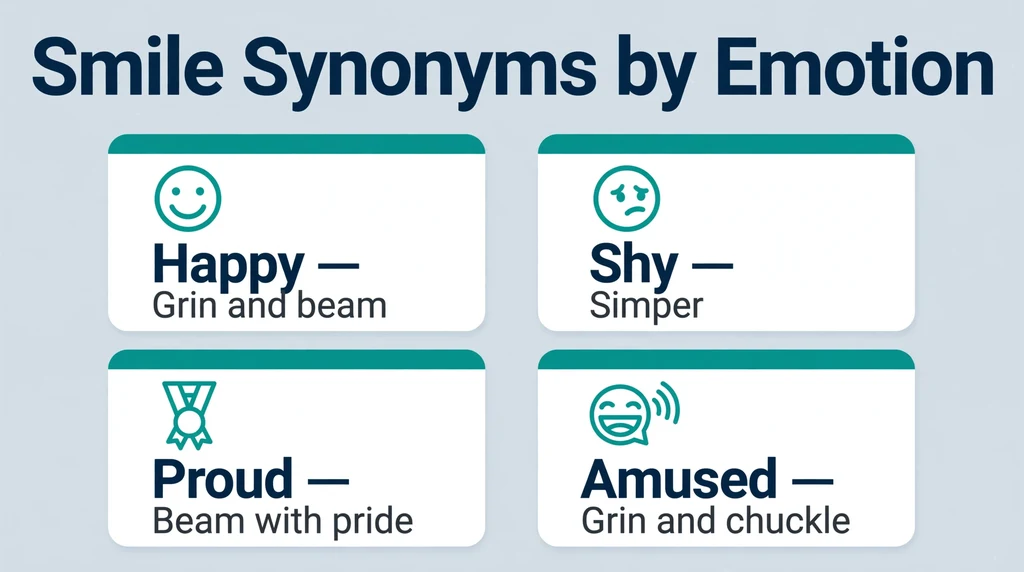
A smile is a small signal, and the feeling behind it changes everything. Grouping smile words by emotion is the fastest way to find the right one, because readers sense the mood long before they register the word itself.
Happy and Delighted Smiles
For pure happiness, grin and beam do most of the work. A grin is broad and often shows the teeth, like the grin of a kid who has just been handed an ice cream. A beam is wider still, and it lights the whole face, so writers save it for proud parents and lottery winners.
When happiness bubbles over, the smile can grow into sound. A soft laugh belongs here, because Merriam-Webster lists it right beside grin as a close relative of smile. The phrases stretch the scale even further. Someone who is all smiles cannot stop, and a person grinning from ear to ear has no room left on the face for anything else.
Shy and Self-Conscious Smiles
Shyness needs a smaller, more uncertain word, and that word is simper. A simper is the smile of someone who wants to please but feels out of place, like an intern laughing at the boss’s weak joke. Dictionaries treat it as a slightly silly or annoying smile, so it suits awkward scenes better than sweet ones.
Use simper carefully in romantic writing. It rarely flatters the person wearing it, and readers may hear it as fake. For a gentle, shy character, a small plain smile with a telling detail often works better than a simper. If you want the softer side of happy instead, our guide to synonyms for happy covers the mood words that pair well with these faces.
Proud and Pleased Smiles
Pride usually borrows the happy words and aims them at an achievement. A coach beams at her team, and a graduate grins at the camera. The words stay the same, yet the context tells readers the smile is about accomplishment rather than amusement.
Trouble starts when pride curdles. Add a hint of superiority and the beam slides toward a smirk, which lives in its own section below. Writers who want warm pride should keep the eyes involved, since a smile described with the eyes reads as genuine. A mouth-only smile, by contrast, quickly starts to look like a performance.
Affectionate and Fond Smiles
Warmth aimed at one particular person has its own flavor. A fond smile is the base word here, and writers often strengthen it with the wide words. A grandmother beams at a toddler, and lovers grin at each other across a crowded room. The emotion does the work, so the verb can stay simple.
What separates affection from general happiness is direction. The smile has a target, and the sentence should name it. She smiled at the dog makes a warmer picture than she smiled happily, because readers can see where the feeling lands. When the target is absent or far away, a soft smile with a wistful detail, like a photograph or a letter, carries the fondness on its own.
Amused Smiles
Amusement sits between smiling and laughing. A chuckle is the sound a smile makes when a joke lands softly, and it suits dry humor and quiet rooms. A grin often appears in the same scenes, because the face and the sound arrive together.
For stronger amusement, the laughter words in a later section take over. Think of amusement as a dial. A smile is the lowest setting, a chuckle turns it up one notch, and a guffaw spins it to the top.
Genuine Smiles vs Polite and Fake Smiles
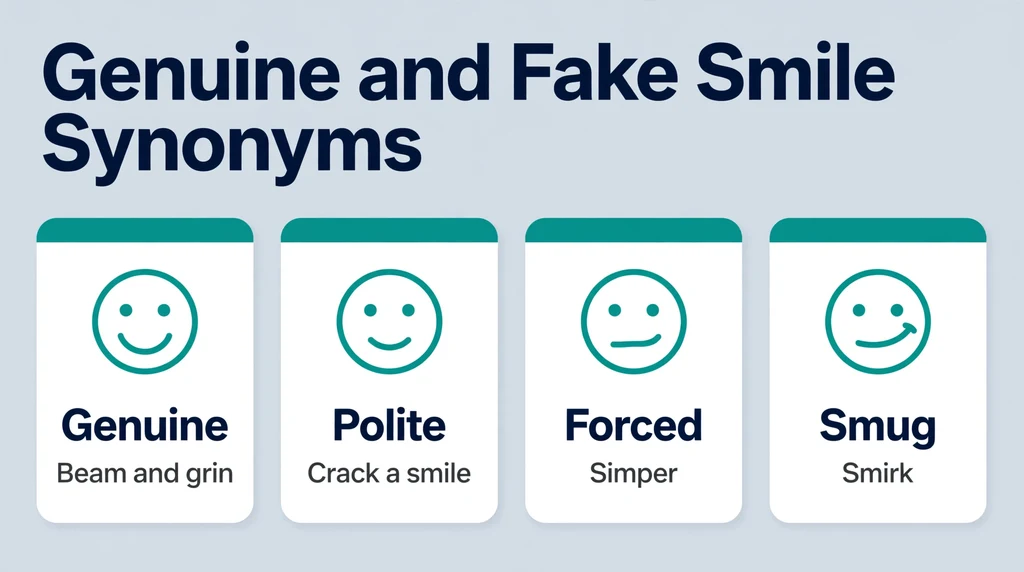
Not every smile tells the truth. Readers know this instinctively, and they judge characters by the gap between the face and the feeling. Sorting smile words by sincerity helps you control that judgment on purpose.
Smiles That Read as Genuine
Genuine joy tends to pick the wide words. A beam is almost impossible to fake on the page, because the word itself suggests light and warmth spreading across a face. A relaxed grin reads as honest too, especially when the writer pairs it with easy body language.
Details sell the honesty more than the word alone. A beam plus crinkled eyes feels real, while a beam plus a clenched jaw feels staged. So when a scene needs trust, choose a warm word and give it one honest detail to stand on.
Polite Smiles and Small Mercies
Social life runs on polite smiles, and English is oddly short of kind words for them. The most useful phrase is crack a smile, which describes a small smile that escapes despite the person’s mood. A grieving uncle who cracks a smile at an old photo is not happy, yet the moment feels human and true.
A plain, brief smile also does polite work in narration. She smiled at the waiter. He smiled through the meeting. Because the word stays neutral, readers fill in the courtesy themselves, and no one mistakes the moment for joy. In formal writing, that restraint is a strength rather than a gap.
Smiles for the Camera
Photographs have changed how people think about smiling. In posed pictures, the wide words rule. Everyone beams at weddings, and graduates grin from ear to ear whether they feel like it or not. Writers describing a photo can use that gap. A character who only cracks a smile in every family picture is telling you something about himself.
First impressions work the same way in interviews and meetings. A warm, brief smile reads as confidence. A simper reads as nerves, and a smirk can end a hiring manager’s interest before the questions begin. When a scene turns on a first impression, pick the word as carefully as you would pick the character’s clothes.
Forced Smiles and Warning Signs
When a smile is forced, writers usually reach for a modifier instead of a new noun. A tight smile, a fixed smile, or a brave smile all signal effort, and readers understand the code at once. The verb simper can help in older or literary settings, where it carries a flavor of flattery and discomfort.
Be careful with smirk in this territory. A forced smile hides a feeling, but a smirk displays one, and that feeling is superiority. Swapping them changes the character, not just the word. The next section gives the smirk and its cousins the attention they deserve.
Smiles That Are Not Happy: Smirk, Sneer, and Friends
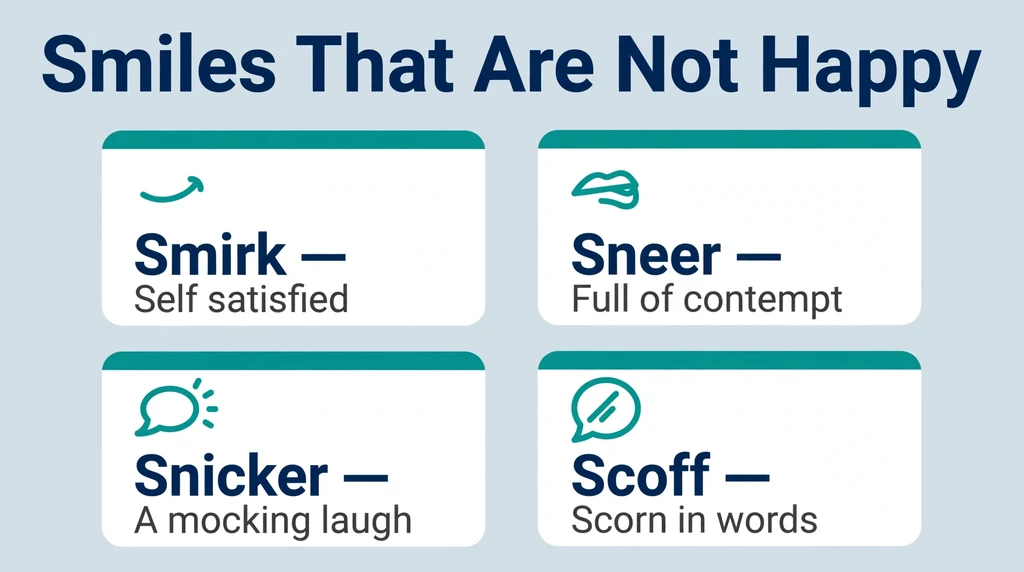
Here is the accuracy point that matters most in this whole guide. Several words sit in the thesaurus under smile, yet they describe contempt, pride, or mockery. Using one of them for a warm moment is the fastest way to confuse a reader.
Smirk: The Self-Satisfied Smile
A smirk is a smile of self-satisfaction. Cambridge marks the word as disapproving, and Collins gives the classic command, “Wipe that smirk off your face.” Nobody says that to someone who looks kind. The smirk belongs to the debate winner, the caught-out liar who is enjoying himself, and the villain who knows something you do not.
In dialogue scenes, a smirk makes a character sound pleased with himself. That makes it perfect for rivals and risky for heroes. If your hero smirks on every page, readers will quietly start to dislike him, even when his lines are charming.
Sneer: The Scornful Smile
A sneer goes further. It is a scornful curl of the lip that says the other person is beneath notice. Merriam-Webster gives smile a whole second sense for this territory: expressing scornful amusement through facial contortions. A sneer is that sense wearing its everyday clothes.
Because a sneer mixes the face with an attitude, it often travels with dialogue. “You?” he sneered. The tag alone tells readers the words dripped with contempt, so writers can keep the spoken line itself short and cold.
The Wry Smile: Amusement with an Edge
One beloved phrase sits between the friendly and the unfriendly camps. A wry smile is the crooked, knowing smile of someone who sees the irony in a bad situation. Collins uses it in its very first example for the noun smile: “She gave a wry smile.” The word wry does the heavy lifting, twisting the plain smile into something dry and self-aware.
Reach for wry when a character is amused by their own misfortune. A detective surveying a flooded office, a parent surveying a finger-painted wall. The wry smile admits defeat and finds it funny at the same time, which is why readers love the characters who wear it.
Snicker, Snigger, and Scoff
The scornful family also makes noise. A snicker is a quiet, half-suppressed laugh, usually at someone else’s expense. Snigger means the same thing and is chiefly British, so match it to your spelling and setting. School corridors and office meetings are full of both.
A scoff pushes the feeling into words. Someone who scoffs dismisses an idea out loud, often with a shake of the head. And a snort is the sound version of the same contempt, a short blast through the nose that needs no sentence after it. In our guide to synonyms for funny, you can see the friendlier side of this family, where the laughter is shared rather than aimed.
Synonyms for Smile by Size and Intensity
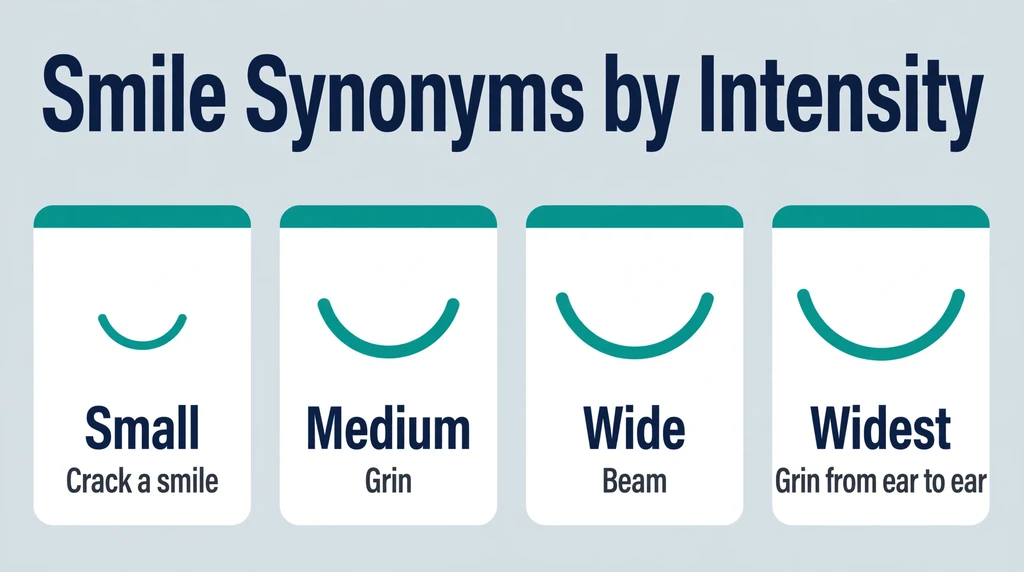
Sometimes the emotion is clear and only the size is wrong. A bride does not crack a smile, and a defendant does not beam. This scale runs from the smallest flicker to the widest grin, so you can match the word to the moment.
Small and Slight Smiles
At the bottom of the scale sits the small smile itself, plain and serviceable. Crack a smile belongs just above it, because the phrase suggests the smile had to break through something first. A simper is small too, though its smallness comes from nerves or flattery rather than restraint.
Small smiles work best in quiet scenes. They suit apologies, first meetings, and moments of relief after bad news. Because they ask little of the reader, they also suit formal reports and news writing, where a beam would look unprofessional.
Medium Smiles
The middle of the scale belongs to the grin. A grin is open, friendly, and easy to picture, which is why it appears so often in fiction. The smirk also sits at medium size, but it points that size at the wrong emotion, so treat it as a different color rather than a different shade.
A medium smile is the safe default for most scenes. It shows warmth without tipping into celebration. If a character smiles at this size on every page, though, vary it with the smaller and wider words, or the pages will feel like a photo shoot.
Wide and Radiant Smiles
At the top of the scale, beam takes over. A beam is the smile of announcements, reunions, and photographs that actually come out well. Beyond it, the phrases finish the climb: grin from ear to ear and be all smiles describe faces that have run out of room.
Wide smiles earn their keep at turning points. Save them for the apology accepted, the exam passed, and the door opening at the airport. Used too often, they lose their power, because readers stop believing anyone could be that delighted that often. For the small faces at the other end of the emotional range, our guide to synonyms for cute gathers the gentler describing words.
Smile Words That Blend Into Laughter
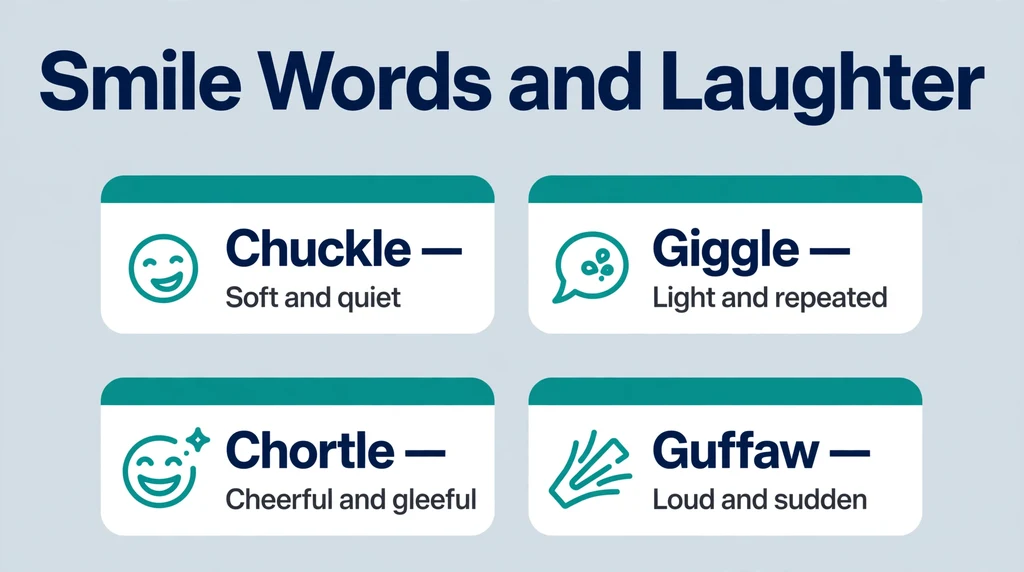
A smile held a second too long often turns into a sound. Merriam-Webster places the words in this section under the related words of smile and grin, not among the strict synonyms. That honesty matters. These are the words a smile grows into, arranged from the quietest to the loudest.
Quiet Laughter: Chuckle, Giggle, and Titter
A chuckle is a soft laugh kept mostly inside. Grandfathers chuckle at newspapers, and villains chuckle at plans, which makes the word flexible but never loud. A giggle is lighter and higher, a small laugh that repeats, and it belongs naturally to children, nerves, and people trying not to laugh at all.
A titter is the most restrained of the three. It is the short, nervous laugh that escapes in a quiet classroom or a tense meeting. Because a titter suggests embarrassment, it pairs well with the small smiles in the intensity section above.
Loud Laughter: Chortle, Cackle, and Guffaw
A chortle is a cheerful, gleeful laugh with real warmth in it. It suits Santa-like characters and anyone enjoying a joke with their whole chest. A cackle, by contrast, is loud and harsh. Witches cackle, hens cackle, and friends only cackle when the writer wants the laugh to sound a little wild.
The guffaw is the loudest of all, a sudden burst that the laugher cannot hold back. It belongs in pubs, playgrounds, and comedy clubs rather than boardrooms. Choose it when the scene is allowed to be noisy, and let the quieter words handle everything else.
Smile or Laugh: Picking the Verb in a Sentence
The border between these words matters in practice. If the character’s mouth moves and no sound comes out, you need a smile word. If sound escapes, you need a laugh word, and choosing wrong makes readers hear a noise you never described. She giggled silently is a contradiction, while she grinned silently is fine.
Sound also changes the social meaning. A chuckle in a meeting is warm, while a guffaw in the same meeting is a scandal. When you revise, read the sentence aloud and check the volume in your head. The right word keeps the room the size you built it.
How to Choose the Right Synonym for Smile
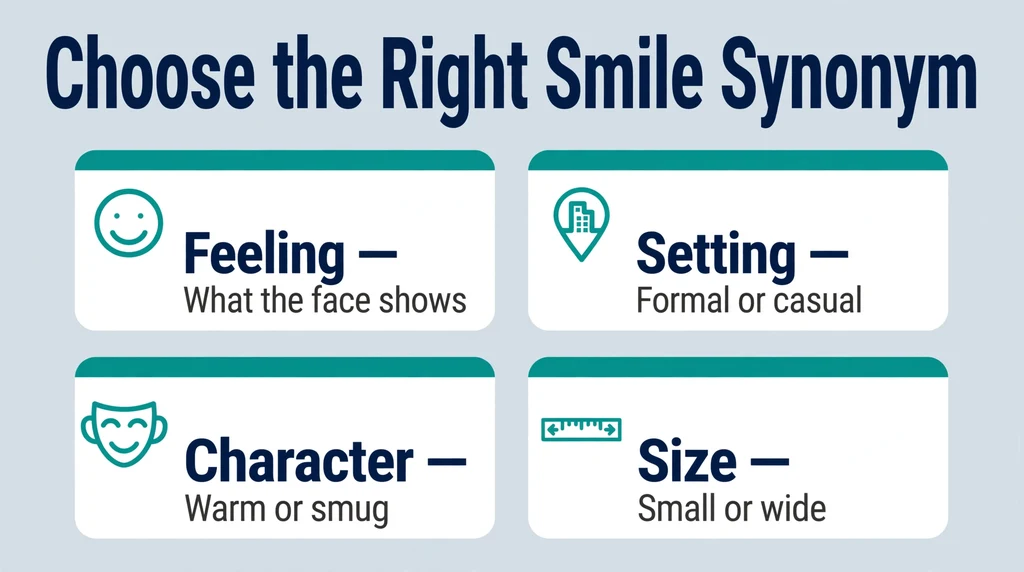
With nineteen options on the table, choosing can feel harder than before. A few quick questions will narrow the field every time.
Ask What the Face Is Hiding
First, ask whether the smile shows a feeling or hides one. A beam shows joy, and a grin shows friendliness. A smirk, on the other hand, performs superiority, and a simper performs eagerness to please. When the hidden thing is scorn, the sneer family is waiting, and the polite crack of a smile covers everything in between.
Readers trust shown feelings and distrust performed ones. So this single question decides whether your character looks warm or slippery. Get it right, and the exact word almost chooses itself.
Match the Word to the Setting
Next, weigh the room. Formal reports, eulogies, and business emails need the plain end of the scale: smiled, a small smile, a brief smile. Fiction and friendly blogging can afford the full shelf, from giggles to guffaws.
Dialogue tags follow the same logic. A judge in a courtroom scene does not chortle on the record. A best man at a wedding, meanwhile, can beam, grin, and crack jokes with smiles in every line, and the scene will still feel natural.
Compare the Pairs Side by Side
Finally, test the closest pairs in your actual sentence. She grinned at the news sounds pleased and open. She smirked at the news sounds pleased with herself at someone else’s cost. He beamed at his daughter glows with pride, while he simpered at his daughter would be strange and a little sad. Swapping the word swaps the story, which is exactly why this choice deserves ten seconds of thought.
Smile Words in Messages and Captions
Online writing has its own smile habits. In chats and captions, people narrate their faces constantly, and the cheerful words dominate. Friends grin in selfies, beam in graduation posts, and report that a compliment left them all smiles. The wide end of the scale rules here, because small screens reward big expressions.
The negative words thrive online too, but as jokes between friends. A smirking reply to a teasing message reads as play, not pride, because the friendship supplies the tone. When you write dialogue for young characters, that playful smirk is often more accurate than a plain smile, provided the scene makes the friendship clear first.
Smile Synonyms for Writing and Dialogue
Writers search for smile synonyms more than almost anyone, because dialogue scenes need smiles constantly. This section gathers the practical craft advice in one place.
Smile Verbs That Carry a Scene
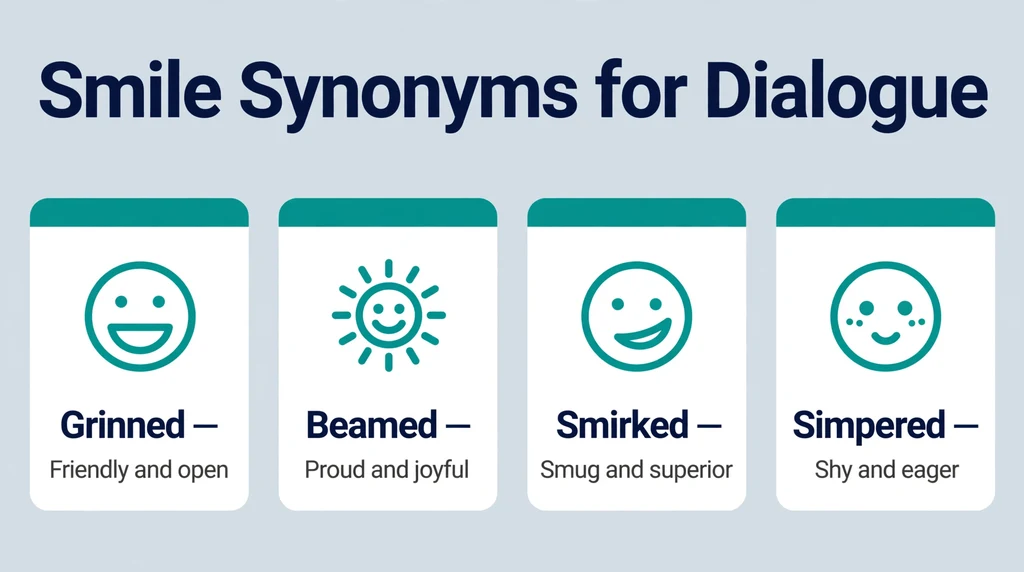
The four hardest-working verbs are grinned, beamed, smirked, and simpered. Each one replaces a plain “said with a smile” and adds an attitude for free. “I knew it,” he grinned, sounds triumphant and friendly. “I knew it,” he smirked, sounds insufferable. Same line, different man.
Beamed works best at emotional peaks, so ration it. Simpered should be rationed even harder, because it mocks the speaker a little. When in doubt, plain smiled plus one physical detail beats an exotic verb that fights the scene.
Avoiding the Smiling Trap
Beginning writers tag every line with a smile, and the characters end up grinning like game-show hosts. Break the habit by giving the emotion to the hands, the eyes, or the pause instead. Her eyes crinkled. He looked down and laughed once. The smile is still there, yet the page breathes.
Vary the size words too. If three characters smile in one scene, let one crack a smile, one grin, and one simply nod through it. Readers will feel the differences without ever noticing your technique.
Describing a Smile Without Naming It
Sometimes the strongest choice is no smile word at all. The corners of her mouth lifted. His whole face changed. A dimple appeared that she had never shown at work. These physical details let readers build the smile themselves, and a smile the reader builds always looks exactly right.
This trick also rescues over-smiled drafts. Search your document for smile, grin, and beam, then rewrite every third one as a detail or a gesture. The smiles that survive will look brighter, because they are no longer competing with each other for the reader’s attention.
Smiles in Essays and Formal Writing
School and business writing asks for restraint. In an essay, a smile usually stays a smile, and the writer shows range elsewhere. The formal end of this guide, words like a brief smile or a slight smile, will carry academic work without raising eyebrows.
In personal statements and speeches, one well-chosen beam or grin from ear to ear can warm a whole paragraph. Place it at the emotional peak, keep the rest simple, and the single bright word will do the work of ten ordinary ones.
Antonyms for Smile
Every smile word has a shadow. Merriam-Webster lists the antonyms of smile as frown, scowl, glare, glower, grimace, pout, sulk, and gloom, along with lower, an older word for a dark, threatening look that is also spelled lour.
These words divide by feeling, just as the smiles did. A frown shows displeasure or concentration. A scowl deepens it into anger, and a glare aims that anger at a person. A grimace twists the face with pain or disgust rather than temper, which makes it the odd one out. A pout and a sulk belong to disappointment, the pout on the lips and the sulk in the whole posture. Writers who describe a smile disappearing often reach for this list, because a face that falls into a scowl tells the reader the mood has turned.
Using Antonyms to Show a Mood Change
Antonyms earn their keep at turning points. A smile that fades into a frown is the oldest mood signal in fiction, and it still works because readers track faces without being told to. The trick is choosing the antonym that matches the new feeling, not just any dark face from the list.
Bad news calls for the frown or the fallen, fixed look of gloom. Betrayal calls for the glare, since the anger has a target. Pain and disgust belong to the grimace, and a childish disappointment belongs to the pout. Match the antonym to the cause, and the single changed word will carry the whole scene shift on its back.
Words That Are Not True Synonyms for Smile
Accuracy matters more than a long list, so this section clears away the impostors. These words appear in sloppy synonym lists, yet careful dictionaries do not support them as smiles.
The most common impostor is leer. A leer is mainly a look, a sidelong and unpleasant way of regarding someone. Cambridge defines it as looking or smiling in an unpleasant or suggestive way, so at best it brushes against smiling, and even then the feeling is closer to a threat than a greeting. Use leer for the look, never for a friendly face.
Grimace causes the opposite confusion. It looks like a smile that went wrong, since the teeth show and the mouth stretches wide. In fact it is an ugly twisted expression of pain, disgust, or effort, and dictionaries file it with the antonyms of smile, not the synonyms. A weightlifter grimaces. A host at a party smiles. Keeping these two apart will make your descriptions sharper and your characters easier to read.
Frequently Asked Questions
What is the closest synonym for smile?
Grin is the closest everyday synonym, with beam right behind it for wider, brighter joy. Both appear at the top of the Merriam-Webster and Collins entries for smile. A grin suggests a broad smile that often shows the teeth, while a beam adds radiance and pride.
What is a fancy word for a big smile?
Beam is the classic choice for a big, radiant smile. For the widest informal option, use the phrase grin from ear to ear. Writers describing a photograph or a celebration often pick beam, because it carries warmth as well as size.
Is a smirk a happy smile?
No. A smirk shows self-satisfaction, smugness, or scorn rather than happiness. Cambridge marks smirk as disapproving, and people say “wipe that smirk off your face” to someone who looks arrogant. If your character is genuinely pleased, grin or beam will say it safely.
What is the difference between a grin and a smile?
A smile is the general word for the upturned mouth. A grin is a specific kind of smile, broader and more open, often showing the teeth and suggesting amusement or delight. Every grin is a smile, but many smiles, like a shy or polite one, are far too small to be grins.
What is a word for a small or shy smile?
Simper is the traditional word for a shy, self-conscious smile, though it carries a silly or flattering flavor that can sound unkind. For a small smile without that edge, the phrase crack a smile works well, especially when the smile escapes in spite of a serious mood.
What are the antonyms of smile?
The main antonyms are frown, scowl, glare, glower, grimace, pout, and sulk. A frown is the everyday opposite. A scowl adds anger, a grimace twists the face with pain or disgust, and a pout belongs to disappointment, so choose by the feeling you need.
What is a word for a smile that is not sincere?
Simper is the classic word for a smile that performs rather than feels, since it suggests flattery or silly eagerness. A smirk is insincere in a different way, replacing warmth with superiority. If you need a neutral option, write a polite smile or a brief smile and let the context supply the doubt.
Which smile synonym is best for formal writing?
Plain smiled is best for formal writing, supported by neutral phrases like a brief smile or a slight smile. Beam can appear once in a speech or personal statement at an emotional peak. Smirk, simper, and guffaw should stay out of reports and essays, since each carries a strong informal attitude.
Final Thoughts
A smile is never just a smile once you know its family. Grin for friendly breadth, beam for radiant pride, and simper for the shy smile that wants to please. Keep smirk and sneer for the faces that are not happy at all, and let chuckle, titter, and guffaw handle the moments when a smile grows a voice. Nineteen words and phrases is a small shelf, yet it covers nearly every face your writing will meet.
When you want to check a nuance before you commit to it, the Merriam-Webster Thesaurus entry for smile shows the same groupings this guide is built on. Pick the word whose feeling matches your scene, and your readers will see the exact face you saw.
One last habit is worth stealing from working writers. Keep a short personal list taped near your desk: your five warmest words, your three sharpest words, and your two quietest words. Smile scenes usually arrive when you are tired and drafting fast, and a list made in a calm moment will save you from reaching for the same grin every time. Update it whenever a book teaches you a new face. Within a month, your smiles will start choosing themselves, and each one will land on the page already wearing the right expression.