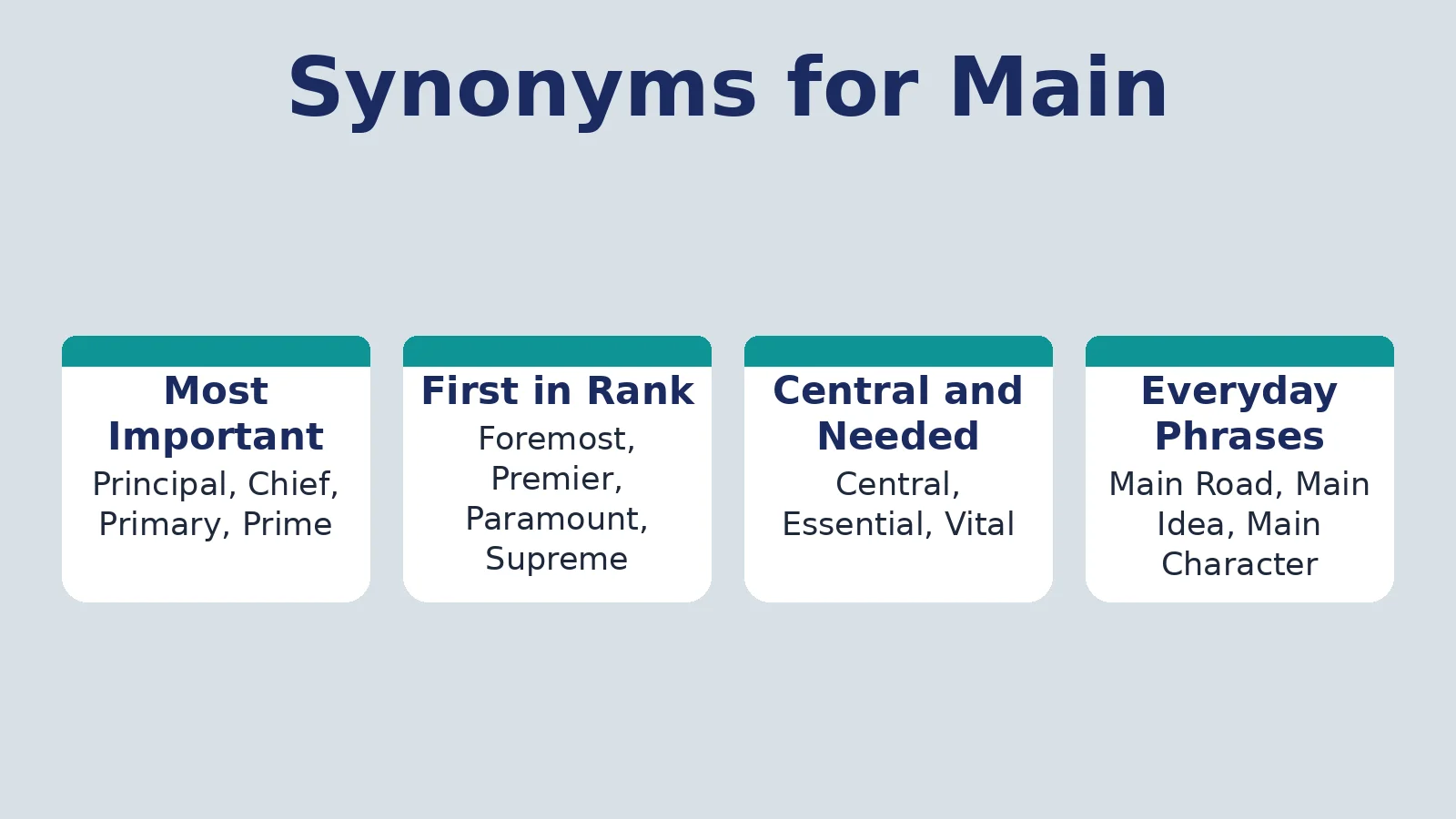
Writers reach for main dozens of times a day, and the word soon starts to sound flat. The good news is that English offers sharper options for almost every job main does. The most useful synonyms for main are principal, chief, primary, prime, leading, foremost, central, and paramount. Each one points at the same idea, the thing that matters most, yet each carries a slightly different weight.
This guide sorts more than 30 synonyms for main by importance, rank, and everyday use. Every word comes with a short meaning, and the key words include example sentences. As a result, you can swap main for a term that fits your sentence exactly, whether you are writing an essay, a report, or a story.
Top Synonyms for Main: Quick Reference
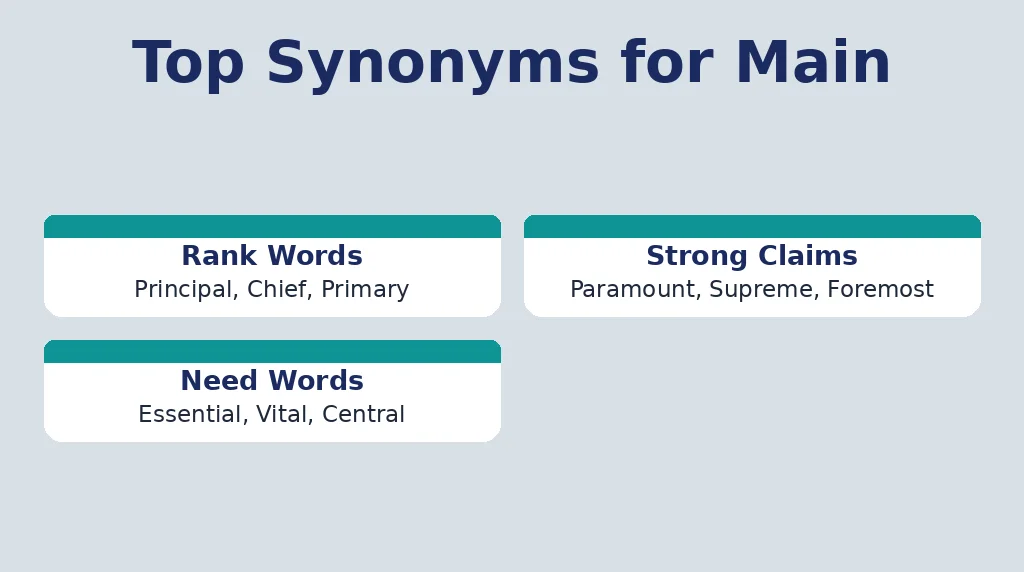
The table below covers the 24 synonyms readers reach for most often. Start here when you need one quick replacement. Later sections sort the full list into finer groups and explain the traps.
| Word | Meaning in one line | Best for |
|---|---|---|
| Principal | First in rank or importance | Formal writing, reports |
| Chief | Highest in rank or importance | Everyday and news writing |
| Primary | First in order or importance | Plans, goals, causes |
| Prime | First in quality or importance | Prime example, prime suspect |
| Leading | Most important or most successful | People, brands, roles |
| Foremost | Most important, first in position | Formal praise, rankings |
| Predominant | Strongest or most common element | Analysis, descriptions |
| Premier | First in importance or position | Companies, events, formal |
| Pre-eminent | Better than all others | Formal, respected figures |
| Supreme | Highest in rank or authority | Power, courts, formal |
| Paramount | More important than anything else | Safety, needs, formal |
| Cardinal | Of the greatest importance | Rules, virtues, formal |
| Central | At the heart of something | Ideas, themes, roles |
| Essential | Absolutely necessary | Needs, skills, steps |
| Vital | Necessary for success or life | Health, supplies, roles |
| Head | Chief, the person at the top | Jobs, head chef, head office |
| Major | Greater or more important | Problems, roles, changes |
| Special | Assigned as the main one | Special correspondent only |
| Sheer | Pure and complete, in force phrases | By sheer force, literary |
| Utter | Complete and total | Utter force, dated phrases |
| Absolute | Total and complete | Absolute force, emphasis |
| Pure | Nothing but, complete | Pure force, literary |
| Entire | Whole and complete | Entire force, formal |
| Direct | Straight and unbroken | Direct force, physics |
What Does Main Mean?
At its core, main describes the one thing that stands first in importance. Collins defines the adjective as chief or principal, and its example is one everyone knows: my main concern is to protect the children. Merriam-Webster puts it just as plainly, describing main as coming before all others in importance. Everything else in the sentence takes second place.
That ranking job explains why main appears in so many fixed phrases. The main road carries the most traffic. The main idea carries the whole paragraph. The main character carries the story. In each case, main does not describe size or quality. It describes position: first among the rest. Writers who keep that idea in mind choose better replacements, because they look for rank words instead of size words.
Main also works as a noun, but only in set phrases and technical uses. A water main is the principal pipe in a supply system. Sailors and poets once called the open sea the main, and the phrase might and main still means with all your strength. Those noun uses get their own section later in this guide, since their synonyms differ from the adjective list.
Main also hides inside a family of compound words, and each one keeps the idea of first or chief. The mainland is the main body of land, set against the islands around it. A mainstay is a chief support, the person or thing a group leans on most. The mainspring of a plan is its chief motive or driving force. Mainstream ideas are the principal current of thought in a society. Even the mainframe, the big central computer of older offices, took its name from being the main machine. When a compound starts with main, it almost always means the central one of its kind.
One grammar point shapes everything else in this article. Main almost always sits directly before a noun: the main reason, the main entrance, the main point. You cannot turn the sentence around and say the reason is main. Several close synonyms share that habit, while others, such as primary, move more freely. The choosing section below shows exactly where each word can go. Readers who want an even wider net can also browse synonyms for important, since the two word families overlap at the edges.
Synonyms for Main: Most Important and First in Rank
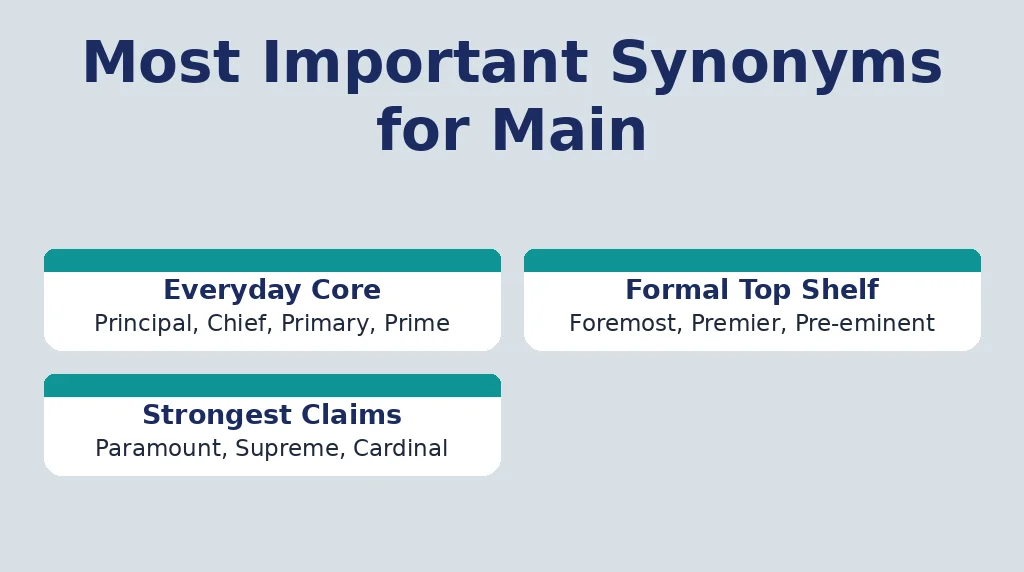
The words in this section all answer the same question: which one comes first? They differ in tone and strength, though, so the section splits them into an everyday core and a formal top shelf. Read the glosses before you swap, because a word like paramount claims far more than a word like chief.
The Everyday Core
These are the replacements you will use most. They sound natural in essays, emails, news reports, and daily speech alike.
- Principal: first in rank or importance, the standard formal choice. Example: The principal reason for the delay was the weather.
- Chief: highest in rank or importance, plain and strong. Example: Cost is the chief concern for most buyers.
- Primary: first in order or importance, common for goals and causes. Example: Our primary goal is to cut waiting times.
- Prime: first in quality or importance, often in fixed pairs. Example: He is the prime suspect in the case.
- Leading: most important or most successful in a field. Example: She is a leading expert on ocean birds.
- Major: greater or more important than the rest. Example: Traffic is a major problem in the city center.
- Head: chief, used before job and place nouns. Example: The head chef tastes every dish first.
First in Rank: The Formal Top Shelf
Some situations need a word that claims the very top spot. These formal options sound grand, so save them for writing that can carry the weight.
- Foremost: most important, first in position or respect. Example: He was the foremost surgeon of his generation.
- Premier: first in importance or position, often for companies and events. Example: The fair is the premier event of the farming year.
- Pre-eminent: better than all others, formal and respectful. Example: She is the pre-eminent historian of the period.
- Supreme: highest in rank or authority. Example: The supreme court gave its ruling on Monday.
- Paramount: more important than anything else at all. Example: Safety is paramount on any building site.
- Cardinal: of the greatest importance, as in fixed phrases. Example: The cardinal rule is to check the facts first.
Notice the strength ladder inside this group. Chief and principal say first. Paramount and supreme say first by a wide margin, above everything else combined. If two or three points share the lead in your paragraph, pick a word from the everyday core instead. Claiming the top spot for all of them weakens every claim at once.
Central and Essential Synonyms for Main
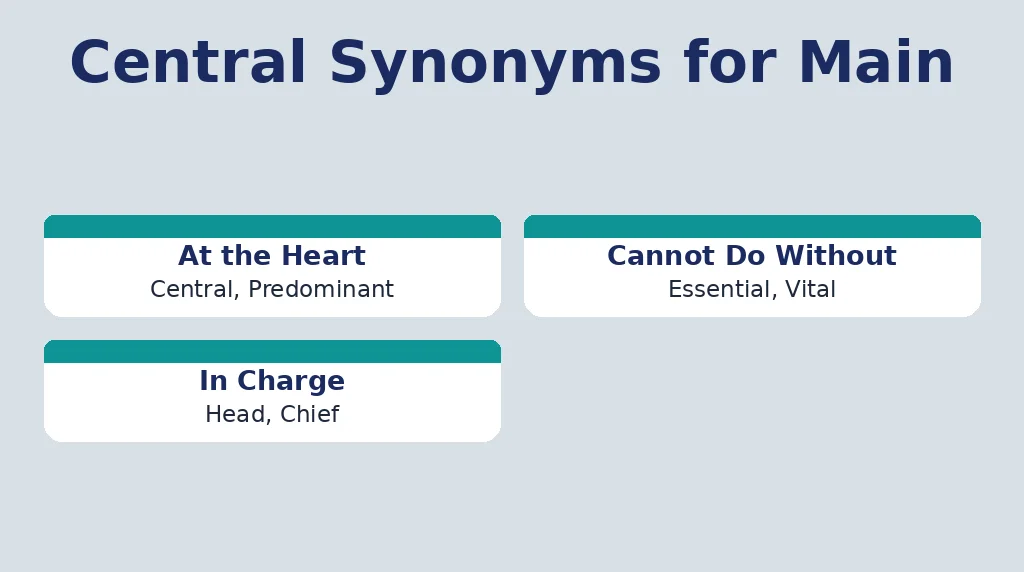
A second family of synonyms stresses position or need rather than rank. These words say the thing sits at the heart of the matter, or that nothing works without it. The difference matters in practice, because a central idea and an essential step fail in different ways when you remove them.
- Central: at the heart of something, the point everything turns on. Example: Cost is central to the whole debate.
- Essential: absolutely necessary, impossible to do without. Example: Sleep is essential for clear thinking.
- Vital: necessary for success, health, or life itself. Example: The bridge is a vital link for the island.
- Predominant: the strongest or most common element in a mix. Example: Blue is the predominant color in the painting.
- Head: also fits here for places, as in the head office, the center of operations. Example: Orders come from the head office in Leeds.
Central works best for ideas, themes, and roles. A central character drives the plot, and a central theme holds a book together. Essential and vital, by contrast, point at need. An essential document is one the process cannot skip. A vital supply is one people cannot safely lose. Predominant is the quiet analyst of the group. It describes which element wins inside a mixture, so it suits reports, surveys, and descriptions of crowds, colors, and opinions.
The word head deserves one extra note, because it builds phrases the others cannot. A head teacher runs a school, a head chef runs a kitchen, and a head office runs a company. In each case head means the person or place in charge, not a body part. Chief builds a smaller set: chief executive, chief inspector, chief engineer. When a job title is involved, reach for head or chief first and leave principal for the school sense, where it names the person in charge in American English.
Writers often mix these families without noticing. Calling a step both the main step and the essential step is fine, since the words stress different things. Swapping them carelessly is not fine. The main reason is the reason that leads. The essential reason sounds like a reason you cannot do without, which is a different and stronger claim.
A Strength Ladder: Mild, Middle and Mighty Synonyms for Main
Not all synonyms for main claim the same amount of power. Sorting them into a ladder helps you match the word to the size of your claim, which is where most weak swaps go wrong.
At the mild end sit central and predominant. They describe position and weight without shouting. A central theme is simply the theme at the heart of a book. The predominant feeling in a room can be calm, even if a few people disagree. These words suit careful writing, because they make modest, provable claims.
The middle rungs hold the everyday workers: chief, principal, primary, prime, leading, and head. They claim first place clearly and calmly. A principal reason beats the other reasons, but it does not crush them. Most professional writing lives on these rungs, and most readers trust them at once.
The top rungs are the mighty words: foremost, premier, pre-eminent, cardinal, paramount, and supreme. Each one claims the summit. Paramount says nothing else comes close. Supreme borrows the language of courts and crowns. Use these words when the fact truly stands alone at the top, and your sentence will sound earned. Use them for ordinary points, and readers stop believing the strong words anywhere else in the piece.
A quick test keeps the ladder honest. Count how many top-rung words appear on one page. If the answer is more than two, the page is probably overclaiming. Demote the weaker claims to chief or principal, and let the one true summit keep its crown.
Main in Everyday Phrases: Roads, Ideas, Characters and Courses
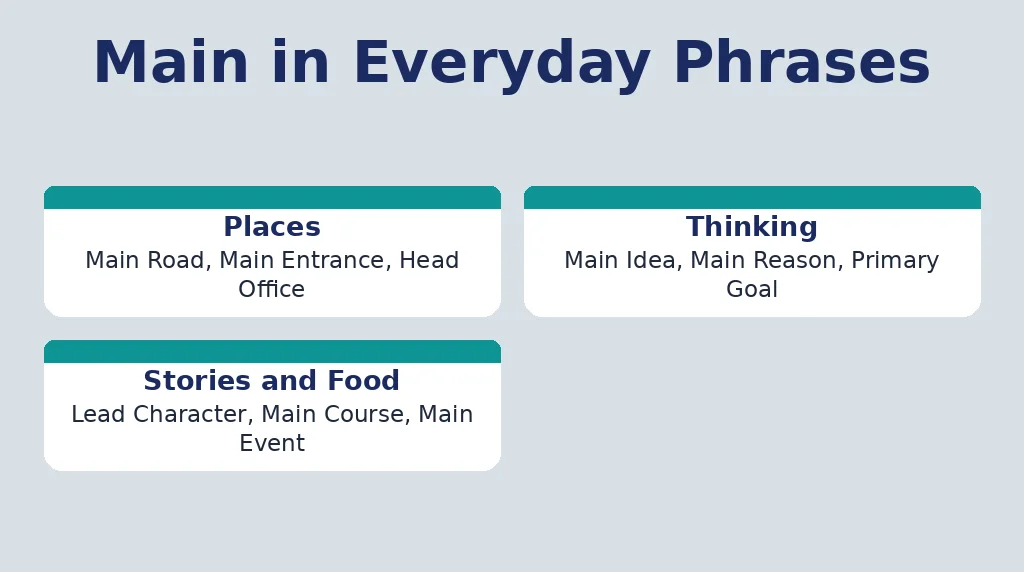
Main earns its keep inside everyday phrases, and each phrase leans toward a different synonym. Learning the phrase pairs is the fastest way to sound natural, because native speakers store these combinations as single chunks.
The main road is the principal route through an area, and writers often call it the chief road or simply the high road in older texts. The main entrance is the primary entrance, the one most visitors should use. A main office is the head office or central office of a company. In each place phrase, central and head swap in cleanly, while paramount and supreme sound absurd. Nobody calls a doorway the paramount entrance.
Thinking phrases behave differently. The main idea is the central idea or the principal point of a text. Teachers also call it the main point, and study guides treat main idea and central idea as the same skill. The main reason is the principal reason or the chief reason. The main goal is the primary goal. Here the rank words from the formal shelf can work in essays, though chief and principal still sound the most natural.
Story and stage phrases have their own favorites. The main character is the lead character, and fiction writers usually say the protagonist or the lead. The main event is the headline event, the chief attraction of the night. At the table, the main course is the principal dish of the meal, the one the menu is built around. In grammar, the main clause is the principal clause, the part that can stand alone as a sentence.
Speech has one more favorite: the main thing. People say it to mark the point that matters most in a conversation: the main thing is, we leave by nine. The phrase works like a spoken underline, and its natural synonyms are the key thing and the important thing. Writers borrow it for dialogue because it sounds like real talk. In formal prose, though, the principal point reads better, since the main thing can sound a touch casual on the page.
One pattern runs through all of these examples. The safer and more common the phrase, the plainer its synonyms are. Everyday phrases prefer chief, primary, central, and head. Grand words belong in grand sentences, and a packed lunch menu is not one of them.
The Other Main: Sheer Force, Pipes and Fixed Phrases
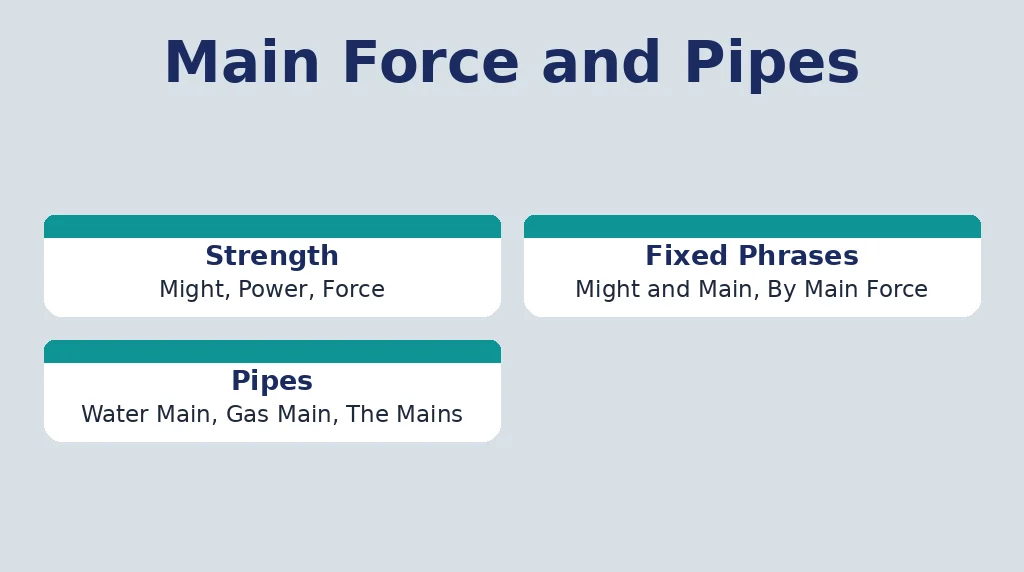
Not every main talks about importance. Older English used main as a noun for strength and force, and a few fossils of that meaning survive today. The phrase with all one’s might and main means using every scrap of strength you have. By main force means by sheer physical power, with no finesse at all. Merriam-Webster still lists this noun sense with words like power and muscle beside it.
The synonyms for this force sense come from a small, intense family. Collins groups sheer, direct, entire, pure, absolute, and utter beside it, because old texts wrote of main force in exactly those terms.
- Might: great power or strength, the partner word in the famous phrase. Example: They pushed with all their might.
- Power: physical strength or force. Example: The power of the blast shook the street.
- Force: strength used against something. Example: The door gave way to sheer force.
- Strength: the quality of being physically strong. Example: It took all his strength to lift the beam.
- Effort: hard work toward a goal. Example: Moving the piano took real effort.
- Potency: power to influence or produce an effect, formal. Example: The potency of the drug surprised the doctors.
The pipe sense is the one you will meet in real life. A water main is the principal pipe that carries water into a district, and gas mains and electricity mains work the same way. British speakers also say the mains for the public electricity supply itself, as in mains supply or plugged into the mains. Collins lists cable and mains supply in this family. There is no elegant synonym here, because plumbers and engineers need the exact term.
Finally, older writing used the main for the open sea or the mainland. Islanders traveled back to the main for supplies. That sense survives in place names and historical novels, and mainland is its plain modern replacement.
Synonyms for Main in Essays, Reports and Professional Writing
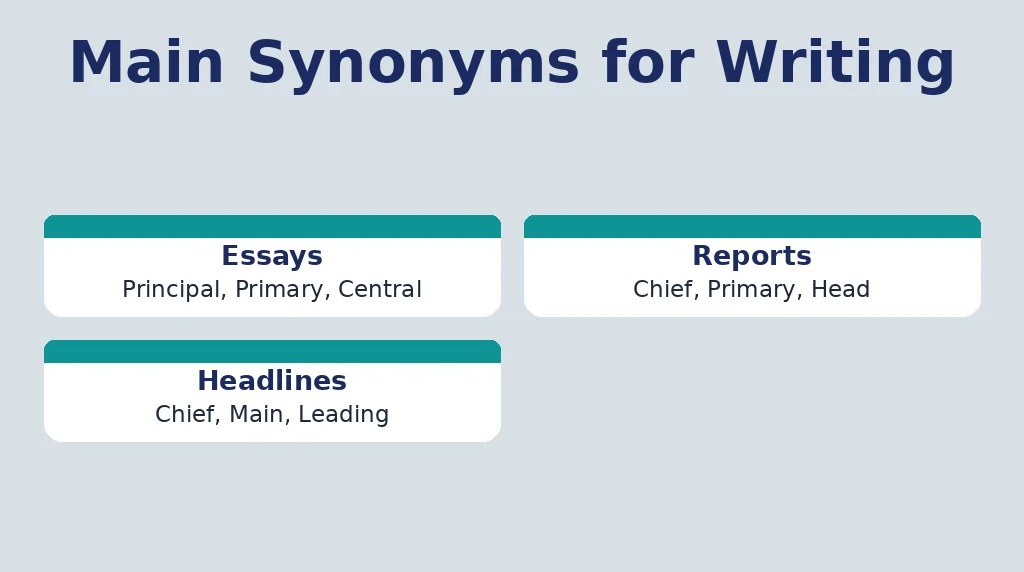
School and office writing uses main more than any other setting, so this section maps the synonyms onto the tasks students and staff actually face. The goal is simple: pick the word a marker or a manager would choose.
In essays, principal and primary do the heavy lifting. The principal cause, the primary source, and the main argument all name the leader of a set. Chief fits news-style essays and reports, since journalists use it constantly: the chief cause of the fire, the chief negotiator. Central belongs with themes and questions. A central issue or a central theme sounds academic in the right way, because it promises analysis rather than ranking.
Reports and business documents prefer primary and principal for structure. The primary objective, the principal findings, and the main recommendations form a natural set. Head appears in titles and places: the head of department, the head office. Leading suits markets and products, as in the leading brand or a leading role in the project. Major crosses into this writing when size or seriousness matters more than rank, a contrast the next section explains in full.
Headlines follow their own rules. Space is tight, so newspapers favor short words: chief, main, and top slot into narrow columns where principal will not fit. A chief inspector, a main road closure, and a leading story all read well at a glance. Broadcast scripts do the same, because listeners cannot reread a long word. When you write for the ear or the front page, stay on the short rungs of the ladder.
Formal praise needs care. Calling a scholar pre-eminent or a rule paramount works in a speech or a report introduction. Dropping those words into a routine email makes the writer sound overheated. Professional writing rewards the plainest word that still tells the truth, and for main that word is usually principal, primary, or chief.
How to Choose the Right Synonym for Main
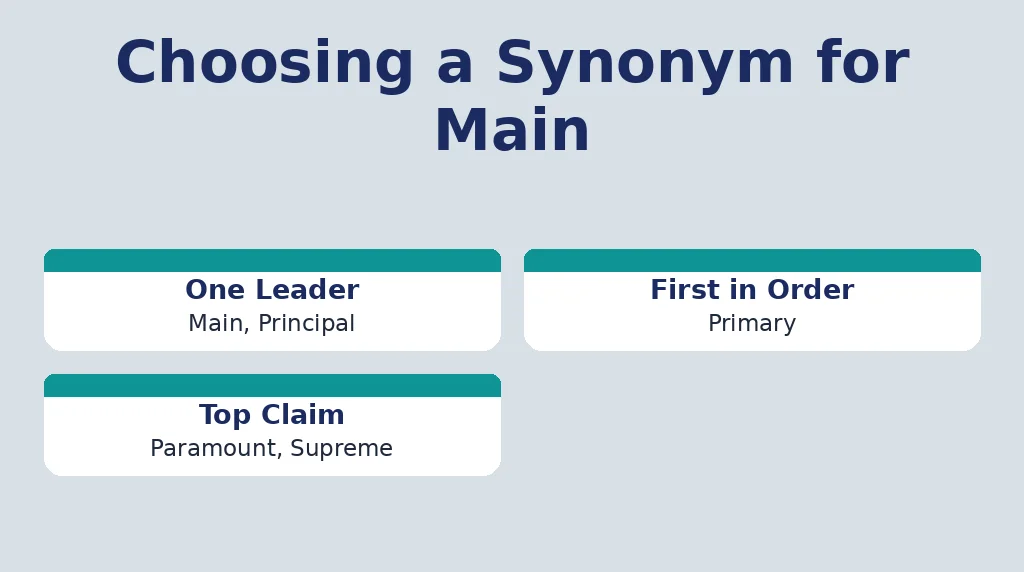
Four questions settle most choices. Are you ranking one thing above others? Are you saying something is needed? Are you writing formally? And does the word sit comfortably before your noun? Work through them once, and the right synonym usually picks itself.
The hardest choice is main against its three nearest rivals. Main names the single central one: the main reason is the reason that leads the list. Primary names the first in a planned order: the primary goal comes before the secondary goals. Principal names the first in rank and sounds the most formal of the three. In practice, the main reason, the primary reason, and the principal reason can all describe the same fact, with only the tone shifting.
Major needs a separate warning. Major measures weight, not position, so a major reason is a big reason rather than the leading one. A report can honestly list three major reasons, but it can have only one main reason. Writers who need that contrast in full should read the guide to synonyms for major, which sorts the size and seriousness words separately.
Paired examples make the gaps visible:
- The main entrance is at the front. Position and custom decide this one.
- The principal entrance is at the front. Same fact, dressed for a formal report.
- The central heating is broken. Here central is part of a fixed term, not a choice.
- Safety is paramount. The claim is total, so the strongest word fits.
- The chief engineer approved the plan. A job title, where head could also stand.
The quick picker below matches common writing situations to strong first choices.
| Situation | Strong first choice |
|---|---|
| The reason that leads the list | Principal |
| A goal in a plan with stages | Primary |
| The theme a book turns on | Central |
| A need nothing can replace | Essential |
| The top expert in a field | Foremost |
| A company office in charge | Head |
| A claim above all others | Paramount |
When two words both fit, read the sentence aloud. Main words carry stress well at the start of a phrase, so the main point sounds punchy. Longer formal words slow the line down, which suits conclusions and speeches. Let the rhythm of the sentence break the tie.
Example Sentences with Synonyms for Main
Seeing the words at work locks the differences in place. Each sentence below uses one synonym in its most natural home, and the short note after it explains why the swap works.
- The principal cause of the flooding was a blocked drain. Principal suits a formal report on causes.
- Her chief worry was the cost of the repairs. Chief sounds natural with worries and concerns.
- The primary aim of the course is confidence, not speed. Primary fits aims and goals in a plan.
- He is the prime suspect, but the police have no proof yet. Prime pairs with suspect by habit.
- She played the leading role in three films last year. Leading is the standard word for roles.
- The foremost expert on the subject teaches at Oxford. Foremost praises rank in a field.
- Respect is paramount in this classroom. Paramount fits rules that outrank everything.
- The central problem is trust, not money. Central names the problem everything turns on.
- Rest is essential after surgery. Essential marks a true need.
- The port is a vital link for the whole region. Vital suits links, supplies, and services.
- The head office approved the budget on Friday. Head pairs with office and department.
- Blue remained the predominant color in her designs. Predominant describes mixes and patterns.
Swap any bold word back to main and the sentence still works. It just says less. That lost detail, a hint of rank, need, or habit, is exactly what a good synonym buys you.
Antonyms for Main
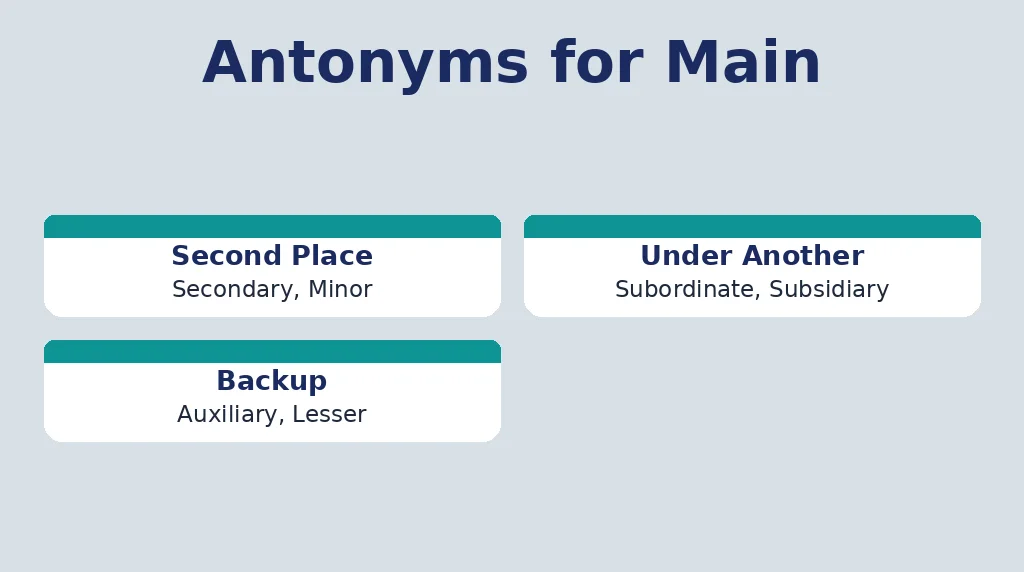
The opposites of main demote a thing from first place. Common antonyms include secondary, minor, unimportant, lesser, subordinate, subsidiary, and auxiliary. Each one pushes the noun down the ranking in a slightly different way.
Secondary is the workhorse opposite, naming whatever comes second in order or importance. Minor stresses small scale, so a minor point is a small point. Subordinate and subsidiary describe things that answer to something higher: a subsidiary company, a subordinate clause. Auxiliary adds the idea of backup help, as in an auxiliary engine that only runs when the main one fails. Lesser is the plain comparative, useful in phrases like the lesser reason.
Two opposites deserve a closer look, because students confuse them often. Secondary and minor both demote, but they demote differently. Secondary speaks of order: the secondary school follows the primary school, and a secondary effect follows the first one. Minor speaks of size: a minor cut needs a plaster, not stitches. A secondary point can still be large, and a minor point can still come first in your speech. Choose the axis you mean, order or size, and then pick the word.
The pairing test is simple. If main marks the leader, its antonym should mark the follower. The main clause and the subordinate clause pass that test in grammar. The main office and the branch office pass it in business speech, even though branch is a noun rather than a true adjective antonym.
Common Mistakes: Words That Are Not True Synonyms for Main
Accuracy matters in a synonym guide, so this section clears up the words that sneak into main lists wrongly.
Big, large, and huge are the most common intruders. They describe size, not rank or importance. A main road can be narrow, and a huge side street is still a side street. When your sentence is really about physical size, the words in synonyms for big will serve you better than anything in this guide.
Mainly is not an adjective at all. It is an adverb meaning for the most part: the crowd was mainly students. It cannot sit before a noun, so it can never replace main in the main reason.
Principle is a spelling trap, not a synonym. Principle is a noun meaning a rule or belief. Principal is the word that means main, and it is also the title of a school head. A quick memory hook helps: the principal is your pal, and a principle is a rule.
Special needs a warning label too. Collins lists it for main in one narrow job, the special correspondent, meaning the correspondent assigned to a story. In ordinary sentences special means unusual or better than normal. The special reason is not the main reason; it is a remarkable one.
Word order trips up many learners. In English the adjective stands before the noun: the main reason, never the reason main. Some languages place the important word after the noun, which is why the error is so common in translated writing. If your sentence sounds off, check the order before you change the word.
One more phrase fools learners in the opposite direction. In the main is an idiom meaning on the whole or generally: in the main, the plan worked. It contains the word main, yet it has nothing to do with ranking. Treat it as a fixed chunk and never split it apart.
Mane is only a sound-alike. A lion has a mane, and the word has nothing to do with importance. Spellcheckers miss this error because mane is a real word, so your own eye has to catch it.
Frequently Asked Questions
What is the best synonym for main?
Principal is the safest all-purpose replacement in formal writing, and chief is the most natural in everyday writing. Primary wins when order matters, as with goals and stages. The best choice depends on the noun: the principal reason, the chief executive, the primary goal.
What is the difference between main and primary?
Main names the central one, the one that leads in practice. Primary names the first in a planned order or ranking. The main entrance is the one everyone uses. The primary entrance, in a fire plan, is the first exit route listed. The meanings overlap, but the flavor differs.
Is main only used before a noun?
Almost always, yes. Main is an attributive adjective: the main point, the main office, the main road. English speakers do not say the point is main. If the word must come after a verb, switch to primary or principal, or rebuild the sentence.
What is a formal synonym for main?
Principal and paramount are the classic formal choices. Pre-eminent, cardinal, and predominant also raise the register. In official writing, principal is the most common of the group, since it sounds serious without sounding grand.
What does water main mean?
A water main is the principal pipe in a water supply system, the large pipe that carries water into a neighborhood. Smaller pipes branch off it to reach each house. Gas mains and electricity mains follow the same pattern.
What is a synonym for main character?
Lead character is the closest swap, and protagonist is the technical term in story analysis. Hero is sometimes used, but it adds a moral judgment that main character does not carry. In film credits, the main role is simply the lead role.
What is the opposite of main?
Secondary is the most common opposite, followed by minor and subordinate. Subsidiary and auxiliary work for companies and equipment. The right opposite depends on the noun: the main clause pairs with the subordinate clause, while the main office pairs with the branch office.
Can you say very main or most main?
No. Main already claims the top position, so it does not take very or most in standard English. If you need extra force, upgrade the word instead: paramount and supreme carry the extra weight on their own.
Final Thoughts
Main is a small word doing a leadership job. Once you see that its synonyms split into rank words, need words, and a few fixed phrases, the right choice usually becomes obvious. Say the principal reason in a report, the chief concern in a meeting, and the main road everywhere else, and each word will earn its place.
For an even deeper list with related words and near-synonyms, the Merriam-Webster Thesaurus entry for main is a reliable next step. Keep this guide bookmarked as well, and your writing will never lean on one flat word again.