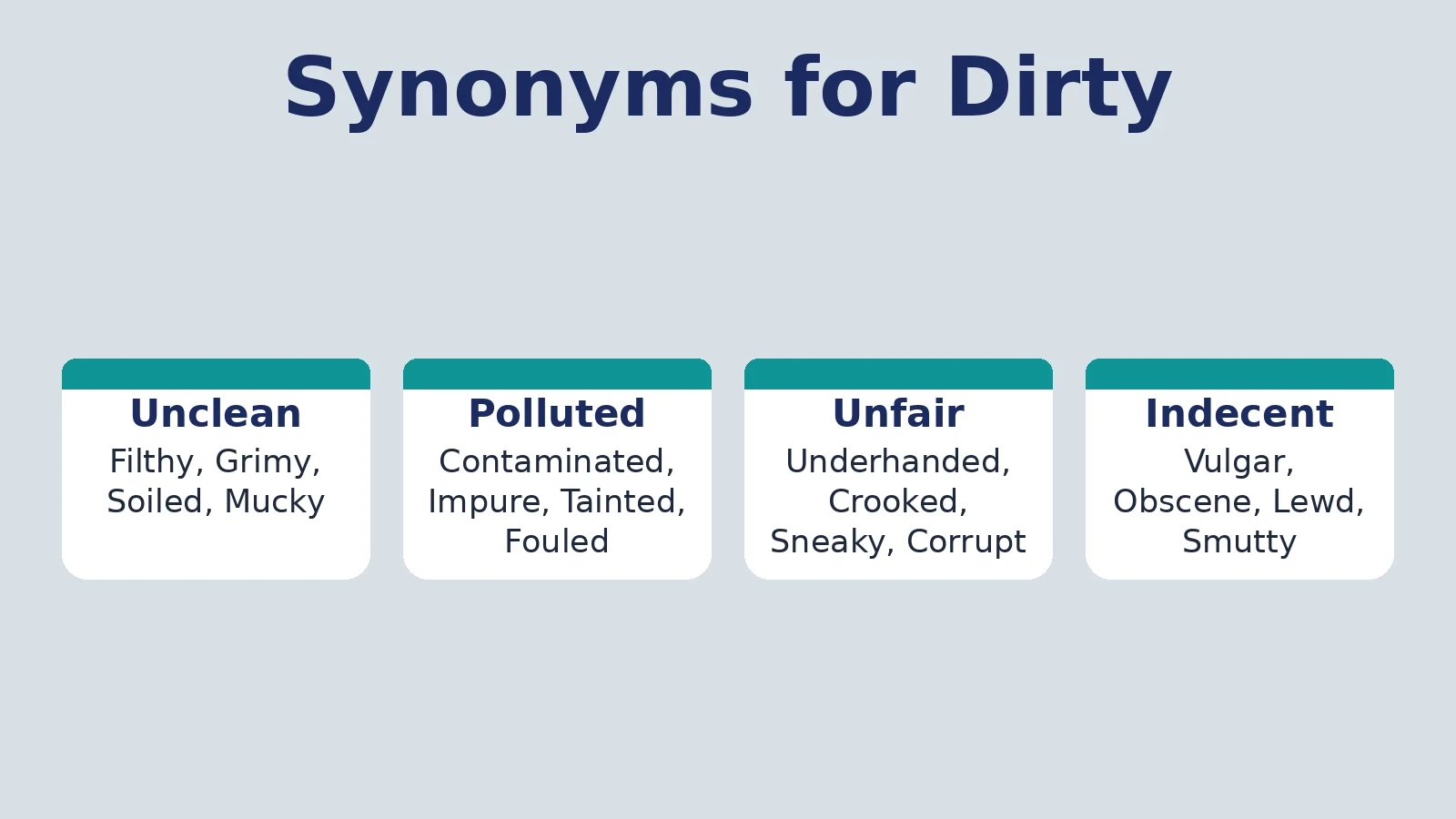
One small word does a surprising amount of work in English. A shirt can be dirty, a river can be dirty, and so can a trick, a joke, and a look. The most useful synonyms for dirty include filthy, soiled, grimy, grubby, mucky, unclean, polluted, contaminated, underhanded, crooked, vulgar, obscene, and smutty. Each one fits a different kind of mess, though, which is why the plain word often feels too vague.
This guide sorts more than 80 synonyms for dirty by sense, so you can match the word to the situation. Every entry carries a short meaning, and the most useful words include example sentences. As a result, you can describe muddy boots, unsafe water, unfair play, and risky humor with equal precision.
Top Synonyms for Dirty: Quick Reference
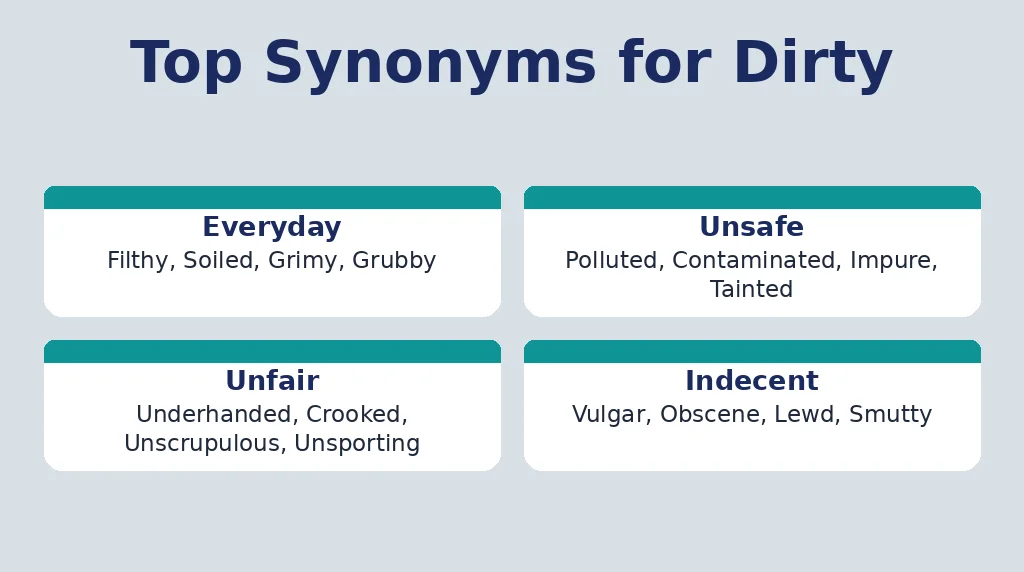
The table below covers the 28 synonyms readers reach for most often. Start here for one quick replacement, then use the later sections to match the word to the exact mess.
| Word | Meaning in one line | Best for |
|---|---|---|
| Filthy | Extremely dirty, often with built-up grime | Strong emphasis, disgust |
| Soiled | Marked or stained with dirt | Formal tone, cloth and linen |
| Unclean | Not clean, sometimes unsafe or impure | Water, health, formal writing |
| Grimy | Covered in ingrained dirt or soot | Faces, hands, windows, cities |
| Grubby | Dirty from handling or hard use | Informal, hands and clothes |
| Mucky | Covered in mud or wet dirt | Informal, boots and floors |
| Unwashed | Never or not yet washed | Hair, dishes, clothes |
| Stained | Marked by a spot that stays | Fabric, teeth, surfaces |
| Squalid | Extremely dirty from neglect | Disapproving, places and housing |
| Foul | Dirty and offensive, or against the rules | Water, smells, sports play |
| Nasty | Very dirty and unpleasant | Informal, strong disapproval |
| Dingy | Dirty and dull in color | Rooms, curtains, old buildings |
| Greasy | Dirty with oil or fat | Kitchens, hair, machinery |
| Messy | Dirty through disorder and spills | Rooms, desks, everyday speech |
| Polluted | Made dirty by harmful waste | Air, rivers, beaches, cities |
| Contaminated | Made unsafe by a harmful substance | Water, food, medical contexts |
| Impure | Mixed with something harmful or unwanted | Formal, water and substances |
| Underhanded | Dishonest and secretive | Tactics, deals, behavior |
| Crooked | Dishonest or corrupt | Informal, officials and schemes |
| Unscrupulous | Without moral limits | Formal, business and politics |
| Unsporting | Unfair and against the spirit of play | Sport, games, competition |
| Vulgar | Rude and indecent in wording | Language, jokes, formal tone |
| Obscene | Offensive to accepted decency | Strong label, language and media |
| Lewd | Indecent in a crude way | Formal reports, language |
| Smutty | Indecent, or marked with soot | Jokes and stories, informal |
| Raunchy | Indecent in a loud, earthy way | Informal, comedy and songs |
| Bawdy | Indecent but playful and humorous | Songs, plays, older literature |
| Gross | Very dirty or indecent, broadly unpleasant | Slang, everyday disapproval |
What Does Dirty Mean?
At its core, dirty means not clean. Cambridge defines it as marked with dirt, mud, or similar matter, or containing pollution or bacteria. Merriam-Webster adds a second shade: something can also be likely to make other things dirty, like muddy shoes on a carpet. That core then stretches into figurative senses.
First, dirty can describe behavior that breaks the rules, as in dirty play or a dirty trick. Second, it can describe language or humor that breaks decency, as in a dirty joke. Third, it appears in the phrase dirty work, which names jobs that are unpleasant, menial, or slightly dishonest. Each sense keeps the same basic idea: something falls short of a clean standard.
British usage adds one smaller sense: speakers there sometimes call rough, stormy weather dirty weather. That sense is regional, though, so this guide focuses on the five main senses above. Keeping them apart is the secret to choosing well, because a synonym from one group rarely fits another.
Synonyms for Dirty: Unclean and Covered in Dirt
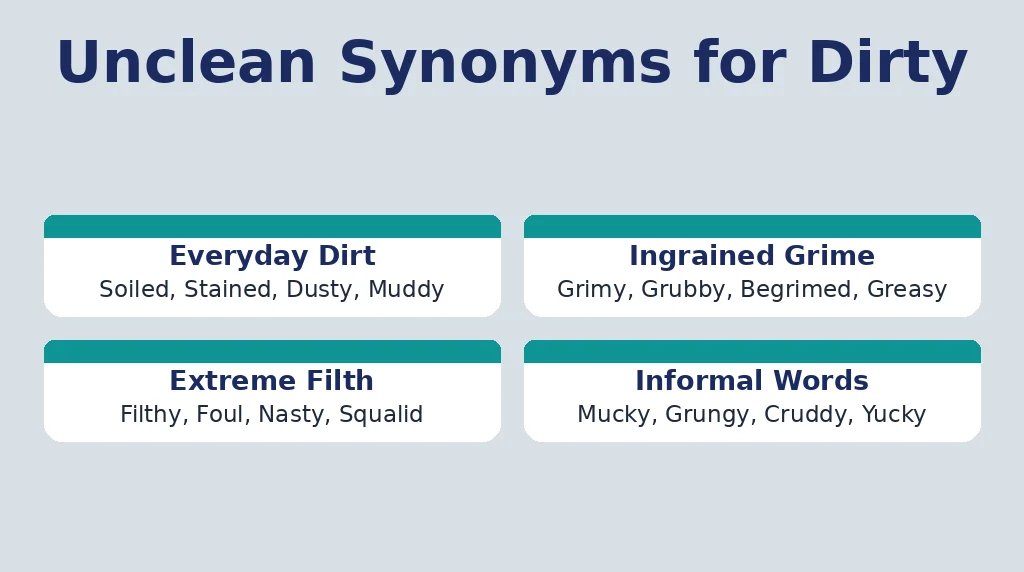
The literal sense is the home ground of dirty. Something looks, feels, or smells unclean, and it usually needs washing or scrubbing. However, the words split by strength and by cause, so a dusty shelf and a neglected room ask for different terms.
Everyday Dirt on Hands, Clothes and Rooms
These words cover ordinary daily dirt, and most of them sound neutral.
- Soiled: marked with dirt or stains, slightly formal. Example: Leave the soiled towels by the machine.
- Stained: marked by a spot that does not wash out easily. Example: His shirt was stained with coffee.
- Dusty: covered in fine, dry dirt. Example: Dusty shelves lined the empty room.
- Smudged: marked by a rubbed smear, like a fingerprint on glass.
- Spotted: marked with small spots of dirt. Spattered is its splashier cousin, used for mud thrown across a surface.
- Unwashed: not yet washed at all. Example: A pile of unwashed dishes waited in the sink.
- Muddy: covered in wet earth. Example: Muddy boots stood by the door.
Covered in Grime: Hands, Faces and Surfaces
Some dirt works its way in and stays, and a quick wipe rarely fixes it.
- Grimy: covered in ingrained dirt or soot. Example: Do not wipe your grimy hands on that towel.
- Grubby: dirty from touch and use, informal. Example: Her grubby fingers left marks on the page.
- Begrimed: covered in grime, formal and slightly literary, used for travelers and old walls.
- Sooty: blackened by smoke or soot, as on chimneys and ceilings near a fire.
- Tarnished: dulled and discolored on the surface, said of silver, brass, and similar metals.
- Greasy: dirty with oil or fat. Example: The greasy pan soaked in hot water.
- Slimy: covered in a slippery wet film, as on pond stones and old pipes.
- Scummy: covered with a dirty film, especially on standing water or glass.
Extremely Dirty: Filth and Neglect
When dirt builds up over time, the vocabulary turns stronger and more judgmental.
- Filthy: extremely dirty, the strongest everyday choice. Example: Wash your hands before dinner, because they are filthy.
- Foul: dirty and offensive at once. Example: A foul smell rose from the blocked drain.
- Nasty: very dirty and deeply unpleasant, informal. Example: A nasty stain spread across the carpet.
- Squalid: extremely dirty through neglect and poverty, disapproving. Example: Inspectors closed the squalid kitchen at once.
- Dingy: dirty and dull, so colors look grey and tired. Example: Dingy curtains hung in every window.
- Bedraggled: wet, limp, and dirty from exposure, as with soaked clothes after rain.
Untidy Dirt: Mess Without Filth
Dirt and disorder often travel together, yet they are not the same thing, so these words need care.
- Messy: untidy and full of spills or clutter. Example: The messy kitchen took an hour to clear.
- Sloppy: carelessly messy, with splashes and spills. It also describes careless work, so context matters.
- Scruffy: dirty and untidy in appearance, used for people, clothes, and places that look neglected.
- Slovenly: habitually dirty and careless about appearance, judging the person as much as the mess.
- Unkempt: messy and uncared for, said of hair, gardens, and clothes, suggesting neglect over time.
Informal and Slang Words for Dirty
Everyday speech adds shorter, punchier words, and most of them sound playful.
- Mucky: covered in mud or wet dirt, informal. Example: Mucky paws printed the clean floor.
- Grungy: dirty in a worn, shabby way, informal. It suits old clothes, bars, and basements.
- Cruddy: dirty and unpleasant, slang. Speakers also use it for feeling ill, so context matters.
- Scuzzy: dirty and squalid, slang, mainly American, often used for unpleasant places.
- Grotty: dirty and unpleasant, informal and originally British. Example: They shared one grotty bathroom.
- Yucky: dirty and disgusting, informal and slightly childish, used about food and messes.
- Icky: sticky, dirty, and unpleasant, slang, good for slimy textures.
- Crummy: dirty and of poor quality, informal, judging condition as much as cleanliness.
- Smutty: marked with soot or dirt in its literal sense. Example: A smutty face peered from the chimney corner. The word serves a second, indecent sense later in this guide.
Synonyms for Dirty: Polluted Air, Water and Places
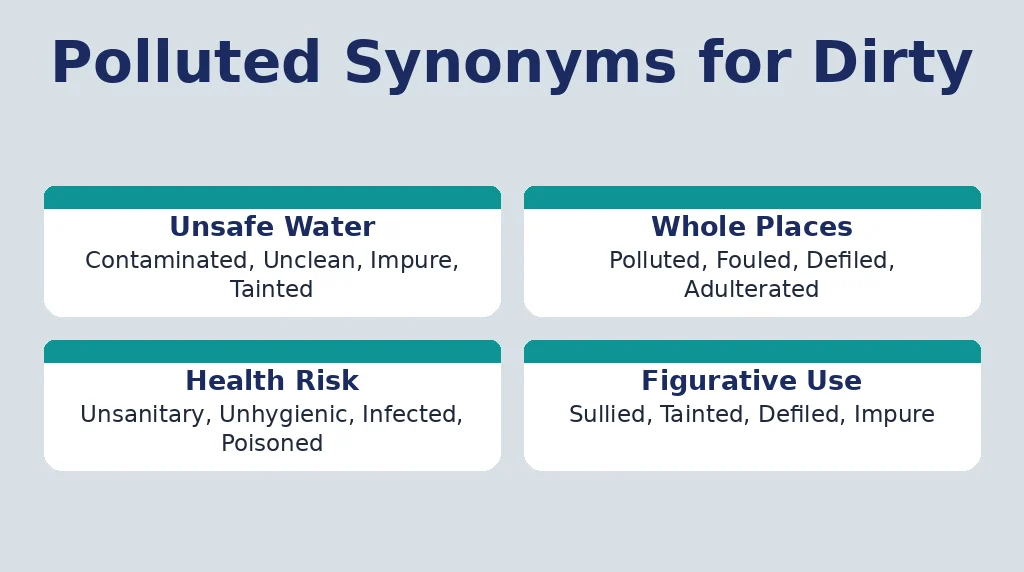
Pollution language works on a bigger scale than household dirt. Here the problem is often invisible, widespread, or dangerous to health. Consequently, these words sound more technical, and they appear often in news and official warnings.
Water and Food That Are Unsafe
Water can look clear and still be dirty in this deeper sense, so the words below stress safety rather than appearance.
- Contaminated: made unsafe by contact with a harmful substance. Example: Residents boiled the contaminated water before drinking it.
- Unclean: not clean and possibly unsafe, a broad and formal word. Example: Disease spreads through unclean water.
- Impure: mixed with an unwanted or harmful substance. Example: Impure water made the whole village ill.
- Tainted: spoiled by a trace of something harmful. Example: The tainted meat was removed from sale.
- Poisoned: made harmful by poison, the strongest option here, used for wells, soil, and food after a spill.
- Infected: carrying germs or disease organisms, used for water supplies and wounds.
Air, Land and Whole Places
When a whole place turns dirty, the vocabulary widens to describe environments, and it often implies human causes.
- Polluted: made dirty by harmful waste or chemicals. Example: Swimmers avoided the polluted beach all summer.
- Fouled: made dirty or tangled, often by waste. Example: Fishing nets fouled the harbor water.
- Defiled: spoiled after being clean, pure, or respected. Example: Vandals defiled the old well. The word carries moral weight, so it suits serious writing.
- Adulterated: made impure by adding a cheaper or harmful substance. Officials use it for food, fuel, and medicines.
- Murky: dark and dirty, so seeing through becomes hard. Example: Murky water hid the riverbed. It describes appearance more than safety.
Health, Hygiene and Official Warnings
Inspectors and health writers need words that judge conditions, not just dirt.
- Unsanitary: dirty in a way that risks health. Example: Inspectors shut the unsanitary kitchen.
- Unhygienic: likely to spread germs through poor cleaning. Example: Unhygienic practices closed the food stall.
- Insanitary: the less common variant of unsanitary, found in older or British official writing.
- Sullied: made dirty in reputation as well as fact. A river can be sullied by waste, and so can a good name.
A quick rule keeps this group straight. If the dirt can harm health, reach for contaminated, polluted, or unsanitary. Meanwhile, if the dirt only shows, the literal words above will serve better.
Synonyms for Dirty: Unfair and Dishonest
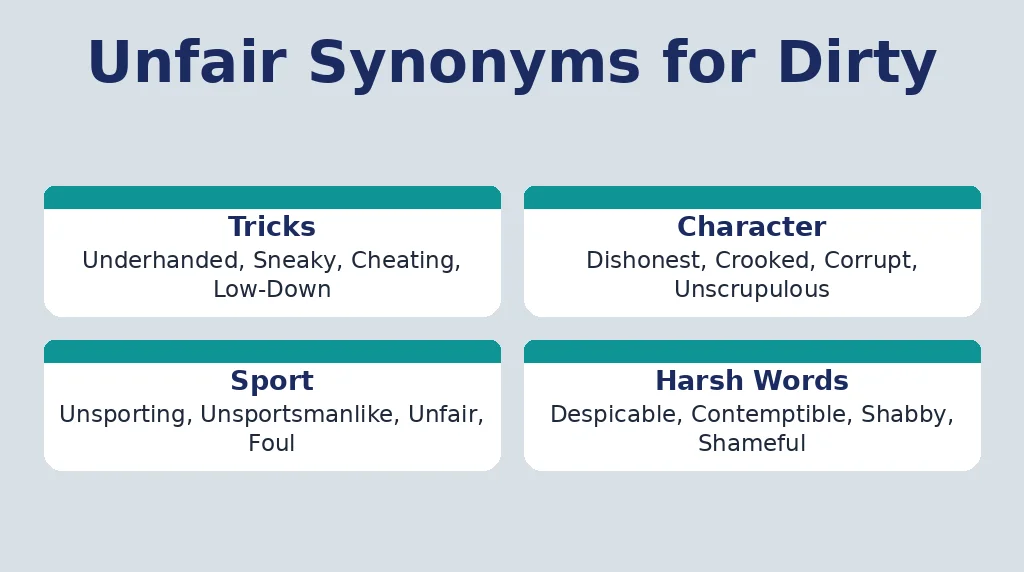
Dirty also judges behavior. In this sense, the dirt is moral rather than physical: someone has broken rules, hidden motives, or treated others badly. Merriam-Webster notes that dirty here stresses meanness or despicableness.
Tricks, Tactics and Secret Moves
Most dirty behavior hides something, so these words name the hiding, the trick, or the broken rule.
- Underhanded: secretive and dishonest. Example: His underhanded tactics cost him every ally.
- Underhand: the shorter twin of underhanded, with the same meaning.
- Sneaky: secretive in a petty, sly way. Example: That was a sneaky way to win the point.
- Cheating: breaking rules to gain an advantage, a plain label for play, exams, and deals.
- Dirty trick: the set phrase for a deliberately unfair move. Example: Spreading that rumor was a dirty trick.
- Low-down: mean and dishonest, slang. Example: Stealing the tip jar was a low-down move.
- Bent: corrupt or dishonest, British slang, used for officials who take bribes.
Character: Dishonest People and Motives
Some words judge the person rather than the act, so they hit harder and need strong evidence.
- Dishonest: not truthful or trustworthy, the neutral core word here. Example: The dishonest claim fooled many buyers.
- Crooked: dishonest or corrupt, informal. Example: A crooked official sold the permits.
- Corrupt: willing to act dishonestly for gain, said of officials, systems, and organizations.
- Unscrupulous: without moral limits, formal. Example: An unscrupulous seller hid the damage.
- Unethical: against accepted moral or professional standards, common in reports and reviews.
- Immoral: against moral standards more broadly, judging conduct or a whole way of life.
- Dishonorable: bringing shame through dishonest conduct, formal.
- Treacherous: betraying trust, with a dramatic tone, used for allies, partners, and plots.
- Base: low and without honor, literary and old-fashioned, met mostly in older texts.
Harsh Judgments: Mean and Contemptible
At the strongest end, dirty behavior earns open contempt, so these words belong in opinion writing more than in reports.
- Mean: unkind and unfair, the everyday word behind many dirty tricks.
- Despicable: deserving contempt, very strong. Example: Cheating a friend is despicable.
- Contemptible: also deserving contempt, slightly more formal.
- Shameful: deserving shame, a clear moral verdict. Example: The shameful cover-up lasted for years.
- Shabby: mean and unfair in treatment, said of behavior. Example: That was a shabby way to treat a guest. The same word can describe worn clothes, so context must guide readers.
- Cheap: mean or despicable, said of a trick or shot. Example: Blaming the intern was a cheap trick.
- Low: beneath decent standards, short and blunt, often paired with trick, blow, or move.
- Ruthless: showing no pity or fairness limits, said of competitors who stop at nothing.
Dirty Play in Sport and Games
Sport gives this sense its clearest home. A player can break a written rule, or can break the unwritten spirit of the game instead.
- Unsporting: unfair and against the spirit of fair play. Example: His unsporting conduct drew loud boos.
- Unsportsmanlike: the formal American twin, common in rulebooks and referee reports.
- Unfair: the plain, general word, covering rules, chances, and treatment in any contest.
- Foul: against the rules, as in a foul tackle. As a noun it names the offense itself.
- Below the belt: unfair in the way a low blow is unfair. The phrase comes from boxing, and writers now use it for insults as well. In short, dirty play is simply wrong play with a nastier smell.
Synonyms for Dirty: Indecent Language and Humor
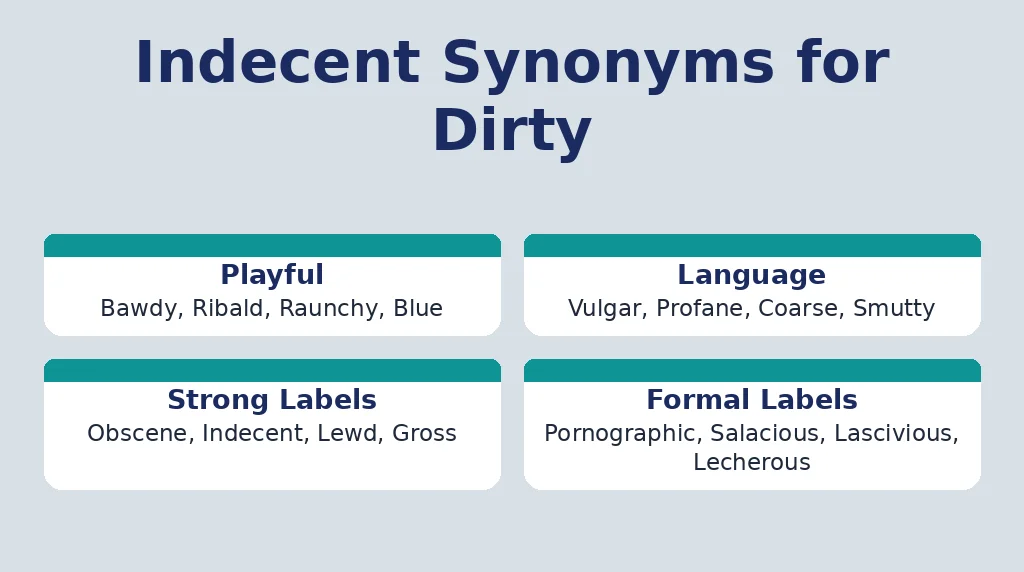
A dirty joke is not covered in mud. Instead, dirty here means indecent: the language deals with taboo topics in a way that polite settings reject. Dictionaries treat this as a standard sense, so this section covers it neutrally. Tone varies widely, though, from playful to strongly offensive.
Playful and Mild: Humor With an Edge
At the mild end, the words suggest naughtiness more than offense, suiting reviews of comedy and songs.
- Bawdy: indecent but cheerful and humorous. Example: The play is famous for its bawdy songs.
- Ribald: indecent in a joking, earthy way, slightly literary, used for humor and stories.
- Raunchy: indecent in a loud, direct way, informal. Example: The comedian dropped the raunchiest jokes for the school show.
- Blue: indecent, informal, as in blue humor. The label is old-fashioned but still widely understood.
- Off-color: slightly indecent or in poor taste, informal. Example: He apologized for the off-color remark.
- Smutty: indecent in a cheap, grubby way. Example: A smutty joke slipped into the speech. The word borrows the grime image from the literal sense.
Stronger Labels: Rude and Offensive Wording
Other words judge the material itself as unacceptable, and editors reach for them when standards are the topic.
- Vulgar: rude and indecent, lacking refinement. Example: Vulgar language filled the comment thread.
- Obscene: offensive to accepted standards of decency, the strongest formal label here, used as a technical term by courts.
- Indecent: not conforming to decency standards, a broad official word covering broadcasts and publications.
- Lewd: indecent in a crude and deliberate way, used in legal and news writing for conduct and words.
- Coarse: rough and indecent in manner or speech. Example: His coarse humor embarrassed the guests.
- Profane: using taboo or sacred words offensively, naming swearing rather than sexual content.
- Gross: indecent or disgusting, broadly informal. Here it judges taste, while in the literal sense it judges grime.
- Filthy: indecent, in phrases like filthy language, informal. Merriam-Webster gives filthy street language as its example of this use.
Formal and Clinical Labels
Reports sometimes need distance rather than color, so these formal and literary words keep a discussion neutral.
- Pornographic: explicitly depicting sexual content, the most clinical label in this group.
- Salacious: treating sexual topics with undue or inappropriate interest, formal, used for coverage that lingers too long.
- Lascivious: showing strong sexual desire in an offensive way, formal and literary.
- Lecherous: showing excessive or offensive desire, said of people and looks more than of texts.
- X-rated: restricted to adults, informal as a label, borrowed for anything too strong for general audiences.
- Squalid: morally dirty as well as physically filthy, as in a squalid, sordid tale.
Two cautions protect accuracy here. First, sleazy and seedy describe sordid places and people without naming indecency itself. Second, naughty merely hints at mild mischief. Careful writers therefore match the label to the actual strength of the material.
Dirty Work: Unpleasant Jobs Nobody Wants
Dirty work names the tasks at the bottom of every list. Some are physically messy, while others are unpleasant because they involve conflict, blame, or quiet dishonesty. Merriam-Webster illustrates the phrase with a warning: do not ask me to do your dirty work.
Physically, dirty work includes the chores that soil hands and clothes. Cleaning drains, scrubbing ovens, clearing gutters, and handling waste all qualify. Writers describe such jobs as menial, thankless, or unpleasant. A menial job needs little training and carries low status, while a thankless task earns no credit when it goes well.
Figuratively, dirty work means doing the unpleasant part for someone else. A manager might fire staff through an assistant, or a campaign might spread rumors through allies. In that pattern, one person keeps clean hands while another takes the blame. Novels and crime reports use the phrase this way often.
Useful near phrases include grunt work and messy work. Grunt work stresses low status and repetition, while messy work stresses disorder and cleanup. However, neither phrase is a true one-word synonym for dirty, so this guide records them as phrases, not as adjective synonyms.
Dirty in Idioms and Set Phrases
Idioms carry the dirt image into everyday speech, and each phrase below keeps a trace of the literal meaning.
A dirty look is a look of strong disapproval. Cambridge defines giving someone a dirty look as looking at someone in a disapproving way. The look is sharper than a merely rude glance, because it carries contempt as well as annoyance. Example: She gave him a dirty look and left.
A dirty word is a taboo or indecent word. Merriam-Webster defines it as a disrespectful or indecent word or expression. Figuratively, any unpopular term can become a dirty word in a debate. Example: In that office, overtime had become a dirty word.
To get your hands dirty has two lives. Literally, it means doing hard, practical work yourself. Figuratively, it means joining something dishonest or unpleasant. Context tells readers which life is active, and good managers proudly claim the first while denying the second.
To play dirty means competing unfairly and without honor. The phrase belongs to sport first, but politics and business borrow it constantly. Its opposite, keeping your hands clean, means staying out of the mess entirely. Together, these phrases show how deeply the clean and dirty contrast runs through English.
How to Choose the Right Synonym for Dirty
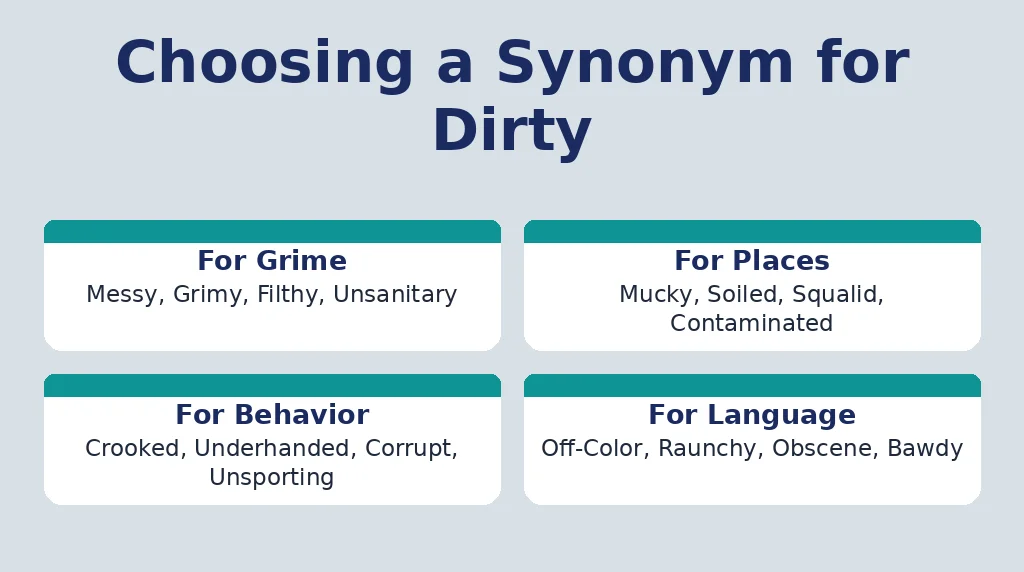
With more than 80 options, the real skill is choosing, not collecting. Three quick questions narrow the field fast. What kind of dirt is it? How strong is it? And finally, who will read the sentence?
Paired examples show how much one word can change a scene. Consider a kitchen after a party:
- The kitchen was messy. It is cluttered, but nothing is truly unclean.
- The kitchen was grimy. Dirt has built up on surfaces over time.
- The kitchen was filthy. The state is extreme, and disgust is the point.
- The kitchen was unsanitary. Health is now at risk, and officials could act.
The room never changed, yet each version tells a different story.
The same test works for behavior. A player who commits one careless foul is not yet crooked. However, a player who plans secret fouls is playing underhanded. Likewise, an official who takes bribes is corrupt, while a rival who merely bends courtesies is unsporting.
Strength is the second test. Dirty itself is the mild, general word. Filthy raises the volume, and squalid adds neglect and judgment. For language, off-color is mild, raunchy is stronger, and obscene is the formal maximum. Therefore, start with the weakest honest word, and escalate only when the facts demand it.
The quick picker below matches common situations to strong first choices.
| Situation | Strong first choice |
|---|---|
| Mud on boots and floors | Mucky |
| Grime on hands and faces | Grimy |
| Cloth marked before washing | Soiled |
| Place ruined by neglect | Squalid |
| River made unsafe | Contaminated |
| Secret dishonest tactic | Underhanded |
| Unfair play in a game | Unsporting |
| Playful indecent humor | Bawdy |
| Strong indecent language | Obscene |
Context clues help as well. Inspectors write unsanitary, referees write unsportsmanlike, and friends say yucky. When a word sounds wrong, it usually clashes with the setting, so reading the sentence aloud exposes most clashes.
Formal vs Informal Synonyms for Dirty
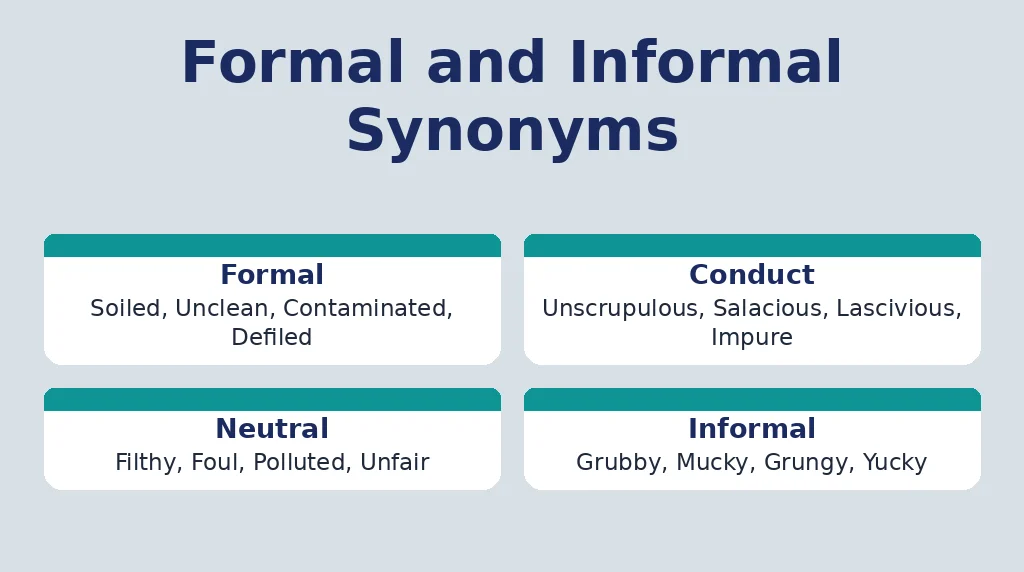
Register decides whether a word sounds like a report or a conversation. The same grime can appear in an inspection, a novel, and a text message, and each setting rewards a different choice.
Formal Words for Reports and Essays
Formal writing prefers precision and distance, so these words appear in inspections, legal writing, and serious journalism.
- Soiled: the formal choice for dirty cloth and linen. Cambridge notes that it is a more formal way to describe something dirty, especially fabric.
- Unclean: broad and formal, common in health, religious, and official writing.
- Contaminated: the technical choice when a harmful substance is present.
- Defiled: formal and moral, used when something pure or respected has been spoiled.
- Impure: formal, used for substances mixed with unwanted matter.
- Unscrupulous: the formal choice for dishonest conduct without moral limits.
- Salacious and lascivious: formal labels for indecent content, common in reviews and legal discussion.
In an essay, these words keep the tone measured. A student can write that the river was contaminated by waste, which sounds exact and calm. Slang like scuzzy would weaken the same sentence instantly.
Neutral Words for Everyday Writing
Neutral words fit almost anywhere. Filthy, foul, polluted, stained, muddy, and unfair all sound natural in news, blogs, and general nonfiction. Similarly, vulgar and obscene serve as neutral labels for language. When in doubt, pick a neutral word first, because it rarely embarrasses the writer.
Informal and Slang Words for Speech and Stories
Informal words add warmth, humor, and voice. Grubby, mucky, grungy, and yucky belong in dialogue and friendly narration. Crooked and low-down give a character instant attitude, while raunchy and blue keep discussions of humor light. However, slang varies by region: grotty sounds British, while scuzzy sounds American, so writers should match the word to the speaker.
Dialogue loves these words because people actually say them. In a formal report, though, the same words read as careless. In short, let the document decide the register, and then pick the dirty word that fits it.
Antonyms for Dirty
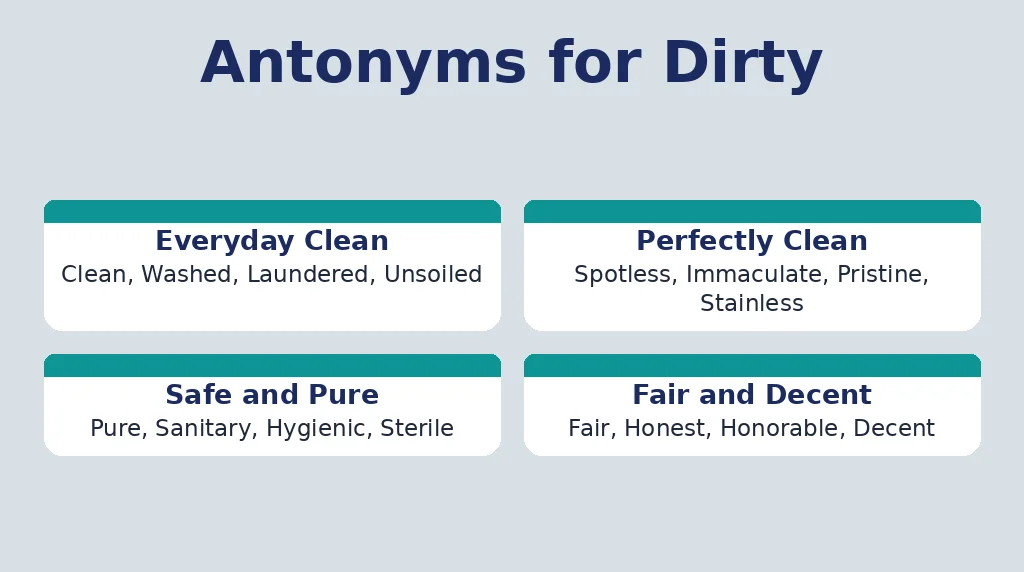
The clearest opposite of dirty is clean. Cambridge calls clean the most common opposite of the word, and every sense of dirty has its own clean counterpart. For the full bright-side word family, see the guide to synonyms for clean.
For everyday cleanness, the main antonyms are clean, washed, laundered, tidy, neat, and unsoiled. Still, each one cancels the dirt differently. Washed and laundered describe a finished action, while tidy and neat describe order as well as cleanness.
For perfect cleanness, writers reach higher. Spotless means no spot remains at all. Immaculate means completely clean and flawless, often with admiration. Pristine suggests untouched, original condition. Stainless and unsullied both mean never stained, and writers use unsullied for reputations as well as cloth.
For safety and purity, the opposites change again. Pure is the direct opposite of unclean and contaminated, as Cambridge notes. Sanitary and hygienic describe conditions that protect health, while sterile and antiseptic belong to medical settings. Untainted, uncontaminated, unpolluted, decontaminated, and disinfected complete the official set.
Conduct and language have their own opposites, finally. Fair answers unfair play, and honest and honorable answer crooked dealing. Decent answers indecent language, and a clean game names the positive standard directly. A quick test helps: if a word can finish the sentence “instead of dirty, it was” naturally, it probably belongs here.
Words That Are Not True Synonyms for Dirty
Accuracy matters in a synonym guide, so this section clears up the words that often sneak into dirty lists wrongly.
Messy and untidy are the most common intruders. They describe disorder, not dirt. A desk can be messy with clean papers, and a kitchen can be tidy yet greasy. Sloppy sits between the two ideas, which is why this guide keeps it with a caution. Disheveled describes appearance, usually hair or clothing, and says nothing certain about washing.
Wet words fail a different test. Wet, soggy, boggy, and swampy describe water content or soft ground. Mud is dirty because of what the water carries, not because it is wet. A clean sponge is wet, while dry dust can be very dirty. Writers should therefore name the dirt itself, as with muddy or dusty.
Smell words mislead in a similar way. Stinking, smelly, fetid, and rank describe odor. Dirty things often smell, yet perfume is clean and smells strongly, while old dust may smell of nothing. Foul survives in the main lists only because the major thesauri list it for dirty itself.
Illegal is too strong for the unfair sense. WordReference lists it near the dishonest group, but a dirty trick can be perfectly legal. Hidden fees and quiet sabotage may break trust without breaking any law. Using illegal without proof also creates legal risk, so careful writers keep the words apart.
Two smaller traps deserve mention as well. First, dark and gloomy describe light, not dirt, even though dingy rooms are often both. Second, naughty only hints at mild mischief in modern use. Calling serious indecent material naughty understates it badly.
Frequently Asked Questions
What is the best synonym for dirty?
There is no single best word, because the right choice depends on the kind of dirt. For everyday writing, filthy and soiled cover the most ground. Filthy suits strong grime, while soiled suits a formal tone and dirty cloth.
What is a formal word for dirty?
Soiled is the classic formal choice for objects and fabric. For water, contaminated and impure sound more technical. For conduct, unscrupulous is the formal option, and salacious serves writing about indecent content.
What is the difference between dirty and filthy?
Filthy is stronger than dirty. Dirty states the simple fact that something is not clean, while filthy adds disgust and suggests dirt built up over time. A shirt can be slightly dirty after one wear, but filthy implies far worse.
What is a synonym for dirty water?
Contaminated is the strongest choice when water is unsafe. Polluted fits water harmed by waste, and unclean is the broad, formal option. If the water only looks dark, murky describes appearance instead.
What is the slang word for dirty?
Cruddy and scuzzy are common slang choices in American English, while icky and yucky are softer options. Grotty is the familiar British informal choice. All suit speech better than reports.
What does dirty mean in sports?
In sports, dirty describes play that is unfair or against the spirit of the game. Unsporting and unsportsmanlike are the precise labels. A foul names a single offense, while dirty play suggests intent.
What is the opposite of dirty?
Clean is the main opposite, with spotless, immaculate, and pristine for perfect cleanness. For polluted things, pure and uncontaminated serve as opposites. For behavior, fair and honest are the counterparts.
Is messy a synonym for dirty?
Not exactly. Messy describes disorder, while dirty describes unclean matter. The two often appear together, which is why lists mix them up. Careful writers choose the word that matches the actual problem.
Final Thoughts
Dirty is a small word with five busy lives. It covers mud on a boot, poison in a river, a trick on the field, a joke at the edge of taste, and the chores nobody wants. Once you sort its synonyms by sense and strength, the right choice usually becomes obvious. Call the boots mucky, the water contaminated, the tactic underhanded, and the joke bawdy, and let each word do its precise work.
For an even deeper list with related words, the Merriam-Webster Thesaurus entry for dirty is a reliable next step. Keep this guide bookmarked too, and your sentences will never settle for a vague mess again.