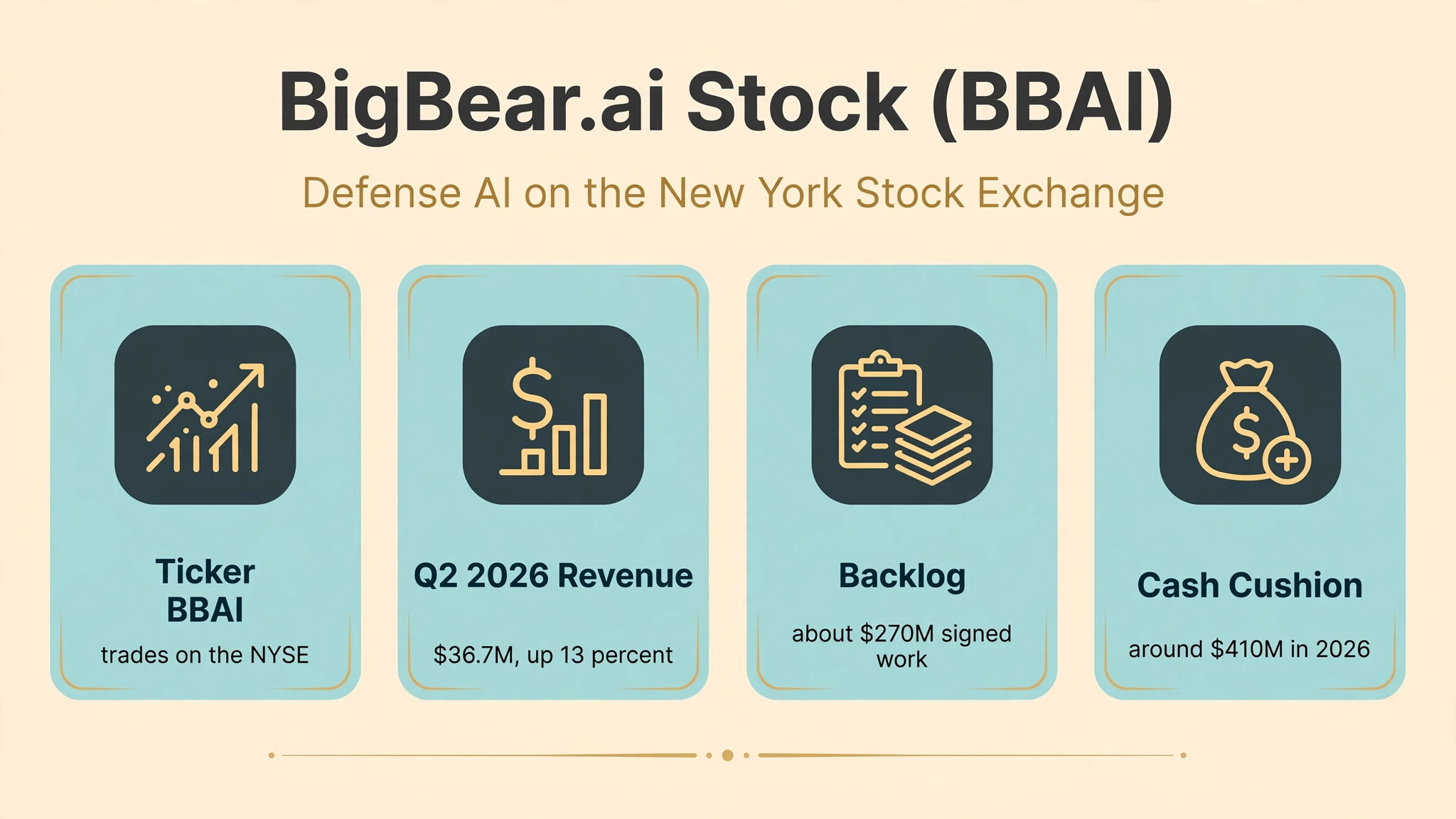
BigBear.ai Holdings, Inc. trades on the New York Stock Exchange under the ticker symbol BBAI. It is an artificial intelligence company that builds decision-intelligence software for U.S. defense, intelligence, and homeland security agencies, helping operators turn messy data into forecasts, plans, and real-time decisions. If you are wondering whether BBAI stock belongs in your portfolio, the short answer is that it is a small, volatile, government-focused AI stock with real contracts but ongoing losses.
We researched the company’s filings, product lineup, and contract announcements to put this guide together. You will find its business model explained in plain language, the key financial figures from its latest reports, the growth drivers management is betting on, and the risks that come with heavy dependence on government budgets. We also walk through exactly how to buy the stock through a regular brokerage account.
This guide is for research and education only and is not financial advice.
Quick Answer
BigBear.ai (NYSE: BBAI) is a U.S. AI software company focused on decision intelligence for defense and intelligence customers. Its products include Ask Sage, a generative AI platform used across government teams, ConductorOS for coordinating autonomous systems, and CargoSeer for cargo and border analytics. The company reported about $127.7 million in 2025 revenue, down roughly 19 percent year over year, with a net loss near $293.9 million. In the second quarter of 2026, revenue grew 13 percent to $36.7 million and backlog reached about $270 million. The stock is small-cap and volatile, suits only risk-tolerant investors, and can be bought through any standard brokerage account that offers NYSE stocks.
What Is BigBear.ai? Company Overview
BigBear.ai Holdings, Inc. is headquartered in McLean, Virginia, and describes itself as a provider of mission-ready AI solutions. The company’s core idea is decision intelligence: software that sits between raw data and human decisions, helping analysts and operators in high-stakes environments act faster and with more confidence. Unlike consumer AI companies, BigBear.ai sells almost entirely to governments and large organizations.
The company went public in December 2021 through a merger with a special purpose acquisition company (SPAC), GigCapital4. Since then it has repositioned itself from a traditional government IT services contractor toward an AI software platform business. That transition is still underway, and it explains much of the lumpiness in its financial results.
Today the customer list reads like a federal org chart. BigBear.ai works with U.S. Customs and Border Protection, the FBI, the U.S. Coast Guard, NASA, the Department of Energy, and the Department of Veterans Affairs, alongside various combatant commands and classified intelligence frameworks. Commercial work exists too, but government contracts dominate revenue.
Leadership matters for a company this dependent on federal relationships. The chief executive is Kevin McAleenan, a former acting Secretary of Homeland Security, which gives the company unusual credibility inside the agencies it sells to. For investors, the key question is whether that access converts into durable, profitable software revenue.
Business Model
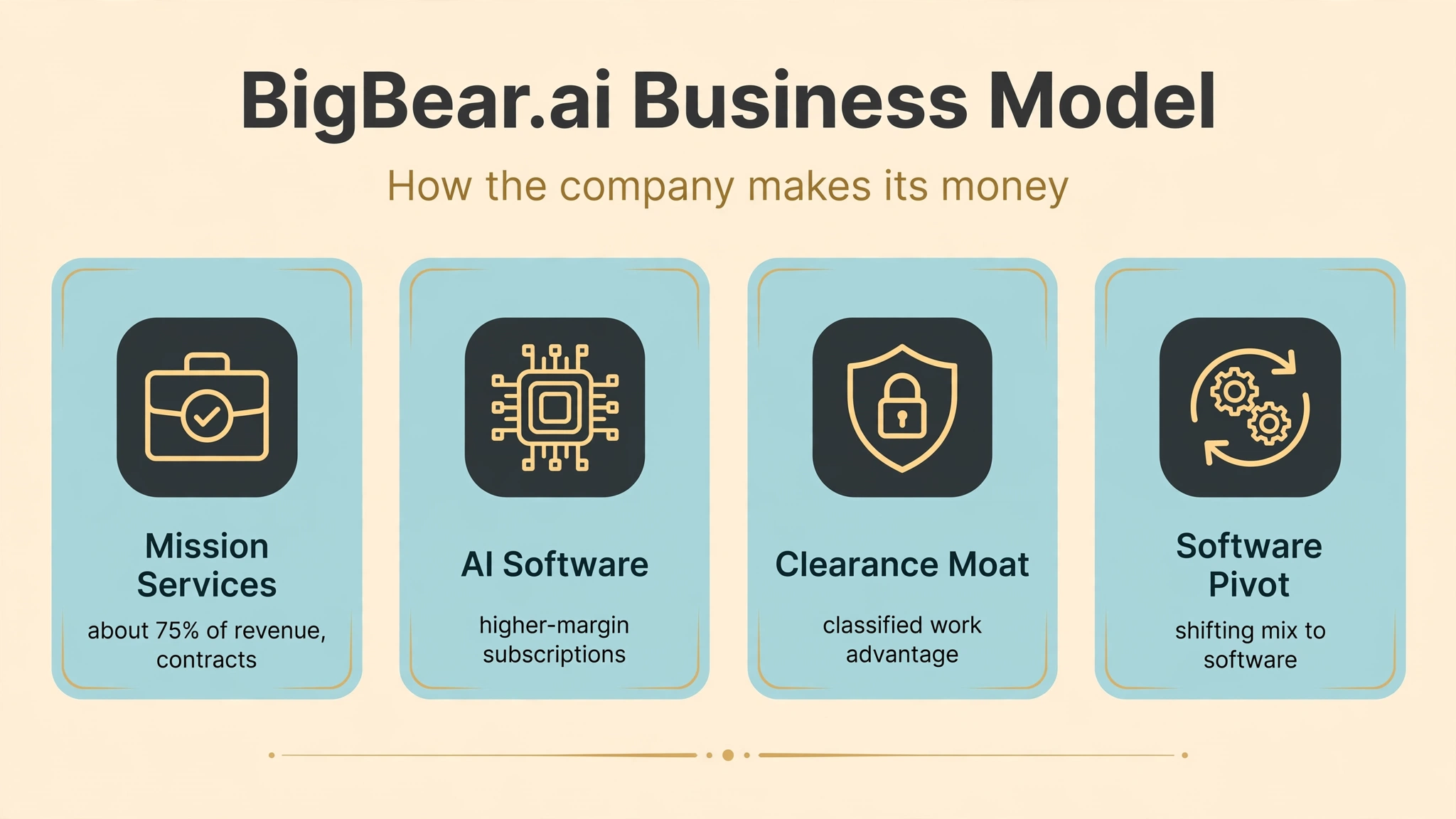
BigBear.ai makes money in two main ways. The first is mission services and engineering: contract-based work that includes system integration, customization, implementation, and support for government programs. This is the legacy side of the business and still accounts for roughly three quarters of revenue. It is steady when contracts are active but lumpy, because it depends on government funding cycles and recompetes.
The second is AI platform and analytics software: higher-margin products sold as subscriptions or licenses. This is the growth engine management wants investors to focus on. It includes Ask Sage, ConductorOS, and computer-vision products, and it carries much better margins than services work. The strategic goal is to shift the revenue mix toward software over time.
What makes the model distinctive is security clearance depth. Much of the work happens in classified or sensitive environments, and the company’s workforce holds high-level clearances. That is a real moat: competitors cannot simply walk into these contracts. The downside is customer concentration, which we cover in the risks section.
For context on how AI software companies monetize, our AI text generator guide explains the broader generative AI market that products like Ask Sage compete in.
Products and Services
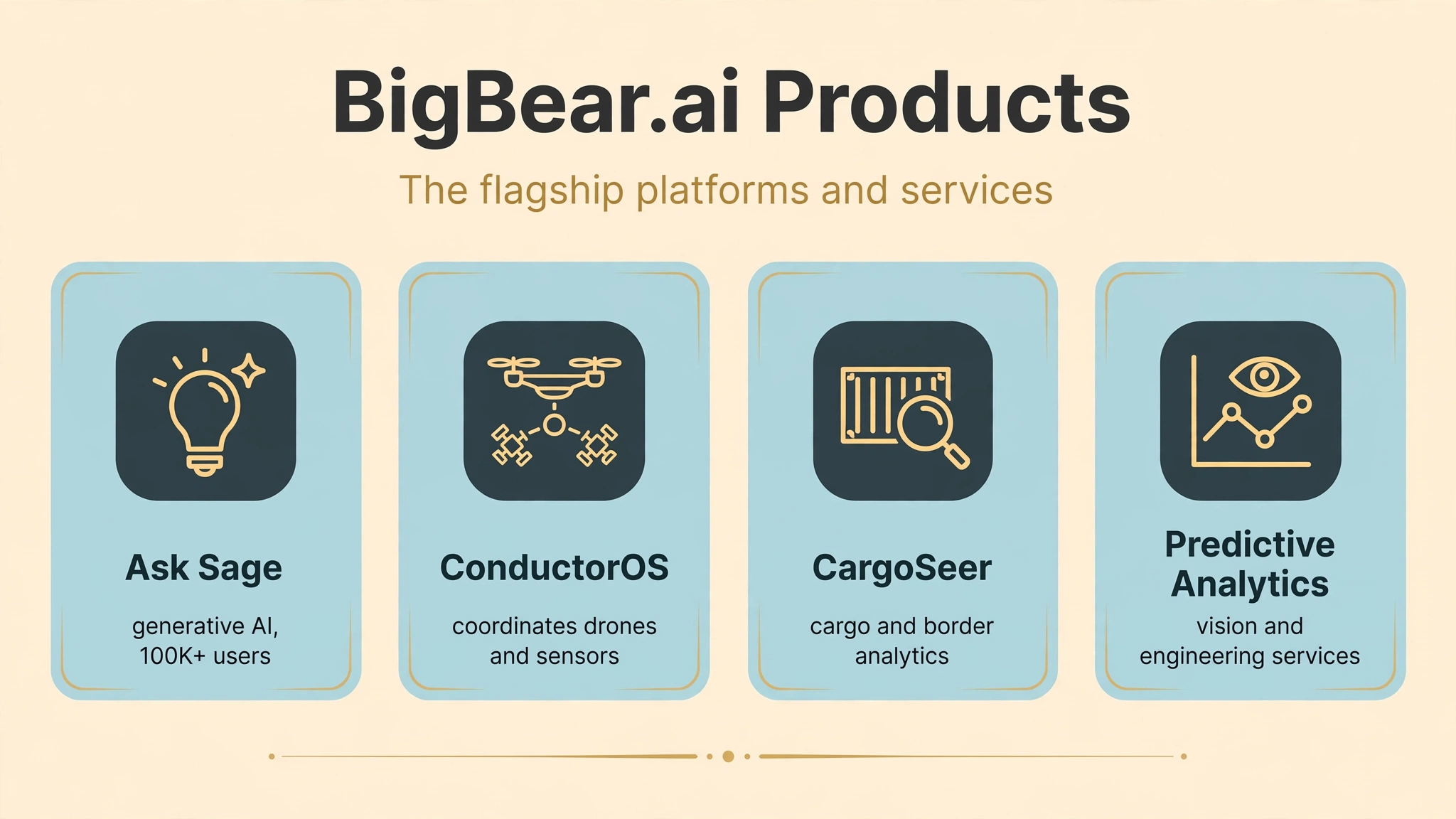
Ask Sage is the flagship generative AI platform. Purpose-built for secure deployment inside government networks, it supports more than 100,000 users across roughly 16,000 government teams. The company is expanding it into disconnected and air-gapped environments, which matters for missions involving sensitive information. BigBear.ai acquired Ask Sage to accelerate its software pivot, and the platform is expected to contribute meaningful recurring revenue.
ConductorOS is software for coordinating drones, sensors, and other autonomous systems from multiple vendors. Successful demonstrations during U.S. military exercises have highlighted its potential, and management points to tens of billions in proposed U.S. fiscal spending on drone and counter-drone technologies as the addressable opportunity.
CargoSeer uses computer vision and AI to analyze cargo scans alongside customs and trade data. After a 12-month pilot, the company secured a five-year commercial deployment agreement in El Salvador, which could serve as a template for international expansion into ports and border operations.
Beyond these, the company offers predictive analytics, computer vision, and systems engineering services tailored to national security, supply chain, and critical infrastructure missions. Learn more about the company directly on the official BigBear.ai website.
Financials and Revenue
The headline numbers tell a story of transition. For full-year 2025, BigBear.ai reported revenue of about $127.7 million, a decline of roughly 19 percent from the prior year, driven by lower volume on certain Army programs. The net loss for the year was approximately $293.9 million, reflecting both operating losses and non-cash charges.
The more recent trend looks better. In the second quarter of 2026, revenue rose 13 percent year over year to $36.7 million, while gross margin expanded significantly to 32.8 percent. Management maintained full-year 2026 revenue guidance of $135 million to $165 million. Backlog, the pipeline of signed but not yet delivered work, stood at about $270 million at mid-2026, up from the start of the year.
The balance sheet is a relative bright spot. As of the end of 2025, the company carried essentially no debt, with a debt-to-equity ratio near zero and a current ratio of about 1.8x, meaning short-term assets comfortably cover short-term liabilities. The company held roughly $410 million in cash and investments in 2026, giving it room to fund product development and acquisitions. Free cash flow, however, was negative at about negative $46.3 million for 2025.
Profitability remains the central challenge. The second quarter of 2026 still showed a net loss of about $25.7 million and negative adjusted EBITDA near $11.6 million, as the company increased spending on sales, go-to-market, and research and development. Investors should expect losses to continue while the software transition plays out.
Stock Performance
BBAI is a small-cap stock, and it trades like one: volatile, news-driven, and sensitive to contract announcements. The shares have spent extended periods near their 52-week lows, trading around the low single digits in late 2026, which reflects skepticism about the path to profitability.
That said, the stock can move sharply on good news. In October 2026, shares jumped as much as 11.7 percent intraday after the company disclosed more than $225 million in contract awards secured since July 2026. More than 25 of those awards were specific to generative AI, spanning the FBI, NASA, the Coast Guard, the Department of Energy, and the Department of Veterans Affairs.
For a balanced third-party view of the investment case, this comparison of BigBear.ai with Cerebras Systems weighs the defense-software story against an AI hardware alternative.
The pattern to understand: BBAI tends to rally on contract wins and fade when attention shifts back to losses and cash burn. Anyone buying should be comfortable with that rhythm and should size the position accordingly.
Growth Drivers
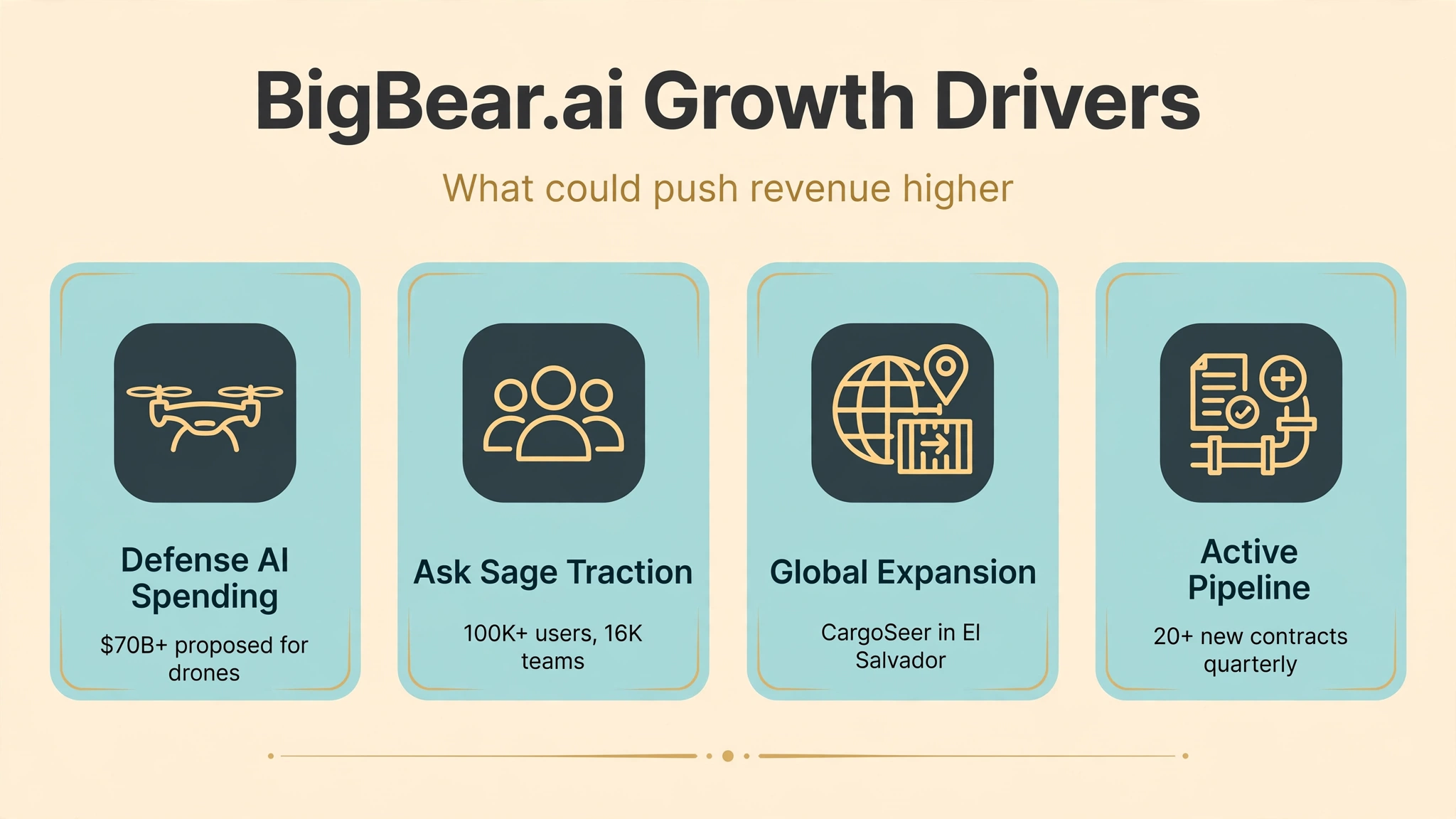
Several forces could push BigBear.ai’s revenue higher over the next few years. The most important is rising U.S. defense modernization spending, particularly around AI, autonomous systems, and drones. Management has highlighted more than $70 billion in proposed fiscal 2027 spending on drone and counter-drone technologies alone.
Second, the Ask Sage platform gives the company a genuine generative AI product inside the federal market, where secure deployment is a differentiator. Expanding it into air-gapped environments opens missions that commercial AI tools cannot touch.
Third, international expansion through products like CargoSeer could diversify revenue beyond U.S. federal budgets. The El Salvador deployment is small but strategically interesting as a repeatable model for ports and borders worldwide.
Fourth, the contract pipeline is active. More than 20 new contracts were won in a single recent quarter, with individual awards valued up to $5 million, and backlog near $270 million provides forward visibility. The open question, as always, is converting backlog into recognized revenue and eventually into profit.
Risks
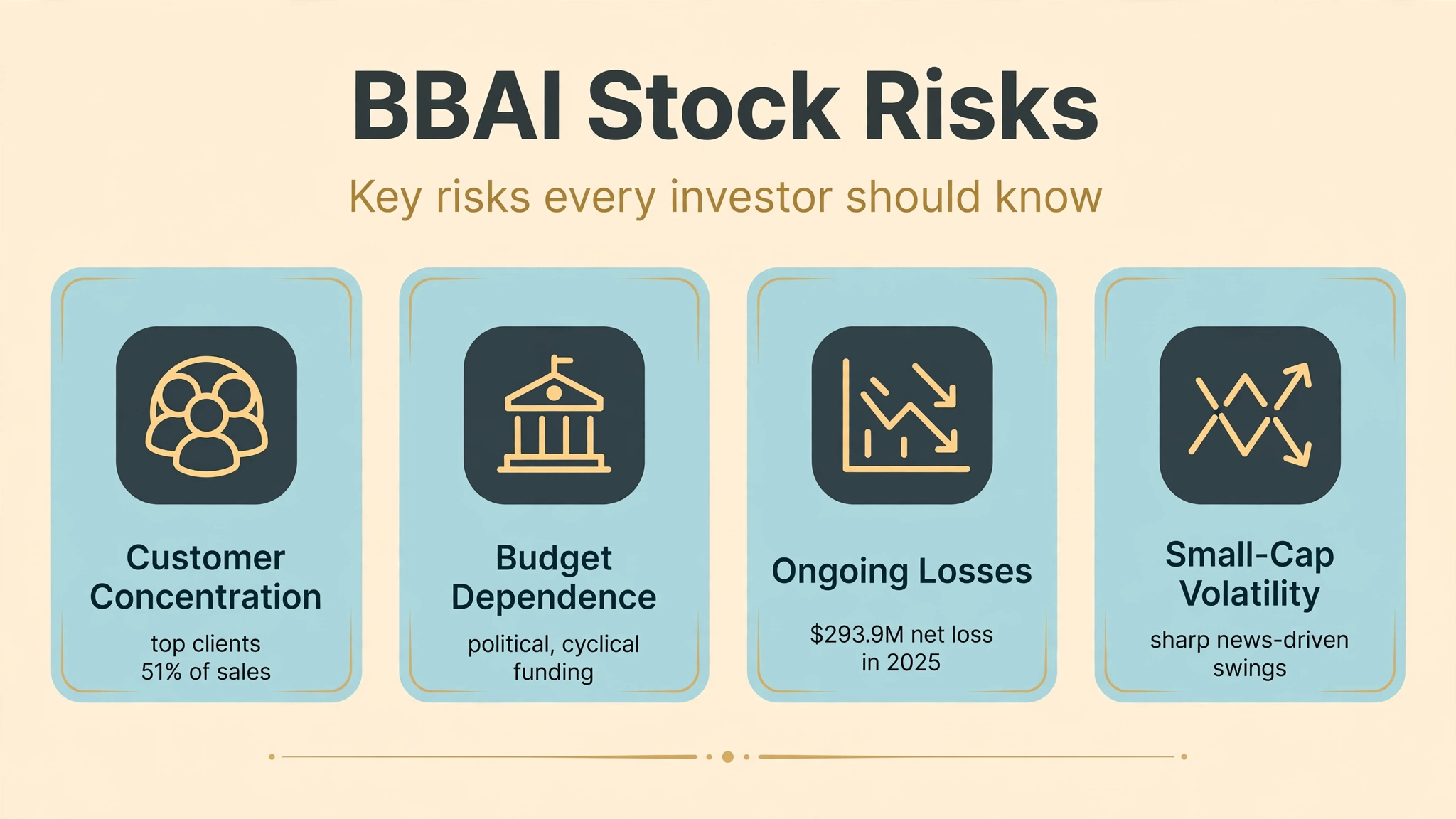
Customer concentration is the biggest structural risk. Clients representing more than 10 percent of revenue accounted for roughly 51 percent of total sales in 2025. Losing or seeing cuts at one or two major programs would hit results hard, and indeed lower volume on Army programs drove the 2025 revenue decline.
Government budget dependence cuts both ways. Federal spending on defense AI is growing, but it is political, cyclical, and subject to continuing resolutions, shutdowns, and shifting priorities. Contract recompetes can also compress margins.
Profitability is unproven. The company has posted large losses, burns cash, and is increasing spending to chase growth. The $410 million cash cushion helps, but sustained negative free cash flow is a risk if revenue growth stalls.
Competition is real. Large defense primes and well-funded AI startups all want the same federal AI budgets. BigBear.ai’s clearance depth and domain expertise are advantages, but they do not guarantee wins.
Finally, small-cap volatility means the stock can swing dramatically on news, dilution from capital raises, or lockup-related selling. This is not a stock for money you cannot afford to lose.
How to Buy BigBear.ai Stock
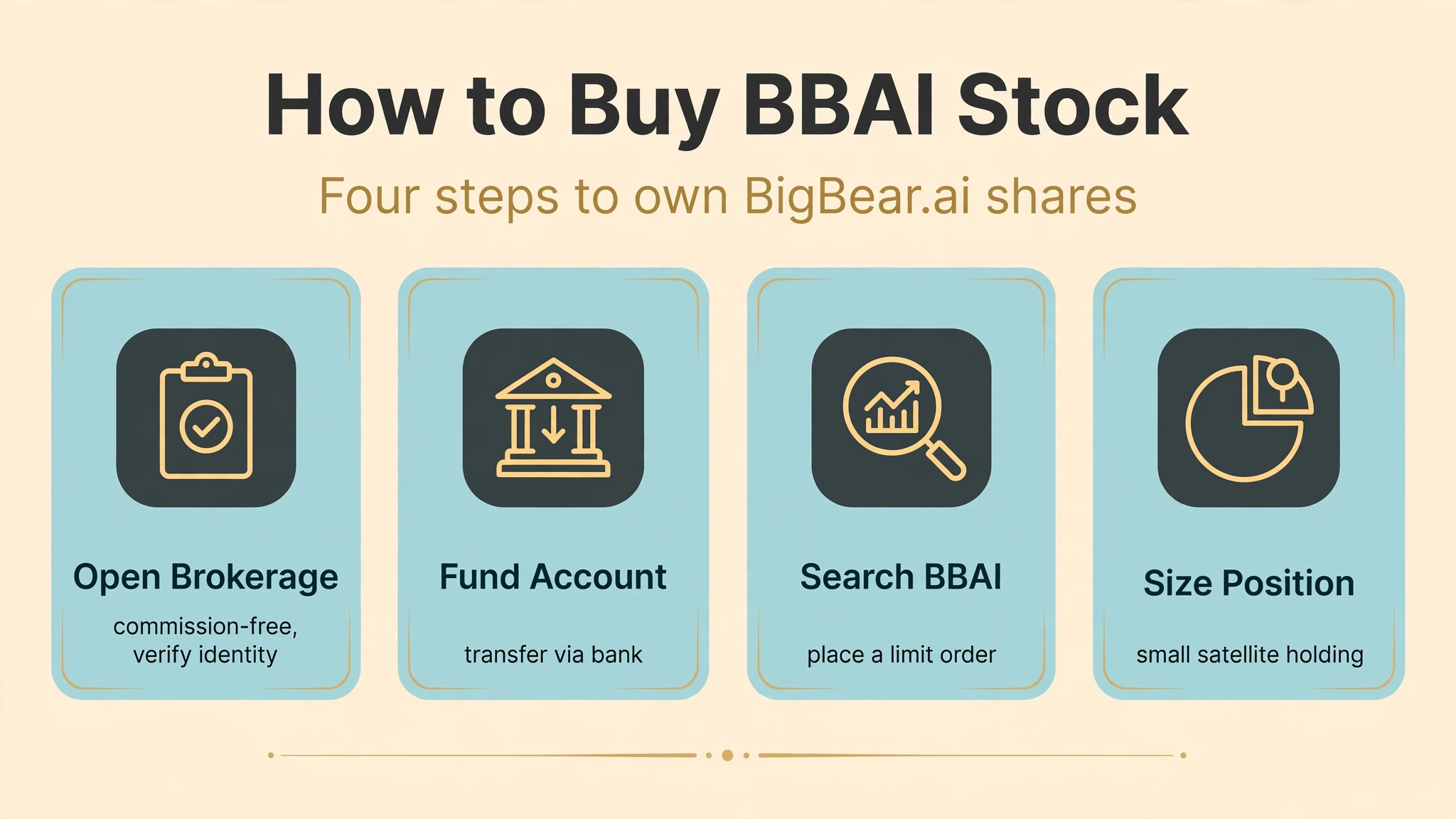
Buying BBAI is straightforward because it trades on the NYSE like any public stock. First, open a brokerage account if you do not have one. Most major brokerages offer NYSE-listed stocks with commission-free trading. You will need to complete identity verification, which usually takes a day or two.
Next, fund the account via bank transfer. Then search for the ticker symbol BBAI in your brokerage’s trade ticket. You can place a market order, which buys at the current price, or a limit order, which buys only at a price you specify. For a volatile small-cap like BBAI, limit orders are usually the smarter choice because they protect you from sudden price jumps between the quote and the fill.
Decide your position size before you buy. Given the volatility and the speculative nature of the story, many investors treat positions like this as a small satellite holding rather than a core position. Consider dollar-cost averaging, buying in smaller pieces over time, instead of going all in at once.
After buying, monitor quarterly earnings, contract announcements, and backlog trends rather than day-to-day price moves. The investment thesis lives or dies on the transition to profitable software revenue.
BigBear.ai vs Competitors
BigBear.ai operates in a crowded field. The large defense primes, including Lockheed Martin, Northrop Grumman, and Booz Allen Hamilton, all sell AI-flavored services to the same agencies, with far deeper balance sheets. Pure-play AI software firms like Palantir compete directly on the data-and-decisions pitch, though Palantir is far larger and already profitable.
Where BigBear.ai differentiates is focus. It is a smaller, more specialized player built around decision intelligence and secure generative AI deployment, rather than a sprawling contractor. Ask Sage has little direct equivalent among the primes, and ConductorOS targets the fast-growing autonomous systems niche.
The trade-off is scale and financial strength. Competitors can outspend BigBear.ai on R and D and absorb contract losses more easily. For investors comparing AI stocks, our Tempus AI stock guide covers a healthcare AI name with a similar high-growth, high-risk profile, while our SoundHound AI stock guide looks at another small-cap AI stock navigating the path to profitability.
Who Should Invest in BBAI
BBAI fits a narrow investor profile. It suits risk-tolerant investors who want small-cap exposure to defense AI, understand government contracting cycles, and can tolerate extended losses and sharp drawdowns. It works best as a small speculative position inside a diversified portfolio, not as a core holding.
It is a poor fit for conservative investors, income seekers, or anyone who needs liquidity on short notice. If you lose sleep over 20 percent single-day moves, this is not your stock. It is also unsuitable as a retirement-account centerpiece.
Before investing, ask yourself whether you believe in the specific thesis: that BigBear.ai can convert its federal relationships and products like Ask Sage into growing, higher-margin software revenue. If that transition stalls, the downside case is a shrinking services contractor with a volatile stock.
Recent Contract Wins and Backlog
The most encouraging recent data point is the contract momentum. Since July 2026, BigBear.ai has disclosed more than $225 million in contract awards across homeland security, defense, intelligence, and federal civilian agencies. The mix matters: over 25 awards were generative-AI specific, suggesting Ask Sage is gaining real traction.
Notable wins include work with U.S. Customs and Border Protection, the FBI, the U.S. Coast Guard, NASA, the Department of Energy, and the Department of Veterans Affairs, plus a contract with Naval Air Systems Command supporting AI applications for the Navy and Marine Corps. The company has also begun work inside classified intelligence frameworks.
Backlog of about $270 million gives forward visibility, though investors should note that only a portion of government backlog is typically funded at signing. Funded backlog, where Congress or the agency has actually set aside money, is the number that converts most reliably into revenue. Watch how funded backlog trends in coming quarters.
FAQs
What does BigBear.ai do?
BigBear.ai builds AI-powered decision-intelligence software for U.S. defense, intelligence, and homeland security agencies. Its products, including Ask Sage, ConductorOS, and CargoSeer, help operators turn data into forecasts, plans, and real-time decisions, alongside traditional mission services and engineering contracts.
Is BigBear.ai profitable?
No. The company reported a net loss of about $293.9 million in 2025 and continued to post quarterly losses into 2026. Management is investing in sales and R and D to grow its higher-margin software business, so profitability is not expected in the near term.
What is the BBAI ticker symbol and exchange?
BBAI is the ticker symbol, and the stock trades on the New York Stock Exchange. It went public in December 2021 through a SPAC merger with GigCapital4.
Who are BigBear.ai’s biggest customers?
U.S. federal agencies dominate the customer base, including Customs and Border Protection, the FBI, the Coast Guard, NASA, the Department of Energy, and the Department of Veterans Affairs. Clients representing over 10 percent of revenue made up about 51 percent of 2025 sales.
What is the biggest risk with BBAI stock?
Customer concentration and dependence on government budgets. A large share of revenue comes from a handful of federal programs, so funding cuts or lost recompetes can hurt results quickly. Combined with ongoing losses and small-cap volatility, the stock is high risk.
Conclusion
BigBear.ai is a genuine defense AI company with real products, real federal customers, and improving recent momentum, including 13 percent revenue growth and a $270 million backlog in mid-2026. The Ask Sage platform and the push into autonomous systems give it credible shots at the fastest-growing parts of the defense tech budget. For speculators who understand the space, it is one of the purer small-cap ways to bet on AI in national security.
But the risks are just as real: steep losses, heavy customer concentration, lumpy government revenue, and a stock that trades near its lows for a reason. Keep any position small, use limit orders, and judge the company on backlog conversion and margin progress, not headlines. This article is for research and education only and is not financial advice.
Discover More: