Healthcare is drowning in data, and Tempus AI is selling the lifeboats. Tempus AI, Inc. trades on the Nasdaq under the ticker symbol TEM: a healthcare technology company applying artificial intelligence and data analytics to precision medicine, mainly in cancer care.
We ran the numbers the way an investor would. The business has two engines: a diagnostics operation running genomic and molecular tests, and a data and software segment licensing clinical data to pharmaceutical companies. Recent quarterly revenue topped $380 million with growth above 20 percent, yet the company still reports GAAP losses and carries a premium valuation around $12 billion in market capitalization. With a beta well above 2, the stock is volatile.
This guide breaks down the business model, financials, growth drivers, risks, and how to buy, so you can decide if TEM fits a high-risk growth allocation. It is not financial advice.
Quick Answer
Tempus AI, Inc. trades on the Nasdaq under the ticker symbol TEM. It is a healthcare technology company that applies artificial intelligence and data analytics to precision medicine, mainly in cancer care. The business has two engines: a diagnostics operation that runs genomic and molecular tests, and a data and software segment that licenses clinical data to pharmaceutical companies. Recent quarterly revenue topped $380 million with growth above 20 percent, yet the company still reports GAAP losses and carries a premium valuation around $12 billion in market capitalization. The stock is volatile, with a beta well above 2, so it suits investors comfortable with high risk growth stories in healthcare technology.
What Is Tempus AI?
Tempus AI is a technology company focused on bringing artificial intelligence into everyday medical decision making. Founded in 2015 and headquartered in Chicago, it set out to fix a structural problem in healthcare: patient data is scattered across labs, hospitals, and records systems, making it hard for doctors to see the full picture. Tempus built a platform that aggregates clinical information, molecular data, and other health datasets, then applies AI models to help physicians choose better treatments.
Oncology is the company’s home turf. Cancer treatment increasingly depends on understanding a tumor’s genetic profile, and Tempus provides the genomic testing and analytics that make personalized treatment plans possible. Over time it has expanded into cardiology, neurology, and other data rich specialties, but cancer care remains the core.
What distinguishes Tempus from a typical diagnostics lab is the data flywheel at the center of its strategy. Every test it runs adds to one of the world’s largest libraries of clinical and molecular data. That data trains better AI models, which improve its products, which attract more physicians and hospital partners, which generate still more data. Pharmaceutical giants including AstraZeneca, Bristol Myers Squibb, GSK, Merck, and BioNTech have signed long term data agreements reportedly exceeding $100 million, betting that this dataset will accelerate drug development.
Tempus AI Stock Overview
Tempus AI, Inc. Class A common stock trades on the Nasdaq Stock Market under the ticker symbol TEM, in US dollars. It sits in the healthcare sector, specifically the life sciences tools and services industry, a group that includes diagnostics and lab service companies rather than drug manufacturers.
The stock is known for sharp moves. With a beta above 2, it tends to swing roughly twice as much as the broader market in either direction, and its 52 week trading range has stretched from the low 40s to the high 90s in dollar terms. Recent trading has put the shares in the low 70s, with a market capitalization in the low teens of billions. Because prices move constantly, always check a live quote before making any decision; figures in articles like this go stale fast.
Ownership is split between public shareholders and institutions, with institutional investors holding roughly a quarter of the stock. Analyst coverage is active, with published consensus price targets that investors can compare against the current quote.
Business Model
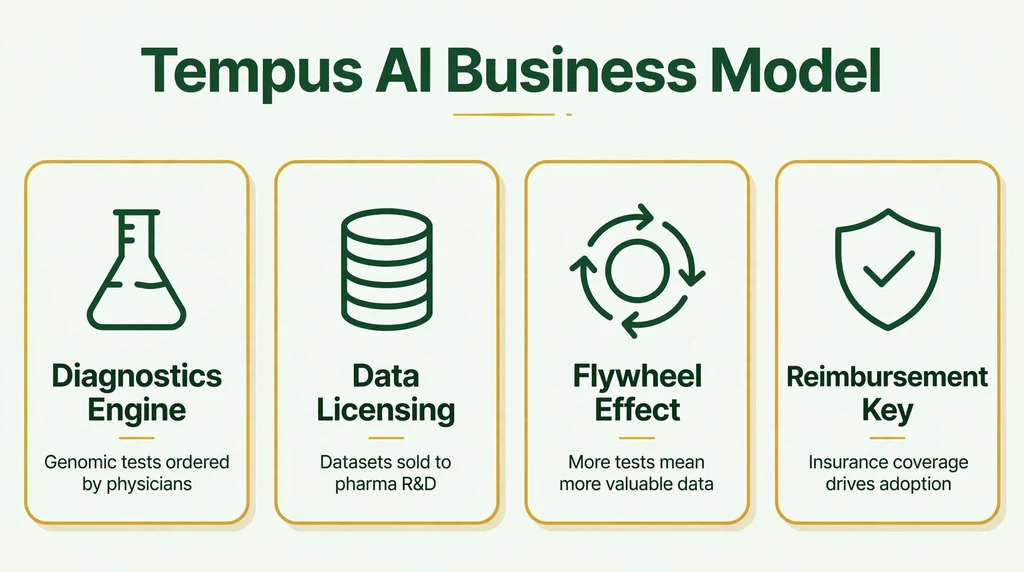
Tempus makes money in two complementary ways, and understanding both is key to evaluating the stock. The diagnostics business is the larger engine today: physicians order genomic and molecular tests, Tempus runs them in its labs, and it gets paid per test, largely through the healthcare reimbursement system. Growth here comes from higher test volumes, broader insurance coverage, and expansion into new clinical areas.
The second engine is data and applications. The same tests that serve patients also feed the company’s dataset, which it monetizes through data licensing to pharmaceutical companies, AI model development partnerships, and software sold to hospitals and researchers. This segment grows when pharma R and D budgets flow toward real world data and when Tempus signs new platform deals.
The strategic beauty of the model is that the two engines reinforce each other. More diagnostic volume means more data, which makes the data products more valuable, which funds expansion of the diagnostic footprint. Management calls this the flywheel, and recent results suggest it is spinning: both segments have been growing at rates above 20 percent.
Reimbursement is the quiet engine of the diagnostics side. When insurers cover a test, physicians order it freely; when coverage is uncertain, adoption stalls regardless of clinical value. Tempus has steadily expanded its covered test menu, and each new coverage decision effectively unlocks a fresh pool of addressable patients. Investors tracking the stock should watch payer policy updates as closely as they watch product launches, because reimbursement breadth translates almost directly into volume growth.
On the data side, the customer is not the patient but the pharmaceutical R and D organization. Drug developers pay for access to real world datasets that help them design trials, identify biomarkers, and rescue struggling programs. These are multi year enterprise contracts, which makes data revenue lumpier but also more predictable once signed. The reported 36 percent growth in data licensing and modeling suggests this motion is accelerating, not maturing.
Key Products and Services
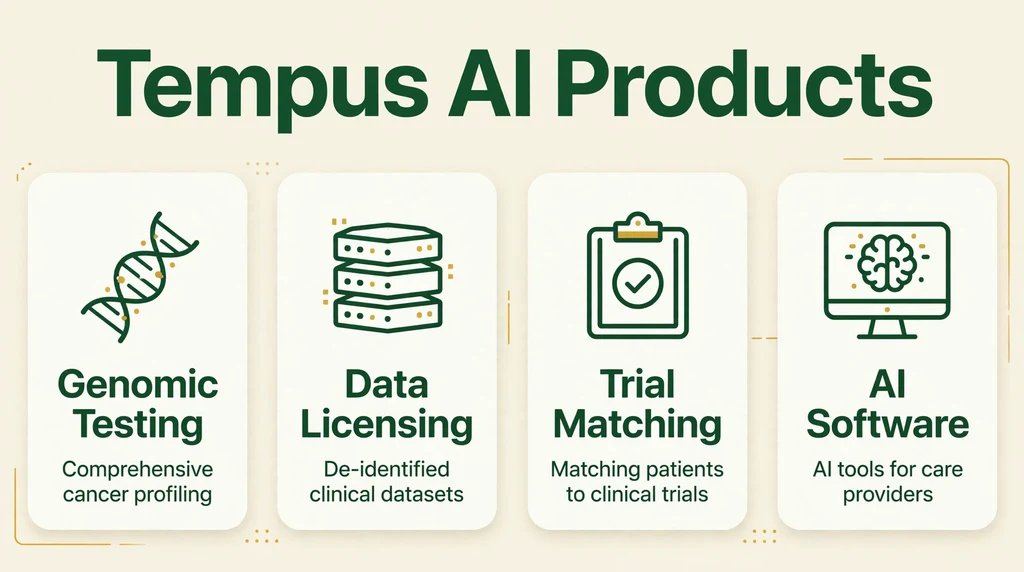
Tempus sells to physicians, hospitals, pharmaceutical companies, and researchers. Its offerings cluster into four groups.
Genomic Testing and Diagnostics
The flagship service is comprehensive genomic profiling for cancer patients: sequencing tumor DNA to identify mutations that guide therapy choices. The company also offers hereditary risk testing and molecular tests used across oncology practices. In the latest reported quarter, oncology testing volume grew about 31 percent, showing strong physician adoption.
Data Licensing and Insights Platform
Tempus licenses de identified clinical and molecular datasets to pharmaceutical and biotech companies for drug discovery and clinical trial design. Data licensing and modeling revenue recently grew around 36 percent, making it the fastest growing corner of the business, with significant total contract value added in recent quarters.
Clinical Trial Matching
Using its patient data, Tempus helps match eligible patients to clinical trials and helps sponsors find trial sites. This serves both sides of the research market: patients get access to experimental therapies, and pharma companies enroll studies faster.
AI Software for Providers
Beyond testing, Tempus sells software that brings its analytics into clinical workflows: decision support tools, real world evidence dashboards, and applications that help care teams act on molecular findings. This software layer deepens relationships with hospital systems beyond individual test orders.
Financial Highlights
The latest reported quarter showed revenue of about $382.5 million, up roughly 22 percent from the prior year period and slightly ahead of analyst expectations. Diagnostics contributed about $289.3 million of that total, while the data and applications segment added about $93.2 million, up 28 percent. Gross profit climbed roughly 26 percent to about $246.5 million, indicating the business is scaling efficiently.
Management raised full year guidance to revenue of $1.59 to $1.60 billion, implying roughly 25 percent annual growth, with expected adjusted EBITDA of about $65 million. Reaching positive adjusted EBITDA would be a meaningful milestone for a company long in investment mode.
The other side of the ledger matters too. Tempus still reports GAAP net losses, with a negative net margin near 18 percent and negative return on equity. Analysts forecast a full year loss per share around $1.38. The balance sheet shows solid liquidity, with current and quick ratios above 3, but also meaningful leverage, with a debt to equity ratio above 3. In short: fast growing, improving, but not yet profitable on a GAAP basis.
Cash flow trajectory is the number to watch next. Adjusted EBITDA approaching breakeven would signal that the growth engine is becoming self funding, reducing the need for future capital raises. Conversely, if losses widen while growth slows, the market will punish the shares quickly given the premium multiple. Quarterly earnings calls therefore matter enormously for this stock, often moving it double digits in a single session.
For context, compare the growth against the valuation: revenue compounding above 20 percent with gross margins in the mid 60s is an attractive profile, but a market capitalization near $12 billion already assumes years of that compounding continue. The stock is priced for execution, which means execution, not promises, is what will be rewarded from here.
What Drives the Tempus AI Stock
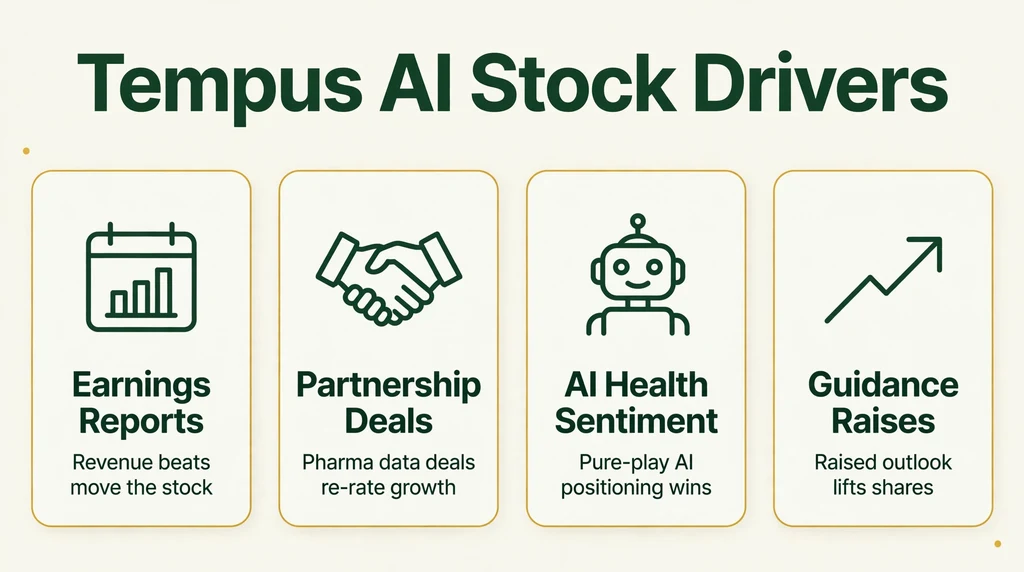
Several forces move TEM shares. Earnings reports are the biggest scheduled catalysts: the stock has reacted sharply to revenue beats, raised guidance, and progress toward profitability. Because expectations run high at a premium valuation, even good quarters can sell off if they merely meet forecasts.
Partnership announcements are the second driver. New data licensing deals with large pharmaceutical companies validate the data flywheel thesis and can re rate the stock’s growth assumptions. Expansion of test reimbursement coverage has a similar effect on the diagnostics side.
Broader sentiment toward AI in healthcare provides the backdrop. When investors are enthusiastic about applied AI with real revenue, TEM benefits disproportionately thanks to its pure play positioning. When sentiment sours on unprofitable growth, its high beta cuts the other way. Regulatory developments in genomic testing reimbursement and data privacy can also move the shares.
Risks to Consider
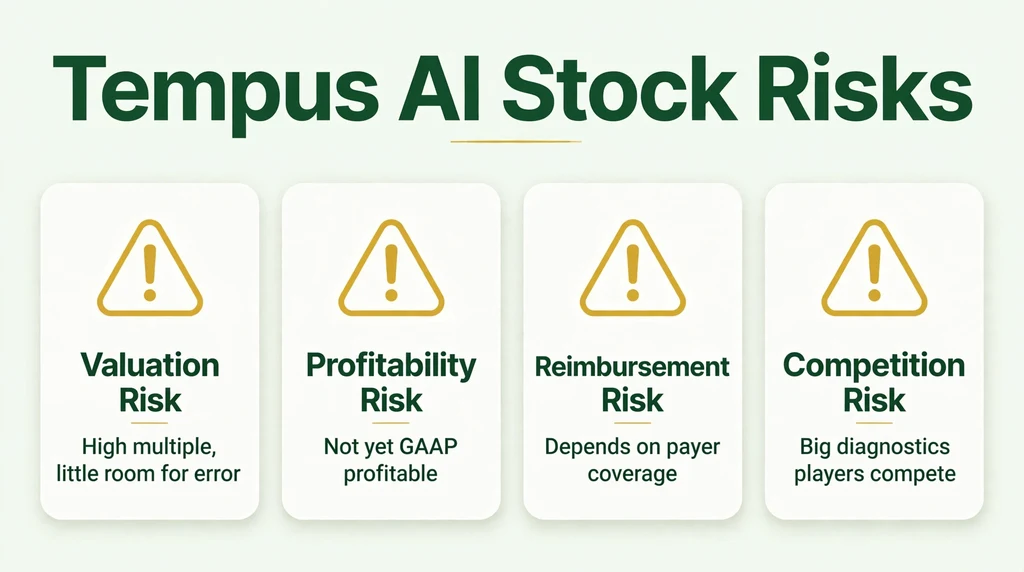
Every investment carries risk, and TEM has several worth weighing honestly.
- Valuation risk: a market capitalization near $12 billion against continuing GAAP losses leaves little room for disappointment. Any growth slowdown could compress the multiple hard.
- Profitability risk: the company is not yet GAAP profitable, and the path depends on sustaining high growth while controlling costs. Negative margins mean dilution or debt remain possible funding routes.
- Reimbursement risk: diagnostics revenue depends on payer coverage decisions. Changes in reimbursement rates or coverage policies would hit the core business directly.
- Competition risk: large diagnostics players and well funded AI health startups contest the same physician relationships and pharma partnerships.
- Data privacy risk: the business model rests on aggregating sensitive health data. Any breach or regulatory tightening around health data use would be damaging.
- Volatility risk: with a beta above 2 and a wide 52 week range, position sizing matters. This is not a sleep well at night holding.
Valuation methodology matters here. Traditional price to earnings ratios are useless for a loss making company, so analysts lean on enterprise value to revenue multiples and compare against high growth healthcare technology peers. On those metrics Tempus screens expensive, which is either justified by its data moat or a warning, depending on your view of how defensible that moat really is. There is no shortcut around forming your own judgment on the durability of the competitive advantage.
Management credibility is the final input. The team has consistently raised guidance and delivered beats in recent quarters, which builds trust. Sustaining that record through an economic downturn or a reimbursement setback would cement the premium; breaking it would invite a harsh re rating. Watch what they do, not just what they guide.
Tempus AI vs Competitors
Tempus competes on two fronts. In diagnostics, it faces established genomic testing companies with deep payer relationships and broad test menus. Tempus differentiates through its AI layer and the breadth of its dataset rather than through any single test.
In health data and AI, it competes with a mix of large technology firms, electronic health record vendors expanding into analytics, and specialized real world data companies. Few combine a scaled diagnostics operation with a data licensing business the way Tempus does, which is the core of the bull case: the flywheel is hard to replicate without both halves.
Against profitable healthcare giants, Tempus offers faster growth but far more risk. Against early stage AI drug discovery firms, it offers something rarer: hundreds of millions in current commercial revenue rather than promises tied to clinical trial outcomes. Investors should decide which trade they prefer before comparing multiples.
How to Buy Tempus AI Stock
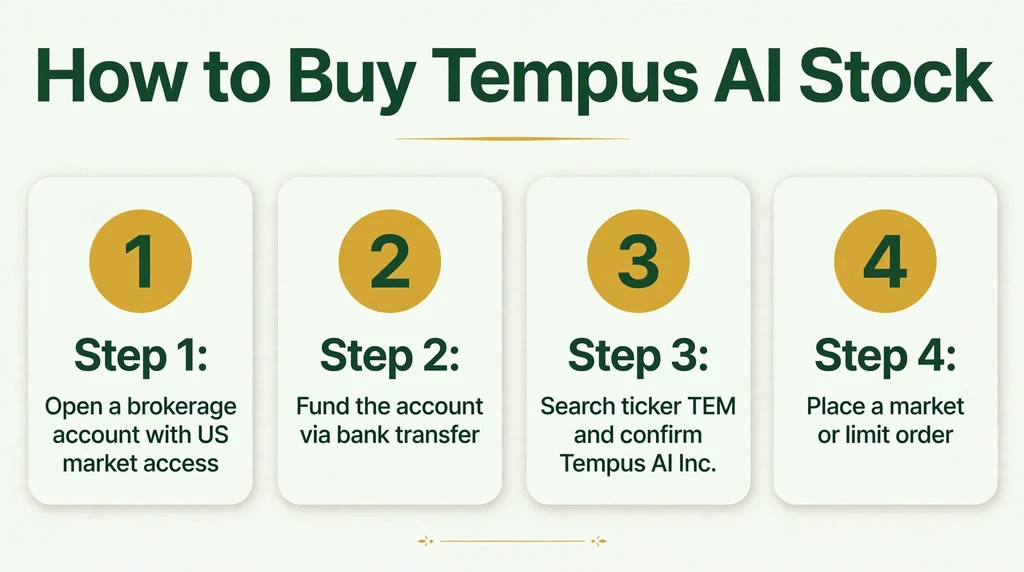
This is general educational information, not a recommendation to buy. The mechanics of buying any US listed stock are the same:
- Open a brokerage account that offers access to US exchanges and the Nasdaq. Compare fees, minimums, and available order types before choosing.
- Fund the account through your bank, keeping in mind settlement times and any currency conversion if you invest from outside the US.
- Search for the ticker symbol TEM and confirm you have the right security: Tempus AI, Inc. Class A common stock.
- Decide on an order type. A market order buys immediately at the current price, while a limit order only fills at your specified price or better, which helps in a volatile stock like this one.
- Choose a position size that fits your risk tolerance. Given the volatility, many investors size high beta positions smaller than their core holdings.
- Monitor quarterly earnings, guidance changes, and partnership news, since these are the primary drivers of the shares.
Consider tax implications in your jurisdiction and whether a retirement account structure suits your goals. When in doubt, speak with a licensed financial adviser.
Fractional shares deserve a mention because TEM trades at a price that may exceed a beginner’s budget for a single share. Most major brokerages now offer fractional investing, letting you buy a dollar amount rather than whole shares. This makes position sizing practical for any account size and removes the temptation to overconcentrate just to own “one share” of something.
Record keeping starts the day you buy. Note the date, price, share count, and your thesis for owning the stock. When earnings roll around, compare results against your original thesis, not against the market’s mood that day. Investors who document their reasoning make calmer decisions than those trading on headlines, especially in volatile names where headlines swing wildly.
Peer comparison sharpens the analysis. Line up Tempus against other high growth health tech names on revenue growth, gross margin, and enterprise value to sales. The exercise quickly shows whether the market prices Tempus as a diagnostics company, a data company, or something entirely new. Your answer to that classification question should drive which multiple you consider fair.
Scenario planning beats point forecasts for stocks like this. Sketch three paths: a bull case where data licensing accelerates and profitability arrives early, a base case of steady 20 percent growth with gradual margin improvement, and a bear case of reimbursement pressure and multiple compression. Assign rough probabilities and see whether the expected value justifies the current price. This discipline turns narrative into arithmetic.
Who Should Consider It?
Tempus AI stock fits a specific investor profile: someone who believes AI driven precision medicine is a durable growth theme, who is comfortable owning unprofitable companies during their scaling phase, and who can tolerate 30 to 50 percent drawdowns without panic selling. It works best as a satellite growth position rather than a portfolio core.
It is a poor fit for conservative investors, dividend seekers, or anyone who needs stable near term returns. If negative earnings, premium multiples, and reimbursement policy risk keep you up at night, the broader healthcare sector offers calmer alternatives with lower expected growth.
Reading the earnings call transcript, not just the headline numbers, separates serious investors from tourists. Management’s tone on guidance, the questions analysts choose to ask, and what gets emphasized versus glossed over all carry signal. Transcripts are free and take twenty minutes; for a stock this volatile, that is among the highest return activities available.
Finally, revisit the thesis on a schedule, not on emotion. Set a calendar reminder each quarter to re read your original investment case and score it against new facts. If the flywheel is spinning faster, the thesis strengthens. If growth decelerates while losses persist, have the discipline to reassess. Process beats prediction in investing, particularly with high beta growth stocks.
Frequently Asked Questions
1. What does Tempus AI do?
Tempus AI applies artificial intelligence and data analytics to precision medicine. It runs genomic and molecular diagnostic tests, mainly for cancer patients, and licenses its vast clinical dataset and AI software to pharmaceutical companies and researchers.
2. What is the ticker symbol for Tempus AI stock?
Tempus AI trades on the Nasdaq Stock Market under the ticker symbol TEM. Always confirm the ticker in your brokerage platform before placing an order, since similar symbols exist.
3. Is Tempus AI profitable?
Not on a GAAP basis. The company reports net losses, though losses per share have been shrinking and management guides toward positive adjusted EBITDA. Profitability remains the key milestone investors are watching.
4. Why is Tempus AI stock so volatile?
A combination of high growth expectations, a premium valuation, ongoing losses, and a beta above 2 makes the shares swing sharply on earnings, guidance changes, and shifts in sentiment toward AI healthcare stocks.
5. Does Tempus AI pay a dividend?
No. Like most high growth technology companies, Tempus reinvests its cash into expansion rather than paying dividends. Investors here are betting on price appreciation, not income.
Final Thoughts
Tempus AI is one of the purest public plays on AI in healthcare, with real commercial revenue, a genuinely differentiated data asset, and growth rates most companies would envy. The question for investors is whether the current valuation already prices in that bright future, given continuing losses and a volatile share price. Do your own research, check live quotes, size any position for the volatility, and remember that this article is educational content, not financial advice.
For analyst sentiment and price target data, see this Tempus AI analyst overview. For a deeper dive into the revenue story, read this breakdown of Tempus AI’s quarterly results.