Voice AI is booming, but the stocks are not all winners. SoundHound AI, Inc. trades on the Nasdaq under the ticker symbol SOUN: a voice artificial intelligence company whose technology lets people talk to cars, restaurant ordering systems, and enterprise customer service agents.
We examined the financials behind the hype. The business is growing fast, with quarterly revenue up about 45 percent to roughly $62 million, driven by automotive partnerships and its OASYS agentic AI platform. But the stock has fallen more than 60 percent over the past year, the company still posts significant net losses, and the valuation remains demanding. It is a high-risk, high-potential story suited only to investors comfortable with volatility.
In this guide we cover the business model, products, financials, key risks, and how to buy shares. As always, this is research, not financial advice.
Quick Answer
SoundHound AI, Inc. trades on the Nasdaq under the ticker symbol SOUN. It is a voice artificial intelligence company whose technology lets people talk to cars, restaurant ordering systems, and enterprise customer service agents. The business is growing fast, with quarterly revenue up about 45 percent to roughly $62 million, driven by automotive partnerships and its OASYS agentic AI platform. But the stock has fallen more than 60 percent over the past year, the company still posts significant net losses, and the valuation remains demanding. It is a high risk, high potential story suited only to investors comfortable with volatility.
What Is SoundHound AI?
SoundHound AI began life as a music recognition app, the company behind the SoundHound song identifier that competed with Shazam. Over time, management pivoted the underlying speech technology toward a bigger opportunity: conversational voice AI for businesses. Today the company builds voice assistants and AI agents that companies embed in their own products, from cars to drive thru lanes to customer service phone lines.
The core idea is that voice becomes the interface. Instead of tapping through menus, a driver asks the car for directions, a diner orders by speaking at the drive thru, and a caller resolves a support issue by talking to an AI agent. SoundHound provides the speech recognition, natural language understanding, and dialogue management that make those interactions work.
A key technical distinction is that SoundHound built its own proprietary foundational speech recognition model rather than licensing one from a large lab. Management argues this independence gives it an edge in accuracy, latency, and cost for real time voice applications, and it avoids dependence on third party providers for its core technology.
SoundHound AI Stock Overview
SoundHound AI, Inc. common stock trades on the Nasdaq Stock Market under the ticker symbol SOUN, in US dollars. It is classified in the technology sector and is widely followed as a voice AI pure play, one of the few public companies focused almost entirely on conversational artificial intelligence.
The shares are famously volatile. After averaging strong annual gains over a multi year stretch, the stock has fallen steeply over the past year, declining more than 60 percent, with the 52 week range stretching from under $5 to above $22. Recent trading has put the shares under $5, with a market capitalization around $2 to $3 billion. Prices change by the minute in a name like this, so always check a live quote; any figure in an article is a snapshot, not a promise.
Trading volume is heavy, reflecting intense retail and speculative interest. The stock’s beta sits near 2.8, meaning it typically moves almost three times as much as the broader market, in both directions.
Business Model
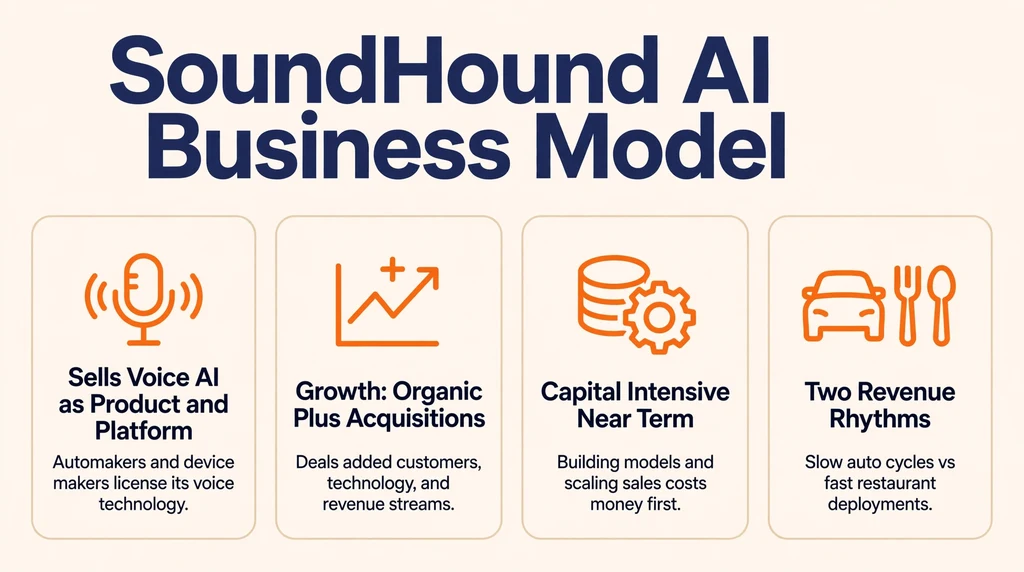
SoundHound makes money by selling voice AI as a product and a platform. Automakers and device manufacturers license its voice assistant technology, often on a per unit or per vehicle basis, embedding it in infotainment systems. Restaurant chains pay for automated ordering systems that take orders by voice in store, over the phone, and at the drive thru. Enterprises subscribe to its agent platform to handle customer service calls and transactions.
Growth has come partly organically and partly through acquisitions. Deals have added customer relationships, technology, and revenue streams, including the recently completed acquisition of LivePerson, which brought access to customers including 25 Fortune 100 companies. The strategy is to land marquee logos, prove the technology in demanding real world environments, and then expand within those accounts.
The model is capital intensive in the near term: building foundational models, integrating with automakers, and scaling enterprise sales all cost money before revenue follows. That is why losses persist even as the top line grows at a 45 percent clip.
The automotive sales cycle deserves attention because it shapes how revenue arrives. Carmakers qualify suppliers years before production, then pay per vehicle as models ship. This creates a long lead time between winning a program and seeing meaningful royalties, but also highly visible, durable revenue once vehicles are on the road. Investors should therefore judge automotive wins on a multi year horizon, not the next quarter.
Restaurants work on the opposite rhythm: deployments are fast and ROI is measurable within months through labor savings and order accuracy. That is why the White Castle and Panda Express references matter; they are proof that the technology survives contact with real customers at scale. Enterprise deals sit in between, with six to twelve month sales cycles typical for large organizations.
Key Products and Services

SoundHound’s offerings cluster around voice interaction across industries.
OASYS Agentic Platform
OASYS, the Orchestrated Agent System, is the company’s enterprise platform for building custom AI voice agents. It lets businesses deploy agents that handle customer inquiries, process transactions, and assist employees across voice, web, mobile, SMS, and social channels. Management is pushing OASYS into IoT, automotive, and voice commerce, aiming to make it the default way enterprises build conversational agents.
In Car Voice Assistants
Automotive is the flagship vertical. Hyundai and Stellantis use SoundHound’s systems in production vehicles, and the company recently launched real time generative voice AI in Kia’s Sorento in India, described as a global first for conversational hands free in car assistance. The vision extends to voice commerce, turning connected cars into transaction points.
Restaurant Ordering Automation
Chains including White Castle and Panda Express use SoundHound’s technology to take orders autonomously in store, over the phone, and at the drive thru. The pitch to operators is order accuracy, labor savings, and upselling consistency, and restaurants are a proven, revenue generating deployment.
Enterprise Customer Service Agents
Following the LivePerson acquisition, SoundHound can offer conversational AI across the full customer service stack. A 7 figure deal with a large healthcare system covering tens of thousands of employees shows the platform moving beyond its automotive and restaurant roots into new verticals.
Financial Highlights
The latest reported quarter delivered record revenue of about $61.9 million, up roughly 45 percent year over year. Management raised full year revenue guidance to a range of $230 to $260 million, with a midpoint around $245 million, and is targeting $350 to $400 million in the following year, implying growth above 50 percent at the midpoint.
The losses remain substantial. The company reported a GAAP net loss of about $42.8 million in the quarter and burned through nearly $60 million in operating cash in the first half of the year. There is no dividend, and profitability is not yet in sight on a GAAP basis.
Valuation has compressed dramatically. The price to sales ratio has fallen to around 12, down from about 90 a couple of years ago and near 27 more recently. That is still a steep multiple for a loss making company, but it is far cheaper than the euphoric peaks. The balance sheet question investors keep asking is how long the cash runway lasts at the current burn rate.
Unit economics are the missing piece analysts keep asking about. The company discloses revenue growth but limited detail on margins per vertical, cost per deployment, or payback periods. Until that disclosure improves, the stock will trade more on narrative and momentum than on fundamentals, which explains both the spectacular rallies and the brutal drawdowns.
Compare the cash position against the burn: with roughly $60 million in operating cash consumed in a half year, the runway question is legitimate and recurring. Management will likely need to demonstrate a credible path to breakeven, or secure additional capital, within the next several quarters. How that funding arrives, through operations, debt, or equity, will matter enormously for existing shareholders.
What Drives the SoundHound AI Stock

Revenue growth is the primary bull fuel: 45 percent top line expansion with raised guidance is the kind of print that can spark rallies in beaten down growth stocks. New logo announcements, especially with major automakers or large enterprises, validate the platform and move the shares.
The LivePerson acquisition is a second driver, for better or worse. Bulls see accelerated enterprise distribution and cross selling; bears see integration risk and a bigger cash burn. How the combined company executes over the next few quarters will shape sentiment.
Automotive deployment milestones matter disproportionately because cars are the highest visibility proof point. The Kia launch generated attention, though analysts noted limited detail on near term revenue, so investors want evidence that these deployments convert into material financial results.
Finally, broad AI sentiment and the speculative appetite of the market set the ceiling. SOUN is a classic high beta AI trade: it soars when risk appetite is strong and craters when it fades, largely independent of quarterly fundamentals in the short run.
Risks to Consider
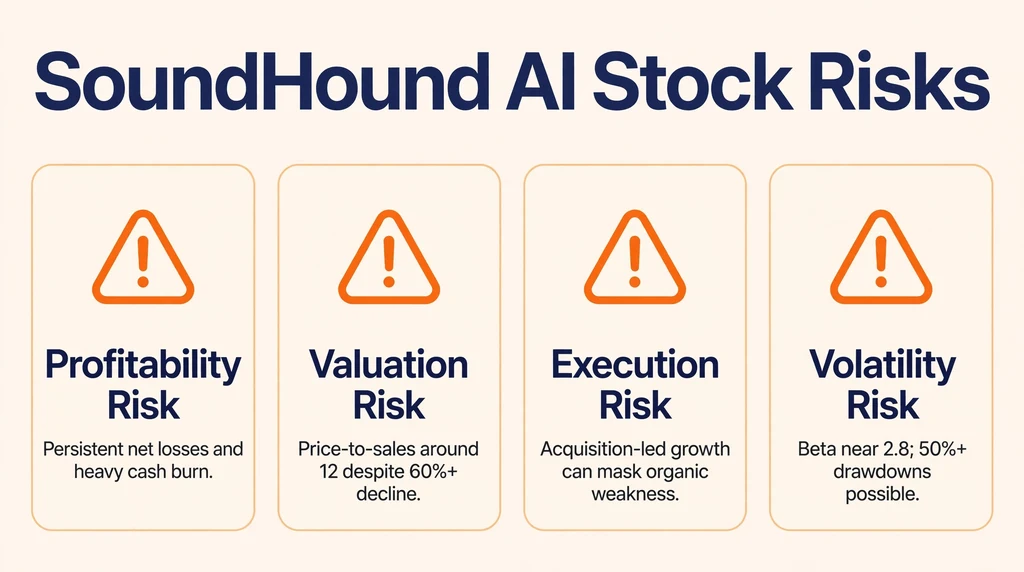
- Profitability risk: persistent net losses and heavy operating cash burn raise questions about the funding runway and potential future dilution.
- Valuation risk: even after a 60 percent plus decline, a price to sales ratio around 12 is demanding for a company with negative cash flow.
- Execution risk: growth has leaned on acquisitions, and integrating LivePerson while scaling OASYS is a complex task. Acquisition led growth can mask organic weakness.
- Customer concentration and deployment risk: automotive programs take years to ramp, and limited disclosure on unit economics makes it hard to verify returns.
- Competition risk: Cerence is a formidable rival in automotive voice AI with deep manufacturer relationships, and large tech platforms could squeeze the space.
- Volatility risk: a beta near 2.8 and a history of 50 percent plus drawdowns mean position sizing is critical. This stock can halve on sentiment alone.
Technology risk cuts both ways. SoundHound’s independent speech model is a differentiator today, but foundation models are improving at a blistering pace across the industry. If general purpose voice models from large labs become good enough and cheap enough, the premium for a specialized provider compresses. The counterargument is that real time, low latency, domain tuned voice remains genuinely hard, and specialization keeps winning in embedded environments like cars.
Partnership risk is subtler. Landing Hyundai, Stellantis, and Kia looks impressive, but automakers are demanding customers with long memories; a single failed rollout can freeze a relationship for a model cycle. Diversification across restaurants, healthcare, and enterprise helps, yet automotive remains the flagship proof point the market watches most closely.
SoundHound AI vs Competitors
In automotive voice AI, the direct rival is Cerence, which offers generative AI powered in car assistants with long standing manufacturer relationships and both embedded and cloud deployment options. SoundHound counters with its independent speech model and newer agentic platform, but Cerence’s incumbency is a real moat.
In enterprise conversational AI, SoundHound now competes with a crowded field of contact center software vendors and AI agent startups, many backed by large tech companies. The LivePerson customer base is its wedge: 25 Fortune 100 relationships are hard to build from scratch.
Against the hyperscalers, SoundHound’s independence is both its pitch and its vulnerability. It does not depend on OpenAI or Anthropic for its core models, which appeals to customers wary of vendor lock in, but it also lacks their balance sheets and distribution. Investors should weigh whether independence is a durable edge or a scale disadvantage.
How to Buy SoundHound AI Stock
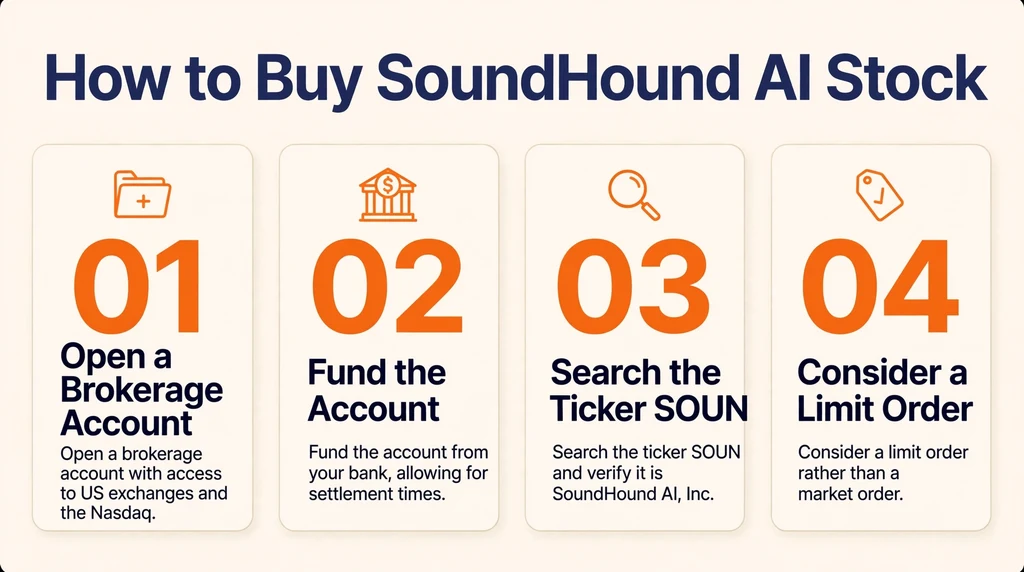
This is general educational information, not a recommendation to buy. The process for buying any US listed stock is standard:
- Open a brokerage account with access to US exchanges and the Nasdaq. Compare commissions, minimums, and order types.
- Fund the account from your bank, allowing for settlement times and any currency conversion fees if you invest from abroad.
- Search for the ticker symbol SOUN and verify it is SoundHound AI, Inc. before proceeding.
- Consider a limit order rather than a market order. In a volatile stock that can swing several percent intraday, limit orders protect you from bad fills.
- Size the position for the risk. High beta names like this one deserve smaller allocations than core holdings for most investors.
- Follow quarterly results, guidance updates, and major partnership announcements, since these drive the shares more than anything else.
Check the tax treatment in your country and consider whether a tax advantaged account fits. For personalized guidance, consult a licensed financial adviser.
Dollar cost averaging is a common approach for volatile names like this: buying a fixed amount on a schedule rather than timing a single entry. It does not guarantee profits, but it prevents the classic mistake of going all in at a local top. Whatever the method, decide your exit criteria in advance, whether a price target, a time horizon, or a fundamental milestone like sustained profitability.
Finally, keep this position in perspective within your portfolio. A stock that can fall 60 percent in a year should represent a fraction of your assets that you can afford to lose entirely. The upside case is real, but so is the downside, and honest sizing is what separates speculation from recklessness.
Options activity can offer clues about positioning, since SOUN’s heavy retail following generates significant options volume. Unusual call buying sometimes precedes news, while heavy put buying can signal hedging by nervous longs. Retail investors should treat options flow as sentiment data, not as a timing signal, and most should avoid trading options on a stock this volatile unless they fully understand the risks.
Insider transactions are worth monitoring too. Executives selling into strength is normal and often pre scheduled, but cluster selling or sudden buying can be informative at the margin. Free SEC filing alerts make this easy to track without effort, and over time a pattern emerges that either supports or undermines confidence in management’s own outlook.
Technical analysis has limited but real utility here. With fundamentals this uncertain, price action itself becomes information: breakouts on heavy volume sometimes precede news, while repeated failures at the same resistance level tell you where supply overwhelms demand. Use charts to time entries and manage risk, never as a substitute for understanding the business.
News flow cadence is worth tracking too. SoundHound tends to move on partnership announcements and auto show demos, which cluster around industry events. Knowing the calendar of automotive and tech conferences helps you anticipate when headlines are likely, so you are positioned thoughtfully rather than chasing spikes after they happen.
Who Should Consider It?
SoundHound AI suits speculators and growth investors who believe voice AI becomes a primary computing interface and who can stomach 50 percent drawdowns. It works as a small, high conviction satellite position for portfolios that already have a stable core.
It does not suit conservative investors, income seekers, or anyone who loses sleep over cash burn and dilution risk. If you need earnings visibility and steady compounding, look to profitable technology leaders instead. Never invest money you cannot afford to lose in a name this volatile.
Frequently Asked Questions
1. What does SoundHound AI do?
SoundHound AI builds voice artificial intelligence for businesses. Its technology powers in car voice assistants, automated restaurant ordering, and enterprise customer service agents, all built on its proprietary speech recognition models and the OASYS agentic platform.
2. What is the ticker symbol for SoundHound AI stock?
SoundHound AI trades on the Nasdaq under the ticker symbol SOUN. Verify the symbol in your brokerage app before trading, as similar tickers exist in the market.
3. Is SoundHound AI profitable?
No. The company reports GAAP net losses each quarter and burns significant operating cash. Revenue is growing around 45 percent annually, but profitability remains distant, which is the central bear case on the stock.
4. Why has SoundHound AI stock fallen so much?
A mix of valuation compression, persistent losses, cash burn concerns, acquisition integration questions, and fading speculative appetite has driven the shares down more than 60 percent over the past year, even as revenue kept growing.
5. Does SoundHound AI pay a dividend?
No. The company reinvests all available cash into growth, technology development, and acquisitions. Like most unprofitable growth stocks, it offers no income; any return would have to come from share price appreciation.
Write down your sell discipline before you buy. Some investors use price targets, others use time horizons, and others use fundamental triggers like two consecutive quarters of missed guidance. Any of these beats the default alternative, which is holding through a 60 percent drawdown while hoping. Hope is not a strategy, but a written plan is.
Revisit the position size as the stock moves. A 2 percent position that triples becomes a 6 percent position, which may be more risk than you intended. Rebalancing winners back to target weights is unglamorous and effective, the kind of discipline that compounds over years while excitement compounds over days.
Final Thoughts
SoundHound AI has real technology, real customers, and real revenue growth, which is more than many speculative AI stocks can claim. The problem is price and patience: the market already knows the story, the losses are large, and the path to profitability is foggy. If voice AI fulfills its promise and SoundHound executes on OASYS and LivePerson, today’s depressed valuation could look cheap in hindsight. If not, the cash burn will keep weighing. Research thoroughly, check live prices, keep positions small, and remember this is education, not financial advice.
For a balanced bull and bear discussion, see this analysis of SoundHound AI’s investment case. For the latest on its platform expansion, read this report on the OASYS platform push.