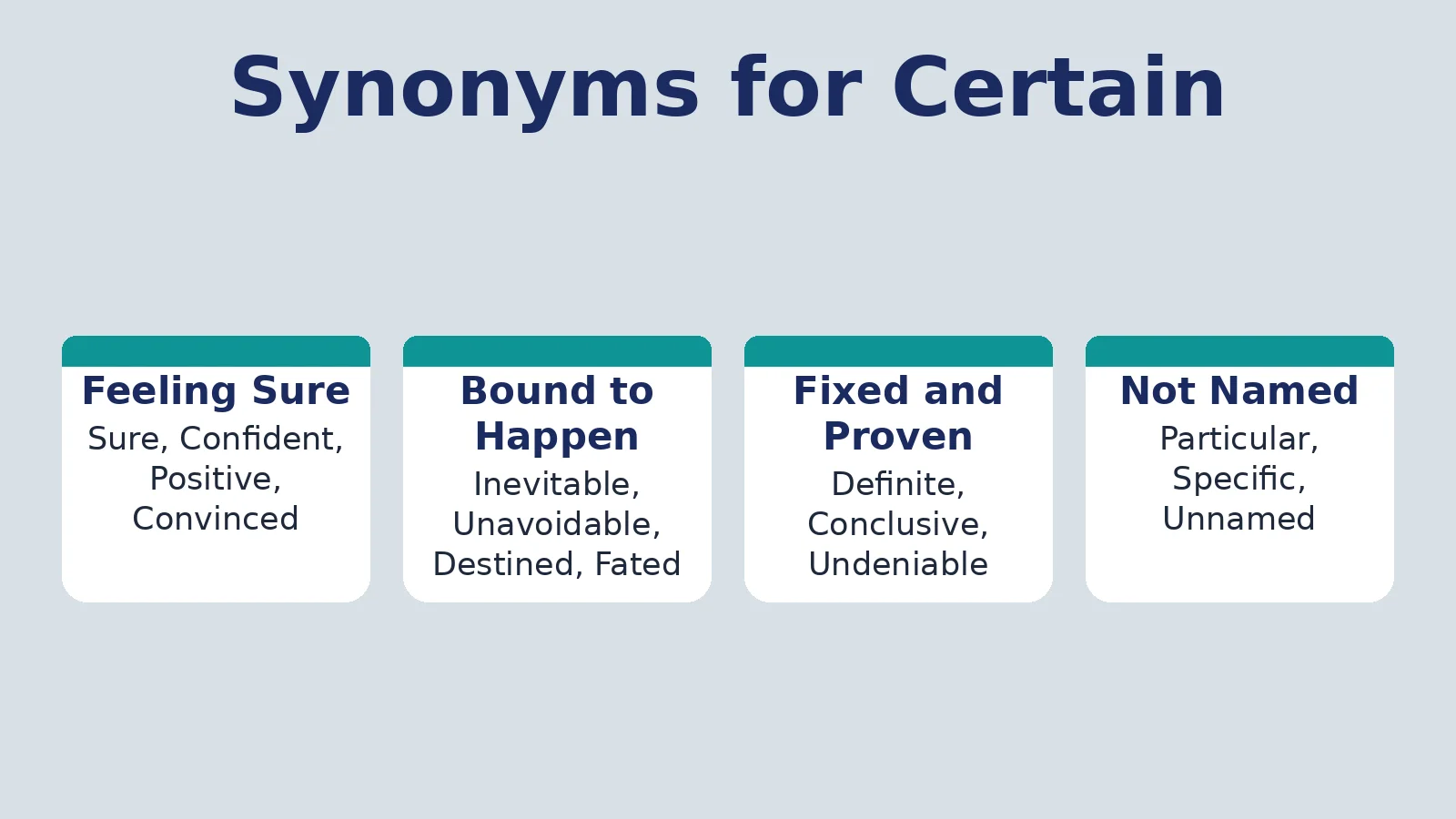
Certain looks like one simple word, yet it quietly does six different jobs in English. You can feel certain about a fact, call an outcome certain to happen, or mention a certain person you never name. The strongest synonyms for certain include sure, confident, positive, convinced, assured, inevitable, unavoidable, definite, conclusive, undeniable, and surefire. Each one fits a different job, though, so the sense always decides the best choice.
This guide sorts more than 90 synonyms for certain by meaning, not by guesswork. Every group comes from real thesaurus entries, and every key word carries a short gloss. Helpful examples then show how the word behaves inside a real sentence. As a result, you can replace certain with confidence instead of hope.
Top Synonyms for Certain: Quick Reference
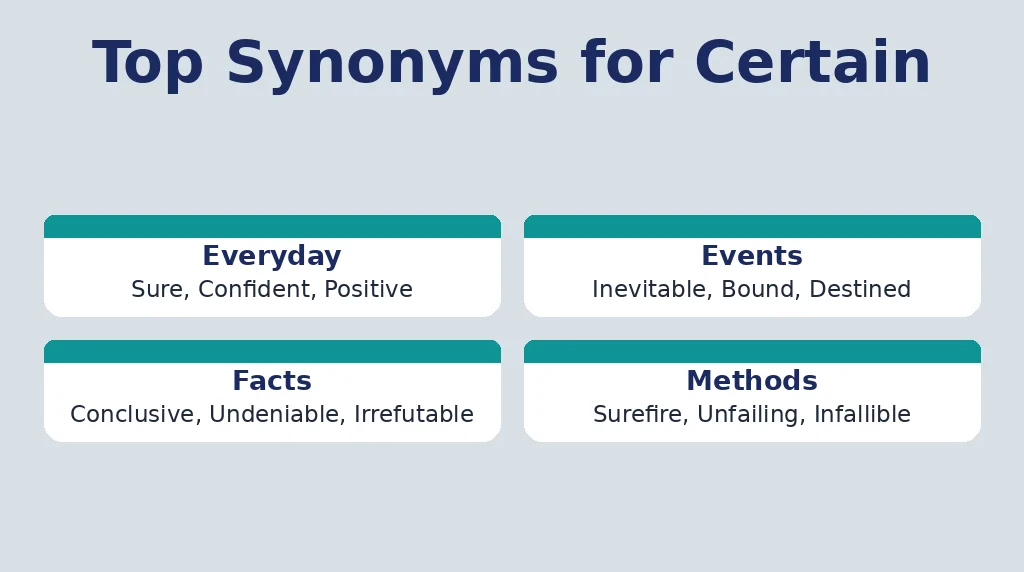
The table below covers the 28 synonyms readers reach for most often. Use it for one fast replacement. Later sections sort the full list into finer groups by sense.
| Word | Meaning in one line | Best for |
|---|---|---|
| Sure | Free from doubt, the everyday default | Speech and general writing |
| Confident | Strongly believing something is true | People, teams, interviews |
| Positive | Emphatic, with no doubt at all | Strong claims, answers |
| Convinced | Persuaded by reasons or evidence | After seeing proof |
| Assured | Confident, calm and guaranteed | Formal tone, promises |
| Doubtless | Without any doubt, rather formal | Essays, formal prose |
| Inevitable | Impossible to avoid | Events, consequences |
| Unavoidable | Cannot be prevented or escaped | Reports, warnings |
| Bound | Certain to happen or to do something | Speech, “bound to fail” |
| Destined | Meant to happen, as if planned | Stories, fate, careers |
| Fated | Decided by fate, often negative | Literature, drama |
| Definite | Clear, fixed and not vague | Answers, plans, amounts |
| Fixed | Set in place and not changing | Prices, dates, rules |
| Settled | Decided and no longer argued about | Agreements, questions |
| Specific | Exact and clearly named | Details, requirements |
| Stipulated | Stated as a condition in an agreement | Contracts, legal writing |
| Conclusive | Proving something beyond argument | Evidence, research |
| Undeniable | Impossible to deny honestly | Facts, talent, success |
| Indisputable | Beyond dispute or challenge | Facts, records |
| Incontrovertible | Cannot be argued against | Formal evidence writing |
| Irrefutable | Impossible to prove wrong | Arguments, logic |
| Unequivocal | Clear, with only one meaning | Statements, support |
| Unmistakable | Impossible to mistake for anything else | Signs, sounds, smells |
| Surefire | Certain to succeed, informal | Plans, methods, tips |
| Unfailing | Never failing or running out | Support, supplies, cures |
| Infallible | Never wrong or never failing | Methods, memory, judgment |
| Particular | One specific person or thing | “A certain person” sense |
| Unnamed | Known but deliberately not named | Reports, polite vagueness |
What Does Certain Mean?
Certain is an adjective, and dictionaries split it into a handful of clear senses. The everyday sense describes a person whose mind is free from doubt. When you feel certain about something, you believe it fully. Police can feel certain about a suspect, and a student can feel certain about an answer.
A second sense points forward in time. An event that is certain to happen cannot be stopped or avoided. Taxes, deadlines and the effects of aging all belong here. A third sense covers things already fixed. A certain percentage, a certain number of days, or a certain sum of money is set and settled, not guessed.
Two senses deal with proof and reliability. Certain evidence cannot be proved wrong, and a certain cure is one that does not fail. Finally, the oldest everyday sense names something known but unnamed. A certain person told you, or a certain place sells it, and both speaker and listener understand why no name appears.
Knowing the sense matters because synonyms rarely cross between them. Convinced describes a person, never a price. Fixed describes a price, never a feeling. The groups below keep each sense in its own lane, so your replacement always fits.
The adverb certainly deserves one quick note as well. It means without doubt, and polite speech uses it as a warm yes. “Certainly, I can help” sounds more gracious than a bare yes. Writers sometimes lean on it too hard, though. Three certainlys in one paragraph weaken each other, so one strong placement beats a scattered handful every time.
Convinced and Confident: Certain About Something

This is the sense most readers mean. A person hears the facts, weighs them, and ends up with no doubt left. Cambridge groups these words under “certain about something”, and Collins calls the sense “positive and confident about something”. The words below run from everyday choices to the strongest, most formal claims.
Everyday Words for Feeling Certain
These options sound natural in speech, messages and most writing. Start here when the tone is neutral.
- Sure: free from doubt, the simplest and most general word of all. Example: I am sure the shop closes at nine.
- Confident: strongly believing that something is true or will go well. Example: She felt confident that the treatment would work.
- Positive: emphatic, with no room for doubt in the answer. Example: “Are you positive you locked the door?” “Completely positive.”
- Convinced: won over by reasons, arguments or evidence. Example: The jury seemed convinced by the final witness.
- Assured: calm and confident, or guaranteed by someone reliable. Example: He spoke in an assured voice throughout the interview.
- Satisfied: convinced after checking, often in formal or official contexts. Example: The inspectors were satisfied that the bridge was safe.
Stronger and More Formal Words
When plain sure feels too weak, these words raise the force. Several of them suit essays, speeches and careful reports better than chat.
- Doubtless: without any doubt, a formal way to say certainly true. Example: The old bridge will doubtless need repairs soon.
- Self-assured: calmly confident in your own judgment or ability. Example: The young pianist gave a self-assured performance.
- Self-confident: believing in yourself, a close partner of self-assured. Example: Years of practice made her quietly self-confident.
- Unwavering: never weakening or changing, like a steady flame. Example: His support for the team stayed unwavering all season.
- Unquestioning: accepting without asking for proof. Example: The dog showed unquestioning trust in its owner.
- Unfaltering: never hesitating or losing strength. Example: She climbed with slow, unfaltering steps.
- Unhesitating: acting or answering with no pause at all. Example: His unhesitating reply surprised the panel.
- Resolute: firm and determined once the mind is made up. Example: The mayor stayed resolute about the new plan.
- Decisive: showing that a decision is final, or proving a result. Example: Her decisive answer ended the debate.
- Clear: free from doubt in phrases like “I am clear that…” Example: I am clear that we agreed on May, not June.
- Implicit: complete and without reserve, usually in “implicit trust”. Example: She placed implicit trust in her surgeon.
Too Certain: When Confidence Tips Over
Two listed synonyms carry a warning label. They describe certainty, but they criticize the person who feels it.
- Cocksure: so certain that it becomes careless and annoying. Merriam-Webster warns that it implies presumptuous positiveness.
- Sanguine: cheerfully sure that things will go well, sometimes too relaxed. It suits hopeful moods, not hard facts.
- Self-conceited: certain because of an inflated opinion of yourself. Dictionaries list it, but nobody uses it as praise.
Inevitable and Bound to Happen

The second big sense looks ahead. A certain event is one that nobody can stop, dodge or vote away. Writers use these words for consequences, endings and outcomes that are already locked in. Collins illustrates the sense with “certain death”, and the example still shows the pattern clearly.
Bound, Destined and Fated
These words say the future is already written. Some sound neutral, while others carry a flavour of fate or story.
- Bound: certain to happen in phrases like “bound to fail”. Example: A plan with no budget is bound to fail.
- Destined: meant to happen, as if a path was set early. Example: The two friends seemed destined to meet again.
- Fated: decided by fate, and usually carrying a sad or heavy ending. Example: The expedition was fated never to return.
- Predestined: settled beforehand by fate or by a higher power. Example: He believed his success was predestined.
- Preordained: ordered in advance, formal and often religious. Example: In the story, their meeting feels preordained.
- Foreordained: the most formal and literary member of this fate family. Example: The outcome, he wrote, was foreordained.
Impossible to Avoid
These words stress the locked door rather than the written script. They fit warnings, science writing and serious reports.
- Inevitable: impossible to avoid, the standard formal choice. Example: With so little rain, a poor harvest looked inevitable.
- Unavoidable: cannot be prevented, plain and practical. Example: The delay was unavoidable because of the storm.
- Inescapable: impossible to escape or to ignore. Example: The report drew one inescapable conclusion.
- Unescapable: a rare variant of inescapable, listed by thesauri but seldom used. Example: The debt felt unescapable, though help existed.
- Ineluctable: formal and literary, meaning impossible to struggle against. Example: The ineluctable tide of change reached every village.
- Ineludible: an even rarer formal cousin of ineluctable. Example: The auditors faced an ineludible duty to report it.
- Inexorable: never stopping or softening, like time itself. Example: The inexorable rise in prices squeezed every family.
Settled Outcomes Stated Plainly
Sometimes a writer needs the fact without the drama. These words close the question and move on.
- Decided: already settled, so no argument remains. Example: The venue was decided weeks ago.
- Settled: agreed and finished, like the inevitable group’s calmer sibling. Example: After the vote, the matter was settled.
- Predetermined: fixed by an earlier decision or by a system. Example: The machine stops at a predetermined temperature.
- Unstoppable: so certain to advance that nothing can block it. Example: The trend now looks unstoppable.
- Unremitting: continuing without pause, used for pressure, rain or effort. Example: Unremitting rain flooded the lower fields.
- Relentless: never easing up, a near neighbour for processes that grind on. Example: Relentless growth changed the town completely.
- In the bag: informal, meaning success is already certain. Example: With two goals in injury time, the trophy was in the bag.
Fixed and Settled: A Certain Amount, Time or Rule
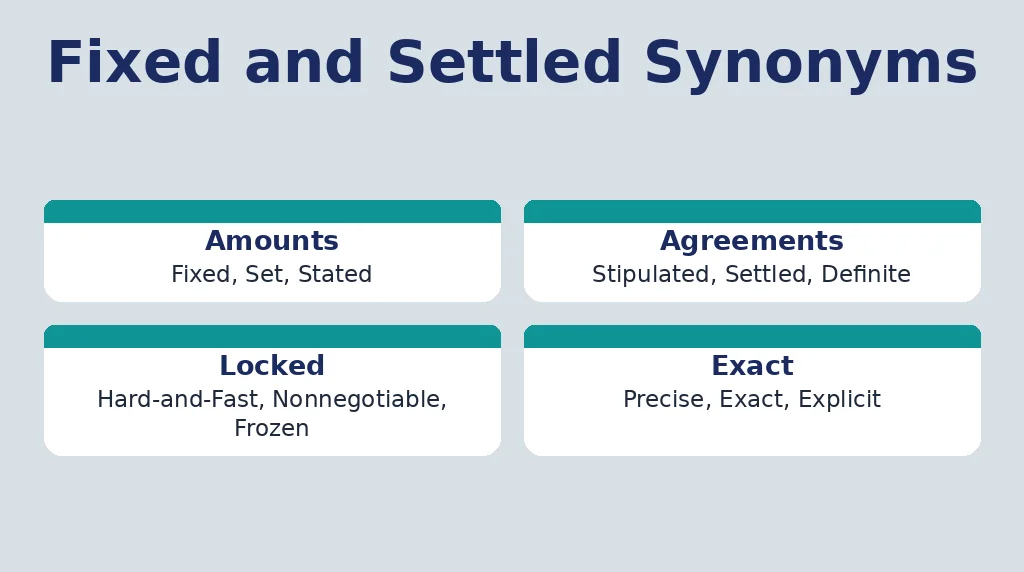
The third sense covers things that are established and not open to change. A certain percentage of profits, a certain number of guests, or a certain sum in child support all belong here. Collins illustrates it with a fixed sum paid every month. The words below help with prices, dates, quotas and rules.
Fixed Amounts and Arrangements
Reach for these words when a number, date or condition has already been agreed. They sound precise because they are precise.
- Fixed: set and not able to change. Example: The rent is a fixed amount each month.
- Set: placed in position or agreed in advance. Example: The exam has a set date in June.
- Settled: decided after discussion, so the matter rests. Example: The settled fee covers the whole course.
- Stated: clearly said or written in an official text. Example: Work must finish within the stated period.
- Stipulated: named as a condition inside an agreement. Example: The contract lists a stipulated number of visits.
- Definite: clear and unlikely to change, the everyday favourite. Example: We finally have a definite date for the move.
- Specific: exactly named rather than general. Example: Each role has specific duties in the plan.
- Given: already stated or assumed in phrases like “at a given time”. Example: Only staff may enter at a given hour.
Not Open to Change
These stronger words say the setting is locked. Lawyers, engineers and careful editors use them often.
- Unchanging: staying the same over time. Example: The lighthouse follows an unchanging routine.
- Unchangeable: impossible to change at all. Example: The date of birth on the record is unchangeable.
- Constant: never varying in amount or rate. Example: The pump keeps a constant pressure.
- Steady: regular and not shifting suddenly. Example: A steady income made planning easier.
- Firm: fixed and not easily moved. Example: The school has a firm rule about phones.
- Hard-and-fast: strict and allowing no exceptions, as in hard-and-fast rules. Example: There is no hard-and-fast limit on drafts.
- Nonnegotiable: not open to discussion, common in offers and law. Example: The deadline is nonnegotiable this quarter.
- Frozen: held at one level, used for prices, pay and accounts. Example: Fees stayed frozen for three years.
- Determinate: having exact limits, a formal and technical word. Example: The sentence had a determinate length.
- Exact: precise, with nothing extra or missing. Example: The exact amount appears on the receipt.
- Precise: exact in every small detail. Example: Pilots record the precise time of landing.
- Explicit: stated clearly, leaving nothing hidden. Example: The form gives explicit instructions.
- Uniform: the same across all cases. Example: A uniform fee applies to every school.
- Stable: steady and unlikely to change suddenly. Example: Prices were stable throughout the spring.
- Flat: fixed at one amount, as in a flat rate. Example: The courier charges one flat fee per box.
Proven and Beyond Doubt: Certain Evidence and Facts
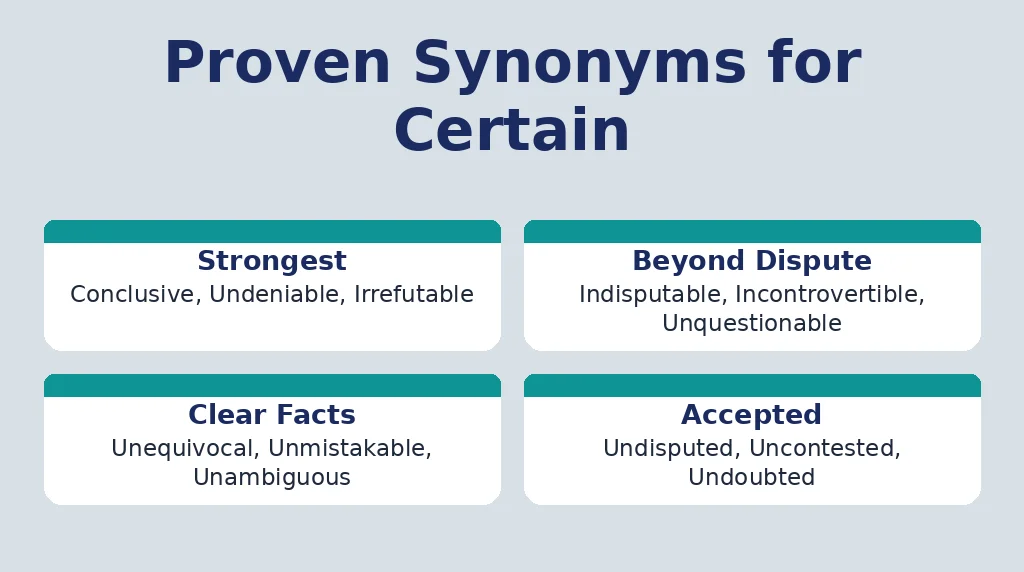
Some sentences claim that a fact cannot honestly be challenged. Detectives, scientists and judges live in this territory. Lab results can show a match, and then the language of proof takes over. The words below are the heavy artillery of certainty, so use them only when the evidence truly earns them.
The Strongest Proof Words
These words close the case. Each one says that reasonable argument has ended.
- Conclusive: proving something so that doubt stops. Example: The DNA test gave conclusive proof of identity.
- Undeniable: impossible to deny honestly. Example: Her talent is undeniable after three hit albums.
- Indisputable: beyond dispute, a twin of undeniable with a formal tone. Example: The records show indisputable growth this year.
- Incontrovertible: cannot be argued against, formal and weighty. Example: The footage is incontrovertible evidence of the break-in.
- Irrefutable: impossible to prove wrong. Example: He presented irrefutable logic in the final round.
- Incontestable: beyond challenge, common in legal writing. Example: The will left an incontestable claim to the house.
- Inarguable: not open to argument, slightly less formal than its cousins. Example: The need for clean water is inarguable.
- Unarguable: the same idea with an un- prefix, listed by Merriam-Webster. Example: The benefit to villages was unarguable.
- Indubitable: beyond doubt, formal and a little old-fashioned. Example: His indubitable honesty won over the committee.
- Unquestionable: impossible to question or doubt. Example: The chef’s skill is unquestionable.
- Undoubted: accepted as true by everyone involved. Example: The concert was an undoubted success.
- Accomplished: in the phrase “an accomplished fact”, meaning already done and certain. Example: By dawn, the takeover was an accomplished fact.
Clear and Recognized Facts
These words say a fact is plain to see or already accepted by all sides. They suit reports, reviews and news writing.
- Unequivocal: clear, with only one possible meaning. Example: The board gave unequivocal support to the plan.
- Unmistakable: impossible to mistake for anything else. Example: The unmistakable smell of rain filled the street.
- Ascertained: found out and confirmed, formal and investigative. Example: The cause of the leak was finally ascertained.
- Absolute: complete, with no exceptions or conditions. Example: The witness spoke with absolute honesty.
- Unambiguous: having one clear meaning only. Example: The results were unambiguous in every test.
- Undisputed: accepted by everyone, with no side arguing back. Example: She is the undisputed champion of the region.
- Unquestioned: never doubted or challenged. Example: His loyalty remained unquestioned for decades.
- Uncontested: not fought against, used for elections and claims. Example: The seat was uncontested in the last election.
- Uncontradicted: standing without any opposing evidence. Example: The account stayed uncontradicted in court.
- Hands-down: informal, meaning easily and certainly, as in “hands-down the best”. Example: It was hands-down the coldest winter on record.
- Irrefragable: a rare, very formal word for impossible to refute. Scholars use it; most writers can admire it from a distance.
A Certain Person: Specific but Not Named
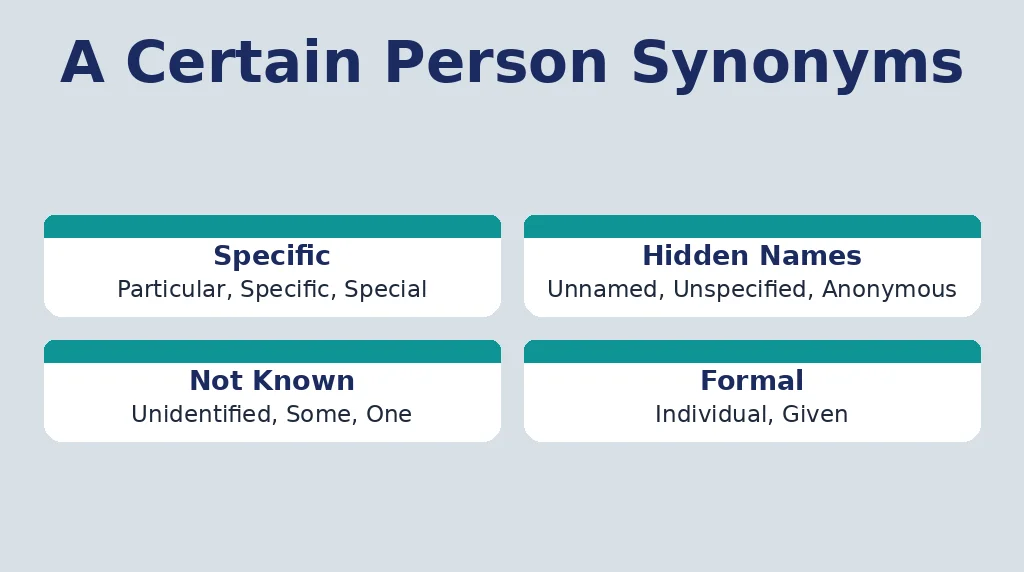
The gentlest sense of certain hides a name on purpose. A certain person has been asking about you. A certain shop sells the good bread. The speaker knows exactly who or where, but politeness, safety or suspense keeps the name quiet. Merriam-Webster defines this sense as “known but not named”, and Collins illustrates it with a visitor looking for you.
Words That Hide a Name
- Particular: one specific person or thing, picked out from the rest. Example: One particular student always asks the best questions.
- Specific: exact and clearly identified, even when unnamed. Example: A specific supplier handles all our paper orders.
- Some: used before a name or thing to suggest it is not important or not known. Example: Some man called about the roof this morning.
- One: in phrases like “one Mr. Khan”, it introduces a person by name but signals distance. Example: One Sara Ahmed has been looking for you.
- Unnamed: not given a name in the report or story. Example: An unnamed official confirmed the decision late last night.
- Unspecified: not stated in detail, common in forms and reports. Example: The delivery will arrive at an unspecified time on Friday.
- Unidentified: not yet known or recognized. Example: An unidentified caller reported the noise twice.
- Anonymous: hiding a name on purpose, as with donors and sources. Example: An anonymous caller left the key at the desk.
- Given: already mentioned or assumed in phrases like “a given topic”. Example: On any given day, the office sees forty visitors.
- Individual: single and separate, used for people in formal writing. Example: Each individual case gets its own review.
- Special: particular and distinct from the general run. Example: The recipe needs a special kind of flour.
A Certain Amount: The Moderate Sense
A close cousin describes amount rather than identity. A certain charm, a certain age, or agreement “to a certain extent” all mean some, but not a great deal. Here only the word some swaps in cleanly, and careful writers keep the phrase itself. Trying to force definite or particular into this sense produces nonsense, as the mistakes section shows.
Surefire and Unfailing: A Certain Cure or Method
One more sense survives in kitchens, workshops and sports pages. A certain cure is a remedy that never fails, and a certain method is one you can bet on. Merriam-Webster illustrates it with grandma’s chicken soup, the certain cure for almost anything. These words promise reliability rather than belief.
- Surefire: certain to succeed, cheerful and informal. Example: A kind word is a surefire way to calm the room.
- Unfailing: never failing, ending or running out. Example: Her unfailing patience steadied the whole class.
- Infallible: never wrong and never failing. Example: No map is infallible, so carry a compass too.
- Reliable: trusted to work every time. Example: He is a reliable source for train times.
- Dependable: able to be trusted, a close partner of reliable. Example: The old truck is slow but dependable.
- Unerring: never making a mistake, used for aim, instinct or judgment. Example: She has an unerring eye for a bargain.
- Fail-safe: designed to keep working safely even when a part breaks. Example: The gate has a fail-safe lock fitted.
- Can’t-miss: informal American praise for a plan that surely works. Example: The recipe is a can’t-miss for new cooks.
- Trustworthy: deserving trust, used for people, news and tools. Example: A trustworthy guide makes any trek safer.
- Trusty: loyal and reliable, slightly old-fashioned and warm. Example: He opened the lock with his trusty penknife.
- Tried-and-true: tested by long use and always successful. Example: The tried-and-true method still fixes the leak.
Notice the pattern across this group. The words praise track records, not feelings. A surefire plan has worked before, and an unfailing supply has never run dry. That record is exactly why the language of certainty fits them.
Formal and Informal Synonyms for Certain
Register can change a sentence as much as meaning can. The same claim sounds very different in a court filing and in a chat message. Sorting the main synonyms by register helps you match the room you are writing for.
Formal Choices for Reports and Essays
Formal synonyms signal care, evidence and distance. They suit academic work, legal writing and serious journalism.
- Indubitable and incontrovertible lead the formal proof words. Both say a fact stands beyond honest challenge.
- Unequivocal is the formal choice for statements and support. Official replies aim to be unequivocal.
- Ineluctable and foreordained handle inevitability in literary or academic prose. Everyday writing rarely needs either.
- Stipulated and determinate belong to contracts and technical texts. They name conditions that somebody fixed deliberately.
- Ascertained suits investigations. Detectives and auditors ascertain facts before they report them.
- Doubtless works as a measured formal adverb or adjective. Essays use it where speech would simply say “no doubt”.
Informal Choices for Speech and Stories
Informal synonyms sound like real people talking. Dialogue, blogs and friendly emails welcome them warmly.
- For sure is the relaxed spoken standard. Example: One thing is for sure, the bus will be late.
- No doubt adds friendly confidence. Example: You will no doubt want the full story first.
- You can bet your life promises total certainty with a grin. Cambridge lists this lively phrase for spoken English.
- In the bag celebrates a result that is already safe. Sports fans and project teams both use it.
- Nailed-on is British slang for absolutely certain, labelled slang by Collins. Example: That penalty looked nailed-on from the stands.
- Hands-down and can’t-miss keep praise informal and upbeat. Both fit reviews far better than reports.
How to Choose the Right Synonym for Certain

Start with one question: which sense of certain is your sentence using? Once the sense is clear, the shortlist almost picks itself.
Certain vs Sure: The Key Choice
The most common choice sits between certain itself and sure. Both words mean free from doubt, but they lean in different directions. Merriam-Webster explains that certain rests on definite grounds or solid evidence. Sure, by contrast, stresses the feeling inside the person. The police are certain about the cause of the fire, because they tested the evidence. You feel sure you locked the door, because your gut says so. Our companion guide to synonyms for sure explores the everyday side of this pair in full.
Paired examples make the gap visible:
- The engineers are certain the bridge is safe. (They ran the tests and signed the report.)
- The engineers are confident the bridge is safe. (They trust their design and their team.)
- The engineers are positive the bridge is safe. (They say it with force, and some pride too.)
- The engineers are cocksure the bridge is safe. (They never bothered to check, and it shows.)
Positive raises the volume, so save it for moments that deserve force. Convinced needs a reason behind it, because somebody or something did the convincing. Assured adds calm, and satisfied adds the sense of a check completed. In formal writing, pick doubtless or unequivocal. In relaxed writing, sure and for sure carry the same meaning with less weight.
Match the Word to the Subject
Watch the subject as well as the sense. When a word sounds wrong in your sentence, it usually belongs to another row of this table.
| Your subject | Strong first choices |
|---|---|
| A person’s belief | Sure, confident, convinced, positive |
| A future event | Inevitable, unavoidable, bound, destined |
| An amount or rule | Fixed, definite, stipulated, set |
| A fact or evidence | Conclusive, undeniable, irrefutable |
| A method or remedy | Surefire, unfailing, infallible |
Antonyms for Certain
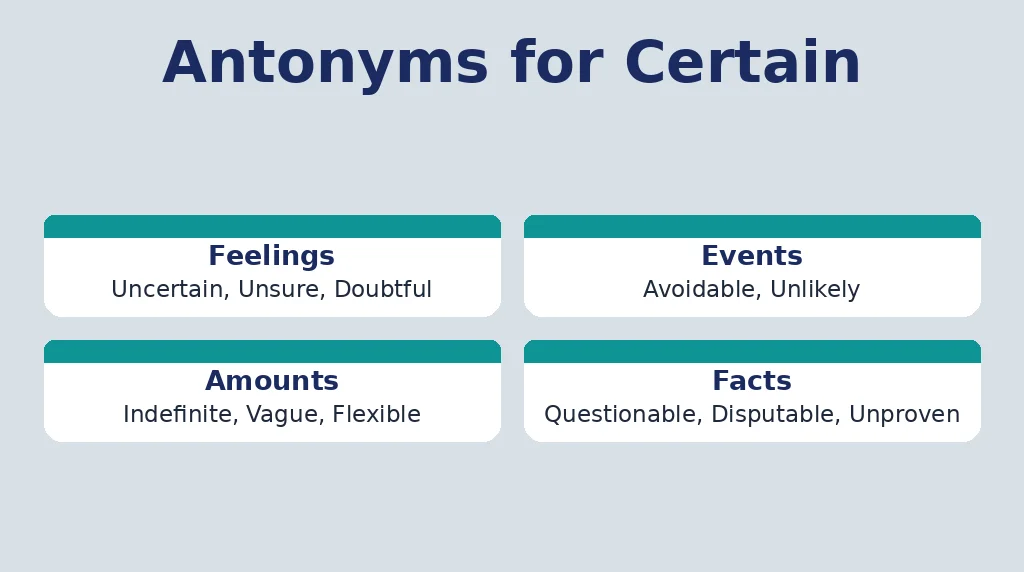
Each sense of certain has its own opposite family. Matching the antonym to the sense keeps your sentence honest.
For a person who feels sure, the opposites are uncertain, unsure, doubtful, dubious, hesitant and indecisive. Cambridge gives uncertain and unsure as the direct antonyms of the feeling sense. A doubtful student has questions left, and a hesitant speaker is not ready to commit.
For events, the opposites are avoidable, unlikely, uncertain and preventable. An avoidable delay is the reverse of an inevitable one. For amounts and rules, use indefinite, vague, unsettled, variable and flexible. A vague deadline is no deadline at all. For facts, the opposites are questionable, disputable, doubtful and unproven. Questionable evidence invites exactly the challenge that certain evidence survives.
One caution closes the section. Uncertain is not a rude or weak word. Honest writing often needs it, because pretending to be certain is far worse than admitting doubt.
Common Mistakes: Words That Are Not True Synonyms for Certain
Accuracy matters in a synonym guide, so this section clears up the words that often sneak into certain lists wrongly.
Probable, likely and possible are the biggest trap. They describe chances, not guarantees. A probable winner can still lose, and a likely delay might never happen. Some loose lists park them beside certain, yet careful writers keep a clear gap between “very likely” and “certain”.
Certified is not a synonym either. A certified document has been checked and stamped by an authority. The stamp proves a process happened; it says nothing about anyone’s state of mind. Use verified or authenticated when the paperwork sense is the point.
Definite and definitive look alike but split sharply. A certain answer is definite, meaning clear and fixed. A definitive answer is the final authority on the subject, like a definitive biography. Swapping them quietly upgrades a simple claim into a grand one.
Assured, ensured and insured cause a written muddle. Assured means confident or guaranteed. Ensure means to make something certain to happen. Insure means to buy financial protection. Only assured belongs in this article’s synonym groups.
Particular and specific fail outside their own sense. “I am particular that he called” is simply wrong English. Those two words name identity, not belief, so they stay inside the unnamed-person section. Finally, cocksure should never appear as praise. It tells readers the person is arrogantly certain, which is the opposite of a compliment.
Frequently Asked Questions
What is the best synonym for certain?
There is no single best word, because certain covers six senses. For a person who feels sure, confident and convinced lead the list. For an event, inevitable is the standard choice, and for a fact, conclusive or undeniable works hardest.
Is certain stronger than sure?
Yes, slightly. Certain rests on definite grounds or solid evidence, while sure stresses a person’s feeling of assurance. That is why reports prefer certain and conversation prefers sure. Both mean free from doubt, but certain sounds firmer and more formal.
What is a formal synonym for certain?
Indubitable and incontrovertible are the classic formal choices for facts. Unequivocal suits statements, while stipulated and determinate fit contracts and technical writing. Doubtless serves as a formal all-rounder in essays.
What is the slang word for certain?
Nailed-on is labelled slang by Collins, especially in British English. In the bag is the common informal phrase for a result that is already safe. For sure is the relaxed spoken standard in both British and American English.
What is a certain person, in the phrase “a certain person”?
It means one specific person who is known but deliberately not named. The speaker usually knows the name and withholds it for politeness, safety or effect. Particular, specific and unnamed are the closest replacements in this sense.
What is the opposite of certain?
Uncertain and unsure are the direct opposites for the feeling sense. For events, avoidable and unlikely take the opposite side. For facts, questionable and disputable are the natural antonyms, and for amounts, indefinite and vague.
Can certain mean “some”?
Yes, in a quieter sense. A certain charm or a certain age means some amount, but not a large one. The phrase “to a certain extent” works the same way. Only the word some replaces certain cleanly in these phrases.
What is the difference between certain and confident?
Certain points to grounds and evidence behind a belief. Confident points to the strength of the belief or the expectation itself. A doctor can be certain about a diagnosis after tests, and confident about a recovery before them.
Final Thoughts
Certain earns its keep by covering belief, fate, fixed amounts, proof and quiet anonymity in one short word. The trick is never the word itself, but the sense hiding inside your sentence. Name the sense first, and the right synonym usually steps forward on its own. Convinced for people, inevitable for events, stipulated for contracts, and surefire for grandma’s soup.
For an even deeper list with related words and near-synonyms, the Merriam-Webster Thesaurus entry for certain is a reliable next step. Keep this guide bookmarked too, and your certainty will always sound exactly as strong as your evidence.