Have you ever found yourself explaining a comparison in writing and realized you keep using the same word over and over? Maybe you are describing how one thing resembles another in an essay, a blog post, or even a social media caption. You know what you want to say, but the word “simile” feels too technical or repetitive. This is where knowing the right synonyms of simile can transform your writing.
Choosing the right synonym does more than just vary your vocabulary. It helps you match your tone to your audience, clarify your meaning, and communicate with greater precision. Whether you are a student analyzing poetry, a professional writing a report, or a blogger crafting vivid descriptions, the right word makes all the difference.
What Are the Best Synonyms of “Simile”?
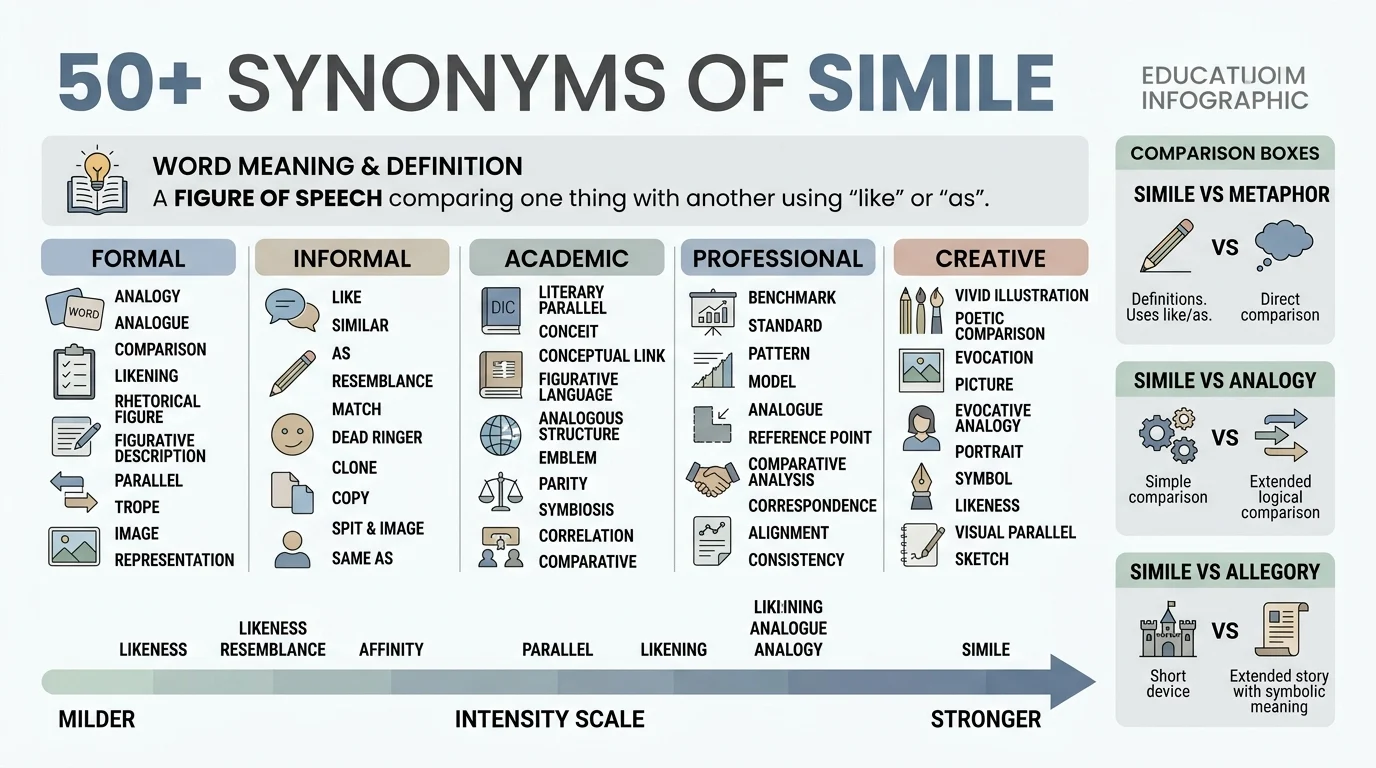
A simile is a figure of speech that directly compares two different things using connecting words like “like” or “as”. For formal writing, choose “comparison” or “analogy.” Casual conversation, use “likening” or “similarity.” For academic work, select “similitude” or “correspondence.” Creative writing, consider “image” or “trope.” The best synonym depends entirely on your context and audience.
Meaning, Tone, and Context
Simple Definition
A simile is a rhetorical device that creates a vivid comparison between two essentially different things by using explicit connecting words such as “like,” “as,” “than,” or “so”. For example, “brave as a lion” and “runs like the wind” are both similes. The purpose is to illustrate one thing by linking it to another that shares a recognizable quality.
Part of Speech
Simile is a noun. It is countable, so you can refer to “a simile” or “several similes”. There is no standard verb form for “simile” itself, though you can describe someone as “speaking in similes”.
Overall Tone
Simile is neutral in tone. It does not carry an inherent positive or negative emotional charge. Instead, its tone is shaped by the comparison being made. Comparing someone to “a ray of sunshine” feels warm and positive, while comparing them to “a storm cloud” feels darker.
Formality Level
Simile is a neutral term that works across all formality levels. In academic and literary analysis, it is the standard technical term. In everyday conversation, people use similes constantly without labeling them as such. The word itself feels slightly formal and academic, which is why knowing synonyms of simile can help you adjust your language to fit different settings.
Common Uses
Native English speakers use similes constantly in both speech and writing. You hear them in everyday conversation (“as busy as a bee”), in advertising (“works like a charm”), in literature (“My love is like a red, red rose”), and in journalism. Similes make language more vivid, relatable, and memorable.
Word Forms
| Form | Word | Example |
|---|---|---|
| Noun | Simile | “The poet used a striking simile.” |
| Adjective | Simile-like | “Her writing style is simile-like.” |
| Related Noun | Similitude | “The similitude between the two passages is clear.” |
| Related Verb | Liken | “She likened his voice to honey.” |
When and How to Use “Simile”
Choose “simile” when you are discussing the specific literary device that uses “like” or “as” to make a comparison. This is the precise, technical term that teachers, professors, and editors expect in academic and analytical contexts.
Here are seven realistic examples showing how to use “simile” naturally in different situations.
Professional (Literary Critique):
“The author’s use of simile in the opening paragraph establishes the novel’s thematic concern with identity.”
Academic (Student Essay):
“Shakespeare employs simile throughout Sonnet 18 to compare the beloved to a summer’s day.”
Workplace (Presentation):
“The marketing campaign relies on a simple simile: our product is like a trusted friend.”
Personal (Conversation):
“I love how that song uses a simile to describe heartbreak as being ‘like a broken mirror.’”
Email (To a Colleague):
“Can you review this section? I am not sure the simile I used in the third paragraph lands correctly.”
Resume (Writing Sample Description):
“Analyzed the use of simile and metaphor in 20th-century American poetry for a senior thesis.”
Social Media (Book Review):
“This author uses simile so naturally that every page feels cinematic.”
Best Synonyms of “Simile”
No synonym is identical to “simile” in every situation. Each alternative carries a slightly different shade of meaning, formality, and connotation. Here is how to choose the best synonym of simile for your specific context.
Professional Writing: Use “comparison.” It is clear, direct, and widely understood in business and professional contexts.
Academic Writing: Use “similitude” or “correspondence.” These sound more formal and precise, which fits scholarly work.
Business Communication: Use “analogy.” It suggests a comparison that explains or clarifies, which is valuable in presentations and reports.
Casual Conversation: Use “likening” or “similarity.” These are straightforward and do not sound overly technical.
Emotional Writing: Use “image” or “metaphor” (carefully). These words evoke feeling and sensory experience.
Creative Writing: Use “trope” or “figure of speech.” These are the standard terms in literary and creative circles.
Resume Writing: Use “figurative language” when describing your communication skills.
Workplace Communication: Use “parallel” to describe how two situations or ideas relate.
Stronger Meaning: Use “allegory” if the comparison extends throughout a whole work.
Softer Meaning: Use “resemblance” for a gentler, less technical comparison.
When Not to Use “Simile”
When It Sounds Too Technical
If you are writing for a general audience, using “simile” can feel overly academic. Your readers might know what it means, but the word itself can create distance.
Less Effective: “The author’s simile compares the city to a living organism.”
Better: “The author compares the city to a living organism.”
The revision replaces the technical term with a simpler verb, making the sentence more accessible.
When It Sounds Too Vague
Sometimes “simile” is too broad. It names the device without explaining the specific nature of the comparison.
Less Effective: “She uses a simile in this line.”
Better: “She compares the sunset to melted gold in this line.”
The second version shows the reader exactly what the comparison is, which is more informative.
When It Sounds Too Formal
In casual conversation or informal writing, “simile” can sound stiff.
Less Effective: “That’s a great simile you just used.”
Better: “I love how you compared those two things.”
The informal version sounds more natural in everyday speech.
When a Metaphor Would Be Stronger
If you are making a direct identification rather than a comparison using “like” or “as,” you are dealing with a metaphor, not a simile.
Using Simile: “Her voice is like silk.”
Using Metaphor: “Her voice is silk.”
The metaphor is more direct and often more powerful. If that is the effect you want, do not call it a simile.
Words Commonly Confused With “Simile”
Simile vs Metaphor
Difference: A simile uses “like” or “as” to make a comparison. A metaphor states that one thing is another thing directly.
When to Use It: Use simile when you want an explicit, easy-to-recognize comparison. Use metaphor when you want a more forceful, direct identification.
Simile Example: “His temper was like a volcano ready to erupt.”
Metaphor Example: “His temper was a volcano ready to erupt.”
Simile vs Analogy
Difference: A simile is a brief, one-point comparison. An analogy is a more detailed comparison that explains how two things are similar across multiple points.
When to Use It: Use simile for a quick, vivid image. Use analogy when you need to explain a complex idea by comparing it to something familiar.
Simile Example: “The brain is like a computer.”
Analogy Example: “The brain is like a computer: it processes information, stores memories, and can crash if overloaded.”
Simile vs Allegory
Difference: A simile is a single comparison in a line or two. An allegory is an extended narrative in which characters and events represent abstract ideas.
When to Use It: Use simile for immediate imagery. Use allegory for a story that carries a deeper symbolic meaning.
Simile Example: “Life is like a box of chocolates.”
Allegory Example: “Animal Farm” by George Orwell.
Simile vs Similitude
Difference: “Similitude” is a more formal and philosophical term for likeness or resemblance. “Simile” specifically refers to the figure of speech.
When to Use It: Use “simile” in literary analysis. Use “similitude” in formal or philosophical writing when discussing general resemblance.
Simile Example: “The poem contains a striking simile.”
Similitude Example: “The similitude between the two theories is worth examining.”
Simile vs Trope
Difference: “Trope” is a broader term that includes any figurative or metaphorical use of language. “Simile” is a specific type of trope.
When to Use It: Use “simile” when you mean the specific “like/as” comparison. Use “trope” when discussing figurative language more generally.
Trope Example: “The novel relies on the classic trope of the hero’s journey.”
Simile Example: “The hero is described as being ‘as strong as an ox.’”
Simile vs Comparison
Difference: “Comparison” is a general term that can refer to any act of noting similarities or differences. “Simile” is a specific figurative comparison that uses “like” or “as”.
When to Use It: Use “comparison” for literal or general comparisons. Use “simile” specifically for figurative ones.
Comparison Example: “Compare the prices of these two products.”
Simile Example: “Her skin was as white as snow.”
Best Synonyms of “Simile” by Context
| Context | Best Synonym | Why It Works | Example |
|---|---|---|---|
| Formal writing | Comparison | Clear and universally understood | “The comparison between the two characters is central to the theme.” |
| Academic writing | Similitude | Sounds precise and scholarly | “The similitude between the two passages suggests intentional borrowing.” |
| Professional communication | Analogy | Explains concepts clearly | “Let me use an analogy to clarify this point.” |
| Business emails | Parallel | Suggests a useful relationship | “There is a clear parallel between our current situation and last year’s.” |
| Resume writing | Figurative language | Demonstrates communication skills | “Skilled in using figurative language to engage audiences.” |
| Workplace communication | Likeness | Straightforward and neutral | “The likeness between the two proposals is striking.” |
| Casual conversation | Likening | Natural and easy to understand | “I love your likening of the situation to a game of chess.” |
| Everyday speaking | Similarity | Simple and direct | “The similarity between those two movies is obvious.” |
| Creative writing | Image | Emphasizes sensory impact | “The poet’s image of the ocean as a breathing creature is unforgettable.” |
| Storytelling | Trope | Standard literary term | “The story uses the classic trope of the reluctant hero.” |
| Emotional writing | Metaphor (with care) | Adds emotional weight | “The metaphor of the caged bird captures her sense of confinement.” |
| Strong emphasis | Allegory | Suggests deeper meaning | “The entire novel is an allegory for political oppression.” |
| Mild tone | Resemblance | Gentle and understated | “There is a resemblance between her writing style and her mentor’s.” |
| Social media captions | Vibe | Modern and casual | “This song has the same vibe as summer.” |
| American English | Simile | The standard term | “The teacher asked us to identify the simile in the poem.” |
How to Choose the Best Synonym of “Simile”
Choosing the right synonym of simile starts with understanding your purpose. Ask yourself these questions.
What is my audience? If you are writing for academics, choose “similitude” or “correspondence.” If you are writing for a general audience, choose “comparison” or “likening.”
What is my tone? For formal writing, use “analogy” or “parallel.” For casual writing, use “similarity” or “likeness.”
How much emotional impact do I need? If you want to create vivid imagery, choose “image” or “metaphor” (if appropriate). If you want to stay neutral, choose “comparison” or “resemblance.”
Am I explaining or illustrating? If you are explaining a complex idea, use “analogy.” If you are simply noting a similarity, use “comparison” or “likeness.”
What is my writing purpose? In literary analysis, “simile” is the precise term. In business writing, “analogy” is often more useful. In creative writing, “image” or “trope” may serve you better.
The best choice is the one that communicates your intended meaning most clearly to your specific reader.
Real Life Examples of “Simile”
School Assignment:
“For my English homework, I need to find a simile in each poem and explain what it compares.”
College Essay:
“The poet’s use of simile transforms an abstract emotion into something tangible and relatable.”
Workplace Email:
“In the proposal, I used a simile to make our value proposition more memorable. Let me know if it works.”
Business Presentation:
“Think of our supply chain like a river. That simile helps visualize how goods flow from source to customer.”
Resume Bullet Point:
“Edited content to improve clarity, replacing vague language with precise similes and metaphors.”
Casual Conversation:
“You know that simile about being ‘as cool as a cucumber’? I finally understand what it means.”
Storytelling:
“She described the forest as being ‘like a cathedral,’ and that simile stayed with me for days.”
Blogging:
“Using a simile in your opening line can hook readers immediately. Compare your topic to something familiar.”
Social Media:
“This book is like a warm blanket on a cold day. Best simile I can think of for it.”
18 Best Synonyms of “Simile”
| Synonym | Simple Meaning | Best Used For | Example Sentence |
|---|---|---|---|
| Comparison | The act of noting similarities between things | General writing, everyday speech | “The comparison between the two candidates is unavoidable.” |
| Analogy | A detailed comparison that explains or clarifies | Teaching, business, explanations | “The professor used an analogy to explain cellular respiration.” |
| Likening | The act of describing one thing as similar to another | Casual conversation, descriptive writing | “Her likening of love to a battlefield felt surprisingly accurate.” |
| Similitude | Formal term for likeness or resemblance | Academic writing, formal essays | “The similitude between the two philosophical systems is remarkable.” |
| Correspondence | A close similarity or connection | Formal writing, research | “There is a clear correspondence between the two data sets.” |
| Parallel | A similarity that can be drawn between two things | Professional writing, analysis | “The parallel between the two historical events is instructive.” |
| Resemblance | The state of being similar in appearance or nature | Neutral, everyday use | “The resemblance between the two paintings is uncanny.” |
| Image | A vivid mental picture created by language | Creative writing, poetry | “The poet’s image of the moon as a silver coin is striking.” |
| Trope | A figurative or metaphorical use of a word | Literary analysis, creative writing | “The novel relies on the trope of the unreliable narrator.” |
| Figure of speech | An expression that uses words in a nonliteral way | General discussions of language | “A simile is a common figure of speech.” |
| Allegory | A story or image with a hidden moral or political meaning | Literary analysis, advanced writing | “The film is an allegory for the struggle against totalitarianism.” |
| Parable | A short story that illustrates a moral lesson | Religious or moral teaching | “The parable of the prodigal son is a well-known example.” |
| Fable | A short story with animals that teaches a lesson | Children’s literature, moral instruction | “Aesop’s fables are classic examples of moral storytelling.” |
| Metaphor (carefully) | A direct comparison without “like” or “as” | Emotional, poetic, or dramatic writing | “His life was a rollercoaster is a metaphor, not a simile.” |
| Likeness | The quality of being similar | Neutral, general use | “There is a strong likeness between the two sisters.” |
| Similarity | The state of being alike | Everyday conversation, simple writing | “The similarity between their arguments is striking.” |
| Emblem | A symbolic representation | Formal, symbolic writing | “The eagle is an emblem of freedom in American culture.” |
| Symbol | Something that represents something else | Symbolic or literary writing | “The green light is a symbol of hope in the novel.” |
Synonyms of “Simile” by Usage
Professional vs Personal Synonyms
In professional settings, choose words that sound clear and authoritative. “Analogy,” “parallel,” and “comparison” work well in reports, presentations, and business emails. They sound competent without being overly academic.
In personal conversations and informal writing, choose words that feel natural and approachable. “Likening,” “similarity,” and “likeness” are straightforward and easy to understand.
Professional: “The analogy between our business model and a subscription service is worth exploring.”
Personal: “The likeness between you and your brother is amazing.”
Formal vs Conversational Synonyms
For formal writing such as reports, essays, and academic papers, use “similitude,” “correspondence,” or “allegory.” These words carry the weight and precision that formal contexts demand.
For casual conversations, texting, and social media, use “comparison,” “likening,” or “similarity.” These words are simple and do not sound pretentious.
Formal: “The similitude between the two theoretical frameworks warrants further investigation.”
Conversational: “The similarity between those two movies is pretty obvious.”
Academic Synonyms
In academic writing, precision matters. “Similitude” and “correspondence” are excellent choices because they sound authoritative and specific. “Analogy” is also widely used in academic contexts, particularly in the sciences and philosophy, where it helps explain complex concepts.
Academic Example: “The correspondence between the linguistic structures of the two languages suggests a common origin.”
Professional and Business Synonyms
In the workplace, clarity is king. “Analogy” is one of the most useful synonyms because it implies a comparison that clarifies or explains. “Parallel” is also effective when you want to show how two situations or ideas relate.
Business Example: “There is a direct parallel between our current marketing strategy and the one we used successfully last quarter.”
Creative and Literary Synonyms
For storytelling, fiction, and poetry, choose words that add texture and depth. “Image,” “trope,” and “allegory” are standard in literary circles. “Metaphor” is closely related and often more powerful, though it is technically distinct from simile.
Creative Example: “The author’s use of the trope of the journey transforms a simple story into a universal meditation on growth.”
Slang or Modern Synonyms
“Simile” does not have widely used slang equivalents. In very casual contexts, you might hear “vibe” used to describe a similarity in feeling or atmosphere.
Slang Example: “That song has the same vibe as summer.”
Use “vibe” only in informal conversation or social media. Avoid it in professional, academic, or formal writing.
Strongest to Mildest Synonyms
Mild:
- Resemblance
- Likeness
- Similarity
Moderate:
- Comparison
- Likening
- Parallel
Strong:
- Analogy
- Similitude
- Correspondence
- Figure of speech
Very Strong:
- Allegory
- Trope
- Symbol
- Metaphor (when used appropriately)
The intensity scale reflects how much weight, formality, or figurative depth each word carries. Mild synonyms are simple and straightforward. Stronger synonyms suggest deeper analysis, greater formality, or more complex figurative meaning.
Emotional vs Neutral Synonyms
Emotional Synonyms
Words like “image,” “metaphor,” and “allegory” often carry emotional weight. They evoke feeling, suggest deeper meaning, and engage the reader’s imagination. Use these when you want to create an emotional response or add richness to your writing.
Emotional Example: “The image of the wilting flower captures her despair perfectly.”
Neutral Synonyms
Words like “comparison,” “likeness,” and “similarity” simply communicate information without adding emotional color. Use these when you want to stay objective, clear, and straightforward.
Neutral Example: “The comparison between the two proposals is based on cost and efficiency.”
Antonyms of “Simile”
| Antonym | Meaning | Example Sentence |
|---|---|---|
| Dissimilarity | The state of being unlike | “The dissimilarity between the two paintings is immediately obvious.” |
| Difference | A point or way in which things are not the same | “The main difference between the two approaches is their underlying philosophy.” |
| Contrast | The state of being strikingly different | “The contrast between the rich and poor characters drives the plot.” |
| Unlikeness | The quality of being not alike | “The unlikeness of their writing styles is apparent on every page.” |
| Disparity | A great difference | “The disparity in their skill levels made the competition uneven.” |
| Divergence | The process of becoming different | “The divergence of their opinions became more pronounced over time.” |
| Distinction | A difference or contrast | “The distinction between fact and fiction is often blurred in memoir.” |
| Separation | The state of being apart | “The separation of their artistic visions is clear in the final works.” |
| Inequality | An unfair or unequal difference | “The inequality in their educational backgrounds affected their opportunities.” |
| Inconsistency | A lack of uniformity | “The inconsistency in his arguments weakened his position.” |
| Discrepancy | A lack of agreement | “The discrepancy between the two accounts raised suspicions.” |
| Variation | A change or difference in condition | “The variation in temperature across the region is significant.” |
| Deviation | A departure from the standard | “The deviation from the original plan caused confusion.” |
| Opposition | The state of being opposed | “The opposition between the two political parties is well documented.” |
| Contradiction | A direct conflict | “The contradiction in her testimony undermined her credibility.” |
Comparison: “Simile” vs Similar Words
Simile vs Metaphor
Main Difference: A simile uses “like” or “as” to compare. A metaphor states that one thing is another.
Which Is Stronger? Metaphor is generally stronger and more direct because it asserts identity rather than similarity.
Which Is More Formal? Both are neutral in formality, but metaphor is often preferred in poetry and creative writing for its dramatic effect.
When to Use Each: Use simile when you want a clear, explicit comparison. Use metaphor when you want a more forceful, poetic statement.
Simile Example: “Her eyes sparkled like diamonds.”
Metaphor Example: “Her eyes were diamonds.”
Simile vs Analogy
Main Difference: A simile is a brief comparison. An analogy is an extended comparison that explains or clarifies.
Which Is Stronger? Analogy is stronger for explanatory purposes because it provides more detail.
Which Is More Formal? Analogy is commonly used in formal and academic writing for explanation.
When to Use Each: Use simile for vivid imagery. Use analogy for explanation and teaching.
Simile Example: “The heart is like a pump.”
Analogy Example: “The heart is like a pump: it circulates fluid through a system of tubes, maintains pressure, and requires regular maintenance to function properly.”
Simile vs Allegory
Main Difference: A simile is a single comparison. An allegory is an entire narrative that represents abstract ideas.
Which Is Stronger? Allegory is more substantial and carries deeper symbolic meaning.
Which Is More Formal? Allegory is primarily used in literary and formal contexts.
When to Use Each: Use simile for a quick comparison. Use allegory for a story with a hidden meaning.
Simile Example: “The government is like a ship navigating stormy seas.”
Allegory Example: “The novel is an allegory for the rise and fall of totalitarian regimes.”
Simile vs Trope
Main Difference: “Trope” is a broader category that includes any figurative language. “Simile” is a specific type of trope.
Which Is Stronger? Trope is more general; simile is more specific and precise.
Which Is More Formal? Both are standard in literary analysis.
When to Use Each: Use “trope” when discussing figurative language generally. Use “simile” when referring specifically to the “like/as” comparison.
Trope Example: “The novel employs several common tropes of the mystery genre.”
Simile Example: “The detective is described as being ‘as sharp as a tack.’”
Simile vs Similitude
Main Difference: “Simile” is the specific figure of speech. “Similitude” is a more formal term for general likeness or resemblance.
Which Is Stronger? Similitude sounds more formal and philosophical.
Which Is More Formal? Similitude is more formal and less commonly used.
When to Use Each: Use “simile” in literary contexts. Use “similitude” in formal or philosophical writing.
Simile Example: “The author uses simile to create vivid images.”
Similitude Example: “The similitude between the two philosophical positions is worth examining.”
Simile vs Comparison
Main Difference: “Comparison” is a general term. “Simile” is a specific figurative comparison.
Which Is Stronger? Simile is more precise and technical.
Which Is More Formal? Both are neutral, but “comparison” is more common in everyday use.
When to Use Each: Use “comparison” for general or literal comparisons. Use “simile” for figurative comparisons using “like” or “as.”
Comparison Example: “Compare the prices of these two laptops.”
Simile Example: “The laptop is as fast as a cheetah.”
Common Phrases and Expressions with “Simile”
| Phrase | Meaning | Example Sentence |
|---|---|---|
| “Use a simile” | To employ a comparison using “like” or “as” | “The teacher asked us to use a simile in our descriptive paragraph.” |
| “Striking simile” | A simile that is particularly memorable or effective | “The poet’s striking simile compares the sunset to a burning ember.” |
| “Extended simile” | A simile that continues over several lines | “Homer’s extended simile in the Iliad compares Achilles to a lion.” |
| “Clichéd simile” | An overused simile that has lost its impact | “Avoid clichéd similes like ‘as busy as a bee’ in your writing.” |
| “Simile in poetry” | A simile used within a poem | “The simile in the second stanza creates a powerful visual image.” |
| “Simile and metaphor” | The two related figures of speech often discussed together | “The lecture covered the difference between simile and metaphor.” |
| “Speak in similes” | To talk using many comparisons | “He tends to speak in similes, which makes his stories more vivid.” |
Common Mistakes to Avoid
Choosing a Vague Synonym Instead of a Precise One
Incorrect: “There is a relation between the two ideas.”
Better: “There is a clear parallel between the two ideas.”
“Relation” is too vague. “Parallel” specifies that the ideas share a similar structure or pattern, which is more precise.
Confusing Simile with Metaphor
Incorrect: “Her smile is like sunshine is a metaphor.”
Better: “Her smile is like sunshine is a simile.”
The presence of “like” makes it a simile, not a metaphor. Using the wrong term can undermine your credibility in academic or professional writing.
Using an Informal Synonym in Formal Writing
Incorrect: “The vibe between the two theories is similar.”
Better: “The correspondence between the two theories is significant.”
“Vibe” is too casual for academic or professional contexts. “Correspondence” sounds more authoritative.
Selecting an Overly Dramatic Synonym
Incorrect: “The allegory between the two marketing strategies is clear.”
Better: “The parallel between the two marketing strategies is clear.”
“Allegory” implies a story with hidden meaning. For business comparisons, “parallel” or “analogy” is more appropriate.
Repeating the Same Word Too Often
Incorrect: “The simile in the first stanza is effective. The simile in the second stanza is also effective.”
Better: “The simile in the first stanza is effective. The comparison in the second stanza is equally powerful.”
Varying your word choice keeps your writing fresh and engaging. Using synonyms of simile helps you avoid repetition.
Choosing a Synonym with the Wrong Emotional Tone
Incorrect: “The image of the factory as a heart is cold and technical.”
Better: “The comparison of the factory to a heart is surprisingly warm.”
“Image” suggests something visual and often emotional. If you mean a neutral comparison, “comparison” is a safer choice.
Using Slang in Academic or Professional Writing
Incorrect: “The vibe between the two characters is off.”
Better: “The dynamic between the two characters is strained.”
“Vibe” is fine for casual conversation but has no place in formal writing. Choose more precise, neutral language instead.
Frequently Asked Questions
What are the best synonyms of “simile”?
The best synonyms depend on your context. Formal writing, use “comparison” or “analogy.” For academic work, use “similitude” or “correspondence.” For casual conversation, use “likening” or “similarity.”
What are the best formal synonyms of “simile”?
The best formal synonyms are “similitude,” “correspondence,” and “analogy.” These words sound precise and authoritative, making them suitable for academic papers, reports, and professional communication.
What are common informal synonyms of “simile”?
Common informal synonyms include “likening,” “similarity,” and “likeness.” These words are straightforward and easy to understand in everyday conversation and casual writing.
What is another word for “simile” in professional writing?
In professional writing, “analogy” and “parallel” are excellent alternatives. They suggest a comparison that clarifies or explains, which is valuable in business communication and presentations.
What is the difference between “simile” and “metaphor”?
A simile uses “like” or “as” to make a comparison, such as “life is like a box of chocolates.” A metaphor makes the comparison directly, stating that one thing is another, such as “life is a box of chocolates”.
What is the opposite of “simile”?
The opposites of simile include “dissimilarity,” “difference,” and “contrast.” These words describe the state of being unlike rather than the act of comparing similarities.
Conclusion
A simile is a figure of speech that compares two different things using connecting words like “like” or “as”. It is one of the most common and effective tools in the English language for creating vivid, memorable descriptions. But no single word works perfectly in every situation. The best synonyms of simile depend on your audience, your tone, and your purpose.
Formal and academic writing, choose “similitude” or “correspondence.” For professional and business contexts, choose “analogy” or “parallel.” For casual conversation, choose “likening” or “similarity.” Ceative writing, choose “image” or “trope.”
The key to strong writing is not just knowing synonyms. It is knowing which synonym fits each specific situation. The next time you reach for the word “simile,” pause and ask yourself: Is this the most precise, most appropriate word for my audience and purpose? If not, choose one of the many excellent synonyms of simile covered in this guide. Your readers will notice the difference.