
Sure is the word we reach for when doubt leaves the room. You can be sure of a fact, sure of a friend, or sure that a plan cannot fail. You can also answer a request with a cheerful “Sure!” and mean nothing more than yes. The most useful synonyms for sure are certain, confident, positive, convinced, inevitable, guaranteed, reliable, dependable, foolproof, and steady. Each one sharpens a different kind of sureness, though, so the swap has to match the sense.
This guide sorts more than 60 synonyms for sure into clear groups. Every word comes with a short meaning, a register label where it matters, and examples for the words people use most. It also settles the classic question of sure versus certain, because those two are close cousins rather than twins.
Top Synonyms for Sure: Quick Reference
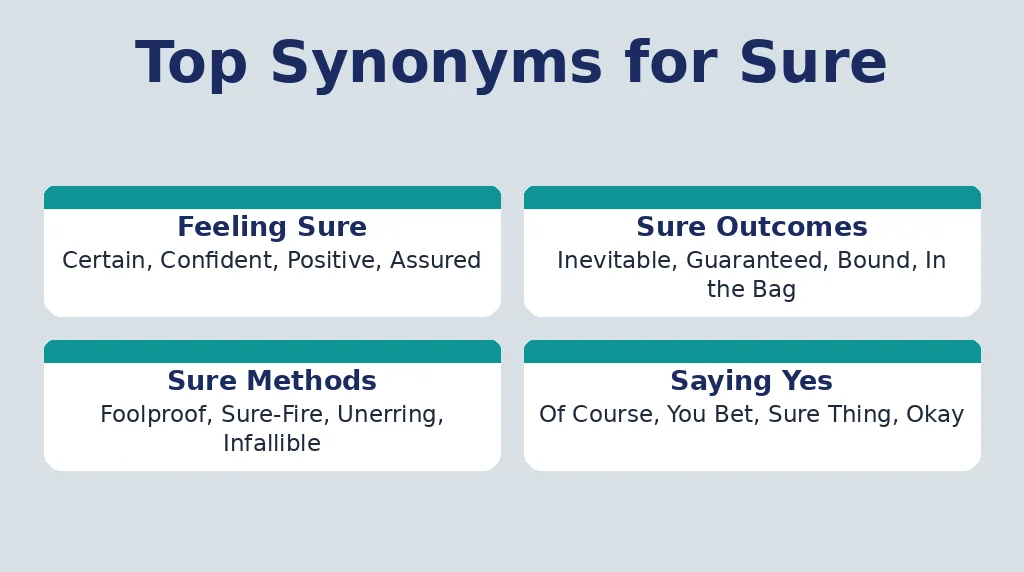
The table below covers the 28 synonyms readers reach for most often. Start here for one fast replacement. The sections after it sort the full list into finer groups, so you can fine-tune both meaning and tone.
| Word | Meaning in one line | Best for / tone |
|---|---|---|
| Certain | Sure based on reasons or evidence | Formal, careful writing |
| Confident | Strongly believing or expecting | People, predictions |
| Positive | Completely sure, stated firmly | Emphasis, identification |
| Convinced | Persuaded until doubt is gone | After arguments or proof |
| Assured | Guaranteed, or calmly confident | Outcomes, formal tone |
| Definite | Clear and decided, not vague | Answers, plans, feelings |
| Inevitable | Certain to happen, cannot be avoided | Events, consequences |
| Guaranteed | Promised to work or happen | Products, results |
| Bound | Certain to happen in time | “Bound to rain”, everyday |
| In the bag | As good as won already | Slang, sport and contests |
| Reliable | Can be trusted to work or behave | People, cars, data |
| Dependable | Reliable in every situation | Friends, staff, tools |
| Unfailing | Never failing, always there | Support, supplies, humour |
| Infallible | Incapable of being wrong | Memory, judgement, methods |
| Unerring | Never missing the target | Instinct, aim, taste |
| Foolproof | Impossible to use wrongly | Instructions, systems |
| Sure-fire | Certain to succeed | Informal, plans and hits |
| Tried and true | Proved reliable by long use | Methods, recipes, advice |
| Unmistakable | Impossible to confuse with another | Signs, sounds, smells |
| Conclusive | Settling the question completely | Evidence, proof, results |
| Indisputable | Impossible to argue against | Facts, records, talent |
| Steady | Calm, firm and controlled | Hands, nerves, footing |
| Firm | Fixed strongly in place | Grip, ground, decisions |
| Secure | Safe and firmly fixed | Fastenings, positions |
| Of course | Yes, naturally | Polite agreement |
| You bet | Yes, gladly and firmly | Informal agreement |
| Sure thing | Yes, certainly | Informal agreement, answers |
| Certainly | Yes, without doubt | Formal agreement, emphasis |
Read the table by families. The first rows grade a feeling inside someone’s mind. The middle rows judge outcomes, evidence, and things that must not fail. The last rows leave meaning behind and turn sure into a handshake word: yes.
What Does Sure Mean?
At its heart, sure means free from doubt. When you are sure, your mind has settled. Merriam-Webster describes this first sense as “having or showing a mind free from doubt,” and it is the sense behind “Are you sure?” and “I am sure I locked the door.”
From that center, the word spreads outward. A sure outcome is one that doubt cannot touch, because it is bound to happen. A sure sign cannot be misread. A sure friend can be trusted for life, and a sure hand does not shake. Finally, sure steps out of the adjective family altogether. It becomes an answer that means yes, and an adverb in phrases such as for sure. Each group below takes one of those steps in turn, so your replacement always lands on the right sense.
Grammarians sometimes call sure a gradable adjective with an absolute heart. You can feel more sure or less sure, yet the word points at total certainty. That tension explains the playful patterns English allows: “I am sure,” “I am quite sure,” “I am absolutely sure.” Each step removes a layer of politeness rather than a layer of doubt. Writers who grade these steps carefully can control exactly how confident a sentence sounds, which is a real skill in reports, negotiations, and apologies.
Synonyms for Sure When You Have No Doubt
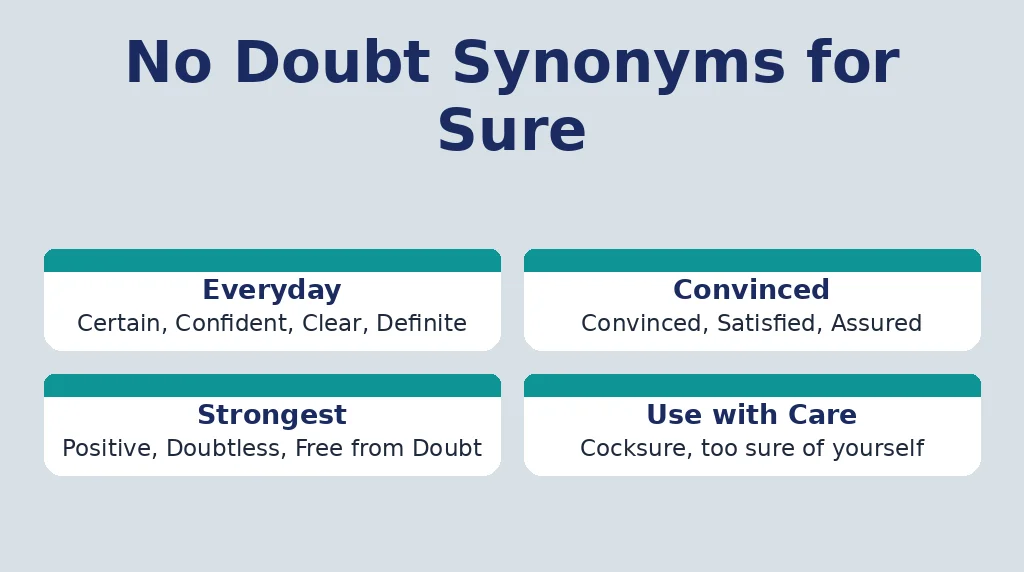
This family lives inside the mind. The words grade how doubt disappears: sometimes a feeling settles it, sometimes reasons do, and sometimes a person simply refuses to waver. You can feel sure of a result long before you can prove it, and this group gives that feeling its precise names.
Everyday English leans on this family hard. “Are you sure?” might be the most common checking question in the language, and “I am not sure” is its polite shadow. That shadow matters: not sure spans everything from a mild guess to near certainty held back by manners. The synonyms below let you replace the shadow with an exact shade, from “I am fairly confident” to “I am positive,” so listeners stop guessing how sure you really are.
Certain, Confident and Convinced
Certain is the heavyweight of the group. It says the belief rests on definite grounds: “Police are certain about the cause of the fire.” Confident stresses the strength of a belief or an expectation: “I am confident that the treatment will work.” Convinced marks the end of an argument. A convinced person doubted once, then saw enough proof: “After the tour, she was convinced the house was safe.”
Assured works two ways. As a feeling it means calmly confident, often in formal writing: “an assured performance.” Satisfied appears in official patterns: “Inspectors were satisfied that the building was safe.” Clear and decided describe a mind with no fog left: “Be clear about what you want,” and “She gave a decided answer.” Definite adds firmness to statements and plans: “We need a definite answer by Friday.” Doubtless and free from doubt close the set. Doubtless suits formal prose, while free from doubt works as a plain descriptive phrase.
Positive and the Strongest Claims
Positive pushes certainty to maximum volume. “I am positive that is the man I saw” leaves no crack for doubt at all. Because it sounds emphatic, positive fits identification, testimony, and moments where hesitation would look dishonest. Used too often, though, it can sound opinionated, a warning both Merriam-Webster and Thesaurus.com attach to the word.
One more word belongs to this family as a caution. Cocksure is a real synonym for sure, but it accuses the person of careless, presumptuous confidence. Nobody describes themselves as cocksure kindly. Keep it for criticism, or avoid it entirely.
Sure of Yourself: Confidence That Shows
Some sure words describe how confidence looks from outside. An assured speaker walks to the front without rushing, because the material feels settled. Self-assured is the everyday compound for the same quality, and it is almost always praise: “a self-assured young manager.” Collins illustrates assured with a performer who looked “much more assured than in recent appearances,” which captures the visible calm perfectly.
Compare that with sure of yourself as a plain phrase. It can praise calm knowledge, yet it can also warn: “He is a bit too sure of himself.” Tone decides which reading wins. When you want pure praise with no shadow, confident and self-assured are the safer gifts. When you describe your own settled belief about a fact, plain sure or certain keeps the focus on the fact instead of your character.
Synonyms for Sure When Something Is Bound to Happen

Here sure leaves the mind and describes the future. A sure victory, a sure defeat, and sure death all share one idea: the event cannot be avoided. The words in this family grade how locked-in the outcome feels.
Two patterns carry most of the load. The first is sure to: “She is sure to win,” “It is sure to rain.” The subject changes, but the promise stays total. The second pattern, be sure to, looks similar and means something else entirely. “Be sure to lock the door” is an instruction to remember and check, a cousin of make sure. Mixing the patterns up is impossible in speech, because context rescues you, but in writing the difference is worth one careful look.
Inevitable, Guaranteed and Bound
Inevitable is the strongest and most formal choice. It says no force can prevent the event: “Change is inevitable.” Guaranteed promises a result inside a system or an offer: “This method is guaranteed to save time.” The promise can be real or just marketing, so careful writers use it only when someone stands behind the claim.
Assured in this sense means made certain: “With that goal, victory was assured.” Bound is the everyday workhorse, almost always in the pattern bound to: “Prices are bound to rise.” Destined adds fate to the forecast: “He was destined to win.” Inescapable belongs to formal writing about consequences nobody can dodge: “an inescapable conclusion.” Ineluctable is its literary cousin, rare and dramatic, best saved for essays and fiction.
The Slang of Certainty
Informal English celebrates locked outcomes. In the bag declares the contest finished before the whistle: “Relax, the deal is in the bag.” Nailed-on is British slang for a certain choice or result: “a nailed-on penalty.” Both phrases drip with confidence, which is exactly why they backfire when the outcome slips. Use them for flavor in speech and sport, never in a legal document or a formal report.
Two noun phrases complete this family. A sure thing is a winner or result treated as certain: “The horse looks like a sure thing.” A sure bet makes the gambling image explicit: “Rain tomorrow is a sure bet.” Pundits and tipsters love both phrases, which should tell you something. They signal confidence inside the speaker, not proof inside the world, so careful writers keep them inside quotation marks, reviews, and speech.
Synonyms for Sure Evidence: Beyond Argument
Some sure words judge proof rather than feelings or futures. A sure sign points one way only. Conclusive evidence ends the discussion. This family is formal by nature, because it belongs to reports, science, law, and serious journalism.
Conclusive is the leader: “The tests gave conclusive proof.” Indisputable and incontrovertible say nobody can honestly argue back: “an indisputable record.” Unquestionable suits authority and standing: “an unquestionable expert in the field.” Indubitable is the most formal of the three and appears mostly in academic prose. Unequivocal removes ambiguity rather than doubt: “an unequivocal answer” says exactly one thing.
Undeniable and irrefutable both answer challenges. Undeniable suits facts and talent: “her undeniable skill.” Irrefutable suits arguments and evidence that survive every attack. Unmistakable works differently. It describes something that cannot be confused with anything else: “the unmistakable smell of rain.” Absolute strengthens nouns in formal phrases such as “absolute certainty” and “absolute proof.” Undoubted simply records that nobody doubts the thing: “an undoubted success.” Together, these words let you say not just that you are sure, but that the case is closed.
Handle this family with respect, because it makes the largest claims in the language. Calling evidence conclusive when it is merely strong invites exactly the argument you wanted to avoid. Scientists, judges, and auditors therefore ration these words carefully. A useful rule: use the evidence family only when a reasonable opponent, shown the same material, would have to agree with you. Anything less belongs one family down, with certain and confident.
Reliable Synonyms for Sure: Signs, Cures and People
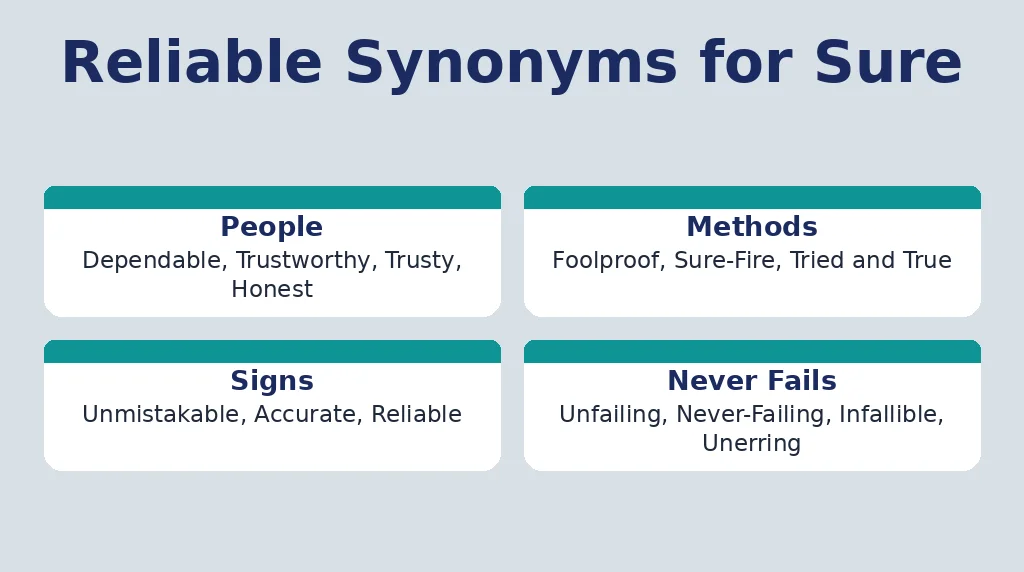
Merriam-Webster splits this family into two senses: “not likely to fail,” as in a sure cure, and “worthy of one’s trust,” as in a sure friend. Both senses promise performance over time. A reliable thing has a record, and that record is why you trust it before the test begins.
People You Can Trust
Dependable is the warmest word for a reliable person. A dependable colleague arrives, delivers, and repeats that pattern for years. Trustworthy judges character rather than performance: a trustworthy witness tells the truth. Honest belongs here in the same character sense, though it says nothing about skill. Trusty is affectionate and slightly old-fashioned, the word for a loyal companion or a faithful old tool: “his trusty bicycle.”
Merriam-Webster’s example for this trust sense is worth stealing as a pattern: “a sure friend for life.” A sure friend is not merely pleasant company. The phrase promises presence during the bad years, which is why it survives in toasts, eulogies, and wedding speeches. When you write about loyalty, sure friend, staunch friend, and dependable friend form a small ladder: sure is the oldest and plainest, staunch adds public loyalty, and dependable adds the daily record.
A sure hand in the human sense often appears as unfailing support. Colleagues praise an unfailing friend because the help never dries up. Never-failing says the same thing with a hyphen and a formal flavor. Stable describes the steady temperament behind reliability: clients trust a stable adviser because panic never reaches the desk.
Methods, Signs and Cures That Do Not Fail
Foolproof is the favorite for systems and instructions. A foolproof plan cannot be ruined by careless use, or so the claim goes. Sure-fire is its informal twin for things certain to succeed: “a sure-fire hit.” Tried and true praises a method with a long record: “the tried and true way to proof dough.” Well-proven makes the same claim in formal dress.
Unfailing and infallible grade accuracy. An unfailing eye spots every error, every time. Infallible claims perfection itself: “No memory is infallible.” Unerring describes aim that never misses, of arrows, instincts, or taste: “her unerring sense of timing.” Accurate and reliable round out the family for signs and data. A sure sign of rain becomes a reliable sign or an accurate signal when you write for scientists, patients, or investors.
The collocation a sure sign deserves its own note, because writers use it constantly. A sure sign of spring, a sure sign of trouble, a sure sign that the plan is working: the phrase promises that one visible detail reveals the whole situation. Its partner, a sure cure, promises a remedy that never fails. Both phrases survive because they are vivid, but both overclaim by design. In careful writing, soften them to a reliable sign or a proven remedy unless the evidence really is total.
A Sure Hand: Steady Synonyms for Sure
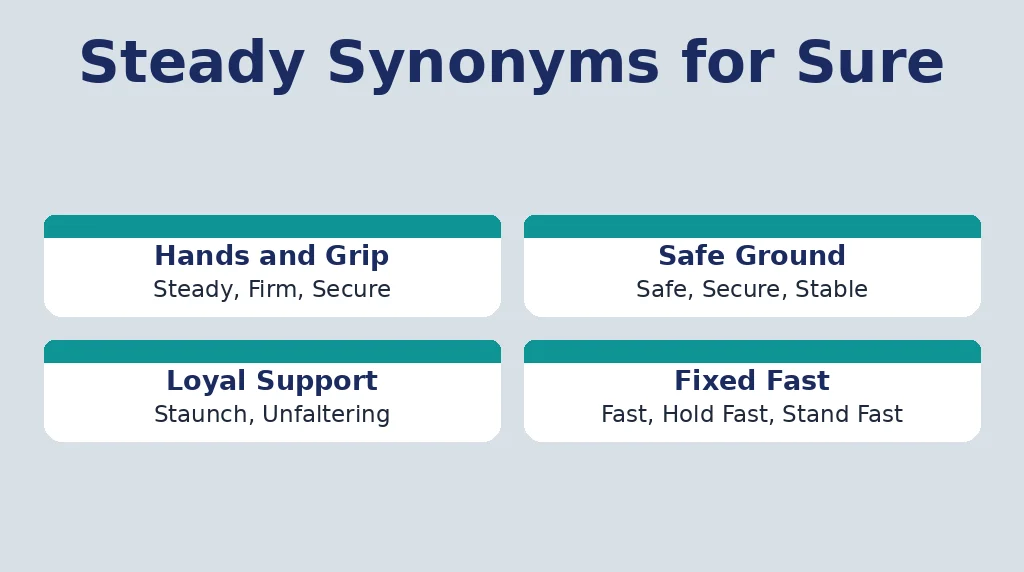
A doctor’s sure hands may perform surgery. A climber needs a sure footing, and a nervous speaker needs a sure voice. In this family, sure means physically steady: fixed, controlled, and not likely to slip. The body’s certainty replaces the mind’s.
Steady is the plain everyday word: “Hold the camera steady.” Firm describes pressure and contact: a firm grip, firm ground, a firm handshake. Secure says the fixing will hold: “Make sure the ladder is secure.” Safe is the general word readers reach for first, though it promises protection from harm rather than steadiness itself. A strong grip helps, but sure adds control to the strength.
Two words need small warnings. Fast means firmly fixed in older patterns such as “hold fast” and “stand fast.” A modern reader may misread it as quick, so use it only inside those phrases. Staunch describes support that never wavers: “a staunch ally.” Unfaltering describes a voice, gaze, or stride that never hesitates. Both words borrow physical steadiness to paint loyalty and courage, which is why they sound slightly literary.
The family’s compound, sure-footed, deserves a mention. Climbers, dancers, and mountain goats earn the label by never slipping. Business writing borrowed it for people who handle risk calmly: “a sure-footed negotiator.” The metaphor works because the literal sense is so clear. If your subject could literally fall, use sure-footed or steady. If only reputations can fall, the same words still work, one level up.
Saying Sure: Words That Mean Yes
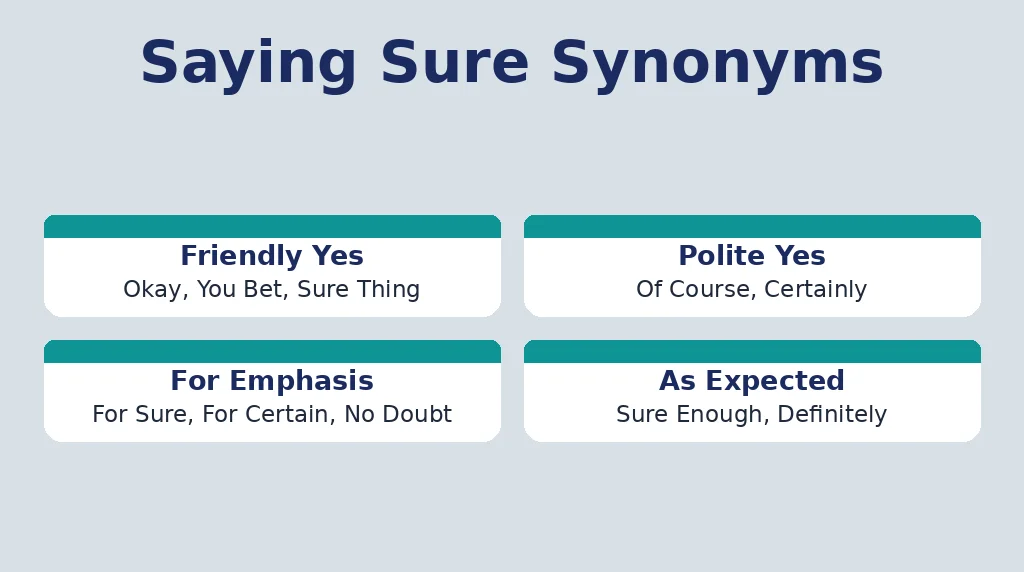
Ask “Can you help me move on Saturday?” and the answer “Sure!” carries no doubt at all. It simply means yes, gladly. Collins lists this as a separate informal sense of sure, with its own family of replies.
The Friendly Yes
Okay is the lightest agreement, a yes with no ceremony. You bet adds enthusiasm and confidence: “You bet I will be there.” Sure thing answers with warmth and a promise inside it: “Sure thing, I will bring the ladder.” All three suit friends, family, and relaxed workplaces. None of them belongs in a contract, a court filing, or a condolence letter.
Watch out for the doubled reply. “Sure, sure,” said quickly, often means the opposite of enthusiasm: it brushes the request aside. Tone of voice decides, which is why careful writers avoid the doubling in email and chat. A single “Sure, happy to help” keeps the warmth and drops the ambiguity.
The Polite and Formal Yes
Of course is the graceful standard. It says yes and adds that the request was natural: “Of course you can borrow it.” Certainly is the formal peak: “Certainly, Madam, right away.” Service language loves certainly because it sounds both willing and respectful. In British English, certainly can also soften a refusal (“Certainly not!”), so tone and the word not decide the meaning there.
Sure as an Adverb
Sure also works as an adverb in informal American English: “It sure is hot today,” or “We sure could use your help.” Definitely is the neutral adverb swap, and certainly is the formal one. For sure confirms a fact with emphasis: “One thing is for sure, the road closes at nine.” For certain says the same in slightly older dress. No doubt concedes a point gracefully: “You will no doubt want the figures first.” Sure enough closes the family: it reports that the expected thing happened, exactly as predicted.
Formal and Informal Synonyms for Sure
Formal writing reaches for certain, conclusive, indisputable, inevitable, and dependable. These words carry evidence and records behind them, which is why reports and contracts trust them. Certainly is the formal agreement word, and assured is the formal outcome word.
Neutral words travel anywhere. Sure itself, reliable, steady, definite, and of course move between a text message and a business report without sounding wrong in either place. When in doubt, stay in this middle band.
Informal English is shorter and bouncier. Sure thing, you bet, and in the bag all promise outcomes with a grin. Sure-fire describes the plan that cannot miss, and iffy, the antonym, describes the one that might. Using slang in formal writing does not just sound casual. It can weaken a promise that the reader needed to trust, so save the bounce for speech.
One regional note helps. The adverb sure (“It sure is late”) is chiefly American. British English usually chooses certainly, definitely, or surely in the same slot: “It is certainly late.” Surely also opens challenging questions in British speech: “Surely you checked the figures?” Knowing the geography of these small words keeps dialogue in novels and scripts sounding true to its setting.
Sure in Sentences: Grading Your Certainty
Watch the certainty dial move across one situation. A detective gathers facts about a fire, and each sentence below turns the dial one notch.
“I think the fire started in the kitchen” admits real doubt, so it belongs to the probability family. “I am fairly sure it started in the kitchen” removes most doubt but keeps a polite gap. “I am sure it started in the kitchen” reports a settled mind. “I am certain it started in the kitchen” adds evidence to the settlement. “The evidence is conclusive: it started in the kitchen” moves the sureness out of the speaker and into the proof, where nobody can argue with it.
The same dial works for trust. “He is a good driver” praises skill. “He is a reliable driver” promises a record. “He is a dependable driver in all weathers” extends the record across conditions. “He has an unfailing sense of direction” removes failure from the story entirely. Choosing among these sentences is not decoration. Each one makes a different promise to the reader, and honest writing keeps the promise level exactly where the facts put it.
How to Choose the Right Synonym for Sure

Four questions settle most choices. Are you describing a feeling, a future event, a piece of evidence, or a thing with a track record? Match the family first, and the exact word usually picks itself. The famous pair below deserves its own careful treatment.
Sure or Certain?
This is the distinction readers ask about most, and the dictionaries agree on the answer. Sure stresses a subjective feeling: the absence of doubt inside one person’s mind. Certain points to the grounds behind the belief, the definite reasons or evidence that removed the doubt. “I am sure I locked the door” reports a feeling. “Investigators are certain about the cause” reports a conclusion built on proof.
Certain is also stronger and more formal than sure. In a report, write certain when evidence exists and sure when you are honestly reporting confidence. In speech, sure sounds warmer and more natural. Nobody thanks a friend by saying “I am certain you will love it,” because certain can even hint that the speaker checked. Match the word to where the sureness lives: in the heart, choose sure; in the evidence, choose certain.
Sure, Confident or Positive?
Confident adds expectation to belief. You are confident about things still to come: results, performances, other people’s success. Sure fits present facts as easily as futures. Positive raises the volume on either one. It suits moments of identification and testimony, where softness would sound like doubt. If positive feels too loud, step down to certain or sure instead of reaching for a weaker word like probably.
The Cocksure Warning
Every family has a trap, and this family’s trap is cocksure. It means sure without having done the work, confident in a careless and presumptuous way. A cocksure answer in an interview can cost the job. Describe evidence, use certain, and let the facts sound sure for you.
Definite or Definitive?
One last pair confuses even careful writers. Definite means clear, decided, and not vague: “a definite plan,” “a definite yes.” Definitive means final and conclusive, the version that settles the subject: “the definitive biography,” “a definitive answer.” If your sentence grades a feeling or a plan, choose definite. If it closes a question for good, choose definitive. Swapping them is the surest way to sound almost right.
Antonyms for Sure
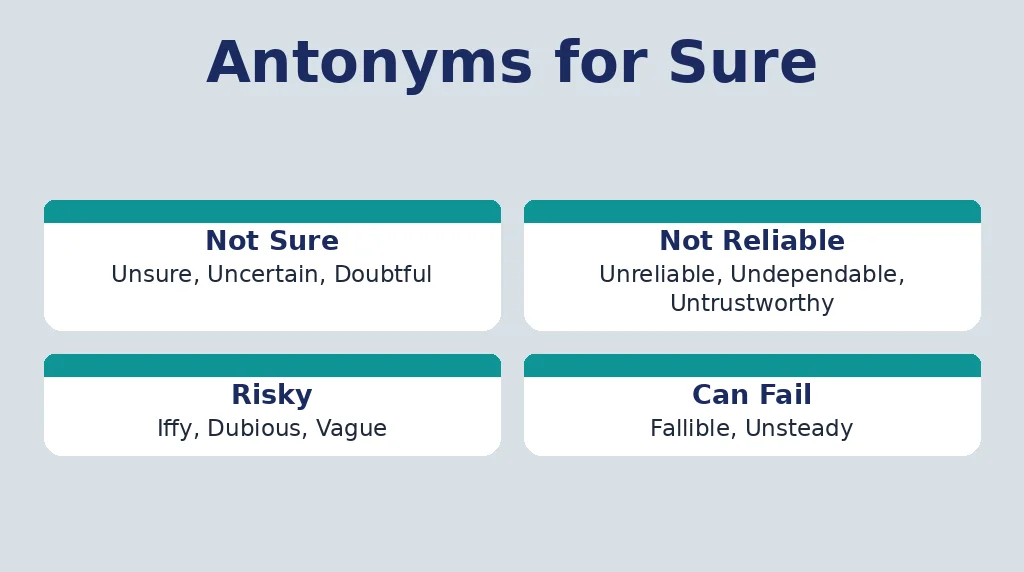
The opposites mirror the senses. For feelings, unsure and uncertain lead: “She felt unsure about the answer.” Doubtful grades the doubt up, and dubious adds suspicion that something is dishonest or unreliable: “a dubious claim.”
For things and people, unreliable and undependable reverse the track record. Untrustworthy attacks character instead: the person may perform, but you cannot believe them. Vague is the opposite of definite, the answer that refuses to settle. Iffy is the informal all-rounder for risky plans and doubtful weather: “The plan is iffy.” Fallible is the formal opposite of infallible, a reminder that every expert can err. Unsteady reverses the body’s sense: an unsteady hand, an unsteady ladder.
Politeness softens several of these in daily speech. “I am not entirely sure” and “I would not bet on it” both admit doubt without sounding careless. Writers can use the same softeners when a flat uncertain would sound rude or abrupt.
Common Mistakes: Words That Are Not True Synonyms for Sure
Likely and probably cause the most damage. Both words admit doubt by design. “He is likely to win” gives him a good chance, not a certain one. Swapping likely for sure quietly upgrades a guess into a promise, so check every prediction sentence twice.
Hopeful and optimistic describe an attitude, not a conclusion. A hopeful fan expects good news while accepting the risk of bad news. That acceptance is exactly what sure excludes. Keep hope words for feelings about the future, and sure words for settled minds.
Make sure is not an adjective swap at all. It is a verb phrase meaning check or ensure: “Make sure the door is locked.” You cannot replace it with certain or confident, and you cannot write “make certain the door” in modern everyday style without sounding like a lawyer from another century.
Finally, beware the guaranteed habit in business writing. A guarantee is a promise that someone must honor, with money or repairs behind it. Calling every likely result guaranteed turns marketing into liability. If nobody will pay when it fails, choose bound, likely, or sure instead.
Surely misleads in the opposite direction. Writers add it hoping to sound certain: “Surely the train leaves at six.” In practice, surely often begs the listener to agree, which quietly admits the point is open. “Surely you remember?” is a nudge, not a proof. When you truly mean certainty, certain, definitely, or for sure will carry it without the nudge.
Frequently Asked Questions
What is the best synonym for sure?
Certain is the closest all-purpose synonym for sure, and it is slightly more formal. Confident works better when the sentence predicts a result. For things that must not fail, reliable is the best swap, and for a friendly yes, of course wins.
What is the difference between sure and certain?
Sure expresses a feeling of having no doubt. Certain suggests the belief rests on definite reasons or solid evidence. Certain is also stronger and more formal. Use sure for personal confidence in speech, and certain for conclusions in careful writing.
What is a formal synonym for sure?
Certain, conclusive, and indisputable lead the formal list. Certain suits beliefs, conclusive suits evidence, and indisputable suits facts and records. For agreements, certainly is the formal way to say yes.
How do you say sure professionally?
In speech and email, of course and certainly are the professional yeses: “Certainly, I will send it today.” Inside reports, replace sure with certain, definite, or reliable, depending on the sense. Avoid you bet and sure thing at work unless the culture is very informal.
What is the opposite of sure?
Unsure and uncertain are the everyday opposites. Unreliable reverses the trust sense, doubtful questions a belief, and iffy covers risky plans in informal speech. Unsteady is the opposite for hands, ladders, and voices.
Is cocksure a compliment?
No. Cocksure describes confidence that looks careless and presumptuous to everyone watching. Merriam-Webster defines it through that warning tone. If you want to praise confidence, use assured, confident, or self-assured instead.
What does sure-fire mean?
Sure-fire describes something certain to succeed or to produce the wanted result: “a sure-fire way to fall asleep on trains.” The word is informal, so it fits speech, reviews, and friendly advice better than contracts or scientific writing.
What does “for sure” mean?
For sure means definitely, with no doubt allowed: “I do not know the time for sure.” It confirms facts rather than feelings. Writers use it at the end of a sentence for emphasis, often in speech and informal prose.
Final Thoughts
Sure looks simple, yet it grades some of the most important judgements in English: what we believe, what we promise, and whom we trust. Let the sense lead. Choose certain for evidence, confident for expectations, inevitable for locked futures, reliable for track records, and of course for a graceful yes.
If you want to check a nuance against the source, the Merriam-Webster Thesaurus entry for sure lays out every sense with examples. Keep this guide beside it, and your writing will sound exactly as sure as you actually are, no more and no less.