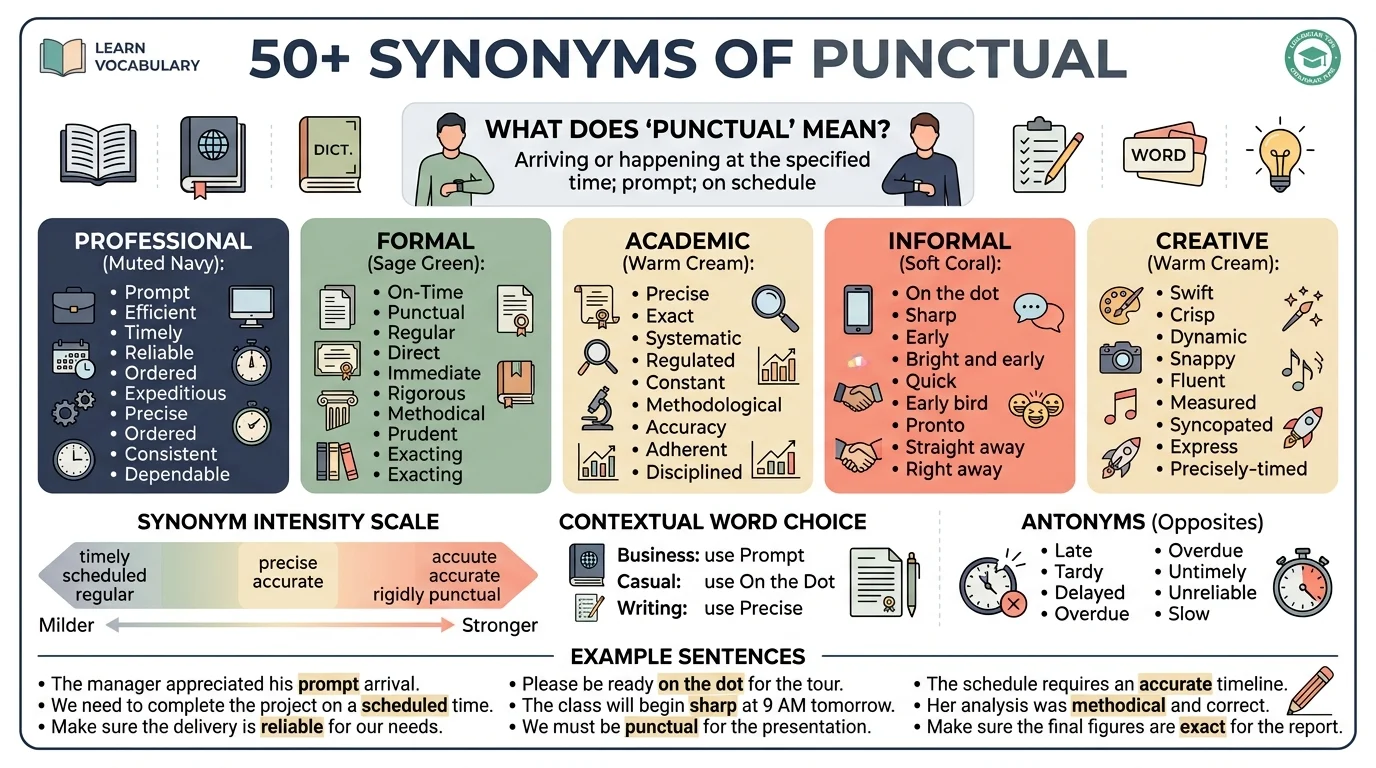
Have you ever found yourself describing someone as “on time” in every email, essay, or conversation? Many writers rely on the same word repeatedly when discussing timeliness, especially in professional settings. Whether you are drafting a performance review, writing a resume, or simply complimenting a colleague, varying your vocabulary makes your communication more precise and engaging. This guide explores the best synonyms of punctual to help you choose the right word for every situation. Understanding subtle differences between similar words will elevate your writing and make your meaning clearer to readers.
What Are the Best Synonyms of “Punctual”?
Punctual means arriving or doing something at the expected or planned time; not late. For formal writing, choose “prompt” or “timely.” For casual conversation, use “on time” or “right on time.” In professional contexts, “dependable” and “reliable” work well. For academic writing, consider “expeditious” or “punctilious”.
Meaning, Tone, and Context
Simple Definition
Punctual describes someone who arrives or completes tasks at the agreed or correct time. A punctual person is never late and respects other people’s schedules.
Part of Speech
Adjective
Overall Tone
Positive. Being punctual is widely admired and associated with professionalism, respect, and reliability.
Formality Level
Punctual is fairly formal. You will commonly encounter it in school, office, and exam settings. It sounds more precise and deliberate than the casual phrase “on time”.
Common Uses
Native English speakers use punctual in:
- Performance reviews and workplace feedback
- Professional emails and business correspondence
- Academic writing and student evaluations
- Job descriptions and resume bullet points
- Formal invitations and event instructions
- Customer service and delivery communications
Word Forms
- Noun: Punctuality
- Adverb: Punctually
- Adjective: Punctual
- Related form: Punctilious (being very precise about details)
- Opposite form: Unpunctual
When and How to Use “Punctual”
Choose “punctual” when you want to emphasize that someone consistently arrives or acts at the correct time. It carries a sense of habit and reliability, not just a one-time occurrence.
Professional Context
“Our new project manager is exceptionally punctual; she has never missed a deadline or arrived late to a single meeting.”
Academic Context
“The professor expects all students to be punctual for lectures, as late arrivals disrupt the learning environment.”
Workplace Context
“Being punctual shows respect for your colleagues’ time and demonstrates your commitment to the team.”
Personal Context
“My grandmother is the most punctual person I know; she always arrives exactly fifteen minutes early to every family gathering.”
Email Context
“Thank you for being punctual with your response. Your timely feedback allowed us to move forward with the project.”
Resume Context
“Consistently punctual and reliable, with a proven track record of meeting all deadlines ahead of schedule.”
Social Media Context
“Shoutout to the most punctual friend I have! Never waits for anyone but never keeps anyone waiting either.”
Best Synonyms of “Punctual”
No synonym perfectly matches “punctual” in every situation. The right choice depends on your audience, tone, and the specific shade of meaning you want to convey.
Best for Professional Writing: Prompt
“Prompt” emphasizes acting without delay. It suggests not just being on time but responding quickly when needed.
Best for Academic Writing: Expeditious
“Expeditious” means done with efficient speed. It sounds authoritative and precise, ideal for research papers and formal essays.
Best for Business Communication: Timely
“Timely” describes actions or responses that happen at the right moment. It works well in emails and reports.
Best for Casual Conversation: On Time
This is the most common and natural way to say punctual in everyday speech. It is simple, clear, and universally understood.
Best for Emotional Writing: Faithful
“Faithful” implies loyalty and trustworthiness in keeping commitments. It adds warmth and emotional depth.
Best for Creative Writing: Clockwork
“Like clockwork” suggests regular, predictable precision. It creates vivid imagery in storytelling.
Best for Resume Writing: Dependable
“Dependable” communicates that others can count on you. Employers value this quality highly.
Best for Workplace Communication: Reliable
“Reliable” focuses on consistency and trustworthiness. It is a staple of professional feedback.
Stronger Meaning: Punctilious
“Punctilious” means being very precise about details. It goes beyond timeliness to include accuracy and care.
Softer Meaning: On Schedule
“On schedule” is gentler and less formal. It simply means following the planned timeline.
When Not to Use “Punctual”
When the Word Sounds Too Formal
In casual text messages or social media posts, “punctual” can feel stiff and overly proper. Say “on time” instead.
Better choice: “See you at 7. Please be on time.”
When the Word Sounds Too Vague
If you need to emphasize speed rather than just timeliness, “punctual” is not specific enough. Choose “prompt” or “immediate.”
Better choice: “We need a prompt response to this client inquiry.”
When the Word Sounds Too Weak
In performance reviews where timeliness is critical, “punctual” may not convey enough urgency. Use “punctilious” or “meticulous”.
Better choice: “She is punctilious about meeting every deadline without exception.”
When the Word Sounds Outdated
In very modern or tech-focused contexts, “punctual” can feel old-fashioned. “On schedule” or “right on time” sounds more contemporary.
Words Commonly Confused With “Punctual”
Punctual vs Prompt
Difference: Punctual emphasizes being on time habitually. Prompt emphasizes acting quickly without delay.
When to use punctual: To describe someone‘s general reliability with time.
When to use prompt: To describe a quick response or action.
Example (punctual): “She is always punctual for her 9 AM meetings.”
Example (prompt): “He gave a prompt reply to my email within minutes.”
Punctual vs Timely
Difference: Punctual relates to exactness at a specific time. Timely relates to appropriateness or fortunate timing.
When to use punctual: To describe arriving at the scheduled time.
When to use timely: To describe something happening at a good or useful moment.
Example (punctual): “The train arrived punctually at 3 PM.”
Example (timely): “The doctor’s advice was timely and prevented further complications.”
Punctual vs Reliable
Difference: Punctual focuses specifically on time. Reliable encompasses overall trustworthiness in all areas.
When to use punctual: To comment specifically on timeliness.
When to use reliable: To describe someone who can be counted on in general.
Example (punctual): “He is punctual for every appointment.”
Example (reliable): “She is a reliable employee who always delivers quality work.”
Punctual vs Dependable
Difference: Punctual is about time. Dependable is about being trustworthy and consistent.
When to use punctual: When the focus is on arrival or completion time.
When to use dependable: When emphasizing overall trustworthiness.
Example (punctual): “The bus service is punctual, never running more than two minutes late.”
Example (dependable): “Our dependable supplier has never missed a shipment in ten years.”
Punctual vs Exact
Difference: Punctual relates to time. Exact relates to precision in general.
When to use punctual: To describe timeliness.
When to use exact: To describe accuracy in measurements, details, or descriptions.
Example (punctual): “He is punctual to the minute.”
Example (exact): “She gave the exact measurements for the project.”
Punctual vs Punctilious
Difference: Punctual is about time. Punctilious is about being very precise and attentive to details in all matters.
When to use punctual: For general timeliness.
When to use punctilious: For someone who is meticulous about rules and details.
Example (punctual): “He is punctual for every class.”
Example (punctilious): “She is punctilious about formatting every document correctly.”
Best Synonyms of “Punctual” by Context
| Context | Best Synonym | Why It Works | Example |
|---|---|---|---|
| Formal writing | Prompt | Sounds professional and precise | “We require a prompt response to this inquiry.” |
| Academic writing | Expeditious | Conveys efficiency and scholarly tone | “The research was conducted in an expeditious manner.” |
| Professional communication | Timely | Emphasizes appropriateness and relevance | “Your timely input was invaluable to the discussion.” |
| Business emails | On schedule | Clear and direct without being too formal | “The project remains on schedule for completion.” |
| Resume writing | Dependable | Signals trustworthiness to employers | “Dependable employee with perfect attendance record.” |
| Workplace communication | Reliable | Focuses on consistency and trust | “She is a reliable team member who never misses deadlines.” |
| Casual conversation | On time | Natural and conversational | “Are you going to be on time for dinner?” |
| Everyday speaking | Right on time | Friendly and informal | “You arrived right on time, as always!” |
| Creative writing | Clockwork | Creates vivid, rhythmic imagery | “His mornings ran like clockwork, precise and predictable.” |
| Storytelling | Like clockwork | Adds descriptive flair | “Every day at noon, like clockwork, the bells would ring.” |
| Emotional writing | Faithful | Adds warmth and loyalty | “She remained faithful to every commitment she made.” |
| Strong emphasis | Punctilious | Conveys extreme precision and care | “He is punctilious about timekeeping.” |
| Mild tone | On schedule | Gentle and non-judgmental | “We are on schedule with our timeline.” |
| Social media captions | On the dot | Fun and engaging | “Showed up on the dot, as promised!” |
| American English | On time | Most commonly used in the US | “Make sure you’re on time for the meeting.” |
How to Choose the Best Synonym of “Punctual”
Choosing the right synonym depends on several factors:
Consider your audience: Are you writing for a professor, a boss, a friend, or a general audience? Formal audiences expect formal language.
Consider your tone: Do you want to sound professional, warm, casual, or authoritative? Match your word choice to your desired tone.
Consider emotional strength: Some synonyms feel neutral (“on time”), while others feel stronger (“punctilious”) or warmer (“faithful”).
Consider your purpose: Are you describing a person’s habit, a single event, or a response time? Different synonyms fit different purposes.
Consider naturalness: Choose the word that sounds most natural in your sentence. If it feels forced, try a different option.
The goal is to communicate your intended message as clearly as possible. When in doubt, read your sentence aloud and ask yourself whether the word sounds right.
Real Life Examples of “Punctual”
School
“The bus arrives punctually at 7:45 AM every morning, rain or shine.”
College
“Professor Martinez expects students to be punctual; late arrivals are not permitted into the lecture hall.”
Workplace
“Our team values punctuality. Everyone is expected to be punctual for all meetings and deadlines.”
Business
“The company built its reputation on punctual delivery and exceptional customer service.”
“Please ensure all reports are submitted punctually by Friday at 5 PM.”
Resume
“Consistently punctual employee with zero unexcused absences over five years.”
Conversation
“Don’t worry about my friend; he’s always punctual. He’ll be here exactly at noon.”
Storytelling
“She was the kind of person who was punctual to the second, never a moment early or late.”
Blogging
“Being punctual is one of the simplest ways to show respect for other people’s time.”
Social Media
“Punctual people make the best friends. They never leave you waiting!”
18 Best Synonyms of “Punctual”
Synonyms of “Punctual” by Usage
Professional vs Personal Synonyms
Professional synonyms work best in workplaces, emails, resumes, and formal documents. They include: prompt, timely, reliable, dependable, expeditious, and businesslike.
Personal synonyms sound better in everyday conversations with friends and family. They include: on time, right on time, on the dot, and like clockwork.
Recommendation: Use professional synonyms in any written communication related to work. Use personal synonyms in casual speech and social media.
Formal vs Conversational Synonyms
Formal synonyms suitable for reports, essays, business writing, presentations, and formal emails:
- Prompt
- Timely
- Expeditious
- Punctilious
- Meticulous
- Conscientious
Conversational synonyms suitable for casual conversations and texting:
- On time
- Right on time
- On the dot
- On schedule
- Like clockwork
Academic Synonyms
Precise vocabulary suitable for research papers, essays, reports, and academic discussions:
- Expeditious: Emphasizes efficient speed and timeliness
- Punctilious: Suggests careful attention to precise timing
- Conscientious: Indicates careful responsibility about commitments
- Methodical: Implies an orderly, time-aware approach
- Meticulous: Conveys extreme care about exactness
These words sound more authoritative and demonstrate sophisticated vocabulary in academic writing.
Professional and Business Synonyms
Strongest choices for resumes, interviews, meetings, presentations, performance reviews, client communication, and business emails:
- Prompt: Signals quick action and responsiveness
- Timely: Emphasizes appropriateness and good timing
- Reliable: Focuses on consistency and trustworthiness
- Dependable: Highlights being counted on by others
- Businesslike: Suggests efficiency and professionalism
- On schedule: Clear and direct for project updates
Each of these synonyms fits professional settings because they convey competence and respect for others’ time.
Creative and Literary Synonyms
Expressive alternatives suitable for storytelling, fiction, poetry, descriptive writing, and speeches:
- Clockwork: Creates rhythmic, predictable imagery
- Like clockwork: Adds a simile for vivid description
- Faithful: Adds emotional warmth and loyalty
- On the dot: Conversational and vivid
- In good time: Polished and slightly old-fashioned
These synonyms add emotion, imagery, and personality to creative writing.
Slang or Modern Synonyms
“Punctual” does not have widely used slang equivalents. In modern English, people simply say “on time” or “right on time” in casual contexts. Avoid forcing slang where none naturally exists.
Strongest to Mildest Synonyms
| Intensity | Synonyms |
|---|---|
| Mild | On time, on schedule, in good time |
| Moderate | Prompt, timely, dependable |
| Strong | Reliable, conscientious, expeditious |
| Very Strong | Punctilious, meticulous, exact |
Emotional intensity increases as you move down the scale. Choose milder synonyms for neutral statements and stronger synonyms for emphasis or formal writing.
Emotional vs Neutral Synonyms
Emotional Synonyms (express stronger feelings):
- Faithful (warmth and loyalty)
- Conscientious (care and responsibility)
- Dependable (trust and security)
- Reliable (confidence and assurance)
Use these when you want to convey appreciation or build emotional connection.
Neutral Synonyms (simply communicate information):
- On time
- On schedule
- Timely
- Prompt
- Expeditious
Use these when you simply need to state a fact about timeliness without adding emotion.
Antonyms of “Punctual”
Comparison: “Punctual” vs Similar Words
Punctual vs Prompt
Main Difference: Punctual emphasizes being on time as a habit. Prompt emphasizes acting quickly without delay.
Which Is Stronger? Prompt often feels more urgent and immediate.
Which Is More Formal? Both are formal, but prompt is more commonly used in business contexts.
When to Use Each: Use punctual for describing people’s general timeliness. Use prompt for describing quick responses or actions.
Examples:
- Punctual: “She is punctual for every appointment.”
- Prompt: “He gave a prompt reply to the client.”
Punctual vs Timely
Main Difference: Punctual relates to exactness at a specific time. Timely relates to appropriateness or fortunate timing.
Which Is Stronger? Neither is stronger; they emphasize different aspects.
Which Is More Formal? Both are formal and professional.
When to Use Each: Use punctual when referring to scheduled times. Use timely when referring to something happening at a good or useful moment.
Examples:
Punctual vs Reliable
Main Difference: Punctual focuses specifically on time. Reliable encompasses overall trustworthiness.
Which Is Stronger? Reliable is broader and often carries more weight.
Which Is More Formal? Both are professional and widely used.
When to Use Each: Use punctual for timeliness specifically. Use reliable for general dependability.
Examples:
- Punctual: “He is punctual for all meetings.”
- Reliable: “She is a reliable employee who delivers quality work.”
Punctual vs Dependable
Main Difference: Punctual is about time. Dependable is about being trustworthy and consistent.
Which Is Stronger? Dependable is often seen as a stronger compliment because it covers more areas.
Which Is More Formal? Both are appropriate in professional contexts.
When to Use Each: Use punctual for timeliness. Use dependable for overall trustworthiness.
Examples:
- Punctual: “The service is punctual and efficient.”
- Dependable: “He is a dependable friend who always helps.”
Punctual vs Exact
Main Difference: Punctual relates to time. Exact relates to precision in general.
Which Is Stronger? Exact conveys a higher degree of precision.
Which Is More Formal? Both are formal and precise.
When to Use Each: Use punctual for time-related situations. Use exact for measurements, details, or descriptions.
Examples:
- Punctual: “She is punctual to the minute.”
- Exact: “He gave the exact dimensions of the room.”
Punctual vs Punctilious
Main Difference: Punctual is about time. Punctilious is about being very precise and attentive to details in all matters.
Which Is Stronger? Punctilious is much stronger and more specific.
Which Is More Formal? Punctilious is highly formal and less commonly used.
When to Use Each: Use punctual for general timeliness. Use punctilious when emphasizing extreme attention to detail and rules.
Examples:
- Punctual: “He is punctual for every class.”
- Punctilious: “She is punctilious about following every protocol.”
Common Phrases and Expressions with “Punctual”
Punctual to the minute
Meaning: Exactly on time, not a minute early or late.
Example: “The train arrived punctual to the minute, as it does every day.”
Punctual as clockwork
Meaning: Extremely regular and predictable in timeliness.
Example: “My grandfather is as punctual as clockwork; he eats lunch at exactly noon every day.”
Be punctual for
Meaning: Arrive on time for a specific event or appointment.
Example: “Please be punctual for the interview; first impressions matter.”
Punctual payment
Meaning: A payment made on or before the due date.
Example: “The company is known for punctual payment of all invoices.”
Punctual arrival
Meaning: Arriving at the scheduled time.
Example: “Punctual arrival is expected at all company events.”
Punctual delivery
Meaning: Delivery that occurs at the promised time.
Example: “Our reputation depends on punctual delivery of every order.”
Punctual attendance
Meaning: Regular attendance without lateness.
Example: “Punctual attendance is a requirement for all employees.”
Common Mistakes to Avoid
1: Using “Punctual” When “Prompt” Is Better
Incorrect: “Please be punctual with your email response.”
Better: “Please be prompt with your email response.”
Why: “Prompt” specifically emphasizes quick action, while “punctual” relates to scheduled times.
2: Confusing “Punctual” with “Timely”
Incorrect: “The bus arrived timely at 3 PM.”
Better: “The bus arrived punctually at 3 PM.”
Why: “Timely” means happening at a good or appropriate moment, not necessarily at an exact scheduled time.
3: Using an Informal Synonym in Formal Writing
Incorrect: “The CEO expects everyone to be on the dot for the board meeting.”
Better: “The CEO expects everyone to be punctual for the board meeting.”
Why: “On the dot” is too casual for formal business writing.
4: Selecting an Overly Dramatic Synonym
Incorrect: “She is punctilious about arriving at 9 AM.”
Better: “She is punctual about arriving at 9 AM.”
Why: “Punctilious” suggests extreme attention to all details, which is too strong for simple timeliness.
5: Repeating the Same Word Too Often
Incorrect: “He is punctual for work. He is punctual for meetings. He is punctual for appointments.”
Better: “He is punctual for work, prompt for meetings, and timely with his appointments.”
Why: Varying vocabulary makes writing more engaging and precise.
6: Choosing a Synonym with the Wrong Emotional Tone
Incorrect: “I need you to be faithful about arriving on time.”
Better: “I need you to be prompt about arriving on time.”
Why: “Faithful” implies loyalty and emotion, which sounds awkward in a simple request about timeliness.
7: Using Slang in Professional Writing
Incorrect: “Make sure you’re clockwork with your deadlines.”
Better: “Make sure you are timely with your deadlines.”
Why: “Clockwork” is creative and descriptive but too informal for professional communication.
Frequently Asked Questions
1. What are the best synonyms of “punctual”?
The best synonyms depend on context. Professional writing, use “prompt” or “timely.” For casual conversation, use “on time” or “right on time.” For resumes, use “dependable” or “reliable.”
2. What are the best formal synonyms of “punctual”?
The best formal synonyms include “prompt,” “timely,” “expeditious,” “punctilious,” and “meticulous.” These words sound professional and precise in academic and business writing.
3. What are common informal synonyms of “punctual”?
Common informal synonyms include “on time,” “right on time,” “on the dot,” and “on schedule.” These phrases are natural in everyday conversation and casual writing.
4. What is another word for “punctual” in professional writing?
In professional writing, “prompt” is an excellent alternative. It emphasizes quick action without delay. “Timely” also works well for describing appropriate timing. “Reliable” and “dependable” are strong choices for resumes and performance reviews.
5. What is the difference between “punctual” and “timely”?
“Punctual” means arriving or doing something at the exact scheduled time. “Timely” means happening at a good or appropriate moment. For example, a train can be punctual at 3 PM, while advice can be timely if it comes at the right moment.
6. What is the opposite of “punctual”?
The most common opposites are “late,” “tardy,” and “unpunctual”. Other antonyms include “behind schedule,” “delayed,” “overdue,” and “belated.”
Conclusion
“Punctual” describes the admirable quality of arriving or acting at the expected time. While it remains the most precise word for this concept, many excellent synonyms exist for different contexts. “Prompt” and “timely” work well in professional settings. “On time” and “right on time” are perfect for casual conversation. “Reliable” and “dependable” strengthen resumes and recommendations. “Expeditious” and “punctilious” add authority to academic writing. No single synonym fits every situation perfectly. The best choice depends on your audience, tone, and purpose. Pay attention to these factors, and you will choose the right word every time. Understanding the synonyms of punctual will make your writing clearer, more precise, and more engaging.