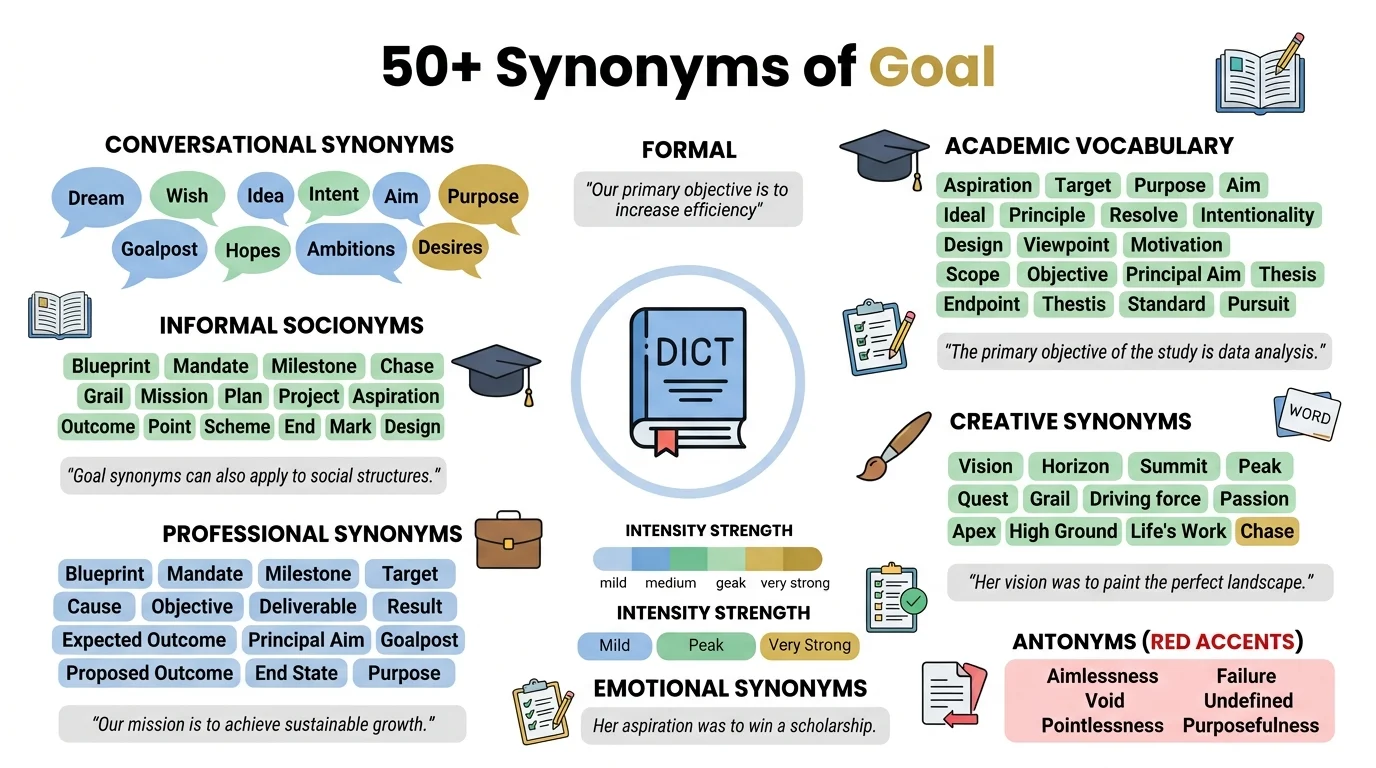
You are writing an important email to your boss. You use the word “goal” three times in the first two sentences. It feels repetitive. Or perhaps you are updating your resume and every bullet point starts with “goal.” You know there are better words, but you are not sure which ones fit.
This is exactly why understanding the synonyms of goal matters. Choosing the right synonym improves your clarity, adjusts your tone, and makes your writing sound more professional. The word “goal” is perfectly fine on its own. But using it too often makes your writing feel flat. And using the wrong synonym can confuse your reader or make you sound less polished than you intend.
This guide will help you understand the meaning of “goal,” explore its best synonyms, and learn exactly when to use each one. By the end, you will confidently choose the right word for every situation.
What Are the Best Synonyms of “Goal”?
A goal is something you aim to achieve through effort and planning. Formal writing, choose “objective” or “target.” For casual conversation, use “aim” or “endgame.” Emotional or personal writing, “dream” or “aspiration” work well. For professional settings, “mission” or “objective” sound strongest. The best synonym depends entirely on your audience and purpose.
Meaning, Tone, and Context
Simple Definition
A goal is the result or achievement toward which effort is directed. It is something you want to accomplish, and it usually requires planning, work, and persistence.
Part of Speech
Goal is a noun. It can also be used attributively, as in “goal setting” or “goal line.”
Overall Tone
The word “goal” is neutral. It does not carry strong emotional weight on its own. The tone comes from how you use it and the words around it.
Formality Level
“Goal” is semi-formal. It works in most contexts. You can use it in academic papers, business meetings, casual conversations, and social media posts. It is safe and versatile.
Common Uses
Native English speakers use “goal” in many situations. In sports, a goal is the act of scoring. In everyday life, a goal is something you want to achieve. People talk about career goals, fitness goals, financial goals, and personal goals. The word appears in resumes, performance reviews, project plans, and casual conversations about life ambitions.
Word Forms
| Form | Example |
|---|---|
| Noun | My goal is to finish this project by Friday. |
| Related Verb | We are goal-oriented in our approach. |
| Adjective | She is a goal-driven professional. |
| Opposite | The opposite of achieving a goal is failure or nonaccomplishment. |
When and How to Use “Goal”
Choose “goal” when you want a clear, neutral word that everyone understands. It works in almost every context. Here are seven realistic examples.
Professional: Our primary goal this quarter is to increase customer retention by 15 percent.
Academic: The goal of this research is to identify effective teaching strategies for struggling readers.
Workplace: Each team member should set at least one personal development goal for the year.
Personal: My goal is to run a marathon before I turn forty.
Email: My goal for this meeting is to align everyone on the project timeline.
Resume: Consistently achieved sales goals exceeding targets by 20 percent year over year.
Social Media: My goal this month is to post consistently and engage more with my audience.
Best Synonyms of “Goal”
No synonym is identical in every situation. The best choice depends on your context, audience, and the specific shade of meaning you want to convey.
Professional Writing
Objective is the best choice for professional writing. It sounds more formal and suggests something specific and measurable. Use it in business plans, project documents, and performance reviews.
Academic Writing
Aim works well in academic contexts. It conveys purpose and direction without sounding overly rigid. Use it in research papers and scholarly articles.
Business Communication
Target is ideal for business communication. It implies a specific number or benchmark that can be measured. Use it in sales reports, quarterly planning, and team meetings.
Casual Conversation
Endgame or aim sound natural in casual conversation. They feel less formal and more conversational than “objective” or “target.”
Emotional Writing
Dream carries emotional weight. It suggests something deeply personal and meaningful. Use it in personal essays, motivational content, and storytelling.
Creative Writing
Quest adds a sense of adventure and purpose. It works well in fiction, fantasy writing, and narratives about personal journeys.
Resume Writing
Objective is the standard choice for resume writing. It sounds professional and focused. You can also use target when discussing measurable achievements.
Workplace Communication
Mission conveys a sense of shared purpose and collective effort. Use it when describing team or company-wide objectives.
Stronger Meaning
Ambition suggests a stronger, more driving desire. Use it when you want to emphasize determination and personal drive.
Softer Meaning
Hope is softer and less certain. Use it when the outcome is less guaranteed or when you want to sound more humble.
When Not to Use “Goal”
When It Sounds Too General
Using “goal” in a resume can sound vague. Employers want to see specific achievements, not generic statements.
Less Effective: My goal was to improve team performance.
Better: My objective was to increase team productivity by 25 percent within six months.
Why It Works: “Objective” sounds more deliberate and measurable.
When It Sounds Too Vague
“Goal” can be too broad for project planning. It does not specify what success looks like.
Less Effective: The goal is to grow the business.
Better: The target is to achieve $2 million in annual recurring revenue by Q4.
Why It Works: “Target” implies a specific number to hit.
When It Sounds Too Informal
In formal academic writing, “goal” can feel slightly informal. Some professors prefer more precise vocabulary.
Less Effective: The goal of this experiment is to test the hypothesis.
Better: The aim of this experiment is to test the hypothesis.
Why It Works: “Aim” sounds more scholarly and deliberate in academic contexts.
When It Sounds Too Weak
“Goal” does not always convey enough determination. If you want to show strong commitment, choose a stronger word.
Less Effective: My goal is to become a leader in my field.
Better: My ambition is to become a leader in my field.
Why It Works: “Ambition” suggests greater drive and personal investment.
When It Sounds Outdated
“Goal” is never truly outdated. But in some modern business contexts, words like “mission” or “vision” feel more current and inspiring.
Words Commonly Confused With “Goal”
Goal vs Objective
Difference: A goal is broader and more general. An objective is more specific and measurable. Your goal might be to improve customer satisfaction. Your objective might be to increase your Net Promoter Score by 10 points.
When to Use Each: Use “goal” for the big picture. Use “objective” for the specific steps.
Example (Goal): Our goal is to become the market leader in sustainable packaging.
Example (Objective): Our objective is to reduce packaging waste by 40 percent by 2027.
Goal vs Aim
Difference: “Aim” often feels slightly less concrete than “goal.” You can have an aim without a clear plan. A goal usually implies more structure.
When to Use Each: Use “aim” for direction and purpose. Use “goal” for something more defined.
Example (Aim): Her aim is to help as many people as possible.
Example (Goal): Her goal is to open five community clinics by 2030.
Goal vs Target
Difference: A target is more specific and often numerical. You hit a target or miss it. A goal can be more qualitative.
When to Use Each: Use “target” when you have a clear metric. Use “goal” for broader aspirations.
Example (Target): Our sales target for this quarter is $500,000.
Example (Goal): Our goal is to build stronger relationships with our clients.
Goal vs Purpose
Difference: Purpose is the reason something exists or is done. Goal is what you want to achieve. Purpose is the “why.” Goal is the “what.”
When to Use Each: Use “purpose” to explain motivation. Use “goal” to state the desired outcome.
Example (Purpose): The purpose of this program is to support first-generation college students.
Example (Goal): The goal of this program is to increase graduation rates.
Goal vs Ambition
Difference: Ambition implies a stronger personal drive and often a longer time horizon. Goals can be short-term. Ambitions are usually long-term and deeply felt.
When to Use Each: Use “ambition” for big, personal dreams. Use “goal” for more practical objectives.
Example (Ambition): Her ambition is to become CEO of a Fortune 500 company.
Example (Goal): Her goal is to complete her MBA by next year.
Goal vs Mission
Difference: A mission often relates to a broader purpose or calling. It can be personal or organizational. A goal is a specific achievement.
When to Use Each: Use “mission” for something that feels like a calling or a larger purpose. Use “goal” for specific targets.
Example (Mission): My mission is to make quality education accessible to every child.
Example (Goal): My goal is to raise $50,000 for school supplies this year.
Best Synonyms of “Goal” by Context
| Context | Best Synonym | Why It Works | Example |
|---|---|---|---|
| Formal writing | Objective | Sounds precise and professional | The objective of this policy is to reduce carbon emissions. |
| Academic writing | Aim | Conveys scholarly purpose | The aim of this study is to explore the effects of sleep on memory. |
| Professional communication | Objective | Clear and business-appropriate | Our objective is to streamline the approval process. |
| Business emails | Target | Implies measurable outcomes | Our target for this campaign is 10,000 new sign-ups. |
| Resume writing | Objective | Standard and professional | Objective: To secure a leadership role in digital marketing. |
| Workplace communication | Mission | Conveys shared purpose | Our mission is to deliver exceptional customer service. |
| Casual conversation | Aim | Natural and conversational | My aim is to save enough for a vacation this year. |
| Everyday speaking | Endgame | Informal and clear | The endgame is to buy a house by age thirty. |
| Creative writing | Quest | Adds adventure and purpose | His quest was to find the lost city. |
| Storytelling | Quest | Creates narrative drive | The hero’s quest was to defeat the dragon. |
| Emotional writing | Dream | Carries personal weight | Her dream was to become a published author. |
| Strong emphasis | Ambition | Suggests powerful drive | His ambition was to change the world. |
| Mild tone | Hope | Softer and less certain | My hope is that we can find a solution. |
| Social media captions | Aspiration | Inspirational and modern | My aspiration is to live a life of purpose. |
| American English | Goal | Standard and widely understood | My goal is to finish this project on time. |
How to Choose the Best Synonym of “Goal”
Choosing the right synonym starts with understanding your purpose.
Consider your audience. Are you writing for a professor, a boss, a friend, or a general audience? Formal audiences usually prefer “objective” or “aim.” Casual audiences respond better to “endgame” or “dream.”
Think about your tone. Do you want to sound professional, emotional, inspiring, or neutral? “Objective” is neutral and professional. “Dream” is emotional and personal. “Mission” is inspiring and purposeful.
Assess the emotional strength you need. “Hope” is mild. “Goal” is neutral. “Ambition” is strong. “Obsession” is very strong. Choose the intensity that matches your message.
Consider the measurability of your statement. If you have a specific number in mind, use “target.” If you have a general direction, use “aim” or “goal.”
Read your sentence aloud. Does the synonym sound natural in context? If it feels forced or awkward, try a different word.
The best synonym communicates your intended message clearly and sounds natural to your reader.
Real Life Examples of “Goal”
School: My goal is to get straight A’s this semester.
Stronger: My objective is to achieve a 4.0 GPA this semester.
College: Her goal is to graduate with honors.
Stronger: Her ambition is to graduate summa cum laude.
Workplace: Our goal is to finish the project by December.
Stronger: Our target is to complete the project by December 1 with all deliverables met.
Business: The company’s goal is to expand into new markets.
Stronger: The company’s mission is to become the leading provider in emerging markets.
Email: My goal for this call is to finalize the budget.
Stronger: My objective for this call is to secure approval for the Q3 budget.
Resume: My goal is to grow my skills in project management.
Stronger: Objective: To leverage project management expertise in a challenging leadership role.
Conversation: My goal is to get in shape this year.
Stronger: My aim is to run a 5K by the end of summer.
Storytelling: Her goal was to find her father.
Stronger: Her quest was to find her father and uncover the truth about his disappearance.
Blogging: My goal is to write more consistently.
Stronger: My aspiration is to build a loyal readership through consistent, quality content.
Social Media: My goal this month is to hit 10,000 followers.
Stronger: My target is to reach 10,000 followers by the end of the month.
18 Best Synonyms of “Goal”
Synonyms of “Goal” by Usage
Professional vs Personal Synonyms
Professional settings call for words like objective, target, and mission. These words sound serious and businesslike. They imply planning and measurement.
Personal conversations work better with aim, dream, and endgame. These words feel more natural and less formal. They reflect personal desires rather than corporate targets.
Formal vs Conversational Synonyms
Formal: objective, aim, purpose, intent, design
Use these in reports, essays, business writing, presentations, and formal emails. They convey precision and professionalism.
Conversational: endgame, aim, dream, hope
Use these in casual conversations, texting, and informal writing. They sound natural and approachable.
Academic Synonyms
Aim is the most common academic synonym for “goal.” It sounds scholarly and deliberate. Objective also works well in academic contexts, especially when discussing research methods.
Purpose is useful when explaining the rationale behind a study. Intention can describe the researcher’s planned course of action.
These words sound more authoritative than “goal” in research papers, essays, reports, and academic discussions.
Professional and Business Synonyms
Objective is the strongest choice for resumes, interviews, and meetings. It sounds focused and results-oriented.
Target works well in performance reviews and client communication. It implies measurable outcomes.
Mission is ideal for presentations and company-wide announcements. It conveys purpose and inspiration.
Ambition is useful in interviews when discussing career goals. It shows drive and determination.
Creative and Literary Synonyms
Quest adds adventure and narrative drive. It works well in fiction, fantasy, and storytelling.
Dream adds emotional depth and personal meaning. It is perfect for poetry and descriptive writing.
End has a literary, philosophical quality. It works in formal creative writing and speeches.
Destination creates a powerful metaphor for life’s journey. It is effective in inspirational writing and memoirs.
Slang or Modern Synonyms
Endgame is a modern, informal synonym that has gained popularity. It is acceptable in casual conversation and social media. Avoid it in formal writing.
Goals (plural) is used informally on social media to express admiration. For example, “Relationship goals” means a relationship worth aspiring to. This usage is casual and should be avoided in professional contexts.
Strongest to Mildest Synonyms
| Intensity | Synonym | Example |
|---|---|---|
| Mild | Hope | My hope is that things will improve. |
| Mild | Intention | My intention is to attend the meeting. |
| Moderate | Aim | My aim is to finish by Friday. |
| Moderate | Goal | My goal is to finish by Friday. |
| Moderate | Objective | My objective is to finish by Friday with all deliverables met. |
| Strong | Target | My target is to finish by Friday at 5 PM. |
| Strong | Mission | My mission is to transform this department. |
| Very Strong | Ambition | My ambition is to become the best in my field. |
| Very Strong | Obsession | His obsession was to win at any cost. |
Emotional vs Neutral Synonyms
Emotional Synonyms: dream, hope, ambition, aspiration, quest
These words express stronger feelings. Use them when you want to connect with your reader on an emotional level. They work well in personal essays, motivational content, and storytelling.
Neutral Synonyms: aim, objective, target, purpose, intention
These words simply communicate information without adding emotion. Use them in professional, academic, and business contexts where objectivity matters.
Antonyms of “Goal”
| Antonym | Meaning | Example Sentence |
|---|---|---|
| Failure | Lack of success | The project ended in failure despite everyone’s best efforts. |
| Defeat | Being beaten or overcome | The team accepted defeat gracefully. |
| Surrender | Giving up or yielding | Surrender was not an option for the determined leader. |
| Abandonment | Giving something up completely | The abandonment of the project surprised everyone. |
| Neglect | Failing to care for or pursue | Neglect of his duties led to his dismissal. |
| Apathy | Lack of interest or concern | Apathy among employees hurt the company’s performance. |
| Indifference | Lack of importance or concern | His indifference to his career was concerning. |
| Aimlessness | Having no purpose or direction | The aimlessness of his efforts was obvious. |
| Purposelessness | Having no purpose | The purposelessness of the exercise frustrated participants. |
| Idleness | Inactivity or laziness | Idleness prevented him from achieving anything meaningful. |
| Inactivity | Doing nothing | Inactivity led to missed opportunities. |
| Stagnation | Lack of progress or development | Stagnation in the market worried investors. |
| Nonaccomplishment | Failure to achieve something | The nonaccomplishment of his goals disappointed him. |
| Defeatism | Acceptance of defeat without a fight | Defeatism spread through the team after the first setback. |
| Resignation | Passive acceptance of failure | His resignation to the situation was heartbreaking. |
Comparison: “Goal” vs Similar Words
Goal vs Objective
Main Difference: A goal is broad and general. An objective is specific and measurable.
Which Is Stronger? Neither is inherently stronger. “Objective” sounds more deliberate and businesslike.
Which Is More Formal? “Objective” is more formal.
When to Use Each: Use “goal” for the big picture. Use “objective” for specific, measurable steps.
Goal: My goal is to become a better public speaker.
Objective: My objective is to deliver three presentations without notes by the end of the quarter.
Goal vs Aim
Main Difference: “Aim” often feels less concrete. A goal usually implies more planning and structure.
Which Is Stronger? “Goal” is generally stronger because it implies more commitment.
Which Is More Formal? Both are semi-formal. “Aim” is slightly more common in academic writing.
When to Use Each: Use “aim” for direction. Use “goal” for something more defined.
Goal: My goal is to save $10,000 this year.
Aim: My aim is to live more frugally.
Goal vs Target
Main Difference: A target is usually numerical and precise. A goal can be qualitative.
Which Is Stronger? “Target” implies greater precision and accountability.
Which Is More Formal? Both are used in formal contexts. “Target” is common in business.
When to Use Each: Use “target” when you have a specific number. Use “goal” for broader aspirations.
Goal: My goal is to improve my fitness.
Target: My target is to run a 7-minute mile.
Goal vs Purpose
Main Difference: Purpose is the reason something exists. Goal is what you want to achieve.
Which Is Stronger? “Purpose” carries more existential weight.
Which Is More Formal? Both are formal enough for most contexts.
When to Use Each: Use “purpose” to explain motivation. Use “goal” to state the desired outcome.
Goal: My goal is to graduate from college.
Purpose: My purpose in going to college is to gain knowledge and skills for my career.
Goal vs Ambition
Main Difference: Ambition implies stronger personal drive and a longer time horizon.
Which Is Stronger? “Ambition” is much stronger.
Which Is More Formal? Both are appropriate in formal and informal contexts.
When to Use Each: Use “ambition” for big, personal dreams. Use “goal” for more practical objectives.
Goal: My goal is to get a promotion this year.
Ambition: My ambition is to become the youngest vice president in company history.
Goal vs Mission
Main Difference: A mission often feels like a calling or larger purpose. A goal is a specific achievement.
Which Is Stronger? “Mission” conveys more significance and purpose.
Which Is More Formal? Both are formal enough. “Mission” is common in organizational statements.
When to Use Each: Use “mission” for something that feels like a calling. Use “goal” for specific targets.
Goal: My goal is to increase team productivity.
Mission: My mission is to build a workplace culture where everyone can thrive.
Common Phrases and Expressions with “Goal”
Set a Goal
Meaning: To decide on something you want to achieve.
Example: I need to set a goal for my fitness journey this year.
Achieve a Goal
Meaning: To successfully accomplish something you aimed for.
Example: She worked hard and finally achieved her goal of becoming a doctor.
Reach a Goal
Meaning: To arrive at or accomplish a goal.
Example: After months of training, he reached his goal of running a marathon.
Work Toward a Goal
Meaning: To make ongoing effort to achieve something.
Example: Every day, we work toward our goal of reducing waste in the office.
Goal in Life
Meaning: A major life ambition or purpose.
Example: Her goal in life is to make a difference in her community.
Common Goal
Meaning: A goal shared by multiple people.
Example: The team had a common goal of winning the championship.
Long-Term Goal
Meaning: A goal that takes a long time to achieve.
Example: Buying a house is a long-term goal for many young professionals.
Short-Term Goal
Meaning: A goal that can be achieved in the near future.
Example: My short-term goal is to finish this report by Friday.
Common Mistakes to Avoid
Choosing a Vague Synonym Instead of a Precise One
Incorrect: My goal is to do better at work.
Better: My objective is to increase my sales numbers by 10 percent this quarter.
Why: “Objective” sounds more specific and measurable. “Do better” is too vague.
Confusing “Goal” With “Purpose”
Incorrect: The purpose of this project is to finish by December.
Better: The goal of this project is to finish by December. The purpose is to increase market share.
Why: Purpose explains why. Goal explains what. Using them interchangeably confuses your reader.
Using an Informal Synonym in Formal Writing
Incorrect: Our endgame is to become the industry leader.
Better: Our objective is to become the industry leader.
Why: “Endgame” is too casual for formal business writing.
Selecting an Overly Dramatic Synonym
Incorrect: My obsession is to get a promotion.
Better: My goal is to get a promotion.
Why: “Obsession” sounds extreme and unhealthy for a professional context.
Repeating the Same Word Too Often
Incorrect: Our goal is to increase sales. Another goal is to improve customer service. A third goal is to reduce costs.
Better: Our goal is to increase sales. Our objective is to improve customer service. Our target is to reduce costs by 10 percent.
Why: Varying your word choice makes your writing more engaging and professional.
Choosing a Synonym With the Wrong Emotional Tone
Incorrect: My dream is to finish this spreadsheet by 5 PM.
Better: My goal is to finish this spreadsheet by 5 PM.
Why: “Dream” implies something deeply personal and meaningful. A spreadsheet is not that.
Using Slang in Academic or Professional Writing
Incorrect: Our goals for this research project are ambitious.
Better: Our aims for this research project are ambitious.
Why: “Aim” sounds more scholarly and appropriate for academic writing.
Frequently Asked Questions
What are the best synonyms of “goal”?
The best synonyms depend on your context. Professional writing, use “objective” or “target.” For academic writing, use “aim.” For casual conversation, use “endgame” or “dream.” Emotional writing, use “ambition” or “aspiration.”
What are the best formal synonyms of “goal”?
The best formal synonyms include “objective,” “aim,” “purpose,” “intent,” and “design.” These words sound professional and precise. Use them in reports, essays, business writing, and formal presentations.
What are common informal synonyms of “goal”?
Common informal synonyms include “endgame,” “dream,” “hope,” and the slang usage of “goals.” These words work well in casual conversation, social media, and personal writing. Avoid them in professional or academic contexts.
What is another word for “goal” in professional writing?
“Objective” is the most common professional synonym. “Target” works well when discussing measurable outcomes. “Mission” is effective for organizational or team purposes. Choose based on whether you need specificity, measurability, or inspiration.
What is the difference between “goal” and “objective”?
A goal is broad and general. An objective is specific and measurable. Your goal might be to improve customer satisfaction. Your objective might be to increase your Net Promoter Score by 10 points. Goals are the big picture. Objectives are the specific steps.
What is the opposite of “goal”?
The opposite of a goal is failure, defeat, surrender, abandonment, or aimlessness. Other antonyms include nonaccomplishment, stagnation, and purposelessness. These words describe the absence of achievement, direction, or purpose.
Conclusion
The word “goal” is simple and versatile. It means something you aim to achieve through effort and planning. But using the same word over and over makes your writing feel repetitive and flat.
The best synonyms of goal depend on your context. “objective” for professional writing. Use “aim” for academic work. Use “target” for measurable outcomes. “dream” or “ambition” for emotional or personal statements. No single synonym works perfectly in every situation.
The key to better vocabulary is paying attention to your audience, your tone, and your purpose. Choose the word that communicates your message most clearly. Your readers will notice the difference.
One practical tip: Before you write, ask yourself what you really mean. Are you stating a broad direction, a specific target, or a personal dream? Once you know, pick the synonym that fits.