You have probably heard this word in a news report, a classroom debate, or a courtroom drama. Yet prejudice is one of those words that people feel strongly about but struggle to define. So what does it actually mean?
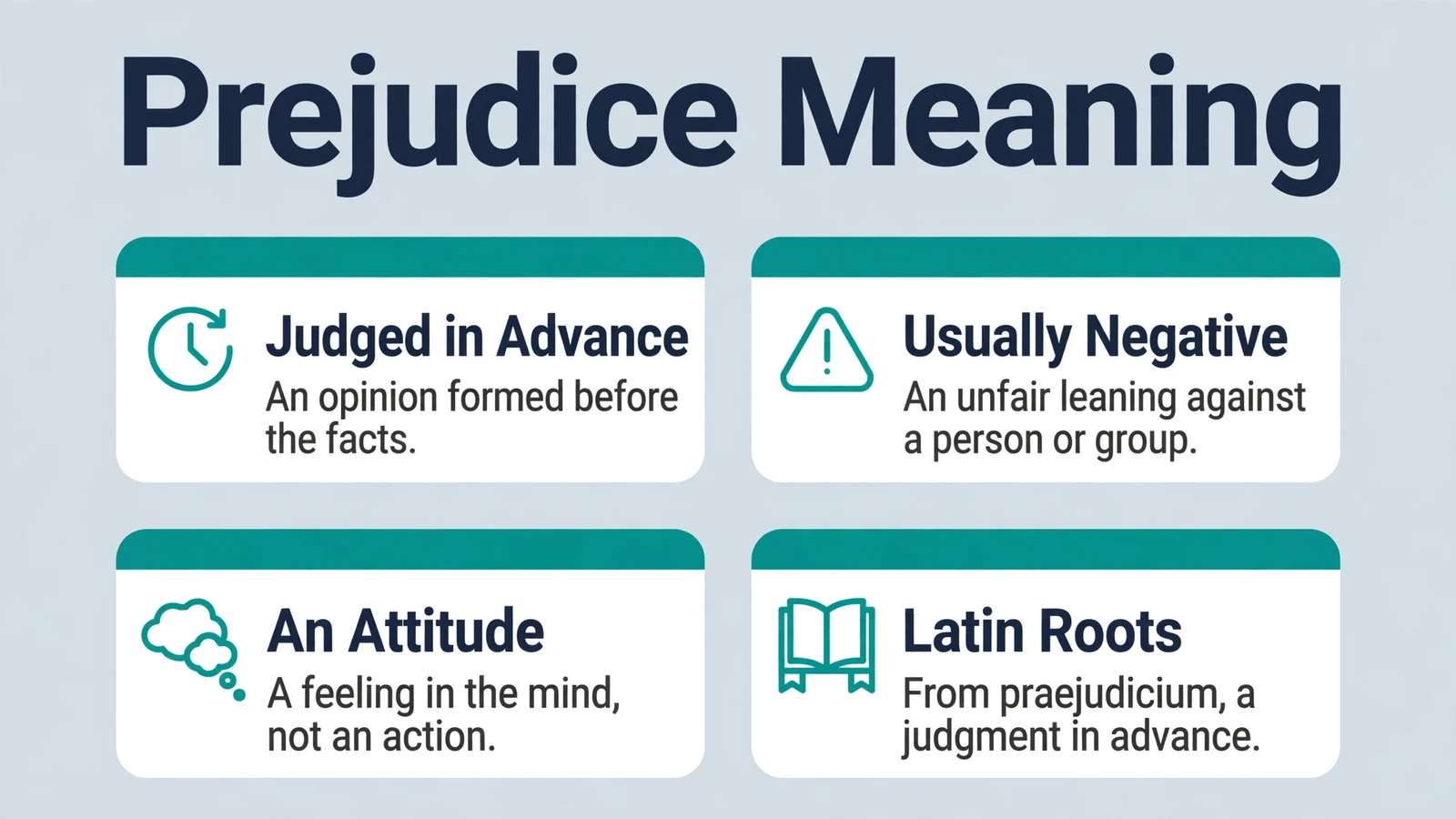
Prejudice means a judgment or opinion formed about a person or group before you know the facts. Merriam-Webster calls it a “preconceived judgment or opinion.” The judgment is usually negative, and it rests on group membership rather than real knowledge of the individual.
This guide explains the word the way dictionaries and psychologists use it. You will find its Latin roots, its main types, and clear examples in sentences. You will also meet the legal sense hiding inside the phrase “dismissed with prejudice.” By the end, you will know how prejudice differs from a stereotype, from discrimination, and from everyday bias.
What Does Prejudice Mean?
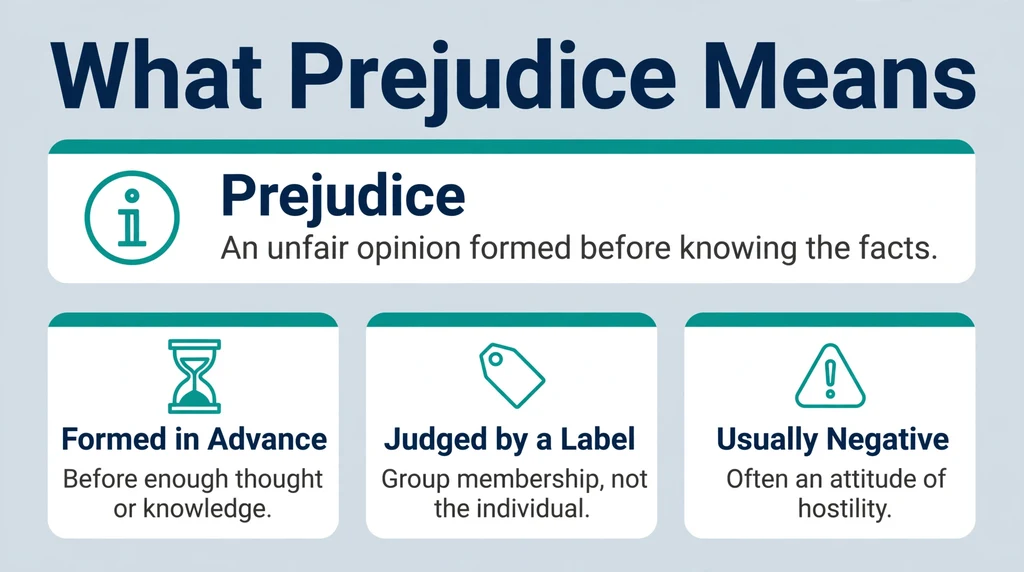
Prejudice is a noun, pronounced “PREJ-uh-dis.” In its most common sense, it means an opinion or feeling about someone that was formed in advance, without enough thought or knowledge.
Cambridge Dictionary puts it plainly. Prejudice is “an unfair and unreasonable opinion or feeling, especially when formed without enough thought or knowledge.” Notice the two key ingredients in that definition. First, the opinion comes before the evidence. Second, it is unfair, because it judges a person by a label instead of by who they are.
The dictionary senses, one by one
Merriam-Webster lists several connected senses. First comes a preconceived judgment or opinion. The second is an adverse opinion or leaning formed without just grounds, or before sufficient knowledge. The third is stronger still: an irrational attitude of hostility toward an individual, a group, or a race.
Each sense adds a layer. A preconceived judgment can be mild, like assuming a new coworker will be difficult. An attitude of hostility is heavier, and it usually targets a whole group. Together, the senses explain why the word covers everything from quiet assumptions to open hostility.
How psychologists define it
Psychologists use the word in a similar way, but with sharper edges. The APA Dictionary of Psychology defines prejudice as a negative attitude toward another person or group. Crucially, that attitude is formed in advance of any experience with the person or group. It can rest on race, sex, age, disability, or other group characteristics.
In short, everyday English and psychology agree. Prejudice is judging first and learning later, if learning happens at all.
Countable, uncountable, and the word “against”
Learners often ask how the noun behaves in a sentence. Prejudice works both as an uncountable noun and a countable one. Used generally, it takes no article: “Prejudice is learned early.” Aimed at one target, it becomes countable: “a prejudice against modern art,” or “her prejudices about city life.”
The preposition matters just as much. English overwhelmingly pairs the noun with “against,” because the feeling usually leans that way. You will also meet “prejudice toward” in American writing. Both patterns point in the same direction: a judgment aimed at a target, formed before the target could speak for itself.
Core Meaning of Prejudice
The core meaning becomes clear when you split the word into its two ideas. You take a judgment, and you move it earlier in time, before the facts arrive. That simple shift explains almost everything about the word.
A judgment made in advance
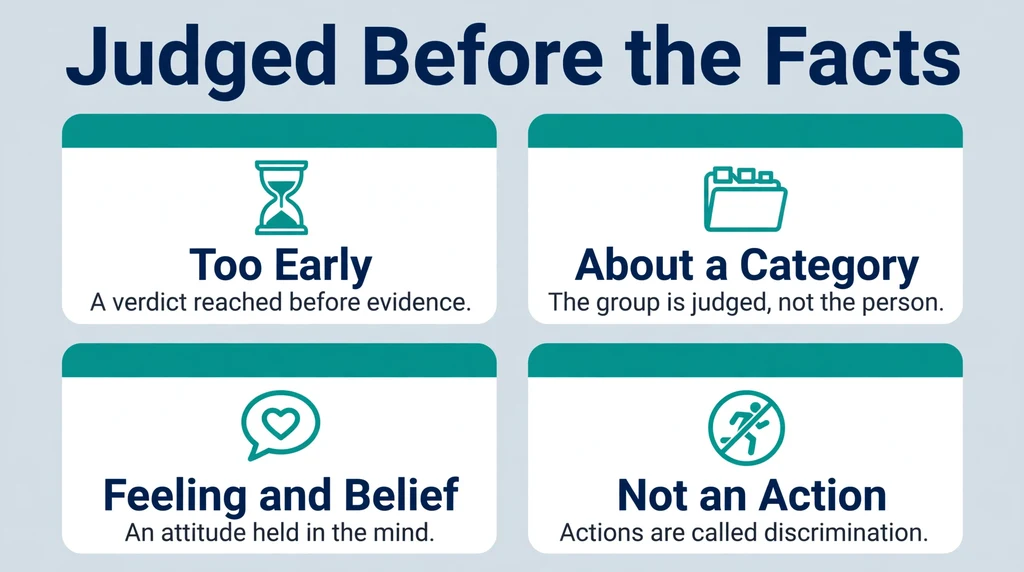
Every prejudice is a verdict reached too early. A hiring manager might decide that a young applicant is unreliable, without reading the application. A traveler might assume a whole city is unfriendly after one rude taxi ride. In both cases, the mind closes before the evidence opens.
Importantly, the judgment attaches to a category, not to a person. Psychologists describe this as judging someone by perceived group membership. The individual in front of you becomes an example of a type, and the type has already been judged.
Usually negative, but not by definition
Modern usage is overwhelmingly negative, and dictionaries reflect that. However, reference works note a subtle point. Strictly speaking, a prejudice can be an opinion formed in advance, either favorable or unfavorable. A reader might be prejudiced in favor of a beloved author, for instance, and forgive a weak new novel.
In practice, though, the favorable sense is rare. When people say prejudice today, they almost always mean an unfair leaning against someone. The rest of this article uses the word in that usual, negative sense.
An attitude, not an action
One more point sits at the core of the word. Prejudice lives in the mind and the feelings. It is an attitude, which means it shapes how a person thinks and feels. Actions may follow from it, but the actions have their own name: discrimination. That distinction matters, and a later section explores it in full.
Feeling, thought, and readiness to act
The APA definition adds a useful detail: prejudice can include affective, cognitive, and behavioural components. In plain words, it mixes feelings, beliefs, and leanings toward action. Feelings might include dislike, fear, or contempt. The belief might be a stereotype about the group. Leanings might include a wish to avoid, exclude, or keep distance.
Not every prejudice contains all three parts in equal measure. A person may feel uneasy without holding any clear belief. Another may repeat a belief without strong emotion. Still, the three strands explain why prejudice is stubborn: challenging the belief alone leaves the feeling untouched, and challenging the feeling alone leaves the belief in place.
Origin and History of Prejudice
Few English words carry their meaning in their bones as clearly as this one. The history of prejudice is, quite literally, the history of judging too soon.
Latin roots: judgment, before its time
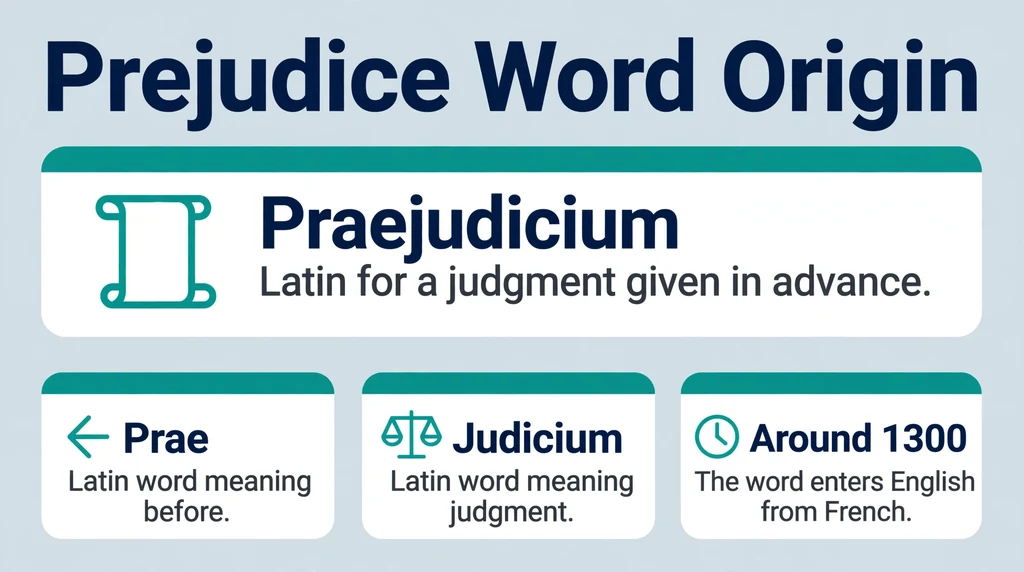
English borrowed prejudice around the year 1300, through Old French. Behind the French word stood the Latin praejudicium. That Latin noun meant a preceding judgment, or a judgment given in advance. It was built from two parts: prae, meaning “before,” and judicium, meaning “judgment” or “trial.” Judicium itself came from judex, the Latin word for a judge.
So the oldest meaning was almost legal. A praejudicium was a preliminary decision, one that could affect a later case. From there, the word widened. By the late 1300s, English speakers were using prejudice for a preconceived opinion of any kind.
The older sense of harm
Interestingly, the first English senses were not mainly about opinions. One of the earliest meanings, recorded in the 13th century, was injury or damage. Specifically, it meant harm caused by someone’s judgment or action, in disregard of your rights. That old legal flavor never fully disappeared, and modern law still uses the word this way.
Allport and the modern study of prejudice
The word took on a scientific life in the twentieth century. In 1954, psychologist Gordon Allport published The Nature of Prejudice, a landmark study of the topic. Allport defined prejudice as “an antipathy based upon a faulty and inflexible generalization.” His definition highlights two faults: the generalization is faulty, and it refuses to bend.
Allport also linked prejudice to categorical thinking, our habit of sorting the world into groups. That sorting is normal and often useful. Prejudice begins when a category hardens into a hostile verdict about everyone inside it.
His book shaped how universities teach the subject to this day. Later textbooks borrowed his central insight: the problem is not having categories, but holding them rigidly. When a generalization cannot bend, every new fact gets forced into the old shape. That is why the definition stresses the word “inflexible.” A flexible opinion can be corrected by experience; a prejudiced one edits experience instead.
A famous title
Long before psychologists adopted the word, a novelist made it famous. Jane Austen published Pride and Prejudice in 1813, anonymously, as was common for women writers of her time. In the novel, Elizabeth Bennet and Mr. Darcy must each overcome their pride and their prejudice. Their story remains a neat portrait of first impressions corrected by experience.
Common Types of Prejudice
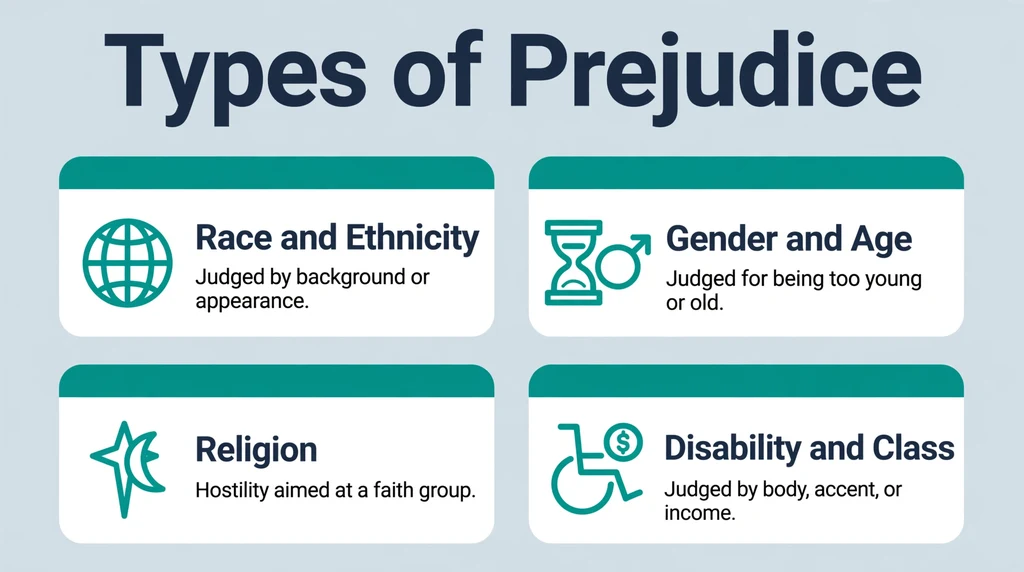
Prejudice is usually sorted by the characteristic it targets. The APA notes bases such as race, sex, age, and disability. Britannica likewise lists targets including ethnicity, weight, disability, and religion. The types below follow those standard categories.
Racial and ethnic prejudice
This is the type most people picture first. It means a negative attitude toward people because of their race or ethnic background. The judgment treats ancestry or appearance as evidence about character. Historically, this form has driven exclusion from jobs, housing, and education.
Gender prejudice
Gender prejudice targets people because they are women, men, or outside the usual gender categories. A classic example is assuming that women are unsuited to leadership, or that men should not work in childcare. The assumption arrives before the person has done anything at all.
Age prejudice
Age cuts in both directions. Older workers may be dismissed as slow with technology, whatever their actual skills. Younger workers may be written off as careless or entitled. In both cases, a birth year does the judging, and the individual’s record is ignored.
Religious prejudice
Religious prejudice is hostility or suspicion aimed at a faith group. It can target any religion, and it often relies on confusing the actions of a few with the beliefs of millions. The attitude judges an entire tradition by its loudest or worst examples.
Prejudice based on sexual orientation
The APA’s definition also names sexual orientation among the bases of prejudice. People may be judged negatively because they are gay, lesbian, bisexual, or assumed to be. As with religion, the attitude often rests on ideas about a whole group rather than knowledge of any individual. It can appear in families, schools, workplaces, and laws, and it follows the same early-judgment pattern as every other type in this section.
Prejudice based on disability, appearance, and class
Other common bases receive less attention but follow the same pattern. People with disabilities may be wrongly assumed to be less capable. People may also be judged by body weight, clothing, accent, or family income. Britannica specifically mentions weight among the targets of prejudice. Whatever the surface trait, the mechanism is identical: the category speaks first, and the person is never heard.
Prejudice vs. Discrimination, Stereotypes, and Bias
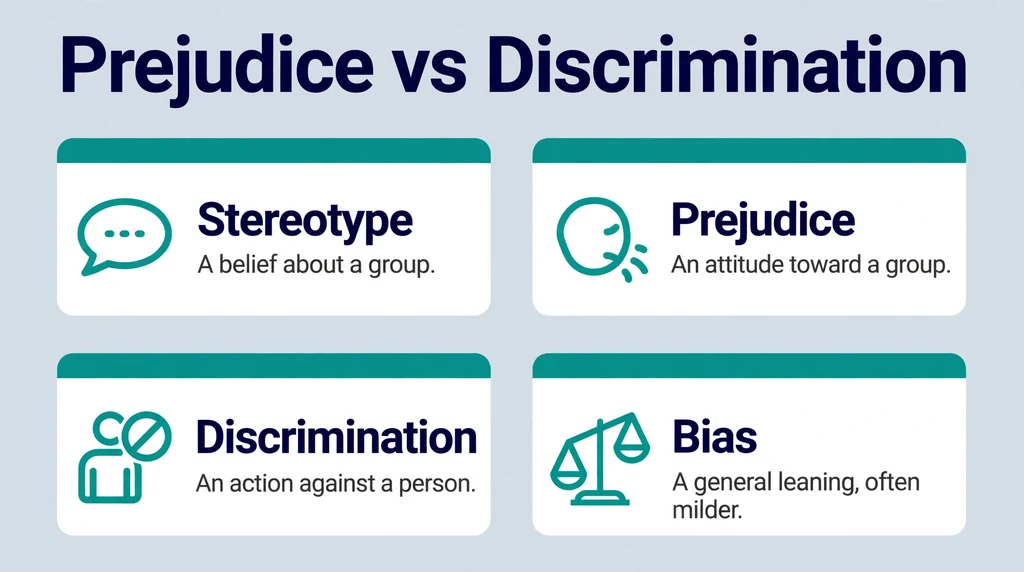
These four words travel together, and many people use them as if they were identical. Social psychologists, however, keep them apart. Learning the difference makes the whole topic much clearer.
Stereotype: the belief
A stereotype is a fixed, oversimplified belief about a group of people. Britannica describes stereotypes as generalizations that often lack rational support. “Older people are bad with computers” is a stereotype. It lives in the realm of thought, and it claims to describe how a group is.
Prejudice: the attitude
Prejudice is the feeling that grows on top of such beliefs. It is an adverse or hostile attitude toward a group, or toward a person simply for belonging to it. Where a stereotype says “they are all like that,” prejudice adds “and I dislike them for it.” Teachers of social psychology often compress the trio into one line: stereotype is the belief, prejudice is the attitude, discrimination is the behaviour.
Discrimination: the behaviour
Discrimination is what happens when the attitude turns into action. It means treating someone unfairly because of group membership. Refusing to rent a flat to a qualified tenant because of her religion is discrimination. Notice the difference in kind: prejudice can stay private, inside one person’s head, while discrimination reaches out and harms someone.
Bias: the broader leaning
Bias is the widest and softest word of the four. It means a leaning toward or against something, and it need not involve hostility at all. Collins Dictionary’s synonym note makes the contrast nicely. Bias is also preconceived and unreasonable at times, it says, but it often implies a less harmful and less uncompromising quality than prejudice. A referee can have a bias toward attacking football; a hiring panel’s prejudice is a far graver charge.
A side by side summary
| Word | What it is | Simple test |
|---|---|---|
| Stereotype | A belief about a group | “They are all like that.” |
| Prejudice | An attitude toward a group | “I dislike them for it.” |
| Discrimination | An action against a person | “They were treated unfairly.” |
| Bias | A general leaning | “I tend to favour this side.” |
The four often work as a chain. A stereotype supplies the belief, prejudice supplies the feeling, and discrimination delivers the behaviour. Still, the chain can break at any link. A person can hold a stereotype without hostility, and another can feel prejudice yet never act on it.
One scene, four words
Watch the chain inside a single hiring round. A panel member believes that graduates of one university are always arrogant; that belief is a stereotype. She feels sure she will dislike this candidate before he speaks; that feeling is prejudice. The panel then scores him lower than an identical rival, without a fair reason; that act is discrimination. Meanwhile, a second member quietly prefers candidates who play team sports; that mild leaning is a bias, harmless here, though worth noticing.
The scene shows why precision helps. Each word points at a different moment, and each moment invites a different remedy.
Examples of Prejudice in Sentences
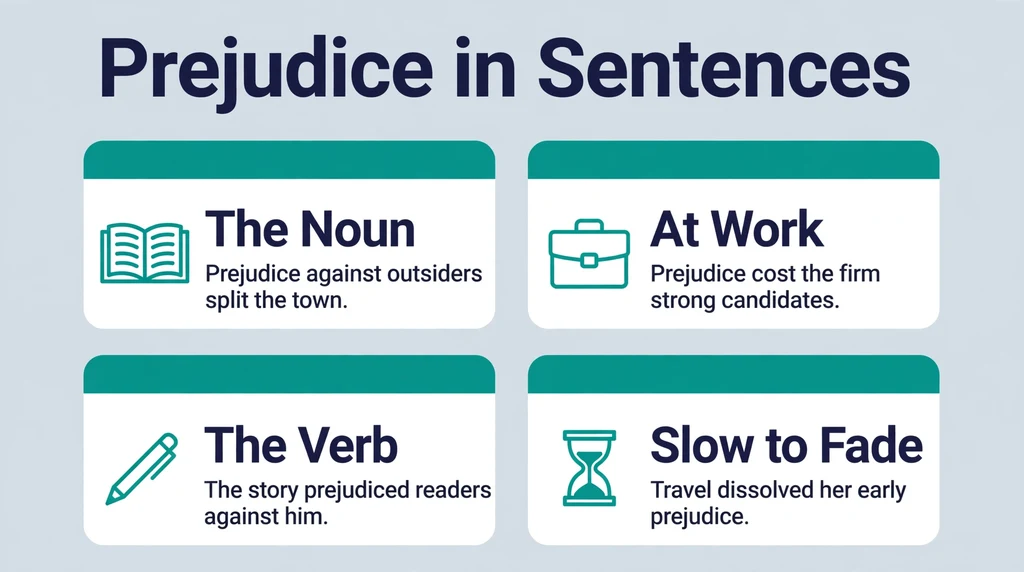
Definitions settle the idea, but examples make it stick. The sentences below are original, and each one shows a judgment arriving before the facts.
The noun in everyday sentences
- Without meeting her new neighbours, she already believed their music would be too loud, a small prejudice built from nothing but a guess.
- The committee’s prejudice against self-taught programmers cost it several strong candidates.
- He grew up hearing prejudice against left-handed people, who were once forced to write with the other hand.
- Years of travel slowly dissolved her prejudice against spicy food.
- The novel shows how prejudice against outsiders can split a small town.
- Their campaign challenged the prejudice that older drivers are always unsafe.
Sentences that show types of prejudice
- Assuming a young manager cannot lead a team is age prejudice at work.
- She faced gender prejudice when her ideas were ignored, then praised once a man repeated them.
- His prejudice against a rival football club stopped him from enjoying a fine match.
The word in its favourable and neutral corners
- Long loyalty made him prejudiced in favour of the old shop, though its prices were higher.
- The editor asked readers to approach the report without prejudice, and to weigh only the evidence.
The verb in sentences
- One angry review prejudiced thousands of readers against the film before it opened.
- The lawyer worried that the headline would prejudice the jury against her client.
- Nothing in his record should prejudice the panel against an otherwise strong application.
More sentences from school and work
- The teacher fought her own prejudice against quiet students, reminding herself that silence is not the same as confusion.
- Prejudice against vocational training kept the school from funding its excellent workshop.
- When the orchestra auditioned musicians behind a screen, it removed the chance for prejudice to guide the judges’ ears.
- His speech attacked the prejudice that treats an accent as a measure of intelligence.
- The report found no prejudice in the marking, because every script was graded anonymously.
Each of these sentences keeps the same skeleton. Someone judges, or refuses to judge, a person or group before fair evidence is available. Change the setting, and the skeleton stays.
Notice the grammar as you read. The noun usually pairs with “against”: prejudice against a group, a method, or an idea. In British spelling, the favourable pairing is “in favour of,” while American writers more often use “in favor of.” The verb, meanwhile, always does something to someone: it biases a mind, a jury, or a decision.
Prejudice in Law: With Prejudice and Without Prejudice
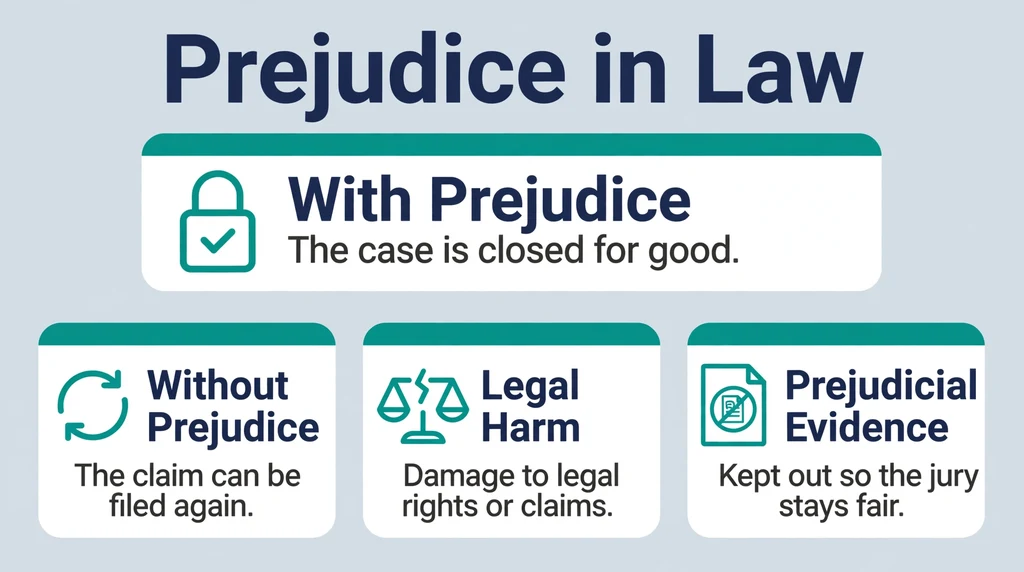
In a courtroom, prejudice changes its meaning almost completely. Lawyers use the word as a technical term, and the sense reaches back to the word’s oldest legal roots.
The legal sense of harm
First, law keeps the ancient idea of damage. A party can suffer prejudice when a judgment or action harms their legal rights or claims. Merriam-Webster records this as a legal sense of the noun: detriment to one’s legal rights. A defendant might argue, for example, that a long delay caused prejudice because witnesses have moved away.
Dismissed with prejudice
When a court dismisses a case “with prejudice,” the decision is final. Cornell Law’s Wex dictionary explains that the court intends the dismissal to be final in all courts. The dismissal counts as an adjudication on the merits, a ruling on the claim itself. Under the doctrine of res judicata, the same claim cannot simply be filed again.
In plain terms, the case is over for good. The phrase sounds negative, yet it often protects defendants from endless repeat lawsuits.
Dismissed without prejudice
A dismissal “without prejudice” works the opposite way. It is not a ruling on the merits of the claim. As Wex explains, the plaintiff remains free to refile the claim, sometimes in a different court. Courts often choose this route when a case has a fixable problem, such as the wrong court or missing paperwork.
So the little preposition carries the whole weight. “With” slams the courthouse door; “without” leaves it open.
Prejudiced or prejudicial?
Two adjectives grow from the noun, and they are not interchangeable. “Prejudiced” describes a person or attitude that holds a prejudice: a prejudiced remark, a prejudiced juror. “Prejudicial” describes something that causes harm or unfairness, and lawyers use it constantly. Evidence can be prejudicial, meaning it might sway a jury unfairly. A delay can be prejudicial to a defendant’s case, meaning it damages the case. Remember it this way: people are prejudiced; things and events are prejudicial.
Prejudicial evidence
The word also appears in the law of evidence. A judge may exclude evidence as prejudicial if it would unfairly bias the jury against a party. Wex points to Rule 403 of the Federal Rules of Evidence on this point. This legal use sits closest to the everyday meaning, since it is all about preventing an unfair prejudgment.
Explicit and Implicit Prejudice
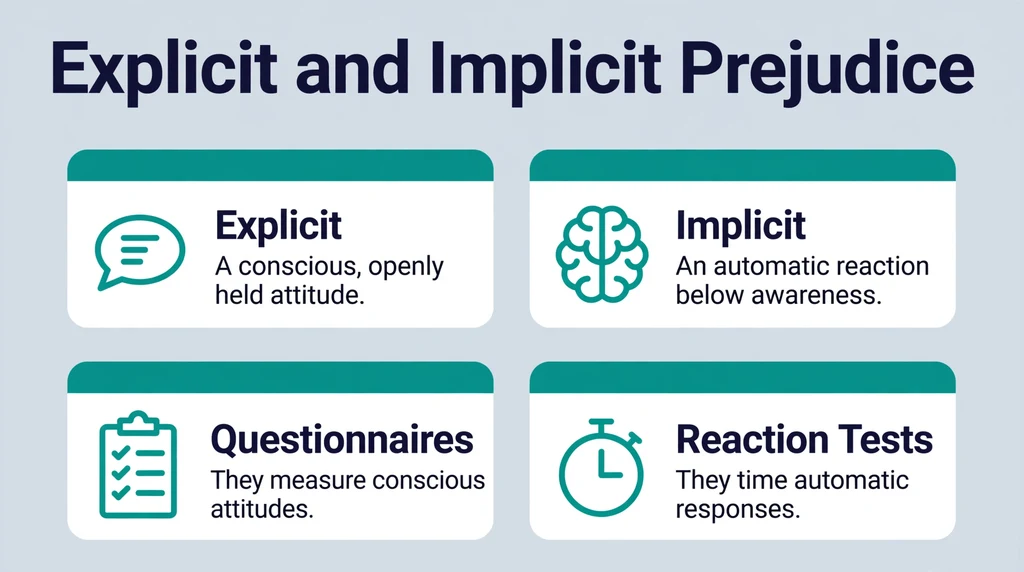
Psychologists add one more distinction, and it explains many modern discussions of the word. Prejudice can be spoken aloud, or it can hide below awareness.
Explicit prejudice: the conscious attitude
The APA Dictionary defines explicit prejudice as a negative attitude against a specific social group that is consciously held. The person is aware of the attitude, even if they never express it in public. Researchers can measure this kind fairly directly, often with questionnaires. Because the attitude is conscious, the person can also examine it, question it, and work to change it.
Implicit prejudice: the automatic attitude
Implicit prejudice works quietly. It is a negative association that surfaces automatically, sometimes in people who sincerely reject prejudice. A person may honestly believe in equality, yet still feel a flicker of suspicion that they did not choose. Social psychologists study this gap between stated beliefs and automatic reactions.
Tests such as the Implicit Association Test try to measure these reactions by timing responses. Results from such tests describe tendencies, not verdicts about a person’s character. Researchers therefore treat them as one tool among several, not as a label.
Why the distinction matters
The distinction matters because the two kinds call for different responses. Explicit prejudice can be challenged with facts, rules, and open discussion. Implicit prejudice is harder to reach, since its owner may not see it. Awareness, reflection, and fair procedures help in both cases, because they slow the rush to judgment.
Can both live in one person?
Yes, and this is more common than most people expect. Someone may openly reject prejudice, pass every questionnaire honestly, and still carry automatic associations from their upbringing. The conscious mind and the automatic mind can hold different settings. Psychologists treat this gap as a normal feature of how attitudes work, not as proof of secret malice. What matters is what a person does with the awareness: pausing, checking, and judging the individual remains a choice.
How Prejudice Forms and How It Can Be Reduced
If prejudice is a judgment formed too early, a fair question follows. Why does the mind rush, and can it learn to slow down?
Categorization: the mind’s shortcut
Allport linked prejudice to categorical thinking, the mind’s habit of sorting people and things into groups. Sorting is not a defect; it is how humans handle a crowded world. Trouble starts when a category becomes a cage. Then every member of the group is treated as identical, and fresh evidence cannot get in.
In-groups, out-groups, and learning
People also favour their own group, the in-group, over outside groups. That tilt can grow into prejudice when the out-group is cast as a threat or a rival. Children absorb attitudes early, from family talk, jokes, stories, and screens. A prejudice is therefore often inherited socially, long before it is examined personally.
Fear plays a part as well. The unfamiliar can feel risky, and a ready-made judgment feels safe. Sadly, the feeling of safety is an illusion, because the judgment was never tested against reality.
The role of stories and screens
Attitudes also arrive through repeated portrayals. When films, jokes, and headlines keep showing one group in the same narrow role, the role starts to feel like the truth. Repetition is powerful because it never announces itself as an argument. Nobody sits down and decides to adopt the idea; it simply becomes familiar, and familiar ideas feel safe. The same channel can work in reverse, of course. Stories that show people as individuals, with mixed motives and ordinary lives, quietly widen what an audience expects.
What helps reduce it
Social psychologists discuss several reliable directions, all consistent with Allport’s framework. Contact between groups helps, especially when people meet as equals and work toward a shared goal. In that setting, the category cracks, and individuals become visible.
Accurate information helps too, though facts alone rarely melt a hardened attitude. Perspective-taking adds what facts cannot: it asks a person to imagine the situation from the other side. Finally, fair rules in schools, hiring, and housing limit the damage prejudice can do, even while attitudes catch up. Change is slow, but the direction is well established.
Common Misconceptions About Prejudice
A few misunderstandings follow this word everywhere. Clearing them up makes conversations about it far more productive.
“Prejudice and discrimination are the same thing”
They are not, however closely they travel together. Prejudice is an attitude held in the mind. Discrimination is behaviour directed at a person. One can exist without the other: a prejudiced landlord may never act, because the law forbids it, while unfair systems can produce discriminatory results. Keeping the words separate shows us where a problem actually sits.
“Prejudice is only about race”
Race is a major basis, but it is far from the only one. Age, gender, religion, disability, weight, accent, and class all attract prejudice. Britannica lists several such targets in its discussion of the topic. The pattern is always the same; only the label changes.
“Prejudice is always a conscious choice”
Some prejudice is deliberate and openly stated. Much of it, though, is implicit, absorbed from surroundings and rarely inspected. A person can be surprised by their own automatic reactions. That surprise is uncomfortable, but it is also the beginning of change.
“Only prejudiced people stereotype”
Everyone generalizes; the human mind runs on categories. The fault lies not in having categories, but in holding them inflexibly against the evidence. EBSCO’s research summary notes that people often protect a stereotype by calling counterexamples “exceptions to the rule.” Recognizing that move, in ourselves and others, is a practical defence.
“One friendly exception fixes everything”
Meeting one kind person from a disliked group rarely dissolves a prejudice. Instead, the mind files that person away as an exception, and the general rule survives untouched. Researchers describe exactly this habit of protecting stereotypes from contrary evidence. Real change usually needs repeated contact with many individuals, in varied settings. A single exception is a crack in the wall; it is not yet a door.
Synonyms and Antonyms of Prejudice
Because this word sits in a crowded family, near-synonyms help pin down its exact strength.
Close synonyms, in rough order of strength
- Preconception and prejudgment: the neutral core of the idea, a notion formed beforehand.
- Bias: a leaning, for or against, often milder than prejudice.
- Partiality: a leaning in someone’s favour, usually from fondness or attachment.
- Intolerance: refusal to accept views, beliefs, or people that differ from one’s own.
- Bigotry: the hardest word in the family, meaning stubborn, intense prejudice, often with hostility.
Collins Dictionary offers a useful warning here. Words like partiality and predilection describe favouring, while prejudice usually implies suspicion, fear, or dislike. Choosing the right synonym is therefore a matter of direction as well as strength.
Antonyms
The natural opposites are fairness, impartiality, tolerance, and open-mindedness. Each one reverses a part of the definition. Fairness waits for evidence, impartiality refuses to take sides in advance, and tolerance makes room for difference. Together, they describe the mindset that prejudice replaces.
A note on “racism”
Readers sometimes ask whether racism is simply a synonym. It is better understood as a specific member of the family. Dictionaries define racism as prejudice, discrimination, or hostility based on race or ethnicity. Prejudice is the wider word, covering many more targets. Every act of racism involves prejudice or discrimination, but much prejudice, against age, faith, disability, or class, has nothing to do with race.
Frequently Asked Questions
What is prejudice in simple words?
Prejudice means judging someone before you know them. You form an opinion about a person because of the group they belong to, not because of anything they have done. The opinion forms early, and it usually is not fair.
What is the difference between prejudice and discrimination?
Prejudice is an attitude, while discrimination is an action. Prejudice says, “I dislike that group.” Discrimination says, “I will treat this person unfairly because of that group.” One happens in the mind; the other happens in the world.
Can prejudice be positive?
Strictly, dictionaries allow it, since a prejudice is any opinion formed in advance. Someone can be prejudiced in favour of a person or a product. In everyday modern English, however, the word almost always carries a negative meaning.
What is an example of prejudice?
A manager who assumes a young employee is careless, before seeing any of the employee’s work, shows prejudice. The judgment came first, the evidence never arrived, and a whole age group did the talking. That is the pattern in nearly every example.
Where does the word prejudice come from?
It comes from the Latin praejudicium, meaning a judgment given in advance. The Latin word joins prae, “before,” with judicium, “judgment.” English took the word from Old French around the year 1300, and the modern opinion sense developed soon after.
What does “dismissed with prejudice” mean?
It means a court has closed the case for good. The dismissal counts as a final ruling on the claim itself. The same claim cannot be brought again, which is very different from a dismissal without prejudice, where refiling is allowed.
How is prejudice different from a stereotype?
A stereotype is a belief about a group, and prejudice is the attitude built on it. The stereotype claims that all members of a group share a trait. Prejudice adds the hostile or unfair feeling, and discrimination, if it follows, adds the act.
Final Thoughts
Prejudice, at its heart, is a timing error. The judgment arrives before the evidence, and it often refuses to leave when the evidence finally shows up. Dictionaries define it as a preconceived judgment, psychologists treat it as an attitude formed in advance, and courts use it for final decisions and legal harm.
Once you see the word clearly, you start noticing its structure everywhere. A stereotype supplies the belief, prejudice supplies the feeling, and discrimination, when it comes, supplies the act. Naming each part correctly is a small skill with large effects, in essays, in exams, and in ordinary fairness.
For a deeper academic treatment of how prejudice connects with behaviour, the Encyclopaedia Britannica’s article on discrimination in psychology is a solid next step.