Have you ever written an email where you used the word “support” five times in three sentences? Or perhaps you struggled to find the right way to say you helped someone without sounding repetitive. This happens to everyone.
Writers, students, and professionals often lean on the same familiar words when they need to describe assistance, encouragement, or backing. The word “support” is useful, but it can feel overused and vague. Sometimes you need a more precise word that captures the exact type of help you are describing.
This guide will help you choose the perfect synonym for every situation.
What Does “Support” Mean?
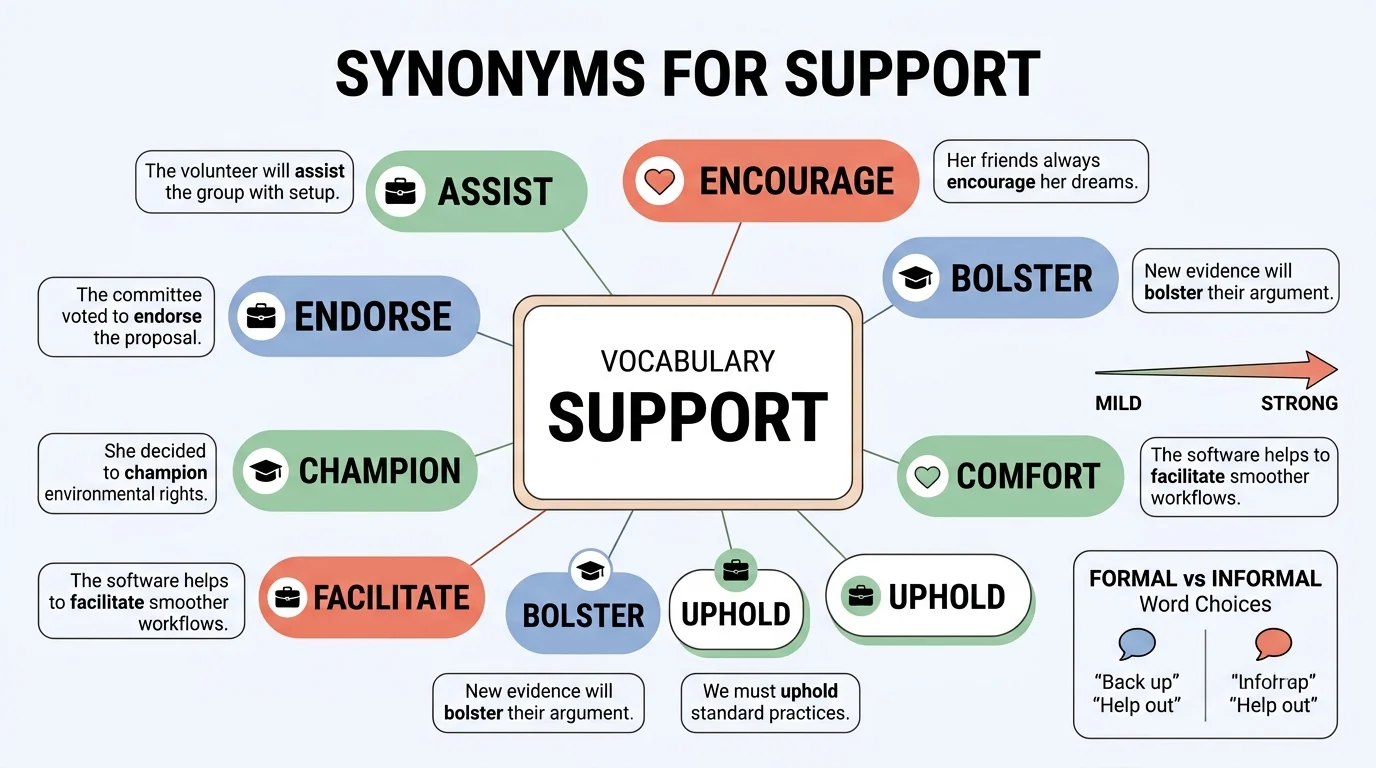
Support means to give assistance, encouragement, or backing to someone or something. The best synonyms depend on your context. For professional situations use “assist” or “facilitate.” casual conversations use “help” or “back up.” emotional contexts use “encourage” or “uphold.” For academic writing use “corroborate” or “substantiate.” Choose the word that matches your tone and meaning.
Meaning, Tone and Context
Simple definition: Support means to hold up, bear weight, or provide help to someone or something.
Part of speech: Support works as both a verb and a noun. You can support a friend, and you can offer your support to a cause.
Tone: The tone is neutral overall. However, the word can shift positive when used for encouragement or negative when used for enabling bad behavior.
Formality level: Support is neutral and works in almost any setting. It is neither too formal nor too casual for most writing.
Common use cases: Support appears frequently in professional emails, academic essays, personal conversations, and creative writing. People use it to describe physical holding, emotional encouragement, financial backing, or agreeing with an idea.
Important word forms: The adjective is “supportive.” The noun forms include “supporter” and “support system.” The opposite is “oppose” or “undermine.”
When and How to Use “Support”
Use support when you need a general, safe word that works across many contexts. It is the default choice when you are not sure which specific synonym fits best. Support communicates help without being too strong or too weak.
Professional use: “Our team will support the new initiative.”
This works in meetings, emails, and project plans.
Academic use: “The research supports the hypothesis.”
This shows evidence backing a claim.
Personal use: “I support your decision to change careers.”
This expresses encouragement and approval.
Emotional use: “She supported her friend through the difficult time.”
This describes being there for someone emotionally.
Creative use: “The pillars support the ancient structure.”
This describes physical holding or bearing weight.
Email use: “Please let me know how I can support your efforts.”
This offers help in a professional but warm way.
Resume use: “Supported cross functional teams in product launches.”
This demonstrates collaborative skills.
Another Word for “Support”
The best single replacement depends on your exact meaning.
Professional writing: “Assist” works best. It sounds polished and clear in workplace communication.
Academic writing: “Corroborate” suits research based contexts. It means to confirm or strengthen evidence.
Casual conversation: “Back up” feels natural and friendly among peers.
Emotional writing: “Uphold” conveys deep emotional commitment and moral backing.
Creative writing: “Bolster” adds imagery of strengthening or reinforcing.
Resume use: “Facilitate” shows you made things easier for others.
Social media captions: “Stand with” connects emotionally with audiences.
Stronger meaning: “Champion” shows active and passionate advocacy.
Softer meaning: “Encourage” suggests gentle support without pressure.
When Not to Use “Support”
Support sounds vague when you need a specific word. It fails to capture the exact type of help you provided.
Too vague: “I supported the project.”
This does not tell the reader what you actually did.
Better option: “I managed the project timeline and resources.”
Too casual: “I support the CEO’s vision.”
This sounds weak in a formal board meeting.
Better option: “I fully endorse the CEO’s strategic direction.”
Too weak: “I support my colleague.”
This does not convey active collaboration.
Better option: “I collaborate closely with my colleague on key deliverables.”
Words Commonly Confused With “Support”
Support vs. Help
Help is more general and casual. Support sounds more substantial and often implies ongoing commitment.
Support vs. Assist
Assist suggests a temporary or specific role. Support implies longer term or broader involvement.
Support vs. Encourage
Encourage is about giving confidence. Support can include action and resources.
Support vs. Maintain
Maintain means to keep something in its current state. Support can mean adding new strength.
Support vs. Uphold
Uphold suggests defending principles or standards. Support can be more practical.
Support vs. Bolster
Bolster implies strengthening something that is weak. Support can be for strong things too.
Best Synonym by Context for “Support”
| Context | Best Synonym | Why It Works | Example |
|---|---|---|---|
| Formal writing | Facilitate | Sounds professional and process oriented | The grant will facilitate community development programs |
| Academic writing | Substantiate | Indicates providing evidence or proof | The data substantiates the researcher’s claims |
| Professional or business use | Endorse | Shows official approval and backing | The board will endorse the new policy |
| Resume | Spearhead | Shows leadership and initiative | Spearheaded the customer retention strategy |
| Casual conversation | Back up | Sounds friendly and supportive | I will back up your idea in the meeting |
| Creative writing | Prop | Adds a sense of holding something up | The old beams prop the ceiling |
| Emotional tone | Comfort | Focuses on soothing and reassurance | She comforted her child after the loss |
| Strong intensity | Champion | Shows passionate advocacy | He champions human rights worldwide |
| Soft or moderate tone | Nurture | Gentle and growth oriented | The program nurtures young entrepreneurs |
| Social media captions | Stand with | Creates connection and solidarity | We stand with our community during this time |
| Physical context | Bear | Describes carrying weight | The bridge bears heavy traffic daily |
Which Synonym Should You Choose?
Consider the type of support you want to describe.
Action oriented support: Choose “assist,” “facilitate,” or “help.”
Emotional support: Choose “encourage,” “comfort,” or “uphold.”
Financial support: Choose “fund,” “sponsor,” or “back.”
Ideological support: Choose “endorse,” “advocate,” or “champion.”
Physical support: Choose “bear,” “hold,” or “prop.”
Formal settings: Choose “facilitate,” “substantiate,” or “endorse.”
Casual settings: Choose “back up,” “help out,” or “stand by.”
Resumes: Choose “spearhead,” “facilitate,” or “collaborate.”
Emails: Choose “assist,” “support,” or “aid.”
Essays: Choose “corroborate,” “validate,” or “confirm.”
Trust your audience and purpose. If you are writing a formal report, choose formal synonyms. If you are texting a friend, choose casual alternatives. The right word makes your meaning clear and your writing engaging.
Real Life Examples of “Support” in Sentences
School: The teacher offers extra sessions to support struggling students.
Workplace: Our department will support the marketing team during the campaign.
Writing: The author uses vivid metaphors to support the novel’s central theme.
Conversation: I fully support your choice to pursue further education.
Social media: We support sustainable fashion brands and ethical production.
Resume: Supported quarterly sales growth through targeted outreach strategies.
Email: Our team is ready to support you with any technical challenges.
Storytelling: The community rallied to support the family after the fire.
15 Synonyms for “Support”
| Synonym | Simple Meaning | Best Used For | Example Sentence |
|---|---|---|---|
| Assist | Give temporary help | Professional and practical situations | The assistant will assist with the presentation setup |
| Back | Provide financial or moral support | Informal and business contexts | The investors back the new startup |
| Bolster | Strengthen or reinforce | Creative and descriptive writing | The evidence bolsters the prosecution’s case |
| Champion | Fight for or advocate strongly | Passionate and persuasive contexts | She champions equal access to education |
| Comfort | Soothe someone emotionally | Emotional and personal situations | The nurse comforted the worried patient |
| Encourage | Give confidence or hope | Emotional and motivational contexts | Parents encourage their children to explore new hobbies |
| Endorse | Give official approval | Professional and formal contexts | The celebrity endorses the new product line |
| Facilitate | Make a process easier | Professional and organizational contexts | The software facilitates remote collaboration |
| Foster | Promote growth or development | Academic and professional contexts | The program fosters creativity in young artists |
| Nurture | Care for and encourage growth | Emotional and developmental contexts | Good teachers nurture their students’ potential |
| Prop | Hold something physically up | Creative and descriptive writing | The wooden beams prop the old barn |
| Sponsor | Provide funding for someone | Professional and financial contexts | Companies sponsor local sports teams |
| Stand by | Be loyal and ready to help | Emotional and supportive contexts | Friends stand by each other during hard times |
| Sustain | Keep something going over time | Professional and formal contexts | Donations sustain the nonprofit organization |
| Uphold | Maintain or defend principles | Formal and moral contexts | The court upholds the rights of citizens |
Synonym Groups and Usage Differences
Professional vs. Personal Synonyms
Professional synonyms include assist, facilitate, and endorse. These words focus on tasks, processes, and official approval. Personal synonyms include comfort, encourage, and stand by. These words focus on relationships, emotions, and individual connection.
Formal vs. Conversational Synonyms
Formal synonyms like substantiate, facilitate, and uphold work best in reports, essays, and speeches. These words carry weight and precision. Conversational synonyms like back up, help out, and stand by work in texts, casual emails, and everyday talk. They feel natural and approachable.
Academic Synonyms
Academic writing benefits from words like substantiate, corroborate, validate, and confirm. These words show evidence, proof, and logical support. They make arguments stronger and more credible.
Professional and Business Synonyms
Workplace communication uses assist, facilitate, endorse, spearhead, and collaborate. These words demonstrate action, leadership, and cooperation. They sound capable and confident.
Creative or Literary Synonyms
Creative writing uses bolster, prop, nurture, and foster. These words add depth and imagery. They help readers visualize and feel the support being described.
Slang or Modern Synonyms
Modern slang includes have someone’s back, ride for someone, and hold down. These words work in casual conversations among friends. They are too casual for professional or academic writing.
Strongest vs. Weaker Synonyms
Intensity scale from mild to strongest: encourage, assist, support, endorse, champion, and spearhead. Encourage is gentle. Spearhead shows leadership and active effort.
Emotional vs. Neutral Synonyms
Emotional synonyms include comfort, encourage, nurture, and uphold. These words convey care and connection. Neutral synonyms include assist, facilitate, and endorse. These words stay professional and factual.
Antonyms of “Support”
| Antonym | Meaning | Example Sentence |
|---|---|---|
| Oppose | Be against something | The senator will oppose the new legislation |
| Undermine | Weaken gradually | Gossip can undermine team morale |
| Hinder | Make progress difficult | Bad weather will hinder the construction work |
| Reject | Refuse to accept | The committee rejected the proposal |
| Contradict | Deny or go against | The new evidence contradicts earlier findings |
| Abandon | Give up on someone | He abandoned his responsibilities |
| Neglect | Fail to care for | She neglected her health for years |
| Discourage | Take away confidence | Failure can discourage young learners |
| Block | Prevent movement or progress | The new policy blocks innovation |
| Weaken | Make less strong | Stress can weaken the immune system |
| Obstruct | Get in the way of | Bureaucracy can obstruct progress |
| Deny | Refuse to give or accept | The leader denied the request |
| Defy | Resist openly | The protestors defy the new rules |
| Counter | Act against | The defense will counter the allegations |
| Disapprove | Have a negative opinion | Parents disapprove of the decision |
Comparison: Support vs. Similar Words
Support vs. Help
Main difference: Support implies ongoing or substantial assistance. Help is more general and casual.
Which is stronger? Support is stronger and more committed.
Which is more formal? Support is more formal in professional contexts.
Example for support: The program supports families throughout the year.
Example for help: Please help me carry these boxes.
Support vs. Assist
Main difference: Assist suggests a specific, often temporary task. Support suggests broader and longer involvement.
Which is stronger? Support is stronger in scope.
Which is more formal? Both are formal, but assist often appears in professional manuals.
Example for support: The agency supports small businesses with loans.
Example for assist: The nurse will assist the doctor during surgery.
Support vs. Encourage
Main difference: Encourage focuses on giving confidence and hope. Support includes practical help as well.
Which is stronger? Support includes action. Encourage is more emotional.
Which is more formal? Support is more formal in academic writing.
Example for support: The grant supports the research project.
Example for encourage: The teacher encourages students to ask questions.
Support vs. Endorse
Main difference: Endorse means giving public approval. Support can be private or practical.
Which is stronger? Endorse carries more weight in public contexts.
Which is more formal? Endorse is formal and often used in official statements.
Example for support: I support your decision to move.
Example for endorse: The governor endorsed the candidate.
Support vs. Champion
Main difference: Champion means actively fighting for a cause. Support can be passive.
Which is stronger? Champion is much stronger and more passionate.
Which is more formal? Champion is used in persuasive and passionate contexts.
Example for support: We support environmental protection.
Example for champion: She champions women’s rights globally.
Support vs. Sustain
Main difference: Sustain means keeping something going over time. Support can be a one time action.
Which is stronger? Sustain implies long term commitment.
Which is more formal? Sustain is formal and often used in academic writing.
Example for support: The donation supports the school.
Example for sustain: Solar energy will sustain the community for decades.
Common Phrases and Expressions with “Support”
1. Support system
Meaning: A network of people who provide help and encouragement.
Example sentence: Her friends and family form a strong support system.
2. Moral support
Meaning: Emotional encouragement rather than practical help.
Example sentence: She attended the meeting for moral support.
3. Support group
Meaning: A group of people who share experiences and provide mutual help.
Example sentence: The support group meets every Tuesday evening.
4. In support of
Meaning: Showing agreement or backing for someone or something.
Example sentence: He spoke in support of the new policy.
5. Support staff
Meaning: Employees who help keep an organization running smoothly.
Example sentence: The support staff handles all administrative tasks.
6. Technical support
Meaning: Help with technology and computer problems.
Example sentence: Call technical support if your device stops working.
7. Support network
Meaning: A group of people who provide practical and emotional help.
Example sentence: She built a support network after moving to a new city.
8. Child support
Meaning: Financial support paid for a child by a non custodial parent.
Example sentence: He pays child support every month.
Common Mistakes to Avoid
1. Using support when a more precise synonym is better.
Incorrect: I supported the event by bringing snacks.
Correct: I contributed to the event by bringing snacks.
Contributed is more specific and active.
2. Confusing support with maintain.
Incorrect: The funds support the building’s structure.
Correct: The funds maintain the building’s structure.
Maintain is better for keeping something in existing condition.
3. Using a casual synonym in formal writing.
Incorrect: We will back up the CEO’s plan.
Correct: We will support the CEO’s plan.
Back up is too casual for boardroom communication.
4. Using an overly dramatic synonym for a simple situation.
Incorrect: I championed my friend to the store.
Correct: I accompanied my friend to the store.
Champion is too strong for ordinary activities.
5. Repeating support too often in one paragraph.
Incorrect: The program supports students. Teachers also support students. The community supports the program.
Correct: The program assists students. Teachers encourage them daily. The community endorses the initiative.
Vary your vocabulary for better readability.
6. Choosing a synonym with the wrong emotional tone.
Incorrect: The sad news supported her mood.
Correct: The sad news affected her mood.
Support does not fit negative emotional descriptions.
7. Using slang in academic or professional writing.
Incorrect: The researcher had her team’s back.
Correct: The researcher supported her team.
Had her back is too informal for academic writing.
FAQs
1. What is the best synonym for support?
The best synonym depends on context. Use “assist” for professional help, “encourage” for emotional support, and “endorse” for official approval.
2. What is a formal synonym for support?
Formal synonyms include facilitate, substantiate, corroborate, and endorse. Use these in reports, academic papers, and professional documents.
3. What is an informal synonym for support?
Informal synonyms include back up, stand by, help out, and have someone’s back. Use these in casual conversations and friendly emails.
4. What is another word for support in professional writing?
Use assist, facilitate, or endorse in professional writing. These words sound polished and action oriented in workplace communication.
5. What is the difference between support and encourage?
Support includes practical help and resources. Encourage focuses on giving confidence and motivation without necessarily providing action.
6. What is the opposite of support?
The opposite of support is oppose. Other antonyms include undermine, hinder, reject, and contradict.
Conclusion
Support is a versatile word that describes help, encouragement, and backing in countless situations. But relying on it too often makes your writing feel repetitive and vague. The best synonyms for support vary by context. Use assist for professional tasks, encourage for emotional situations, endorse for official approval, and champion for passionate advocacy. Always consider your audience, purpose, and tone. The right synonym makes your message clearer and more engaging. Keep this guide handy whenever you need to replace support with a word that fits perfectly.