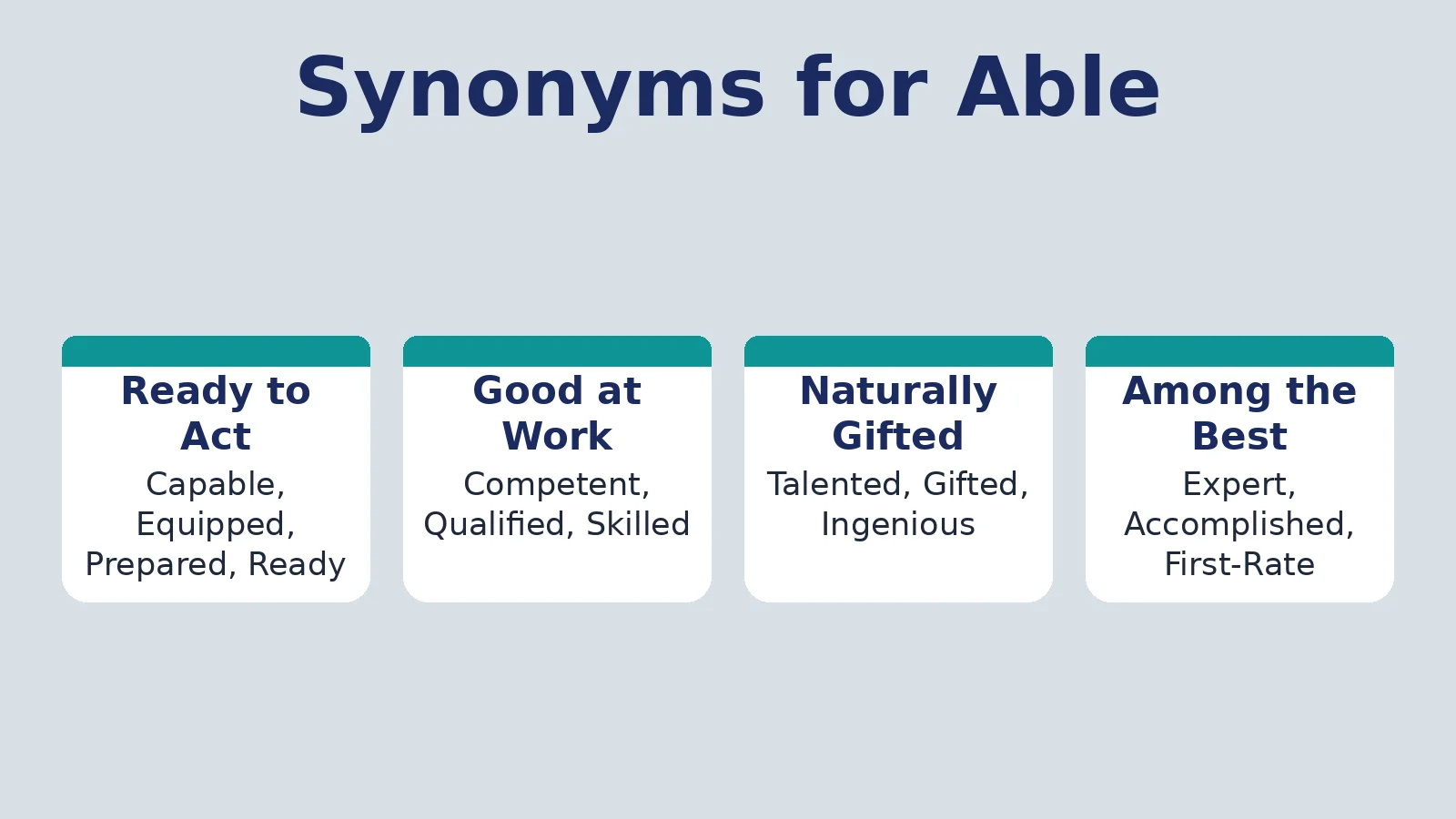
Able is one of the hardest-working adjectives in English, and one of the vaguest. A toddler is able to walk, a surgeon is able to operate, and a manager can be an able leader. The most useful synonyms for able include capable, competent, qualified, skilled, skillful, proficient, talented, gifted, accomplished, expert, and first-rate. Each one points at a different kind of ability, though, so the right choice depends on the sentence.
This guide sorts more than 70 synonyms for able by sense, from simple capability to top-level expertise. Every word comes from real thesaurus entries, and the key words carry short glosses and examples. As a result, you can praise a person’s skill precisely instead of reaching for the same flat word every time.
Top Synonyms for Able: Quick Reference
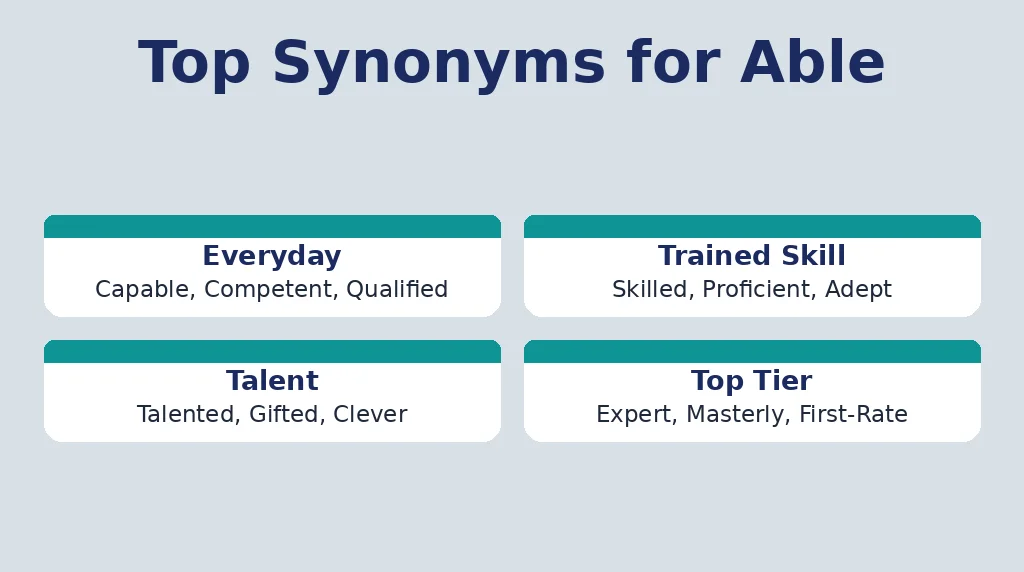
The table below covers the 26 synonyms readers reach for most often. Start here for one fast replacement. Later sections sort the full list into finer groups by sense.
| Word | Meaning in one line | Best for |
|---|---|---|
| Capable | Having the skill to do something well | The closest all-rounder |
| Competent | Good enough at a job, reliably | Work, reports, reviews |
| Qualified | Having the training or papers required | Jobs, official roles |
| Skilled | Trained and good at a practical task | Trades, crafts, sports |
| Skillful | Showing skill in how something is done | Performance, handling |
| Proficient | Highly skilled through practice | Formal praise, CVs |
| Adept | Very good at something, often quick | Skills, diplomacy, tech |
| Experienced | Skilled because of years of practice | Hiring, trust |
| Seasoned | Experienced and hardened by practice | Formal praise |
| Fit | Suitable and ready for a task | “Fit for the job” |
| Suited | Naturally right for a role | Matching people to tasks |
| Equipped | Having what is needed to do something | Tools, training, readiness |
| Talented | Naturally good at something | Arts, sports, school |
| Gifted | Having rare natural ability | Exceptional talent |
| Ingenious | Clever at inventing solutions | Ideas, designs, fixes |
| Clever | Quick and bright in mind | Everyday praise |
| Bright | Intelligent and quick to learn | Students, young people |
| Dexterous | Skilled with the hands | Crafts, surgery, music |
| Deft | Quick, neat and skillful | Movements, handling |
| Accomplished | Highly skilled and polished | Formal praise |
| Expert | Having deep knowledge and skill | Specialists |
| Masterly | Like a true master of the craft | Art, writing, performance |
| First-rate | Of the very best quality | Praise for work and people |
| Top-notch | Excellent, informal praise | Reviews, casual writing |
| Versatile | Able at many different things | All-rounders |
| On the ball | Quick, alert and effective, informal | Workplace slang |
What Does Able Mean?
Able is an adjective with one core idea and several shades. Merriam-Webster sums up the core sense as having the required skills for an acceptable level of performance. Its example is a workplace one: looking for an able and reliable assistant. Most job adverts, references and reviews live inside this sense.
The commonest pattern in speech is different, though. In “be able to”, the word measures power, skill or opportunity. She is able to swim mixes skill with a working body. He is able to help on Friday is mostly about time and chance. One small word quietly covers all three ingredients, which is why replacing it takes care.
A third shade praises talent rather than basic competence. A highly able lawyer or an able young pianist is not merely adequate. The word here means genuinely good, sometimes exceptionally good. Strength alone never decides it, and the guide to synonyms for strong covers that separate idea. Able always involves skill meeting a task.
Able also grades like a normal adjective, which helps writers fine-tune praise. One candidate can be abler than another, in the older spelling, and reports often say “more able” instead. Students get sorted into the more able and the less able in school reports. At the top sits “most able”, a phrase British schools use for their highest-attaining pupils. These comparisons matter because the synonyms grade too. Competent sits low, proficient sits higher, and expert waits at the summit.
Able as a Suffix: The -able Family
Able also survives as a suffix, spelled -able or -ible, at the end of hundreds of adjectives. There it means capable of being, or fit to be. Readable means able to be read with ease. Washable means able to be washed safely. Portable means able to be carried. The suffix does the same job as the free word, just glued to a verb. It is a word-building note, not a synonym, so the lists below stick to true adjectives.
Able to Do It: Power, Skill and Opportunity
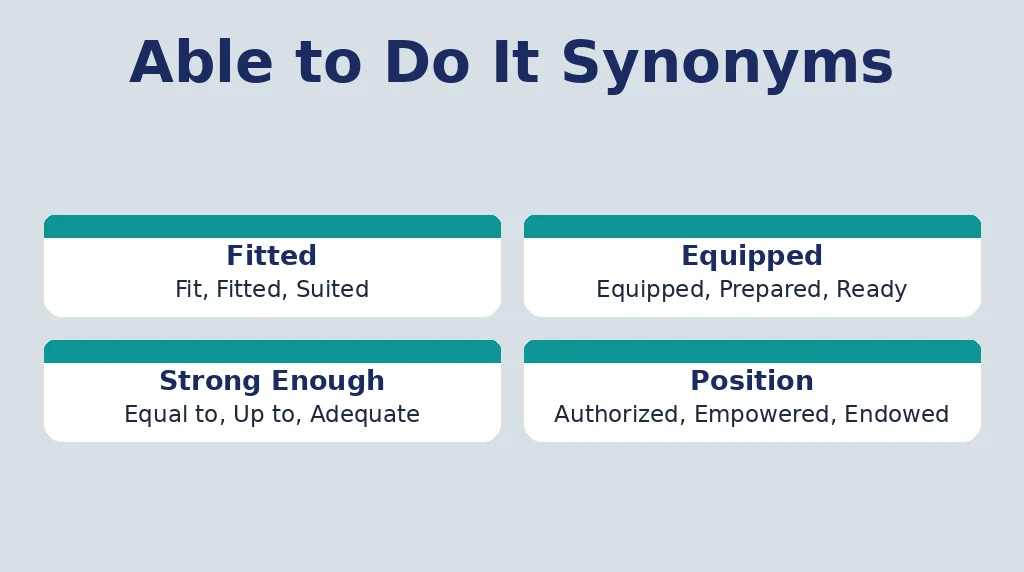
The first group replaces able inside the “be able to” pattern, or describes someone ready and positioned to act. These words focus on having what the moment requires: the strength, the tools, the permission or the chance.
Think of ability here as three locks on one door. The first lock is skill: the person knows how. The second is means: the tools, money or health are in place. The third is opportunity: the moment and the permission line up. Plain able opens all three locks with one turn, which is exactly why it can sound vague. The synonyms below each name the lock they open, so your sentence tells readers which ingredient mattered.
Fitted, Equipped and Ready
These words say the person matches the task in front of them. Nothing is missing, and nothing needs improvising.
- Capable of: having the skill or power for an action, the closest phrase swap. Example: The hall is capable of holding 300 guests.
- Fit: suitable and in the right condition for something. Example: Only fit swimmers should attempt the crossing.
- Fitted: made suitable by training or nature. Example: She is well fitted for a career in nursing.
- Well-fitted: fitted especially thoroughly, a stronger form of the same idea. Example: The course left him well-fitted for site work.
- Suited: naturally right for a role or task. Example: Quiet villages are suited to slow holidays.
- Equipped: having the tools, training or qualities a task demands. Example: The team arrived equipped for cold weather.
- Well-equipped: equipped to a high standard. Example: It is a well-equipped lab for a small school.
- Equal to: strong or skilled enough for a challenge, as in “equal to the task”. Example: She proved equal to every emergency.
- Up to: able to handle something, in phrases like “up to the job”. Example: The old laptop is not up to modern games.
- Adequate: good enough for the need, without spare brilliance. Example: His French is adequate for booking hotels.
- Prepared: ready because the groundwork is done. Example: Come prepared to defend your numbers.
- Ready: able and willing to act at once. Example: The crew stood ready at the gate.
Permission, Position and Natural Endowment
A few group members describe why someone is in a position to act at all. Authority and natural gifts both open doors.
- Authorized: officially allowed and therefore able to act. Example: Only authorized staff may open the safe.
- Empowered: given the power or confidence to act. Example: The new rules left managers empowered to decide.
- Endowed: given a quality by nature, in phrases like “endowed with patience”. Example: She was endowed with a remarkable memory.
- Qualified: having the training that puts you in position. It earns a fuller treatment in the next section.
The old hiring phrase “ready, willing and able” survives because the three words split the job neatly. Ready covers timing, willing covers attitude, and able covers capability. Our companion guide to synonyms for ready explores the first word of that trio in full.
Competent and Qualified: Able at Work
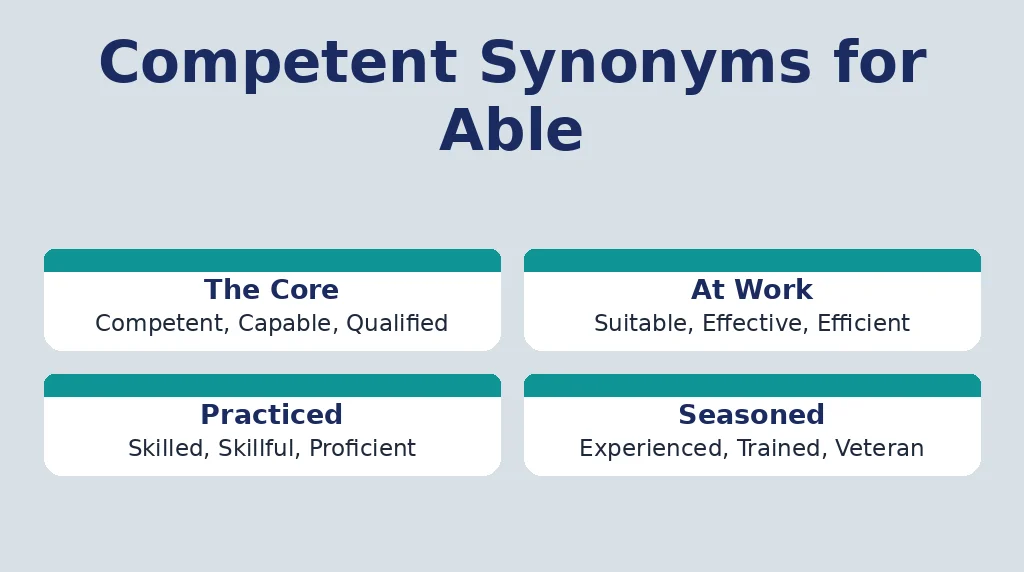
Most professional writing needs the middle register of able: not genius, not bare minimum, but reliably good. Merriam-Webster anchors this group with its top words for able: qualified, suitable, capable, competent and good. The two halves below separate passing the bar from mastering the craft.
Competent, Qualified and Fit
These words say a person meets the standard a job sets. Recruiters and reviewers use them daily, and each one leans a slightly different way.
- Competent: able to do a job properly and reliably. Example: We need a competent electrician, not a hero.
- Capable: the all-rounder, suggesting skill that can be trusted. Example: She is a capable and efficient editor.
- Qualified: holding the training, exams or experience a role demands. Example: The post needs a fully qualified nurse.
- Suitable: right for the purpose, used for people and things alike. Example: He is a suitable candidate for the night shift.
- Suited: fitted by nature or training, a close partner of suitable. Example: She is perfectly suited to teaching beginners.
- Good: in phrases like “a good hand at repairs”, it means genuinely able. Example: He is a good man in a crisis.
- Effective: producing the wanted result, used for methods and people. Example: She is an effective chair who ends meetings on time.
- Efficient: working well without wasting time or effort. Example: An efficient clerk cleared the backlog in days.
- Responsible: trusted to handle duties with care. Example: The role calls for a responsible, level-headed lead.
- Workmanlike: done with solid, honest skill, without flair. Example: He gave a workmanlike performance all season.
Skilled, Proficient and Practiced
This half praises skill that training and repetition built. The words climb from trained competence toward real polish.
- Skilled: trained and good at a practical task. Example: The hospital needs skilled theatre nurses.
- Skillful: showing skill in the doing, not just the result. Example: Her skillful handling calmed the horse at once.
- Proficient: highly skilled, the formal favourite in reports and CVs. Example: He is proficient in three design tools.
- Adept: very skilled, often with a quick or delicate touch. Example: She is adept at defusing angry customers.
- Experienced: skilled because of time spent doing the work. Example: An experienced guide reads the weather early.
- Practiced: polished by rehearsal, as in a practiced smile or hand. Example: With practiced ease, she tied the knot one-handed.
- Trained: taught formally for the task. Example: Every lifeguard here is trained in first aid.
- Seasoned: experienced and unshaken by pressure, formal praise. Example: A seasoned negotiator never rushes the first offer.
- Veteran: long-serving and deeply experienced, used as an adjective in “a veteran campaigner”. Example: Veteran staff handled the outage calmly.
- Schooled: trained thoroughly, often in a discipline or habit. Example: He is schooled in the old methods of joinery.
Knowledgeable and Well-Versed: Familiarity Words
Some able people shine through knowledge rather than hand skill. These words praise the contents of the mind and the ease that comes from long familiarity.
- Knowledgeable: knowing a great deal about a subject. Example: Ask the knowledgeable woman at the seed counter.
- Conversant: familiar enough with a topic to discuss it well, formal. Example: Applicants should be conversant with safety law.
- Well-versed: deeply familiar, a partner of conversant. Example: She is well-versed in contract disputes.
- Au fait: fully informed and up to date, a French borrowing for formal writing. Example: Keep yourself au fait with the new rules.
- Resourceful: good at finding quick, clever ways around problems. Example: A resourceful cook can stretch three ingredients into dinner.
- Inventive: full of new ideas and original solutions. Example: The inventive engineer rebuilt the pump from scrap.
- Enterprising: ready to take on new projects with energy and imagination. Example: An enterprising graduate started a repair club at college.
Talented and Gifted: Naturally Able
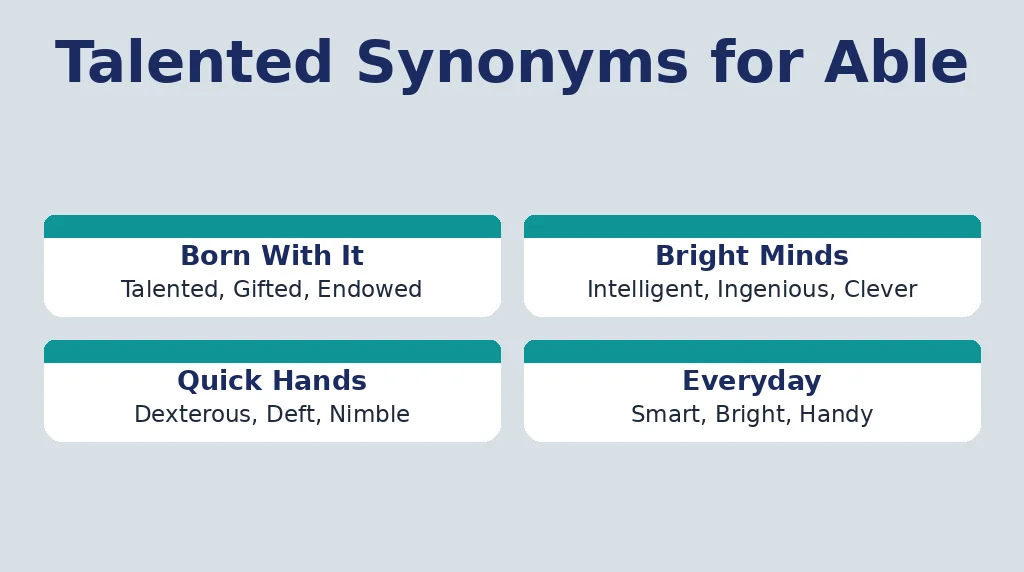
Some people seem to arrive with the skill already installed. This group praises inborn ability rather than earned competence. If the gift is mainly mental, the guide to synonyms for smart explores that territory in depth. The words here cover talent of every kind.
Talent words carry one quiet risk. They can make skill sound like magic, which hides the practice that usually feeds it. A gifted violinist at nine becomes an accomplished one at twenty through a decade of unglamorous work. Good writing keeps both truths visible. Credit nature with these words, then let the earned words in the previous section describe what the person built on top of it.
Born With It
These words credit nature first and training second. Teachers and talent scouts reach for them constantly.
- Talented: naturally good at something, the everyday leader of this group. Example: The school show revealed several talented singers.
- Gifted: having rare natural ability, stronger than talented. Example: Gifted children often need harder puzzles early.
- Endowed: blessed by nature with a quality, in formal phrasing. Example: The valley is endowed with rich soil.
- Intelligent: able to learn and reason well. Example: An intelligent dog picks up routines in days.
- Ingenious: clever at inventing or solving in original ways. Example: She built an ingenious trap for the leaking pipe.
- Clever: quick in mind and often witty with it. Example: A clever reply ended the argument kindly.
- Smart: bright and quick, the informal twin of clever. Example: That was a smart move by the young defender.
- Bright: intelligent and quick to learn, used warmly of students. Example: A bright class asks endless questions.
- Canny: shrewd and careful, with a Scottish flavour. Example: The canny trader bought before the rush.
- Apt: naturally suited or quick to learn, also in “an apt pupil”. Example: He is an apt student of languages.
Quick Hands, Quick Minds
Talent often shows in movement. These words praise speed and neatness in hands, feet and reactions.
- Dexterous: skillful with the hands, formal and precise. Example: Watch a dexterous weaver at the loom.
- Deft: quick, light and skillful in movement. Example: One deft twist opened the jar.
- Adroit: skillful and resourceful, for hands and minds alike. Example: The adroit manager turned a complaint into praise.
- Nimble: quick and light in movement or thought. Example: Nimble fingers fly over the piano keys.
- Agile: able to move quickly and easily, or to think fast. Example: Rescue dogs must be agile on rough ground.
- Handy: good with practical jobs and tools, warm and informal. Example: It pays to be handy around the house.
Expert and First-Rate: The Most Able of All
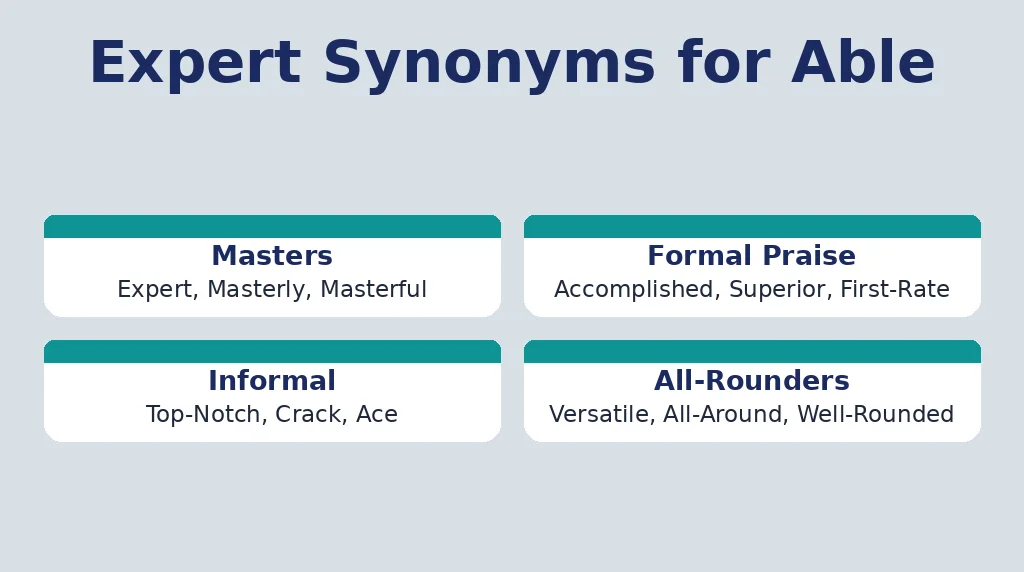
At the top of the scale, able stops meaning adequate and starts meaning outstanding. These are the words for masters, champions and the people everyone else calls for help.
Masters of the Craft
Formal praise lives here. These words suit award citations, reviews and professional biographies.
- Expert: having deep skill and knowledge in a field. Example: Only an expert eye can date the painting.
- Masterly: done like a true master, used for work and performances. Example: She gave a masterly reading of the poem.
- Masterful: powerful and skillful, with total control. Example: It was a masterful display of patience and timing.
- Master: used before a noun, as in “a master builder”. Example: The master baker still proofs every loaf himself.
- Accomplished: highly skilled and polished, a formal compliment. Example: The orchestra hired an accomplished young conductor.
- Superior: better than the usual standard, calm and formal. Example: Her superior footwork decided the match.
- First-rate: of the very best quality. Example: The clinic offers first-rate care at fair prices.
- Top-flight: among the very best in a field, often for athletes and firms. Example: Top-flight surgeons train for a decade.
- Learned: deeply educated, pronounced with two syllables in formal use. Example: A learned judge wrote the final opinion.
- Artful: skillful in a clever, sometimes cunning way. Example: The artful dodger of the team slipped every tackle.
Informal Praise: On the Ball and Up to Snuff
Everyday speech praises ability with shorter, brighter words. These suit conversation, reviews and lively writing far better than reports.
- Top-notch: excellent, the friendliest of the praise words. Example: The hotel serves top-notch breakfasts.
- Crack: first-class, in phrases like “a crack shot” or “a crack team”. Example: They sent a crack unit to fix the line.
- Crackerjack: outstanding, an old-fashioned American cheer. Example: She is a crackerjack mechanic, booked out for weeks.
- Ace: brilliant at something, as in “an ace pilot”. Example: Our ace reporter broke the story first.
- Hotshot: a person who is notably skilled, sometimes with a hint of showing off. Example: The hotshot lawyer won the case in a day.
- Slick: smooth and skillful, occasionally too smooth to trust. Example: His slick presentation hid the weak numbers.
- Smooth: effortless and polished in manner or movement. Example: A smooth operator, she closed the deal by lunch.
- All-around: good at many sides of a job (British: all-round). Example: He is the team’s best all-around player.
- Versatile: able to turn to many different tasks well. Example: A versatile actor, she plays tragedy and comedy alike.
- Well-rounded: developed in many areas, used for people and education. Example: The course produces well-rounded graduates.
- On the ball: quick to understand and act, informal workplace praise. Example: The new assistant is really on the ball.
- Up to snuff: meeting the required standard, informal and slightly dated. Example: His last report was not up to snuff.
Formal and Informal Synonyms for Able
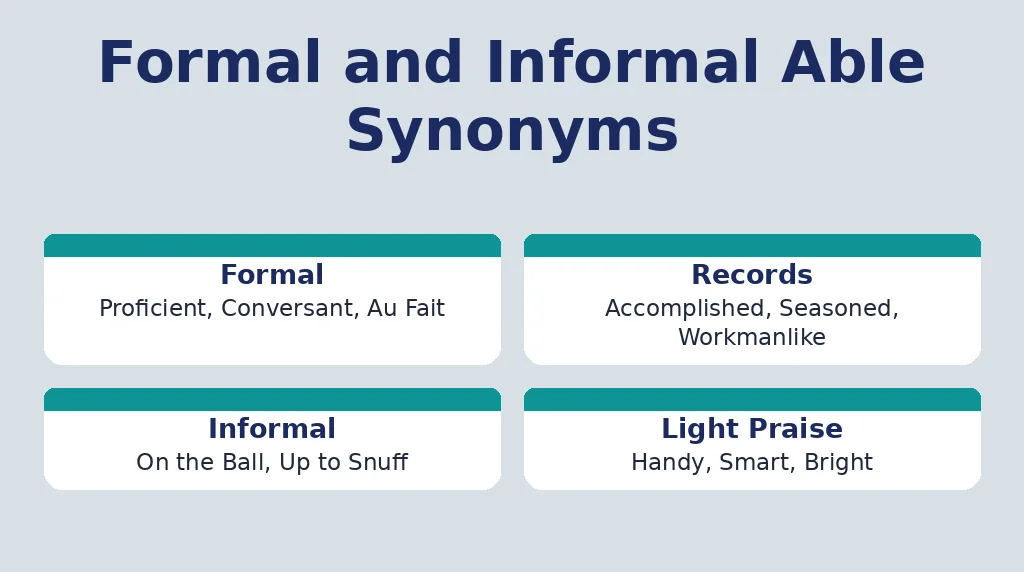
Register decides how praise lands. The same worker can be “proficient” in an appraisal and “on the ball” in the team chat. Sorting the main words by tone keeps both versions honest.
Formal Choices for Reports, CVs and References
Formal synonyms sound measured and evidenced. They suit applications, assessments and professional biographies.
- Proficient and conversant lead the formal set. One certifies skill; the other certifies familiarity with a field.
- Accomplished and seasoned praise a record, not a promise. References use them for people with years behind them.
- Au fait signals that someone is fully briefed. It appears in business writing far more than in speech.
- Workmanlike is formal but double-edged. It praises solidity while quietly denying brilliance, so choose it with care.
- Dexterous and adroit handle physical and mental skill in elevated prose. Reports on surgeons and diplomats use both.
Informal Choices for Speech and Reviews
Informal synonyms trade polish for warmth. Dialogue, blogs and friendly reviews welcome them.
- On the ball praises alertness at work. Example: Our coordinator is on the ball this week.
- Up to snuff checks a standard in a homely way. Example: The sequel is not up to snuff.
- Hotshot, ace and crack turn praise into a nickname. Sports pages love all three.
- Handy is the quiet compliment for practical skill. Example: He is handy with a drill and a paintbrush.
- Smart and bright keep mental praise light. Teachers use both where “gifted” would feel heavy.
Synonyms for Able in Essays, Resumes and Professional Writing
Different documents reward different rungs of the ability ladder. Choosing the right rung is a credibility skill in itself, because readers quietly grade every claim you make.
Essays and school writing need precision more than fireworks. A history essay can call a general able, then prove it with evidence from the campaign. Student writers often overreach for gifted or masterly, which sound grand but demand proof the essay rarely supplies. Competent, capable and effective carry claims that a paragraph can actually defend. Teachers reward that match between word and evidence far more than rare vocabulary.
Resumes and cover letters live or die on the same match. Proficient belongs beside tools and languages, because it promises tested skill. Experienced belongs beside years and project counts. Results verbs do the heavy lifting, yet the adjective still frames them. “Proficient in data analysis” reads as a claim a test could check. “Talented in data analysis” reads as a compliment somebody else should be giving. Recruiters notice the difference instantly.
References and appraisals carry the highest stakes, because another person’s career rides on your adjectives. Seasoned and accomplished suit long records. Conscientious writers keep one level in reserve, so a truly exceptional worker still has somewhere to go. When every reference says first-rate, the words inflate into meaninglessness. Honest grading, from competent upward, is what makes the top grade worth reading.
Professional reports prefer the quieter words for a practical reason. A report that calls a supplier capable and a process effective can be audited line by line. Praise that cannot be checked, like calling a contractor a hotshot, weakens everything around it. Save the bright informal words for reviews and profiles, where personality is part of the evidence.
How to Choose the Right Synonym for Able
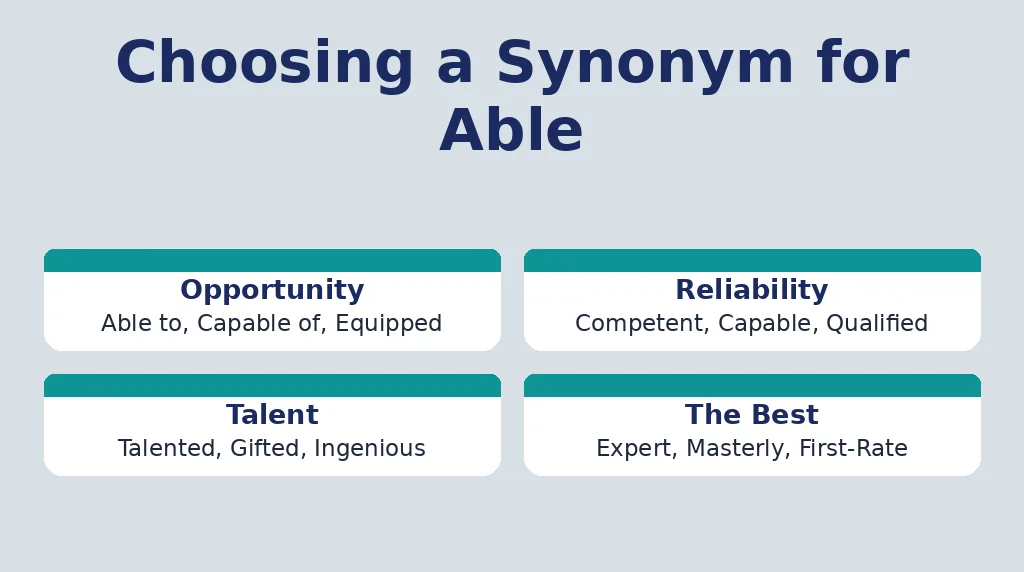
Start by asking what kind of ability your sentence describes. A chance to act, a job done reliably, a talent, and a master at work are four different claims. Match the word to the claim, and the praise stays believable.
Able vs Capable: The Pair Everyone Mixes Up
Able and capable share one dictionary definition, yet they behave differently in sentences. Grammar draws the first line. Able pairs with to: she is able to swim. Capable pairs with of: she is capable of swimming. Writing “capable to swim” is simply wrong, and examiners notice it.
When Capable Goes Dark
Meaning draws the second line. Capable often describes capacity, including dark capacity. A person can be capable of lying, capable of cruelty, or capable of anything. Able never works in those sentences, because able only reports skill, power or opportunity for a stated action. In workplace praise, the two also lean apart. An able leader suggests high skill and judgment. A capable leader suggests steady, reliable competence. Both are compliments, but the able one shines a little brighter.
Paired examples show the lean clearly:
- She is an able negotiator. (Her skill is the point, and it is impressive.)
- She is a capable negotiator. (She handles talks reliably and well.)
- He is capable of great cruelty. (Capacity, not skill; able cannot replace capable here.)
- He is able to start on Monday. (Opportunity and timing; the natural everyday choice.)
After the pair, the other choices fall into place. Use competent when reliable is enough, and qualified when papers or training matter. Reach for talented and gifted only when nature did the heavy lifting. Save expert, masterly and first-rate for records that prove the claim. When a reference letter calls everyone first-rate, readers stop believing any of it.
| Your claim | Strong first choices |
|---|---|
| Has the chance or power to act | Able to, capable of, equipped, in a position to |
| Does the job reliably | Competent, capable, qualified, efficient |
| Has trained, polished skill | Skilled, proficient, adept, seasoned |
| Has natural talent | Talented, gifted, ingenious, bright |
| Is among the very best | Expert, masterly, first-rate, top-notch |
Antonyms for Able
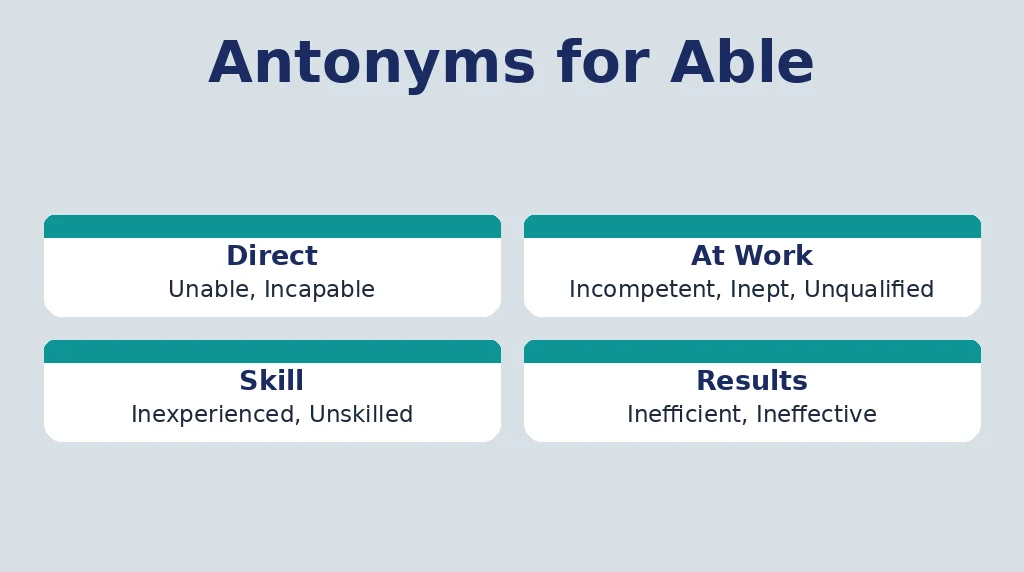
The opposites of able split along the same lines as the synonyms. Matching the antonym to the claim keeps criticism fair and precise.
The direct opposites are unable and incapable. Unable answers “be able to” in any sentence, and incapable adds a stronger sense of lacking the power entirely. For work and competence, use incompetent, inept, unqualified and unfit. An incompetent worker cannot do the job properly. An inept one fumbles it clumsily, and an unqualified one lacks the required training.
For skill built by practice, the opposites are inexperienced, unskilled and unskillful. For results, inefficient and ineffective describe work that wastes effort or misses the goal. For power itself, older thesaurus lists give powerless, weak and impotent in the literal sense of lacking strength. Each word criticizes a different layer, so name the layer you mean.
Fair criticism also remembers what the softer words can do. Calling a new starter inexperienced states a fact with an expiry date, because experience arrives with time. Calling the same person incompetent states a verdict with no door left open. Managers, teachers and reviewers all write better feedback when the antonym matches the fixable problem.
Common Mistakes: Words That Are Not True Synonyms for Able
Accuracy matters in a synonym guide, so this section clears up the words that often sneak into able lists wrongly.
Able-bodied is the biggest trap. It appears in thesaurus lists because one old sense of able means physically fit. However, able-bodied describes a body, not a skill: it means physically healthy and not disabled. It remains standard in set phrases, since an able-bodied seaman is a naval rank, and work rules still use the term. Many modern style guides still advise care, because the word defines people by contrast with disability. Neutral alternatives like “physically fit” fit most sentences better. Never use able-bodied to mean talented or competent.
Can is not an adjective synonym. It is a verb that replaces the whole phrase “be able to”, as in “she can swim”. Learners meet it in able searches constantly, and teachers answer with it happily. Just do not list it beside adjectives like capable, because the grammar is entirely different.
Enable is a relative, not a synonym. It is a verb meaning to make someone able, or to switch a feature on. “The ramp enables wheelchair access” is correct English, but enable cannot describe a skilled person.
Willing sneaks in through the idiom “ready, willing and able”. Willing means glad to do something by choice. A willing volunteer may still lack the skill, and an able expert may be unwilling. Keep the two ideas in separate words, exactly as the idiom does.
Finally, watch capable of anything. In praise lists it sounds like range, but in real sentences it usually warns that a person might do something bad. Context decides, so read the whole sentence before borrowing the phrase.
Frequently Asked Questions
What is the best synonym for able?
Capable is the closest all-rounder, and competent is the safest choice at work. For stronger praise, skilled, proficient and accomplished climb the scale in that order. The best pick always depends on whether you mean opportunity, reliability, training or talent. When in doubt, choose the word whose claim you could defend with one concrete example from the person’s record.
What is the difference between able and capable?
Able pairs with to, as in “able to swim”, and reports skill, power or opportunity for a stated action. Capable pairs with of, as in “capable of swimming”, and often describes capacity, including bad capacity like “capable of lying”. At work, able hints at higher skill, while capable stresses steady reliability.
What is a formal synonym for able?
Proficient is the standard formal choice for skill, and qualified is the formal choice for roles that need training. Conversant suits familiarity with a subject, while accomplished and seasoned praise a proven record. Au fait works when someone is fully briefed and up to date.
What is the opposite of able?
Unable is the direct opposite, and incapable is its stronger partner. At work, incompetent, inept and unqualified take the opposite side. For trained skill, inexperienced and unskilled are the natural antonyms, and for results, ineffective is the key word.
Is “can” a synonym for able?
Not exactly. Can is a verb, and able is an adjective, but the verb can replaces the whole phrase “be able to” in everyday sentences. “She can swim” and “she is able to swim” mean almost the same thing. Formal writing often prefers able to, especially in the past tense with “was able to” for a single achievement.
What does able-bodied mean?
Able-bodied describes a person who is physically fit and healthy and not disabled. It is not a compliment about skill or intelligence. The term survives in set phrases like able-bodied seaman, a naval rank, but many writers choose “physically fit” or name the actual requirement instead.
What is a word for someone who is good at many things?
Versatile is the classic choice, with all-around and well-rounded close behind. A versatile worker can turn to many tasks and do them well. Jack-of-all-trades names the same idea informally, though it sometimes hints at shallow skill.
How do you use able in a sentence?
Use able before to plus a verb: “The team was able to finish early.” Or place it before a noun for the talent sense: “She is an able leader.” Add be, seem or become before it in most patterns, and avoid “capable to”, which is always a mistake.
Final Thoughts
Able covers the whole ladder of human capability, from a child tying shoelaces to a master at the height of a craft. The word works hard, but its synonyms work smarter. Capable and competent keep everyday praise honest, while talented, expert and first-rate save their shine for people who earned it.
For an even deeper list with related words and near-synonyms, the Merriam-Webster Thesaurus entry for able is a reliable next step. Keep this guide bookmarked too, and your praise will always match the ability it describes. After all, describing ability precisely is itself a skill, and now you have more than 70 ways to prove you have it.