A surgeon saves a life, shrugs, and credits the whole team. A founder sells a company, then thanks the janitor by name. Moments like these stick in the memory, and one word explains why: humility.
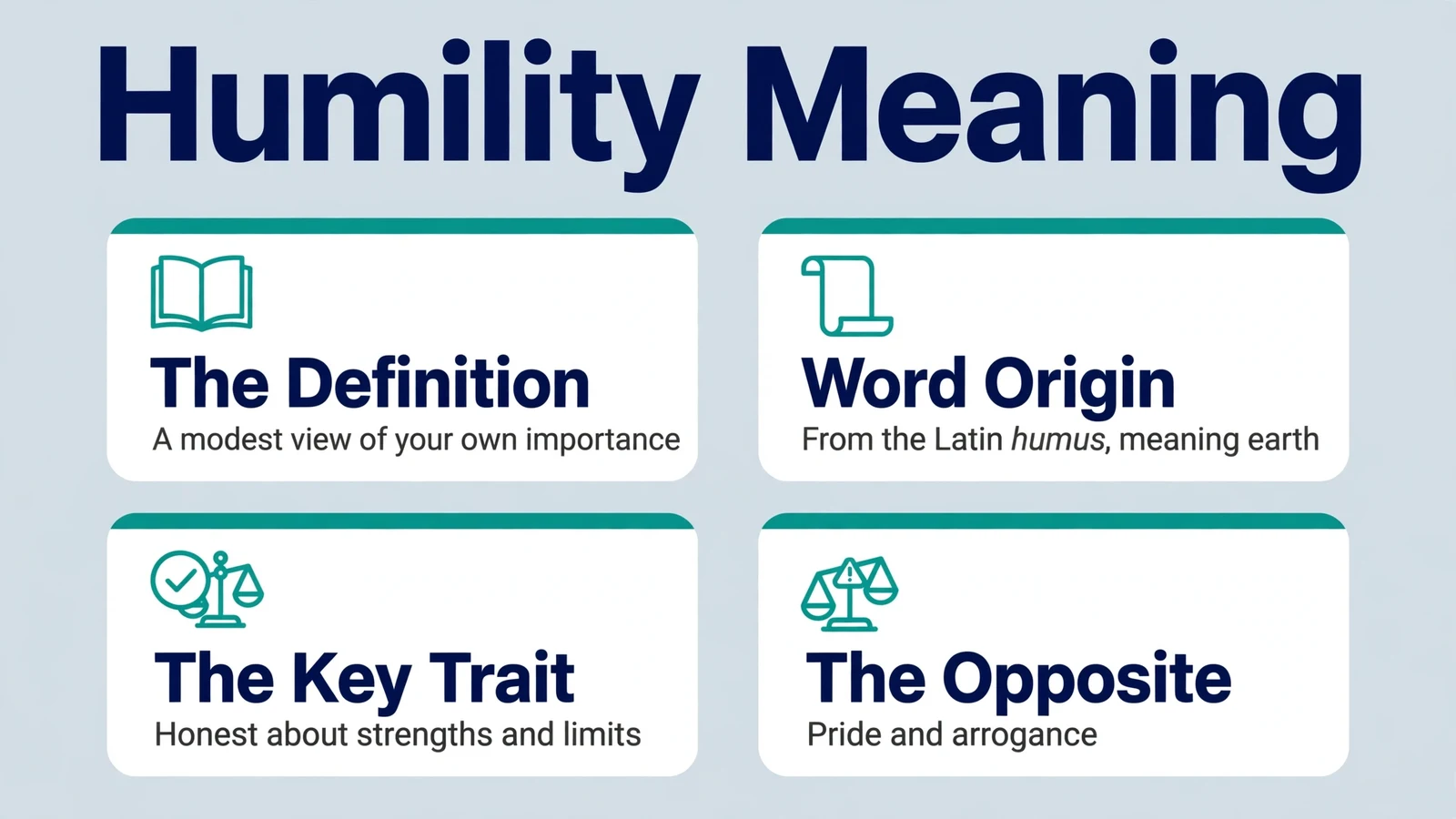
Humility means having a modest view of your own importance. It is the quality of not being proud or arrogant, even when you have real talent and real success to point to. A humble person knows what they are good at. They also know their limits, and they do not need the room to revolve around them.
That sounds simple, yet the word is often misunderstood. Many people confuse humility with weakness, low confidence, or putting yourself down. In fact, true humility is none of those things.
This guide covers the humility meaning from every angle: the dictionary definitions, the story behind the word, and how it differs from modesty and humiliation. You will also see the signs of a humble person, examples in sentences, and simple ways to practice the quality.
What Does Humility Mean?
Humility is the quality of being humble. In plain words, it means you do not see yourself as more important than other people. You rate your own worth honestly, and you stay free of pride and arrogance.
The major dictionaries define the word in strikingly similar ways. Each one points to the same core idea: a modest, honest view of yourself.
The dictionary definitions
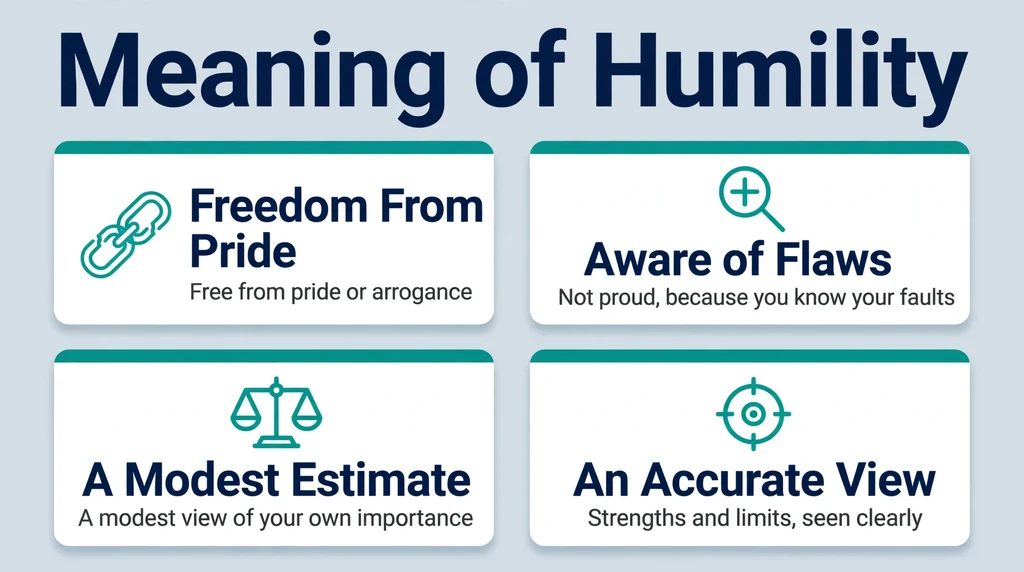
Merriam-Webster defines humility as “freedom from pride or arrogance: the quality or state of being humble.” That word freedom matters. Pride is treated almost like a weight, and humility sets you down from it.
Cambridge Dictionary takes a slightly different angle. It calls humility “the quality of not being proud because you are aware of your bad qualities.” Here the focus falls on self-knowledge. You know your flaws, so you cannot easily feel superior.
Dictionary.com adds the social side of the word. It defines humility as “the quality or condition of being humble; modest opinion or estimate of one’s own importance, rank, etc.” In other words, humility is about where you place yourself among other people.
The meaning in plain words
Put the three definitions together, and a clear picture forms. Humility means you see yourself accurately. Your strengths are real, and you know them. Your weaknesses are real too, and you admit them.
Because of that honest view, status loses its grip on you. Titles, rankings, and applause stop being the point. You can enjoy success without needing to display it.
Humility also changes how you treat people. If you do not see yourself as above anyone, you listen more. You share credit easily. And you stay willing to learn from anyone, whatever their position.
Humility as a word: form and sound
Humility is a noun, and it names a quality rather than a thing. You cannot count it, so English treats it as uncountable. People speak of “a sense of humility” or “great humility,” never “three humilities.”
The word is pronounced hyoo-MIL-uh-tee, with the stress on the second syllable. It belongs to a small family of related words. The adjective is humble, as in “a humble leader.” The adverb is humbly, as in “she humbly thanked the crowd.”
Humility at a glance
- Part of speech: noun (uncountable)
- Pronunciation: hyoo-MIL-uh-tee
- Adjective form: humble
- Adverb form: humbly
- Closest synonyms: modesty, humbleness, meekness
- Main opposite: pride, along with arrogance and vanity
- Root idea: staying close to the ground, from Latin *humus*, earth
Where the Word Humility Comes From
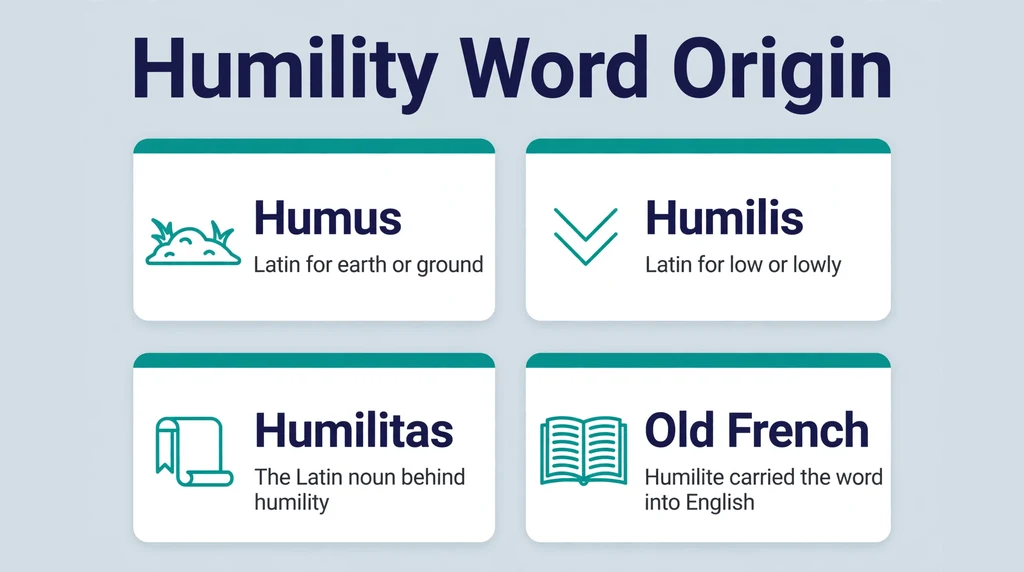
Words carry their history inside them, and humility carries a picture of the ground. The English word comes from the Latin *humilitas*. That noun grows out of the adjective *humilis*, which means low or lowly.
Follow the chain one step further, and you reach *humus*. In Latin, *humus* means earth or ground. So at its root, humility describes someone who stays close to the ground. English speakers still use the same image today when they call a person “down to earth” or “grounded.”
The journey into English
The word did not jump straight from Latin into English. It travelled through French first. Old French had the form *humilite*, taken from the Latin *humilitatem*. Middle English borrowed the French word, and over time its spelling settled into the modern humility.
The adjective humble walked a similar road. Both words keep the old Latin sense of lowness. But notice something important: in the modern word, the lowness is chosen by the person. Nobody has to force a humble person down.
A famous phrase with an uncertain story
You may know the expression “to eat humble pie,” which means admitting you were wrong. A popular story links it to feudal England. In that tale, the lowest cuts of meat, called umbles, went to the lowest-ranking people at the table.
The story is neat, and it may even hold some truth. However, word historians treat the link as uncertain rather than proven. The phrase survives either way, and it still carries that old flavour of being lowered after a mistake.
One root, several English words
The Latin root *humus* left more than one footprint in English. Gardeners use the word humus itself for the dark, rich part of soil. It is the same Latin word, borrowed with its literal meaning intact.
Two other relatives took the moral path. Humble grew into the everyday adjective for a modest person or a modest home. Humiliate split away in a darker direction, toward shame and disgrace. So one family covers the soil under your feet, a virtue teachers praise, and an insult nobody wants. The shared thread is lowness: of the ground, of rank, or of dignity.
Humility vs Modesty: How They Differ
People often use humility and modesty as if they were the same word. The two qualities overlap, and one person can easily have both. Still, they are not identical, and the difference is worth knowing.
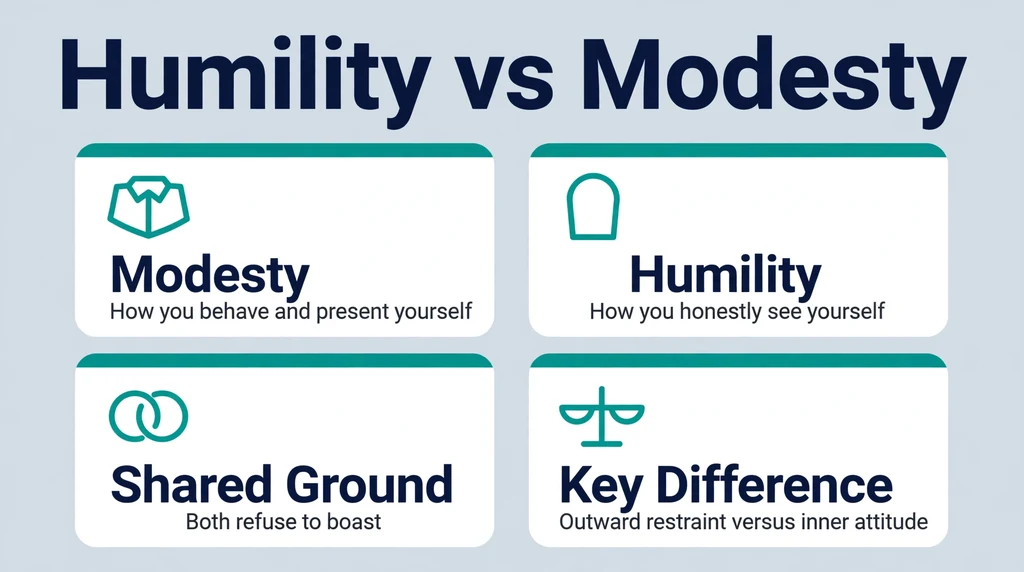
Modesty is mainly about behaviour and appearance. A modest person does not boast, dress to show off, or push their achievements into every conversation. Modesty is what other people can see from the outside.
Humility, by contrast, works on the inside. It is the honest view you hold of yourself, even when nobody is watching. A humble person does not merely avoid boasting. Deep down, they genuinely do not believe they outrank everyone else.
A quick way to picture the difference
Imagine two prize winners on a stage. The modest winner says little and waves the praise away. That is good manners, and it may reflect real humility.
Now imagine the winner later, alone at home. If they still see their win clearly, neither huge nor tiny, that inner honesty is humility. Modesty managed the moment. Humility shapes the mindset behind it.
The gap can also run the other way. Someone may act modest in public while privately craving praise. Their behaviour looks humble, yet the inner quality is missing. This is why humility is considered the deeper of the two words.
Where the two words meet
In everyday speech, the boundary stays blurry. Dictionaries even define each word partly through the other. If you call a person modest or humble in conversation, listeners will understand almost the same compliment.
The careful distinction matters most in writing and study. Use modesty for outward restraint. Use humility for the inner attitude of honest, low self-regard.
Can you have one without the other?
Yes, in both directions. A naturally retiring person may behave modestly while still nursing a proud inner life. Their quiet manner owes more to shyness than to self-knowledge. Meanwhile, a confident speaker can hold deep humility while presenting boldly to a crowd. Their manner is loud, yet their self-view stays level.
This is why observers sometimes misjudge both ways. Behaviour gives clues, but only time reveals the attitude underneath. The person who keeps sharing credit, year after year and praised or not, is showing you the inner quality at work.
Humility vs Humiliation: Why They Are Not the Same
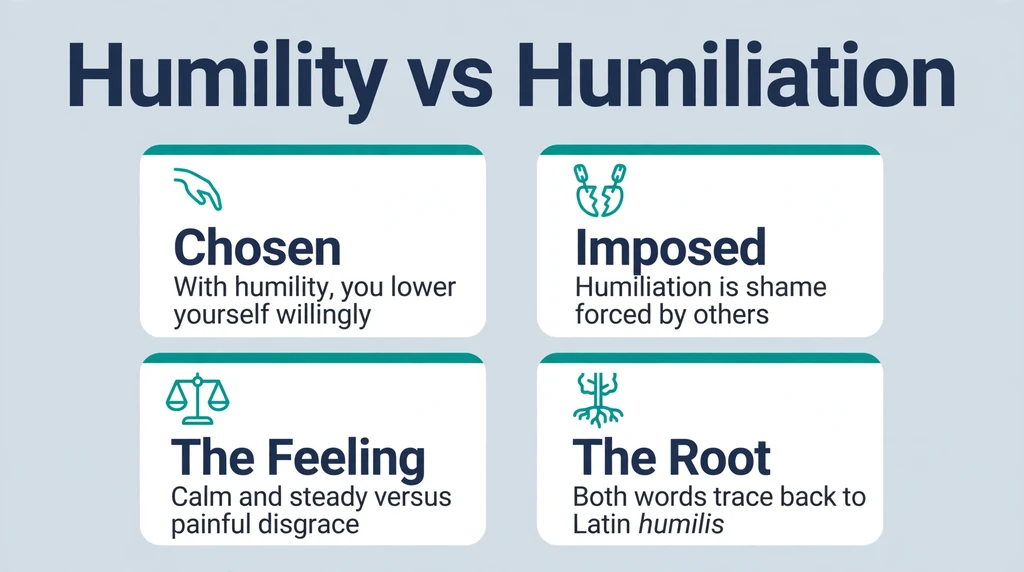
Humility and humiliation share Latin roots and similar sounds. Beyond that, they point in opposite directions. Confusing them causes real misunderstanding, so this contrast deserves care.
Humiliation is a painful feeling of shame and disgrace. It usually arrives from outside. Someone mocks you, exposes a failure, or strips away your dignity in front of others. The experience is forced on you, and it wounds.
Humility, on the other hand, is a quality you hold yourself. It is calm rather than painful. A humble person feels no disgrace in admitting a mistake or taking a lower seat. Nothing has been forced, and nothing has been lost.
One is chosen, the other is imposed
Reference works draw exactly this line. Humility is an outward expression of a healthy inner view of yourself. Humiliation is an imposition, often external, of shame upon a person.
Think of it through control. With humility, you lower yourself willingly, the way a tall person ducks through a doorway. With humiliation, somebody pushes your head down. The posture may look similar, but the meaning could not be more different.
The verb forms show the split
English grammar keeps the two ideas apart as well. You can humiliate another person, and the word always sounds like an attack. But nobody can truly give you humility. Other people can teach it or model it, yet the quality itself must grow inside you.
So if a lesson leaves you steadier and more honest, it taught humility. If it leaves you shamed and smaller in your own eyes, it was humiliation. The first builds people up over time. The second only tears them down.
What Humility Looks Like in Psychology
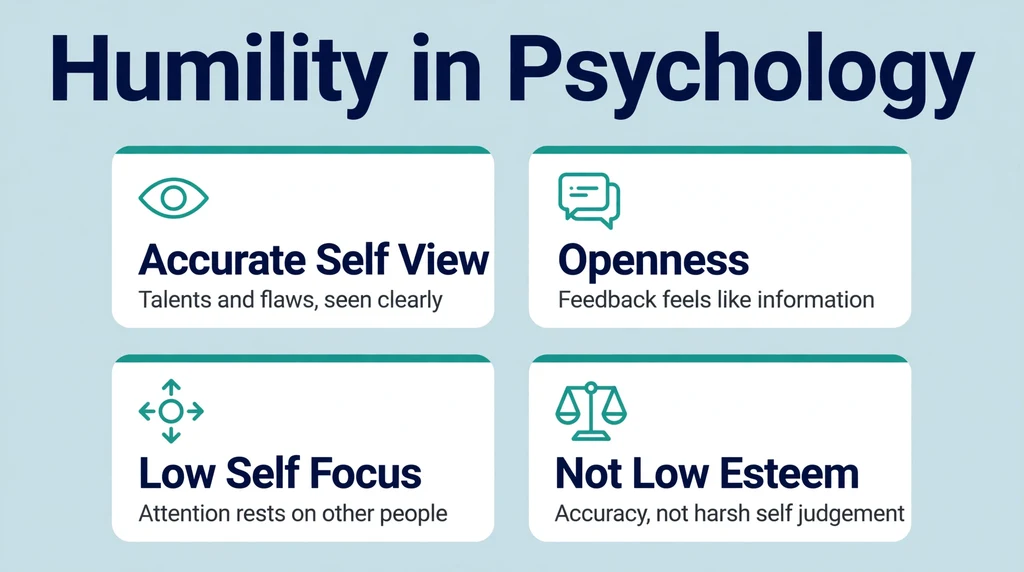
Psychologists study humility as a trait, and their picture matches the dictionary one closely. In this field, humility is not about feeling small. It is about seeing yourself clearly and keeping your ego in proportion.
Writers on the topic describe humility as the ability to view your talents and flaws accurately, without arrogance. Notice the balance inside that description. Talents get acknowledged. Flaws get acknowledged too. Neither side gets exaggerated.
Three parts psychologists point to
First, humble people hold an accurate self-assessment. They know what they can do, and they know where their skill ends. This honesty protects them from both boasting and false shame.
Second, they stay open. Because they accept their limits, feedback does not feel like an attack. Criticism becomes information, and other people’s ideas get a fair hearing.
Third, they show low self-focus. Their attention rests on the task, the team, or the person in front of them. They spend less time wondering how they look, which frees up real energy for the work itself.
Intellectual humility
One branch of this research gets special attention: intellectual humility. The term names the habit of recognising that your beliefs might be wrong. A person with intellectual humility can say “I do not know” without feeling threatened.
That habit matters far beyond the classroom. It shapes how people argue, vote, lead, and learn new skills. When being wrong costs nothing socially, changing your mind becomes much easier.
Humility is not low self-esteem
Psychology also clears up a common mix-up. Low self-esteem means judging yourself harshly and doubting your worth. Humility asks for accuracy, not harshness. A humble surgeon can trust her hands completely while still crediting her team.
In short, humility and confidence can live in the same person. Indeed, they often strengthen each other. Clear self-knowledge makes confidence steadier, because it rests on facts rather than on a fragile image.
Signs of Humility: Traits of Humble People
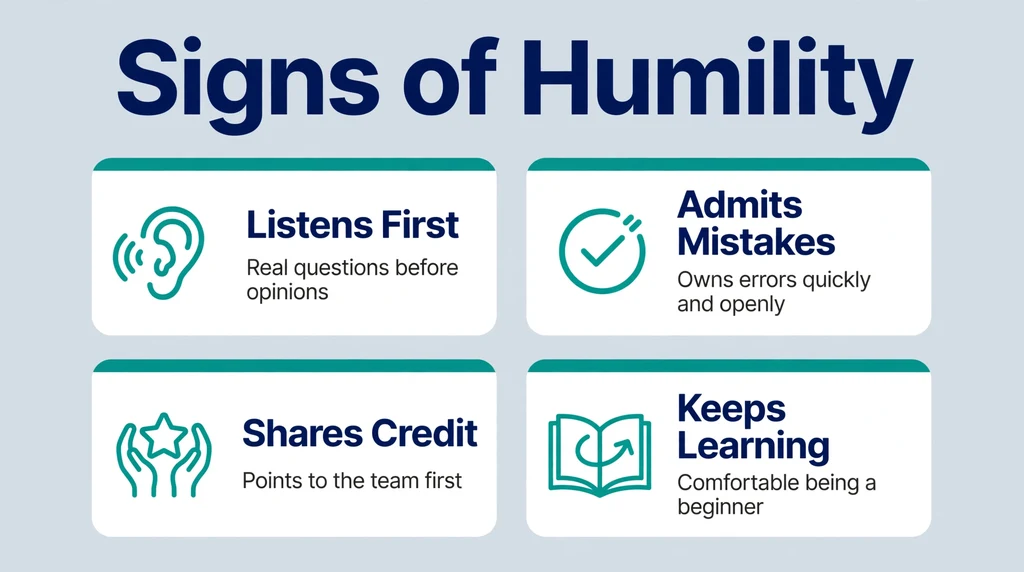
Humility is an inner quality, yet it leaks into behaviour constantly. You can spot it in meetings, families, and friendships if you know what to look for. Here are the signs that appear again and again.
They listen more than they speak
A humble person treats other people’s words as worth hearing. They ask real questions and let answers finish. In conversation, they are curious rather than competitive.
They admit mistakes quickly
When something goes wrong, humble people name their part in it. They do not hide behind excuses or shift the blame. An honest “that was my fault” costs them little, because their worth does not hang on being perfect.
They share credit and accept blame
Watch who gets thanked when a project succeeds. Humble leaders point at the team first. Then, when results disappoint, they step forward themselves. Credit flows outward from them, and responsibility flows inward.
They keep learning
Humble people act like students for life. They read, ask, and practise skills they have not mastered yet. Being a beginner does not embarrass them, because they never claimed to know everything.
They treat everyone with the same respect
Rank does not change how a humble person speaks to someone. The intern and the director get the same courtesy. This evenness comes straight from the definition: if no one is beneath you, no one gets talked down to.
They accept help and feedback gracefully
Pride often refuses help, since needing help feels like weakness. Humility accepts help with simple thanks. Likewise, humble people receive criticism calmly and sort the useful parts from the rest.
They apologise sincerely
Humble people say sorry without dressing it up. Their apology names the harm, skips the excuses, and arrives quickly. Because they do not treat error as disgrace, they can repair relationships while prouder people are still composing defences.
They do not need to be the centre
Finally, humble people are comfortable outside the spotlight. They can enjoy an event they did not organise and praise work they did not do. Their satisfaction comes from things going well, not from being seen.
Humility Examples in Sentences
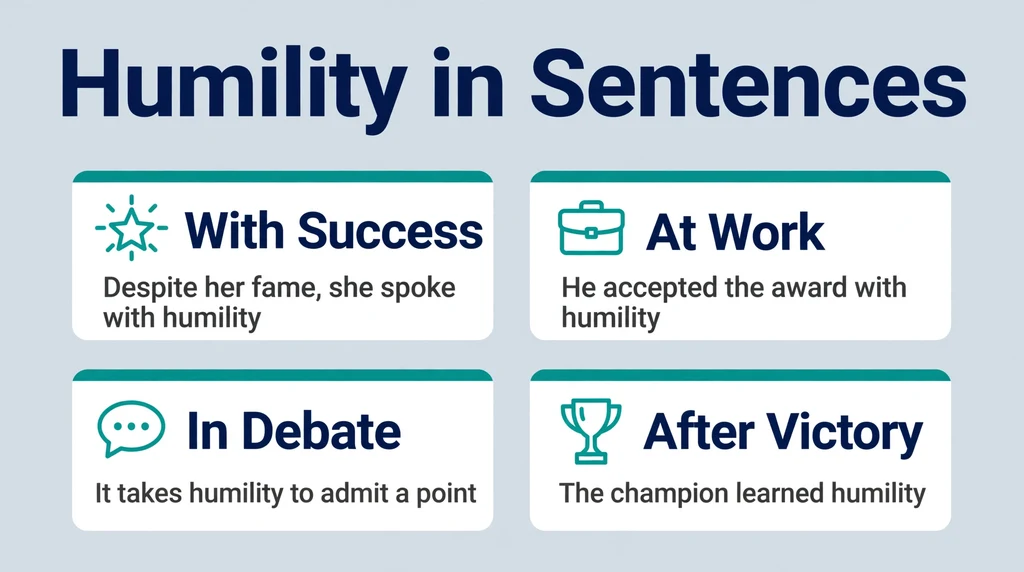
Seeing a word at work fixes its meaning in memory. The sentences below show humility in its common patterns, from formal writing to everyday speech. Notice how often the word sits beside success, fame, or praise.
1. Despite her fame, she spoke about her early failures with striking humility.
2. The award surprised him, and he accepted it with genuine humility.
3. It takes humility to admit that your opponent has a point.
4. Years of coaching taught the champion humility after every victory. 5. She listened to the junior staff with patience and humility. 6. His humility after the promotion impressed everyone in the office. 7. The scientist answered her critics with calm humility. 8. Travel has a way of teaching humility to anyone who pays attention. 9. He thanked his teachers, saying that humility had shaped his career. 10. True humility showed in the way she shared credit for the discovery.
Patterns worth noticing
Most of these sentences pair humility with a reason to feel proud. That pairing is the whole point of the word. Humility rarely appears when someone has nothing; it appears when success could easily inflate the ego.
You will also notice the common companions of the word. Writers often place humility after verbs like show, learn, teach, and accept. They pair it with words such as genuine, true, and great. Learning these partners will make your own writing sound natural.
Register matters too. In formal essays, humility often appears in reflective sentences about character and leadership. In everyday speech, people reach for it after praise, apologies, and awards. If you are writing for school or an exam, the reflective pattern is the safer model to copy.
How to Practice Humility Every Day
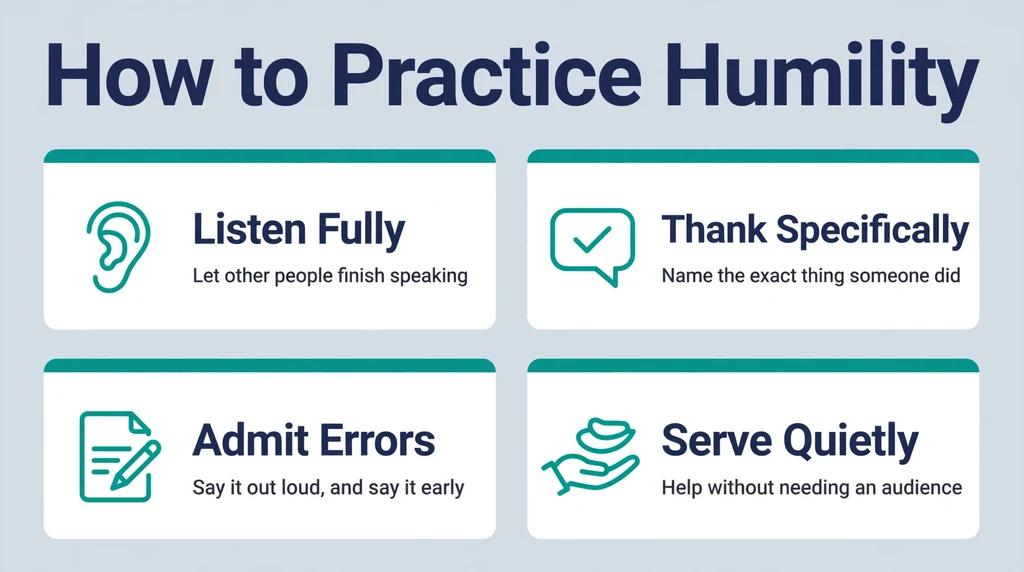
Humility sounds like something you either have or lack. In reality, it behaves more like a habit than a gift. Small repeated actions shape it, and anyone can start with a few simple practices.
Listen before you answer
In your next conversation, let the other person finish completely. Then repeat their point back before giving your own view. This tiny pause trains your attention outward, and people feel the respect immediately.
Keep a short list of what you do not know
Write down skills, topics, and questions where you are still a beginner. Review the list when success makes you feel complete. It is a private, honest anchor, and it keeps curiosity alive.
Thank people specifically
Vague thanks is easy. Specific thanks takes attention. Name the exact thing someone did and why it helped. The habit does two things at once: it honours others, and it reminds you how much of your progress was shared.
Admit small mistakes out loud
Do not save honesty for huge failures. Correct your small errors in the open, at work and at home. Each quick admission lowers the price of the next one, and trust around you quietly grows.
Ask for feedback, then act on some of it
Ask a colleague or friend where you could improve. Listen without defending yourself. Later, apply at least one suggestion and report back. Few actions prove humility as clearly as visible change.
Serve without being seen
Help in ways that bring no credit. Wash the dishes nobody notices, mentor quietly, tidy the shared space. Work done without an audience slowly rewires what you need praise for.
Compare less, learn more
Comparison feeds pride on good days and shame on bad ones. Replace it with study. When someone outperforms you, ask what they did and what you can borrow. Envy loses its fuel when learning takes its place.
Review your week honestly
Once a week, look back at two moments: one where you listened well, and one where your ego drove. Write a line about each. The review takes five minutes, yet it builds the accurate self-view that sits at the centre of humility. Over months, patterns appear, and progress becomes visible on the page.
Humility at Work and in Leadership
The workplace tests humility daily. Promotions, presentations, and performance reviews all invite people to inflate themselves. Yet teams tend to trust the leader who stays grounded, and there are practical reasons why.
A humble manager admits what she does not know. That honesty makes it safe for others to flag problems early. Small issues surface while they are still cheap to fix, instead of hiding until they explode.
Humble leaders also listen beyond their own circle. One famous magazine passage, quoted by Merriam-Webster, puts it well. A humble boss, The Economist wrote, listens not only to the big names but also to customers, the people who never get invited to the big meetings.
What humility is not at work
Workplace humility is sometimes misread as weakness. Colleagues may assume the quiet, credit-sharing person lacks ambition. However, the behaviour usually signals security, not softness. It takes real confidence to let others shine.
Nor does humility mean accepting unfair treatment. A humble employee can negotiate firmly, report a problem, or defend a boundary. The quality governs self-importance, not self-respect. Knowing your worth and knowing your limits are partners, not enemies.
Humility in interviews and reviews
Job interviews tempt everyone to perform. A candidate with humility handles the classic weakness question honestly, naming a real limit and the steps taken to improve it. Recruiters hear answers like that often, yet genuine ones still stand out, because they sound specific rather than scripted.
Performance reviews reward the same honesty. Employees who acknowledge gaps early can ask for training, mentors, and stretch projects. Their managers get an accurate map of the team. In this way, humility quietly becomes a career skill, not only a personal virtue.
Humility in Religion and Philosophy
Few qualities appear in as many traditions as humility. Across religions and schools of philosophy, teachers return to the same insight. The ego, left unchecked, distorts how a person sees the world.
In the Jewish and Christian scriptures, humility stands close to wisdom. The book of Proverbs teaches that “when pride comes, then comes disgrace, but with humility comes wisdom.” The prophet Micah sums up a faithful life as acting justly, loving mercy, and walking humbly with God.
Christian teaching treats humility as a foundational virtue. Medieval thinkers defined it as knowing yourself as you truly are and keeping within your true bounds. Pride, in this tradition, is the root failure from which other failures grow.
Islam gives the quality a central place as well. Humility before God shapes daily prayer, where worshippers bow and prostrate themselves close to the ground. The tradition also praises humility between people: gentleness, patience, and a refusal to look down on others.
Eastern traditions
Eastern thought reaches similar ground by different roads. Buddhist teaching links humility with letting go of the self and its cravings. Hindu thought also honours humility as a virtue that makes other virtues possible, an idea voiced strongly by Gandhi in his writings on the subject.
Taoist teaching uses water as its favourite image. Water serves every living thing, the classic texts observe, yet it settles in the lowest places and never competes. The lesson is practical rather than mystical: the low position is not the weak position. It is where usefulness quietly gathers.
Philosophers outside religion value the trait too. Ancient Greek culture warned against hubris, the swollen pride that invites a fall. Confucian teaching praised modesty and deference as marks of a cultivated person. The details differ across traditions, but the direction of travel is the same.
Why the agreement matters
This wide agreement explains the word’s weight in modern English. When speakers call humility a virtue, they echo thousands of years of teaching. Even in a secular office or classroom, the word carries that old moral gravity.
Common Myths About Humility
Because the word sounds soft, myths gather around it. Clearing them away protects the real meaning, so here are the most common ones.
Myth one: humility means thinking badly of yourself
This is the biggest misunderstanding of all. Humility means thinking of yourself accurately, not badly. A popular modern saying captures it well: humility is not thinking less of yourself, but thinking of yourself less.
Myth two: humble people lack ambition
Watch actual humble high achievers, and the myth collapses. Many train, compete, and build with full intensity. What they skip is the self-display. Ambition aims at the work, while pride aims at the applause. Humility removes only the second aim.
Myth three: humility cannot be faked, so it cannot be practised
People do sometimes perform humility to win praise, and listeners smell the performance quickly. Still, the answer is practice, not surrender. Habits of listening, thanking, and admitting error slowly become genuine. Behaviour leads, and attitude often follows behind it.
Myth four: humility is only a religious idea
Religions teach humility, certainly. But the word does full work in science labs, sports teams, and boardrooms where no faith is involved. Wherever accuracy, teamwork, and learning matter, humility earns its place.
Synonyms and Antonyms of Humility
A word’s neighbours sharpen its meaning. Humility sits among several softer virtues on one side and a family of pride words on the other. Knowing the neighbours helps you pick the exact word you need.
Close synonyms
Modesty is the nearest everyday synonym, covering restraint in behaviour and speech. Humbleness names the same quality as humility, in a slightly plainer, less formal dress. Writers reach for it in warm, personal contexts.
Meekness adds a note of gentleness and patience under pressure. Lowliness is older and more literary, pointing at low status accepted without complaint. Unpretentiousness describes someone with no airs at all, comfortable and unaffected. Each synonym keeps the core sense while shifting the flavour a little.
Antonyms: the pride family
On the far side stand pride in its swollen sense, arrogance, vanity, conceit, and haughtiness. Hubris, borrowed from Greek, names the extreme case: pride so inflated that it invites a fall. Narcissism is the modern clinical cousin, an excessive focus on the self.
Notice the pattern in the two lists. The synonyms describe people whose attention rests lightly on themselves. The antonyms describe people whose attention is glued to their own image. Humility and its opposites are, at heart, about where the focus sits.
Choosing the right word
For formal or reflective writing, humility is the standard choice. For everyday warmth, humble and humbleness often sound friendlier. When the setting involves patience under insult, meekness fits better. And when you want to praise someone plainly, “down to earth” remains the friendliest phrase of all.
Frequently Asked Questions
What is the simple meaning of humility?
Humility means having a modest view of your own importance. A person with humility is not proud or arrogant. They know their strengths, admit their limits, and do not treat themselves as better than anyone else. It is the quality of being humble.
Is humility a good quality?
Yes, humility is widely treated as a virtue. Religions and philosophies have praised it for thousands of years. Modern psychology views it positively too, because it supports learning, honest feedback, and strong relationships. People generally trust and enjoy working with humble people.
What is the difference between humility and modesty?
Modesty is mostly outward. It covers how you behave, speak, and present your achievements. Humility is the inner attitude beneath that behaviour: an honest, modest view of yourself. Modesty can be performed for an audience. Humility is what you believe when nobody is watching.
What is the difference between humility and humiliation?
Humility is a calm quality you hold yourself, and it involves no shame. Humiliation is a painful feeling of disgrace that is usually imposed by someone else. One is chosen and steady. The other is forced and wounding, which is why the two words should never be swapped.
Can a person be humble and confident at the same time?
Yes, and the two often support each other. Humility asks for an accurate view of yourself, and accuracy includes your real abilities. A confident person who also knows their limits does not need to boast. Their calm comes from facts, not from an image they must protect.
What is the opposite of humility?
The standard opposite is pride, in its negative sense of an inflated view of yourself. Arrogance, vanity, and conceit are also common antonyms. Each one describes the focus turned inward and upward, where humility keeps the focus level and outward.
Where does the word humility come from?
Humility comes from the Latin word *humilitas*, built on *humilis*, meaning low. That adjective traces back to *humus*, the Latin word for earth or ground. The word reached English through Old French. Its history explains why English still calls a grounded person “down to earth.”
How can I show humility in daily life?
Start small. Listen fully before answering, admit mistakes quickly, and thank people for specific things they did. Share credit when work goes well, and ask for feedback without defending yourself. Repeated daily, these habits build the quality from the outside in.
Final Thoughts
Humility is a small word with deep roots. It began with the Latin word for earth, and it still points downward in the best way. A humble person stays grounded: honest about their gifts, open about their limits, and free of the need to impress.
That freedom is what makes the quality so attractive. It improves learning, steadies leadership, and softens every relationship it touches. Best of all, humility is not a talent you are born with or without. It grows through practice, one honest moment at a time.
Start where the word itself starts: on the ground, at eye level with everyone else. From there, your strengths need no announcement, your mistakes need no hiding, and other people get the space to shine beside you. That is the humility meaning in full, and it is available to anyone willing to practice it.
If you want to check the exact dictionary wording for yourself, the Merriam-Webster entry for humility is a good place to start. Then look for the quality in the people around you. You will start seeing it everywhere.