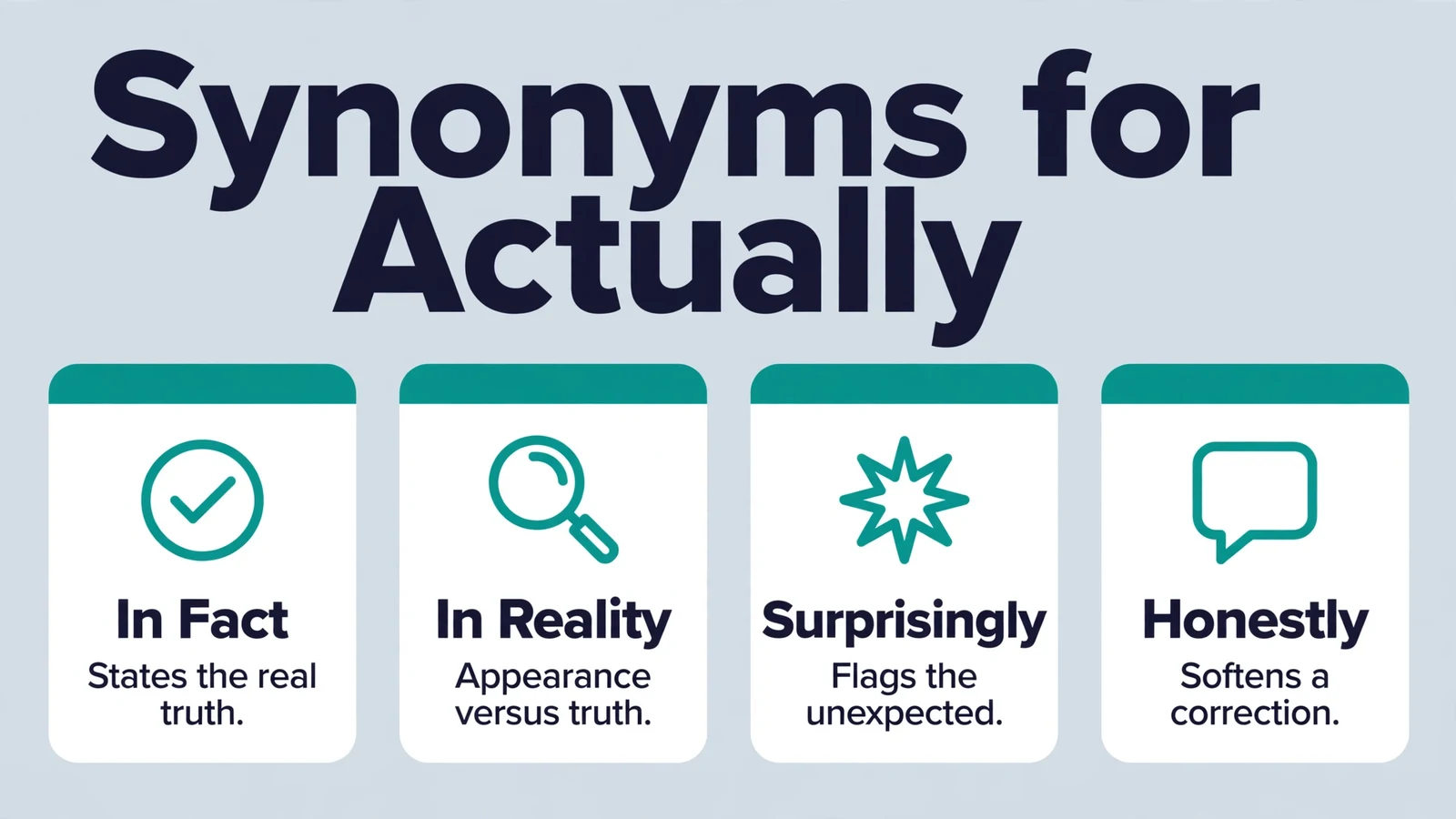
Few small words work as hard as *actually*. It corrects a rumour in one breath and softens a refusal in the next. The trouble is that repeating it in every paragraph makes writing sound flat. Worse, swapping in the wrong replacement can quietly change your meaning. The safest everyday synonyms for actually are *in fact*, *really*, *truly*, *in reality*, *genuinely*, *indeed*, *as a matter of fact* and *in truth*. Each one, however, suits a slightly different job. This guide groups more than 70 alternatives by the work they do: correcting, surprising, softening and intensifying. Every word comes from major dictionaries and thesauruses, and each entry shows where it fits and where it fails. You will also find the formal picks that editors prefer, plus the look-alike words that are not synonyms at all.
The Best Synonyms for Actually: Quick Reference Table
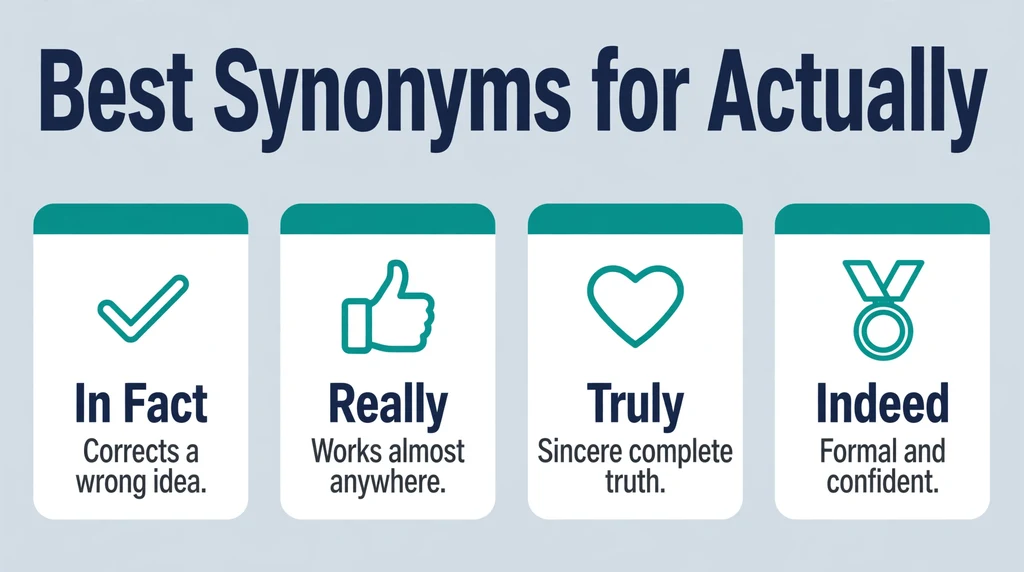
Start with this table when you need a fast answer. It collects the most useful replacements and shows what each one does best. The sections after the table explain the differences in detail, with examples you can borrow for your own writing.
| Word | What it does | Best for |
|---|---|---|
| In fact | States the real truth | Correcting a wrong idea |
| In reality | Contrasts appearance with truth | Explanations and essays |
| In actuality | Formal version of in reality | Academic writing |
| In truth | Honest, slightly formal truth | Speeches and essays |
| As a matter of fact | Confident correction | Speech and writing |
| In point of fact | Very formal correction | Legal and academic prose |
| Really | Everyday truth or degree | Almost anywhere |
| Truly | Sincere and complete truth | Emphasis and formal letters |
| Genuinely | Real, not fake | Feelings and quality |
| Indeed | Confirms and adds weight | Formal writing and agreement |
| Honestly | Opens an honest opinion | Conversation and softening |
| Frankly | Blunt and direct truth | Opinions and criticism |
| Surprisingly | Flags an unexpected result | Stories and reports |
| Believe it or not | Playful surprise marker | Speech and informal writing |
| As it happens | Marks a surprising coincidence | Conversation |
| Very | Pure degree | Intensifying adjectives |
| Just | Exactness or pure emphasis | Phrases like just right |
| Simply | Sheer and complete degree | Strong statements |
| Literally | Word for word, or sheer emphasis | Definitions and casual speech |
| Practically | True in effect, almost | Everyday approximation |
| Virtually | True in effect | Formal approximation |
| Positively | Certain and definite truth | Confident statements |
| Certainly | No doubt at all | Agreement and formal prose |
| Undoubtedly | Beyond question | Essays and arguments |
If you only remember five, take *in fact*, *really*, *truly*, *indeed* and *in reality*. Together, they cover most sentences safely, in both speech and writing.
Notice what the table leaves out: the archaic and playful words. A quick answer should be a safe answer, so *verily*, *forsooth* and *indeedy* wait in their own section below. The table also skips the softening openers in their dialogue role. Those appear later, beside the corrections they make polite.
What Does Actually Mean?
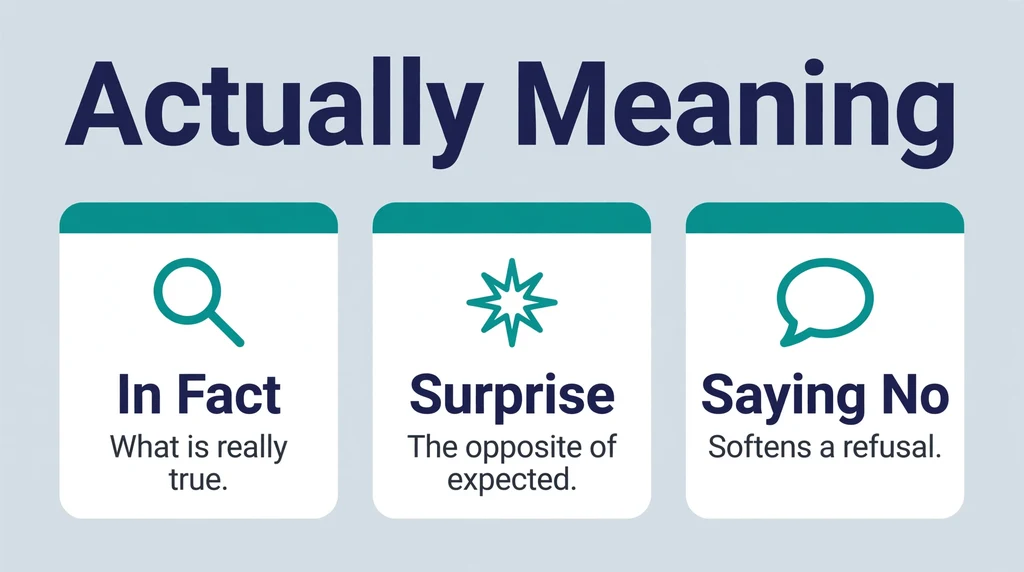
Cambridge Dictionary gives *actually* three main uses, and good replacements follow the same split. In its basic sense, the word means “in fact or really.” You use it to say what is true about a situation. Consider the plain question, “So what actually happened?” Nothing in that sentence is surprising. The word simply separates fact from guesswork, rumour and assumption. Merriam-Webster’s thesaurus makes a similar cut in a different way. It divides the word into two senses: “to tell the truth” and “in actual fact.” Both senses point to the same core job, which is anchoring a sentence to reality.
Actually for Surprise
The second job is surprise. Cambridge notes that *actually* often introduces information that is surprising, or the opposite of what most people would expect. Think of the sentence “Don’t tell me he actually paid for you!” Here, the word carries the shock. Remove it, and the sentence still works, but the raised eyebrows disappear. Collins gives this use its own dictionary sense and labels it “surprisingly.” That is why *surprisingly* and *believe it or not* count as true synonyms in this guide. They are not loose relatives of the word. They do the same job in the same slot.
Actually for Saying No Politely
The third job is the most British, and arguably the most useful. Cambridge lists a separate sense for saying no, where *actually* makes a sentence slightly more polite. It cushions an opposing opinion, a correction or a refusal. For example, “Well, actually, I’d rather you didn’t” sounds gentler than a bare “No.” In this position, the word carries almost no factual weight at all. Instead, it protects the other person’s feelings while you disagree with them. Replacements for this job are openers such as *honestly*, *frankly* and *to tell the truth*. They signal honesty early, before the awkward part of the sentence arrives.
Where Actually Sits in a Sentence
Position changes the flavour of the word, and Cambridge’s grammar pages pay close attention to it. At the start of a sentence, *actually* usually corrects or introduces a contrast: “Actually, the train leaves at nine.” In the middle, it stresses the verb: “She actually apologised.” At the end, especially in British speech, it softens a statement or adds a mild afterthought: “I would not mind a coffee, actually.” Replacements follow the same map. Openers such as *in fact* and *honestly* live at the front of a sentence. Intensifiers such as *really* sit beside the verb. Trailing softeners are harder to replace, which is one reason the original word survives so well in conversation.
Synonyms for Actually That Correct and Contrast
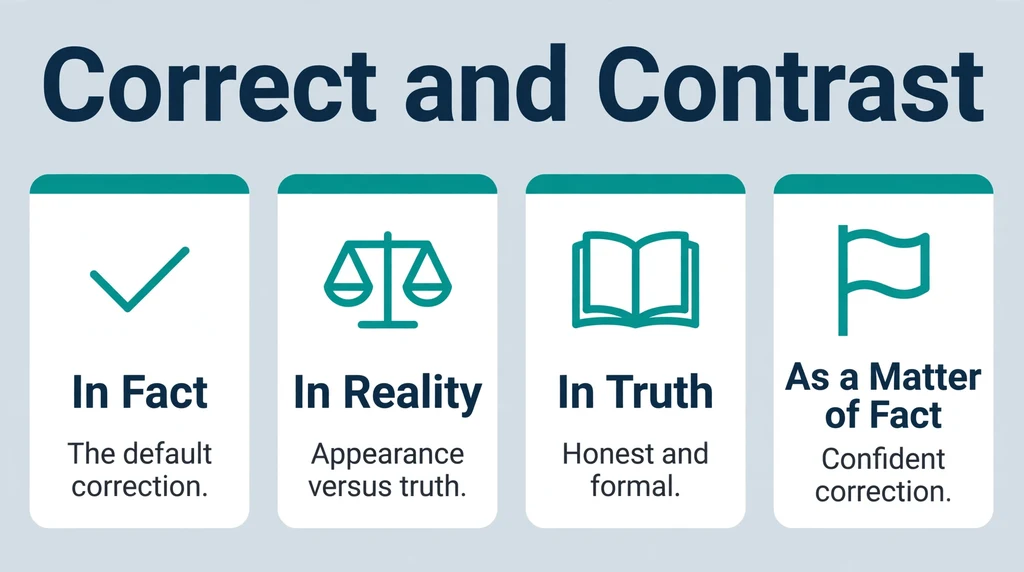
Most searches for this word start here. Someone has said something wrong, or a situation is not what it seemed. You need a word that sets the record straight. The phrases in this group all point at reality instead of appearance. They differ mainly in strength, formality and rhythm, so read the notes before you swap one into a sentence.
The In Fact Family
- In fact: the default correction, safe almost everywhere. Example: “The shop is not closing. In fact, it is hiring two new assistants.”
- In reality: contrasts how things look with how they are. Example: “He seems strict, but in reality he is patient and kind.”
- In actuality: the formal twin of *in reality*, common in reports and academic prose.
- In truth: honest and slightly literary, good for speeches. Example: “In truth, we were both nervous that day.”
- As a matter of fact: confident and conversational. Example: “As a matter of fact, I have already sent the file.”
- In point of fact: the most formal of the family. It suits legal, academic and official writing, but it can sound pompous in chat.
- In actual fact: a mainly British variant of *in fact*, with the same correcting force.
- In effect: true in practical terms, whatever the official wording says. Example: “The rule is, in effect, a ban.”
Truth-Telling Openers
These words open a sentence by promising honesty. Several of them also soften disagreement, a job explored later in this guide.
- Honestly: the friendliest opener. It frames what follows as a sincere opinion rather than an attack.
- Frankly: direct and blunt. It warns the listener that the truth may sting a little.
- Truthfully: plain and sincere, slightly more formal than *honestly*.
- Admittedly: concedes a point against your own side. Example: “Admittedly, the first draft was weak.”
- To tell the truth: a warm, spoken opener that buys you a second to think.
- If truth be told: a reflective variant of the same promise, common in storytelling.
- To be sure: concedes a fact before a contrast. Example: “To be sure, the plan is costly, but it works.”
- Certainly: firm agreement or firm fact, with no doubt attached.
- Absolutely: total, emphatic truth. It works best in speech and lively writing.
- Positively: definite and certain, as in “The test was positively identified.”
Before and After: Corrections in Action
Watch how the swaps change real sentences. “The museum is actually free on Sundays” becomes “In fact, the museum is free on Sundays.” The meaning survives, and the tone turns more written. “He actually owns the building” becomes “In reality, he owns the building,” which stresses the gap between rumour and truth. “Actually, I sent it yesterday” becomes “As a matter of fact, I sent it yesterday,” a firmer and slightly more formal correction. One more: “The drug actually works” becomes “The drug works in reality, not only in trials,” when you need the contrast spelled out. In every case, the correction still lands. Only the temperature changes.
Synonyms for Actually That Express Surprise
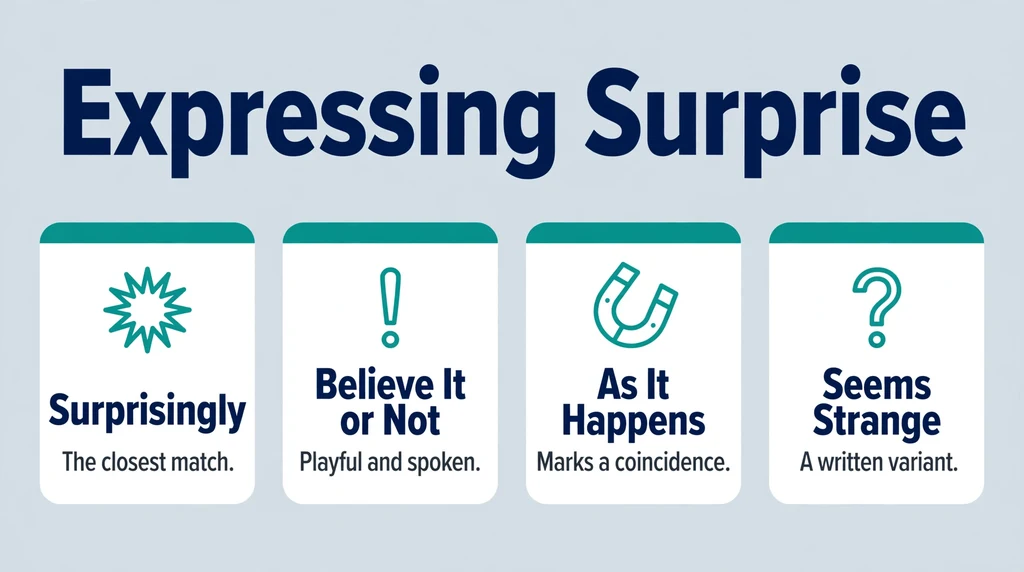
Sometimes *actually* does not correct anyone. Instead, it waves a small flag that says the next fact is unexpected. Collins treats this as a separate sense of the word, and the replacements below come from that sense. Use them when the surprise itself is the point of your sentence.
- Surprisingly: the closest single-word match. Example: “Surprisingly, the old car started on the first try.”
- Believe it or not: playful and spoken. It invites the listener to share your amazement. Example: “Believe it or not, he finished the race barefoot.”
- Though it may seem strange: a fuller, more written variant. It suits essays and stories better than chat.
- As it happens: marks a coincidence rather than a shock. Example: “As it happens, I know the manager personally.”
*Really* and *truly* can also carry surprise when the sentence supplies the shock. “She truly won?” works because the question does the heavy lifting. Still, if you want the surprise to be unmistakable, choose *surprisingly*. It names the feeling directly, so the reader cannot miss it.
Writers lean on this sense more than anyone else. A flat sentence like “The shop was open” gains a small jolt as “The shop was actually open,” because readers expected it to be closed. Storytellers use the same trick with *as it happens* at a coincidence and *believe it or not* before a tall but true claim. Keep the trick rare, though. Surprise fades fast when every second sentence promises it.
Synonyms for Actually as an Intensifier
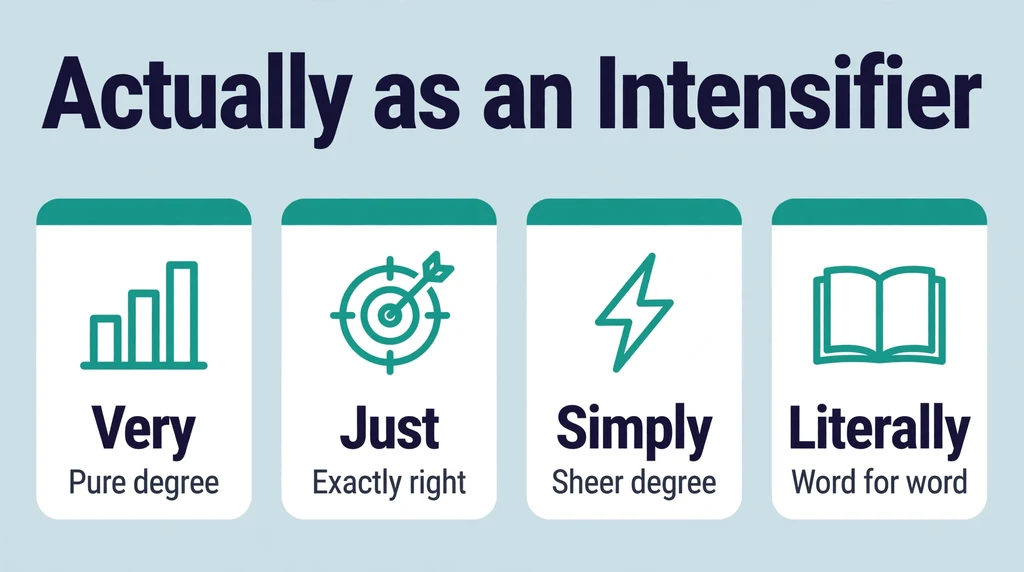
In many sentences, *actually* adds degree rather than correction. “She actually finished the marathon” can mean she really did it, completely, against the odds. Merriam-Webster places these degree words in the same sense as *really*, and they are the right swaps when your sentence is about extent, not about error. For the wider family, see our full guide to synonyms for really, which covers this ground in depth.
Degree Words: Very, Just, Simply and Friends
- Very: the plainest intensifier of all. It raises the degree of an adjective or adverb and nothing more. Our list of synonyms for very gives dozens of stronger options.
- Just: marks exactness or pure emphasis. Example: “The soup is just right.” It can also mean simply, as in “I just love this song.”
- Simply: sheer, complete degree. Example: “The view was simply stunning.” It signals that no stronger word is needed.
- Exactly: precision first. Example: “That is exactly what I meant.” It fits when the fit itself matters.
- Precisely: the formal twin of *exactly*, common in technical and academic prose.
- Literally: in its strict sense, word for word: “The sign literally says no entry.” Informally, it works as a sheer emphasizer, a use dictionaries record but formal editors still resist.
Exactly and Genuinely
- Genuinely: in a real and sincere way. Example: “She was genuinely sorry.” It answers doubt about whether a feeling is real.
- Authentically: true to its origin or nature. Example: “The recipe is authentically Sicilian.”
- Accurately: correctly and without error. Example: “The model accurately predicts rainfall.”
- Certifiably: in a way that can be proven or certified. It often appears in lively or humorous writing.
- Squarely: directly and exactly. Example: “The blame falls squarely on the design team.”
- Right: survives in fixed phrases such as “right in the middle” and “right on time,” where it means exactly.
- Smack-dab: informal and playful, meaning exactly in a spot. Example: “The café sits smack-dab in the centre of town.”
True in Effect: Practically and Virtually
- Practically: true in effect, though not in a strict sense. Example: “By Friday, the work was practically done.”
- Virtually: the formal partner of *practically*. Example: “The two designs are virtually identical.”
- Nearly: close to a state or result, but not quite there. It measures distance rather than truth.
- Almost: the everyday version of *nearly*. Example: “Dinner is almost ready.”
Choose these four only when “almost true” is what you mean. They weaken a claim on purpose, while *actually* strengthens one. Swapping them by accident reverses your sentence.
One more pattern deserves a mention. Before verbs of happening and doing, *actually* often answers silent doubt: “Did it actually happen?” Here the closest swaps are *really* and *truly*, because the sentence questions reality itself. Degree words cannot help you there. “Did it very happen?” is not English, and noticing that fact will stop you misusing half of this section.
Synonyms for Actually That Soften Your Words
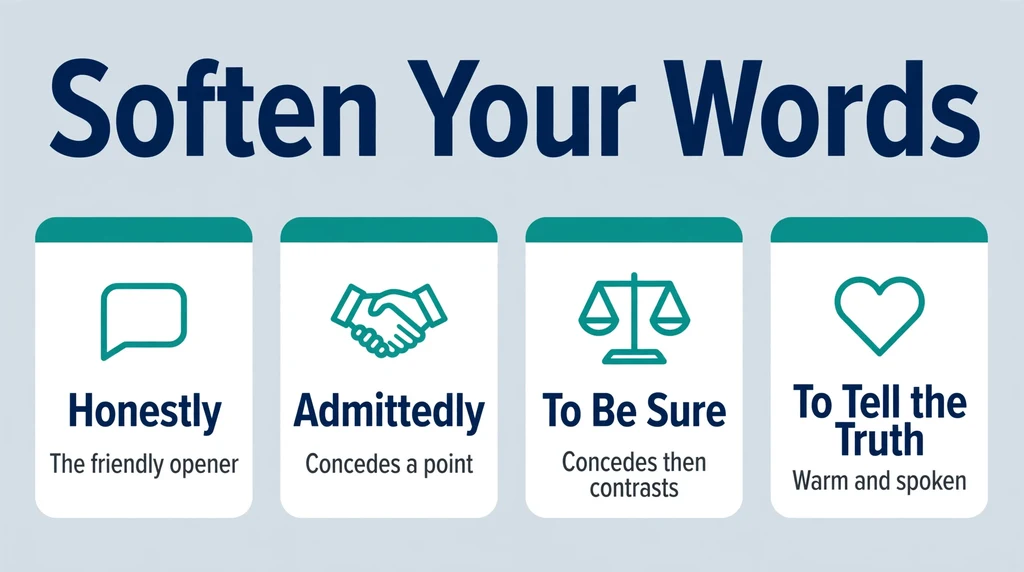
This is the job learners miss most often. In British speech especially, *actually* works as a cushion. Cambridge explains that it makes a sentence slightly more polite when you express an opposing opinion, correct someone, or refuse an offer. The factual content barely changes. What changes is the temperature of the conversation.
The same truth-telling openers from earlier do this softening work, because they announce honesty before disagreement. Compare these pairs:
- Blunt: “That meeting is not today.” Softer: “Actually, that meeting is tomorrow.”
- Blunt: “No, I will not lend it.” Softer: “Honestly, I would rather keep it at home.”
- Blunt: “You are wrong about the date.” Softer: “If truth be told, the date was the Tuesday, not the Wednesday.”
- Blunt: “I disagree.” Softer: “Admittedly, your plan is cheaper, but I still prefer the safer one.”
*Frankly* is the exception in this group. Although it promises honesty, it often sharpens a sentence instead of softening it. “Frankly, the report is late” sounds like a warning. When your goal is kindness, reach for *honestly*, *admittedly* or *to be sure* instead. They concede something first, and that small concession is what makes the correction easy to accept.
The Trailing Actually
British speakers also park the word at the end of a sentence: “I would not mind something to eat, actually.” Cambridge uses almost exactly this example for its saying-no sense. The trailing position turns a request into a gentle suggestion and leaves the listener an easy exit. Few synonyms can sit in that slot. *Honestly* can trail in casual speech, as in “I am fine with either, honestly.” Mostly, though, the end position belongs to *actually* alone. Keep it there when politeness matters more than variety.
Formal Synonyms for Actually for Essays and Professional Writing
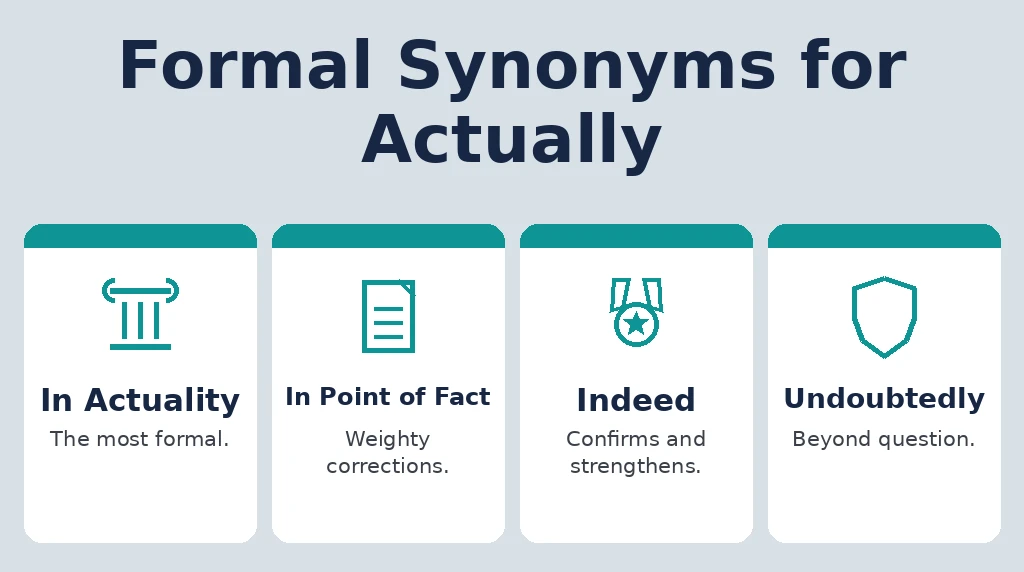
Examiners and editors often circle *actually* in formal prose, because it sounds spoken. The replacements below keep the meaning while raising the register. They also pair well with the contrast connectors in our guide to synonyms for however, which handles the “but” side of an argument.
Safe Essay Replacements
- In fact: the safest formal swap. It corrects or strengthens a claim without sounding casual.
- Indeed: confirms a point and often adds a stronger one. Example: “The method is slow; indeed, it is the slowest we tested.”
- In reality: sets appearance against truth, a classic essay move.
- In actuality: the most formal member of the family. Use it in reports, theses and official documents.
- In point of fact: formal and emphatic. Reserve it for weighty corrections, since it can sound grand in short essays.
- In truth: formal with a literary edge, at home in speeches and reflective writing.
- Veritably: truly and demonstrably. It is emphatic and old-fashioned in flavour, so use it sparingly.
- Categorically: without any doubt or exception. Collins lists it with *indeed*, and it suits firm denials and conclusions.
- De facto: in practice, whatever the official position says. Example: “She is the de facto leader of the team.”
Certainty Words for Arguments
Arguments need words that close off doubt. The following adverbs, all drawn from the thesaurus lists for *actually* and its closest senses, state that something is beyond question:
- Undoubtedly: no doubt remains. The workhorse of academic conclusions.
- Unquestionably: cannot reasonably be questioned.
- Indisputably: settled by the evidence, not open to dispute.
- Indubitably: the formal, slightly old-fashioned twin of *undoubtedly*.
- Without a doubt: a clear phrase that works in essays and speeches alike.
- For a certainty: old-fashioned but still understood: known for sure.
- Assuredly: confidently certain, common in formal assurances.
- Decidedly: clearly and definitely, as in “a decidedly better result.”
Words That Say It Is Clear to See
A second family argues from visibility rather than from certainty. These words claim that the truth is open to inspection:
- Clearly: plain for anyone to see.
- Obviously: clear, though it can sound dismissive if the reader missed the point.
- Manifestly: formal: evident and impossible to hide.
- Patently: formal: plainly, often in criticism, as in “patently unfair.”
- Demonstrably: can be shown with evidence. Excellent for research writing.
- Undeniably: impossible to deny honestly.
- Unmistakably: impossible to mistake for anything else.
- Noticeably: clearly enough to be noticed, a milder claim.
- Observably: can be seen or measured, suited to science writing.
- Factually: in a way that matches the facts, as in “factually correct.”
- Realistically: when judged in a practical way. Example: “Realistically, the bridge cannot open this year.”
A practical editing routine helps here. Search your draft for every *actually* and ask what job each one does. If it corrects, replace it with *in fact*. If it intensifies, try *truly*, or delete it, since formal prose often needs no intensifier at all. If it softens, rebuild the sentence around a concession, because formal writing rarely needs cushions. Two or three careful replacements per page will lift the register of a whole essay, and your argument will sound calmer and more confident as a result.
Informal and Archaic Synonyms for Actually
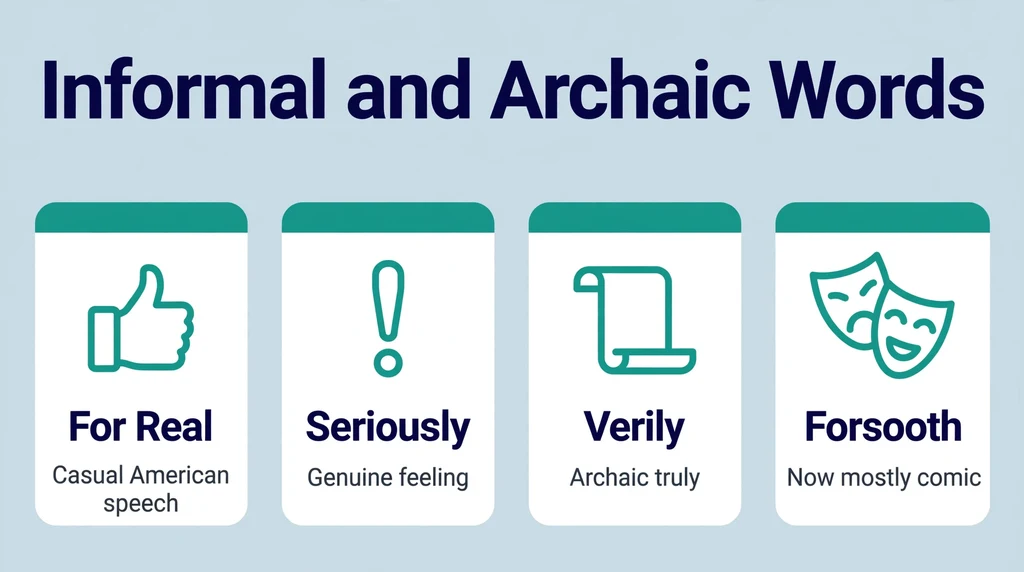
Register cuts both ways. The words below are too loose for an essay, yet they are perfect for dialogue, fiction and everyday speech. Others belong to older English and survive now mainly in novels, plays and jokes.
Informal Choices
- For real: casual and emphatic, common in American speech. Example: “Did he for real say that?”
- Seriously: signals genuine feeling or disbelief. Example: “I seriously cannot find my keys.”
- Literally: the casual emphasizer again. Fine in speech and social posts, risky in graded writing.
- Really-truly: playful and childlike, used for warm emphasis or gentle teasing.
- Indeedy: a humorous, old-fashioned yes-word. It now appears mostly in jokes and period dialogue.
- Quite: in British English, *quite* before words like *true* and *right* means completely. Example: “You are quite right.” American readers may hear it as “somewhat,” so context matters.
Archaic and Literary Choices
- Verily: truly. Collins marks it archaic, and it is familiar from the Bible and Shakespeare.
- Forsooth: in truth. Once sincere, it is now almost always comic or theatrical.
- In very sooth: an old phrase meaning in real truth, found in early modern texts.
- Of a truth: a biblical-flavoured phrase with the same meaning.
- In all conscience: an old-fashioned way to say truly or certainly, often in moral statements.
- Nothing else but: an old emphatic pattern, as in “It was nothing else but the truth.”
Use the archaic set only when you are writing dialogue for another century, quoting older texts, or joking on purpose. In a job application, *verily* will raise the wrong kind of eyebrow.
How to Choose the Right Synonym for Actually
With more than 70 options, the real skill is choosing by purpose. Ask yourself one question before you write: what is this word doing in my sentence? Then match the job to the word.
- Correcting a fact: reach for *in fact* or *in reality*. They are neutral, precise and safe in any register.
- Sounding sincere: choose *truly* or *genuinely*. They work for feelings and facts alike. Example: “I truly appreciate your help.”
- Surprising the reader: choose *surprisingly* or *believe it or not*. The first suits writing, while the second suits speech.
- Softening a no: choose *honestly*, *admittedly* or *to be sure*. They concede a little ground, which makes the refusal easier to hear.
- Writing an essay: choose *in actuality*, *indeed* or *in point of fact*. Avoid *for real* and *as a matter of fact*, which carry a spoken rhythm.
- Adding degree: choose *very*, *simply* or *just*. They raise intensity without adding a factual claim.
Two strength warnings will save you from most errors. First, *frankly* promises honesty but often delivers a slap, so keep it away from delicate corrections. Second, *in point of fact* and *veritably* are heavy coats. They look impressive on a formal occasion, yet they smother a casual sentence. When in doubt, the shorter word usually wins.
Finally, test every swap by reading the sentence aloud. If the replacement changes what the sentence claims, it is the wrong synonym, however elegant it looks. Meaning comes first, decoration second.
Three Pairs in Action
Three quick pairs show the system at work. “Actually, the results were good” corrects a doubt, so *in fact* fits: “In fact, the results were good.” “I actually cried at the ending” reports a surprise, so the writing choice is *surprisingly*: “Surprisingly, I cried at the ending.” “I would actually prefer tea” softens a preference, so the opener *honestly* does the same kind work: “Honestly, I would prefer tea.” Same facts, three different tools, each chosen by the job rather than by habit.
Antonyms for Actually
*Actually* asserts that something is true. Its opposites do the reverse job: they mark a claim as unproven, reported or merely apparent. Dictionaries define *actually* as saying something is true even when the real situation may not be widely known. The words below signal the opposite state of knowledge.
- Supposedly: according to what people claim or assume, without proof.
- Allegedly: claimed by others but not proven. News reports use it for accusations.
- Ostensibly: appearing to be true, with a hint that appearances may deceive.
- Seemingly: judging by appearances only.
- Apparently: based on what seems true from what you can see or hear.
- Reportedly: according to reports that the speaker has not confirmed.
- Falsely: in a way that is not true, the direct opposite of *truly*.
Compare two sentences: “He allegedly took the money” and “He actually took the money.” The first reports an accusation. The second states a fact. Choosing between these families is therefore not a style decision. It is a truth decision, and in news, law and science writing it carries real consequences.
The same contrast protects you as a reader. When a headline says a celebrity allegedly did something, careful legal work is hiding inside that single adverb. Treat every word in this family as a yellow flag: a claim is travelling, but the truth has not yet arrived and may never do so.
Common Mistakes: Words That Are Not Synonyms for Actually
Mistake 1: Using Actually to Mean Currently
This is the classic false friend, and Cambridge lists it among the typical errors learners make. In several European languages, the look-alike of *actual* means “current.” French has *actuellement*, Spanish has *actualmente*, German has *aktuell*, Italian has *attualmente* and Polish has *aktualnie*. All of them mean “currently” or “at present.” English *actually* never does that job.
So the sentence “I am actually working in Madrid” cannot mean “I currently work in Madrid.” A native reader hears something else: “In fact, surprisingly, I work in Madrid.” If you mean now, use *currently*, *at present* or *right now*. If you mean in fact, keep *actually* and enjoy the surprise it adds.
Mistake 2: Confusing Actual and Actually
*Actual* is an adjective, while *actually* is an adverb. Cambridge’s grammar note is blunt: *actual* means “true, real and the thing in itself,” and it does not refer to time. It also stands immediately before the noun it describes. So you write “the actual cost,” not “the actually cost.” Flip the pattern for the adverb: “It actually costs more.” Mixing the pair is one of the fastest ways to make a sentence look unedited.
Mistake 3: Reaching for Eventually or Effectively
*Eventually* is a time word. It means after a long time or in the end, so it cannot replace *actually* in a factual sentence. German speakers meet a second trap here, because German *eventuell* means “possibly,” not “eventually.”
*Effectively* is the subtler trap. Its main meaning is “in a way that works well.” In “the treatment effectively cured him,” the word praises the method. It only occasionally means “in effect.” When your point is factual truth, *in fact* says it cleanly, with no sideways meanings.
A note on *literally* completes the picture. Strictly, it means word for word. Informally, millions of speakers use it as a pure emphasizer, and dictionaries record that use. You may use it in conversation without fear. In an exam or a report, though, *truly* and *genuinely* will never start an argument.
Mistake 4: Using Actually as Filler
The last mistake is not about meaning but about habit. In speech, *actually* can turn into a filler, sprinkled into every sentence the way other speakers use *like* or *basically*. On the page, that habit reads as nervousness. The fix is simple: delete the word and reread the sentence. If the sentence loses nothing, it never needed the word at all. Keep *actually* for corrections, surprises and softened refusals, where it earns its place and does real work.
Frequently Asked Questions
What is the best synonym for actually?
*In fact* is the best all-round choice. It corrects mistakes, strengthens claims and fits both speech and writing. If your sentence is about surprise, *surprisingly* works better. If you are softening a refusal, *honestly* is warmer. Match the word to the job, and you will rarely go wrong.
What is a formal synonym for actually?
The strongest formal options are *in actuality*, *in point of fact* and *indeed*. *In reality* and *in truth* are also safe in essays and reports. These choices sound written rather than spoken, which is exactly what formal style requires.
Is “in fact” always a perfect replacement for actually?
Almost always, for the fact-stating sense. It fails in two places, though. It cannot soften a refusal the way sentence-initial *actually* does, and it does not flag surprise. For those jobs, use the openers and surprise words from the sections above.
Can I use actually in an essay?
Yes, but sparingly. One well-placed *actually* can sharpen a contrast in an essay. Five of them will make the page sound like a transcript of speech. Prefer *in fact*, *indeed* and *in actuality* as your defaults, and save *actually* for the one contrast that matters most.
Does actually mean currently?
No. English *actually* means in fact or really, and it never refers to present time. The confusion comes from European languages where the similar-looking word means “currently.” If you mean now, write *currently* or *at present* instead.
What is the difference between actually and really?
*Really* is the broader word. It can mean in fact, very, or truly, and it asks questions too, as in “Really?” *Actually* is narrower. It always points at the truth behind an assumption, which is why it so often corrects or surprises. If nothing is being corrected, *really* is usually the calmer choice.
What is a stronger word than actually?
For certainty, *undoubtedly*, *unquestionably* and *categorically* are stronger. For correction, *in point of fact* carries the most weight. For surprise, *believe it or not* is the most dramatic. Strength, however, is not always an improvement, so save these for claims you can fully support.
What can I say instead of actually at the start of a sentence?
Sentence-initial *actually* usually corrects or softens. For a correction, open with *in fact* or *in reality* instead. For a softening, open with *honestly*, *to tell the truth* or *admittedly*. Each opener keeps the polite signal while varying the rhythm of your writing.
Final Thoughts
*Actually* is three words wearing one coat: a corrector, a surprise flag and a polite cushion. Once you see which job your sentence needs, the right synonym chooses itself. Keep *in fact*, *really* and *truly* for daily use. Save *in actuality* and *in point of fact* for formal pages. Reach for *honestly* when feelings are at stake. For the full dictionary picture, with pronunciations and example sentences for every sense, read the Cambridge Dictionary entry for actually. And remember the one hard rule from this guide: *actually* never means currently, whatever your first language tells you.