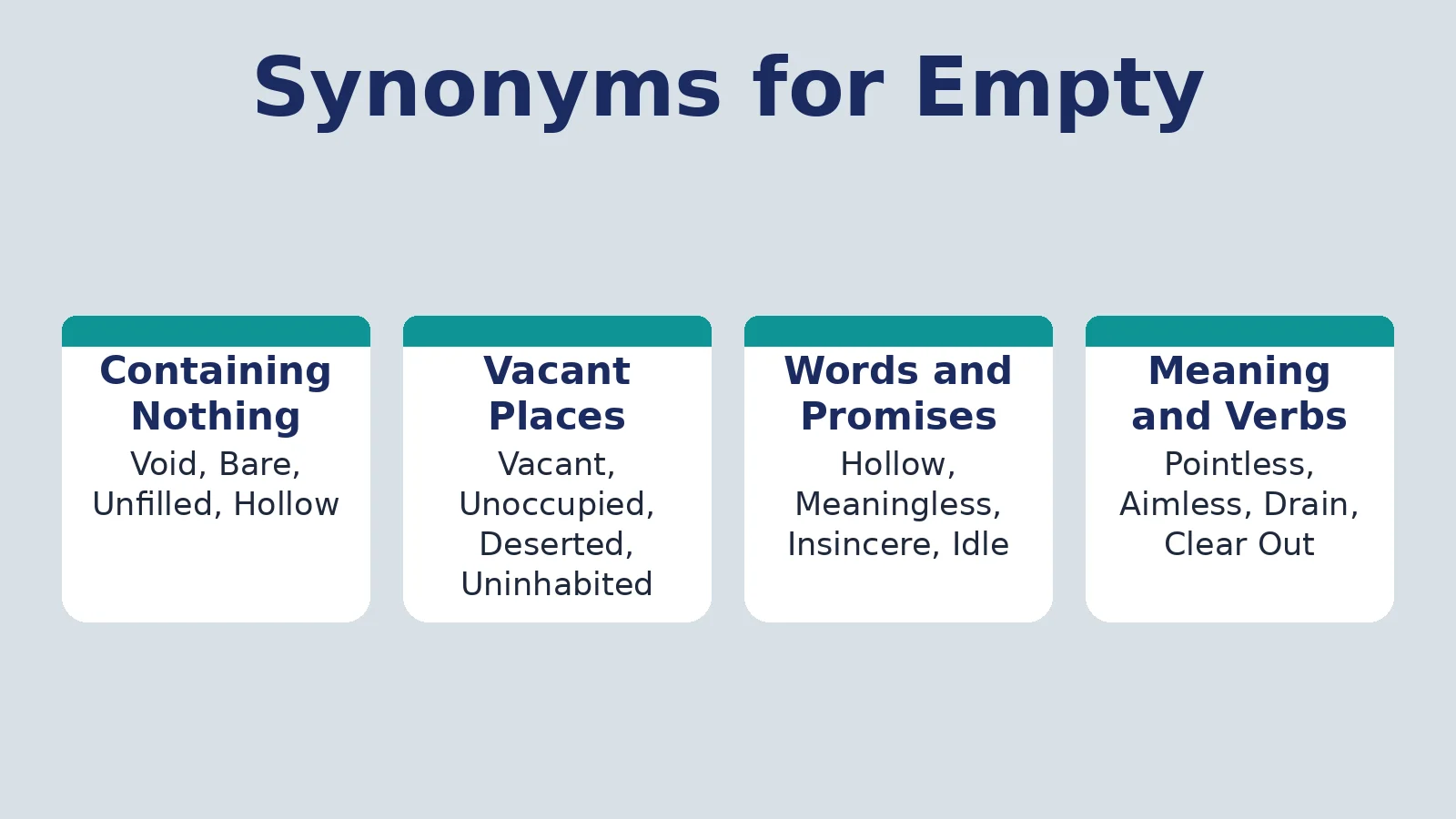
Empty looks like a simple word, yet it quietly covers five different jobs. A box can be empty, a seat can be empty, and a promise can be empty too. The most useful synonyms for empty include void, bare, vacant, unoccupied, deserted, hollow, meaningless, pointless, and drained. Each one fits a different job, though, so swapping them at random quickly goes wrong.
This guide sorts more than 70 synonyms for empty by sense. First, it covers things that contain nothing. Next, it moves to places with no one in them. Later sections handle empty words and promises, empty days and lives, and the verb itself. As a result, you can pick the word that matches your sentence instead of repeating empty five times.
Top Synonyms for Empty: Quick Reference
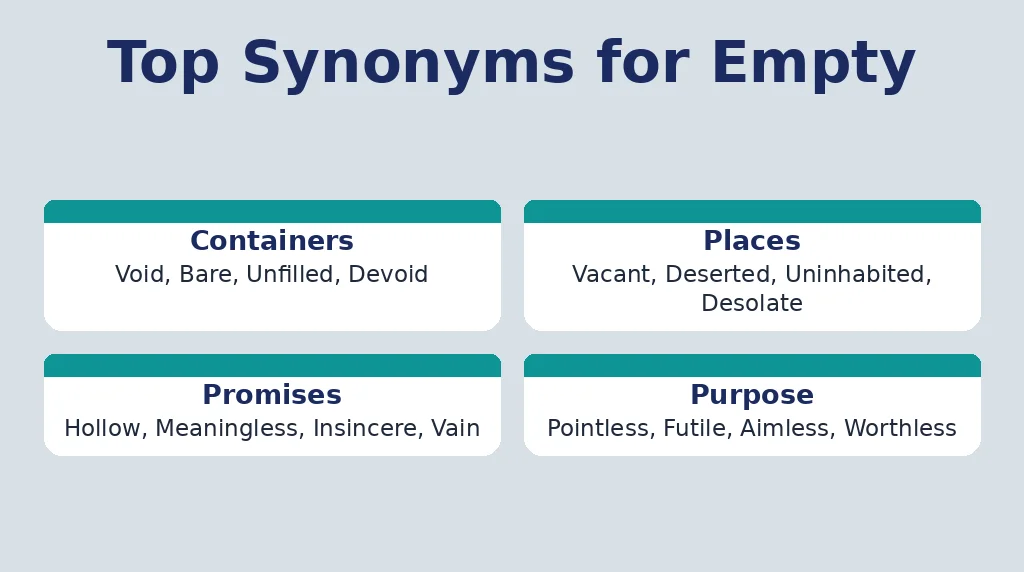
The table below gathers the 28 synonyms readers reach for most often. Use it for a fast swap. After that, the grouped sections below explain the finer differences in detail.
| Word | Meaning in one line | Best for / tone |
|---|---|---|
| Void | Completely empty, nothing at all inside | Formal, strong |
| Bare | With nothing in it or nothing on it | Rooms, shelves, walls |
| Unfilled | Not yet filled, still waiting for contents | Forms, bottles, posts |
| Hollow | Empty inside, or lacking sincerity | Trees, balls, promises |
| Devoid | Completely lacking something, formal | Devoid of meaning, life |
| Vacant | Not occupied, and often available | Seats, rooms, jobs |
| Unoccupied | With no one in it or using it | Houses, seats, land |
| Deserted | Empty because everyone has left | Streets, towns, beaches |
| Uninhabited | With no one living there at all | Islands, regions |
| Abandoned | Left behind and no longer used | Buildings, cars, plans |
| Desolate | Empty, bare and rather bleak | Landscapes, places |
| Unfurnished | With no furniture inside | Rental homes, rooms |
| Meaningless | Having no real meaning | Words, gestures, talk |
| Insincere | Not truly meant or felt | Apologies, praise |
| Idle | Not serious, or not in use | Idle threats, idle hours |
| Vain | Without effect or value | Vain efforts, vain hopes |
| Pointless | With no purpose or result | Tasks, arguments |
| Futile | Bound to fail, so without point | Attempts, resistance |
| Aimless | With no clear goal or direction | Days, wandering, talk |
| Purposeless | Lacking any purpose at all | Lives, routines |
| Worthless | Having no value at all | Strong, negative |
| Senseless | Making no sense at all | Violence, chatter |
| Vacuous | Empty of thought or intelligence | Looks, remarks, formal |
| Blank | With nothing written or shown | Pages, screens, looks |
| Drained | Emptied out, or left tired | Tanks, faces, feelings |
| Drain | To let or draw liquid out | Verb, tanks and sinks |
| Clear out | To remove everything inside | Verb, rooms and cupboards |
| Pour out | To tip contents out of something | Verb, jugs and bags |
Read the table by sense, not by habit. A word from the vacant row will sound wrong for a bottle. Similarly, a word from the promise row will sound strange for a chair. If you already know which sense you need, jump straight to that group below. Otherwise, the definition section right after this table sorts the senses out for you.
What Does Empty Mean?
At its core, empty means containing nothing. Merriam-Webster gives that as the first adjective sense, with examples like empty shelves. Cambridge adds that empty has the broadest meaning in its family. You can use it for things that usually hold people or things. Consequently, empty is the safe default when no special shade is needed.
One smaller sense deserves a note of its own. People speak of an empty stomach when they have not eaten. In that setting, empty simply means hungry and in need of food. Dictionaries list the sense directly, and warnings like never drink on an empty stomach rely on it. The synonyms there are plain hungry and, informally, starving.
The adjective also covers places with no one in them. An empty building has no occupants, and an empty street has no people on it. A third family of senses leaves the physical world behind. Empty promises lack substance, empty hours lack purpose, and an empty look lacks expression. Each sense, however, pulls a different set of synonyms behind it.
Empty works as a verb as well. As a verb, it means to make something empty or to remove its contents. You empty a bin, a glass, or a washing machine. Rivers also empty into the sea, and theaters empty after a show. Finally, empty can even act as a noun. In that role, empties are containers that people have already emptied, usually bottles returned to a shop.
Synonyms for Empty: Containing Nothing
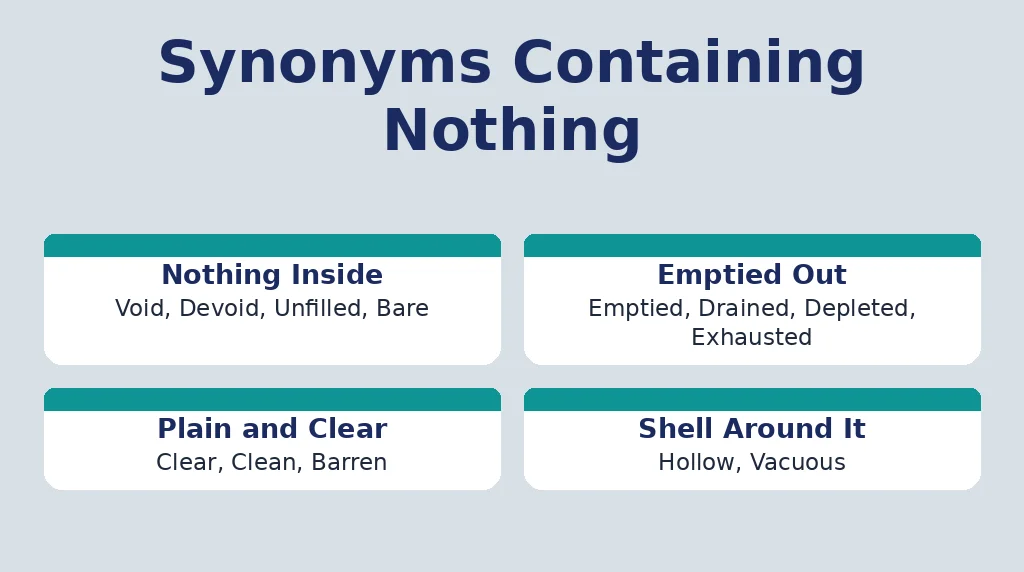
Start with the most literal sense of all. A container, box, or glass is empty when there is nothing inside it. The words below sharpen that basic idea in small ways. Some stress total absence, while others stress that contents were removed or never arrived.
Nothing Inside at All
These words describe complete absence. They suit fridges, bottles, tanks, and boxes that hold nothing whatsoever.
- Void: completely empty, with a formal and absolute tone. Example: The tank was void of fuel by morning.
- Devoid: lacking something completely, almost always in the phrase devoid of. Example: The shelf stood devoid of books.
- Unfilled: not yet filled, so the contents are still expected. Example: She handed back the unfilled bottle.
- Bare: with nothing in it or nothing on it. Example: He opened the bare cupboard and sighed.
- Clear: free of contents or obstacles. Example: Keep the exit clear at all times.
- Clean: swept or picked completely clean, informal in this sense. Example: The kids picked the plate clean.
Emptied Out or Used Up
Sometimes the point is not the emptiness itself. Instead, the point is that something was there and now it is gone. These words carry that history with them.
- Emptied: with the contents taken out on purpose. Example: He set the emptied crate by the door.
- Drained: emptied by letting liquid or energy flow out. Example: The drained pool waited for repairs.
- Depleted: reduced almost to nothing through steady use. Example: Their depleted savings barely covered rent.
- Exhausted: used up completely, for supplies or strength. Example: The exhausted well gave no water.
- Barren: producing nothing, or lacking what should grow or live there. Example: Only weeds crossed the barren field. A clean and empty desk shows the same idea in a calmer, everyday scene.
Empty Inside, With a Shell Around It
A few words describe things that look solid outside but hold nothing within. They often set up the figurative uses covered later.
- Hollow: empty inside, with solid material around the space. Example: The hollow tree hid a nest.
- Vacuous: empty like a vacuum, formal and rare for objects. Example: The vacuous chamber echoed oddly. In daily writing, though, vacuous belongs mostly to looks and remarks, as later sections show.
Synonyms for Empty: Vacant and Unoccupied Places
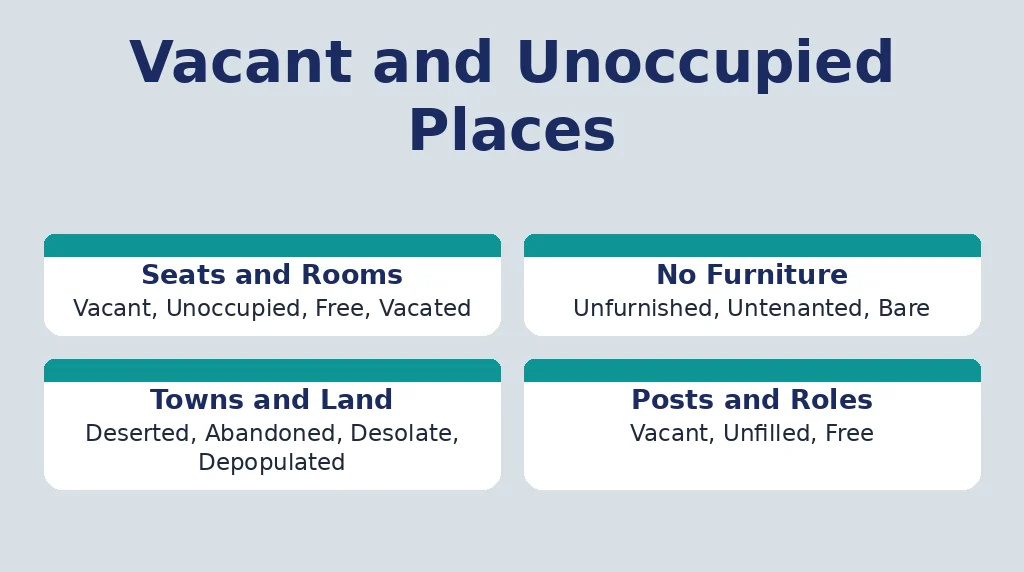
Places become empty in a different way. Nothing is missing from inside a box. Rather, the people who should be there are absent. Because of that shift, this group has its own vocabulary, and container words like unfilled sound wrong here.
Seats, Rooms and Buildings With No One In Them
These are the everyday words for spaces waiting for people. Most of them also hint that the space could be used again soon.
- Vacant: not occupied, and often available to use. Example: One vacant seat remained near the window.
- Unoccupied: with no one in it or living in it. Example: The house stood unoccupied for a year.
- Free: not taken or being used, for seats and time slots. Example: Is this seat free, or is someone sitting here?
- Vacated: emptied because the last users left. Example: Crews cleaned the vacated office on Monday.
- Unfurnished: with no furniture inside, for homes and rooms. Example: They rented an unfurnished flat near work.
- Untenanted: with no tenant, formal and mostly British. Example: The untenanted shop gathered dust.
Streets, Towns and Land With No People at All
Larger places need stronger words. These terms describe areas where people have left, or where people never lived in the first place.
- Deserted: empty because everyone has gone away. Example: At dawn, the beach was completely deserted.
- Uninhabited: with no one living there at all. Example: The uninhabited island has no fresh water.
- Abandoned: left behind and no longer cared for. Example: An abandoned factory borders the river.
- Desolate: empty, bare, and rather bleak. Example: Snow covered the desolate plain for miles.
- Depopulated: having lost most of its people, formal. Example: War left the valley depopulated.
- Forsaken: deserted and neglected, slightly literary. Example: Few travelers stop at the forsaken station.
- Waste: bare, unused land, mostly in the phrase waste ground. Example: Nettles covered the waste ground behind the mill. By contrast, a new notebook is empty in the happiest way, full of room and waiting to be filled.
Posts, Roles and Slots With No Holder
Emptiness also applies to jobs and roles. A post is empty when nobody holds it. Organizations feel this kind of absence keenly, because work waits while the chair stays bare.
- Vacant: with no one currently doing the job. Example: The manager post stayed vacant for months.
- Unfilled: advertised or planned, but still without a holder. Example: Two unfilled roles slowed the whole project.
- Free: not booked or taken, for slots in a schedule. Example: Her only free hour sat between two meetings. In formal reports, however, vacant and unfilled sound more precise for jobs, so most writers save free for seats, rooms, and time.
Synonyms for Empty Words, Promises and Threats
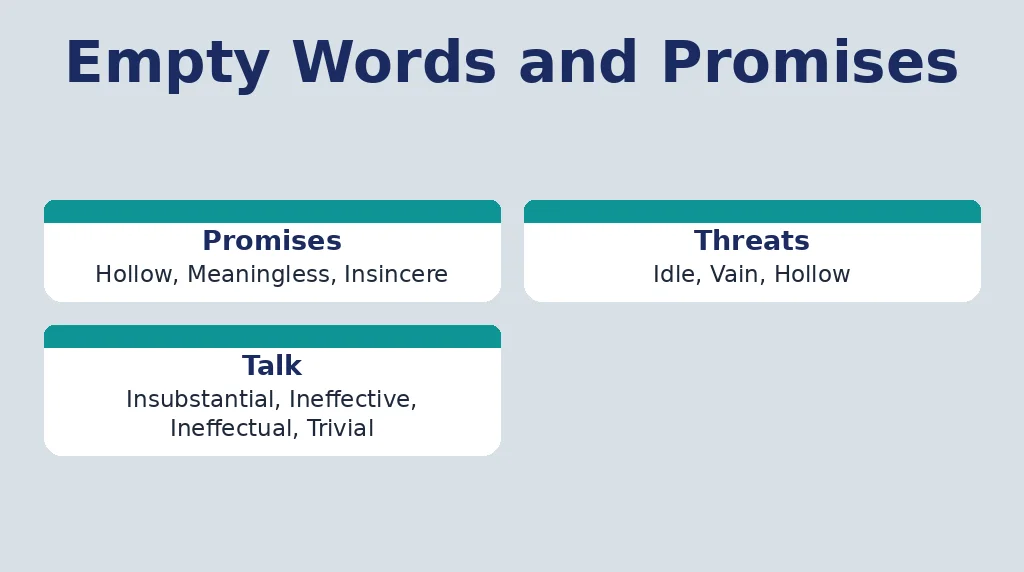
Words can be empty too. An empty promise sounds reassuring but commits the speaker to nothing. An empty threat warns of action that will never come. The synonyms here judge the words themselves, so each one carries a small criticism.
Promises and Threats That Mean Nothing
Reach for these words when someone speaks but does not mean it. They fit politics, arguments, and everyday bluffing equally well.
- Hollow: lacking sincerity or substance beneath a fine surface. Example: His apology rang hollow after the third excuse.
- Meaningless: having no real meaning or effect. Example: The form letter offered meaningless comfort.
- Insincere: not truly meant or felt. Example: She smiled through the insincere praise.
- Idle: not serious and not meant to be acted on. Example: It was an idle threat, and everyone knew it.
- Vain: without effect or result, slightly formal. Example: He made vain promises to change.
Talk With Nothing Behind It
Some empty language is not a promise at all. Instead, it is noise: words that fill time without adding sense, weight, or value.
- Insubstantial: lacking real substance or strength. Example: The report rested on insubstantial claims.
- Ineffective: failing to produce the wanted effect. Example: Empty slogans proved ineffective with voters.
- Ineffectual: unable to achieve anything, often about people or efforts. Example: The committee issued an ineffectual warning.
- Trivial: too small or unimportant to matter. Example: Their chat stayed trivial all evening.
Synonyms for Empty: A Life Without Meaning or Purpose
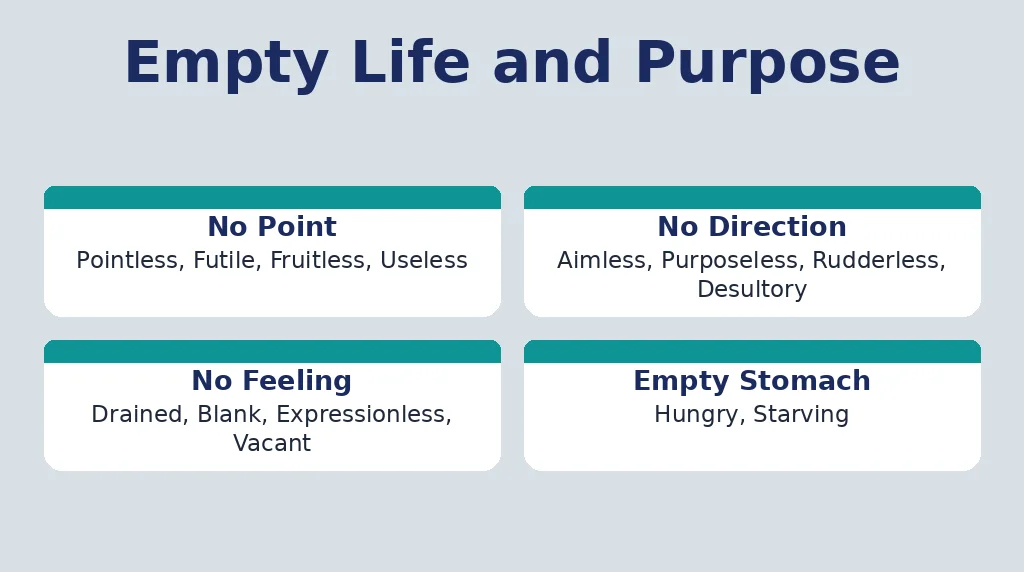
The saddest sense of empty has nothing to do with boxes. An empty life has hours, routines, and even successes, yet none of it feels worthwhile. Writers reach for this group when they describe time, work, and feelings rather than things.
Days, Tasks and Efforts With No Point
These words judge activities. They say the effort leads nowhere, however busy it may look from outside.
- Pointless: with no purpose or useful result. Example: The meeting felt pointless after the decision leaked.
- Futile: certain to fail, so without point. Example: Arguing with the closed door was futile.
- Fruitless: producing no useful result after real effort. Example: A fruitless search filled the whole afternoon.
- Useless: serving no purpose at all. Example: The spare key proved useless at midnight.
- Senseless: making no sense, often about harm or waste. Example: Neighbors condemned the senseless damage.
- Worthless: having no value at all, strong and blunt. Example: He feared the certificate was worthless.
Lives and Routines With No Direction
Other words describe a longer drift rather than one failed task. They fit memoirs, fiction, and honest personal writing.
- Aimless: with no clear goal or direction. Example: After graduation, his days turned aimless.
- Purposeless: lacking any purpose at all. Example: She dreaded another purposeless winter.
- Directionless: without direction, a close cousin of aimless. Example: The directionless inquiry finally closed.
- Rudderless: without anyone or anything steering, often about groups. Example: The rudderless team missed every deadline.
- Desultory: jumping from one thing to another without plan. Example: Their desultory chat never reached a decision.
- Valueless: having no value, formal beside worthless. Example: Critics dismissed the prize as valueless.
- Inane: lacking sense or substance, often about talk. Example: Inane chatter filled the waiting room.
- Frivolous: not serious, treating weighty things lightly. Example: The court rejected the frivolous claim.
- Insignificant: too small to matter much. Example: The error looked insignificant at first.
- Inconsequential: having no important result. Example: Most of the changes were inconsequential.
- Nugatory: of no value or effect, formal and rare. Example: The clause rendered the promise nugatory.
- Otiose: serving no practical purpose, formal and literary. Example: Scholars cut the otiose chapter. When an empty feeling settles in, these words name it far more precisely than empty alone.
The Drained and Blank Feeling
Emptiness also shows on faces and in bodies. After bad news, people report feeling empty inside. Their look goes blank, and their energy drains away. Sources support a small, careful group here.
- Drained: emptied of energy or feeling after strain. Example: He felt drained and oddly hollow all week.
- Blank: showing no expression or understanding. Example: She gave him a blank look and turned away.
- Expressionless: showing no feeling on the face. Example: His expressionless stare unsettled the room.
- Vacant: showing no interest or thought, for looks and stares. Example: A vacant gaze replaced her usual smile.
- Hungry: needing food, for an empty stomach. Example: Never train hard on a hungry stomach.
- Starving: very hungry, informal and exaggerated. Example: By noon, the hikers were starving.
Empty as a Verb: Words for Emptying Something
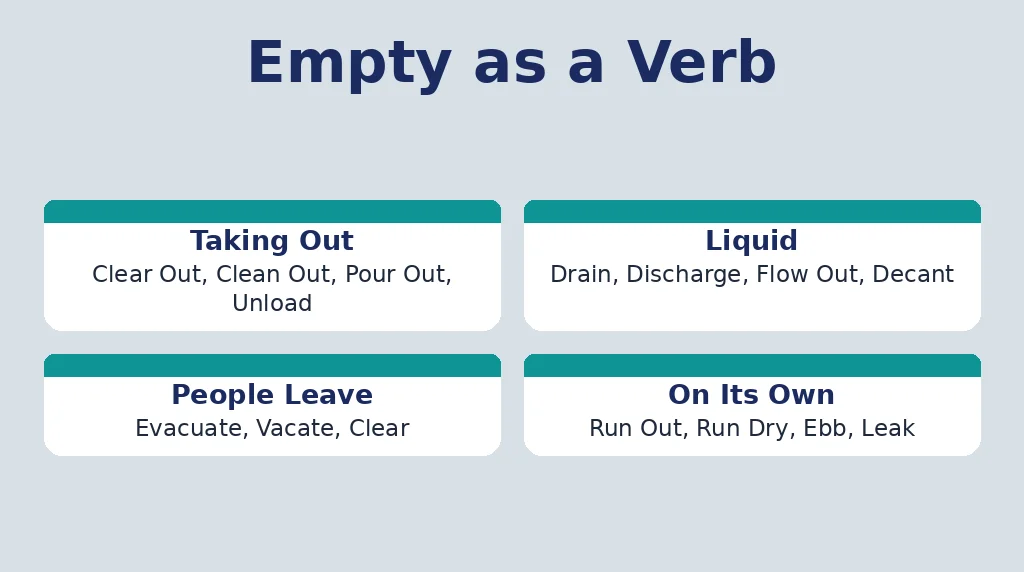
Empty also names an action. You can empty a bin, a room, a glass, or a whole building. The verb synonyms split by method. Some involve liquid, some involve people leaving, and some involve taking everything out by hand.
Taking the Contents Out
These verbs cover the everyday chore sense. They suit kitchens, garages, offices, and moving days.
- Clear out: remove everything from inside a space. Example: We cleared out the garage in one weekend.
- Clean out: clear completely, often with a thorough tone. Example: She cleaned out the fridge before shopping.
- Pour out: tip something so its contents flow out. Example: He poured out the last of the sand.
- Unload: take a load off a vehicle or container. Example: They unloaded the van at the gate.
- Unpack: take things out of a bag or box. Example: She unpacked the suitcase onto the bed.
- Dump: empty something out roughly or all at once. Example: He dumped the crumbs into the bin.
- Spill: let contents fall out, usually by accident. Example: She spilled the rice across the counter.
- Gut: remove the inside completely, strong and informal. Example: Fire gutted the old warehouse.
- Decant: pour liquid gently into another container. Example: He decanted the juice into a clean jug.
- Unburden: empty yourself of worries or a load, figurative. Example: She unburdened herself to an old friend.
Draining Liquid and Using Things Up
Liquid has its own verbs, and supplies have theirs. The next group covers tanks, pools, rivers, and stores of food or money.
- Drain: let or draw liquid out until empty. Example: Drain the pool before winter arrives.
- Discharge: release contents formally, for cargo, water, or waste. Example: The pipe discharges into the harbor.
- Flow out: move out as a stream, for crowds and liquids. Example: Fans flowed out of the stadium.
- Deplete: use up a supply almost completely. Example: The long drought depleted the reservoir.
- Use up: finish a supply so nothing remains. Example: We used up the paint on the fence.
- Exhaust: use up completely, formal beside use up. Example: The crew exhausted its water by Thursday.
Making People Leave a Place
Finally, some verbs empty places of people rather than things. Officials use them for buildings, halls, and whole districts.
- Evacuate: move people out for safety, or empty a place fully. Example: Police evacuated the hall within minutes.
- Vacate: leave a place empty by moving out. Example: Tenants must vacate the flat by Friday.
- Clear: remove people from a place, in short official use. Example: Security cleared the square before noon.
When Something Empties Itself
Some emptying needs no helper at all. Tanks run dry, crowds thin out, and rivers pour themselves into the sea. These verbs describe that self-emptying movement.
- Run out: come to an end as contents finish. Example: The tap ran out of pressure by noon. More exactly, supplies run out when the last of them is used.
- Run dry: reach the point where no liquid remains. Example: The well ran dry in August.
- Discharge: flow out in a steady stream, formal. Example: The stream discharges into the bay.
- Ebb: flow back or fade away slowly, literary. Example: The crowd ebbed from the square at dusk.
- Leak: escape slowly through a small opening. Example: Air leaked from the old tire overnight.
How to Choose the Right Synonym for Empty
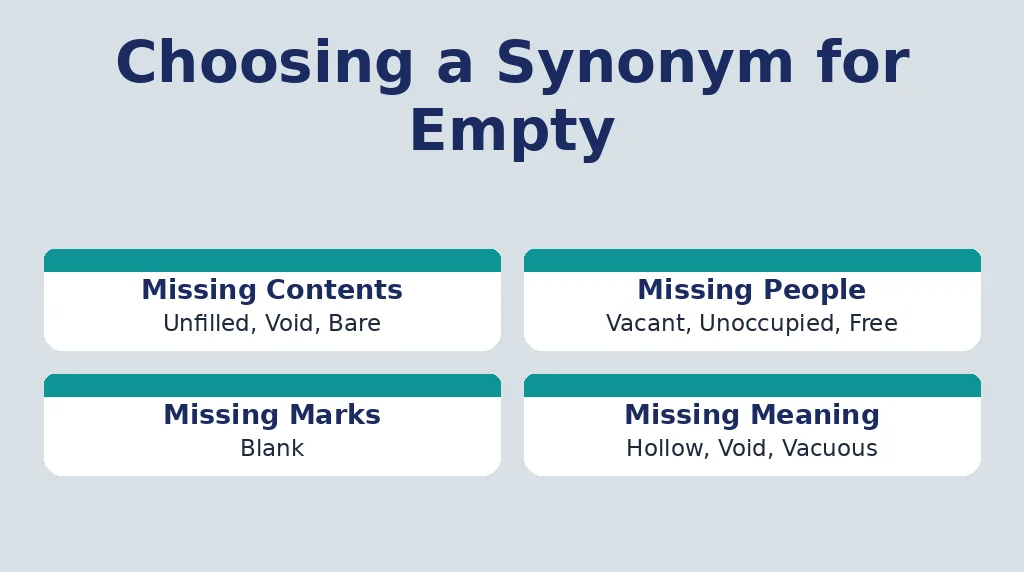
With so many options, the sense decides first. Ask what is missing. Is it contents, people, sincerity, purpose, or liquid? Once you name the missing thing, the right family of words appears almost on its own.
Paired examples make the differences concrete. Consider four short sentences:
- The box is unfilled. Nothing has been put in it yet, and something probably will be.
- The seat is vacant. Nobody is sitting there, and you may take it.
- The page is blank. Nothing is written on its surface, though the page itself exists.
- The promise is hollow. Words were spoken, but no real commitment sits inside them.
Empty vs Vacant vs Blank vs Hollow vs Void
These five words cause most of the confusion, so they deserve a slow look. Merriam-Webster sets them side by side for exactly this reason. Each one stresses a different kind of absence.
Empty is the broad word. It suggests a complete absence of contents. An empty bucket, an empty room, and an empty stomach all work naturally.
Vacant stresses missing occupants or holders. A vacant apartment has no tenant. A vacant job has no one doing it. A vacant seat is therefore an invitation, while an empty seat sounds merely factual.
Blank belongs to surfaces. A blank wall, a blank page, and a blank screen lack marks or features. However, a bottle cannot be blank, because bottles hold contents rather than display marks.
Hollow means empty inside a solid shell. A hollow log and a hollow chocolate egg fit perfectly. Figuratively, hollow describes praise, laughter, or victories that lack real substance underneath.
Void and Vacuous: The Formal End of the Scale
Void is the strongest and most formal choice. It suggests absolute emptiness, as in a void of meaning. In legal writing, void also means having no force, as in null and void. That legal sense is separate, so context must make your meaning clear.
Vacuous completes the set. It describes emptiness of thought or intelligence. A vacuous remark and a vacuous stare are fair targets. Still, a vacuous fridge sounds like a joke, so keep the word for minds and faces.
The quick picker below matches common situations to strong first choices. Use it when two words both seem possible and the deadline is close.
| Situation | Strong first choice |
|---|---|
| Bottle with nothing in it | Unfilled |
| Chair nobody is using | Vacant |
| House nobody lives in | Unoccupied |
| Street after everyone left | Deserted |
| Promise nobody believes | Hollow |
| Page with nothing written | Blank |
| Tank after liquid leaves | Drained |
| Life with no direction | Aimless |
Formal and Informal Synonyms for Empty
Register changes how a sentence lands. Formal words signal care and distance. Informal words signal warmth, speed, or exaggeration. Matching the register to the document matters as much as matching the sense.
Formal writing favors void, devoid, vacuous, unoccupied, and futile. Reports say a post remained unfilled, and essays say a claim was devoid of evidence. Legal and official texts also use vacate and evacuate for the verb. Otiose and nugatory sit at the far formal edge. Use them rarely, since many readers must pause over them.
Neutral words carry most daily writing. Vacant, bare, deserted, meaningless, and pointless fit news, school, and office prose without fuss. They are precise without sounding stiff. As a result, they are the safest upgrades from plain empty.
Informal speech adds color at the edges. Starving exaggerates a hungry stomach at lunch. Clear out and clean out sound like spoken chore talk. Gut, in its verb sense, feels brisk and physical. Meanwhile, phrases like picked clean add a friendly, kitchen-table tone. Save these choices for dialogue, blogs, and casual messages rather than formal reports.
Antonyms for Empty
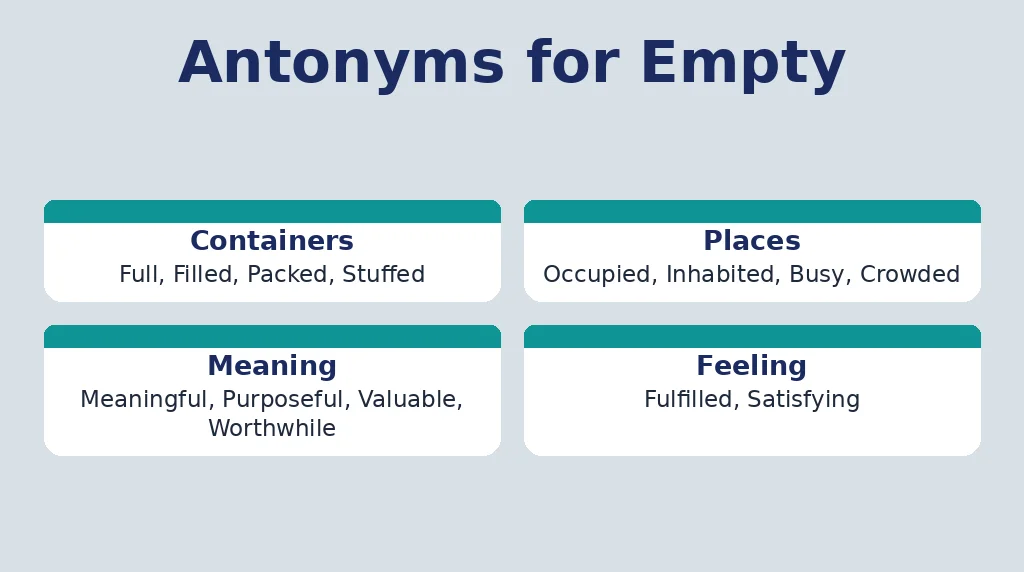
The center of the opposite camp is one small word: full. Around it, each sense of empty grows its own set of opposites. Sorting them by sense keeps the list honest and useful.
- Full: holding as much as possible, the direct opposite for containers. A full glass answers an empty glass exactly.
- Filled: having been filled, for bottles, forms, and seats taken one by one.
- Packed: full to bursting, often with people. Example: The packed hall buzzed before the talk.
- Stuffed: filled tightly, informal for bags and animals alike.
- Occupied: being used or lived in, the opposite of vacant. Example: Every desk stood occupied by nine.
- Inhabited: having people living there, the opposite of uninhabited.
- Busy: full of activity, the opposite for streets and days. Example: A busy market replaced the deserted square.
- Crowded: full of people in a tight space.
- Meaningful: full of meaning, answering meaningless and empty words.
- Purposeful: having a clear purpose, answering aimless and purposeless.
- Valuable: having real worth, answering worthless and valueless.
- Worthwhile: worth the time or effort spent.
- Fulfilled: feeling complete and satisfied, answering the empty feeling.
- Satisfying: giving a sense of fullness or completion.
Words That Are Not True Synonyms for Empty
Accuracy matters in a synonym guide, so this section clears away the near misses. Each word below appears in loose online lists. Each one, however, fails a simple test when placed in a real sentence.
Surface Words in the Wrong Place
Blank for containers is the most common error. A blank bottle sounds wrong because blank describes surfaces without marks. Bottles hold contents, so unfilled, void, or plain empty fits instead. Conversely, a blank page is correct, while an unfilled page sounds odd.
Bare for seats fails in the other direction. Bare describes rooms without furniture or surfaces without covering. A seat with nobody on it is vacant or unoccupied. Saying a bare seat suggests the seat lacks cushions or cover, which is a different complaint entirely.
Judgment Words and Technical Words
Silly, stupid and foolish appear in broad thesaurus clusters for the meaningless sense. Still, they judge the quality of an idea, not its emptiness. A foolish promise may be sincerely meant. An empty promise is not. Careful writers therefore keep the two judgments apart.
Null belongs to special contexts. It fits maths sets, data fields, and the legal phrase null and void. Outside those homes, null sounds technical and strange. A null fridge is not a thing anyone says.
Free needs care as well. A free seat means nobody has taken it, which matches vacant. A free gift, however, means it costs nothing. Only the first sense belongs in this guide, so the word appears with its seat sense explained.
Vacant for containers is the mirror mistake. Writers sometimes call a jar vacant because it sounds elegant. Jars, however, do not have occupants, so the word misses. Unfilled or void respects what a jar actually is. Similarly, calling a tenantless house unfilled confuses stock with people. Houses take unoccupied, while shelves take bare and bottles take unfilled.
Frequently Asked Questions
What is the best synonym for empty?
There is no single best word, because the right choice depends on what is missing. For containers, void and unfilled work well. For seats and rooms, vacant is usually the strongest pick. For promises, hollow says the most in the fewest letters.
What is a fancy or formal word for empty?
Void is the classic formal choice, and devoid is its close partner in phrases like devoid of meaning. Vacuous is formal too, but it targets thought and intelligence. For very formal writing about purpose, otiose exists, though most writers choose futile or pointless instead.
What is the difference between empty and vacant?
Empty is the broad word for a complete absence of contents. Vacant focuses on missing occupants or holders. Therefore, a vacant apartment has no tenant, and a vacant post has no holder. An empty apartment might simply have no furniture or people inside at that moment.
Is blank a synonym for empty?
Only for surfaces and expressions. A blank page, a blank screen, and a blank look are all standard. In contrast, boxes, bottles, and rooms cannot be blank, because they hold contents rather than carry marks. Use unfilled or void for containers instead.
What is a synonym for empty promises?
Hollow is the most common choice, as in hollow promises. Meaningless, insincere, idle, and vain also fit well. Idle suits threats that nobody intends to carry out. Vain suits efforts and hopes that produce no result.
What is the verb for empty?
Drain fits liquids, as in drain the tank. Clear out fits rooms and cupboards. Pour out fits jugs and containers you tip. Evacuate and vacate fit places that people must leave. Each verb names a method, so choose by how the emptying happens.
What is the opposite of empty?
Full is the main opposite for containers and glasses. Filled, packed, and stuffed give stronger versions. For places, occupied and inhabited answer vacant and uninhabited. For lives and words, meaningful, purposeful, and worthwhile are the natural opposites.
What is a word for an empty life or empty feeling?
Pointless and purposeless describe lives without direction. Aimless adds the picture of drifting without a goal. For the feeling itself, writers often say a person felt drained or hollow. Blank fits the facial expression that comes with the feeling.
Final Thoughts
Empty earns its keep by covering many kinds of absence at once. Once you sort its synonyms by what is missing, the choices become simple. A box is unfilled, a seat is vacant, a page is blank, and a promise is hollow. Each word then does quiet, exact work inside your sentence.
Keep the sense test beside you as you write. Ask what is missing, pick the family that matches, and then choose the register that suits your reader. For an even deeper list with related words and near-synonyms, the Merriam-Webster Thesaurus entry for empty is a reliable next step.