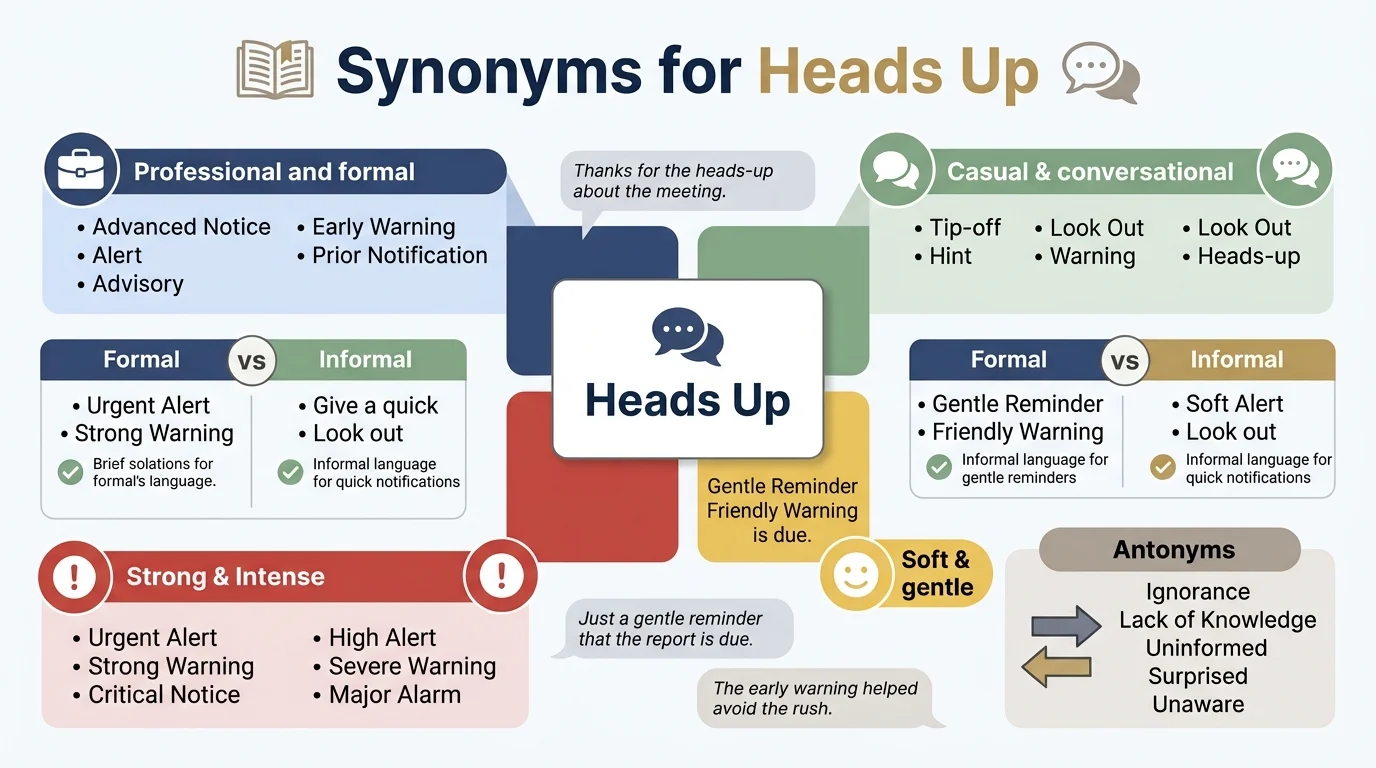
Have you ever found yourself writing “heads up” repeatedly in emails, messages, or conversations? Maybe you are giving someone advance notice about a meeting change. Perhaps you are warning a colleague about an upcoming challenge. Or you might be letting a friend know about something important coming their way.
Using the same phrase over and over can make your writing feel stale and repetitive. It can also make you sound less professional or less precise than you intend. The good news is that English offers dozens of excellent alternatives for “heads up.” Each synonym carries its own unique tone, formality level, and emotional weight.
This guide will help you master every synonym for “heads up.” You will learn exactly which word works best in professional emails, academic writing, casual conversations, creative projects, and social media captions. By the end, you will never struggle to find the perfect alternative again.
What Does “Heads Up” Mean?
“Heads up” means advance notice, warning, or alert about something that is about to happen. The best synonyms vary by context. Use “notification” or “advisory” for formal writing. Try “warning” or “alert” for stronger intensity. Choose “tip off” or “word” for casual conversation. Use “advance notice” for professional situations and “forewarning” for emotional or dramatic contexts.
Meaning, Tone and Context
Simple Definition
A heads up is information given in advance to help someone prepare for something coming soon.
Part of Speech
The phrase functions as a noun in most cases. You can also use it as an interjection to get someone’s attention quickly.
Tone
The tone is generally neutral to slightly positive. It implies helpfulness and consideration. You are giving someone the gift of preparation.
Formality Level
The phrase leans toward informal and conversational. It works well in workplace settings but feels too casual for academic papers or formal legal documents.
Common Use Cases
People use heads up in work emails, text messages, meeting announcements, project updates, and friendly warnings. It appears frequently in both spoken and written American English.
Important Word Forms
The singular noun is “heads up.” The plural is “heads ups” though some style guides suggest “heads up” works for both singular and plural contexts. The verb form is less common but appears as “to give someone a heads up.”
When and How to Use “Heads Up”
Understanding when to use “heads up” helps you communicate clearly and appropriately. Here are seven realistic examples showing the phrase in action across different contexts.
Professional Email
“I wanted to give you a heads up that the client meeting has been moved to 2 PM tomorrow.”
Personal Conversation
“Just a heads up, the restaurant gets very crowded on Friday nights, so we should book a table early.”
Academic Setting
“Professor Chen gave us a heads up about the pop quiz scheduled for next week.”
Emotional Situation
“I am giving you a heads up that the conversation with your manager might be difficult this afternoon.”
Creative Writing
“The sudden silence gave them a heads up that danger was approaching.”
Social Media Caption
“Heads up to all my followers: new content drops tomorrow morning.”
Resume or Workplace Use
“Provided team members with advance notice and status updates on all project milestones.”
Another Word for “Heads Up”
The best single replacement depends entirely on your situation. Here are the top alternatives organized by context.
Professional Writing
Use “notification” when you need a straightforward, professional term. It sounds polished and appropriate for formal correspondence.
Academic Writing
Choose “advance notice” for research papers or scholarly articles. It sounds precise and avoids casual language.
Casual Conversation
Say “word” or “tip” when talking with friends. These short, friendly terms keep the conversation light and natural.
Emotional Writing
Select “forewarning” to add a dramatic or serious tone. It suggests that the information carries emotional weight.
Creative Writing
Use “portent” or “omen” to add literary flair. These words create atmosphere and intrigue in storytelling.
Resume or Workplace
Write “early notification” or “advance warning” to sound professional and proactive in job applications.
Social Media Captions
Pick “alert” for quick, engaging posts. It feels urgent and grabs attention effectively.
Stronger Meaning
Use “caution” when you want to emphasize danger or serious consequences. It carries more weight than a simple notification.
Softer Meaning
Choose “reminder” when the information is gentle and not urgent. It sounds helpful rather than alarming.
When Not to Use “Heads Up”
Sometimes “heads up” sounds too vague or casual for the situation. Here are examples where a more precise synonym improves your communication.
Too Vague
Instead of: “Just a heads up about the report.”
Better: “Please note that the report deadline has been extended to Friday.”
Too Casual
Instead of: “Heads up, the CEO is visiting.”
Better: “This is to inform you that the CEO will be visiting our office next Tuesday.”
Too Weak
Instead of: “Heads up about the budget cuts.”
Better: “I am writing to warn you about the upcoming budget reductions.”
Too General
Instead of: “Heads up on the project.”
Better: “This is an update on the project status and timeline changes.”
Words Commonly Confused With “Heads Up”
Several words overlap with “heads up” but carry distinct meanings. Understanding these differences helps you choose the right word every time.
Notice
A notice is formal written information. It is more official than a heads up. Use notice for legal documents or official announcements.
Warning
A warning emphasizes danger or negative consequences. It is much stronger than a heads up. Use warning when you need to sound serious.
Alert
An alert suggests urgency and immediate attention. It feels more dramatic than a heads up. Use alert for time sensitive information.
Tip
A tip is helpful advice rather than advance notice. It focuses on guidance more than preparation. Use tip when sharing practical suggestions.
Update
An update provides new information about something ongoing. It does not necessarily offer advance notice. Use update when reporting current status.
Reminder
A reminder prompts someone about something they already know. It is gentler than a heads up. Use reminder when you are not sharing new information.
Best Synonym by Context for “Heads Up”
| Context | Best Synonym | Why It Works | Example |
|---|---|---|---|
| Formal Writing | Notification | Sounds official and professional | Please submit your formal notification of attendance. |
| Academic Writing | Advance Notice | Precise and scholarly | The syllabus includes advance notice of all assignment deadlines. |
| Professional Business | Advisory | Clear and authoritative | The advisory about policy changes was sent to all departments. |
| Resume Use | Early Notification | Shows initiative and communication skills | Provided early notification of schedule changes to team members. |
| Casual Conversation | Word | Friendly and natural | Just giving you the word about the party location change. |
| Creative Writing | Forewarning | Adds dramatic literary value | The forewarning came too late to change their plans. |
| Emotional Tone | Caution | Carries weight and concern | I offer this caution out of genuine care for your wellbeing. |
| Strong Intensity | Warning | Emphasizes seriousness | The warning about dangerous conditions saved many lives. |
| Soft Moderate Tone | Reminder | Gentle and helpful | Just a gentle reminder about our lunch meeting tomorrow. |
| Social Media | Alert | Engaging and attention grabbing | Alert for all followers about tomorrow’s live session. |
| US Usage | Heads Up | Widely understood and accepted | Give me a heads up before you arrive. |
| UK Usage | Prior Notice | Common in British English | We require prior notice of any schedule changes. |
Which Synonym Should You Choose?
Choosing the right synonym depends on several factors. Here is a practical decision guide to help you select the perfect word.
Consider Your Audience
Use formal words like “notification” or “advisory” with executives, clients, and academic audiences. Use casual words like “word” or “tip” with friends and close colleagues.
Consider Your Purpose
Choose “warning” when you need to prevent harm or mistakes. Choose “reminder” when you are being helpful. Choose “update” when you are reporting progress.
Consider Your Emotional Intent
Use “forewarning” when the news is serious or dramatic. Use “advance notice” when the news is neutral. Use “alert” when the news is urgent.
Consider Your Medium
Use professional language in emails and official documents. Use casual language in text messages and social media. Match your word choice to your communication channel.
Consider Your Desired Impact
Stronger words like “caution” and “warning” grab attention. Softer words like “reminder” and “tip” sound helpful. Choose based on how you want the reader to react.
Real Life Examples of “Heads Up” in Sentences
These examples show how “heads up” and its synonyms work in real situations. Each sentence demonstrates a different context and purpose.
School Setting
The teacher gave the students advance notice about the final exam schedule changes.
Workplace Communication
My manager provided a warning about the upcoming performance review process.
Writing Project
The editor offered a gentle reminder about the deadline for submitting revisions.
Casual Conversation
I received a tip from a friend about the best time to visit the new coffee shop.
Social Media
Content creators posted an alert for their audience about the live streaming schedule.
Email Correspondence
Please consider this message as your formal notification regarding the policy update.
Storytelling
The mysterious letter served as a forewarning of the challenges that lay ahead.
15 Synonyms for “Heads Up”
| Synonym | Simple Meaning | Best Used For | Example Sentence |
|---|---|---|---|
| Notification | Formal advance information | Professional and academic writing | The university sent a notification about the new academic calendar. |
| Warning | Information about danger or problems | Serious situations requiring caution | The weather service issued a warning about the approaching storm. |
| Alert | Urgent time sensitive information | Breaking news and urgent updates | The security team sent an alert about suspicious activity. |
| Advisory | Official guidance or recommendation | Business and professional contexts | The committee released an advisory about the new safety protocols. |
| Forewarning | Advance notice with dramatic emphasis | Emotional or literary writing | The forewarning gave them time to prepare for difficult news. |
| Advance Notice | Information given before an event | Formal and neutral situations | We received advance notice of the schedule changes. |
| Tip | Useful piece of advice | Casual conversation and guidance | Let me give you a tip about avoiding traffic on Monday morning. |
| Word | Informal advance information | Friendly casual communication | I got the word that the meeting has been canceled. |
| Caution | Careful warning about potential issues | Situations requiring care | I offer a caution about entering that negotiation unprepared. |
| Reminder | Gentle prompting about known information | Helpful friendly communication | This is just a reminder about our lunch meeting at noon. |
| Update | New information about ongoing situation | Progress reports and status updates | I have an update about the project timeline. |
| Notice | Formal written announcement | Official documentation | The notice about the new policy appeared on the company intranet. |
| Signal | Indication of something coming | Creative and descriptive writing | The dark clouds were a signal of the impending storm. |
| Indication | Suggestion or hint about something | Subtle communication | The manager gave an indication that changes were coming. |
| Tip Off | Secret or inside information | Informal and confidential contexts | The reporter received a tip off about the breaking story. |
Synonym Groups and Usage Differences
Professional vs. Personal Synonyms
Professional alternatives include notification, advisory, and advance notice. These words sound competent and polished in workplace settings. Personal alternatives include word, tip, and reminder. These words create warmth and familiarity in personal relationships.
Formal vs. Conversational Synonyms
Formal words work well in reports, essays, speeches, and official documents. Use notification, advisory, and advance notice in these contexts. Conversational words work well in texts, casual emails, and friendly conversations. Use word, tip, and heads up in these situations.
Academic Synonyms
Academic writing demands precision and neutrality. Advance notice and notification work best for scholarly work. These words avoid casual language while remaining clear and accurate. Many professors prefer prior notice when discussing deadlines and requirements.
Professional and Business Synonyms
Business communication benefits from clear, authoritative language. Advisory, notification, and caution appear frequently in workplace emails and presentations. These words demonstrate professionalism and clarity.
Creative or Literary Synonyms
Creative writers can use forewarning, signal, and portent to add depth and imagery. These words create atmosphere and emotional resonance. Use them in novels, short stories, and descriptive writing.
Slang or Modern Synonyms
Some casual synonyms like heads up itself feel modern and conversational. These words are acceptable in text messages and social media. Avoid them in formal academic or professional writing.
Strongest vs. Weaker Synonyms
Mild intensity words: reminder, tip, indication.
Moderate intensity words: heads up, advance notice, update.
Strong intensity words: warning, caution, alert.
Strongest intensity words: forewarning, urgent notification, critical advisory.
Emotional vs. Neutral Synonyms
Emotional synonyms add feeling and weight. Forewarning and caution carry emotional depth. Neutral synonyms stay factual and objective. Notification and update focus on information without emotional coloring.
Antonyms of “Heads Up”
| Antonym | Meaning | Example Sentence |
|---|---|---|
| Surprise | Unexpected event without warning | The surprise announcement caught everyone off guard. |
| Ambush | Unexpected attack or approach | The sudden questions felt like an ambush during the meeting. |
| Shock | Unexpected and startling event | The news came as a complete shock to the entire team. |
| Suddenness | Quality of happening without warning | The suddenness of the decision left no time for preparation. |
| Unforeseen | Not anticipated or predicted | The unforeseen delay caused major problems for the project. |
| Unexpected | Not expected or predicted | The unexpected visit disrupted our entire schedule. |
| Impromptu | Done without preparation | The impromptu speech caught everyone by surprise. |
| Spontaneous | Happening without planning | The spontaneous decision created chaos in the schedule. |
| Unannounced | Arriving without prior notice | The unannounced inspection made everyone nervous. |
| Unheralded | Coming without prior announcement | The unheralded change confused all the employees. |
| Abrupt | Sudden and unexpected | The abrupt ending of the meeting surprised everyone. |
| Hasty | Done quickly without warning | The hasty decision gave no time for input from the team. |
| Precipitate | Done suddenly without consideration | The precipitate action caught everyone unprepared. |
| Out of the Blue | Completely unexpected occurrence | The announcement came out of the blue and shocked us all. |
| Without Notice | Happening with no advance warning | The policy change happened without notice to employees. |
Comparison: Heads Up vs. Similar Words
Heads Up vs. Warning
The main difference lies in intensity. A heads up is neutral and helpful. A warning emphasizes danger or serious consequences. Warnings carry more weight and urgency. Heads ups feel more like friendly gestures.
Heads Up Example
“I wanted to give you a heads up that the printer is low on ink.”
Warning Example
“This is a warning that the printer will stop working if you do not replace the ink immediately.”
Heads Up vs. Notice
Notice is more formal and official than heads up. Notice often appears in legal or administrative contexts. Heads up appears in everyday conversations and casual emails. Notice demands attention while heads up offers help.
Heads Up Example
“Just a heads up, the parking lot closes at 10 PM.”
Notice Example
“Please be advised that the parking lot will be closed for maintenance.”
Heads Up vs. Alert
Alert suggests urgency and immediate action. Heads up suggests preparation and awareness. Alerts demand quick responses. Heads ups allow time to plan. The emotional intensity differs significantly between these words.
Heads Up Example
“Here is a heads up about the weather forecast for tomorrow.”
Alert Example
“This is a severe weather alert requiring immediate shelter.”
Heads Up vs. Tip
A tip offers advice or guidance. A heads up offers advance information. Tips help people make better decisions. Heads ups help people prepare for events. Tips often include recommended actions.
Heads Up Example
“Just a heads up, the store closes early on Sundays.”
Tip Example
“Here is a helpful tip for saving money at that store.”
Heads Up vs. Reminder
Reminders focus on something people already know. Heads ups focus on new information. Reminders prompt action on known tasks. Heads ups introduce new information to consider. Reminders feel gentler than heads ups.
Heads Up Example
“Just a heads up, the new policy starts next month.”
Reminder Example
“Just a reminder, the new policy starts next month as we discussed.”
Heads Up vs. Update
Updates report current status or progress. Heads ups look forward to future events. Updates cover what has already happened or is happening now. Heads ups cover what will happen soon. Updates keep people informed about the present.
Heads Up Example
“Heads up, the project deadline is approaching next week.”
Update Example
“Here is an update on the project’s current progress.”
Common Phrases and Expressions with “Heads Up”
1. Give Someone a Heads Up
Meaning: To provide advance notice or warning to someone.
Example: Please give me a heads up before you schedule the meeting.
2. Just a Heads Up
Meaning: A casual way to introduce advance information.
Example: Just a heads up, the coffee machine is broken this morning.
3. Heads Up on Something
Meaning: Providing advance information about a specific topic.
Example: I need a heads up on any changes to the project timeline.
4. Quick Heads Up
Meaning: Brief advance notice without many details.
Example: Quick heads up, the boss is in a bad mood today.
5. Heads Up for Someone
Meaning: Advance notice intended to help a specific person.
Example: That heads up for the new employee was very helpful.
6. Appreciate the Heads Up
Meaning: Expressing gratitude for advance notice.
Example: I appreciate the heads up about the schedule change.
7. Heads Up Email
Meaning: A message containing advance notice or warning.
Example: Send a heads up email before the policy goes into effect.
Common Mistakes to Avoid
Using Heads Up When a More Precise Synonym Works Better
Many people default to heads up when other words fit better. Consider whether you are giving a warning, an update, or a reminder. Choose the most precise word for your situation.
Confusing Heads Up With a Warning
These words are not interchangeable. A heads up is helpful and neutral. A warning is serious and urgent. Using the wrong word changes how your message is received.
Using a Casual Synonym in Formal Writing
Words like word and tip sound too friendly for academic papers and legal documents. Match your word choice to the formality of your writing.
Using an Overly Dramatic Synonym for a Simple Situation
Forewarning and caution sound too serious for routine announcements. Reserve strong words for genuinely important matters.
Repeating the Same Word Too Often
Repetition makes writing dull. Use this guide to vary your vocabulary and keep readers engaged.
Choosing a Synonym With the Wrong Emotional Tone
Different words carry different feelings. Notification feels neutral. Warning feels scary. Reminder feels kind. Match the emotional tone to your message.
Using Slang in Academic or Professional Writing
Words like heads up itself are informal. Using slang alternatives in formal contexts damages your credibility. Choose appropriate language for your audience.
FAQs
What is the best synonym for heads up?
The best synonym depends on your context. Use notification for formal situations, word for casual conversations, and warning for serious matters.
What is a formal synonym for heads up?
Notification and advisory are excellent formal synonyms. They sound professional and appropriate for official correspondence.
What is an informal synonym for heads up?
Word and tip are casual alternatives. They work well in text messages and friendly conversations.
What is another word for heads up in professional writing?
Advance notice and early notification work perfectly in professional writing. They communicate preparation and professionalism.
What is the difference between heads up and warning?
A heads up is helpful advance information. A warning emphasizes danger or serious consequences with greater intensity.
What is the opposite of heads up?
Surprise and unexpected are direct opposites. They describe events that happen without advance preparation.
Conclusion
“Heads up” is a versatile phrase that means advance notice or warning about something coming soon. The best synonyms depend entirely on your situation. Use notification and advisory for formal professional writing. Choose word and tip for casual conversations. Select warning and caution for serious matters. Pick forewarning for emotional or dramatic contexts.
The key to great vocabulary is matching your word choice to your audience, purpose, and tone. Consider how formal your writing needs to be. Think about whether you want to sound helpful, urgent, serious, or casual. Choose words that fit your emotional intent and communication medium.
Remember that variety makes your writing more engaging. Avoid repeating the same word too often. Use this guide to expand your vocabulary and communicate more effectively. Your readers will appreciate your clear, precise, and varied language choices.
Start practicing today. Replace your next “heads up” with a more precise alternative. Notice how the different words change the tone of your message. You will quickly become more confident in your word choices.