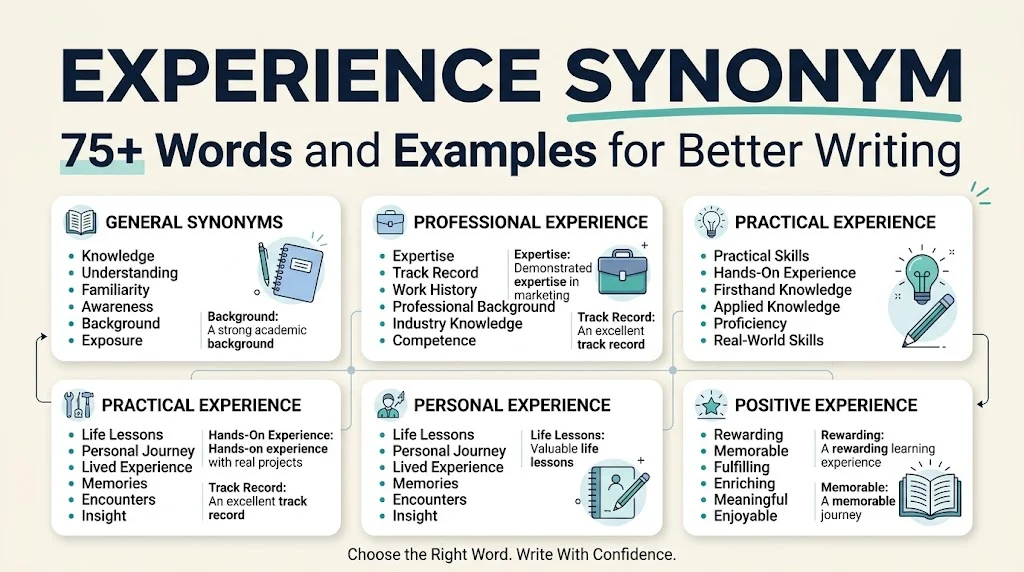
Finding the right experience synonym can make your writing clearer, more natural, and more effective. Whether you’re updating your resume, writing an essay, or describing an important life event, choosing the right word helps you communicate your meaning without repeating the same expression.
For example, expertise highlights advanced knowledge or ability, while background describes someone’s previous education or professional history. Similarly, firsthand knowledge emphasizes direct involvement, and encounter describes a particular event or interaction.
However, not every word with a similar meaning works in every sentence. Experience can refer to knowledge gained through practice, a person’s professional history, or an event they’ve lived through. Understanding these differences helps you select words that fit your message.
This guide covers more than 75 useful alternatives, their meanings, and practical examples. You’ll discover general synonyms, professional alternatives, resume-friendly expressions, academic vocabulary, and words for describing positive or negative experiences.
What Is Another Word for Experience?
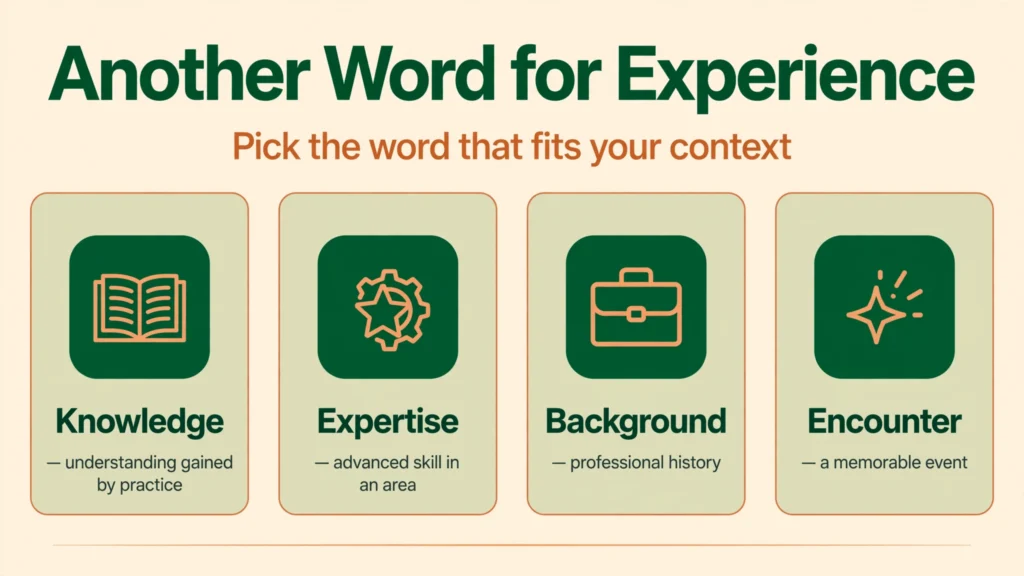
The best synonym for experience depends on the context. If you’re describing knowledge gained through practice, practical knowledge may fit. When discussing someone’s professional history, professional background or work history may be more accurate. For a memorable event, encounter, adventure, or life event could communicate your meaning more clearly.
Here are some of the most useful other words for experience, along with their meanings and examples.
| Synonym | Meaning | Example sentence |
|---|---|---|
| Knowledge | Information and understanding gained through learning or practice | Her knowledge of customer service helped resolve the complaint. |
| Expertise | Advanced knowledge or skill in a particular area | He has expertise in digital marketing. |
| Background | Previous education, employment, or personal history | She has a background in business administration. |
| Familiarity | Knowledge of or acquaintance with something | I’m familiar with project management software. |
| Exposure | Contact with a subject, situation, or activity | The internship gave him exposure to the industry. |
| Practice | Repeated performance or application of a skill | Regular practice improved her writing. |
| Proficiency | Demonstrated competence in a particular activity | He demonstrated proficiency in spreadsheet analysis. |
| Competence | The ability to perform a task effectively | The position requires competence in team management. |
| Insight | A deeper understanding of a subject or situation | The discussion gave us valuable insight into customer needs. |
| Firsthand knowledge | Understanding gained through direct involvement | She has firsthand knowledge of the challenges teachers face. |
| Track record | Evidence of previous performance or achievements | The company has a strong track record of successful projects. |
| Encounter | An event involving contact with a person or situation | Their encounter with local residents changed their perspective. |
| Involvement | Participation or engagement in an activity | His involvement in the project strengthened his leadership skills. |
| Understanding | Knowledge of how something works or what it means | She has a clear understanding of workplace safety. |
| Life lessons | Insights gained from personal events and challenges | His life lessons helped him make better decisions. |
| Know-how | Practical knowledge of how to perform a task | Her technical know-how helped resolve the issue. |
| Awareness | Recognition or knowledge of something | The training increased awareness of workplace hazards. |
| Acquaintance | Knowledge of or familiarity with a person, subject, or activity | His acquaintance with the software helped him get started. |
Quick tip: Choose a synonym that preserves your intended meaning. Expertise suggests advanced ability, while exposure may describe only an introduction to a subject.
Experience Meaning and Synonyms
Understanding the meaning of experience makes it easier to choose an accurate replacement. The noun experience has two main uses.
Experience as accumulated knowledge: This meaning refers to knowledge, familiarity, or ability gained through activities, practice, observation, or involvement over time.
Example: She has extensive experience in project management.
Possible alternatives include practical knowledge, professional background, expertise, and familiarity. Each emphasizes a slightly different aspect of the person’s experience.
Experience as an event or occurrence: This meaning refers to something that happens to someone or something they personally go through.
Example: The trip was an unforgettable experience.
Possible alternatives include adventure, encounter, event, episode, and memorable occasion.
When people search for experience meaning synonyms, they’re often looking for both a definition and words that fit a particular sentence. The key is to identify which meaning applies before choosing a replacement.
For example, you wouldn’t normally replace an unforgettable experience with an unforgettable expertise. Likewise, a memorable encounter may describe one meeting but won’t necessarily replace years of professional experience.
Experience Synonyms by Context
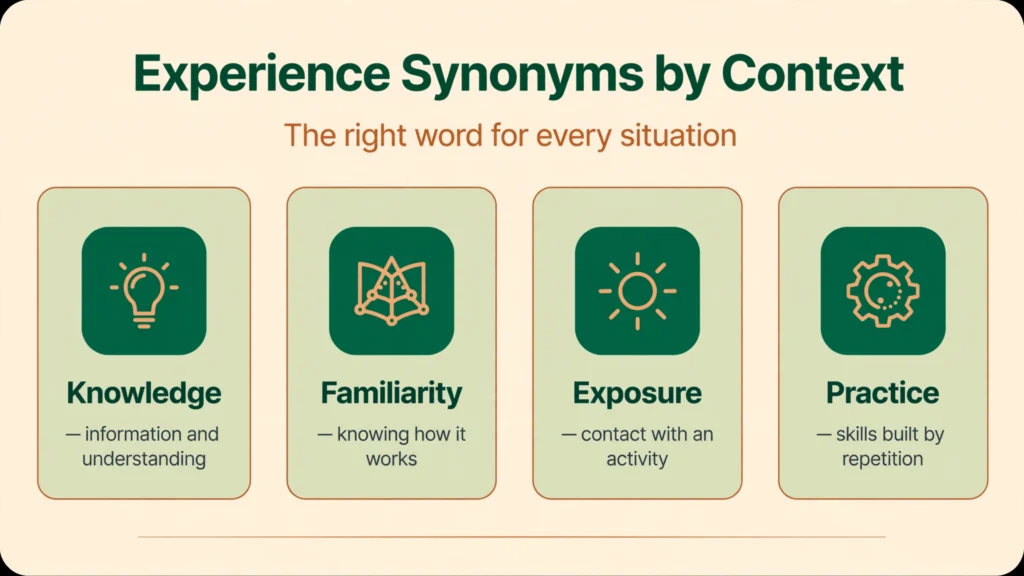
A synonym that works in professional writing may sound unnatural in a personal story. Choosing words by context makes your writing more precise and prevents awkward substitutions.
General Synonyms for Experience
General synonyms describe knowledge, familiarity, participation, or understanding. They’re useful in everyday conversations, workplace communication, and many forms of writing.
- Knowledge: Information and understanding about a subject.
- Familiarity: Being acquainted with something or knowing how it works.
- Understanding: Grasping the meaning, nature, or operation of something.
- Exposure: Having contact with a subject or activity.
- Practice: Repeatedly performing an activity to develop or maintain ability.
- Learning: Gaining knowledge or developing a skill.
- Involvement: Taking part in an activity or situation.
- Participation: Actively joining an event, program, or process.
- Acquaintance: Knowledge of a person, subject, or activity.
- Insight: A deeper understanding of a situation or problem.
- Awareness: Recognition or knowledge of something.
- Know-how: Practical knowledge of how to perform a task.
- Observation: Information gained by watching something happen.
- Engagement: Active participation or attention.
- Competence: The ability to perform a task effectively.
Consider this example:
Original: I have experience using graphic design software.
Revised: I have practical knowledge of graphic design software.
The revised sentence emphasizes applied understanding. However, if you’ve only tried the program once or twice, some familiarity with graphic design software may describe your ability more accurately.
Another example:
Original: The workshop gave me experience in public speaking.
Revised: The workshop gave me practice speaking in front of an audience.
The second sentence identifies what you did rather than using a broad term.
Professional and Work Experience Synonyms
In a career setting, experience may refer to previous jobs, professional development, job responsibilities, or knowledge gained in the workplace. The strongest alternative depends on which part of your background you want to emphasize.
Useful professional experience synonyms include:
- Professional background: Your employment history, education, and relevant career preparation.
- Work history: A record of jobs you’ve held.
- Employment history: Your previous positions and periods of employment.
- Career history: The progression of your professional roles.
- Industry experience: Knowledge gained by working within a particular industry.
- Practical knowledge: Understanding developed through real tasks and applications.
- Track record: Evidence of previous performance or accomplishments.
- Professional practice: The application of knowledge and skills within a profession.
- Occupational experience: Experience connected to a particular occupation.
- Field experience: Knowledge gained by working in a real-world setting.
- Relevant background: Previous work or education that relates to a particular role.
- Technical expertise: Advanced knowledge of specialized tools, methods, or systems.
- Professional competence: The ability to meet the demands of a professional role.
- Career accomplishments: Results or achievements gained throughout your career.
- On-the-job learning: Knowledge and ability developed while performing actual work.
For example:
Original: I have five years of experience in customer service.
Alternative: My professional background includes five years in customer service and client support.
Another option: I bring five years of customer service experience and a strong record of resolving customer concerns.
The second alternative focuses on career history. The third highlights a professional strength alongside experience.
These phrases aren’t interchangeable in every situation. Work history describes previous employment, while track record emphasizes performance. Select the term that tells your reader what matters most.
Personal and Life Experience Synonyms
Personal experiences include events, relationships, challenges, discoveries, and moments that shape how someone thinks or behaves. In this context, the best synonym depends on the nature of the event.
Useful personal experience synonyms include:
- Life lessons: Insights learned through personal events.
- Personal history: Events and circumstances that have shaped someone’s life.
- Life events: Important or ordinary occurrences in a person’s life.
- Memories: Mental recollections of past events.
- Encounters: Meetings or experiences involving people, places, or situations.
- Adventures: Experiences involving exploration, uncertainty, or excitement.
- Interactions: Experiences involving communication or contact with others.
- Lived experience: Knowledge gained by personally living through a particular situation.
- Milestones: Important events that mark progress or change.
- Personal journey: A series of experiences connected to someone’s development.
- Challenges: Difficult situations that require effort or problem-solving.
- Discoveries: New things learned, found, or understood.
- Reflections: Thoughts about events and what they mean.
- Episodes: Individual events within a larger sequence of experiences.
- Life changes: Experiences that substantially affect someone’s circumstances or direction.
For example:
Traveling alone was a valuable experience that taught me independence.
You could rewrite this as:
Traveling alone taught me valuable life lessons about independence and decision-making.
The revised sentence focuses on what you learned rather than the trip itself.
Similarly, lived experience can describe how personal circumstances shape someone’s understanding of a subject. The phrase often appears in discussions of education, social issues, community needs, and personal development.
Hands-On and Practical Experience Synonyms
Sometimes you need to show that you’ve done something yourself rather than simply studied it. Words related to direct involvement and practical application can communicate that distinction.
Common alternatives include:
- Firsthand experience: Direct involvement in or personal knowledge of something.
- Practical knowledge: Understanding developed through application.
- Applied knowledge: Information used to solve problems or complete tasks.
- Real-world practice: Activities performed in actual settings rather than only theoretical situations.
- Direct involvement: Active participation in an event or process.
- Fieldwork: Practical work conducted in a real-world environment.
- Experimentation: Testing ideas or methods to observe results.
- On-the-job training: Learning through tasks performed in the workplace.
- Apprenticeship: Structured learning that combines practical work with instruction.
- Experiential learning: Learning through activities and reflection on those activities.
- Practical training: Training that focuses on performing tasks.
- Operational knowledge: Understanding of how a system or process works in practice.
- Hands-on practice: Directly performing an activity rather than only reading or listening about it.
- Immersion: Deep involvement in an environment, activity, or subject.
- Demonstrated ability: Evidence that someone can perform a specific task.
For example:
Original: The internship gave me experience in software development.
Improved: The internship gave me hands-on practice developing and testing software applications.
The improved version explains what the person actually did. It gives readers a clearer picture of the work involved.
One distinction matters here: training is a method of learning, while experience describes what someone has encountered or learned through activities. Someone may complete training without having substantial experience performing the job independently.
Extensive Experience Synonyms
If you’ve worked in a field for many years or handled complex responsibilities, you may want to communicate the depth or breadth of your background.
Useful alternatives include:
- Considerable experience: A substantial amount of experience.
- Substantial experience: A significant level of involvement or practice.
- Broad experience: Experience across several tasks, roles, or areas.
- Deep expertise: Advanced knowledge of a subject.
- Wealth of experience: A large amount of accumulated experience.
- Extensive background: A wide-ranging history of relevant activity or employment.
- Proven track record: Evidence of previous results.
- Years of practice: A stated period spent developing or applying a skill.
- Seasoned professional: Someone with considerable experience in a profession.
- Significant experience: A meaningful amount of relevant work or involvement.
- Strong professional background: A history of relevant career preparation and work.
- Advanced proficiency: A high level of ability in a specific area.
- Specialized expertise: Advanced knowledge within a particular subject or field.
- Long-standing experience: Experience accumulated over an extended period.
- Demonstrated competence: An ability supported by evidence or performance.
For example:
She has extensive experience managing healthcare projects.
You could write:
She brings a wealth of experience in healthcare project management.
Or, when the evidence supports the claim:
She has a proven track record of delivering healthcare projects on time and within budget.
The last sentence emphasizes results. However, only use it when the person’s previous performance supports that claim.
Important distinction: Extensive experience describes the amount or breadth of past involvement. Expertise describes a high level of knowledge or ability. Years in a field can help develop expertise, but time alone doesn’t prove mastery.
Positive Experience Synonyms
When describing an event that made someone happy, taught them something, or created a lasting impression, a specific adjective can improve your sentence.
| Alternative phrase | Meaning | Example |
|---|---|---|
| Rewarding experience | Provides satisfaction or a sense of achievement | Mentoring new employees was a rewarding experience. |
| Memorable experience | Easy to remember or emotionally significant | The graduation ceremony was a memorable experience. |
| Enjoyable experience | Pleasant or fun | We had an enjoyable experience at the workshop. |
| Fulfilling experience | Creates a sense of purpose or personal satisfaction | Teaching children was a fulfilling experience. |
| Enriching experience | Broadens knowledge or perspective | Living abroad was an enriching experience. |
| Valuable experience | Provides useful knowledge or benefits | The internship was a valuable experience. |
| Worthwhile experience | Worth the time, effort, or cost involved | Completing the research project was a worthwhile experience. |
| Beneficial experience | Produces a useful or positive outcome | The training proved beneficial to the team. |
| Satisfying experience | Meets expectations or creates contentment | Helping the customer find a solution was satisfying. |
| Pleasant experience | Comfortable or enjoyable | The consultation was a pleasant experience. |
Other useful expressions include eye-opening experience, transformative experience, meaningful encounter, and positive learning experience.
Choose the adjective according to the result you want to emphasize. A rewarding experience often brings satisfaction. An enriching experience broadens someone’s perspective. A transformative experience causes a significant change.
Negative or Difficult Experience Synonyms
Not every experience feels positive. When describing an unpleasant event, the right word communicates the level of difficulty without exaggerating what happened.
Useful alternatives include:
- Ordeal: A difficult or painful experience that requires considerable endurance.
- Hardship: A condition or event involving serious difficulty.
- Setback: An event that delays progress or creates a problem.
- Unpleasant encounter: An uncomfortable interaction with someone or something.
- Difficult episode: A challenging event within a larger period.
- Adverse experience: An unfavorable or harmful event.
- Disappointment: An experience that falls short of expectations.
- Challenge: A situation that requires effort or skill.
- Traumatic event: An event that causes or may cause serious psychological distress.
- Unfortunate incident: An undesirable event, often unexpected.
- Negative encounter: An unpleasant interaction or meeting.
- Trying experience: An event that tests someone’s patience or strength.
- Distressing event: An event that causes significant worry or emotional upset.
- Frustrating experience: A situation that causes annoyance or difficulty.
- Unwelcome surprise: An unexpected development that someone doesn’t want.
For example:
The long delay was an unpleasant experience.
A more precise alternative might be:
The long delay was a frustrating setback.
The right choice depends on the actual situation. Calling an ordinary inconvenience an ordeal may overstate the problem, while traumatic event carries a more serious meaning than difficult experience.
Experience Synonym Resume: Professional Words and Examples
Your resume should communicate what you’ve done, what you can do, and what results you’ve achieved. Replacing every use of experience with an impressive synonym won’t accomplish that goal. The better approach is to describe your professional background with specific skills, responsibilities, and evidence.
Words to Describe Professional Experience on a Resume
The following phrases work well in resumes, cover letters, and professional profiles when they accurately describe your background.
| Phrase | Best use | Example statement |
|---|---|---|
| Professional background | Summarizing your career history | My professional background includes finance and business analysis. |
| Industry knowledge | Showing familiarity with an industry | I bring strong industry knowledge in retail operations. |
| Technical expertise | Highlighting advanced technical ability | My technical expertise includes database administration. |
| Practical knowledge | Emphasizing applied understanding | I have practical knowledge of inventory management. |
| Demonstrated competence | Showing an ability supported by evidence | I have demonstrated competence in team coordination. |
| Proven track record | Highlighting previous results | I have a proven track record of improving customer retention. |
| Relevant skills | Connecting abilities to job requirements | My relevant skills include scheduling and data analysis. |
| Professional practice | Describing work within a profession | My professional practice focuses on financial reporting. |
| Career accomplishments | Emphasizing achievements | My career accomplishments include leading a successful product launch. |
| Specialized knowledge | Describing subject-specific understanding | I have specialized knowledge of compliance procedures. |
Notice how each phrase communicates a different idea. Professional background describes your history, technical expertise highlights advanced ability, and proven track record points to previous results.
How to Say “I Have Experience” Professionally
The phrase I have experience is perfectly acceptable. However, it may sound vague when you need to demonstrate why you’re a strong candidate.
Consider these alternatives.
Instead of: I have experience in customer service.
Write: My background includes customer service, client communication, and complaint resolution.
Instead of: I have experience managing projects.
Write: I have practical experience coordinating project schedules, tracking deadlines, and communicating with stakeholders.
Instead of: I have experience using Excel.
Write: I have working knowledge of Excel, including spreadsheet organization and formula-based reporting.
Instead of: I have experience leading teams.
Write: My leadership background includes coordinating team activities, delegating responsibilities, and supporting employee development.
Instead of: I have experience in digital marketing.
Write: My digital marketing background includes content planning, campaign coordination, and performance analysis.
These alternatives make your statements more informative. They show readers what your experience involves instead of leaving them to guess.
Whenever possible, add evidence.
For example:
Managed social media accounts for three clients and increased audience engagement by 25% over six months.
This statement provides more useful information than experienced social media manager. Use numbers only when they reflect real, supportable results.
How to Describe Years of Experience
When an employer asks for years of experience, a direct answer usually works best. You can vary the surrounding phrasing while keeping the duration clear.
Examples include:
- Five years of professional experience in customer support.
- Five years of industry practice in commercial construction.
- A five-year background in financial services.
- Five years of hands-on experience with inventory systems.
- A decade of experience in educational administration.
- More than eight years in the field, focusing on software quality assurance.
- Extensive experience gained over six years in operations management.
Choose the expression that best describes the work you’ve performed.
For example, five years in the field emphasizes time spent in an occupation. Five years of hands-on experience emphasizes practical activity. A five-year background in finance can include both employment and relevant preparation.
Don’t use expert, master, or highly proficient merely because you’ve worked in a field for a long time. Support these descriptions with relevant skills, responsibilities, results, and accomplishments.
Resume Examples by Profession
Different professions require different kinds of experience. A teacher’s classroom practice doesn’t look like a software developer’s technical work, so professional language should reflect the role.
| Profession | Useful alternative | Example statement |
|---|---|---|
| Customer service | Client relations background | My client relations background includes handling inquiries and resolving complaints. |
| Project management | Project coordination experience | I have practical experience coordinating timelines, budgets, and project deliverables. |
| Teaching | Classroom practice | My classroom practice includes lesson planning and student assessment. |
| Software development | Technical expertise | My technical expertise includes debugging applications and maintaining software systems. |
| Leadership | Team management background | My team management background includes staff scheduling and performance support. |
| Marketing | Campaign management experience | My campaign management experience includes content planning and results tracking. |
| Sales | Sales track record | My sales track record includes meeting quarterly targets and developing client relationships. |
| Research | Research involvement | My research involvement includes data collection, analysis, and report preparation. |
The key is to choose language that reflects the job’s actual requirements. If you’re applying for an entry-level role, relevant coursework, internships, volunteer work, and practical projects can demonstrate preparation without overstating your employment history.
Formal and Academic Synonyms for Experience
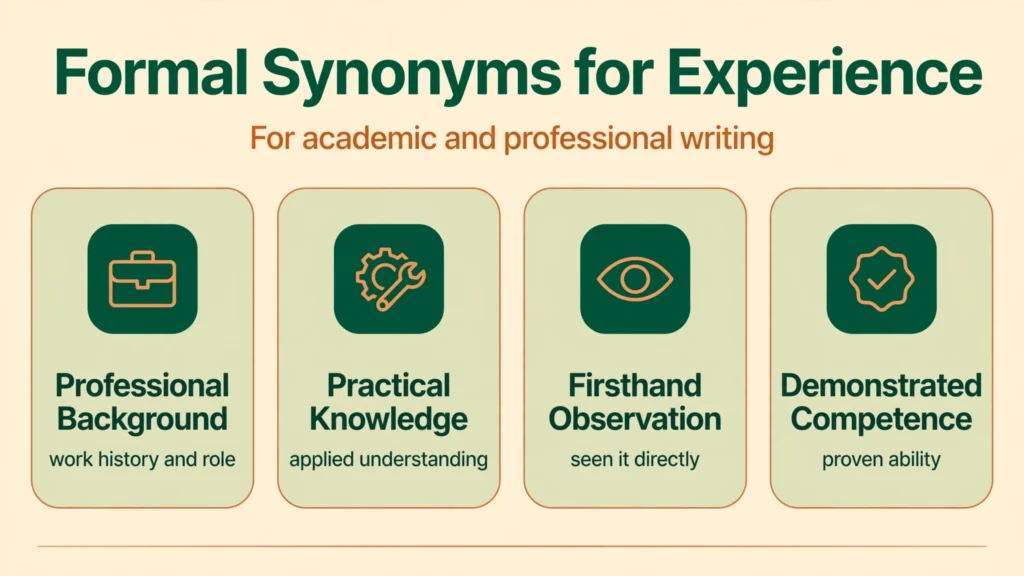
Formal and academic writing often requires greater precision than casual conversation. The right alternative can clarify whether you’re describing personal involvement, evidence collected through observation, or knowledge developed through a structured learning process.
Formal Alternatives to Experience
Useful formal expressions include:
- Professional background
- Direct involvement
- Practical knowledge
- Firsthand observation
- Previous engagement
- Professional practice
- Relevant background
- Demonstrated competence
- Operational knowledge
- Practical application
For example:
Informal: She has a lot of experience working with community organizations.
More formal: She has extensive experience collaborating with community organizations.
Another option: Her professional background includes substantial involvement in community programs.
The best choice depends on whether you’re describing employment, volunteering, collaboration, or another activity.
Academic Alternatives to Experience
Academic vocabulary often distinguishes between learning, observing, participating, and testing a theory. These differences are especially important in research and scientific writing.
| Term | Meaning | Example |
|---|---|---|
| Empirical observation | Information obtained through systematic observation or measurement | The conclusion draws on empirical observations from the study. |
| Practical application | Using knowledge or a theory in an actual task | The course emphasizes the practical application of mathematical concepts. |
| Fieldwork | Research or professional work conducted in the field | The researchers gained useful insight during fieldwork. |
| Experiential learning | Learning through activities and reflection | The course uses experiential learning to develop problem-solving skills. |
| Research involvement | Participation in research activities | Her research involvement included interviews and data analysis. |
| Applied knowledge | Knowledge used to address practical tasks or problems | The project required applied knowledge of statistics. |
| Firsthand evidence | Information obtained directly from a source or observation | The report incorporates firsthand evidence from interviews. |
| Laboratory practice | Practical work performed in a laboratory setting | Laboratory practice helped students understand the process. |
These terms aren’t interchangeable. Empirical observation implies evidence gathered through observation or measurement. It shouldn’t replace experience when you’re describing a personal memory.
Likewise, experiential learning describes a learning approach rather than a single event. Use technical terms when their specific meanings fit your argument.
Experiences Synonym: Words for Different Events and Situations
The plural noun experiences often refers to multiple events, encounters, or situations someone has lived through. If you’re looking for an experiences synonym, the most suitable alternative depends on whether those events were ordinary, memorable, positive, or challenging.
Useful plural alternatives include:
- Events: Things that happen.
- Encounters: Meetings or interactions.
- Occurrences: Things that take place.
- Episodes: Individual events within a larger sequence.
- Adventures: Events involving exploration or excitement.
- Memories: Recollections of past events.
- Life lessons: Insights gained from personal events.
- Challenges: Difficult situations that require effort.
- Milestones: Important events that mark progress.
- Interactions: Exchanges involving people or groups.
- Discoveries: Things learned or found.
- Journeys: Series of experiences or stages of development.
For example:
Original: My travel experiences taught me to appreciate different cultures.
Alternative: My travels taught me to appreciate different cultures.
Original: The students shared their experiences during the workshop.
Alternative: The students shared their stories and observations during the workshop.
Original: Their experiences in the workplace helped them develop confidence.
Alternative: Their workplace encounters helped them develop confidence.
A useful rule is to match the replacement to the events being described. Stories emphasizes what people tell others, observations highlights what they noticed, and encounters focuses on meetings or interactions.
Experience Synonyms by Common Phrase
Some expressions use the word experience so frequently that a more specific phrase can improve clarity. The following alternatives cover common vocabulary needs.
Past, Previous, and Prior Experience Synonyms
These expressions refer to something that happened or was acquired earlier.
Useful alternatives include:
- Previous work history
- Prior involvement
- Earlier experience
- Relevant background
- Previous exposure
- Past professional practice
- Earlier participation
- Prior engagement
Examples:
Please describe your previous experience in administration.
Alternative: Please describe your previous administrative roles.
My prior experience helped me prepare for the new position.
Alternative: My previous work prepared me for the new position.
The second example removes experience entirely and explains the result more directly.
Remember that past, previous, and prior refer to time. They don’t automatically communicate the amount or quality of someone’s experience.
Relevant Experience Synonyms
Relevant experience refers to previous activities or knowledge that relate to a specific purpose, role, or task.
Useful alternatives include:
- Related professional background
- Applicable skills
- Relevant work history
- Job-related knowledge
- Related experience
- Applicable training
- Industry-specific background
- Transferable skills
For example:
My previous role gave me relevant experience in budget management.
Alternative: My previous role developed my budget management skills.
Another option: My financial administration background aligns with the position’s budget management responsibilities.
The final example connects the person’s background to the position. That connection is often more useful than a general statement about having relevant experience.
Valuable Experience Synonyms
A valuable experience provides knowledge, learning, personal growth, or another meaningful benefit.
Possible alternatives include:
- Rewarding experience
- Beneficial learning opportunity
- Meaningful encounter
- Enriching experience
- Worthwhile activity
- Important life lesson
- Useful practical exposure
- Valuable learning opportunity
- Significant personal milestone
- Formative experience
For example:
The volunteer program was a valuable experience.
Alternative: The volunteer program provided a rewarding opportunity to support the local community.
Working with the research team was a valuable experience.
Alternative: Working with the research team strengthened my analytical skills and improved my understanding of research methods.
The second sentence explains why the experience mattered and gives the reader more useful information.
Real-World Experience Synonyms
Real-world experience refers to involvement in actual situations, tasks, or working conditions rather than purely theoretical learning.
Useful alternatives include:
- Practical experience
- Hands-on practice
- Direct field experience
- Applied knowledge
- Workplace practice
- On-the-job learning
- Firsthand involvement
- Practical training
- Operational experience
- Field-based learning
For example:
The course helps students gain real-world experience.
Alternative: The course gives students opportunities to apply their knowledge to practical tasks.
Another version: Students develop workplace skills through supervised projects and practical assignments.
These alternatives explain how the learning happens instead of using real-world experience as a broad label.
Limited Experience Synonyms
When someone has little experience, neutral wording can describe their current level without undermining their potential.
Possible alternatives include:
- Basic familiarity
- Introductory knowledge
- Limited exposure
- Beginner-level knowledge
- Early-stage practical experience
- Foundational understanding
- Entry-level background
- Initial practice
Examples:
I have limited experience with project management.
Alternative: I have foundational knowledge of project management and have supported several project-related tasks.
She has limited experience with the software.
Alternative: She has basic familiarity with the software and is developing her skills through practice.
These statements communicate the current level of ability while identifying what the person already knows.
Experience in Dealing With People
If you want to describe experience working with people, a more specific phrase can highlight the type of interaction involved.
Useful alternatives include:
- Interpersonal skills
- Customer relations experience
- Client-facing experience
- People-management experience
- Stakeholder engagement
- Communication skills
- Conflict resolution experience
- Relationship management
- Team collaboration
- Community engagement
For example:
I have experience dealing with customers.
Alternative: I have customer relations experience, including handling inquiries and resolving complaints.
For a managerial role, you might write:
My people-management background includes coordinating teams, resolving workplace conflicts, and supporting employee development.
The best phrase depends on whether you’re describing customer contact, teamwork, management, negotiation, or another form of interpersonal work.
Other Words for Experience in Everyday Writing
You don’t always need formal vocabulary. In everyday writing, the simplest alternative is often the most natural.
Consider these examples:
- I had a good experience. → I had a great time.
- It was a bad experience. → It was an unpleasant encounter.
- She has experience with cooking. → She’s familiar with cooking.
- He gained experience by traveling. → He learned a lot through traveling.
- It was an unforgettable experience. → It was an unforgettable adventure.
- The event was a learning experience. → The event taught us an important lesson.
- I have experience working with children. → I’ve worked with children before.
- The trip was a unique experience. → The trip was a memorable adventure.
The best alternative depends on the meaning of the original sentence. I had a great time describes enjoyment, while I learned a lot emphasizes knowledge gained. They aren’t identical, even when both describe the same event.
Experience vs. Expertise, Knowledge, Skills, and Exposure
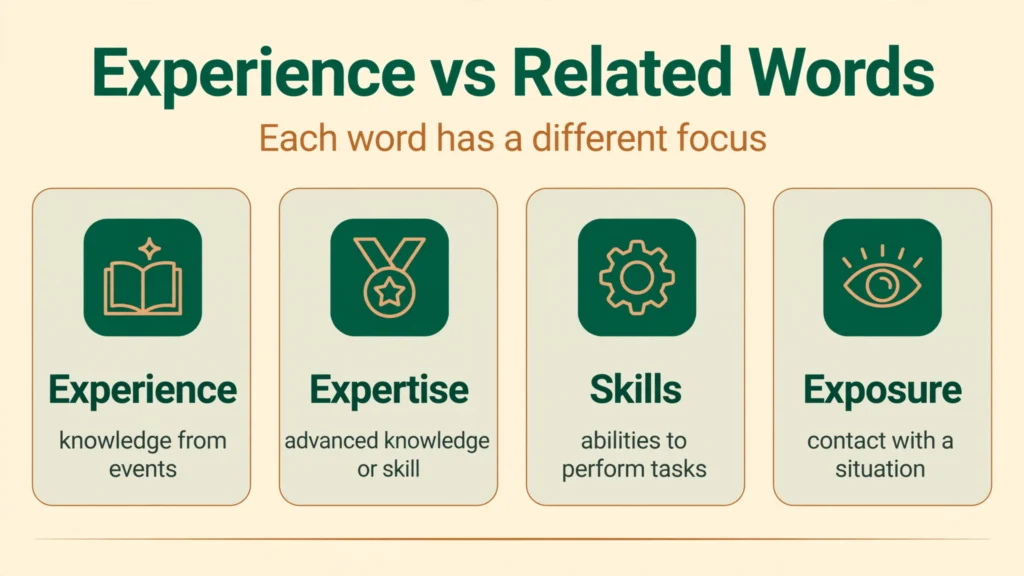
Many words associated with experience overlap in meaning. Still, each one emphasizes a different aspect of what someone knows, has done, or can accomplish.
| Term | Meaning | Example |
|---|---|---|
| Experience | Knowledge or familiarity gained through events and activities | She has experience managing projects. |
| Expertise | Advanced knowledge or skill in a particular area | She has expertise in risk management. |
| Knowledge | Information and understanding about a subject | She has knowledge of project planning methods. |
| Skills | Abilities used to perform tasks | She has strong scheduling and communication skills. |
| Exposure | Contact with a subject, activity, or situation | She gained exposure to construction planning. |
| Proficiency | A demonstrated level of competence | She has proficiency in project management software. |
| Practice | Repeated performance or application | Regular practice improved her planning skills. |
| Background | Previous education, employment, or personal history | Her background includes engineering and operations. |
| Familiarity | Being acquainted with something | She has familiarity with scheduling tools. |
| Track record | Evidence of previous performance | She has a track record of completing projects on time. |
| Insight | A deeper understanding of something | She has insight into common project delays. |
| Wisdom | Good judgment developed through knowledge and experience | Her wisdom helps her manage difficult decisions. |
Is Knowledge a Synonym for Experience?
Knowledge can be a synonym for experience in certain contexts, but the two words don’t mean exactly the same thing.
Knowledge refers to information or understanding. You can gain knowledge through books, classes, observation, discussion, or practical activities.
Experience often describes the events, activities, or situations through which you gain familiarity and understanding.
For example, a student may know laboratory safety rules after studying a textbook. A student who has also worked in a laboratory may have practical experience applying those rules.
Both forms of learning have value, but they aren’t identical.
Use knowledge when you want to emphasize understanding. Use experience when you want to emphasize previous involvement or what you’ve encountered.
Is Expertise the Same as Experience?
No. Expertise describes advanced knowledge or skill, while experience describes previous involvement or familiarity.
Someone can have many years of experience without becoming an expert. Conversely, a person may develop strong expertise through focused study, intensive practice, and high-quality training in a shorter period.
Consider a software developer who has worked in the same role for ten years. The length of employment indicates substantial experience, but it doesn’t automatically prove expertise in every programming language or system.
A more precise description would identify the person’s actual strengths, such as advanced knowledge of database design, demonstrated coding ability, or a successful record of solving complex technical problems.
This distinction matters in resumes, hiring decisions, and professional biographies. Choose expertise when the person’s level of ability supports it.
Experience vs. Exposure
Exposure generally means contact with a subject or situation. Experience often suggests broader or more active involvement, although the degree of involvement depends on the context.
For example:
- Exposure: You attended a workshop introducing project management software.
- Experience: You used the software to organize tasks on a real project.
- Expertise: You can configure the software, train other users, and solve complex workflow problems.
These examples show a possible progression, not a fixed rule. Exposure can lead to experience, and repeated experience can help develop expertise.
However, attending a workshop doesn’t establish proficiency. Always describe what you actually did and what you learned.
Experience vs. Proficiency
Experience refers to what you’ve encountered or done. Proficiency refers to how well you perform a particular activity.
A person may have several years of experience using a language without being proficient in every aspect of it. Another person may have fewer years of experience but strong proficiency in a specific task.
For example:
She has experience using spreadsheets.
This tells readers that she has used them before.
She has proficiency in spreadsheet formulas and data analysis.
This makes a more specific claim about her ability.
Use proficiency when you can reasonably demonstrate the relevant skill. Use experience when you need to describe participation, previous activity, or accumulated exposure.
Experience vs. Background
Background generally refers to the history that shapes a person’s current position, including education, employment, training, and sometimes personal circumstances.
Experience usually focuses more directly on activities, events, or practical involvement.
For example:
His background includes a degree in accounting and three years in financial reporting.
This sentence describes both education and employment.
His experience includes preparing financial reports and reviewing account records.
This sentence focuses on tasks he has performed.
Both descriptions may appear on the same resume. Use background to summarize a person’s history and experience to explain what that person has done.
How to Choose the Right Experience Synonym
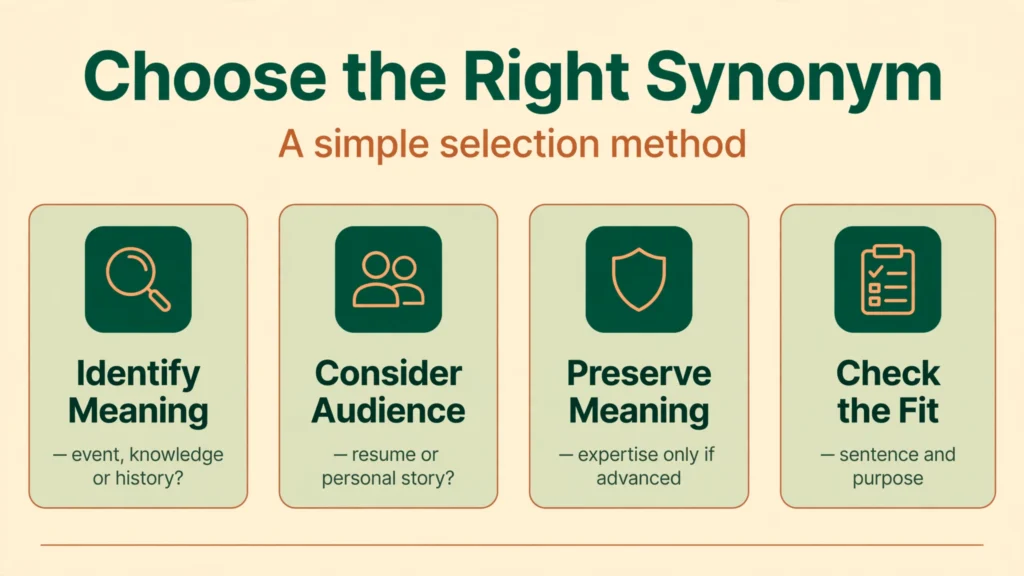
Choosing a synonym isn’t just about finding another word with a similar dictionary definition. The replacement should fit your meaning, sentence structure, audience, and purpose.
Identify the meaning first. Decide whether experience refers to a personal event, practical knowledge, employment history, or demonstrated ability. This narrows your options immediately.
Consider the audience. A resume may benefit from professional background or technical expertise. A personal story might sound more natural with memory, adventure, or encounter.
Preserve the original meaning. Don’t replace experience with expertise unless you mean advanced knowledge or skill. Don’t use qualification as a substitute for time spent performing a task.
Choose specific words over impressive ones. Managed weekly reports for a sales team gives readers more information than possesses extensive professional expertise.
Check the entire sentence. Some alternatives require grammatical changes. For instance, I experienced a challenge can become I faced a challenge, but you can’t replace experienced with expertise and keep the sentence grammatical.
Avoid repetition without sacrificing clarity. Vary your vocabulary when doing so improves the writing. However, repeating experience is perfectly reasonable when no alternative communicates the meaning as clearly.
Consider these examples:
| Original sentence | Revised sentence | Why it works |
|---|---|---|
| I have experience in customer service. | My background includes customer service and complaint resolution. | Adds specific responsibilities. |
| The trip was a good experience. | The trip was an enjoyable adventure. | Highlights the positive nature of the trip. |
| She has experience with data analysis. | She has practical knowledge of data analysis. | Emphasizes applied understanding, if accurate. |
| He gained experience through volunteering. | He developed communication and teamwork skills through volunteering. | Identifies what he gained. |
| The project was a valuable experience. | The project strengthened my problem-solving skills. | Focuses on the outcome. |
The most effective revision usually adds meaning rather than simply swapping words.
Experience Synonym Example Sentences
Examples show how small vocabulary changes can shift the emphasis of a sentence. Use the following examples to understand how different alternatives work in real contexts.
Professional Examples
- Experience: She has experience managing remote teams.
- Background: Her background includes managing remote teams across several departments.
- Expertise: She has expertise in remote team leadership.
- Track record: She has a track record of helping remote teams meet project deadlines.
- Practical knowledge: She has practical knowledge of remote collaboration tools.
Each phrase serves a different purpose. Background summarizes previous work, while track record emphasizes performance.
Academic Examples
- Experience: Students gain experience through laboratory activities.
- Practical application: Students apply theoretical concepts through laboratory activities.
- Experiential learning: The course uses experiential learning to build problem-solving skills.
- Research involvement: Her research involvement includes collecting and analyzing data.
- Firsthand observation: Firsthand observation helped researchers understand the process.
These alternatives work when they accurately describe the type of learning or research taking place.
Personal Examples
- Experience: Moving to another country was a life-changing experience.
- Adventure: Moving abroad became an adventure filled with new discoveries.
- Life lesson: Living abroad taught me an important lesson about independence.
- Personal journey: Her personal journey helped her develop greater confidence.
- Milestone: Moving abroad marked an important milestone in her life.
Use milestone when an event represents a significant stage. Choose life lesson when the emphasis falls on what someone learned.
Everyday Examples
- Experience: We had a pleasant experience at the restaurant.
- Visit: We enjoyed our visit to the restaurant.
- Encounter: I had an interesting encounter with a fellow traveler.
- Memory: The concert left us with a wonderful memory.
- Interaction: My interaction with the staff was friendly and helpful.
The most natural word depends on what actually happened. Visit emphasizes going somewhere, while interaction emphasizes communication with someone.
Experience Antonyms and Opposite Words
An antonym is a word with an opposite meaning. The clearest antonym for experience, when the word refers to accumulated knowledge or practical involvement, is inexperience.
Other related opposites may fit particular sentences, but their meanings differ.
| Antonym or related opposite | Meaning | Example |
|---|---|---|
| Inexperience | Lack of previous experience or practice | Her inexperience with the equipment meant she needed supervision. |
| Unfamiliarity | Lack of knowledge about something | His unfamiliarity with the system slowed the process. |
| Incompetence | Inability to perform a task adequately | The error revealed incompetence in the assigned procedure. |
| Unskilled status | Lack of developed skill in an activity | The role offered training for workers with limited skills. |
| Ignorance | Lack of knowledge or information | Ignorance of the rules can lead to avoidable mistakes. |
| Novice status | Being new to a subject or activity | As a novice, she needed guidance during the first project. |
These terms aren’t universal opposites of every meaning of experience.
For example, if experience means an event someone has lived through, inexperience isn’t the direct opposite in the sentence The concert was an unforgettable experience. You would need to change the sentence or express a different idea.
For career writing, limited experience, beginner-level knowledge, and basic familiarity may sound more neutral than incompetence. They describe the person’s current level without making an unsupported judgment about their overall ability.
Frequently Asked Questions
What Is the Best Synonym for Experience?
The best synonym depends on the context. Knowledge or practical knowledge may fit when discussing understanding gained through practice. Professional background works well when describing someone’s career history. For a personal event, encounter, adventure, or life event may be more accurate.
What Is Another Word for Experience?
Other words for experience include knowledge, expertise, background, familiarity, practice, exposure, insight, and understanding. For a specific event, words such as encounter, adventure, and episode may work better.
What Are Some Synonyms for Experience?
Common synonyms for experience include knowledge, familiarity, understanding, practical knowledge, expertise, involvement, proficiency, background, and track record. The best option depends on the sentence and intended meaning.
What Are the Synonyms of Experience for a Resume?
For resumes, useful alternatives include professional background, work history, industry knowledge, practical knowledge, technical expertise, relevant skills, and track record. Choose wording that accurately describes your responsibilities and abilities.
What Is an Experience Synonym for a Resume?
A useful experience synonym for a resume is professional background when describing career history. You can also use practical knowledge to describe applied understanding, technical expertise to highlight advanced ability, or track record to emphasize previous results.
What Is an Experiences Synonym?
When experiences refers to several events or situations, useful alternatives include events, encounters, occurrences, episodes, adventures, memories, and interactions. The most suitable word depends on the events being described.
What Is a Professional Synonym for Experience?
Professional background is a useful alternative when describing career history. Expertise emphasizes advanced skill, while industry knowledge focuses on understanding a particular sector. Track record works well when highlighting previous results.
What Is a Formal Word for Experience?
Formal alternatives include professional background, direct involvement, practical knowledge, and professional practice. In academic writing, empirical observation, fieldwork, or experiential learning may fit narrower meanings.
What Is Another Word for Hands-On Experience?
Useful alternatives include practical experience, firsthand experience, direct involvement, applied knowledge, and real-world practice. On-the-job training may also fit when someone learns through supervised workplace tasks, although training and experience aren’t exactly the same.
What Is Another Way to Say Extensive Experience?
You could say substantial experience, considerable experience, broad experience, or a wealth of experience. If you want to emphasize results instead of duration, a proven track record may be more effective.
What Is a Synonym for Previous Experience?
Depending on the sentence, you can use prior involvement, earlier experience, previous work history, past professional practice, or relevant background. If you’re discussing an earlier job, previous role may communicate the idea more clearly.
Is Knowledge a Synonym for Experience?
Sometimes. Knowledge refers to information and understanding, while experience often refers to events, activities, or practical involvement. Someone may gain knowledge by studying a subject without performing tasks connected to it.
What Is the Difference Between Experience and Expertise?
Experience means previous involvement or familiarity with an activity or subject. Expertise means advanced knowledge or skill. Experience can contribute to expertise, but years of participation don’t automatically establish a high level of ability.
What Is the Opposite of Experience?
Inexperience is the clearest antonym when experience means accumulated knowledge or practical involvement. Unfamiliarity and lack of experience are also useful in specific contexts. The most accurate choice depends on how the original word is being used.
What Is Another Word for Valuable Experience?
You might use rewarding experience, enriching experience, meaningful encounter, or valuable learning opportunity. If the experience developed a particular ability, describing that result may be more informative than using a general adjective.
How Can I Avoid Repeating the Word Experience?
First, identify what the word means in each sentence. Replace it with a more specific term where appropriate, such as work history, practical knowledge, encounter, or track record. You can also restructure the sentence to describe the activity or result directly.
For example, instead of writing I gained experience in leadership, you could say I led a five-person team and coordinated weekly project meetings. The revised sentence gives readers concrete information without relying on the word experience.
Conclusion
Finding the right experience synonym becomes easier when you understand the meaning behind your sentence. Words such as knowledge, expertise, background, familiarity, and practical experience can improve professional writing, while encounter, adventure, memory, and life lesson often suit personal experiences.
For resumes and cover letters, focus on relevant responsibilities, practical skills, and measurable achievements. In academic writing, choose terms that distinguish observation, participation, research, and learning. In everyday conversation, simple alternatives often sound more natural than formal expressions.
Above all, don’t choose a word simply because it sounds impressive. Select the term that communicates what you know, what you’ve done, or what you’ve learned. The clearest word is usually the strongest one.