Have you ever caught yourself writing “dangerous” three times in a single paragraph? You are not alone. English learners, students, and even professional writers often rely on this one word for every risky situation. But “dangerous” has many shades of meaning. A dangerous job is not the same as a dangerous person. A dangerous road is different from a dangerous idea.
This guide will show you exactly how to replace “dangerous” with more precise and powerful words. You will learn which synonyms fit formal reports, casual conversations, creative writing, and workplace communication. By the end, you will never feel stuck reaching for the same word again.
What Does “Dangerous” Mean?
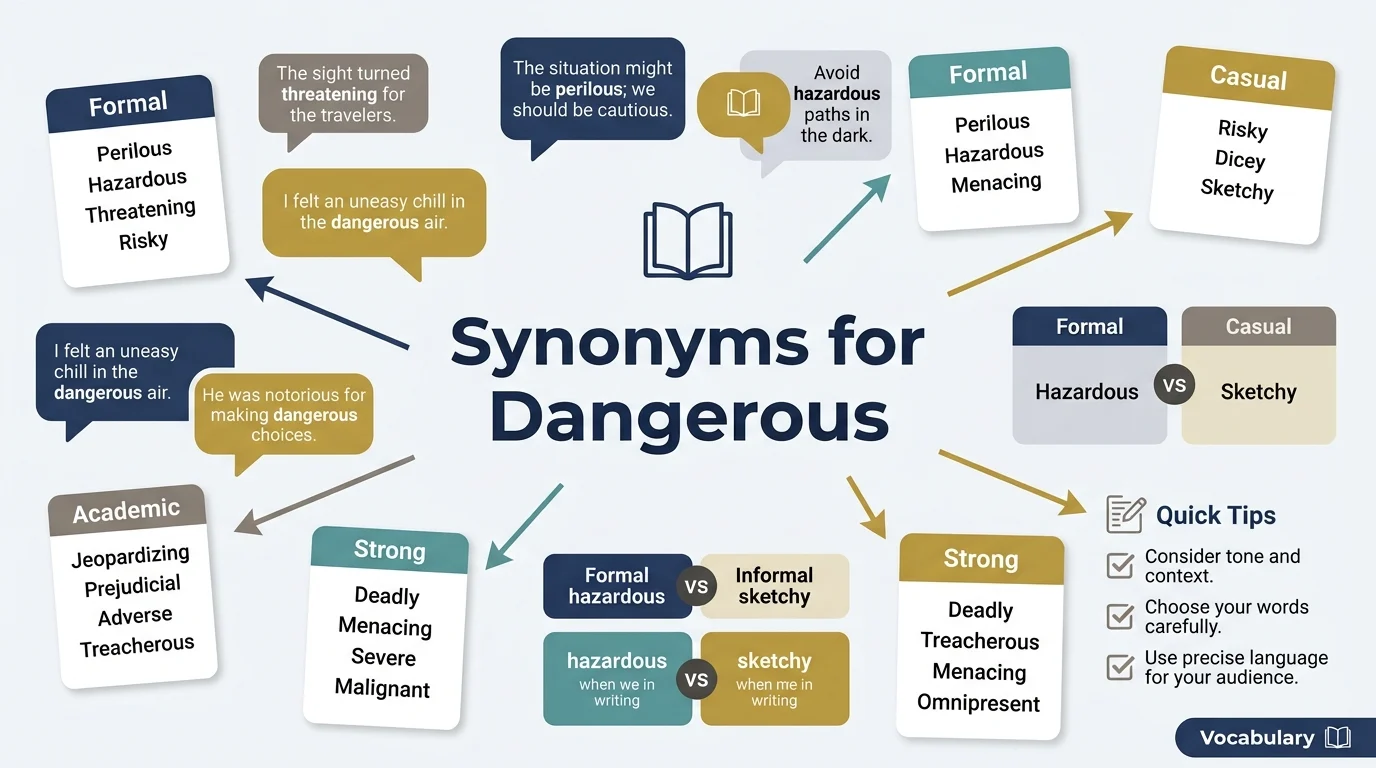
Dangerous means likely to cause harm, injury, or negative consequences. The best synonyms for dangerous depend on context. For formal writing, use “perilous” or “hazardous.” Casual conversation, try “risky” or “unsafe.” For emotional impact, choose “menacing” or “treacherous.” Creative writers might prefer “ominous” or “precarious.”
Meaning, Tone and Context
Simple definition
Dangerous describes something that has the potential to cause harm, damage, or loss. It applies to physical threats, emotional situations, and even abstract ideas.
Part of speech
Adjective. The noun form is “danger.” The adverb form is “dangerously.”
Tone
Neutral to negative. The word itself is factual, but it often carries a warning or sense of urgency.
Formality level
Standard formality. It works in most settings, from casual speech to professional reports. However, some situations call for stronger or more specific alternatives.
Common use cases
Dangerous appears in safety warnings, health discussions, crime reports, travel advice, and descriptions of weather, animals, activities, or people.
Important word forms
Adjective: dangerous. Noun: danger. Adverb: dangerously. Related noun: endangerment. Verb: endanger.
When and How to Use “Dangerous”
Use “dangerous” when you need a general, clear warning without extra emotion or detail. It is the safest choice when you want to be understood quickly.
Professional context
The construction site contains dangerous materials that require special handling.
Personal context
Walking alone in that neighborhood after midnight feels dangerous.
Academic context
The study examined the dangerous effects of prolonged sleep deprivation on cognitive function.
Emotional context
She found herself in a dangerous relationship that isolated her from friends and family.
Creative context
The forest grew darker and more dangerous with every step they took.
Social media caption
This hiking trail is more dangerous than it looks in photos. Stay safe out there.
Email context
Please be aware that the software update contains a dangerous security flaw that needs immediate patching.
Resume context
Managed emergency response protocols for dangerous chemical spills in a high risk manufacturing environment.
Another Word for “Dangerous”
The best single replacement for “dangerous” depends entirely on your situation. Here are the top alternatives by context.
Professional writing
Hazardous works best for workplace safety, health risks, and technical reports.
Academic writing
Perilous suits research papers, historical analysis, and scholarly discussions about serious threats.
Casual conversation
Risky is the most natural choice for everyday talk about decisions, activities, or situations.
Emotional writing
Menacing adds a personal threat or intimidation factor to your description.
Creative writing
Treacherous creates vivid imagery, especially for landscapes, weather, or unpredictable characters.
Resume or workplace use
High risk communicates professional awareness without sounding dramatic or unqualified.
Social media captions
Sketchy is modern and conversational for describing places, people, or situations that feel off.
Stronger meaning
Deadly implies life threatening consequences and the highest level of danger.
Softer meaning
Unsafe offers a gentle warning without alarming your audience.
When Not to Use “Dangerous”
“Dangerous” sounds too vague when you need precision. It fails to communicate the specific nature of the threat.
Too vague
The machine is dangerous.
Better
The machine has exposed electrical wiring that poses a shock hazard.
Too casual for formal reports
The financial situation is dangerous.
Better
The financial situation presents significant liquidity risks.
Too dramatic for simple situations
This homework assignment is dangerous.
Better
This homework assignment is challenging and time consuming.
Too general for emotional nuance
His words were dangerous.
Better
His words were manipulative and designed to undermine her confidence.
Too weak for life threatening events
The storm was dangerous.
Better
The storm was catastrophic and destroyed entire neighborhoods.
Words Commonly Confused With “Dangerous”
- Dangerous vs. Risky
Risky focuses on the chance of loss or failure. Dangerous focuses on the potential for harm. A risky investment might lose money. A dangerous investment might involve illegal activity. - Dangerous vs. Hazardous
Hazardous is more technical and often used for materials, chemicals, or workplace conditions. Dangerous is broader and applies to people, animals, situations, and ideas. - Dangerous vs. Perilous
Perilous suggests immediate, serious danger, often with a sense of adventure or high stakes. Dangerous is more neutral and everyday. - Dangerous vs. Menacing
Menacing describes a threatening appearance or behavior. describes actual capacity to cause harm. A menacing person might not be dangerous. - Dangerous vs. Precarious
Precarious means unstable or insecure. Dangerous means harmful. A precarious ladder could be dangerous, but a precarious financial situation might just be unstable. - Dangerous vs. Deadly
Deadly means capable of causing death. Dangerous includes nonfatal harm like injury, illness, or emotional damage.
Best Synonym by Context for “Dangerous”
| Context | Best Synonym | Why It Works | Example |
|---|---|---|---|
| Formal writing | Perilous | Sounds sophisticated and serious for reports or official documents | The expedition faced perilous weather conditions throughout the journey. |
| Academic writing | Hazardous | Precise and technical for research papers | Researchers identified hazardous levels of lead contamination in the water supply. |
| Professional business | High risk | Clear and measured for workplace communication | The company decided against the high risk expansion into emerging markets. |
| Resume writing | High stakes | Shows you can handle serious responsibility | Managed high stakes negotiations with international regulatory agencies. |
| Casual conversation | Risky | Natural and relatable for everyday speech | Buying a used car without a mechanic is pretty risky. |
| Creative writing | Treacherous | Evokes vivid images of unpredictable danger | The treacherous mountain pass claimed another traveler that winter. |
| Emotional tone | Menacing | Conveys personal threat and intimidation | His menacing tone made everyone in the room uncomfortable. |
| Strong intensity | Deadly | Communicates life threatening severity | The deadly virus spread through the community with terrifying speed. |
| Soft or moderate | Unsafe | Gentle warning without alarming your audience | The playground equipment was deemed unsafe for young children. |
| Social media captions | Sketchy | Modern and conversational for online audiences | This alley looks sketchy. Let’s find another way around. |
| US usage | Dangerous | Standard in American English for general use | The hurricane created dangerous conditions along the coast. |
| UK usage | Dodgy | Common British slang for suspicious or unsafe | That pub looks a bit dodgy to me. |
Which Synonym Should You Choose?
Start by identifying the nature of the danger. Is it physical, emotional, financial, or abstract? Physical danger often calls for “hazardous” or “perilous.” Emotional danger might require “menacing” or “toxic.”
Consider your audience and formality level. Academic readers expect “hazardous” or “perilous.” Friends understand “risky” or “sketchy.” Professional colleagues respond to “high risk” or “unsafe.”
Think about intensity. Is the situation life threatening or merely uncomfortable? “Deadly” and “fatal” signal extreme severity. “Unsafe” and “risky” suggest moderate concern.
Match the tone to your purpose. A warning needs clarity. A story needs imagery. A report needs precision. Choose the word that fits your goal.
Real Life Examples of “Dangerous” in Sentences
School context
The chemistry teacher warned students about the dangerous reaction between the two compounds.
Workplace context
Employees must complete safety training before working in dangerous areas of the factory.
Writing context
Editors often flag repeated words like “dangerous” and suggest more vivid alternatives.
Conversation context
My grandmother thinks driving on the highway is dangerous, so she always takes back roads.
Social media context
This new TikTok challenge looks dangerous. Please do not try it at home.
Resume context
Developed safety protocols for dangerous equipment that reduced workplace injuries by 40 percent.
Email context
I wanted to alert you about a dangerous scam targeting small business owners in our area.
Storytelling context
The villagers knew the forest was dangerous, but they had no choice but to enter it.
25 Synonyms for “Dangerous”
| Synonym | Simple Meaning | Best Used For | Example Sentence |
|---|---|---|---|
| Hazardous | Involving risk or danger, especially from substances or conditions | Technical and workplace safety | The hazardous waste required special disposal procedures. |
| Perilous | Full of danger or risk, often with a dramatic tone | Formal and literary writing | The soldiers embarked on a perilous mission behind enemy lines. |
| Risky | Involving the chance of loss, injury, or failure | Everyday conversations | Starting a business without a plan is extremely risky. |
| Unsafe | Not protected from harm or danger | General warnings and safety notices | The bridge was closed because it was unsafe for vehicles. |
| Menacing | Threatening or suggesting harm | Describing people or behavior | The dog’s menacing growl kept strangers away from the gate. |
| Treacherous | Dangerous because of hidden or unpredictable risks | Weather, terrain, or people | The icy roads made driving treacherous that morning. |
| Deadly | Capable of causing death | Life threatening situations | The deadly snake was found in the garden shed. |
| Precarious | Dangerously unstable or insecure | Physical positions or situations | The climber was in a precarious position on the cliff edge. |
| Destructive | Causing great damage or harm | Events, behaviors, or forces | The destructive storm flattened entire neighborhoods. |
| Harmful | Causing or capable of causing damage | Health and environmental contexts | UV rays are harmful to unprotected skin. |
| Toxic | Poisonous or very harmful | Substances, relationships, or environments | The toxic workplace culture pushed many employees to quit. |
| Fatal | Causing death or complete failure | Medical and high stakes situations | A fatal error in the software crashed the entire system. |
| Severe | Very serious or intense | Medical, weather, or legal contexts | The patient was admitted with severe complications. |
| Grave | Very serious and worrying | Formal situations and news reporting | The country faced a grave threat from the spreading disease. |
| Critical | At a point of crisis or danger | Medical, technical, or emergency use | The patient was in critical condition after the accident. |
| Insecure | Not safe or stable | Emotional or physical vulnerability | The insecure scaffolding swayed in the wind. |
| Chancy | Involving risk or uncertainty | Informal conversation | Investing in cryptocurrency is a chancy move. |
| Dicey | Risky or uncertain | Casual British and American slang | The weather looks dicey for our outdoor event. |
| Dodgy | Suspicious, unreliable, or unsafe | British informal usage | That secondhand car seems a bit dodgy to me. |
| Sketchy | Suspicious or potentially dangerous | Modern American slang | The neighborhood gets sketchy after dark. |
| Unstable | Likely to change or fail suddenly | Emotional, political, or physical states | The unstable government created dangerous conditions. |
| Threatening | Suggesting danger or harm | Describing actions, words, or appearances | The threatening letter alarmed the entire office. |
| Lethal | Sufficient to cause death | Medical, military, and scientific contexts | The lethal dose of the drug was surprisingly small. |
| Noxious | Harmful, poisonous, or very unpleasant | Environmental and health contexts | The noxious fumes from the factory made people sick. |
| Volatile | Likely to change suddenly and dangerously | Financial, political, or emotional situations | The volatile stock market worried all investors. |
Synonym Groups and Usage Differences
Professional vs. Personal Synonyms
Professional settings demand precise, measured language. “Hazardous,” “high risk,” and “unsafe” communicate danger without emotional exaggeration. Personal situations allow for “risky,” “sketchy,” or “dicey.” A professional report would say “hazardous working conditions.” A friend might say “that job sounds risky.”
Formal vs. Conversational Synonyms
Formal writing favors “perilous,” “grave,” and “hazardous.” These words appear in academic papers, official reports, and serious journalism. Conversational English prefers “risky,” “unsafe,” and “dodgy.” You would not tell a colleague “the meeting is perilous.” You would say “the meeting could go badly.”
Academic Synonyms
Academic writing values precision and neutrality. “Hazardous” works for scientific research. “Perilous” fits historical analysis. “Detrimental” suits social science discussions. These words avoid emotional language while maintaining scholarly tone.
Professional and Business Synonyms
Business communication benefits from “high risk,” “volatile,” and “critical.” These words sound measured and analytical. They show you understand serious situations without panicking. Use “high stakes” for negotiations and “unstable” for market conditions.
Creative or Literary Synonyms
Creative writers choose vivid, sensory words. “Treacherous” suggests unpredictable danger. “Menacing” creates visual threat. “Precarious” builds tension. These words add atmosphere and emotion to stories, poems, and descriptive passages.
Slang or Modern Synonyms
“Sketchy” and “dicey” work in casual conversation and social media. “Dodgy” is common in British English. These words are acceptable among friends but inappropriate in formal writing. Never use slang in job applications, academic papers, or professional reports.
Strongest vs. Weaker Synonyms
Mild unsafe, risky, chancy
Moderate hazardous, perilous, harmful
Strong deadly, lethal, fatal
Strongest catastrophic, devastating, apocalyptic
Choose intensity based on actual severity. Do not overstate minor risks. Do not understate serious threats.
Emotional vs. Neutral Synonyms
Emotional synonyms include “menacing,” “threatening,” and “treacherous.” These words trigger feelings of fear or unease. Neutral synonyms include “hazardous,” “unsafe,” and “risky.” These words state facts without emotional coloring. Choose emotional words for storytelling and neutral words for reporting.
Antonyms of “Dangerous”
| Antonym | Meaning | Example Sentence |
|---|---|---|
| Safe | Free from harm or risk | The children played in the safe, fenced playground. |
| Secure | Protected from danger or threat | The secure building had guards at every entrance. |
| Harmless | Not capable of causing damage | The harmless spider was actually quite small. |
| Innocuous | Not harmful or offensive | His innocuous comment went completely unnoticed. |
| Benign | Gentle and not dangerous | The benign tumor was successfully removed. |
| Reliable | Consistently good and trustworthy | The reliable car never broke down on long trips. |
| Stable | Firmly established and not likely to change | The stable economy attracted foreign investors. |
| Protected | Kept safe from harm or danger | The protected wildlife sanctuary was off limits to hunters. |
| Guarded | Watched over and kept safe | The guarded compound kept everyone inside secure. |
| Sheltered | Protected from harsh conditions | The sheltered valley escaped the worst of the storm. |
| Unthreatening | Not suggesting danger or harm | His unthreatening demeanor put everyone at ease. |
| Friendly | Kind and pleasant, not dangerous | The friendly dog wagged its tail at visitors. |
| Gentle | Mild and not severe or harsh | The gentle breeze cooled the hot afternoon. |
| Safe | Not dangerous or risky | The safe investment offered modest but reliable returns. |
| Nonhazardous | Not involving risk or danger | The nonhazardous materials could be disposed of normally. |
Comparison: Dangerous vs. Similar Words
Dangerous vs. Hazardous
Main difference
Dangerous is general. Hazardous is technical and specific to substances, conditions, or activities that present a known risk.
Which one is stronger
Hazardous often implies regulated or documented danger, especially in workplace or environmental contexts.
Which one is more formal
Hazardous is more formal and appears in safety manuals, regulations, and scientific reports.
Example sentence for dangerous
The construction site is dangerous for untrained visitors.
Example sentence for hazardous
The construction site contains hazardous materials that require special handling.
Dangerous vs. Risky
Main difference
Risky focuses on the chance of negative outcomes. Dangerous focuses on actual potential for harm.
Which one is stronger
Dangerous is stronger because it implies real harm rather than just possibility.
Which one is more formal
Both are standard, but risky appears more often in business and financial contexts.
Example sentence for dangerous
Skydiving is dangerous because equipment failure can be fatal.
Example sentence for risky
Skydiving is risky because weather conditions can change quickly.
Dangerous vs. Perilous
Main difference
Perilous suggests immediate, serious danger, often in dramatic or adventurous contexts. Dangerous is more everyday.
Which one is stronger
Perilous is stronger and more urgent.
Which one is more formal
Perilous is more literary and formal.
Example sentence for dangerous
The mountain road is dangerous in winter.
Example sentence for perilous
The mountain road is perilous and has claimed many lives.
Dangerous vs. Menacing
Main difference
Menacing describes threatening appearance or behavior. Dangerous describes actual capacity to cause harm.
Which one is stronger
Dangerous is stronger because it implies real capability for harm.
Which one is more formal
Menacing appears more in creative writing and descriptions.
Example sentence for dangerous
The weapon is dangerous and should be locked away.
Example sentence for menacing
His menacing glare made everyone uncomfortable.
Dangerous vs. Precarious
Main difference
Precarious means unstable or insecure. Dangerous means harmful or threatening.
Which one is stronger
Dangerous is stronger because harm is more serious than instability.
Which one is more formal
Precarious is more formal and appears in academic or literary writing.
Example sentence for dangerous
The chemical spill created dangerous conditions for workers.
Example sentence for precarious
The precarious stack of boxes could collapse at any moment.
Dangerous vs. Deadly
Main difference
Deadly means capable of causing death. Dangerous includes nonfatal harm like injury or illness.
Which one is stronger
Deadly is stronger and more severe.
Which one is more formal
Deadly is used in medical, military, and serious reporting contexts.
Example sentence for dangerous
The snake is dangerous and can cause serious injury.
Example sentence for deadly
The snake is deadly and its venom kills within minutes.
Common Phrases and Expressions with “Dangerous”
1. Dangerous ground
Meaning A situation or topic that could cause problems or offense.
Example sentence Bringing up politics at dinner is dangerous ground with my family.
2. Dangerous game
Meaning An activity or situation that involves significant risk.
Example sentence He was playing a dangerous game by lying to his boss about the project.
3. Dangerous curves ahead
Meaning A warning about upcoming challenges or risks, often used literally on road signs.
Example sentence The road sign warned of dangerous curves ahead for the next ten miles.
4. Dangerous liaisons
Meaning Secret relationships or connections that involve risk.
Example sentence The scandal exposed their dangerous liaisons with foreign agents.
5. Dangerous offender
Meaning A person who has committed serious crimes and poses a threat to society.
Example sentence The court designated him a dangerous offender requiring special supervision.
6. Dangerous precedent
Meaning An action that sets a negative example for future situations.
Example sentence Allowing that exception would set a dangerous precedent for other cases.
7. Dangerous territory
Meaning An area of discussion or activity that involves high risk.
Example sentence We are entering dangerous territory by questioning the company’s ethics.
8. Dangerous obsession
Meaning An extreme and harmful fixation on something or someone.
Example sentence His dangerous obsession with winning destroyed his relationships.
Common Mistakes to Avoid
Mistake 1: Using “dangerous” when a more precise synonym is better
“Dangerous” is too general for many situations. A chemical is “hazardous.” A situation is “precarious.” A person is “menacing.” Choose the specific word.
Mistake 2: Confusing “dangerous” with “risky”
Risky involves chance. Dangerous involves actual harm. A risky investment might lose money. A dangerous investment involves fraud or illegal activity.
Mistake 3: Using casual synonyms in formal writing
“Sketchy” and “dicey” are fine with friends but inappropriate in reports, essays, or professional emails. Use “perilous” or “hazardous” instead.
Mistake 4: Using overly dramatic synonyms for simple situations
Calling a challenging test “deadly” or “fatal” sounds exaggerated and silly. Save strong synonyms for genuinely serious situations.
Mistake 5: Repeating the same word too often
Do not use “dangerous” three times in one paragraph. Vary your vocabulary with appropriate synonyms for each sentence.
Mistake 6: Choosing a synonym with the wrong emotional tone
“Menacing” sounds threatening. “Hazardous” sounds technical. “Risky” sounds uncertain. Match the emotional tone to your purpose.
Mistake 7: Using slang in academic or professional writing
Never use “sketchy,” “dodgy,” or “dicey” in formal contexts. These words undermine your credibility and professionalism.
Mistake 8: Overstating danger for effect
Do not describe minor inconveniences as “dangerous.” This dilutes your message and makes you sound dramatic and unreliable.
FAQs
What is the best synonym for dangerous?
The best synonym depends on context. Use “hazardous” for technical situations, “perilous” for formal writing, and “risky” for casual conversation.
What is a formal synonym for dangerous?
“Perilous” and “hazardous” are excellent formal synonyms. “Grave” and “critical” also work in serious professional or academic contexts.
What is an informal synonym for dangerous?
Risky,” “sketchy,” and “dicey” are common informal synonyms. “Dodgy” works well in British casual conversation.
What is another word for dangerous in professional writing?
“Hazardous,” “high risk,” and “unsafe” work best in professional writing. “Volatile” is useful for financial or political contexts.
What is the difference between dangerous and hazardous?
Dangerous is a general term for anything that can cause harm. Hazardous is more technical and often refers to substances, materials, or regulated risks.
What is the opposite of dangerous?
“Safe” is the most direct opposite. “Secure,” “harmless,” and “innocuous” are also strong antonyms depending on the context.
Conclusion
“Dangerous” is a useful word, but it cannot cover every situation that involves risk or harm. The synonyms for dangerous you choose should match your context, audience, and purpose. Formal writing demands “perilous” or “hazardous.” Casual conversation welcomes “risky” or “sketchy.” Creative writing thrives on “treacherous” and “menacing.”
The best vocabulary advice is simple: think before you write. Ask yourself what kind of danger you are describing. Is it physical or emotional? Is it life threatening or merely uncomfortable? Answer these questions, and the right synonym will follow.
Remember to verify definitions using trusted dictionaries such as Cambridge, Oxford, Merriam Webster, Collins, or Britannica before publishing any important work.