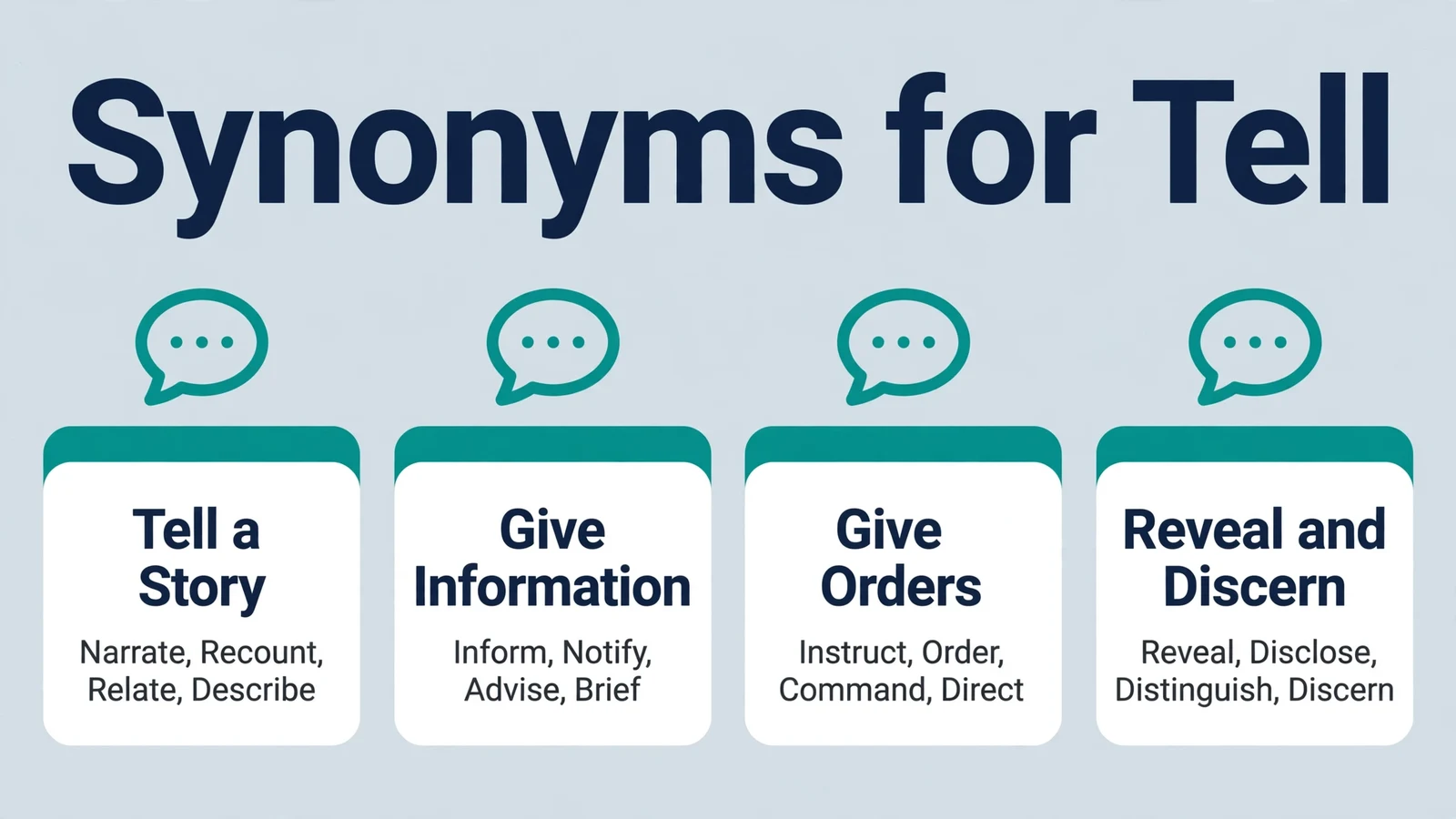
Few verbs work as hard as tell. You tell a story, tell a friend the news, tell a child to wait, and tell two twins apart, all with the same four letters. The most useful synonyms for tell include narrate, recount, relate, inform, notify, advise, instruct, direct, distinguish, discern, reveal, and disclose. Each one fits a different job, though, and the wrong choice can quietly change your meaning.
This guide sorts more than 55 synonyms for tell by sense, so you can match the word to the moment. Every entry comes with a plain meaning, and the key words include short examples. You will also find the tell and say contrast that learners ask about most. Whether you write fiction, reports, or everyday messages, the right synonym helps your point land the first time. Every group below rests on dictionary and thesaurus entries, so the shades of meaning are real, not guessed.
Top Synonyms for Tell: Quick Reference
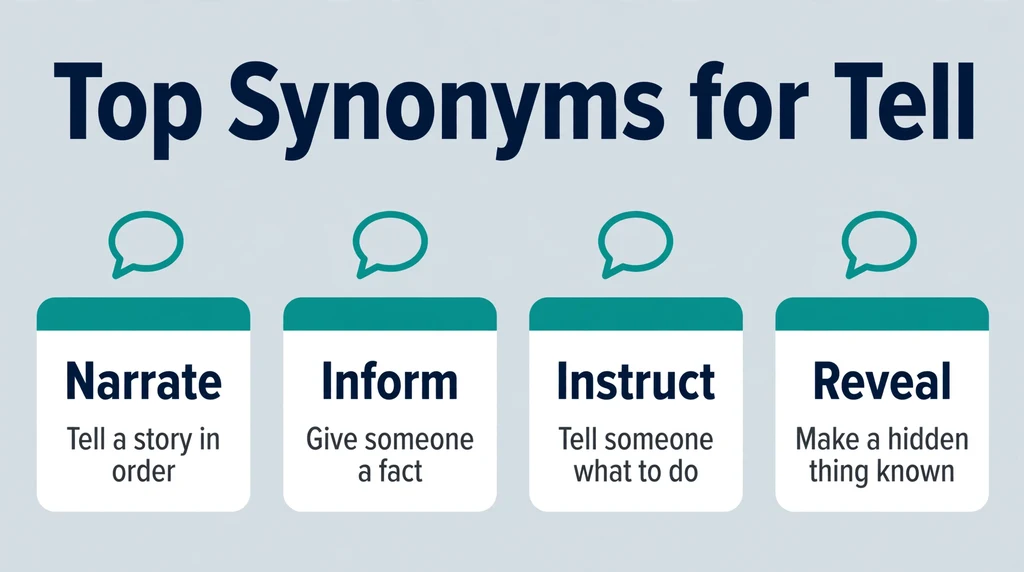
The table below covers the 26 replacements readers reach for most often. Later sections sort the full list by sense, with finer shades of meaning.
| Word | Meaning in one line | Best for |
|---|---|---|
| Narrate | Tell a story in order | Films, novels, audiobooks |
| Recount | Tell events in full detail | Reports, witness accounts |
| Relate | Tell a story or experience | Formal storytelling |
| Describe | Give details in words | Scenes, people, events |
| Report | Give a factual account | News, work updates |
| Inform | Give someone a fact | Neutral, everyday use |
| Notify | Inform officially | Letters, schools, banks |
| Advise | Inform formally, or suggest | Official notices, advice |
| Apprise | Inform, very formal | Legal and business writing |
| Brief | Give short, key facts | Meetings, teams, press |
| Instruct | Tell someone what to do | Manuals, bosses, teachers |
| Order | Tell with authority | Strong commands |
| Command | Order with full authority | Military, formal orders |
More Core Synonyms for Tell
| Word | Meaning in one line | Best for |
|---|---|---|
| Direct | Tell someone to do a task | Workplaces, procedure |
| Distinguish | Tell things apart | Comparisons, tests |
| Discern | Notice or work out | Subtle differences |
| Differentiate | State how things differ | Essays, analysis |
| Reveal | Make a hidden thing known | Secrets, results, truth |
| Disclose | Reveal secret information | Official statements |
| Divulge | Reveal private information | Confidences, leaks |
| Say | Speak words aloud | General speaking |
| State | Say formally and clearly | Documents, speeches |
| Announce | Make known publicly | News, events, results |
| Fill in | Bring someone up to date | Informal, friendly updates |
| Clue in | Tell someone a hidden fact | Informal, playful tone |
| Blab | Reveal a secret carelessly | Informal, gossip |
The quick list mixes all five senses on purpose, because most readers arrive with one sentence to fix. If your replacement must match a single sense exactly, use the grouped sections below. They add the near words, the register labels, and the traps that a bare table cannot show.
What Does Tell Mean?
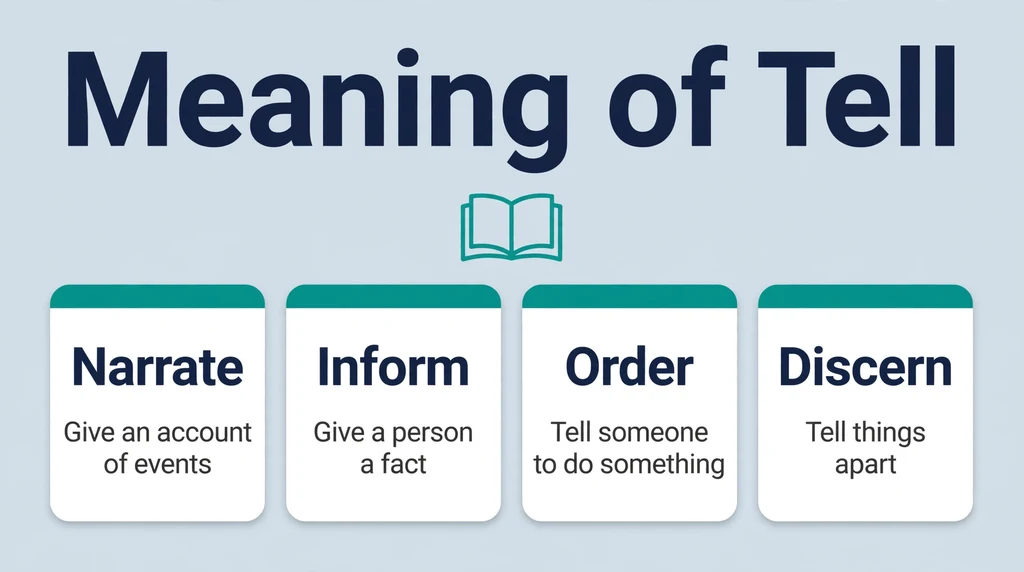
At its core, tell means to give someone information in words, or to give an account of something. Merriam-Webster Thesaurus splits the verb into clear sense families: giving an account, giving information, issuing orders, and making secrets known. Collins lists the same spread, and it adds the discerning sense, as in telling twins apart.
The grammar matters as much as the meaning. Tell normally needs a person after it. You tell a friend the news, or you tell the team to wait. That personal object is the feature that separates tell from say, and later sections return to it.
The Main Senses of Tell in One Place
Five senses cover almost every use. First, tell can mean narrate: “She told us a story.” Second, it can mean inform: “Tell me the time.” Third, it can mean order: “He told them to leave.” Fourth, it can mean discern: “I cannot tell them apart.” Fifth, it can mean reveal: “Time will tell.”
Each sense has its own family of synonyms. As a result, a word that fits one sense often fails in another. You can narrate a story, for example, but you cannot narrate a child to sit down. Sorting by sense first keeps every replacement accurate.
How Tell Connects to Its Objects
Tell builds three main patterns. The first is tell someone something: “She told me the answer.” The second is tell someone to do something: “She told me to wait.” The third flips the order: tell something to someone, as in “Tell it to the judge.”
Collins usage notes highlight the first two patterns, because learners mix them with say. Notice that the person comes first in the commonest patterns. That habit is the grammar footprint of the verb’s meaning: a fact moves from one person to another. Once you hear the person first pattern, spotting tell in the wild becomes easy.
A Verb That Once Meant Count
Tell started life as a counting word. Old English tellan meant to reckon, calculate, or give an account of numbers. The narrating meaning appears around the year 1000, the announcing meaning in the early 1100s, and the ordering meaning in the 1590s.
The old counting sense still survives in plain sight. A bank teller counts money, and the phrase all told means the final count. French conter and Spanish contar show the same pairing, since both can mean to count and to narrate.
One small sense sits apart from the rest. In “the strain began to tell,” tell means to have an effect. Collins lists register, weigh, and take its toll for that use, but most writers simply keep tell itself there.
Synonyms for Tell When You Tell a Story
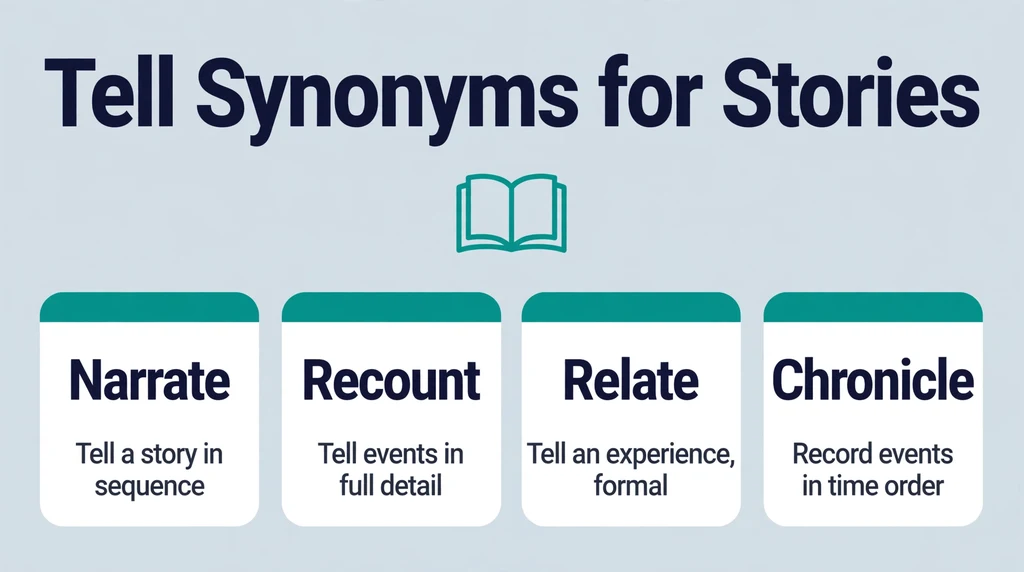
Storytelling is the oldest sense of tell, and it owns a rich family of words. Most of them add one detail: order, detail, formality, or pictures in words. The everyday words come first, then the vivid written ones.
Everyday Story Words
Narrate means to tell a story in sequence, step by step. It suits films, novels, and audiobooks. “A calm voice narrates the documentary.”
Recount means to tell events again, in full detail. Witnesses recount what they saw, and reports recount a timeline. Cambridge marks it formal, so save it for serious contexts.
Relate also means to tell a story or experience, with a formal tone. “She related her adventures to the class.” It sounds slightly old fashioned in casual chat.
Describe means to give details about something in words. You describe a scene, a face, or a feeling. It paints the picture rather than following the plot.
Report means to give a factual account. Journalists report events, and staff report progress. It promises facts, not entertainment.
Vivid and Written Accounts
Chronicle means to record events in time order. Histories chronicle a reign, and diaries chronicle a year. It implies a long, careful record.
Recite means to say aloud something learned by heart. Pupils recite poems, and actors recite lines. Use it only when memory does the work.
Rehearse, in its older sense, means to recount a list or story in full. It survives in formal phrases like “the facts need no rehearsing here.”
Portray means to describe someone or something in a particular way. Reviews portray a hero as brave or flawed. It carries the writer’s angle, not just facts.
Depict means to show something in words or pictures. A novel depicts village life, for instance. Like portray, it suits written and visual accounts best.
The plain phrase give an account of covers all of these neutrally. It sounds formal, and officials use it when they must state events carefully.
Synonyms for Tell in Story Sentences
Watch how the choice changes the scene. “The sailor narrated his voyage” sounds steady and complete; “the sailor recounted his voyage” adds detail and a second telling; and “the sailor related his voyage” turns formal, almost like a report to officials.
Swap in “described his voyage” and the events slow down, because description lingers on places and faces. One verb change moves the same story from logbook to fireside. That is why storytellers keep several of these words ready.
Synonyms for Tell When You Share Information
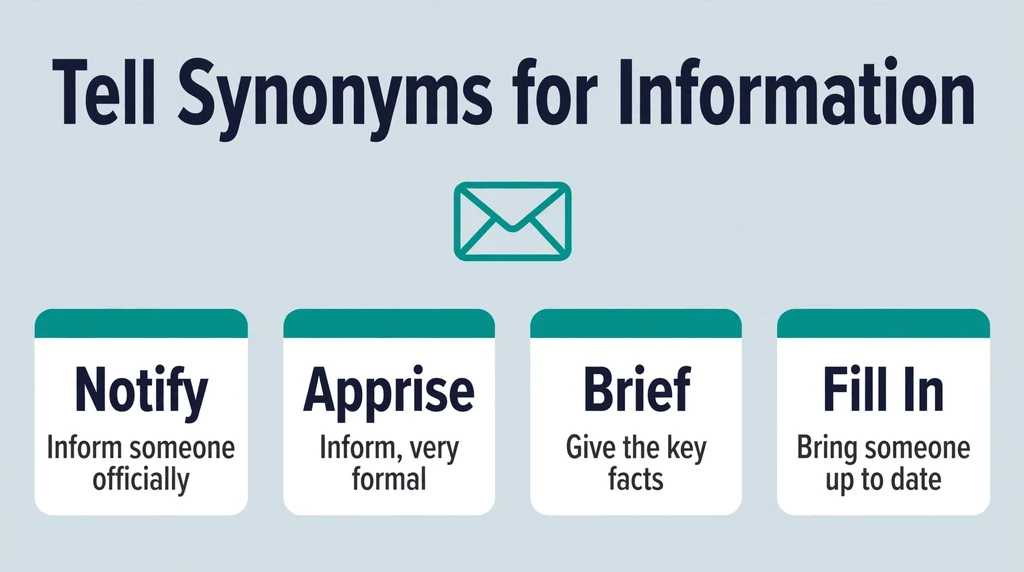
This is the busiest sense of tell. Someone has a fact, and someone else needs it. The words below split into everyday options, formal and official options, and public or strong options. Tone is the main difference between them.
Everyday Information Words
Inform is the closest all purpose synonym. You inform people of a fact, or inform them that something happened. It sounds neutral and slightly formal.
Let know is the relaxed twin of inform. “Let me know your answer” fills inboxes everywhere. It is friendly, short, and safe in almost any message.
Mention means to tell briefly, in passing. You mention a name or a detail without building on it. It signals that the point is small.
Communicate means to share information clearly, by any channel. It suits formal writing about messages and media. For one quick fact, it can feel heavy.
Fill in means to bring someone up to date. “Fill me in on the meeting.” It implies the listener missed earlier facts.
Clue in means to tell someone a fact they were missing, often a hidden one. It is informal and playful. “Clue me in, what is the surprise?”
Update means to tell the latest news on a topic. Teams update clients, and apps update users. Cambridge lists it for this sense, and modern workplaces use it daily.
Formal and Official Words
Notify means to inform someone officially. Schools notify parents, and banks notify customers. It often arrives in writing, with a record behind it.
Advise has two jobs. Formally, it means to inform: “We advise you that the office has moved.” In everyday English, it means to give advice. Context decides which one readers hear.
Apprise means to inform, and it is the most formal word in this group. Lawyers apprise clients of their rights. Outside legal or business writing, it can sound stiff.
Brief means to give the key facts, briefly and on purpose. A spokesperson briefs reporters, and a manager briefs a team. It implies preparation and selection.
Acquaint means to make someone familiar with a fact. “She acquainted him with the rules.” It pairs with with, and it sounds formal.
Impart means to give knowledge or news to others. Teachers impart knowledge, and elders impart wisdom. It suggests the fact carries weight.
Make known is a calm formal phrase. Officials make results known, for example. It avoids naming a speaker, which suits announcements.
Public, Strong and Teaching Words
Announce means to make something known publicly. You announce results, winners, and plans. It needs an audience, not one listener.
Declare means to say something firmly and officially. Governments declare emergencies, and travelers declare goods at customs. It carries authority and finality.
State means to say or write something clearly and formally. Reports state the facts, and letters state a position. It avoids emotion on purpose.
Proclaim means to announce proudly and publicly. Kings proclaimed laws, and fans proclaim a winner. It is grander than announce, so use it sparingly.
Assure means to tell someone something positively, to remove doubt. “I assure you, the work is done.” It belongs to the teller’s confidence, not the fact itself.
Warn means to tell someone about danger or a problem ahead. Signs warn drivers, and friends warn friends. It always carries a risk in the background.
Alert means to warn quickly, so someone can act. Systems alert users, and guards alert the team. Speed is part of its meaning.
Enlighten means to tell someone facts that clear up confusion. It often appears in polite or slightly ironic requests: “Please enlighten me.”
Educate means to inform in a way that builds knowledge. Campaigns educate the public about health. It is broader than one message.
Familiarize means to make someone know a system or place well. Trainers familiarize new staff with the tools. It takes time, like educate.
Teach means to tell and show, again and again, until the skill sticks. Because it needs practice, it fits long learning, not one quick fact.
Inform, Notify or Advise: The Fine Lines
These three cause the most hesitation. Inform is the neutral default for passing a fact to a person. Notify adds official weight and usually a written record. Advise, in its formal sense, matches inform, but most readers today hear its advice meaning first.
In a legal notice, advise is safe because the genre sets the reading. In a friendly message, it can misfire, so inform or let know reads more clearly. When in doubt, test the sentence aloud, because the ear catches register faster than the eye.
Synonyms for Tell When You Give Orders
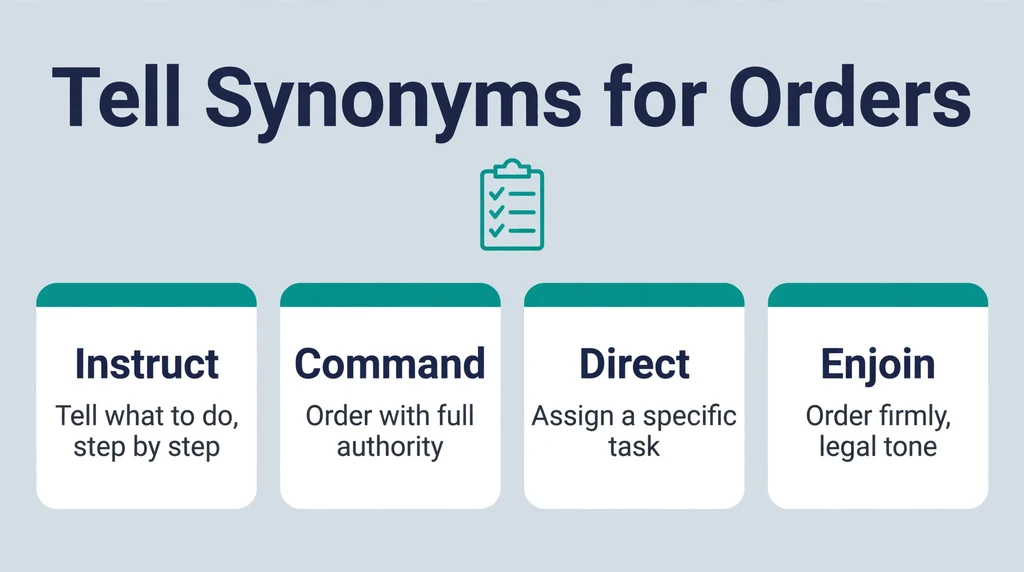
When tell is followed by an action, it becomes an order: “She told him to leave.” The words in this family differ in force. Some belong to manuals, some to the military, and one is barely an order at all.
Direct Orders
Instruct means to tell someone what to do, step by step. Judges instruct juries, and manuals instruct users. Merriam-Webster notes that instruct expects obedience and clear procedure.
Order means to tell someone to do something with authority. It is stronger than instruct, and it can sound peremptory. Officers order, and so do angry managers.
Command is the heaviest word here. Generals command troops, and kings command subjects. It stresses official power, so everyday use sounds dramatic.
Direct means to tell someone to carry out a specific task. Managers direct staff to hold calls, for example. It is firm, businesslike, and common in formal writing.
Firm, Formal and Polite Orders
Bid is an old fashioned order word. “She bade him sit down.” Merriam-Webster calls it peremptory, the tone used with children or servants. Today it reads as literary.
Enjoin means to order firmly and urgently, often with a warning attached. Courts enjoin actions in legal rulings. It is formal and rare outside law.
Charge means to instruct someone with a duty. Leaders charge a team with a mission. It implies trust and responsibility, not just obedience.
Ask is the polite end of the scale. “She asked him to leave” softens the same message. Our guide to synonyms for ask shows how these gentle request words differ.
The pattern stays constant across the family. Every one of these verbs can take a person plus to and a verb, exactly like tell.
A Ladder of Force, Weakest to Strongest
Picture the family as a ladder. Ask stands on the bottom rung, a request dressed as an order. Instruct and direct share the middle, firm but professional. Order climbs higher, with authority doing the pushing. Command tops the ladder, backed by rank or law.
Bid and enjoin stand slightly off the ladder: bid is literary, and enjoin belongs to courts. Choosing a rung is choosing how much pressure your sentence applies. Writers who climb too high too fast make ordinary requests sound like threats.
Synonyms for Tell When You Spot the Difference
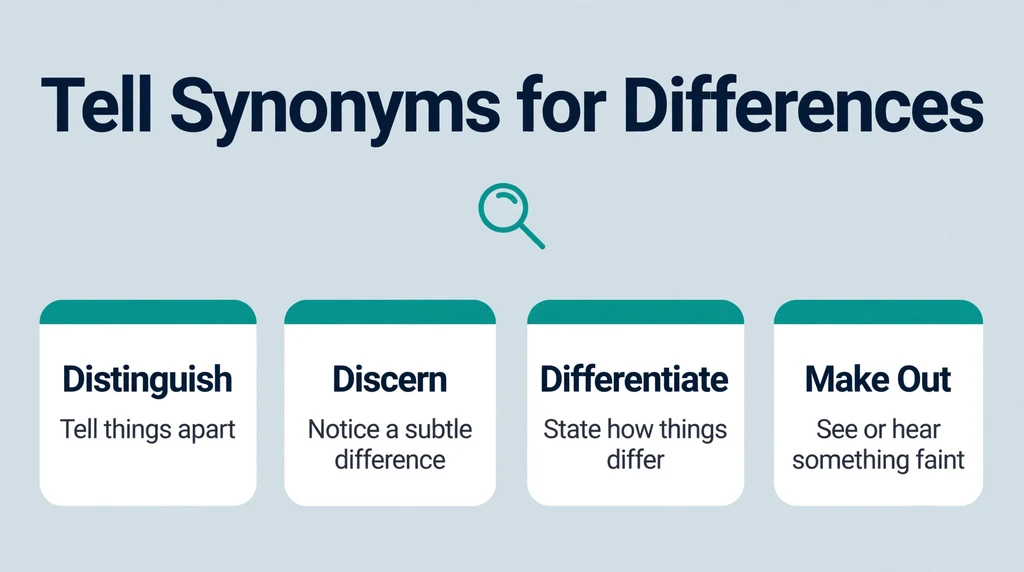
Sometimes tell has nothing to do with speaking. In “I cannot tell the twins apart,” tell means to notice or work out a difference. Collins gives this sense its own lists, and the words below come from them.
Telling Things Apart
Distinguish is the word most people want here. It means to notice how two things differ. “Can you distinguish the real painting from the copy?” It is neutral and works everywhere.
Differentiate means to state or show the difference between things. Essays differentiate two theories, and labels differentiate products. It sounds analytical and formal.
Discriminate also means to tell things apart, in careful formal use. “He cannot discriminate between good and bad ideas.” Note that its common modern meaning, unfair treatment, is different, so context must stay clear.
Noticing With Eyes and Mind
Discern means to notice something subtle, with effort. You discern a shape in fog, or discern a pattern in data. It suggests the difference hides below the surface.
Make out means to manage to see or hear something faint. “I could just make out a figure in the dark.” It fits senses straining at their limit.
See works in this sense too, beyond eyesight. “Now I see the problem.” It marks the moment understanding arrives.
These words answer questions silently. Nobody speaks, yet the mind tells one thing from another, which is why this sense feels so different from the rest.
Tell Apart and Other Set Phrases
The phrasal form tell apart is the everyday champion of this sense. “The twins dress alike, so strangers cannot tell them apart.” Tell by works differently: it names the clue. “You can tell by her accent where she grew up.”
A third phrase, cannot tell, confesses defeat: “I cannot tell whether he is joking.” Each phrase keeps the silent, judging sense of tell, with no speaking involved at all.
Synonyms for Tell When the Truth Comes Out
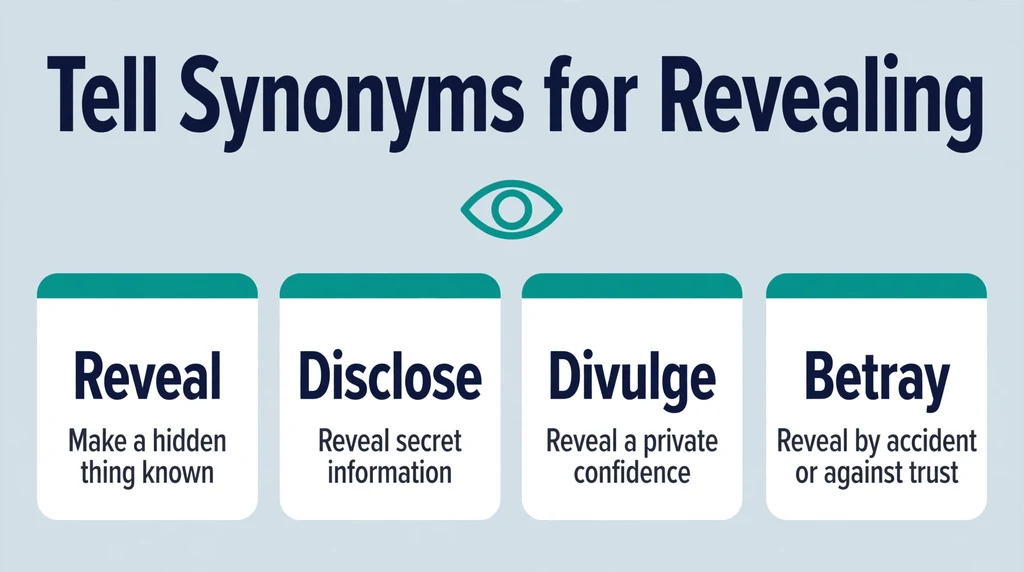
In this sense, tell opens what was closed. Secrets, results, and quiet signs all tell us things. Merriam-Webster groups betray, disclose, divulge, and reveal here, and its notes draw fine lines between them.
Revealing Facts and Secrets
Reveal means to make a hidden thing known. It is the broadest word in this group. A curtain reveals a stage, and a study reveals a cause.
Disclose means to reveal information that was kept secret. Officials disclose figures, and candidates disclose assets. It sounds official and deliberate.
Divulge means to reveal private information, often when you should not. Sources divulge secrets to reporters. Merriam-Webster ties it to a breach of confidence.
Betray means to reveal something by accident, or against trust. “A blush betrayed her embarrassment.” The teller often never meant to speak.
Expose means to uncover something hidden and usually bad. Reports expose fraud, and sunlight exposes a flaw. It carries a hint of shame.
Uncover means to find and reveal what was covered. Detectives uncover evidence, and audits uncover errors. It stresses the search before the reveal.
Confess means to tell something you did wrong, or a private truth. People confess mistakes, fears, and love. It is personal, unlike the official disclose.
When Signs and Facts Tell
People are not the only tellers. Show means to make something clear by evidence. “The results show a clear pattern.” The facts do the telling here.
Indicate means to point to something as a sign. Surveys indicate a trend, and a gauge indicates pressure. It is the formal partner of show.
The famous phrase time will tell belongs to this family. It means the future itself will reveal the answer, and no person needs to speak.
Informal Ways to Spill a Secret
Spill the beans means to reveal a secret, often by accident. It is informal and a little playful. “Who spilled the beans about the party?”
Let the cat out of the bag means the same thing, with the same accidental flavor. Both idioms suit speech and light writing, never formal reports.
Blab means to talk carelessly and give secrets away. “Do not blab about the plan.” Collins marks it informal, and it always criticizes the teller.
Telling Details in Stories and Reports
Writers lean on this sense with the phrase telling detail. A telling detail is a small fact that reveals a large truth: a shaking hand, an unpaid bill. Journalists hunt for telling details, and novelists plant them.
The adjective telling comes straight from this sense of the verb, which is why it means significant, not talkative. A telling silence works the same way, since the quiet itself gives the secret away. Critics praise a telling performance for the same reason: it reveals more than the script says outright.
Tell vs Say: Choosing the Right Word
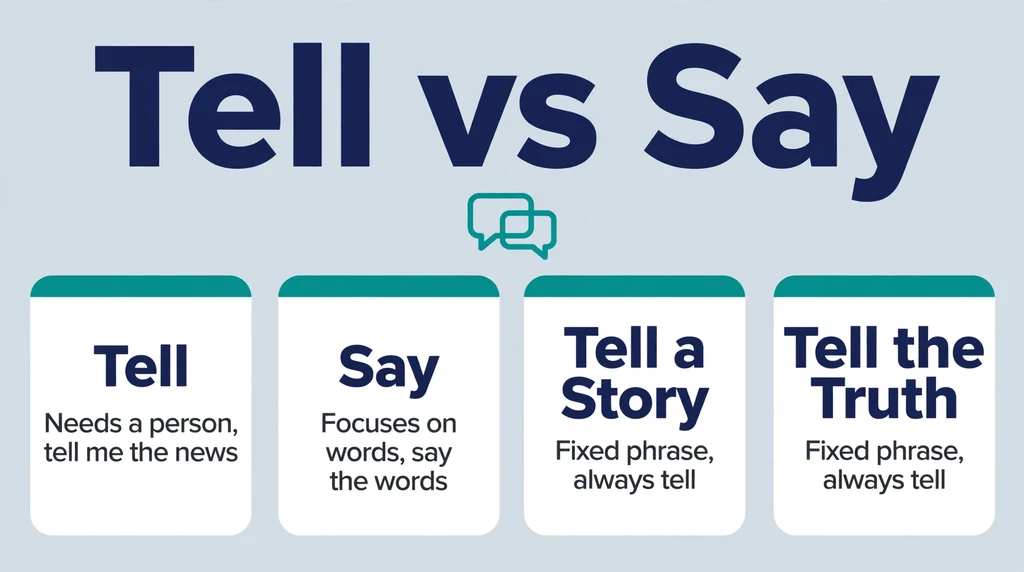
This contrast causes more learner errors than any other in this guide. The short rule is simple. Tell focuses on the listener, and say focuses on the words. Our companion guide to synonyms for say sorts the say family by tone and volume.
The Object Test
Tell almost always needs a person right after it. You tell me, tell her, tell the class. Then the message follows: “Tell me the story.” Without a person, the sentence usually breaks, unless the phrase is fixed.
Say works the other way. You say something, say that, or say hello. A person can join with to: “Say it to me.” But the words stay in charge of the sentence.
Two pure saying words behave like say. State and utter present words without needing a personal object first. “She uttered a warning” focuses on the warning itself.
Fixed Phrases That Always Take Tell
Some phrases refuse say completely. You tell a story, tell a joke, and tell a lie. You tell the truth, tell the time, and tell the difference. Dictionaries list these as set uses of tell, and no synonym swaps in neatly.
The pattern makes sense once you see it. Each phrase hands something to a listener: a story, a fact, a judgement. That handover is exactly what tell means at its core.
In dialogue writing, the same logic picks your tags. Characters say lines, but they tell each other news. Our list of synonyms of said covers the reporting verbs writers use instead.
Reported Speech: Said That, Told Me That
In reported speech, the two verbs split again. Say takes a that clause directly: “She said that she was tired.” Tell needs its person first: “She told me that she was tired.” Dropping the person after told is one of the commonest learner errors in English.
If no listener matters, choose said. If the listener is the point of the sentence, choose told. The same split explains why headlines prefer said for quotes and told for instructions.
Formal and Informal Synonyms for Tell
Register decides whether a synonym sounds right. The same fact can arrive as a stiff legal notice or a friendly whisper. Sorting the main words by tone helps you match the setting.
Formal Choices
Formal writing favors notify, apprise, advise, instruct, enjoin, declare, state, disclose, and recount. These words fill contracts, official letters, court writing, and serious reports. They signal records, duties, and care.
Formal does not mean better, though. In a friendly email, apprise looks odd, and enjoin looks stranger. Match the word to the reader, not to a wish to sound grand.
Official synonyms also travel in pairs with set partners. Candidates disclose assets, lawyers apprise clients, and officers notify families. Learning the partner noun with the verb makes formal writing sound natural instead of decorated.
Informal Choices
Relaxed speech favors let know, fill in, clue in, blab, and the two secret idioms. They suit conversation, messages, and light fiction. Their warmth is the point.
Informal words carry risk in formal settings. A report that says a minister blabbed will sound biased, because blab judges the teller. Choose neutral words when the tone must stay clean.
Fiction plays by looser rules. A narrator who writes “she filled me in” sounds like a friend talking, which is often exactly the voice a novel wants.
Antonyms for Tell
Antonyms depend on the sense, because tell does so many jobs. The opposites below follow the same sense split as the synonym groups.
For revealing and informing, the opposites are conceal, hide, keep secret, withhold, and suppress. Each one holds information back instead of handing it over. A witness who withholds a fact does the reverse of telling it.
For speaking in general, the opposites are be quiet and listen. A listener takes in words instead of giving them out. Ask and question also flip the direction, since the speaker requests information instead of supplying it.
For discerning, the opposites are misunderstand, mix up, overlook, and miss. To mix up twins is the exact failure of telling them apart. Guess and estimate oppose the old counting sense, where tell once meant an exact reckoning.
One more opposite pair hides in the order sense. The person who is told can obey or disobey, so disobey answers tell from the listener’s side. It is the only antonym here that belongs to the receiver, not the speaker.
Common Mistakes: Words That Are Not True Synonyms for Tell
Some words sit near tell without matching it. Using them as direct swaps creates errors that readers feel at once.
Say is the classic trap. It shares ground with tell, but it cannot take a personal object the same way. “She said me the news” is wrong; “she told me the news” is right. The object test above settles every case.
Speak and talk name the act of speaking itself. They do not hand a fact to a named listener. You talk about the news or speak to a crowd, but neither verb replaces tell in “tell me the answer.”
Explain means to give reasons and detail so something becomes clear. Telling can be one short fact, while explaining always unpacks. A teacher tells the class the date, then explains why it matters.
Whisper, shout, and mutter describe how words sound, not the act of informing. They answer “in what voice,” not “with what meaning.” They belong with say, not with tell.
Finally, order as a noun phrase, “give an order,” works fine, but the verb demand goes further than tell. Demand insists on rights and urgency. Tell stays neutral about the speaker’s claim.
Guess fails in the discerning sense for the opposite reason: it gives up. To tell twins apart is to succeed; to guess is to admit you cannot tell. In the old counting sense, reckon did serve as a real synonym, but in modern American English it mostly means suppose, so it misleads there too.
Frequently Asked Questions
What is the best synonym for tell?
It depends on the sense. For stories, narrate and recount lead the list. For facts, inform and let know cover most cases. Orders take instruct as the safe default, and for secrets, reveal is the broadest choice.
What is a formal synonym for tell?
Notify and apprise are the most formal information words. Instruct and enjoin lead the formal order words, while disclose leads the formal secret words. Each suits official letters, legal writing, and serious reports.
What is the difference between tell and say?
Tell needs a person as its object: you tell someone something. Say focuses on the words and needs no personal object: you say something. Fixed phrases like tell the truth and tell a joke always take tell.
What is another word for tell a story?
Narrate is the closest match, with recount for detailed retellings and relate for formal storytelling. Chronicle suits long records in time order, while describe fits stories built from detail rather than plot.
What is a synonym for tell in “tell the difference”?
Distinguish is the everyday choice, and discern fits subtle differences noticed with effort. Differentiate suits essays and analysis, where you state exactly how two things differ.
What is the past tense of tell?
The past tense is told, and the past participle is also told. “She told me yesterday,” and “I have told you twice.” The word belongs to a small set of verbs that change their vowel in the past.
What is an informal synonym for tell?
Let know and fill in are friendly everyday options. Clue in suits a missing fact shared playfully. For secrets, blab and spill the beans are informal, and both suggest the telling was careless.
What is the opposite of tell?
For secrets and facts, the opposites are conceal, hide, keep secret, and withhold. For conversation, listen and be quiet flip the roles. The right opposite depends on which sense of tell you start from.
Final Thoughts
Tell looks simple, but it quietly covers stories, facts, orders, judgments, and secrets. Once you split it by sense, the right synonym becomes easy to spot. Narrate the story, notify the parents, instruct the team, distinguish the twins, and reveal the result.
The five families also explain why one word rarely fits two jobs. A verb that charms in a story can bully in an office, and a verb built for secrets sounds wrong for the weather.
Keep the object test in mind, and tell will rarely lead you wrong. For the full dictionary treatment of every sense, the Merriam-Webster Thesaurus entry for tell shows the complete lists side by side.