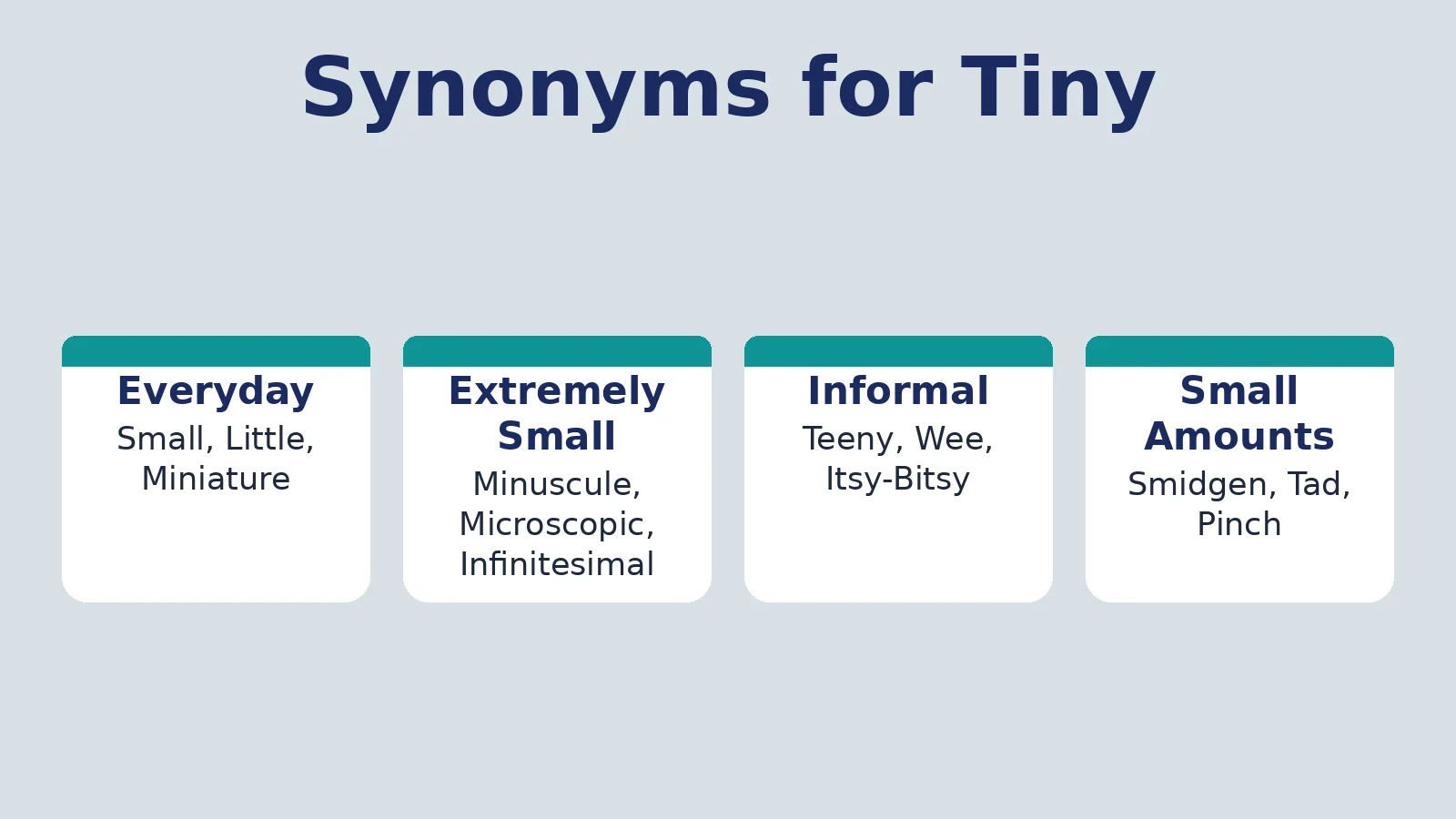
Small is a fine word, but sometimes it simply is not small enough. The most useful synonyms for tiny include small, little, miniature, minute, minuscule, microscopic, and diminutive, and they cover very different levels of littleness. A tiny crack in a painting needs one kind of word. A tiny puppy in a story needs another, and a tiny trace of evidence needs a third.
This guide groups more than 40 synonyms for tiny by degree, tone, and job. The core words come first, then the extreme science-leaning words, then the playful informal set. A final group collects nouns for a tiny amount, like a smidgen or a tad. Every word carries a short meaning, and the key entries include examples, so you can pick the exact shade of small.
Top Synonyms for Tiny: Quick Reference
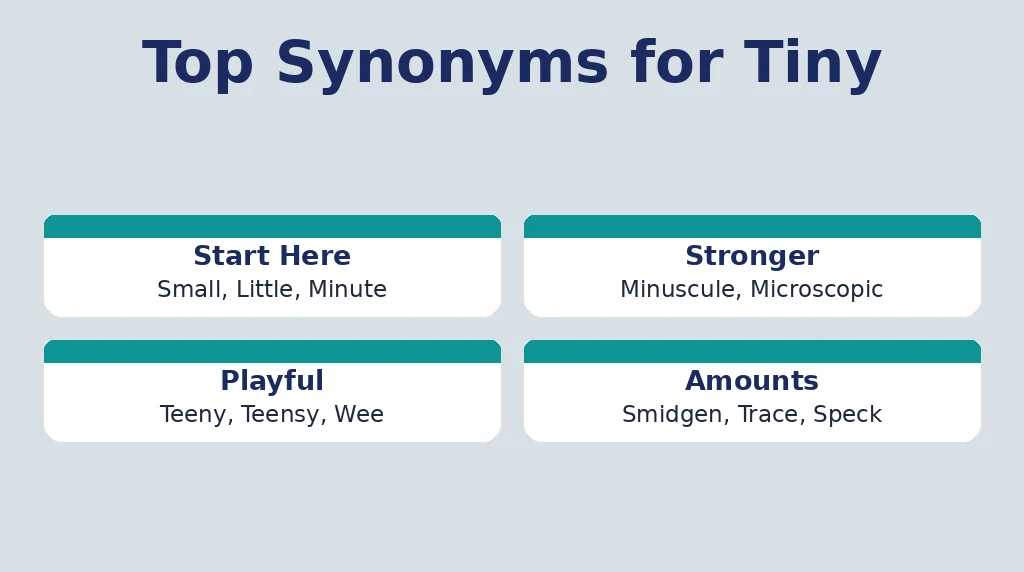
The table below covers the 24 synonyms readers reach for most often. Start here for one quick replacement. Later sections sort the full list into finer groups.
| Word | Meaning in one line | Best for |
|---|---|---|
| Small | Below average in size | Neutral, everyday use |
| Little | Small, often with warmth or feeling | Stories, descriptions |
| Miniature | A scaled-down copy of something bigger | Models, dollhouses, replicas |
| Diminutive | Unusually small in size | People, animals, formal tone |
| Minute | Extremely small, pronounced my-NOOT | Formal writing, amounts |
| Minuscule | Very small indeed | Strong everyday emphasis |
| Microscopic | Too small to see without a microscope | Science, strong emphasis |
| Infinitesimal | Immeasurably small | Maths, physics, rhetoric |
| Atomic | At the scale of atoms | Science, figurative use |
| Compact | Small because neatly packed | Products, rooms, design |
| Petite | Small and neat in build | People, clothing sizes |
| Dainty | Delicately small and pretty | Objects, features, food |
| Undersized | Smaller than the usual size | Fish, products, clothing |
| Puny | Small and weak | Critical descriptions |
| Teeny | Very small, informal | Speech, friendly writing |
| Teensy | Very small, informal variant | Speech, playful tone |
| Wee | Very small, Scottish flavor | Speech, stories |
| Itty-bitty | Extremely small, playful | Children, humour |
| Itsy-bitsy | Extremely small, playful | Songs, children, humour |
| Mini | A small version of a bigger thing | Products, fashion, tech |
| Dinky | Neat and small (UK), shabby (US) | Informal, region matters |
| Smidgen | A very small amount, noun | Cooking, quantities |
| Tad | A small amount, noun | Speech, adjustments |
| Trace | A barely detectable amount, noun | Evidence, flavors, smells |
What Does Tiny Mean?
Tiny means very small. Merriam-Webster’s thesaurus puts the core family neatly: small, little, miniature, minute, and tiny all mean “noticeably below average in size.” Within that family, though, tiny makes the strongest everyday claim. A small dog might weigh ten kilos. A tiny dog fits in a handbag, and readers picture the difference at once.
The same source calls tiny an informal equivalent to minute. That one line explains the word’s flavor. Tiny sounds warm, spoken, and slightly playful, while minute sounds measured and formal. A scientist reports a minute amount of caffeine. A grandparent admires a tiny pair of shoes. Both mean extremely small, yet swapping the words would bruise both sentences.
Picture a size ladder and tiny’s place becomes clear. Large sits at the top, then average, then small, then tiny near the bottom. Below tiny come the extreme words of the degree section: minute, minuscule, and microscopic. Writers who feel that ladder instinctively rarely overstate or understate a size. Writers who treat small and tiny as identical end up describing elephants and ants in the same flat tone.
Tiny also teams up with amount words in daily speech. People ask for a tiny bit more time, spot a tiny trace of doubt, and win by the tiniest of margins. Those amount uses get their own section later, because their synonyms are nouns rather than adjectives.
Common Partners: Tiny Bit, Tiny Share, Tiny Margin
Some partnerships appear so often that they work like single units. A tiny bit is the universal request for slightly more: more time, more cake, more patience. News writing favours a tiny share, for investors or voters who hold almost nothing, and a tiny margin, for elections and races decided by a breath. Sport adds the tiny opening and the tiny error, both small enough to miss at full speed.
Notice what each partner does. Bit measures quantity, share measures proportion, and margin measures the gap between two sides. Tiny shrinks all three, yet the reader still knows which scale is in play. That teamwork is why tiny outranks fancier synonyms in headlines: it shrinks the noun without stealing the reader’s attention from it.
Core Synonyms for Tiny for Everyday Writing
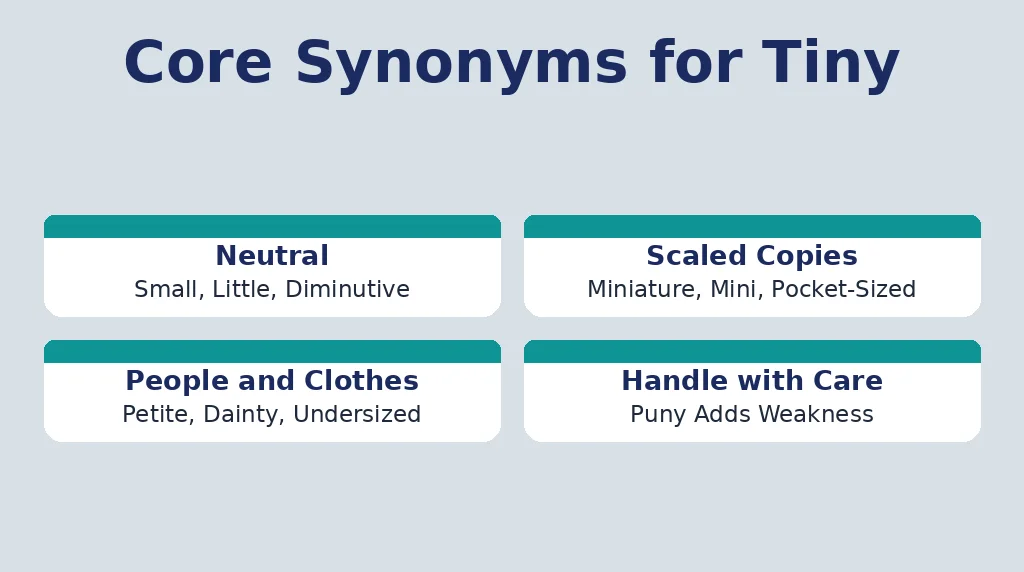
Everyday writing needs words that readers trust at once. The core group below covers rooms, animals, objects, and people without slang or science. Each subgroup solves a slightly different problem, so read the glosses before you swap.
The Neutral Everyday Words
These three carry most daily work. They fit news reports, product pages, school essays, and polite conversation alike.
- Small: below average in size, the safest default of all. Example: They rented a small flat near the station.
- Little: small, often with warmth, affection, or feeling attached. Example: A little cottage stood at the end of the lane.
- Diminutive: unusually small, slightly formal. Example: The diminutive singer filled the whole hall with sound.
- Compact: small because everything is packed neatly together. Example: The compact kitchen hides a surprising amount of storage.
Small Copies and Scaled Versions
Some small things are small by design, because someone copied a bigger thing at a reduced scale. English keeps special words for them, and using the general words instead loses that crafted detail.
- Miniature: an exactly proportioned copy on a very small scale. Example: The museum displays a miniature railway village.
- Mini: a small version of a standard product or garment. Example: She packed a mini umbrella in her handbag.
- Pocket-sized: small enough to fit inside a pocket. Example: He carried a pocket-sized notebook everywhere.
Merriam-Webster draws the key line here: miniature suits the dollhouse with its scaled-down furnishings, because every chair copies a real chair at the same reduced ratio. A naturally small chair is just tiny. Keep miniature for copies, models, and replicas, and your descriptions stay exact.
Words for People and Clothes
Describing people demands extra care, because size words can sound like judgments. The safe words below focus on build and fit rather than worth.
- Petite: small and neat in build, standard in clothing sizes. Example: The petite frame suited her perfectly.
- Dainty: delicately small and pretty. Example: She wore dainty silver earrings.
- Undersized: smaller than the usual or expected size. Example: The undersized fish was returned to the water.
Petite and dainty usually flatter, much like the words collected under synonyms of beautiful, so they suit friendly description. One caution belongs here too. Puny means small and weak together, so a puny puppy sounds frail rather than cute. Save puny for criticism, and never aim it at a person you hope to keep as a friend.
Tiny Rooms, Homes and Spaces
Homes give this word family its hardest daily work. Estate agents describe small flats, compact kitchens, and pocket-sized gardens, and each word argues a different case. Small simply reports the measurement. Compact promises clever design, where every shelf and cupboard earns its place. Pocket-sized adds charm, suggesting the garden is a jewel rather than a compromise.
Tiny itself appears in real listings more often than agents admit, usually softened by a partner: a tiny but bright kitchen, a tiny home office under the stairs. The famous tiny house movement turned the word into a badge of pride, where small living space signals freedom from clutter and cost. Context, as always, decides whether tiny reads as a warning or an invitation.
Synonyms for Tiny by Degree: The Extremely Small
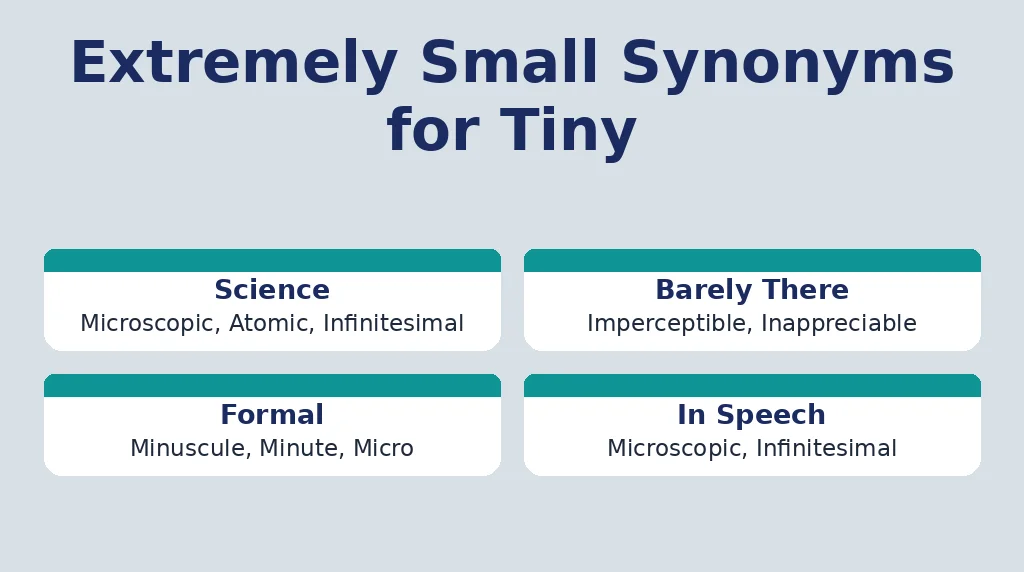
Sometimes tiny itself is too weak. A dust particle, a flaw in a diamond, and a rounding error all sit far below the sizes of daily life. The words in this section push to the bottom of the scale, and several of them come from science.
Science-Leaning Words
Laboratories and textbooks favour these words because they promise measurement, not just impression. Borrow them when your subject is genuinely minute.
- Microscopic: so small that only a microscope reveals it. Example: Microscopic cracks spread across the lens.
- Infinitesimal: too small to measure, a word born in mathematics. Example: The chances of success were infinitesimal.
- Atomic: at the scale of atoms, the smallest units of matter. Example: The sensor reacts to atomic changes in the surface.
- Micro: extremely small, common in technology compounds. Example: A micro drone buzzed over the garden.
Barely There Words
These words describe things at the edge of detection. They suit traces, amounts, and differences that almost escape notice.
- Minuscule: very small, stronger than tiny in most sentences. Example: Only a minuscule amount of dust remained.
- Imperceptible: too slight to be perceived by the senses. Example: The slope was imperceptible to passengers.
- Inappreciable: too small to be noticed or valued, formal. Example: The delay caused an inappreciable loss.
- Minute: extremely small, the formal partner of tiny. Example: A minute quantity of the dye colours a whole tank.
Handle the science words honestly. Microscopic began as a literal claim about microscopes, and readers still hear that echo. Calling a small apartment microscopic is a joke, not a measurement, and it works only when the joke is intended. Infinitesimal carries the same discipline from mathematics. In careful prose, reserve both for things that truly approach the unmeasurable.
Extreme Words in Everyday Speech
Outside the laboratory, these giants of smallness work as exaggeration. A microscopic portion of cake complains about the host. An infinitesimal chance of rain calms nobody, because the speaker clearly means the picnic is safe. Atomic survives mostly in set phrases and science reporting, while micro has escaped into products, from micro apartments to micro weddings.
Exaggeration is a legitimate tool, as long as the reader shares the joke. The same words turn dishonest in factual writing. A report that calls a measured difference infinitesimal tells scientists the difference cannot be measured, which may be the opposite of the truth. Match the extreme words to playful contexts, and keep minute and minuscule for honest emphasis.
Informal and Playful Synonyms for Tiny
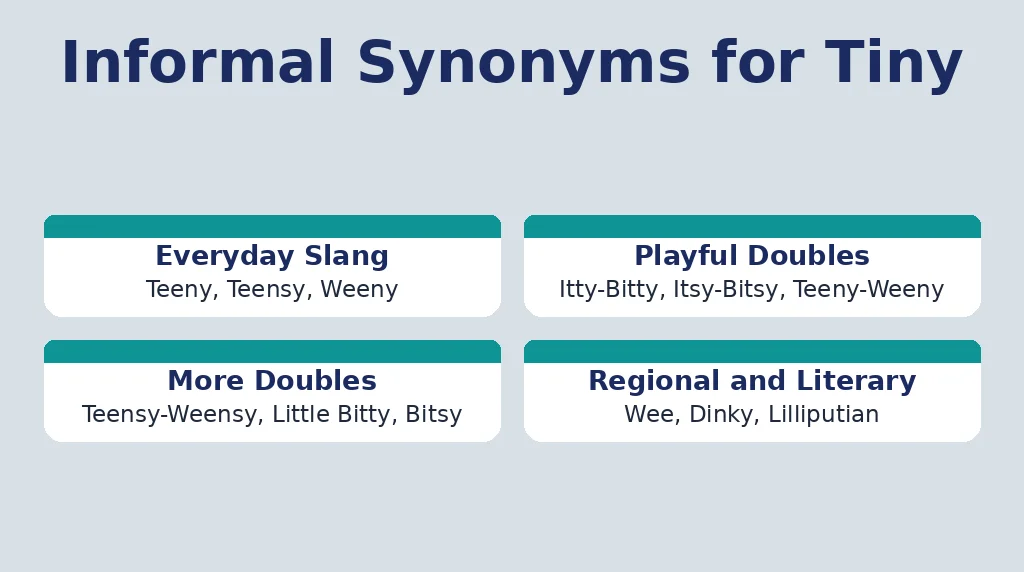
Informal English adores smallness. It shrinks words, doubles them, and adds rhymes until the word itself sounds tiny. These forms suit speech, stories, advertising, and writing for children. In a legal contract, however, they would look like a typing accident.
Everyday Informal Words
- Teeny: very small, friendly and informal. Example: A teeny spider crossed the page.
- Teensy: a variant of teeny with the same playful tone. Example: We lived in a teensy flat above the bakery.
- Weeny: very small, informal, often in the doubled forms below. Example: Just a weeny slice of cake, please.
- Wee: very small, with a Scottish flavor. Example: The wee dog barked at the postman.
The Playful Doubles
Doubling is the trick here. English repeats the smallness until the phrase itself performs it, which is why children learn these words early and remember them forever.
- Itty-bitty: extremely small and cute. Example: The kitten slept in an itty-bitty basket.
- Itsy-bitsy: extremely small, famous from the children’s song about a spider. Example: An itsy-bitsy crack appeared in the glaze.
- Teensy-weensy: very small, doubled for comic effect. Example: He took a teensy-weensy step forward.
- Teeny-weeny: very small, the twin of the entry above. Example: A teeny-weeny frog sat on the leaf.
- Little bitty: very small, a warm American phrase. Example: The recipe needs a little bitty pinch of salt.
- Bitsy and bitty: the short forms behind the doubles. Example: A bitsy label hung from the seam.
Regional and Literary Flavors
Two words in this family change meaning as they cross borders. Dinky in British English can praise something neat and attractively small, like a dinky little car. In American English it more often means insignificant or shabby, so the same compliment can land as an insult. Check your audience before you use it.
At the literary end sits Lilliputian, borrowed from the tiny people of Lilliput in Jonathan Swift’s Gulliver’s Travels. It describes things comically or pointedly small, and it suits essays and satire better than product pages. A Lilliputian kitchen sounds like a criticism of the architect, which may or may not be your intention.
Tiny Words in Songs and Children’s Books
Children meet this family before they can read. The itsy-bitsy spider climbs the waterspout in classrooms everywhere, and the doubled rhythm teaches the meaning before any dictionary could. Picture books lean on teeny and wee for the same reason: the words sound like the sizes they describe, so a teeny mouse feels smaller than a small one.
Writers for adults borrow the trick in dialogue. A character who asks for a teensy favour is performing helplessness, and readers hear the performance instantly. Narration can borrow it too, in small doses. One itty-bitty detail in a chapter charms; five on a page turn the narrator into a children’s presenter, which suits very few novels.
A Tiny Bit: Words for a Small Amount
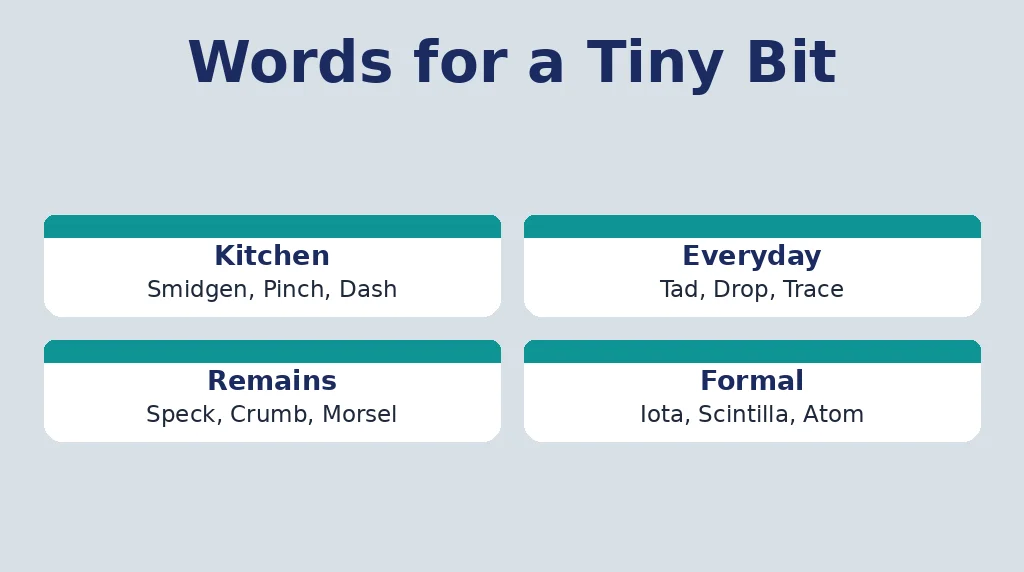
Not every tiny thing is an object. Often the smallness lives in an amount: a tiny bit of luck, a tiny trace of spice, a tiny drop of rain. Those phrases take nouns, and English keeps a rich little cupboard of them. When the smallness concerns importance rather than quantity, the guide to synonyms for minor covers that neighbouring family.
Kitchen and Recipe Words
Cooks own the friendliest amount words, because recipes need amounts too small for scales. Old measuring-spoon sets even gave these words fixed sizes, though published sources disagree on the exact fractions, so treat them as pinches of language rather than units.
- Smidgen: a very small amount of anything. Example: Add a smidgen of cayenne to the sauce.
- Pinch: the amount held between finger and thumb. Example: Season with a pinch of salt.
- Dash: a small quantity, usually of a liquid. Example: Finish with a dash of lemon juice.
- Tad: a small amount, or slightly, in speech. Example: Turn the heat up a tad.
- Drop: the smallest everyday amount of liquid. Example: Not a drop of milk was left.
Traces and Remains
These nouns describe what is left when nearly everything is gone. Detectives, bakers, and editors all live on them.
- Trace: a barely detectable amount. Example: The report found a trace of metal in the water.
- Speck: a tiny spot or particle. Example: A speck of dust landed on the lens.
- Crumb: the smallest piece of a baked thing. Example: Not a crumb of the cake survived.
- Morsel: a small piece of food. Example: He saved the last morsel for his sister.
- Atom: the smallest possible bit, usually figurative. Example: There was not an atom of truth in the rumour.
Formal Amount Words
Formal prose prefers its small amounts in Latin dress. Iota appears most often in negatives, as in “not an iota of evidence,” and it suits arguments and editorials. Scintilla means a tiny trace and survives in legal writing, where a scintilla of evidence is the smallest amount a court will even consider. Both words sound grand for such small things, which is exactly their charm.
A Tiny Bit of Time, Luck and Doubt
Abstract amounts borrow the same cupboard. People ask for a tiny bit more time, admit to a trace of doubt, and hope for a smidgen of luck before an exam. A tad works for adjustments of feeling as well as heat: a tad nervous, a tad late, a tad disappointed. Each phrase shrinks the emotion to a size the listener can forgive.
Negatives love these words most of all. Not an iota of doubt, not a trace of regret, and not a crumb of comfort all insist that the amount is zero while still measuring it. The pattern is a small rhetorical trick: naming the tiniest unit makes the absence feel total. Writers of apologies and denials have relied on it for centuries.
How to Choose the Right Synonym for Tiny
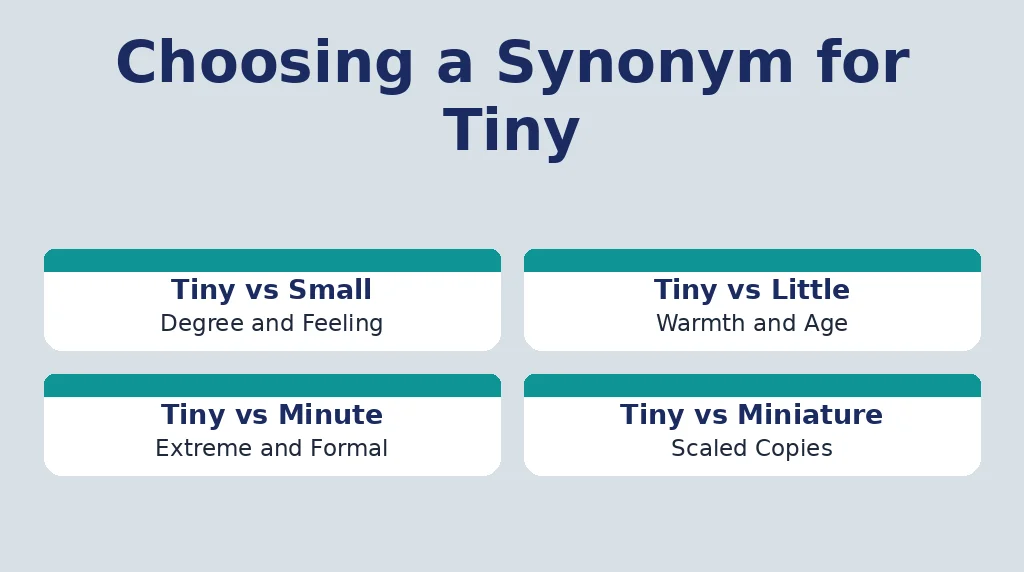
Four comparisons solve nearly every tiny dilemma. They separate the everyday default from the warm synonym, the formal one, and the copy word.
Tiny vs small. Small is the neutral measuring word. It compares size without drama, and it fits reports, specifications, and polite description. Tiny goes further down the scale and adds feeling. A small room is simply below average. A tiny room makes the reader feel the squeeze. Choose small when you are measuring, and tiny when you are picturing.
Tiny vs little. Little overlaps tiny heavily, yet it wanders into extra meanings. It can mean young, as in a little boy, and it can mean not much, as in little time. It can even carry scorn, which Merriam-Webster illustrates with “your pathetic little smile.” Tiny never does any of those jobs. When you mean pure physical smallness with a warm tone, tiny is the cleaner choice.
Tiny vs minute. Minute implies extreme smallness, and it is the formal member of the pair. Scientific and official writing prefers minute amounts, minute differences, and minute details. Tiny is its informal equivalent, better for stories, speech, and friendly articles. Watch the pronunciation too: the adjective is my-NOOT, while the time unit is a MIN-it.
Tiny vs miniature. Miniature names a scaled copy, not a natural size. A miniature horse was bred down over generations, and a miniature painting was made small by design. A tiny horse in a field is just a small horse that surprises you. If nothing was copied or crafted, tiny is usually the honest word.
Two More Comparisons Worth Knowing
Tiny vs compact. Compact praises efficiency. A compact car wastes no space, and a compact kitchen hides storage in every corner. Neither sentence complains about size. Tiny, by contrast, simply marvels at smallness, and it can sound like a complaint. Sellers therefore choose compact, while storytellers choose tiny, and each audience hears the intended message.
Tiny vs petite. Petite belongs to people and the clothes made for them. It describes a small, neat build, and clothing labels use it as a size category. Tiny can describe a person too, but it sounds like a remark rather than a category, and it can patronise. In fashion and friendly description, petite is the professional choice; in a story, a tiny grandmother may be exactly the picture required.
Paired Examples
The picker test works on any sentence. Read each pair aloud and feel how the picture changes while the facts stay fixed.
- The shop sells small watches. They are ordinary watches in modest sizes.
- The shop sells tiny watches. Now the watches feel delicate and surprising.
- She found a little shell. The shell sounds charming, almost loved.
- She found a minute shell. The shell sounds measured, as if recorded in a notebook.
- They built a miniature village. Every building copies a real one at scale.
- They built a tiny village. The village is small, with no promise about copies.
The Quick Picker
| Situation | Strong first choice |
|---|---|
| A neutral product size | Small |
| A cute animal in a story | Tiny or itty-bitty |
| A scaled-down model | Miniature |
| A laboratory amount | Minute or minuscule |
| An invisible flaw | Microscopic |
| A child in dialogue | Teeny or wee |
| A recipe amount | Smidgen or pinch |
| A formal trace | Iota or scintilla |
Synonyms for Tiny in Stories, Essays and Professional Writing
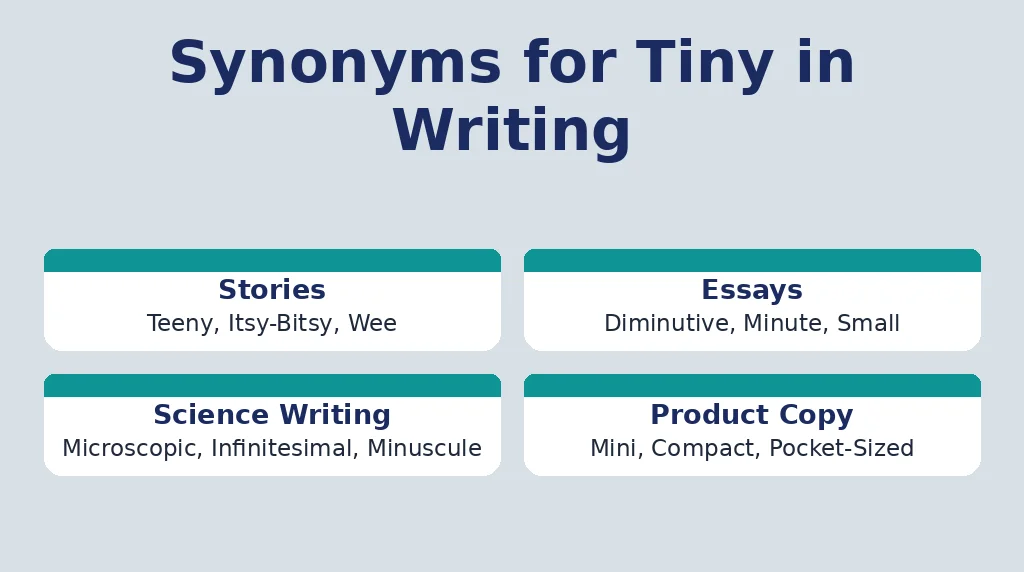
Different documents reward different levels of smallness. Stories live on the playful end of the scale. A narrator can call a cottage teensy, a mouse itty-bitty, and a garden wee, and the words themselves perform the charm. Children’s writing goes further still, because doubled words like itsy-bitsy teach rhythm while they describe size.
Essays need restraint. Academic writing prefers small, little, diminutive, and minute, because those words describe without performing. A biology essay can discuss a diminutive species or a minute quantity and sound exact. The same essay would wobble if it called the species itsy-bitsy, however accurate the size claim felt.
Science and technical writing form the strictest case. There, microscopic, infinitesimal, and atomic carry defined meanings, and editors check them. A microscopic organism can be seen only with a microscope; that is a testable claim, not a style choice. Writers who borrow science words for colour should expect science readers to audit them.
Professional and commercial writing sits between the poles. Product copy loves mini, compact, and pocket-sized, because those words promise convenience rather than weakness. Nobody markets a puny laptop or a dinky hotel room in the American sense. The lesson repeats across every genre: match the word’s tone to the reader’s expectations, and smallness becomes a feature instead of a flaw.
Tiny in Headlines and Social Posts
Headlines reward tiny for a different reason: it is short. Four letters shrink a headline while still promising a story, so editors reach for it constantly. A tiny discovery, a tiny town, and a tiny habit all fit where an extremely small discovery never could. Social captions borrow the playful doubles for the same space-saving charm, and a teeny announcement gathers warmth that a small announcement would miss.
The risk is sameness. When every headline promises something tiny, the word stops shrinking anything at all. Rotate in wee, mini, and minute where the register allows, and save tiny for the stories that genuinely astonish. Scarcity keeps the small word powerful.
Antonyms for Tiny
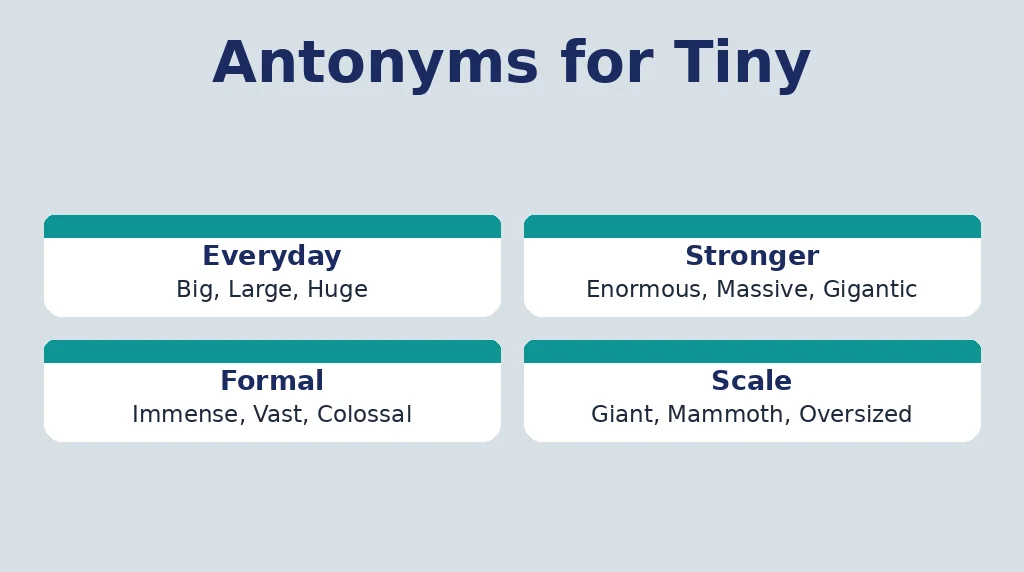
The opposite end of the scale is crowded. Big and large are the everyday antonyms, and huge adds everyday emphasis. Beyond them, enormous, massive, and gigantic describe size that impresses or overwhelms. Immense and vast suit spaces and quantities, while colossal and mammoth bring a statue-like grandeur. Giant works as both noun and adjective, and oversized simply means bigger than the standard.
Match the antonym to the sense you used. A tiny room pairs naturally with a spacious one, although huge is the direct swap. A tiny amount pairs with a vast amount or a considerable one, depending on whether you measure space or number. If your sentence needs the big end of the scale in full, the guide to synonyms for big gathers those heavyweight words by sense and tone.
Antonyms also expose weak writing. If replacing tiny with huge leaves the sentence unchanged in feeling, the size word was decoration rather than information. Strong size words earn their place by changing what the reader pictures, in both directions along the scale.
Try the swap test on real sentences. The tiny puppy slept through the storm becomes the huge puppy slept through the storm, and the whole scene changes breed. A tiny margin of victory becomes an enormous margin, and the election story flips. When the swap changes the picture this completely, the original word was carrying real weight.
Common Mistakes: Words and Spellings That Trip Writers Up
Accuracy matters in a synonym guide, so this section clears up the errors that cluster around tiny and its family.
Miniscule is the wrong spelling. The standard spelling is minuscule, from the Latin *minusculus*, meaning somewhat smaller. Merriam-Webster labels miniscule a disputed spelling variant, and usage guides generally treat it as an error. The confusion is understandable, because mini suggests smallness too, but careful writers choose minuscule every time.
Minute has two pronunciations. The adjective meaning extremely small is pronounced my-NOOT. The noun for sixty seconds is pronounced MIN-it. Reading “a minute detail” aloud with the clock pronunciation turns a tiny detail into a sixty-second one, and listeners will stumble.
Two Words to Handle with Care
Midget is not a safe synonym. The word is offensive when applied to people and dated almost everywhere else. Lists still circulate it, but modern style guides advise against it. Diminutive, petite, and tiny cover the honest uses without the baggage.
Puny is not a cute word. Puny promises weakness along with smallness. A tiny engine might be powerful, and a tiny guard dog might be fearless. A puny one, by definition, is not. Writers who reach for puny as a playful variant accidentally insult their subject.
Miniature is not a general intensifier. As the choosing section explained, miniature belongs to scaled copies and crafted replicas. A miniature poodle is a recognized breed size, but a miniature raindrop is just a raindrop described wrong. Tiny and minuscule do that job cleanly.
A tiny house is a category, not just a compliment. In housing writing, a tiny house names a specific kind of very small dwelling, often built for simple, low-cost living. Calling any small flat a tiny house borrows the movement’s meaning by accident. If the home is simply small, say so, and let tiny house keep its technical sense.
Frequently Asked Questions
What is the best synonym for tiny?
Small is the safest neutral choice, and little is the warmest. For stronger smallness, minuscule is the best everyday upgrade, while microscopic suits science. In playful writing, itty-bitty and teeny do the job with charm.
What is the difference between tiny and small?
Both mean below average in size, but tiny goes further down the scale. Small is the neutral measuring word, while tiny adds feeling and emphasis. A small box holds shoes; a tiny box holds a ring.
What is a formal synonym for tiny?
Minute is the classic formal choice, and diminutive follows close behind. Scientific writing adds microscopic and infinitesimal for extreme cases. Inconsequential territory belongs to a different word family, since formality here concerns size only.
Is it spelled minuscule or miniscule?
The standard spelling is minuscule, with a u after the n. It comes from the Latin word for somewhat smaller. Miniscule is a common variant that Merriam-Webster calls disputed and most usage guides treat as an error.
What is the opposite of tiny?
Huge is the everyday opposite, with big and large close behind. Stronger options include enormous, massive, gigantic, immense, and colossal. Spaces often pair tiny with vast or spacious instead, depending on the sentence.
What is a word for a tiny amount?
Smidgen is the friendliest choice, with tad, pinch, and dash close behind in the kitchen. Formal writing prefers iota and scintilla, especially in phrases like not an iota of proof. Trace suits flavors, smells, and evidence.
Is tiny an informal word?
Slightly. Merriam-Webster calls tiny an informal equivalent to minute, which makes it perfect for stories, speech, and friendly articles. Formal reports usually prefer small, minute, or diminutive, although tiny still appears in edited prose everywhere.
What is the difference between tiny and little?
Little does extra jobs that tiny never attempts. It can mean young, as in a little girl, or not much, as in little time left. Tiny only ever measures smallness, which makes it the clearer choice for pure size.
Final Thoughts
Tiny proves that a short word can hold a whole scale inside it. Sort its synonyms by degree and tone, and the right choice usually announces itself. A crack can be microscopic, a puppy itty-bitty, and a flavor a mere trace, and each sentence lands exactly as intended.
For an even deeper list with related words and near-synonyms, the Merriam-Webster Thesaurus entry for tiny is a reliable next step. Keep this guide bookmarked too, and your smallest descriptions will never sound flat again.