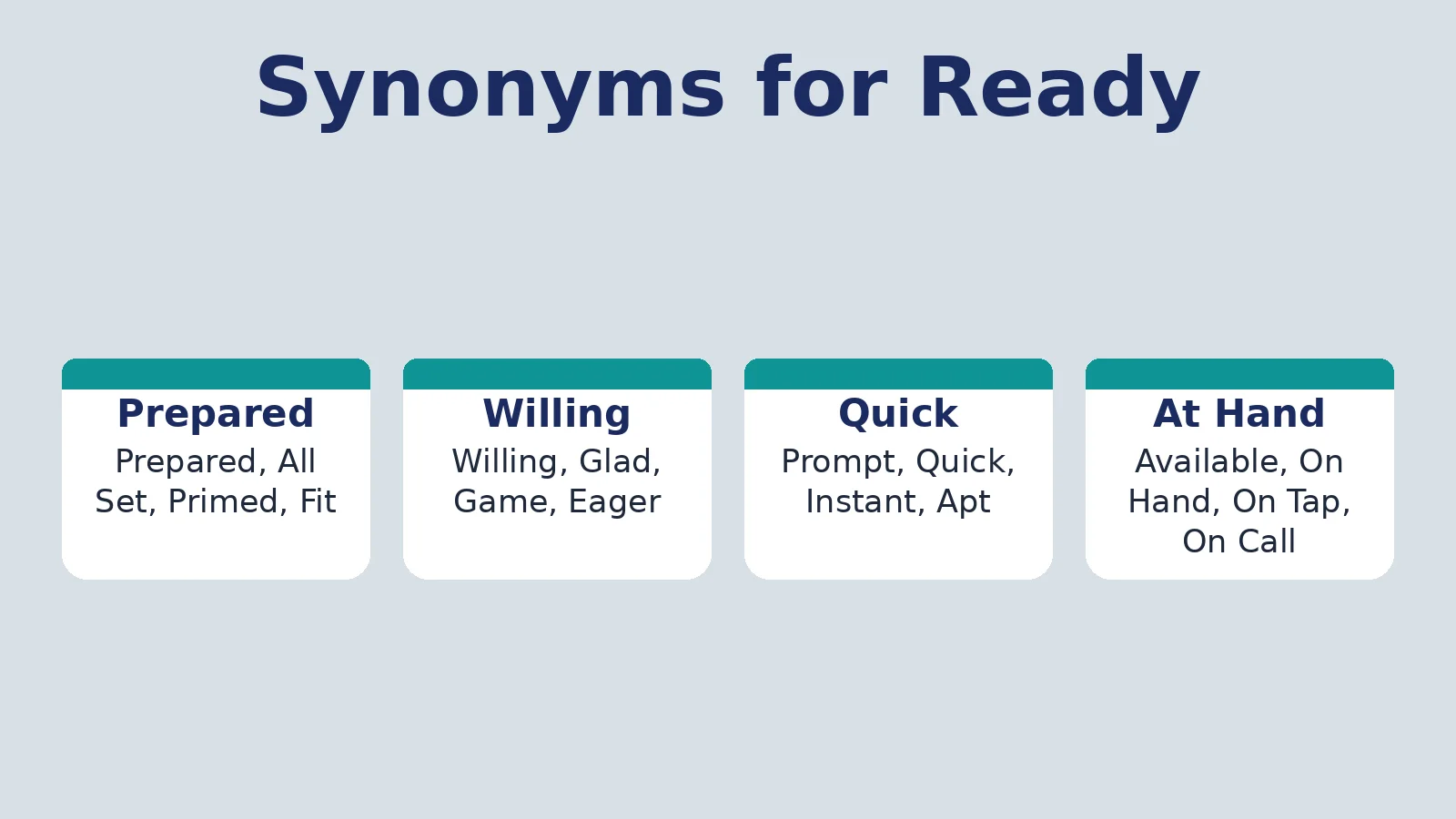
Ready is a small word that does five different jobs. It can mean prepared for action, willing to help, or just about to burst into tears. It can also describe cash sitting in your pocket or an answer that arrives without a pause. The most useful synonyms for ready are prepared, set, all set, primed, willing, glad, game, prompt, quick, available, and ripe. Each one fits a different job, though, so swapping them blindly can change your meaning.
This guide sorts more than 80 synonyms for ready into clear groups. Every word comes with a short meaning, a register label where it matters, and example sentences for the words people use most. As a result, you can pick the exact term your sentence needs instead of repeating ready five times in one paragraph.
Top Synonyms for Ready: Quick Reference
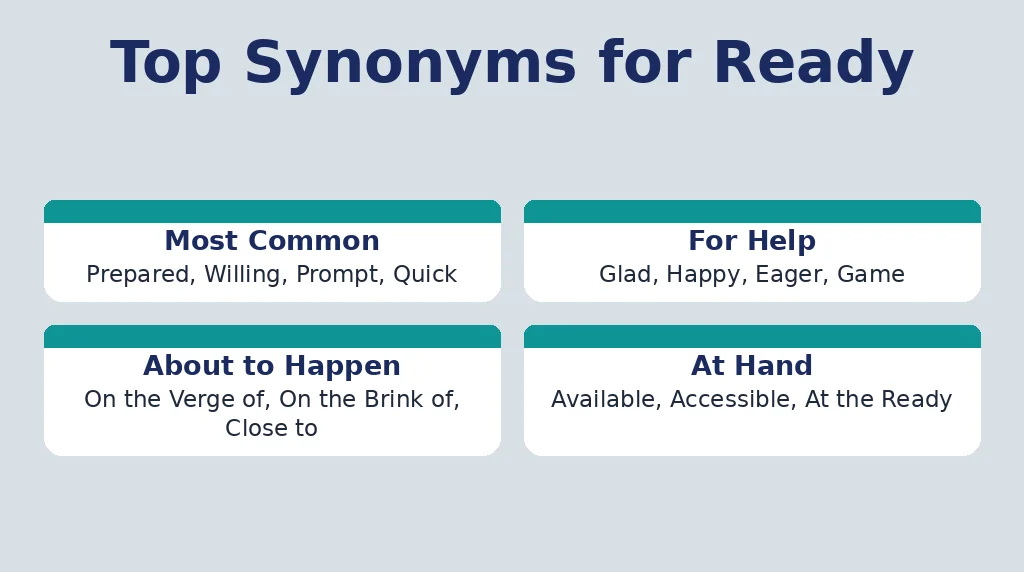
The table below covers the 28 synonyms readers reach for most often. Use it when you need one fast replacement. The sections after it sort the full list into finer groups, so you can fine-tune your choice.
| Word | Meaning in one line | Best for / tone |
|---|---|---|
| Prepared | Fully ready for action or use | The safest everyday choice |
| Set | In position and ready to start | Instructions, races, plans |
| All set | Completely prepared, nothing missing | Informal, conversational |
| Primed | Prepared in advance for a task | Briefings, interviews, pumps |
| Willing | Happy to do something if asked | Polite offers and requests |
| Glad | Pleased to do something | Warm, friendly tone |
| Game | Willing to try something, informal | Casual speech, challenges |
| Eager | Very willing and enthusiastic | Energy and interest |
| Prompt | Quick to respond, without delay | Formal, professional replies |
| Quick | Fast to answer or react | Neutral, everyday |
| Instant | Happening with no delay at all | Answers, results, reactions |
| Apt | Quick to learn, or likely to | Brains, habits, tendencies |
| Ripe | Fully mature and ready to use | Fruit, plans, timing |
| Mature | Fully developed over time | Cheese, ideas, markets |
| Available | Free to be used or taken now | Time, money, stock, people |
| Accessible | Easy to reach or use | Places, files, services |
| On hand | Present and within reach | Supplies, staff, cash |
| On tap | Available whenever needed | Informal, resources |
| On call | Available if needed, on duty | Doctors, engineers, support |
| At the ready | Prepared to act immediately | Tools, weapons, cameras |
| On the verge of | Just about to happen | Change, tears, collapse |
| On the brink of | Just about to happen, dramatic | Crises, wars, breakthroughs |
| Close to | Nearly at the point of | Feelings, everyday speech |
| Likely to | Expected to happen | Neutral predictions |
| Completed | Finished and ready for use | Work, forms, projects |
| Done | Finished, nothing left to do | Informal, tasks and food |
| Easy | Needing little effort | A ready solution or answer |
| Handy | Useful and within reach | Tools, tips, skills |
Notice how the table already splits into families. Some words describe a person who has prepared. Others describe a thing that is finished, a moment that is about to arrive, or a mind that answers fast. Keeping those families apart is the whole secret of choosing well.
What Does Ready Mean?
Ready describes someone or something that is in the right state for what comes next. A runner can be ready at the start line. A report can be ready on your desk. Dinner can be ready on the table. In each case, nothing more needs to happen before the main event begins.
The word also covers willingness. When you say you are ready to listen, you are not describing preparation. You are saying you are willing and glad to do it. On top of that, ready can mean quick, as in a ready wit, or available, as in ready cash. Dictionaries list these as separate senses of the same word, which is why one simple swap rarely fits every sentence. The groups below follow those dictionary senses one by one.
It helps to see the five jobs side by side. First, ready means prepared: “The team is ready for the final.” Second, it means willing: “She is ready to apologize.” Third, it means about to: “He looked ready to fall asleep.” Fourth, it means quick: “She always has a ready answer.” Fifth, it means at hand: “Keep some ready cash at home.” Whenever a synonym feels wrong in your sentence, one of the other four jobs is usually the reason. The rest of this guide keeps the five jobs in separate groups, so the mix-ups stop happening.
Synonyms for Ready: Prepared and Set to Go
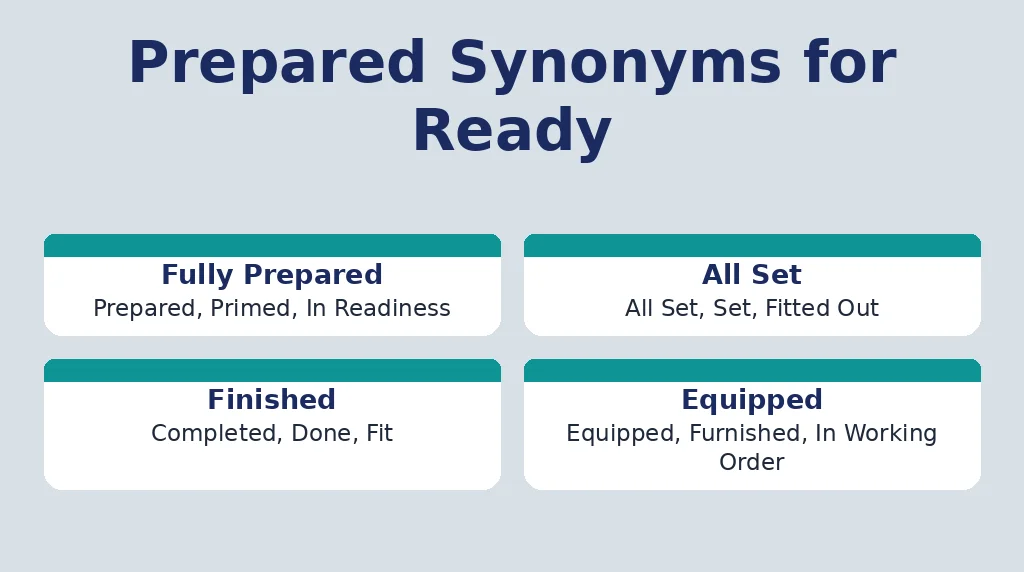
This is the core sense of ready, and prepared is its closest synonym. Prepared means you have done the work in advance, so nothing stands between you and the action. After months of training, she felt prepared for the marathon. The word suits exams, meetings, trips, speeches, and emergencies equally well.
Notice what prepared quietly promises. It tells the reader that effort happened earlier, out of sight. A prepared speech was written and rehearsed. A prepared team studied the opponent. Because of that promise, prepared is the strongest choice when you want credit for the groundwork. Plain ready makes no such claim. It only reports the state at this moment, which is why coaches shout “Get ready!” instead of “Get prepared!” when seconds matter.
All Set and Ready to Start
Set and all set describe the moment when preparation is complete. Set is short and neutral, so it fits instructions and sport: “On your marks, get set, go.” All set adds a friendly, conversational tone. It means nothing is missing and nobody is waiting. “We are all set for the trip” tells your friends the bags are packed and the car is loaded.
In readiness is the formal member of this family. Official reports use it for ceremonies and inspections: “Everything was in readiness for the visit.” Primed sits between neutral and formal. It suggests someone prepared the person or thing on purpose. A witness is primed before an interview, and a pump is primed before it works. Fitted out and furnished describe things supplied with everything they need. A kitchen can be fitted out with new steel, and a flat can be furnished and in working order before tenants arrive.
Finished and Ready to Use
Sometimes ready simply means the work is over. Completed is the formal word for tasks, forms, and projects: “The completed form is ready to submit.” Done is its informal twin, perfect for food and chores: “Dinner is done, come and eat.”
Fit belongs here too, in the sense of being in the right condition. Soldiers are passed fit for duty, and a part is machined until it is fit for use. Equipped rounds out the group. It stresses the gear rather than the person, as in “a lab equipped for chemistry.”
One pattern ties this family together. Every word answers the question “Is anything missing?” Prepared says the work is done. All set says the checklist is complete. Equipped says the tools are present. Done and completed say the task itself is finished. If your sentence would sound natural with “nothing is missing” added, you are safely inside this first family.
Synonyms for Ready to Help: Willing and Glad
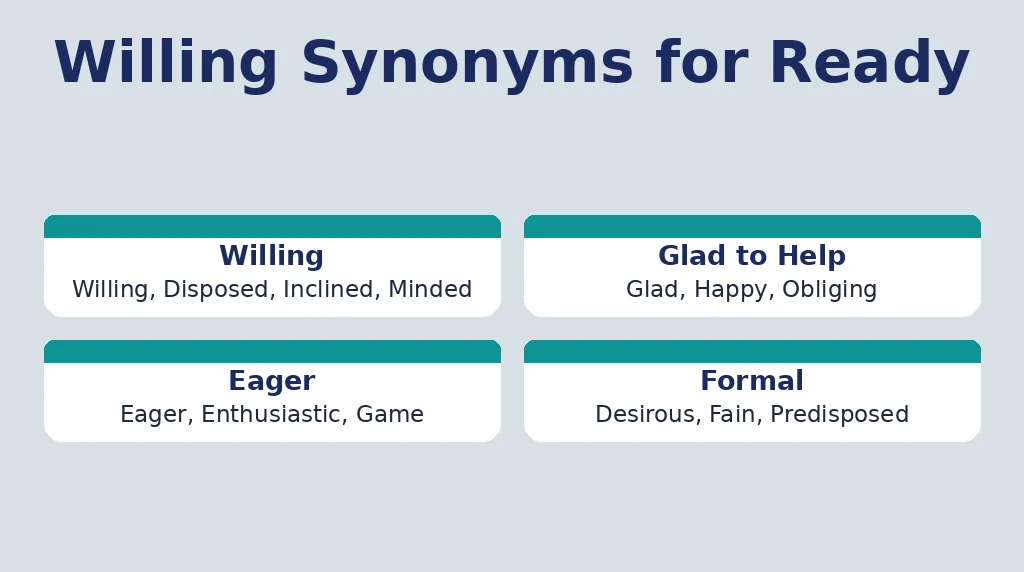
When ready is followed by an action, it usually means willing. “I am ready to help” does not describe your tools or your training. It announces that you are happy to start. This family is large, because English has many ways to sound agreeable.
The fixed phrase ready and willing shows how close the two words sit. Speakers use it when they want to promise both preparation and consent at once: “We are ready and willing to sign today.” If only one idea matters in your sentence, choose the matching word. Willing alone drops the preparation claim, and prepared alone drops the warmth.
The Everyday Willing Words
Willing is the direct swap. It sounds polite and slightly formal: “We are willing to negotiate.” Glad is warmer. “I would be glad to show you around” promises help with pleasure. Happy works in set patterns such as “happy to help” and “happy to answer questions.” It does not mean cheerful here, so keep it inside those patterns.
Disposed, inclined, and minded are softer and more formal. They describe a leaning rather than a promise: “I am inclined to agree.” Game is the informal star of the group. “I am game for a hike” means you are up for the idea, challenges included. Eager adds real enthusiasm. An eager volunteer is not just willing but keen to begin.
Formal, Literary and Agreeable Words
Business writing adds amenable, obliging, cooperative, and receptive. An amenable partner is willing to be persuaded. An obliging neighbor happily does favours. A cooperative team works willingly with others, and a receptive audience listens with an open mind. Compliant and agreeable appear in reports, though both can sound grudging. Desirous and fain sit at the literary end. Fain is archaic, so save it for historical fiction. Enthusiastic and predisposed describe attitudes in formal prose: “The board is predisposed to approve the plan.”
Two Words to Handle with Care
Apt and prone hide inside this family, but they lean toward habits and problems. People are apt to forget names and prone to errors. Both words appear in thesaurus lists for ready, yet neither sounds right for an offer of help. “I am apt to help” suggests helping is a weakness you suffer from. Use them for tendencies, not for willingness.
Synonyms for Ready to Happen: On the Point Of
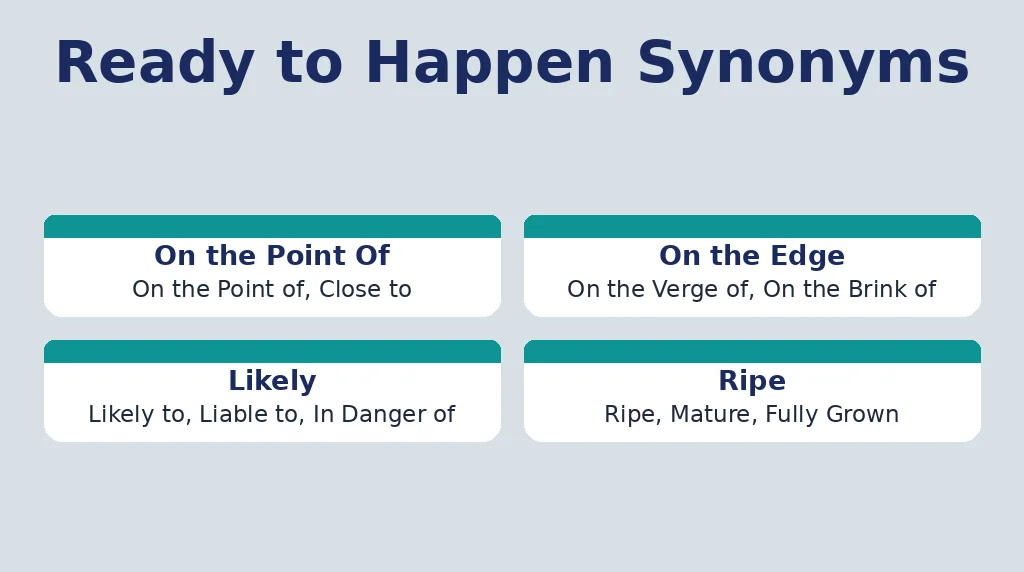
Ready can stand at the edge of an event. “She looked ready to cry” means the tears were seconds away. This group replaces that pattern with precise phrases.
Writers reach for this family when a scene needs tension. The event has not happened yet, and that delay is the whole point. A character ready to confess, a market ready to turn, a kettle ready to boil: each one holds the reader at the edge for a beat. The phrases below grade that edge from gentle to dramatic, so you can set the tension level yourself.
On the Point of, On the Verge of, On the Brink of
On the point of is the most literal choice: “He was on the point of leaving when the phone rang.” On the verge of suits change and discovery: “The team is on the verge of a breakthrough.” On the brink of is heavier and more dramatic. Wars, collapses, and disasters live on the brink. Close to is the soft everyday option, especially for feelings: “She was close to tears.” When the wait finally ends, this is usually the family you need.
Likely to and liable to look forward with cooler eyes. Likely to is a neutral prediction: “Prices are likely to rise.” Liable to often warns about unwanted results: “This road is liable to flood.” In danger of is the most explicit warning of the three. Use it when the risk itself is the point of the sentence.
Ripe and Mature: Ready Because the Time Has Come
Fruit taught English this sense of ready. A ripe mango is ready to eat because time has finished the job. Ripe also works for moments and plans: “The time is ripe for change.” Mature describes slower development. Cheese, wine, ideas, and markets all mature before they are ready. Ripened and fully grown describe the process completed, as in “fully grown trees” or “beans ripened on the vine.”
Two smaller words complete the set. Mellow suits wine, cheese, and light that has softened with age. Seasoned belongs to food and timber that has been prepared by time or treatment. Keep this whole family for things that develop. A prepared person is never “ripe” in modern English.
Quick Synonyms for Ready: Answers, Wits and Minds
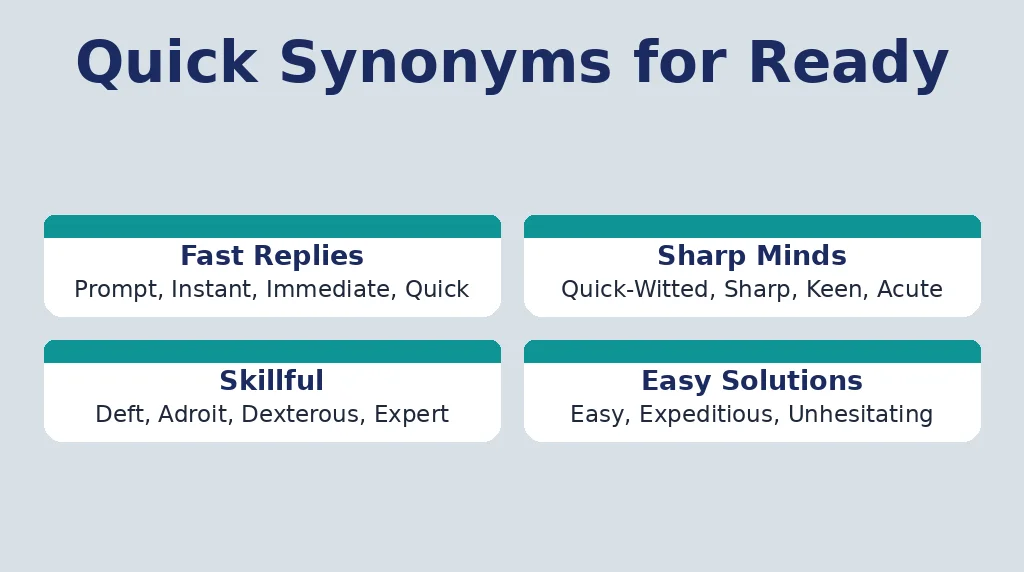
A ready answer is one that arrives at once, fully formed. A ready wit charms a room because the jokes land without a pause. Merriam-Webster links ready, apt, prompt, and quick in this sense, and notes that ready suggests fluency in response. The words below split into speed, sharpness, and ease.
Fast Answers and Instant Responses
Prompt is the professional favorite. It suggests training and discipline behind the speed: “Thank you for your prompt reply.” Quick is the neutral everyday word, and it stresses natural speed: “She gave a quick answer.” Instant and instantaneous remove the gap entirely. Instant suits reactions and results, while instantaneous sounds technical and precise.
Immediate means the response follows with nothing in between. “We need an immediate decision” allows no delay at all. Swift and rapid raise the pace further, and both suit formal writing. Expeditious is the most formal member, common in official letters: “an expeditious resolution.” Speedy, brisk, and fast are plainer choices. Alert describes the person behind the answer: an alert mind notices the question early and responds at once. Responsive praises someone who answers reliably, and unhesitating removes every trace of doubt from the reply.
Sharp Minds and Skillful Tongues
Some ready words praise the quality of the answer, not just its speed. A smart reply is clever and well judged. Sharp suggests a mind that cuts straight to the point. Keen and acute describe perception that misses nothing: “an acute sense of timing.” Quick-witted and ready-witted name the talent directly, so they fit compliments about humour.
Astute and perceptive belong to formal praise. An astute negotiator reads motives quickly, while a perceptive critic spots flaws at a glance. Deft, adroit, and dexterous describe skillful handling, of words or of tools. Expert and skillful describe proven ability rather than speed, and bright in this family means quick-thinking, not shining. Handy praises useful skill: “She is handy with figures.”
Easy Answers and Ready Solutions
Easy is the last member of the quick family. Merriam-Webster gives ready a sense meaning “involving minimal difficulty,” as in “a ready solution to our problem.” An easy answer costs no effort at all. Facile looks similar, but it carries a warning. A facile excuse sounds smooth, shallow, and a little dishonest. Reach for facile only when you mean that criticism.
Ready to Hand: Synonyms for Things Available Now
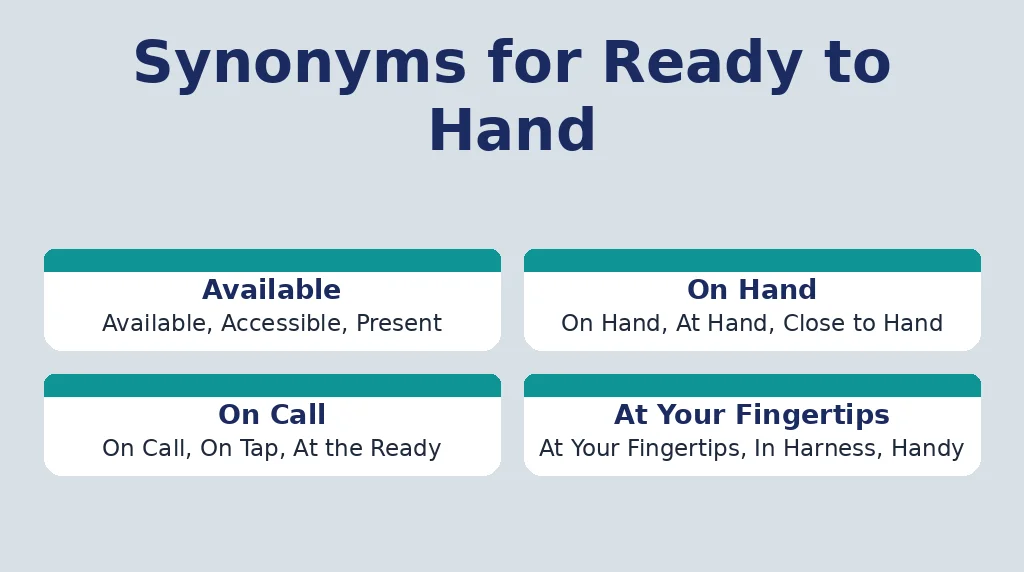
Ready also means within reach. Ready cash can be spent today. A tool kept ready to hand saves a trip to the shed. This family describes money, supplies, staff, and services that are available the moment you need them.
Available, Accessible and On Hand
Available is the umbrella word. Rooms, tickets, doctors, and data can all be available. Accessible adds the idea of easy reach or easy use: “The files are accessible online.” Present simply confirms that the thing or person is here: “All members were present.” On hand and at hand describe stock and help within reach, as in “We keep spare batteries on hand.” Close to hand is the same idea in a slightly warmer, British-flavored form.
On call describes people who are available if needed: “A doctor is on call tonight.” On tap is informal and suggests a supply that flows when wanted: “He has experts on tap.” At the ready is vivid and military in flavor. It pictures tools or soldiers waiting for the signal: “Cameras at the ready.” In harness is an older phrase meaning at work and on duty. Convenient, handy, and serviceable judge the thing itself: convenient saves effort, handy is useful in practice, and serviceable works well enough for the job.
Ready Cash, Ready-Made and at Your Fingertips
Ready cash and ready money both mean money available to spend at once, not tied up in property or promises. At your fingertips describes information that sits within instant reach: “Every report is at your fingertips.” Ready-made is the family’s compound member. It describes things bought or made in advance, in a standard form: ready-made meals, ready-made curtains, a ready-made excuse. Note the trap here. A ready-made suit is prepared, but the person wearing it is not “ready-made.” The word belongs to products, not people.
Synonyms for Ready in Everyday Phrases
Some of the most common ready expressions cannot be swapped word for word. They work as fixed phrases, and each one has a favorite replacement pattern.
Ready When You Are, Ready and Waiting
“Ready when you are” is the polite phrase that hands the timing to someone else. Cambridge gives it as a set expression: one person is prepared and simply waits for the signal. “Ready and waiting” adds patience and a touch of eagerness: “Your table is ready and waiting.” Both phrases belong to service language, travel, and friendly arrangements.
Sports and games own “ready, set, go” and its British cousin “ready, steady, go.” Set and steady both mean ready in these calls, frozen there by tradition. “Ready to roll” is the informal modern version. A crew that is ready to roll has finished preparing and wants to move now.
Rough and Ready, At the Ready
Rough and ready describes something made quickly and simply, without polish, that still does the job: “We built a rough and ready shelter before dark.” The phrase praises usefulness over beauty. It is a compliment in a crisis and a criticism in a design review, so context decides the tone.
At the ready pictures a person holding a tool or weapon, prepared to use it the instant it is needed: “He waited by the door, phone at the ready.” Ready for anything is the broadest phrase of the set. It promises preparation for every surprise, which makes it a favorite of advertisements and a slight exaggeration everywhere else.
Ready as a Verb: Words for Making Ready
Ready is also a verb, though everyday speech prefers get ready or prepare. News and sport use the verb often: “Crews readied the stadium for the final.” Prepare is the standard swap for people and plans. Arrange fits things put in order in advance: “She arranged the chairs before the guests arrived.”
Organize suits events and teams, while equip focuses on supplying what is needed. Get ready is the phrasal everyday choice, and get set belongs to starting lines and final checks. Fit out appears when buildings and vehicles are supplied: “The van was fitted out as a workshop.” Fortify survives in a literary reflexive use, where people ready themselves mentally: “He fortified himself for the interview.” Because the verb sounds formal, most writers choose it only for deliberate, large-scale preparation.
One more verb deserves a warning. Make ready is an old-fashioned phrase that survives in ceremonies and legal writing: “Make ready the hall.” Outside those settings it sounds theatrical. Modern writers almost always do better with prepare or get ready, which say the same thing without the costume.
Formal and Informal Synonyms for Ready
Register decides whether a swap sounds polished or odd. Formal writing prefers prepared, prompt, expeditious, and in readiness. Reports also favour disposed, inclined, and receptive when they describe willingness. A formal reply thanks a client for a prompt response, never for a speedy one.
Neutral words work almost everywhere. Prepared, willing, quick, available, and ripe move between speech and writing without friction. They are the safe defaults when you do not know your reader well.
Informal English is warmer and shorter. All set is the classic spoken closer: “That is everything, we are all set.” Game signals cheerful willingness: “Game for a swim?” On tap, at the ready in casual use, and done for finished food all belong to conversation. Fain and desirous sit at the opposite extreme. They are literary and old-fashioned, so they belong in historical novels, not office email. Matching the word to the room matters as much as matching it to the sense.
A quick test helps when you are unsure. Read the sentence aloud as if you were speaking to a friend. If the word sounds like a costume, downgrade it: expeditious becomes prompt, and prompt becomes quick. If it sounds too loose for a report, upgrade it the same way. Two steps in either direction usually land on the right register.
Ready in Sentences: One Word, Five Jobs
Seeing the families at work makes the choice faster. Each pair below keeps one sentence frame and changes only the synonym, so you can watch the meaning shift.
For preparation, compare “The hall is ready for the concert” with “The hall is prepared for the concert.” Both work, yet prepared quietly credits the crew who cleaned and arranged it. Now add informality: “The hall is all set for the concert” sounds like a friend reporting good news, not a manager filing a report.
For willingness, compare “She is ready to listen” with “She is glad to listen.” Glad adds pleasure, so the listener sounds kind rather than merely available. “She is game to listen” would sound odd, because game promises appetite for a challenge, not for patience. The family is right, but the member is wrong, and that is the most common ready mistake of all.
For the edge of an event, compare “The soup is ready to boil” with “The soup is on the verge of boiling.” The second version slows time down and focuses on the surface of the soup. Drama lives in the longer phrase. For speed, compare “He had a ready answer” with “He had a prompt answer.” Ready praises the man’s fluency, while prompt praises his discipline. Finally, for things at hand, compare “Keep ready cash” with “Keep cash on hand.” The swap is perfect, because both versions promise money you can reach without asking anyone.
How to Choose the Right Synonym for Ready
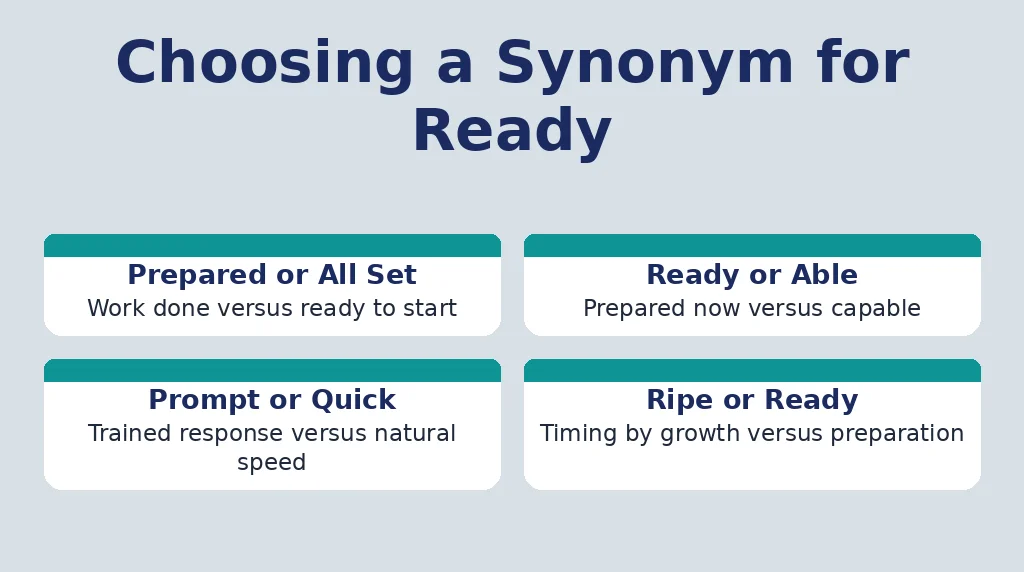
Start by naming the job ready is doing. Is the subject a person, a finished thing, a moment, or an answer? That single question places you in the right family. The finer choices below then polish the tone.
Prepared or all set? Prepared looks backward at the work done: “She was prepared for the interview.” All set looks forward from the finish line: “We are all set to leave.” Use prepared in reports and all set in speech. Set alone sits between them, at home in instructions and plans.
Ready or able? These two are cousins, not twins. Ready means prepared and willing right now. Able means having the skill, power, or chance to do something. A surgeon can be able but not ready, scrubbed hands make her ready. A singer can be ready but not able, if the hall has no power. When both ideas matter, writers often pair them: “ready and able.”
Prompt or quick? Merriam-Webster draws this line clearly. Prompt suggests training and discipline, so it suits services and professionals: “prompt medical care.” Quick stresses natural, instant speed, so it suits reflexes and minds: “quick reflexes.” Ready itself adds fluency, the sense that the answer comes out polished: “a ready reply to every objection.”
Ripe or ready? Choose ripe when time and growth did the preparing: ripe fruit, a ripe moment. Choose ready for everything people prepare on purpose. Willing or eager? Willing is calm consent, while eager adds visible enthusiasm. Offer willing in formal letters and eager when energy is the compliment.
Antonyms for Ready
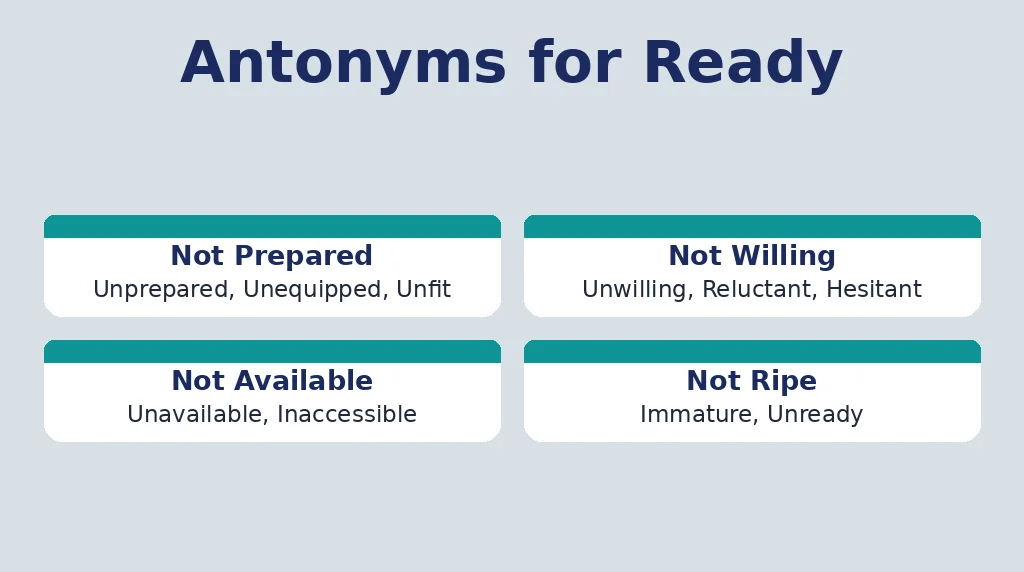
The opposites split along the same senses. For preparation, the main antonyms are unprepared and unready. An unprepared speaker has done no work, while an unequipped team lacks the tools. Unfit declares that the condition itself is wrong: “The car is unfit for the road.”
For willingness, use unwilling, reluctant, and hesitant. A reluctant helper agrees slowly, and a hesitant one pauses before agreeing. For availability, unavailable and inaccessible do the work: the money is unavailable, or the office is inaccessible. Immature is the opposite of ripe: “The plan is immature and needs more time.” Each antonym reverses one family, so pick the one that matches your sentence’s sense of ready.
Speech has its own ready-made negations. “Not yet” is the answer people give when preparation is unfinished: “Dinner is not ready yet.” “Not quite ready” softens the same message for people: “I am not quite ready to decide.” Writers can borrow that softness with almost ready, which places the subject one step from the line without crossing it.
Common Mistakes: Words That Are Not True Synonyms for Ready
Able and capable top the error list. Both describe ability, not readiness. A capable mechanic might still need an hour to get ready. Keep the words apart unless your sentence covers both ideas.
Excited is not willingness. Excitement is a feeling, and a person can feel excited yet refuse to take part. Available is not willingness either. A manager can be available on Tuesday and still be unwilling to help. Ready to help promises both presence and consent.
Prompt gets misused for general preparation. A prompt reply is fast, but a “prompt student” sounds like a student who answers quickly, not one who did the homework. Facile is a trap of the opposite kind. It looks like praise for an easy answer, yet it usually criticises the answer as shallow.
Finally, watch set in the wrong family. A set menu and a set time are fixed, not prepared. Set means ready only in starting patterns such as “ready, set, go” and “all set.” Checking the family first prevents every one of these mistakes.
Frequently Asked Questions
What is the best synonym for ready?
Prepared is the best all-purpose synonym for ready. It covers people, plans, speeches, and things without changing the meaning. When the tone is casual, all set works better in speech: “We are all set.” For offers of help, willing is the cleaner swap.
What is a formal synonym for ready?
Prepared and prompt are the safest formal choices. Prepared suits people and plans, while prompt suits replies and services. Very formal writing also uses in readiness for things prepared for an event, and expeditious for fast, efficient action.
What is a synonym for ready to help?
Willing is the direct synonym, and glad is the warm one. “I am ready to help” becomes “I am willing to help” in formal writing or “I would be glad to help” in friendly writing. Informally, game works: “I am game to help you move.”
What is the difference between ready and prepared?
The two overlap heavily, but prepared stresses the work done in advance. Ready adds the feeling of standing at the start line, able to begin at once. A meal can be ready without anyone feeling prepared, and a student can be prepared yet not feel ready.
What is the opposite of ready?
Unprepared is the general opposite. Unwilling reverses the helping sense, reluctant shows slow agreement, and unavailable reverses the at-hand sense. Immature is the opposite when ready means ripe.
Is ready a verb as well?
Yes. Ready can mean to make something ready, as in “They readied the room for the guests.” The verb sounds formal, so news reports and novels use it most. Everyday speech usually prefers get ready or prepare.
Is ready-made the same as ready?
Not quite. Ready-made describes a product that was bought or made in advance, in a standard form: ready-made meals, ready-made curtains. Ready itself describes any state of preparation. A meal you cooked from scratch is ready, but it is not ready-made.
What does ready cash mean?
Ready cash is money that is available to spend immediately. It is not promised, borrowed, or locked inside property. The phrase explains why available sits inside the ready family: the cash is at hand the moment you need it.
Final Thoughts
Ready earns its keep because it covers preparation, willingness, timing, speed, and availability in four letters. The cost of that range is confusion, so let the sense choose the synonym. Pick prepared for work done, willing for help offered, prompt for answers, ripe for timing, and available for things at hand.
When you want to check a nuance against the source, the Merriam-Webster Thesaurus entry for ready shows every sense with examples. Keep this guide open beside it, and the word ready will stop repeating itself in your writing.