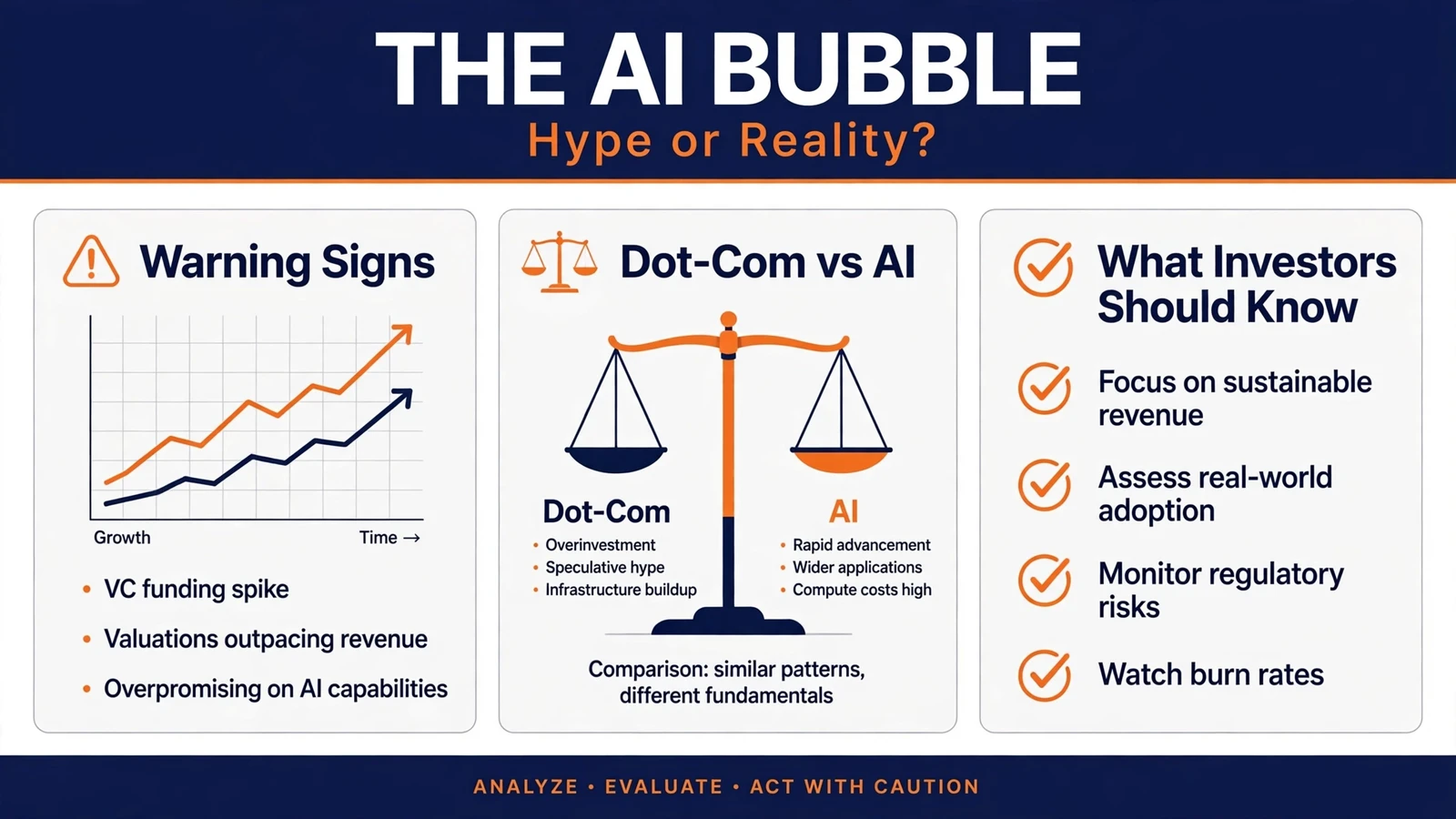
The AI bubble refers to the possibility that artificial intelligence companies, stocks, and investments are becoming overvalued because of excessive expectations about future growth. Although AI has real applications in business, healthcare, education, and technology, its market value may rise faster than actual revenue and profits. If expectations fail to match results, some AI companies could face falling valuations, reduced funding, or financial losses.
Artificial intelligence is changing how people work, communicate, create content, and solve problems. Companies are investing heavily in AI software, advanced computer chips, cloud computing, and data centers. Investors also see opportunities to profit from this technology, which has increased interest in AI stocks and startups. Looking for more ways to say “very”? Check our list of synonyms for very.
For even more word choices, explore our guide to synonyms of sexy.
However, rapid growth raises an important question: Are we experiencing an AI boom built on real business value, or is the market developing an AI bubble?
The answer is not simple. Some AI businesses generate revenue and help customers improve productivity, while others depend heavily on funding and expectations of future success. High valuations can create risks when profits fail to meet investor expectations.
Understanding the AI bubble means looking beyond headlines. You need to examine investment spending, company valuations, revenue growth, profitability, and the technology’s long-term economic potential.
What Does AI Bubble Mean?
An AI bubble is a possible financial market condition in which artificial intelligence-related investments become excessively expensive compared with the underlying business value they are expected to generate.
The term includes investments in AI startups, technology stocks, semiconductor companies, data centers, and AI-powered software platforms. It can also describe a broader economic situation in which investors, businesses, and the public develop unrealistic expectations about how quickly AI will transform the economy.
A bubble often develops when excitement attracts more investment, rising valuations encourage additional speculation, and investors assume that future growth will justify current prices.
For example, an AI startup might receive a multibillion-dollar valuation because investors expect its technology to dominate the market. However, the company may still have limited revenue, high operating costs, and no clear path to consistent profitability.
If future earnings do not support that valuation, investors may reconsider what the business is worth.
An AI bubble does not mean artificial intelligence is useless. It means the financial expectations surrounding some AI companies or investments may exceed their realistic economic value.
Why Is AI Considered a Bubble?
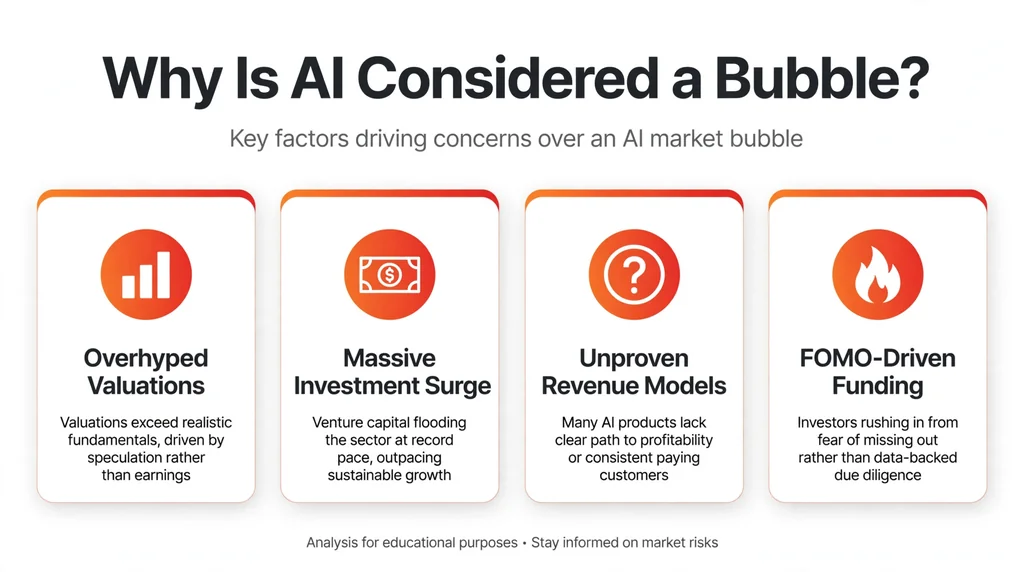
Several factors explain why investors and market observers question whether the AI boom is sustainable.
1. High AI Company Valuations
AI companies can attract substantial investment because investors expect the technology to become an important part of the global economy. These expectations can push valuations higher, even when current profits remain limited.
A company’s valuation should reflect factors such as its revenue, growth potential, competitive position, operating costs, and future cash flow.
Problems arise when investors focus almost entirely on future possibilities instead of measurable business performance.
For example, two companies might develop similar AI products, but one could have paying customers and stable revenue while the other relies mainly on investor funding. Giving both companies similarly high valuations may create financial risk.
High valuations alone do not prove a bubble exists. The central question is whether future earnings can reasonably justify the price investors are paying.
2. Massive AI Infrastructure Spending
Modern AI systems require substantial computing power. Training and operating advanced models can involve expensive chips, data centers, electricity, cooling systems, networking equipment, and cloud infrastructure.
Technology companies are therefore spending significant amounts to expand their AI capabilities.
This investment can support genuine innovation. However, it also creates uncertainty about future returns.
If businesses purchase more computing capacity than customers ultimately need, some infrastructure may generate less revenue than expected. Companies could then struggle to recover their spending.
The AI investment bubble debate partly centers on whether future demand will justify the scale and cost of this infrastructure expansion.
3. Investor Speculation and Market Hype
Market speculation occurs when investors purchase assets primarily because they expect prices to rise, rather than because of the assets’ underlying financial performance.
AI hype can contribute to this behavior. Headlines about breakthrough models, new startups, and potential productivity gains may encourage investors to assume that nearly every AI-related business will succeed.
This creates a risk of indiscriminate investment.
Not every company using artificial intelligence has a sustainable business model. Some products may face strong competition, limited customer demand, or high development costs.
When investors stop rewarding promises and start demanding measurable results, speculative valuations can decline.
4. Uncertain AI Profitability
Revenue growth and profitability are different measures of business performance.
An AI company may attract many users and generate increasing revenue while spending even more on computing resources, research, employees, and customer acquisition.
If operating expenses continue to exceed the income a business generates, growth alone may not create a sustainable company.
Investors therefore need to examine whether AI products can produce lasting profits. Subscription revenue, enterprise contracts, customer retention, pricing power, and operating margins all provide useful evidence.
A major warning sign appears when companies repeatedly raise large amounts of capital without demonstrating a credible path toward positive cash flow.
5. Fear of Missing Out
Fear of missing out, often called FOMO, occurs when people invest because they worry that others will become wealthy without them.
During a technology boom, this behavior can push investors toward popular stocks and startups without sufficient research.
Companies may also feel pressure to adopt AI quickly because competitors are investing in it. While early adoption can provide advantages, purchasing technology without a clear business purpose can waste resources.
FOMO does not automatically create a bubble, but it can amplify market speculation and reduce attention to financial fundamentals.
What Are the Warning Signs of an AI Bubble?
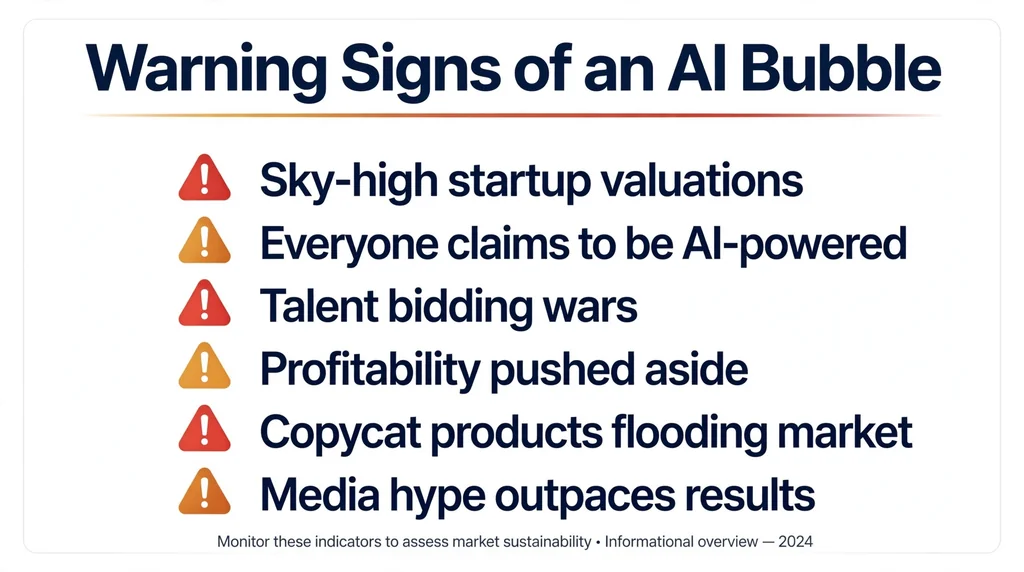
There is no single indicator that proves the AI market has become a bubble. However, several warning signs can help explain why concerns about an AI investment bubble arise.
| Warning Sign | Why It Matters |
|---|---|
| Extremely high valuations | Investors may be paying more than future earnings can justify. |
| Weak profitability | Companies may struggle to turn AI adoption into sustainable profits. |
| Excessive borrowing | Debt can increase financial pressure if expected returns do not materialize. |
| Unclear business models | Some companies may lack reliable ways to monetize their technology. |
| Speculative investment | Prices may depend more on hype than measurable business results. |
| Overbuilt infrastructure | Excess capacity can reduce returns on data center and computing investments. |
| Concentrated market gains | Heavy reliance on a small number of large companies can increase market vulnerability. |
| Unrealistic growth expectations | Companies may disappoint investors even when their businesses continue growing. |
These warning signs need to be evaluated together. For example, a company with a high valuation might still be reasonably priced if it has strong revenue growth, durable competitive advantages, and substantial future earnings potential.
Likewise, falling stock prices do not necessarily prove that an AI bubble has burst. Markets can decline for many reasons, including higher interest rates, weaker economic conditions, or changes in investor sentiment.
Is AI a Bubble or a Genuine Technological Revolution?
The most useful distinction is between the value of artificial intelligence and the price investors pay for AI-related assets.
Artificial intelligence can create genuine economic value while some AI investments become overvalued.
Reasons the AI Boom Could Be Sustainable
AI tools can automate repetitive tasks, support software development, analyze large datasets, improve customer service, and help businesses work more efficiently.
These capabilities create potential commercial benefits across multiple industries.
For example, a business might use an AI assistant to handle routine customer questions. If the system reduces operating costs while maintaining service quality, the company may gain measurable financial benefits.
AI can also support research, document processing, medical image analysis, fraud detection, and personalized learning. Its usefulness may expand as models become more capable, accessible, and affordable.
If businesses continue adopting AI and achieve sufficient productivity gains, demand could support long-term industry growth.
Reasons the AI Market Could Be Overvalued
Technological usefulness does not guarantee that every company will make money.
AI products may become cheaper as competitors enter the market. Open-source models can reduce the advantages of some proprietary systems. Customers may also switch providers when products offer similar features.
At the same time, expensive computing infrastructure and research programs can place pressure on profit margins.
Some companies may discover that customers appreciate AI tools but are unwilling to pay enough to support their development costs.
These factors could cause investors to reassess valuations, even while AI adoption continues to increase.
The most balanced conclusion is that AI can be a transformative technology without making every AI investment a good investment.
AI Bubble vs. Dot-Com Bubble
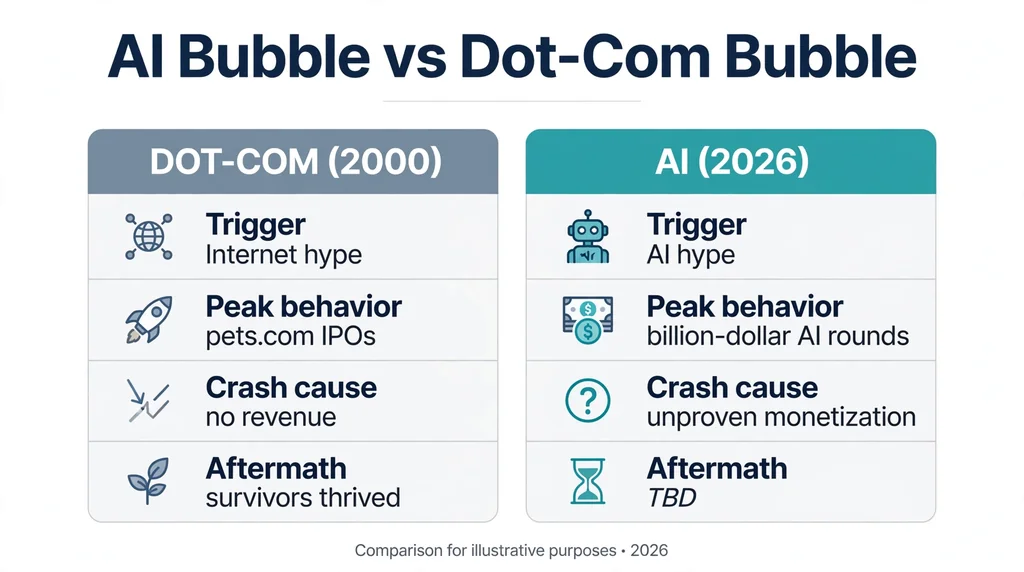
The dot-com bubble of the late 1990s and early 2000s provides a useful comparison for understanding the risks of the current AI investment boom.
During the dot-com era, enthusiasm about the internet encouraged heavy investment in technology companies. Some businesses achieved enormous valuations despite limited revenue or weak business models. When expectations changed, many technology stocks collapsed, and several companies failed. Looking for more ways to say “despite”? Check our guide to synonyms for despite.
The internet itself, however, continued to develop and became essential to modern commerce and communication.
The AI bubble discussion follows a similar pattern: investors are trying to determine which companies will build sustainable businesses and which are benefiting mainly from temporary enthusiasm.
| Comparison Factor | Dot-Com Bubble | AI Bubble Concerns |
|---|---|---|
| Main technology | Commercial internet | Artificial intelligence and generative AI |
| Investment focus | Internet startups and online businesses | AI startups, chips, software, and data centers |
| Main concern | Excessive valuations and weak business models | High valuations, infrastructure costs, and uncertain returns |
| Potential winners | Companies with sustainable internet businesses | Companies that turn AI capabilities into lasting profits |
| Possible outcome | Major losses followed by long-term internet growth | Potential market corrections alongside continued AI adoption |
The comparison has limits. Today’s AI market includes established technology companies with existing customers, mature operations, and significant revenue. The dot-com era contained many businesses with less-developed commercial foundations.
Nevertheless, both periods show why investors should separate technological progress from speculative investment.
What Happens If the AI Bubble Bursts?
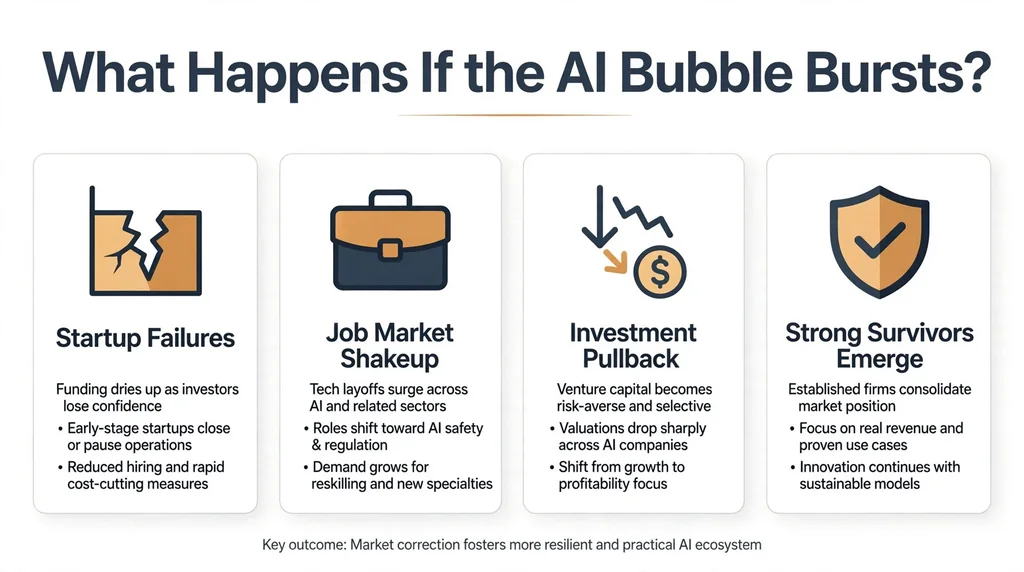
An AI bubble burst would occur if investors sharply reduced their expectations about AI-related business growth, causing valuations to fall significantly.
The severity would depend on how widespread the overvaluation was, how much debt companies had taken on, and how closely their financial positions were connected.
1. AI Stocks Could Decline
Companies whose share prices depend heavily on optimistic growth forecasts could experience significant declines.
Investors might shift toward businesses with stronger cash flow, lower debt, and more dependable earnings.
However, not every technology company would necessarily fall by the same amount.
2. AI Startups Could Lose Funding
Venture capital firms and other investors might become more selective about funding new AI businesses.
Startups without paying customers or a clear path to profitability could face layoffs, reduced spending, acquisitions, or closure.
Businesses with sustainable revenue and useful products might remain attractive despite weaker investment conditions.
3. Infrastructure Spending Could Slow
If demand grows more slowly than expected, companies might delay data center construction, cancel equipment orders, or reduce computing capacity expansion.
That could affect semiconductor manufacturers, cloud providers, construction companies, energy infrastructure businesses, and other suppliers.
Some facilities could remain valuable if long-term demand eventually catches up. Others might generate disappointing returns.
4. The Wider Economy Could Feel the Impact
A severe AI market correction could reduce investor wealth and weaken business confidence. Companies might cut spending, while financial institutions could face losses on loans connected to struggling businesses.
The impact would depend on the scale of the correction and the financial connections between AI companies, lenders, and investors.
A stock market decline would not automatically cause a global recession. However, extensive debt, concentrated investment, and falling business spending could make a correction more damaging.
5. AI Technology Could Continue Advancing
A market correction would not necessarily stop AI research or adoption.
Lower valuations and tighter funding could encourage businesses to focus on practical applications, lower operating costs, and products with proven customer demand.
Some weaker companies might disappear, while stronger businesses continue developing useful technology.
This distinction matters because a financial bubble concerns prices and expectations, not necessarily the long-term value of the underlying technology.
Will the AI Bubble Burst?
There is no reliable way to predict the exact timing or severity of a potential AI market correction.
The outcome will depend on several factors, including the pace of AI adoption, revenue growth, infrastructure spending, competitive pressure, financing costs, and the profitability of AI products.
Three broad scenarios are possible.
Scenario 1: Sustainable growth. Businesses generate enough revenue and productivity gains to justify continued AI investment. Some valuations may still be excessive, but the industry expands over time.
Scenario 2: Gradual market correction. Investors become more selective as they demand stronger financial results. Overvalued companies lose market value, while profitable businesses continue to grow.
Scenario 3: A sharp AI market crash. Revenue disappointments, excessive borrowing, or weaker demand trigger a broad reassessment of AI-related investments. Stock prices fall sharply, funding becomes harder to obtain, and some companies fail.
These scenarios are possibilities, not predictions. An investor or business owner should avoid treating a crash as inevitable or assuming that strong AI demand guarantees rising stock prices.
How to Evaluate AI Investment Risks
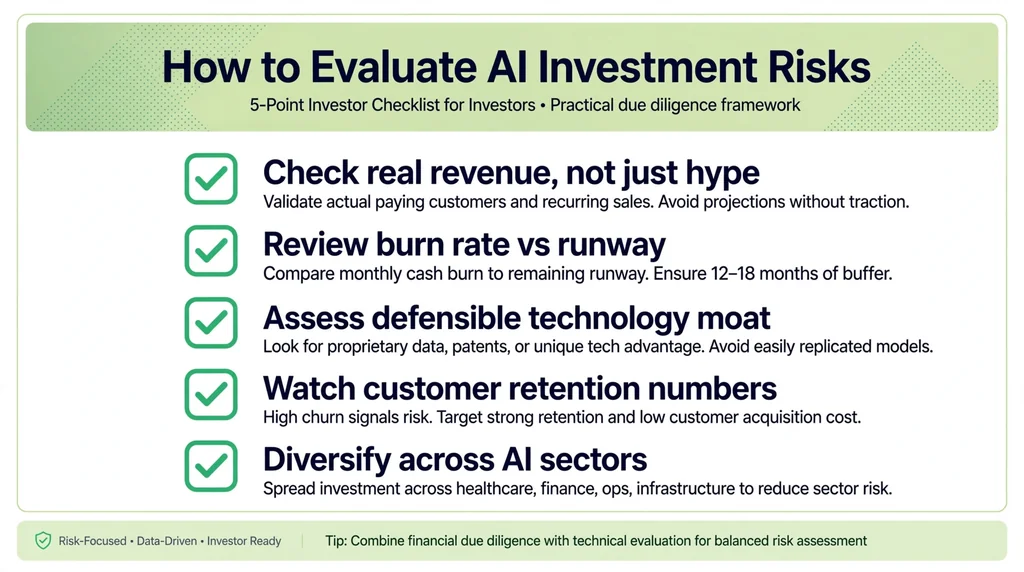
Whether you are studying AI stocks, evaluating a startup, or deciding whether to adopt AI at work, focus on measurable results rather than hype.
Examine Revenue and Profitability
Determine whether the company generates income from actual customers. Look at operating expenses, profit margins, cash flow, and the amount of capital needed to sustain growth.
For startups, distinguish between funding raised and revenue earned. Investment funding provides capital, but it does not prove that a business model is profitable.
Evaluate Return on Investment
Compare the cost of developing, purchasing, and operating AI systems with the financial benefits they deliver.
A business should consider implementation costs, software subscriptions, computing expenses, maintenance, training, and the time required for employees to use the technology effectively.
If the benefits do not justify the costs, widespread adoption may be slower than expected.
Consider Competition
AI companies may face competition from large technology platforms, startups, open-source projects, and new market entrants.
Strong competition can lower prices and reduce profit margins. Companies need sustainable advantages, such as specialized data, reliable products, customer relationships, distribution, or technical capabilities.
Review Debt and Spending
Large AI infrastructure projects require substantial capital. Businesses that rely heavily on borrowing may face additional risks if revenue disappoints or financing becomes more expensive.
Evaluate whether spending plans are supported by credible demand and realistic financial projections.
Avoid Assuming Every AI Company Will Win
The AI industry includes businesses with different products, costs, competitive positions, and revenue models.
Some may become highly profitable. Others may struggle despite developing useful technology.
A careful assessment considers each company’s fundamentals instead of treating AI exposure as a guarantee of future success.
Frequently Asked Questions
1. What Is the AI Bubble in Simple Terms?
The AI bubble is the possibility that investor excitement has pushed the value of AI companies and investments above what their actual business performance can justify.
2. Is AI a Bubble Right Now?
Some AI investments may be overvalued, but that does not prove the entire AI market is a bubble. The answer depends on valuations, earnings, investment costs, and future demand.
3. What Could Cause the AI Bubble to Burst?
A sharp correction could follow weaker-than-expected revenue, disappointing profits, excessive borrowing, declining investor confidence, or evidence that AI spending will produce lower returns than anticipated.
4. How Is the AI Bubble Different From the Dot-Com Bubble?
Both involve enthusiasm about transformative technology, but today’s AI market includes established companies with existing businesses alongside speculative startups. Their financial foundations differ significantly.
5. Will AI Still Be Useful If the AI Bubble Bursts?
Yes. A market correction could reduce company valuations and investment funding without eliminating AI’s practical applications. Useful technologies can continue growing after speculative investments decline. Looking for more ways to say “after”? Check our guide to synonyms for after.
Final Thoughts
The AI bubble debate highlights an important difference between technological innovation and financial speculation. Artificial intelligence has the potential to improve productivity, support research, automate tasks, and create new business opportunities. However, those possibilities do not guarantee that every AI company will deliver strong financial returns.
High valuations, infrastructure spending, uncertain profitability, and unrealistic expectations deserve careful attention. At the same time, genuine customer demand and measurable productivity gains can support sustainable growth.
The most sensible approach is to evaluate the evidence rather than choose between extreme predictions. An AI market correction is possible, but it is not inevitable. The long-term winners will likely be businesses that convert useful AI capabilities into reliable products, durable customer relationships, and sustainable profits.
Ultimately, understanding the AI bubble requires one central question: Can the economic value created by artificial intelligence justify the money being invested in it? The answer will become clearer as companies demonstrate their results over time.
Related synonym guides: synonyms of denotation.