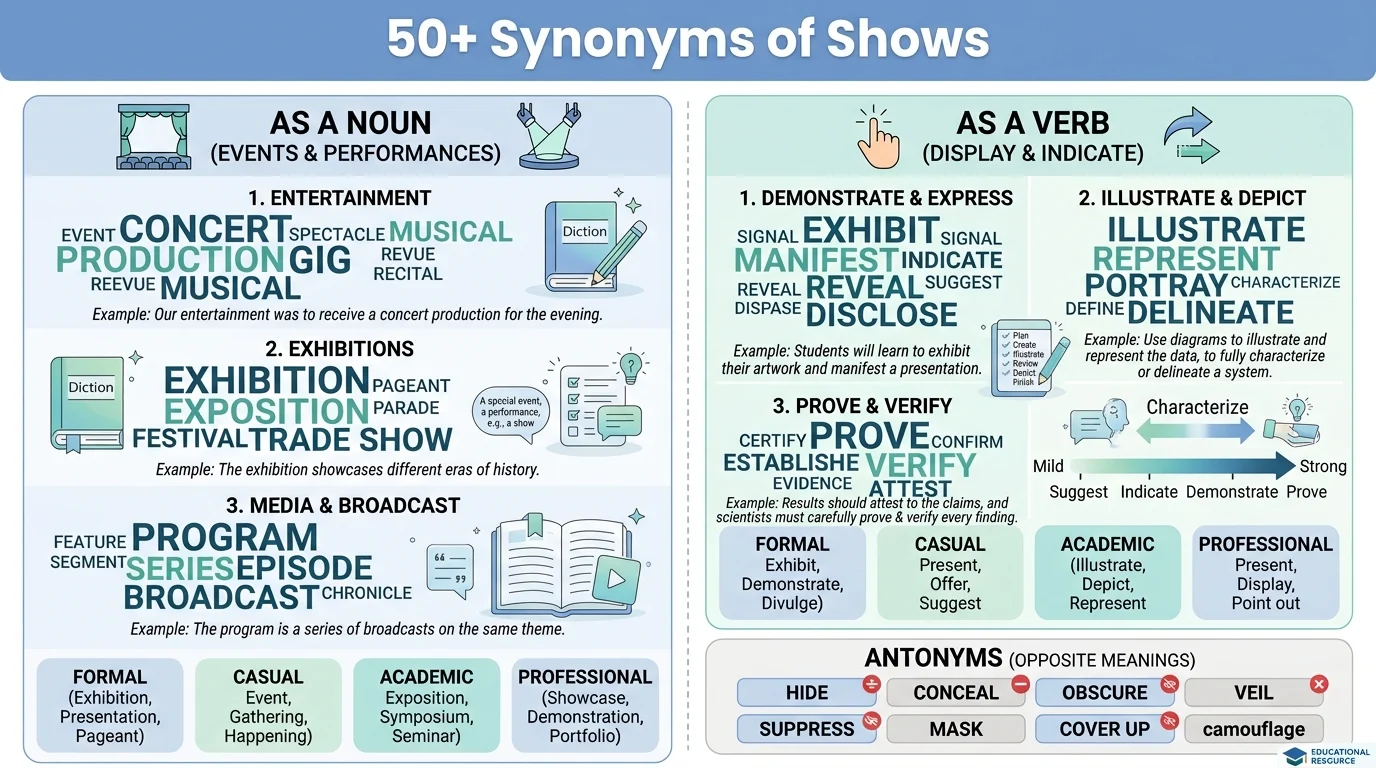
Have you ever read through an essay or email and realized you used the word “shows” six times in three paragraphs? Most writers do this without noticing. The word feels safe and familiar, but it makes your writing sound repetitive and dull. Finding the right synonym of shows can transform your sentences from basic to brilliant. Whether you are writing a resume, crafting a business email, or working on a school assignment, having a rich vocabulary helps you communicate with precision. The right word makes your message clearer and more memorable. This guide will help you understand exactly how to choose the best alternative every time.
What Are the Best Synonyms of “Shows”?
“Shows” means to display, demonstrate, or make something visible or evident. Its tone is neutral and commonly used in both spoken and written English. Formal writing and academic work, use “demonstrates” or “illustrates.” For casual conversations, try “points to” or “makes clear.” Professional settings, “indicates” and “reveals” work well. Emotional or creative writing, “exposes,” “unveils,” or “showcases” add impact.
Meaning, Tone, and Context
Simple Definition: To cause or allow something to be seen, displayed, or understood. It means making information, emotions, or objects visible or apparent to others.
Part of Speech: Verb (primarily). Also used as a noun in different contexts.
Overall Tone: Neutral
Formality Level: Neutral. “Shows” works in almost every setting, which is part of why writers overuse it.
Common Uses: Native English speakers use “shows” constantly in everyday conversation, workplace updates, academic papers, news reporting, and casual writing. People use it to describe visual displays, evidence, emotions, data, performance, and countless other situations.
Word Forms:
- Show (verb/noun)
- Shows (verb/noun, third person singular)
- Showed (past tense)
- Shown (past participle)
- Showing (present participle)
- Showy (adjective, meaning ostentatious)
- Showman (noun)
When and How to Use “Shows”
Choose “shows” when you need a clear, straightforward verb that everyone understands instantly. It works beautifully in everyday situations where precision is less important than clarity. Here are seven realistic examples.
Professional: The quarterly report shows a 15 percent increase in customer engagement.
Academic: The researcher’s findings show a direct correlation between sleep quality and cognitive performance.
Workplace: Sarah’s presentation shows how our new software streamlines the approval process.
Personal: His expression shows that he is genuinely excited about the opportunity.
Email: The attachment shows the revised budget projections for next quarter.
Resume: My portfolio shows my ability to manage complex projects from start to finish.
Social Media: This video shows our team volunteering at the community food bank last weekend.
Best Synonyms of “Shows”
No synonym is identical in every situation. Each alternative carries its own subtle meaning, formality level, and emotional weight. Here is a breakdown of the best synonyms by context.
Professional writing: Indicates. This word sounds more analytical and objective than “shows.” It suggests evidence or data pointing toward a conclusion.
Academic writing: Demonstrates. This is the gold standard in academic papers. It implies proof through evidence or logical reasoning.
Business communication: Reveals. This word adds a touch of discovery or new information, which works well in business contexts.
Casual conversation: Points to. This phrase feels natural and conversational while still conveying the same basic meaning.
Emotional writing: Exposes. This word carries emotional weight and suggests vulnerability or revelation of something private.
Creative writing: Unveils. This word adds drama and imagery, perfect for storytelling or descriptive passages.
Resume writing: Showcases. This word highlights achievements in a confident, professional way.
Workplace communication: Highlights. This word is perfect for emphasizing important information in meetings or memos.
Stronger meaning: Proves. Use this when the evidence is undeniable and you want to convey certainty.
Softer meaning: Suggests. Use this when the evidence is not conclusive or you want to sound more tentative.
When Not to Use “Shows”
Too General: “Shows” is safe but often too vague. It does not tell the reader exactly what kind of display or demonstration is happening.
Better synonym: Demonstrates
Rewritten: The data demonstrates a clear pattern of consumer behavior.
Too Vague: “Shows” lacks specificity. It does not convey the method or strength of the demonstration.
Better synonym: Illustrates
Rewritten: The graph illustrates the relationship between income and education levels.
Too Formal for Casual Use: “Shows” is actually neutral, but its alternatives can sound overly formal.
Better synonym: Makes clear
Rewritten: Her tone makes clear that she is not interested in continuing the conversation.
Too Weak: Sometimes “shows” does not convey enough conviction.
Better synonym: Proves
Rewritten: The witness testimony proves the defendant’s innocence beyond any doubt.
Too Strong: In some cases, “shows” claims too much certainty.
Better synonym: Suggests
Rewritten: The early data suggests we might exceed our quarterly targets.
Words Commonly Confused With “Shows”
Exhibits
Difference: Exhibits implies a more deliberate, public display. Shows is broader and can refer to any display.
When to Use It: Use “exhibits” when discussing art displays, museum pieces, or conscious behavioral displays.
Example: The gallery exhibits work from emerging local artists every month.
Reveals
Difference: Reveals suggests uncovering something that was previously hidden or unknown. Shows is more neutral about whether the information was known before.
When to Use It: Use “reveals” when there is an element of discovery or disclosure.
Example: The investigation reveals a pattern of misconduct spanning several years.
Demonstrates
Difference: Demonstrates emphasizes proof and evidence more strongly than shows. It often involves a logical or experimental process.
When to Use It: Use “demonstrates” in academic, scientific, or analytical contexts.
Example: The experiment demonstrates the effectiveness of the new compound.
Illustrates
Difference: Illustrates specifically means making something clear through examples or visual aids. Shows is broader.
When to Use It: Use “illustrates” when providing examples or visual explanations.
Example: This case illustrates the challenges small business owners face daily.
Portrays
Difference: Portrays suggests representation rather than direct display. It often applies to art, literature, or performance.
When to Use It: Use “portrays” when discussing how something is depicted or represented.
Example: The novel portrays life in rural America during the Great Depression.
Indicates
Difference: Indicates suggests a sign or signal pointing toward a conclusion. Shows can be more direct.
When to Use It: Use “indicates” when discussing data, evidence, or indirect signs.
Example: The patient’s symptoms indicate a possible allergic reaction.
Best Synonyms of “Shows” by Context
| Context | Best Synonym | Why It Works | Example |
|---|---|---|---|
| Formal writing | Demonstrates | Conveys proof and evidence academically | The study demonstrates the effectiveness of early intervention. |
| Academic writing | Illustrates | Makes concepts clear through examples | The textbook illustrates complex theories with real world cases. |
| Professional communication | Indicates | Suggests analysis and data interpretation | The survey indicates strong customer satisfaction. |
| Business emails | Reveals | Adds a sense of discovery or new insight | The report reveals unexpected market opportunities. |
| Resume writing | Showcases | Highlights achievements confidently | My experience showcases my ability to lead diverse teams. |
| Workplace communication | Highlights | Emphasizes important information | The presentation highlights our key performance metrics. |
| Casual conversation | Points to | Sounds natural and conversational | Everything points to a successful event next month. |
| Everyday speaking | Makes clear | Simple and easy to understand | Her explanation makes clear what we need to do next. |
| Creative writing | Unveils | Adds drama and imagery | The final chapter unveils the protagonist’s true identity. |
| Storytelling | Portrays | Conveys representation and emotion | The film portrays the struggle of immigrant families beautifully. |
| Emotional writing | Exposes | Carries emotional weight and vulnerability | The memoir exposes the author’s deepest fears. |
| Strong emphasis | Proves | Conveys certainty and undeniable evidence | The evidence proves his theory was correct all along. |
| Mild tone | Suggests | Tentative and less definitive | The results suggest further research is needed. |
| Social media captions | Captures | Perfect for visual content | This photo captures the joy of our wedding day. |
| American English | Shows | Standard usage across all contexts | The data shows an interesting trend. |
How to Choose the Best Synonym of “Shows”
Choosing the right word starts with understanding your purpose. Ask yourself what you are trying to communicate. Are you proving something? You simply displaying information? Are you revealing a secret? The answers will guide your choice.
Consider your audience. Academic readers expect formal language like “demonstrates” or “illustrates.” Business colleagues respond well to “indicates” and “highlights.” Friends and family appreciate simpler words like “points to” or “makes clear.”
Think about the strength of your claim. If you are absolutely certain, choose “proves.” If you are working with limited evidence, choose “suggests.” This precision makes your writing more honest and trustworthy.
Evaluate the emotional tone of your message. “Exposes” and “unveils” add drama and feeling. “Shows” and “indicates” stay neutral. Choose the word that matches the emotional register of your writing.
Finally, read your sentence aloud with each option. The best synonym is the one that sounds most natural in your specific sentence. Trust your ear as much as your dictionary.
Real Life Examples of “Shows”
School: The science fair project shows how plants respond to different light conditions.
College: Her thesis shows a deep understanding of postcolonial literature and its cultural implications.
Workplace: The weekly report shows our team has exceeded production goals for three consecutive months.
Business: The financial forecast shows steady growth potential in emerging markets.
Email: The proposal shows why we should invest in sustainable packaging solutions.
Resume: My work history shows consistent advancement through increasing responsibility.
Conversation: Your reaction shows you did not expect this news, did you?
Storytelling: The old photograph shows a family gathered around a Christmas tree in 1955.
Blogging: This recipe shows how simple ingredients can create something extraordinary.
Social Media: The video shows our rescue dog learning his first commands.
18 Best Synonyms of “Shows”
| Synonym | Simple Meaning | Best Used For | Example Sentence |
|---|---|---|---|
| Demonstrates | Proves through evidence | Academic and scientific writing | The data demonstrates a clear link between diet and health outcomes. |
| Illustrates | Makes clear through examples | Educational and explanatory writing | The case illustrates how policies can affect real people. |
| Indicates | Points toward a conclusion | Professional and analytical writing | The results indicate a shift in consumer preferences. |
| Reveals | Uncover something hidden | News, investigative, and business writing | The audit reveals significant cost savings opportunities. |
| Highlights | Emphasizes important information | Presentations and workplace communication | The report highlights areas requiring immediate attention. |
| Showcases | Displays in an impressive way | Portfolios, resumes, and creative work | The exhibition showcases emerging talent from around the world. |
| Unveils | Reveals for the first time | Product launches and creative writing | The company unveils its latest innovation at the conference. |
| Exposes | Reveals something negative or private | Investigative and emotional writing | The documentary exposes corruption within the industry. |
| Portrays | Represents through art or description | Literature, film, and creative writing | The author portrays the character with remarkable depth. |
| Exhibits | Displays publicly | Art, museums, and behavioral contexts | The artist exhibits her work at galleries nationwide. |
| Depicts | Represents through images or words | Art history and descriptive writing | The painting depicts a peaceful countryside scene. |
| Points to | Suggests or indicates informally | Casual conversation and informal writing | Everything points to a successful partnership. |
| Captures | Represents effectively | Photography, social media, and creative work | The video captures the energy of the live performance. |
| Confirms | Establishes truth or accuracy | Formal and professional contexts | The test confirms our initial hypothesis. |
| Proves | Establishes conclusively | Legal, scientific, and persuasive writing | The evidence proves the defendant’s innocence. |
| Suggests | Implies without confirming | Tentative and academic writing | The findings suggest new approaches to treatment. |
| Reflects | Shows as a mirror or result | Analytical and personal writing | The outcome reflects our team’s dedication. |
| Manifests | Shows clearly through visible signs | Formal and medical contexts | The symptoms manifest differently in each patient. |
Synonyms of “Shows” by Usage
Professional vs Personal Synonyms
In professional settings, words like “demonstrates,” “indicates,” “reveals,” and “highlights” are the strongest choices. They sound analytical and trustworthy. In personal conversations, simpler words work better. Try “points to,” “makes clear,” or “captures” for a natural, casual tone. The distinction matters because professional writing demands precision, while personal writing values connection.
Formal vs Conversational Synonyms
Formal synonyms fit reports, essays, business writing, and academic presentations. These include “demonstrates,” “illustrates,” “indicates,” “confirms,” and “proves.” Conversational synonyms work better for emails, texting, and casual conversations. These include “points to,” “captures,” “makes clear,” and simply “shows.” Matching the formality level to your audience makes your writing feel appropriate and professional.
Academic Synonyms
Academic writing demands precise, authoritative vocabulary. “Demonstrates” is the most common choice because it implies evidence-based proof. “Illustrates” works well for explanatory passages. “Indicates” is perfect for data-driven conclusions. “Manifests” adds a formal, almost clinical tone suitable for medical or psychological research. These words signal to readers that you are writing with academic rigor.
Professional and Business Synonyms
In resumes, choose “showcased” over “showed.” “Demonstrated” and “exhibited” also perform well. For presentations and meetings, “highlights” is invaluable because it directs attention to key points. “Reveals” works for sharing new findings. “Indicates” is perfect for client communication and performance reviews because it sounds analytical and measured.
Creative and Literary Synonyms
“Unveils” adds theatrical drama. “Portrays” suggests artistic representation. “Depicts” is great for visual descriptions. “Exposes” carries emotional weight and vulnerability. These words transform simple statements into vivid imagery. They are essential for storytelling, fiction, poetry, and any writing that aims to evoke feeling.
Slang or Modern Synonyms
There are no established slang words that mean exactly “shows.” However, phrases like “puts on display,” “throws in your face,” and “makes plain” have informal uses. These are rarely appropriate in professional or academic writing. In casual conversation, simply using “points to” or “captures” is more effective than forcing unnatural slang.
Strongest to Mildest Synonyms
Mild: Suggests, points to, indicates, shows
Moderate: Illustrates, highlights, showcases, reveals
Strong: Demonstrates, establishes, confirms, exposes
Very Strong: Proves, verifies, substantiates, validates
Emotional vs Neutral Synonyms
Emotional Synonyms: Exposes, unveils, captures, portrays. These words carry feeling and imagery. Use them in creative writing, personal narratives, and emotional contexts. They make readers feel something.
Neutral Synonyms: Demonstrates, indicates, shows, suggests, illustrates. These words communicate information without added emotion. Use them in academic papers, business reports, and professional writing where objectivity matters.
Antonyms of “Shows”
| Antonym | Meaning | Example Sentence |
|---|---|---|
| Hides | Keeps out of sight | She hides her feelings behind a cheerful exterior. |
| Conceals | Prevents from being seen | The fog conceals the distant mountains. |
| Obscures | Makes unclear or difficult to see | His explanation obscures the real issue. |
| Covers | Places something over to hide | The blanket covers the stain on the sofa. |
| Disguises | Changes appearance to hide identity | He disguises his accent when meeting new clients. |
| Masks | Conceals or covers up | Her smile masks her disappointment. |
| Camouflages | Hides by blending in | The animal camouflages itself against the forest floor. |
| Suppresses | Prevents from being revealed | The government suppresses information about the incident. |
| Withholds | Keeps back from view | The witness withholds crucial testimony. |
| Veils | Covers or conceals | The secrecy veils the company’s true intentions. |
| Screens | Protects from view | The fence screens the property from the road. |
| Shrouds | Envelops and conceals | Mystery shrouds the ancient artifact’s origins. |
| Enshrouds | Covers completely | The fog enshrouds the harbor. |
| Envelops | Wraps up and conceals | Darkness envelops the abandoned house. |
| Obfuscates | Makes unclear or confusing | The lawyer obfuscates the facts to confuse the jury. |
Comparison: “Shows” vs Similar Words
Shows vs Demonstrates
Main Difference: “Demonstrates” implies proof through evidence, logic, or action. “Shows” is more general and can mean simply displaying something without proving anything. “Demonstrates” is stronger and more academic.
Which Is Stronger? Demonstrates is stronger because it implies conclusive evidence.
Which Is More Formal? Demonstrates is more formal and academic.
When to Use Each: Use “demonstrates” in research, academic writing, and professional contexts where you need to convey proof. Use “shows” in general writing when the act of displaying is more important than proving.
Examples:
Shows: The photo shows my family at the beach.
Demonstrates: The experiment demonstrates the chemical reaction clearly.
Shows vs Reveals
Main Difference: “Reveals” suggests uncovering something previously hidden or unknown. “Shows” does not carry this implication of secrecy or discovery. “Reveals” adds drama and disclosure.
Which Is Stronger? Reveals is stronger in an emotional sense. It suggests a significant disclosure.
Which Is More Formal? Reveals is neutral but often used in formal writing for dramatic effect.
When to Use Each: Use “reveals” when there is an element of surprise, discovery, or disclosure. Use “shows” when the display is ordinary or expected.
Examples:
Shows: The website shows our product features.
Reveals: The investigation reveals serious misconduct.
Shows vs Illustrates
Main Difference: “Illustrates” specifically means making something clear through examples, pictures, or explanations. “Shows” is broader and does not always include the element of clarifying.
Which Is Stronger? Neither is inherently stronger. They serve different purposes.
Which Is More Formal? Illustrates is slightly more formal and often used in academic or explanatory writing.
When to Use Each: Use “illustrates” when you are providing examples or visual aids to explain a concept. Use “shows” for general display or demonstration.
Examples:
Shows: The map shows the location of the park.
Illustrates: This diagram illustrates how the engine works.
Shows vs Indicates
Main Difference: “Indicates” suggests a sign, signal, or piece of evidence pointing toward a conclusion. “Shows” can be more direct and conclusive. “Indicates” is often used with data and symptoms.
Which Is Stronger? Shows is often stronger because it can mean direct proof. Indicates is more tentative.
Which Is More Formal? Indicates is more formal and technical.
When to Use Each: Use “indicates” when discussing evidence that points to a conclusion. Use “shows” when the demonstration is direct and clear.
Examples:
Shows: The test shows she passed.
Indicates: The test indicates she might need more practice.
Shows vs Portrays
Main Difference: “Portrays” means representing something through art, literature, or performance. “Shows” can be more direct and literal. “Portrays” is creative and interpretive.
Which Is Stronger? Neither is stronger. They serve different purposes.
Which Is More Formal? Portrays is used in arts and humanities contexts. It is formal in that specific domain.
When to Use Each: Use “portrays” for creative works, character descriptions, and artistic representation. Use “shows” for literal or factual display.
Examples:
Shows: The video shows the process step by step.
Portrays: The film portrays the heroine as courageous and determined.
Shows vs Exhibits
Main Difference: “Exhibits” implies a public, deliberate display, often in a formal setting like a museum or gallery. “Shows” can be any display in any setting.
Which Is Stronger? Exhibits suggests more intentionality and public visibility.
Which Is More Formal? Exhibits is more formal and specific.
When to Use Each: Use “exhibits” for art, museum pieces, or deliberate behavioral displays. Use “shows” for all other contexts.
Examples:
Shows: The child shows her drawing to her mother.
Exhibits: The museum exhibits artifacts from ancient Egypt.
Common Phrases and Expressions with “Shows”
Show up
Meaning: To arrive or appear, especially when expected. It can also mean to reveal or become visible.
Example Sentence: Please show up to the meeting on time tomorrow morning.
Show off
Meaning: To display abilities or possessions in a boastful way. It can also mean to display something proudly.
Example Sentence: He always shows off his new car to everyone in the office.
Show around
Meaning: To guide someone through a place, introducing them to important locations or people.
Example Sentence: Let me show you around the campus before your orientation begins.
Show business
Meaning: The entertainment industry, including theater, film, and television.
Example Sentence: She has worked in show business for over twenty years.
Show of hands
Meaning: A vote or expression of opinion by raising hands.
Example Sentence: The teacher asked for a show of hands to decide the class activity.
Show the way
Meaning: To lead or guide someone to a destination or through a process.
Example Sentence: Our mentor shows the way for new employees during their first week.
Show one’s true colors
Meaning: To reveal one’s real character, especially when it is negative or unexpected.
Example Sentence: The crisis showed his true colors as a selfish leader.
Common Mistakes to Avoid
Choosing a Vague Synonym Instead of a Precise One
Incorrect: The data points to that the product fails.
Better: The data demonstrates that the product fails.
The word “points to” is vague and does not convey proof. “Demonstrates” is clearer and stronger.
Confusing “Shows” with “Portrays”
Incorrect: The graph portrays a steady increase in sales.
Better: The graph shows a steady increase in sales.
“Portrays” is for art and creative representation. “Shows” is correct for data and factual displays.
Using “Reveals” When “Indicates” Is Better
Incorrect: The report reveals a 5 percent drop in revenue.
Better: The report indicates a 5 percent drop in revenue.
“Reveals” suggests secrecy or drama. “Indicates” is neutral and professional. Use “indicates” for ordinary data.
Selecting an Overly Dramatic Synonym
Incorrect: The email exposes our meeting time for tomorrow.
Better: The email shows our meeting time for tomorrow.
“Exposes” implies scandal or vulnerability. “Shows” is appropriate for routine information.
Repeating the Same Word Too Often
Incorrect: The study shows results. The graph shows trends. The table shows data.
Better: The study demonstrates results. The graph illustrates trends. The table indicates data.
Varying your word choice keeps your writing engaging and professional.
Choosing a Synonym with the Wrong Emotional Tone
Incorrect: The celebration showcased the family’s joy.
Better: The celebration captured the family’s joy.
“Showcases” suggests a display or presentation. “Captures” suggests emotion and experience. Choose based on the feeling you want to convey.
Using Slang in Professional Writing
Incorrect: The data throws in your face the need for change.
Better: The data highlights the need for change.
Slang has no place in professional or academic writing. Choose appropriate, formal synonyms instead.
Frequently Asked Questions
What are the best synonyms of shows?
The best synonyms depend on context.Academic writing, use “demonstrates.” For professional settings, use “indicates” or “highlights.” For casual conversation, use “points to.” Creative writing, use “portrays” or “captures.”
What are the best formal synonyms of shows?
The best formal synonyms include “demonstrates,” “indicates,” “illustrates,” “confirms,” and “establishes.” These words are widely used in academic papers, business reports, and professional correspondence. They add authority and precision.
What are common informal synonyms of shows?
Common informal synonyms include “points to,” “captures,” “makes clear,” and “shows” itself. These words work well in everyday conversation, text messages, and casual emails. They sound natural and approachable.
What is another word for shows in professional writing?
In professional writing, use “demonstrates,” “indicates,” “highlights,” “reveals,” or “illustrates.” These words sound analytical and credible. Choose “demonstrates” for proof, “indicates” for data, and “highlights” for emphasizing important points.
What is the difference between shows and demonstrates?
The main difference is that “demonstrates” implies proof through evidence or logic, while “shows” is more general. “Demonstrates” is stronger and more academic. Use “demonstrates” in research and professional contexts where evidence matters.
What is the opposite of shows?
The opposite of “shows” is “hides,” “conceals,” or “obscures.” “Hides” keeps something out of sight. “Conceals” prevents something from being seen. “Obscures” makes something unclear. These antonyms are useful in both literal and figurative writing.
Conclusion
“Shows” is a versatile word that communicates display, demonstration, and revelation. Its neutrality makes it useful in countless situations, but its overuse weakens your writing. Choosing the right synonym elevates your communication and makes your message more precise. “Demonstrates” works best in academic contexts. “Indicates” and “highlights” excel in professional settings. “Portrays” and “captures” enhance creative writing. “Reveals” and “exposes” add emotional weight. No single synonym fits every situation. Consider your audience, your purpose, and your tone. The best synonym of shows is the one that communicates your exact meaning with clarity and confidence. Expanding your vocabulary is a journey. Start by replacing one overused “shows” in your next email or essay with a stronger alternative. Your readers will notice the difference.