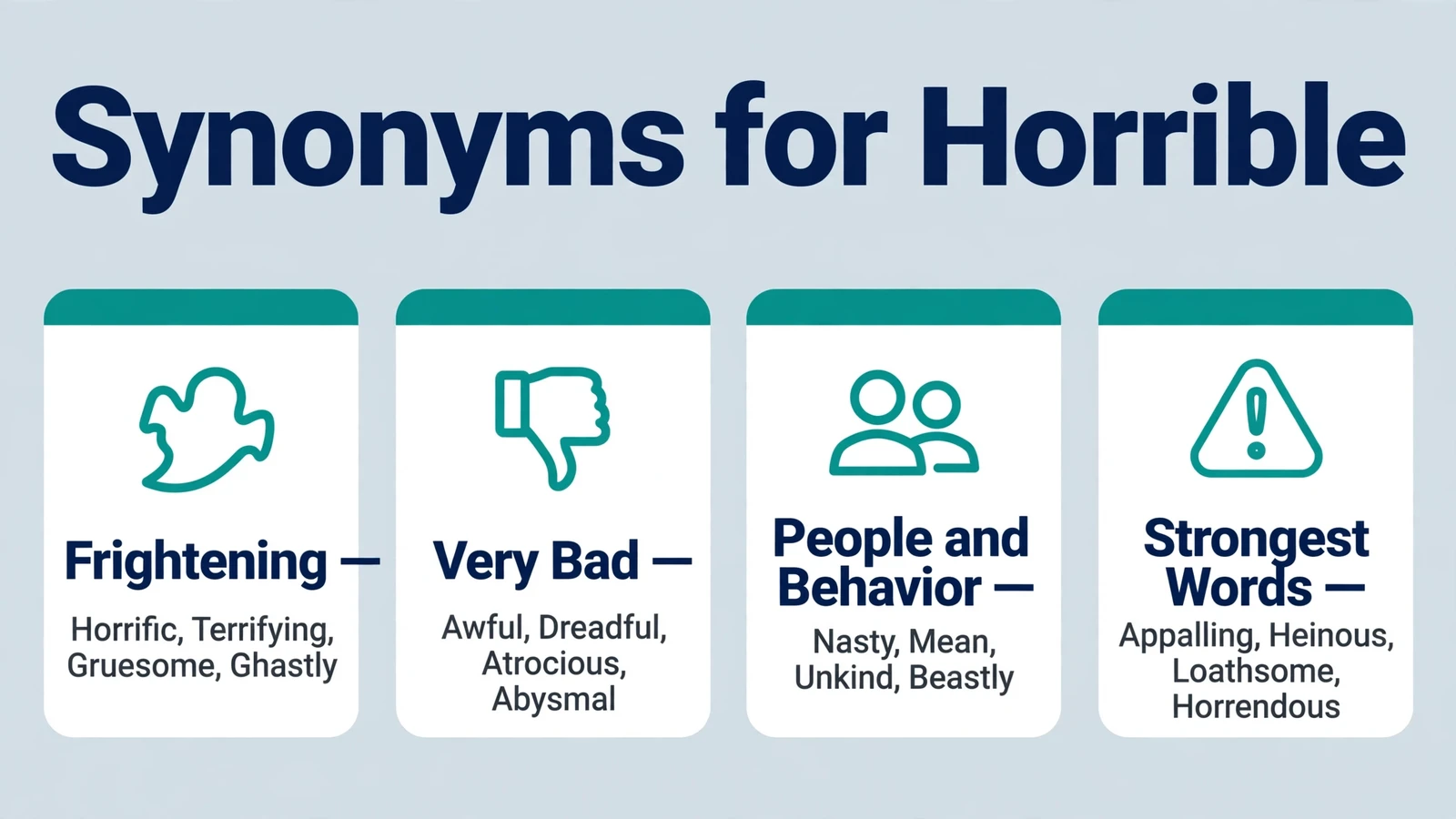
Horrible is the word we reach for when something feels wrong in every direction at once. A smell turns the stomach, a headline makes the skin crawl, and a meal disappoints from the first bite. For pure fear, the strongest synonyms for horrible are horrific, terrifying, gruesome, ghastly and horrifying. For everyday bad quality, writers lean on awful, dreadful, terrible, atrocious and abysmal instead. And when a person behaves badly, nasty, mean and unkind do the real work.
This guide sorts more than 30 verified synonyms for horrible by sense, so each word lands in the right sentence. Every group comes with short meanings and original examples. As a result, you can match the word to the harm instead of using horrible for everything.
Top Synonyms for Horrible: Quick Reference
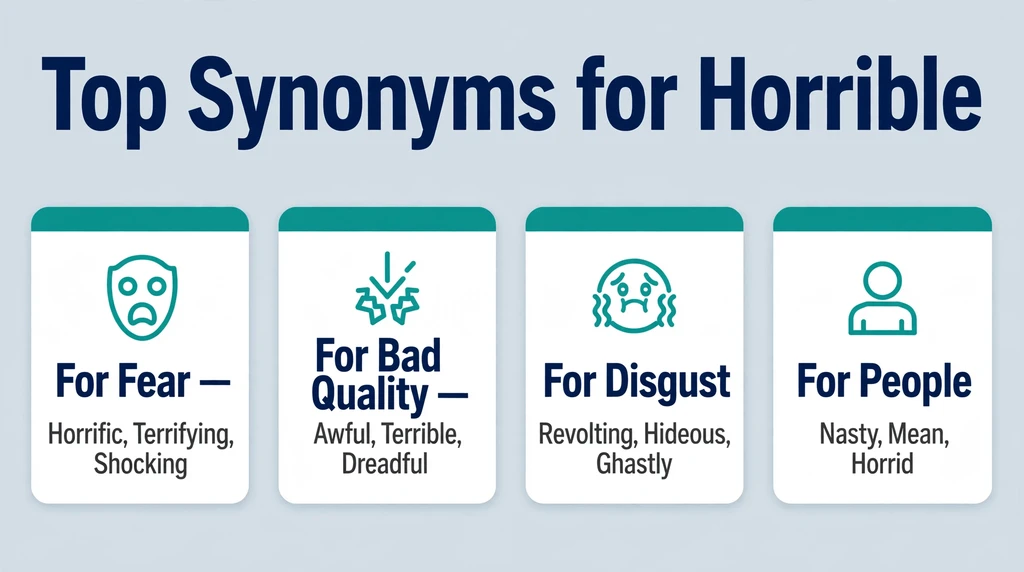
The table below covers the 24 synonyms readers reach for most often. Each row gives the word, a one-line meaning and the job it does best. Later sections sort the full list into finer groups.
| Word | Meaning in one line | Best for |
|---|---|---|
| Horrific | Extremely disturbing or repellent | Accidents, attacks, shocking scenes |
| Terrifying | Causing intense fear | Threats, moments of real danger |
| Horrifying | Filling someone with horror | News, discoveries, revelations |
| Gruesome | Grisly in gory detail | Injuries, crime scenes |
| Ghastly | Deathly, shocking or dreadful | News, sights, mistakes |
| Shocking | Causing sudden outrage or disbelief | Behaviour, revelations, prices |
| Dreadful | Causing dread, or simply very bad | News, weather, quality |
| Horrendous | Extremely shocking or unpleasant | Traffic, costs, injuries |
| Horrid | Very unpleasant or unkind | Informal speech, people |
| Appalling | Causing shock or dismay | Conditions, suffering, standards |
| Atrocious | Shockingly cruel or shockingly bad | Crimes, conditions, quality |
| Heinous | Utterly wicked and hateful | Formal writing about crimes |
| Awful | Very bad or unpleasant | Almost any everyday bad thing |
| Terrible | Extremely bad or unsatisfactory | Service, results, mistakes |
| Nasty | Unpleasant or unkind | Smells, surprises, people |
| Hideous | Extremely ugly or shocking | Appearance, crimes, sights |
| Disgusting | Causing strong revulsion | Smells, tastes, behaviour |
| Revolting | Making someone feel disgust | Smells, sights, conduct |
| Grim | Bleak and depressing | News, prospects, reality |
| Dire | Extremely serious or urgent | Warnings, situations, poverty |
| Abysmal | Extremely and hopelessly bad | Performance, results, standards |
| Deplorable | Deserving strong condemnation | Conditions, conduct, formal writing |
| Godawful | Truly dreadful | Informal speech, mild swearing tone |
| Beastly | Very unpleasant or unkind | British informal speech |
How to Use This Table
Read the table by reaction, not by alphabet. If your sentence describes a scene, start in the top rows, where the fear and shock words live. If it describes quality, drop to awful, terrible and abysmal. And if it describes a person, nasty, mean and horrid are your rows. One caution applies to the whole table. Strong words fade fast with repetition, so pick one per paragraph at most. A page where everything is horrific, ghastly and heinous at once reads like a parody of itself. Restraint is what keeps these words frightening.
What Does Horrible Mean?
Horrible is an adjective with two main jobs in modern English. Merriam-Webster defines the older job first: something horrible is marked by or arousing painful and intense fear, dread, dismay or aversion. In plain terms, it makes you shudder. The second job is broader and far more common today. Something horrible is simply extremely bad or unpleasant, like horrible food or a horrible mistake.
The Three Faces of Horrible
Collins sorts the word by the reaction it causes: fear, shock or disgust. That split explains why one word covers a car crash, a rotten smell and a rude remark. First, some horrible things frighten us. Next, some disgust us. Finally, some simply disappoint us or treat us badly. Each reaction has its own best synonyms, and this guide keeps them apart.
Horrible in Everyday Sentences
Notice how naturally the word stretches across a single day. The morning brings a horrible commute. Lunch offers a horrible sandwich. The evening news reports a horrible accident, and a friend describes a horrible boss. Four sentences, four different complaints, and the same adjective carries them all. That flexibility explains the word’s popularity. It also explains why careful writers often replace it. Each swap in this guide trades one broad word for a precise picture, and precision is what readers remember.
Horribly: The Adverb Form
The adverb horribly stretches the same two senses. Something can go horribly wrong, which keeps the flavour of disaster. Or prices can be horribly expensive, where the word works as a plain intensifier meaning extremely. Merriam-Webster lists horribly as the adverb of horrible, and everyday speech uses it constantly. Writers should still ration it. Horribly is a seasoning, not a structure, and three uses on one page will make the prose sound breathless. Terribly does the same intensifying job when a change is needed.
Where the Word Comes From
The history of horrible explains its fear-first meaning. Merriam-Webster traces it to Latin *horribilis*, built on *horrēre*, a verb meaning to bristle, shudder or shiver. So the earliest horrible things literally made hair stand on end. The word entered English in the 14th century with that fear sense. Only later did it widen into the general word for very bad that speakers use today.
Synonyms for Horrible That Mean Frightening or Shocking
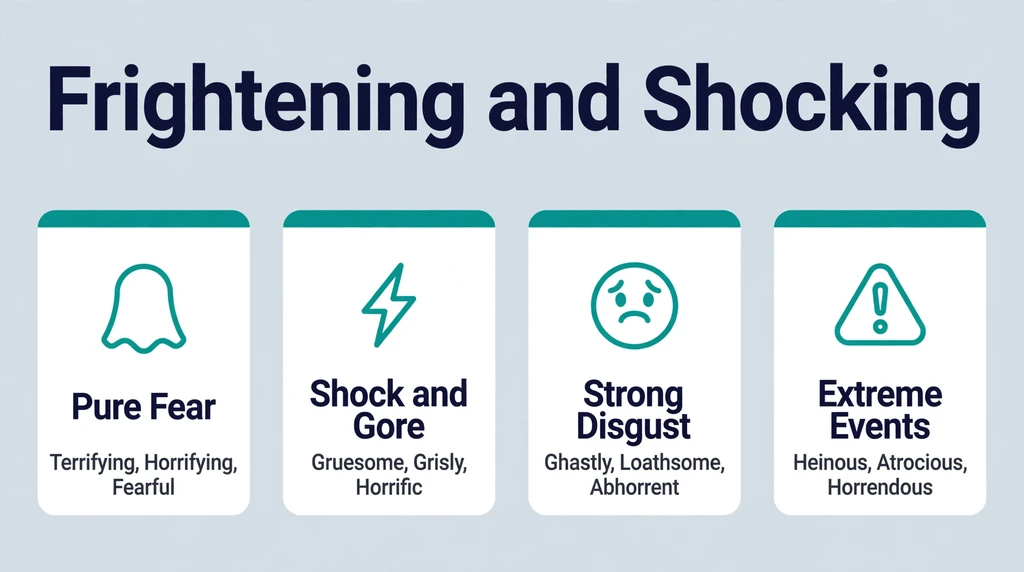
This is the oldest and strongest sense of horrible. These words describe scenes, events and sounds that trigger fear or shock. Because they carry real weight, writers save them for moments that deserve it. A terrifying storm earns the word. A slow queue at the supermarket does not.
Words for Pure Fear
Start with the words that name fear itself. Terrifying is the clearest choice when something causes intense fear in the moment. A terrifying scream, for example, freezes everyone who hears it. Horrifying works slightly differently. It describes the effect on the witness, so a horrifying discovery is one that fills people with horror as they take it in.
Fearful sounds softer and a little old-fashioned in this sense, yet thesauri still list it for dreadful events. Collins, for instance, gives the example of a fearful disaster after an earthquake. Use fearful when the tone is formal or literary rather than urgent.
- The terrifying descent lasted less than a minute, but nobody on board forgot it.
- Rescuers described a horrifying scene inside the flooded tunnel.
- A fearful silence followed the explosion, and then the alarms began.
One more pattern deserves a mention. English speakers often borrow the noun nightmare and set it in front of another noun: a nightmare journey, a nightmare scenario, a nightmare customer. Merriam-Webster lists nightmare among the close words for this sense of horrible. The pattern is informal and vivid, and it suits speech and lively writing. In formal reports, though, a precise adjective like disastrous or severe will usually read better. Treat the nightmare pattern as a spoken flourish rather than a core synonym.
Words for Shock, Gore and Disgust
Some horrible sights shock the eyes before they scare the mind. Horrific is the modern news word for this job. Reports use it for accidents, attacks and injuries that disturb everyone who sees them. Gruesome goes one step further into gory detail. It suits injuries and crime scenes described closely, so use it only when the detail is really there.
Grisly is the close cousin of gruesome. Journalists favour it for murders and discoveries, as in a series of grisly murders. Ghastly is broader and stranger. It can describe a deathly pale face, a shocking mistake or dreadful news. British speakers also use it for things that are simply appalling, like ghastly weather or a ghastly misunderstanding.
- The horrific crash closed the motorway for nine hours.
- Detectives released few details about the gruesome find.
- She made a ghastly error in the final paragraph of the report.
The Strongest Words: Moral Horror
A final group condemns rather than frightens. Heinous is the formal word for utterly wicked acts, and it belongs in legal, journalistic and official writing. Courts and headlines speak of heinous crimes, never of heinous sandwiches. Abhorrent works the same way. It says that decent people reject the thing completely, as in cruelty that most readers find abhorrent.
Loathsome adds personal disgust to the condemnation. A loathsome spectacle is one people hate watching and hate remembering. Abominable sits nearby, formal and heavy, often used for crimes and attacks in official statements. Together, these four words mark the top of the scale. Save them for cruelty and crime, and they will keep their force.
Horrible in Horror Writing and Film
Fiction writers lean on this whole sense when they build dread. A horrifying chapter ending leaves the reader unable to stop. A ghastly figure in a doorway chills more than a merely scary one, because ghastly suggests something deathly. Meanwhile, gruesome belongs to the evidence: wounds, remains and scenes described in detail. Good horror writing mixes the three carefully. Fear words set the mood, shock words land the blows, and disgust words linger after the page closes. If every paragraph screams at full volume, though, readers stop hearing any of it.
Synonyms for Horrible That Mean Very Bad or Unpleasant
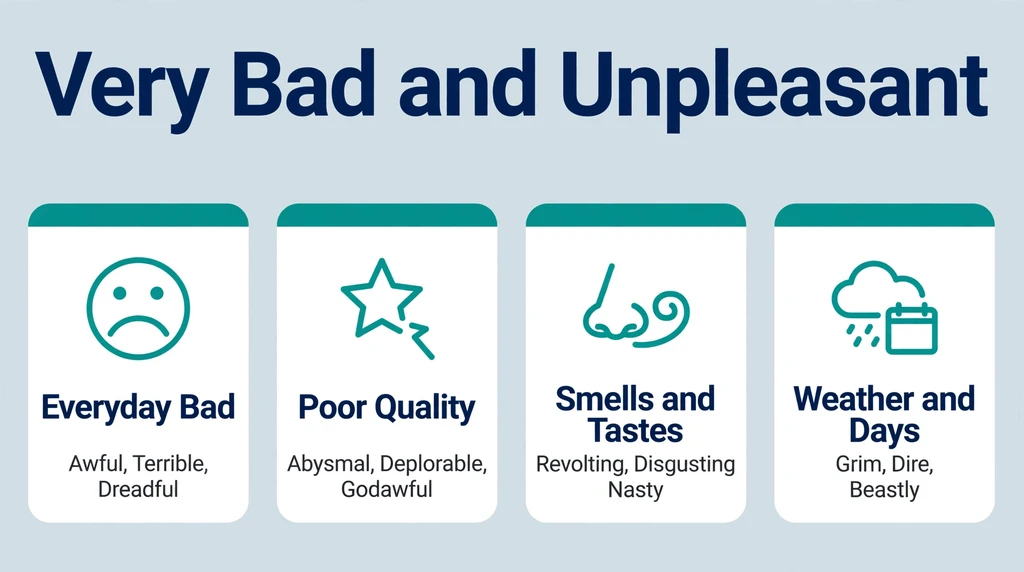
Most everyday horrible sentences belong in this section. The food was horrible, the service was horrible, the weather was horrible. Here the word means very bad, and English offers a rich set of swaps. If you want an even wider set for plain quality judgments, the guide to synonyms of bad covers the general bad family in depth.
Everyday Words for Bad Quality
Awful is the most flexible replacement of all. It fits weather, food, service, pain and performance without strain. Terrible runs a close second, and it sounds slightly stronger in formal writing. A terrible mistake usually costs more than an awful one. Dreadful adds a British flavour and a hint of gloom. It suits news, weather and quality alike, as in the dreadful forecast for tomorrow.
Nasty covers the unpleasant surprise. A nasty smell, a nasty shock and a nasty fall all share that sudden, unwelcome edge. Unpleasant is the mildest word in this group. Choose it when you want to stay polite in complaints and formal letters.
- The hotel room was awful: damp walls, cold water and a broken lock.
- He made a terrible decision and spent months undoing it.
- A nasty smell drifted up from the drains all afternoon.
Words for Hopeless Quality and Failure
Sometimes bad is not enough, and the thing has failed completely. Abysmal is the standard word for that depth of failure. Results, standards and records are abysmal when they sit far below every expectation. Atrocious works for quality too, especially in British English. Atrocious handwriting, atrocious conditions and an atrocious performance all sound natural.
Deplorable condemns while it criticises. Workers living in deplorable conditions are not just uncomfortable; someone deserves blame for it. For informal speech, godawful delivers the same verdict with a sigh built in. It suits traffic, headaches and weather in conversation, but it stays out of formal reports.
- The team’s away record this season has been abysmal.
- Tenants complained about the deplorable state of the stairwells.
- We sat in godawful traffic for nearly three hours.
Words for Smells, Tastes and Sights
Disgust has its own vocabulary. Disgusting is the everyday leader for smells, tastes and behaviour that revolt us. Revolting is a touch stronger and a touch more formal. A revolting smell in the cell, for example, is the example Collins gives for this word.
Hideous began with appearance, and it still describes extreme ugliness best. Even so, speakers extend it to crimes and attacks, as in a hideous attack on his family. Use hideous when the sight itself offends the eye, and disgusting when the stomach reacts first.
Words for Weather, Days and Journeys
British speakers complain about the weather with real relish, and this sense gives them the tools. Dreadful is the classic forecast word: a dreadful day of rain ahead. Beastly adds grumbling charm, as in beastly weather that ruins a picnic. Grim suits the outlook rather than the rain itself, so grim prospects and a grim reality sound right.
Journeys collect their own set. Horrendous is the traffic word of choice, since Cambridge illustrates it with the traffic getting here. A dire journey warns of delays and danger combined. And a truly miserable trip earns the informal label godawful, especially in speech. Choose by tone first, then by strength, and the complaint will land exactly as intended.
Words for Mistakes, Luck and Bad Timing
Mistakes attract horrible almost automatically. A horrible mistake is the example Merriam-Webster itself prints under the word. Terrible mistake sounds equally natural and slightly more formal. When the error shocks others, ghastly mistake steps in, and when it ruins everything, dreadful works too.
Luck follows the same ladder. Horrible luck and terrible luck cover most situations. Dreadful luck adds gloom, while dire straits describes the position the luck leaves you in. The pattern is consistent: choose the word whose emotional colour matches the story. A comic anecdote wants awful or godawful. A serious report wants terrible or dire.
Synonyms for Horrible People and Behavior
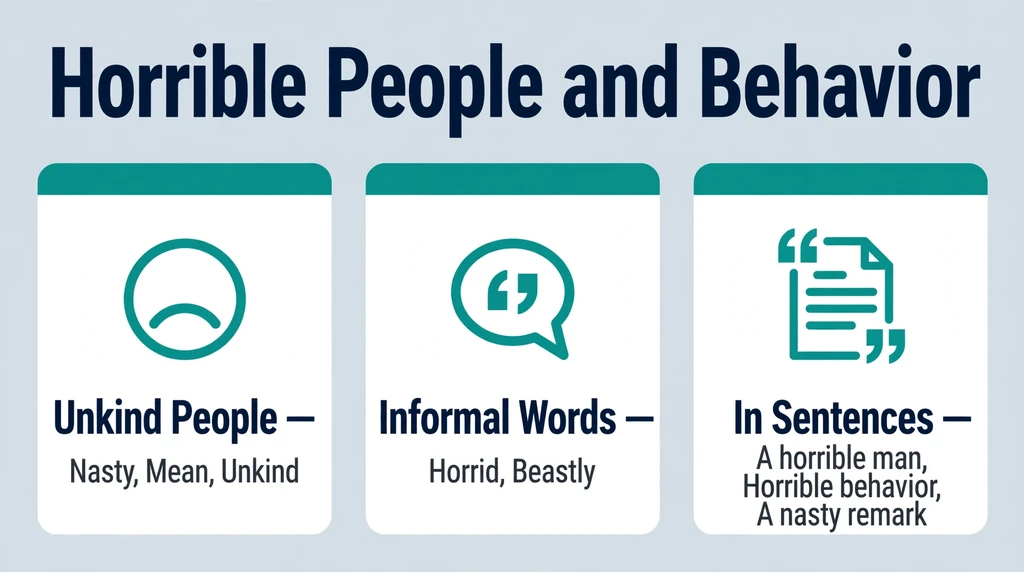
Horrible also describes people, and here the meaning shifts again. A horrible man is not frightening like a monster. He is unkind, unpleasant and hard to be around. Collins captures this sense with its own example: a horrible little boy. The words below keep that human meaning separate from fear and gore.
Unkind and Unpleasant People
Nasty is the everyday leader for this sense. It covers spiteful remarks, selfish behaviour and people who are kind only when others are watching. Collins makes the point neatly: he is only nasty to me when there is no one around to see it. Mean is the simpler, blunter word. Children use it early, and adults keep it for petty cruelty, as in the meanest man he had ever met.
Unkind is the gentlest choice in this group. It suits apologies and careful feedback, since it names the behaviour without attacking the person. He apologised for being unkind, for instance, sounds measured rather than furious. When cruelty is the real charge, writers sometimes reach for cruel itself. Thesaurus.com lists it beside horrible for behaviour, although the other thesauri keep it in its own entry, so treat it as a close cousin rather than a core synonym.
- My first manager was a horrible man who mocked new staff in meetings.
- She can be really nasty about other people’s mistakes.
- It was unkind of him to laugh at her accent.
Informal Words for Horrible People
British speakers often call an unpleasant person horrid. The word sounds old-fashioned to American ears, yet it survives in family speech: a horrid little girl, a horrid thing to say. Collins labels it informal, and Cambridge marks it old-fashioned informal. Either way, it softens the blow compared with nasty. It scolds rather than condemns.
Beastly is the other British informal favourite. It can describe weather, as in the beastly rain, but it also fits people who behave badly. Both words belong to speech and storytelling rather than reports. In a formal complaint, unkind or unacceptable will serve you better.
Horrible Bosses, Bullies and Dinner Guests
Certain stock characters attract this sense of horrible. The horrible boss belittles staff and claims their work. The horrible bully chooses targets who cannot answer back, which is exactly the behaviour Collins describes under nasty. The horrible dinner guest insults the cooking, dominates the table and never notices either fault.
For each character, writers can grade the wording. Unkind fits the guest who merely lacks warmth. Nasty fits the boss whose remarks carry spite. Mean fits the bully’s petty, repeated cruelty. One word change, and the reader knows precisely how much sympathy the victim deserves.
Horrible vs Terrible vs Horrific
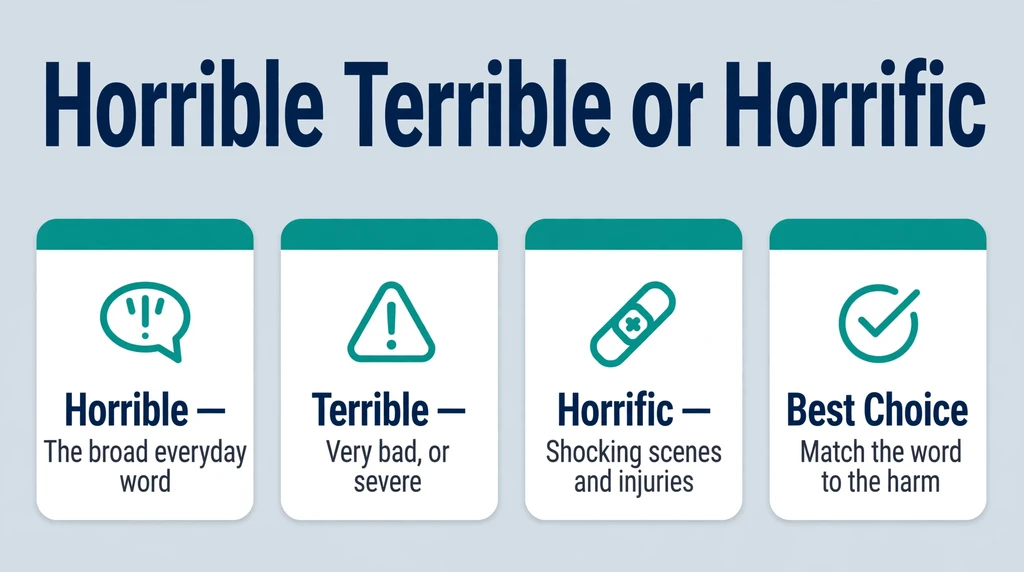
These three words overlap, and readers mix them up constantly. A quick comparison clears the fog. If you want the full family for the middle word, the dedicated guide to synonyms for terrible goes deeper.
Horrible: The Broad All-Rounder
Horrible covers the widest ground of the three. Merriam-Webster gives it four senses: disturbing, fear-causing, disgust-causing and extremely unsatisfactory. That range is its strength and its weakness. It always sounds negative, but it rarely says exactly which kind of negative. A horrible day might involve fear, disgust, pain or simple failure.
Terrible: The Quality and Severity Word
Terrible shares the fear root in its history, but modern usage centres on severity and quality. Merriam-Webster actually uses terrible as the headword for horrible’s “extremely unsatisfactory” sense. So horrible service and terrible service mean the same thing, and nobody blinks. Terrible also intensifies naturally: a terrible headache, a terrible loss, terrible consequences.
Horrific: The Shock-Only Word
Horrific is the narrow specialist. Both Merriam-Webster and Cambridge tie it to scenes that disturb or repel: horrific accidents, horrific injuries, horrific attacks. It never describes taste or service. Nobody with native instincts calls a meal horrific unless someone was poisoned at the table. Reach for horrific only when real shock is involved, and its power will stay intact.
A Simple Rule of Thumb
Ask what went wrong. If people were shocked or sickened by a scene, horrific fits. If the standard was dreadful or the impact severe, terrible fits. If you need one safe, broad complaint, horrible fits almost everywhere. That single question sorts most sentences in seconds.
What About Awful?
Awful deserves a footnote here, because it behaves like a fourth sibling. It matches horrible for bad quality, bad weather and bad behaviour, and Merriam-Webster uses awful as one of horrible’s four sense anchors. In practice, awful feels a shade milder and a shade more everyday than horrible. Nobody is surprised by an awful cup of tea. A horrible cup of tea, by contrast, hints that something went seriously wrong in the pot. When in doubt, awful is the safer everyday pick, and horrible is the stronger complaint.
Which Words Do News Writers Prefer?
The examples in the major thesauri reveal a clear newsroom pattern. Horrific attaches to accidents and attacks, as in Cambridge’s example of a bus in a horrific accident. Heinous attaches to crimes in both Collins and formal reporting. Grisly attaches to murders and discoveries. Appalling attaches to suffering and conditions that demand a response. None of this is a rule, but it is a reliable map. If your sentence resembles a headline, borrow the headline’s word and you will rarely go wrong.
How to Choose the Right Synonym for Horrible
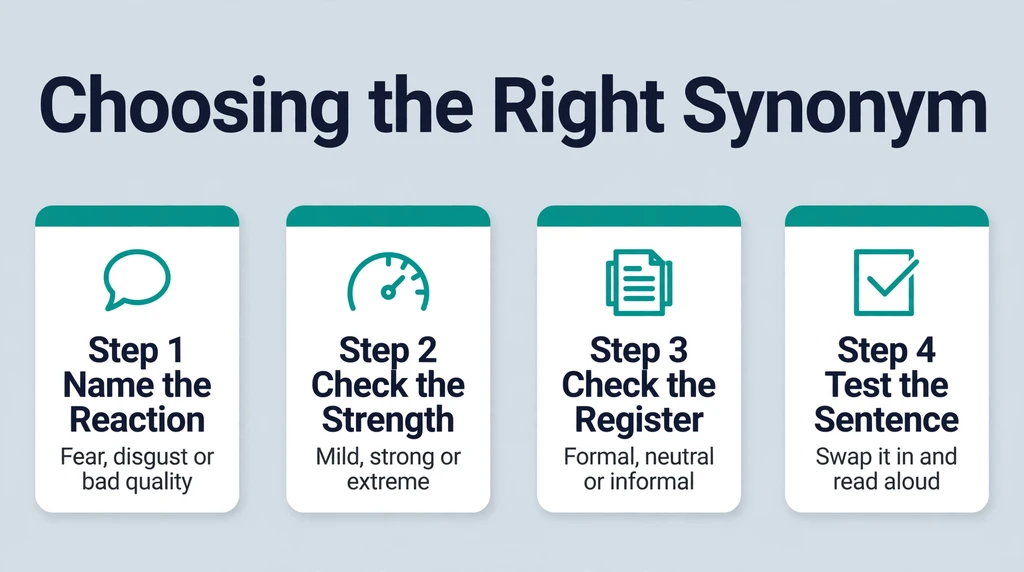
Choosing well takes four quick checks. Work through them in order, and the right word usually picks itself.
Step 1: Name the Reaction
Decide what the reader should feel. Fear points to terrifying or horrifying. Disgust points to revolting, disgusting or loathsome. Disappointment points to awful, dreadful or abysmal. Condemnation points to heinous, abhorrent or deplorable. Consider the pair below. Both sentences describe the same event, but they ask for different reactions.
- Weak: The attack was horrible, and the town felt sad for weeks.
- Stronger: The attack was heinous, and the town mourned for weeks.
The second version works because heinous condemns the act itself. Horrible only reported that it was bad.
Step 2: Check the Strength
These words form a ladder. Unpleasant sits at the mild end, then awful and terrible, then dreadful and appalling, and finally heinous and abhorrent at the top. Match the rung to the facts. If the soup was merely cold, awful is honest and horrific is theatre. Readers trust writers who keep their strongest words in reserve.
Step 3: Check the Register
Think about where the sentence will live. A news report can carry horrific, appalling and deplorable without strain. A text message to a friend suits godawful or beastly far better. School and work writing sits in the middle: awful, terrible and dreadful pass everywhere. The next section maps the registers in full.
Step 4: Read It Aloud
Finally, read the sentence aloud with the new word in place. Your ear catches collisions that your eye misses. A ghastly mistake sounds natural, while a ghastly sandwich sounds like a joke. When the swap sounds odd, the sense has probably shifted under your feet.
Step 5: Consider Your Reader
Finally, picture the person reading. Children meet horrible in storybooks, where it signals a villain or a fright without real gore. Students meet it in essays, where awful and dreadful earn safer marks than godawful. Customers meet it in reviews, where specific words like revolting or abysmal persuade far better than a general rant. The same event can honestly wear three different words for three different audiences. Skilled writers choose for the reader in front of them, not for the dictionary.
More Paired Examples
Practice makes the ladder feel natural. Study these pairs, and notice how each stronger version adds information rather than volume.
- Weak: The conditions in the camp were horrible.
- Stronger: The conditions in the camp were deplorable, and aid groups demanded action.
Deplorable blames someone, which is the point of the sentence.
- Weak: We had a horrible journey home.
- Stronger: We had a horrendous journey home through flooded roads.
Horrendous fits travel chaos, and the detail proves the word earns its place.
- Weak: He told a horrible lie about his colleague.
- Stronger: He told a loathsome lie about his colleague, and nobody trusted him afterwards.
Loathsome turns a bad act into one readers actively despise.
Formal and Informal Synonyms for Horrible
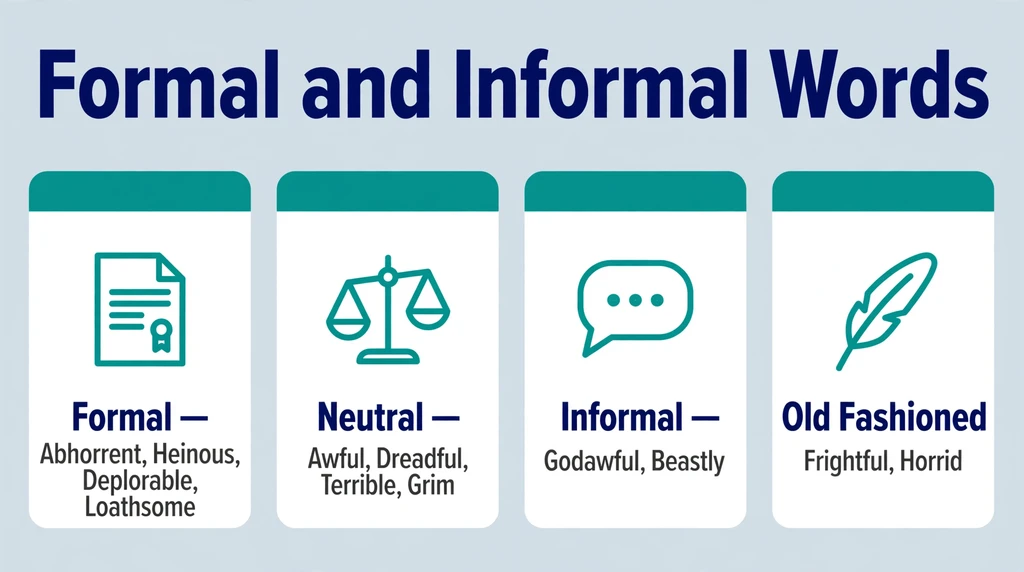
Register decides whether a sentence sounds like a court ruling or a kitchen complaint. This section sorts the main synonyms for horrible into three shelves, so you can grab the right tone quickly.
Formal Words
Formal writing favours words that judge calmly. Abhorrent states rejection without emotion: practices that the public finds abhorrent. Heinous adds legal weight for crimes. Deplorable condemns conditions and conduct while keeping a measured tone, which is why reports and editorials love it. Loathsome and abominable also appear in official statements, though both sound slightly old-fashioned today.
Neutral Words for Any Context
Most writers live on this shelf. Awful, terrible, dreadful, appalling, grim and dire pass in essays, emails, reports and conversation alike. Dire deserves a special note. It warns rather than complains: dire predictions, dire poverty, a dire situation. Choose it when the point is urgency, not disgust.
Informal and Old-Fashioned Words
Informal English relaxes the rules. Godawful moans about traffic and weather. Beastly complains with British charm. Everyday speech also allows plain lousy for a horrible performance or a horrible day, a word Thesaurus.com ranks among the strongest matches for horrible. Older speakers may add frightful and horrid, which Cambridge labels old-fashioned informal. They survive in family phrases and period fiction, so use them when a slightly vintage voice suits your text.
Synonyms for Horrible in a Sentence
Examples lock the senses in place better than definitions do. Read these ten sentences, and notice how each bold word fits only its own kind of bad.
1. The horrific pile-up involved six vehicles and closed the road overnight.
2. A terrifying roar came from the enclosure as the lights failed.
3. The report spared readers the gruesome details of the discovery.
4. It was a ghastly mistake to send the draft to the whole company. 5. The committee called the delays appalling and demanded a new timetable. 6. After three hours in the rain, the journey home felt horrendous. 7. His abysmal exam results surprised nobody who had seen his revision plan. 8. A nasty rumour spread through the office before lunch. 9. The soup had a revolting smell, so we sent it back. 10. She gave a dreadful performance and knew it before the applause faded.
Antonyms for Horrible
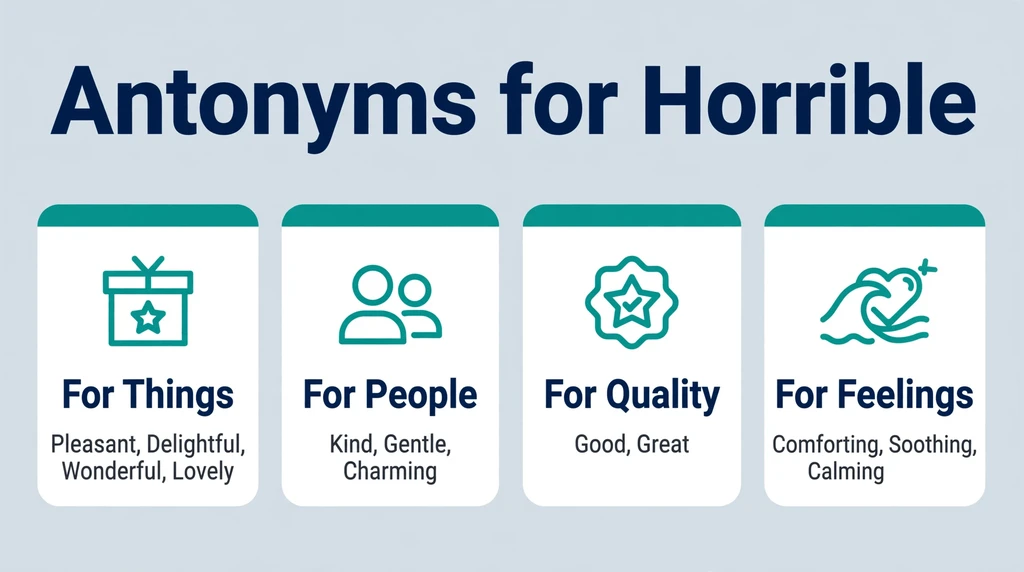
Every horrible thing has an opposite, and naming it sharpens both words. Collins lists appealing, charming, pleasant, wonderful, attractive, lovely and delightful among the opposites of horrible. Thesaurus.com adds good, great, kind, gentle, nice, pleasing, beautiful, calming, comforting and soothing. Cambridge simply pairs horrible with good in its entry.
Grouped by sense, the pattern is easy to remember. For things and experiences, use pleasant, delightful, wonderful and lovely. For people, use kind, gentle and charming. For quality, good and great do the heavy lifting. And for feelings, comforting and soothing reverse the shiver that horrible creates. The full guide to synonyms of good explores that positive family in detail.
- After a horrible week of storms, we enjoyed one lovely, calm evening.
- He was a kind and gentle teacher, the opposite of horrible in every way.
Words That Are Not True Synonyms for Horrible
Some words sit close to horrible without truly matching it. Using them as swaps creates sentences that mislead, so this section clears the border.
Terrific
Terrific is the classic trap. Merriam-Webster still lists it beside horrible because it once meant terror-causing. Modern readers, however, understand terrific as excellent. Calling a meal terrific praises it, whatever you intended. Leave terrific out of your synonym lists for horrible.
Bad on Its Own
Bad is not wrong, but it is weak and vague. Cambridge places bad inside horrible’s topic group because horrible often means bad with extra force. Replacing horrible with bad drains the sentence of that force. If a plainer word is truly needed, awful or poor will usually say more.
Terrified and Horror
Terrified describes the person who feels the fear, not the thing that causes it. The crowd was terrified is correct; a terrified crash is not. Horror, meanwhile, is a noun and a film genre. It names the feeling itself, so it cannot swap for the adjective horrible. Keep the grammar straight, and half of these mix-ups disappear.
Scary and Eerie
Scary feels like an obvious synonym, yet among the major thesauri checked for this guide, only Thesaurus.com lists it beside horrible. Eerie fails the same test and also means something narrower: strange in a way that unsettles. Both words are fine in casual writing, but neither carries horrible’s full range, so this guide leaves them outside the main groups.
Frequently Asked Questions
What is the strongest synonym for horrible?
Heinous and abhorrent sit at the top of the scale for acts and crimes. For scenes and events, horrific and appalling carry the most force. The strongest choice depends on whether you are condemning an act or describing a sight.
What is a formal synonym for horrible?
Abhorrent, heinous, deplorable and loathsome all suit formal writing. Reports often describe conditions as deplorable and crimes as heinous. Awful and terrible are safe too, although they sound less formal.
Is horrific stronger than horrible?
Yes, in practice it is. Horrific is reserved for scenes that genuinely disturb or repel, such as accidents and attacks. Horrible covers those scenes too, but it also stretches to food, weather and service, which dilutes its force.
Can horrible describe a person?
Yes. A horrible person is unkind, unpleasant or spiteful rather than frightening. Nasty, mean, unkind and the informal horrid all capture that sense. Collins even uses a horrible little boy as its example for this meaning.
What is the difference between horrible and terrible?
In everyday quality judgments, almost nothing: horrible service and terrible service mean the same. Terrible leans slightly more formal and severe, while horrible feels broader and more emotional. Both stay far weaker than horrific, which demands real shock.
Is horrid the same as horrible?
Nearly. Horrid means very unpleasant or unkind, and speakers use it the same way as horrible in informal speech. Cambridge labels it old-fashioned informal, so it sounds quaint in modern American writing and cosier in British family speech.
What is the opposite of horrible?
Common opposites include pleasant, lovely, delightful, wonderful and charming for things, and kind and gentle for people. For simple quality judgments, good and great are the natural antonyms.
Where does the word horrible come from?
It comes from Latin *horribilis*, from *horrēre*, meaning to bristle, shudder or shiver. Merriam-Webster notes its first known use in English in the 14th century. The fear sense came first; the general sense of very bad developed later.
Final Thoughts
Horrible earns its keep by being broad, but breadth is also its limit. Once you name the exact reaction, a sharper word is always waiting. Let terrifying carry the fear, let revolting carry the disgust, and let abysmal carry the failure. Keep heinous and horrific in reserve for the moments that truly deserve them, and your writing will sound measured instead of melodramatic. For the dictionary’s own full list, the Merriam-Webster Thesaurus entry for horrible is the best place to keep exploring.