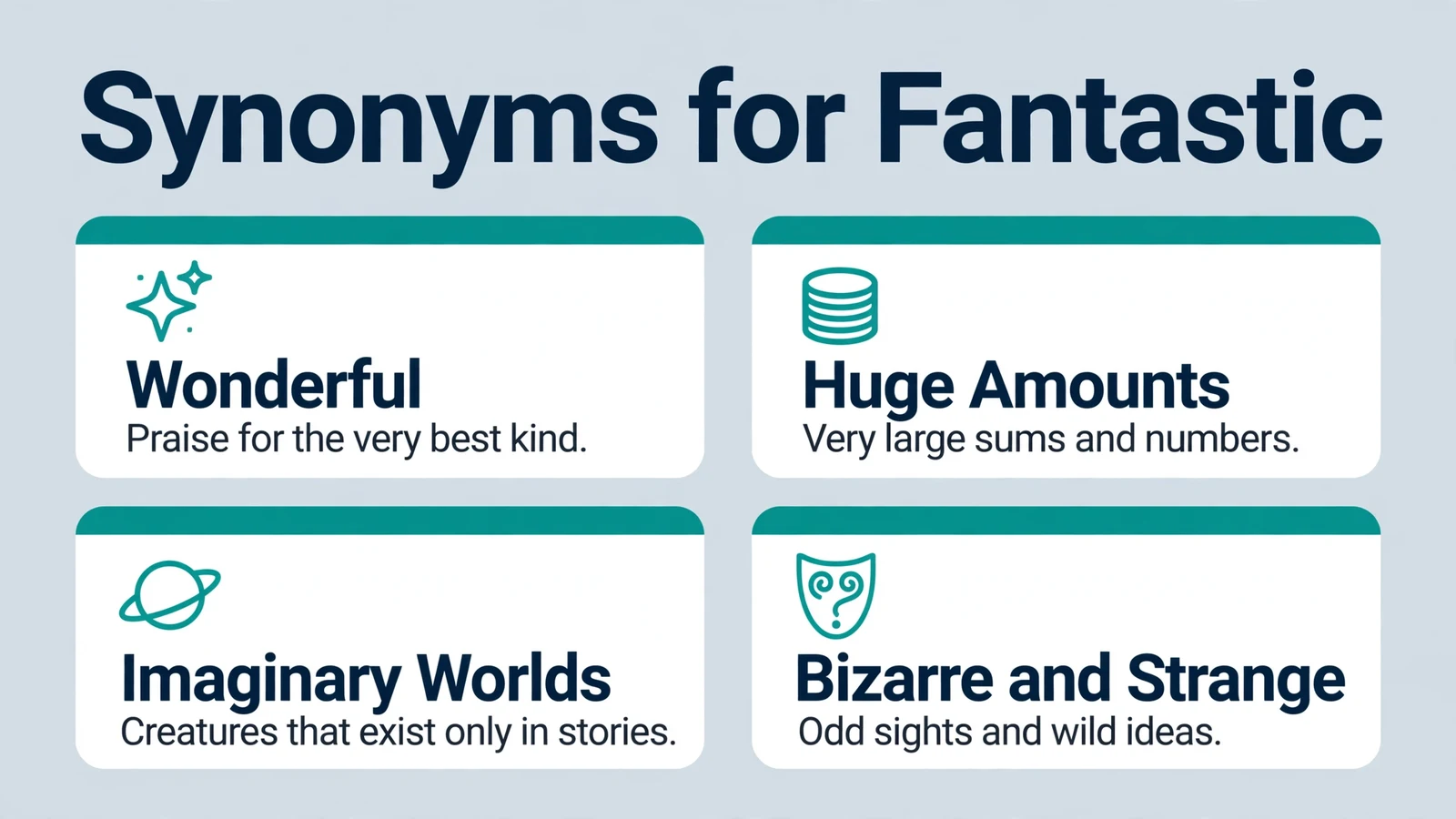
Fantastic is one of the hardest-working praise words in English, but it hides more than one meaning. The most useful synonyms for fantastic include wonderful, fabulous, marvelous, superb, terrific, tremendous, and amazing for praise, enormous and huge for very large amounts, and imaginary, fanciful, bizarre, and grotesque for its older literary senses. Each group points in a different direction, so picking the wrong one can quietly change your meaning.
This guide sorts more than 45 verified synonyms for fantastic by sense and tone. It also covers antonyms, formal and informal choices, and the near misses that are not true synonyms at all. Dictionaries and thesauruses were cross-checked for every word on the list. As a result, each entry below sits in the group where the sources actually place it, not where it merely sounds right.
Top Synonyms for Fantastic: Quick Reference
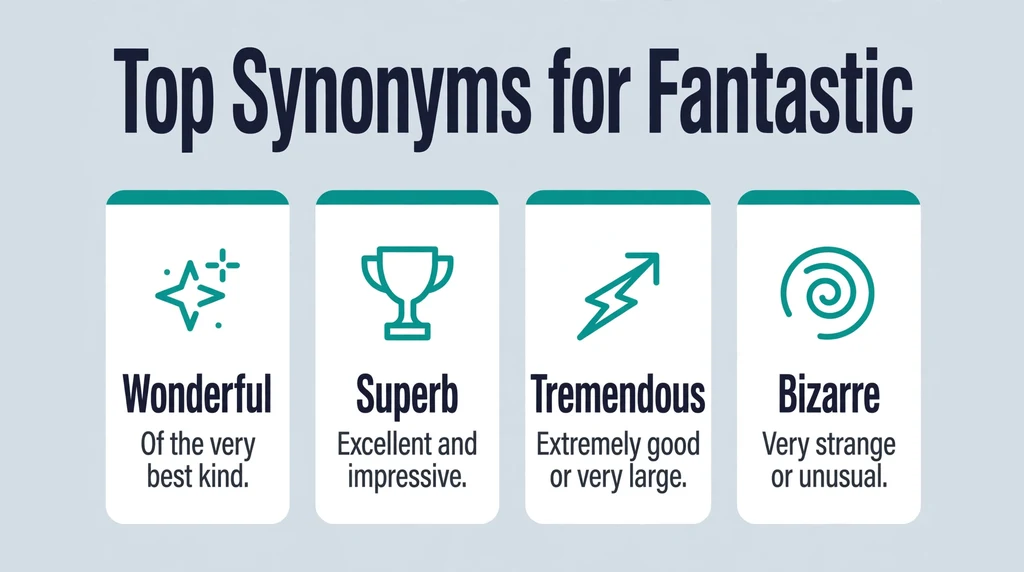
The table below covers the synonyms readers reach for most often. Start here when you need one fast replacement. The later sections then sort the full list into finer groups by sense.
| Word | Meaning in one line | Best for |
|---|---|---|
| Wonderful | Of the very best kind | Warm, general praise |
| Excellent | Extremely good quality | Work, results, formal praise |
| Great | Very good, informal | Everyday speech and news |
| Superb | Excellent in an impressive way | Performances, food, skill |
| Terrific | Extremely good | Enthusiastic everyday praise |
| Fabulous | Wonderful and impressive | Style, looks, celebrations |
| Amazing | Surprisingly good | Reactions and results |
| Marvelous | Causing wonder, excellent | Slightly formal praise |
| Sensational | Causing great excitement | Headlines, performances |
| Tremendous | Extremely good or very large | Praise and amounts |
| Brilliant | Extremely good, British informal | UK speech, ideas, plans |
| Awesome | Extremely good, informal | Casual speech, younger tone |
| First-rate | Of the highest quality | Services, professionals |
| Stupendous | Extremely impressive | Big achievements, views |
| Imaginary | Existing only in the mind | Stories, children, fiction |
| Fictional | Invented for a story | Books, films, characters |
| Fanciful | Imagined, not practical | Ideas, designs, tales |
| Bizarre | Very strange or unusual | Events, sights, behaviour |
| Grotesque | Strange in an ugly, twisted way | Images, art, descriptions |
| Outlandish | Strange and unfamiliar | Claims, outfits, customs |
More Quick Picks by Sense
| Word | Meaning in one line | Best for |
|---|---|---|
| Weird | Strange or unnatural | Casual speech, odd moments |
| Fanciful | Imagined rather than practical | Ideas, designs, tales |
| Unreal | Not real, dreamlike | Scenes, atmospheres |
| Vast | Very large in scale or amount | Sums, data, reserves |
| Overwhelming | So large it dominates | Majorities, support, evidence |
| Cool | Very good, informal | Quiet casual praise |
| Super | Very good, old-fashioned | Dated or gentle speech |
| Cracking | Very good, British informal | Hearty British praise |
| Whimsical | Playfully strange | Designs, humour, stories |
| Far-fetched | Hard to believe | Tales, excuses, claims |
| Astonishing | So surprising it amazes | Results, feats, news |
| Miraculous | Like a miracle, remarkable | Recoveries, escapes, wins |
| Incredible | Hard to believe, extraordinary | Stories, offers, feats |
| Huge | Very large in amount | Money, numbers, support |
| Enormous | Extremely large in amount | Scale and quantity |
What Does Fantastic Mean?
Fantastic has four main senses in modern dictionaries, and they split into two families. The first family is about praise and size. The second family, which is much older, is about imagination and strangeness. Keeping those families apart is the key to using the synonyms well.
The praise and size senses
In everyday speech, fantastic usually means extremely good. Merriam-Webster phrases this sense as “of the very best kind”, as in “the surfing conditions were simply fantastic”. Collins marks this sense informal, which matches how people actually use it. A fantastic meal, a fantastic job offer, and fantastic news all carry simple, strong approval.
The size sense grows out of the same informal habit. Collins lists a separate sense, “very large in degree or amount”, with the example “fantastic amounts of money”. So a fantastic amount, a fantastic sum, or fantastic support means a strikingly large one. The word works like a volume dial here rather than a quality badge.
The imagination and strangeness senses
The older senses point somewhere else entirely. Merriam-Webster lists fantastic for things “conceived or made without regard for reason or reality”, for things “not real and existing only in the imagination”, and for stories “too extraordinary or improbable to believe”. A fantastic creature is invented, not excellent. A fantastic excuse is hard to believe, not impressive.
The word’s history explains the split. Fantastic entered English in the late 1300s with the imagination meaning, from a Greek root meaning “able to imagine”. The praise sense, by contrast, is recorded only from 1938. In other words, the imaginary meaning is the original one, and the praise meaning is a modern guest in the word.
The four senses in real sentences
Examples make the split easy to spot. “She landed a fantastic new job” uses the praise sense, and wonderful or excellent could replace the word at once. “He spent a fantastic amount on the car” uses the size sense, so huge or enormous fits better. “The story is full of fantastic beasts” uses the imaginary sense, because the beasts were invented by an author. Finally, “he arrived in a fantastic costume of feathers and clocks” uses the strange sense. The costume is real, yet its design ignores every normal rule. One word, four jobs, and the noun beside it tells you which job is running.
Synonyms for Fantastic That Mean Excellent
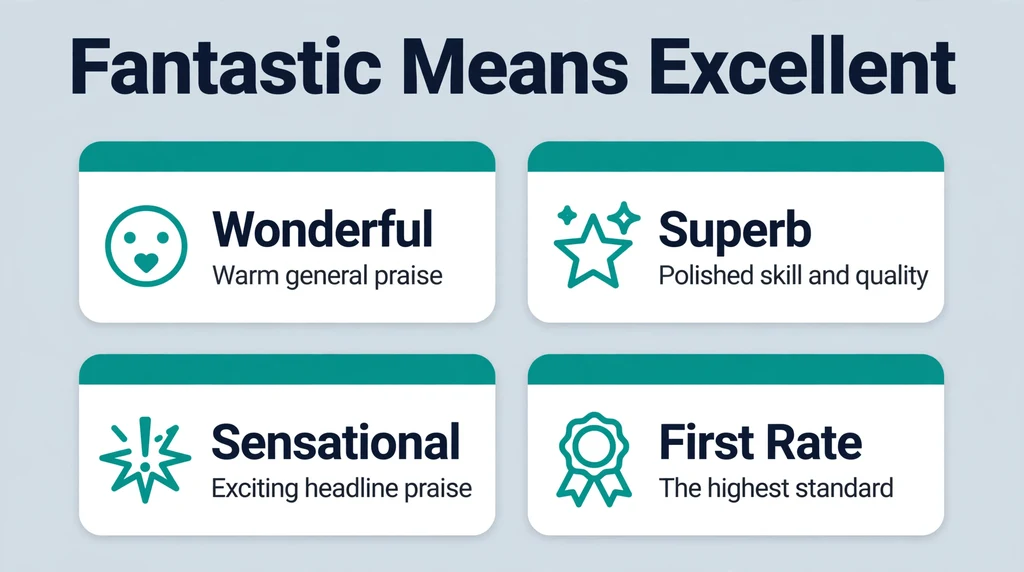
This is the group most readers want. All of these words praise quality, yet each one leans in a slightly different direction. Some sound warm, some sound grand, and some sound like a headline.
Warm, everyday praise
Wonderful is the closest all-purpose match. It praises warmly without sounding over the top, so it suits people, days, meals, and news. Excellent sounds a touch more measured. It fits work, results, and service, where quality matters more than excitement. Great is the informal staple. Cambridge and Collins both mark it informal, and it covers almost any good thing in speech.
Terrific adds energy to the same ground. It suits news, ideas, and performances that genuinely please you. Amazing, meanwhile, adds surprise. Something amazing is not just good, it is better than you expected. That small difference is why “amazing” fits results and reactions so well.
Grand and impressive praise
Fabulous suggests something wonderful and a little glamorous. It loves dresses, parties, holidays, and success stories. Marvelous causes wonder as it praises, so it feels slightly formal and literary. Writers often choose it for places, voices, and achievements with real charm.
Superb praises skill and quality in an impressive way. A superb performance, a superb meal, and a superb golf course all sound polished. First-rate does similar work for services and professionals. It promises the highest standard without any sparkle. Sensational is the headline word of the group. It praises by stressing excitement, so it fits performances, victories, and revelations.
So good it is hard to believe
A smaller set praises by stressing scale or surprise. Stupendous describes something extremely impressive, often through sheer size or effort. Astonishing stresses the shock of the thing. An astonishing result makes people stop and stare. Miraculous goes further still. It suits recoveries, escapes, and wins that seemed almost impossible.
Incredible sits on the border between praise and disbelief. Collins places it with stories that are difficult to believe, yet speakers also use it for extraordinary quality. Context decides which way it leans. Tremendous also crosses groups, since it praises quality here and measures amount later. Both words earn a closer look in the choose section below.
Example sentences with excellent synonyms
Short examples show how the shades separate in practice. “The orchestra gave a superb performance” praises polish and skill. “She is a first-rate surgeon” promises a top professional standard. “What a fabulous evening that was” adds glamour and delight to simple approval. “The news is terrific” sounds warmer and more excited than “the news is excellent”. Meanwhile, “he pulled off a miraculous escape” praises by stressing how close the outcome came to impossible. Each sentence approves, yet no two approvals feel the same.
For two close cousins of this group, see the dedicated pages on synonyms for brilliant and synonyms for amazing, which sort those words by their own shades of meaning.
Informal and Slang Synonyms for Fantastic
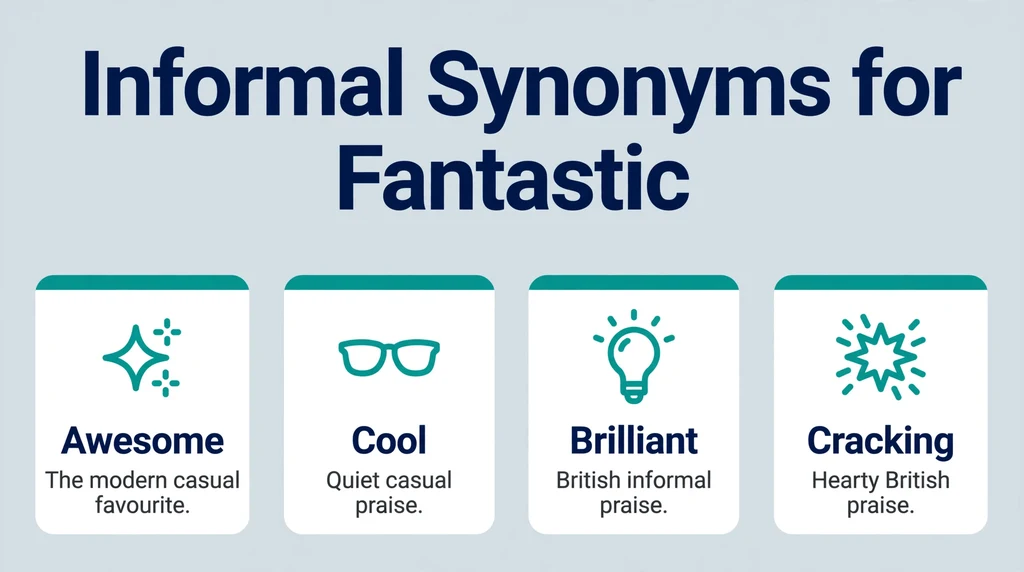
Praise words age quickly, and the informal shelf shows it. These words sound natural in speech, messages, and social posts. However, they can look careless in formal writing, so use them where a relaxed tone already fits.
Current casual favourites
Awesome is the modern default for strong approval. Cambridge marks it informal, and it suits wins, plans, and good news. Cool praises more quietly. A cool bike, a cool idea, or a cool venue sounds pleased but calm. Brilliant is the British favourite of the group. Cambridge marks it UK informal, and British speakers use it for plans, news, and arrangements far more than for shining light.
Cracking is British informal praise with real energy. A cracking game or a cracking meal sounds hearty and pleased. It feels dated to some younger speakers, though, so it often carries a cheerful, slightly old-school flavour.
Older and fading praise
Super once did the work that awesome does now. Cambridge marks it old-fashioned informal, and it still appears in polite, slightly dated speech. “How was your holiday?” “It was super, thanks.” Today it often sounds gently ironic. Smashing and topping belong to the same older British shelf in the Collins lists. They can charm in period writing, yet they risk sounding like a costume in modern prose.
The lesson is simple. Slang praise dates a text faster than almost any other choice. If your writing must stay fresh for years, the excellent group above will age far more gracefully.
Fantastic in texts and social posts
Short messages reward short praise, which is why awesome and cool rule there. “Awesome, see you at seven” approves a plan in two syllables of effort. British friends might answer “brilliant” to the same message, and the word works as a complete reply. Fantastic itself often appears as a one-word answer too. “I got the job.” “Fantastic!” The reply needs no noun at all, because the praise sense is the default in conversation. That default is exactly why the older senses need clear context everywhere else.
Synonyms for Fantastic for Very Large Amounts
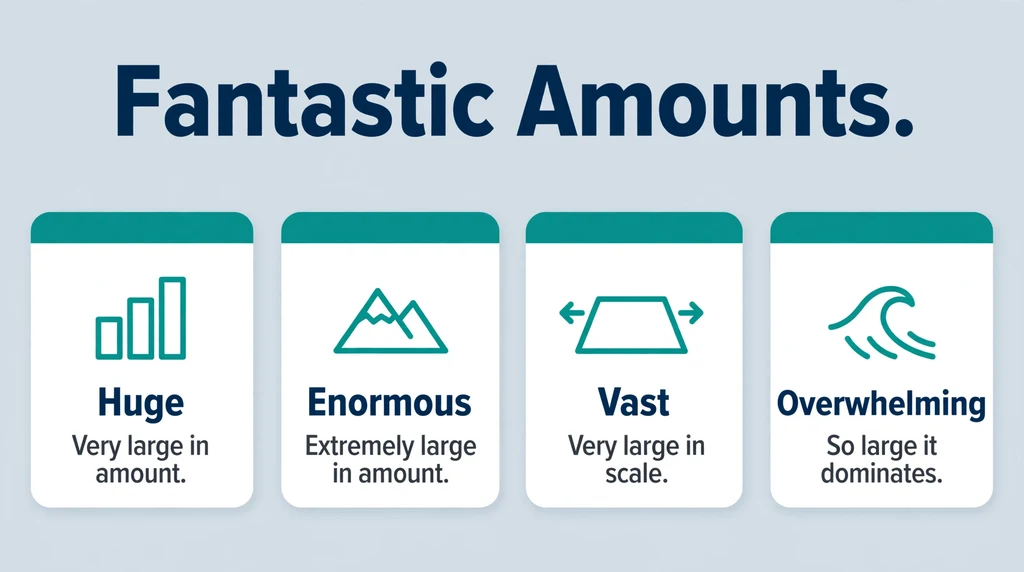
Fantastic also works as a size word in informal English. Collins defines this sense as “very large in degree or amount” and gives the example “fantastic amounts of money”. The synonyms below belong only to this sense. None of them praises quality by itself.
Amounts of money and numbers
Huge is the plainest replacement. A huge amount, a huge sum, and a huge response all stress size without drama. Enormous reaches further. It suits amounts so large that they feel hard to picture. Vast prefers wide, sweeping quantities. Writers use it for vast sums, vast amounts of data, and vast reserves.
Tremendous belongs here as well as in the praise group. A tremendous amount of work means a very large amount, not necessarily excellent work. That double duty makes tremendous useful, but it also makes it ambiguous. If size is your only point, huge or enormous says it more cleanly.
Pressure, majorities and extremes
Overwhelming fits amounts that dominate everything else. An overwhelming majority, overwhelming support, or overwhelming evidence wins by sheer weight. Extreme marks the far end of a scale. Extreme wealth, extreme heat, and extreme poverty all sit beyond the normal range.
One caution belongs here. These size words can sound vague in serious reporting. A precise figure beats a fantastic amount almost every time. Save the size synonyms for colour, and give readers the real number whenever you have it.
Fantastic sums in headlines and reports
Headlines love this sense because it promises scale in one word. “Charity raises a fantastic sum” tells readers the total impressed the writer. Swapping in huge keeps the size and drops the excitement. “The club paid an enormous fee” sounds weightier still, as if the number strains belief. Cambridge even shows the pattern with praise instead of money: a writer can receive “a fantastic amount of praise”. Amounts of praise, support, and attention all behave like amounts of money here. The sense measures volume, never quality, so a fantastic amount of criticism is just as possible.
Synonyms for Fantastic That Mean Imaginary
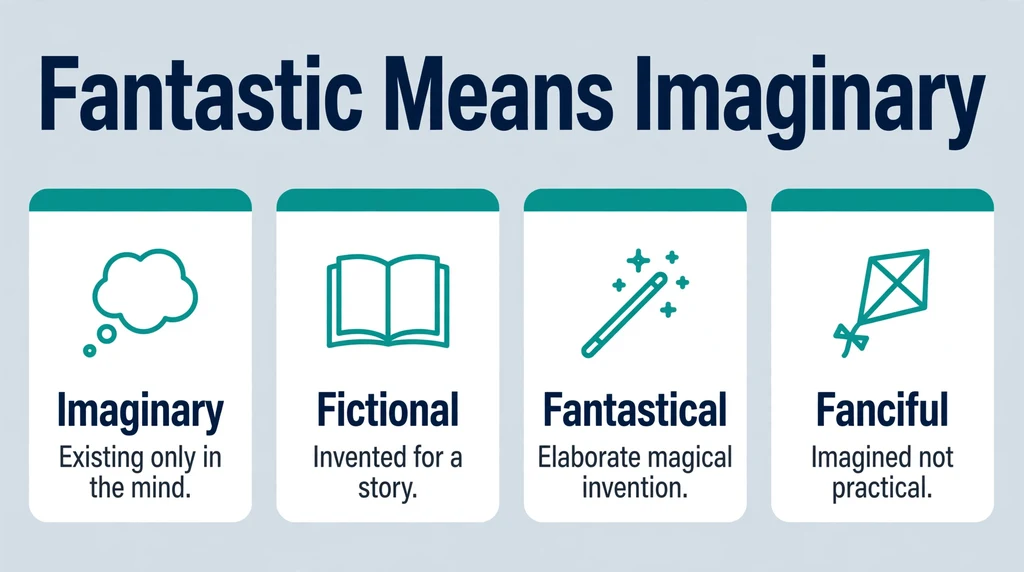
This is the oldest sense of fantastic, and it still thrives in writing about stories. A fantastic creature, a fantastic world, or a fantastic tale is invented. Nothing here praises quality, so keep this group well away from the excellent group.
Worlds, creatures and characters
Imaginary is the clear, neutral choice. It simply says that something exists only in the mind. An imaginary friend, an imaginary line, and an imaginary illness all use it plainly. Fictional belongs to stories. Fictional characters, fictional places, and fictional accounts were invented for a narrative, even when they feel real.
Fantastical is the closest relative of fantastic itself. Cambridge lists it in the imaginary group for creations and designs. It often describes elaborate, magical invention, as in fantastical creatures or a fantastical castle. Because it keeps the flavour of the original word, writers favour it in fantasy and book talk.
Ideas, tales and inventions of the mind
Fanciful describes ideas that are imagined rather than practical. A fanciful scheme, a fanciful design, and fanciful notions all sound pretty but unlikely. It often carries a gentle warning that the idea will not survive contact with reality. Unreal stresses the gap from the real world. An unreal landscape or an unreal atmosphere feels dreamlike and slightly strange.
A quick test keeps this sense straight. If the sentence is about a story, a creature, or an imagined thing, choose from this group. If the sentence praises a meal or a job offer, fantastic means excellent instead, and this group would mislead your reader.
Fantastic in fantasy, tales and make-believe
Book talk keeps this sense busy. Reviewers describe fantastical worlds, imaginary kingdoms, and fictional schools, and each adjective tells readers the place was invented. Cambridge compares two softer relatives here: a storybook romance and a fairy-tale wedding. Those phrases borrow the imaginary sense but turn it approving, since both describe real events that feel lifted from a tale. The borrowing works because readers know the source. Without a story nearby, though, calling a real plan fantastical would suggest it exists only in someone’s head.
Synonyms for Fantastic That Mean Strange or Bizarre
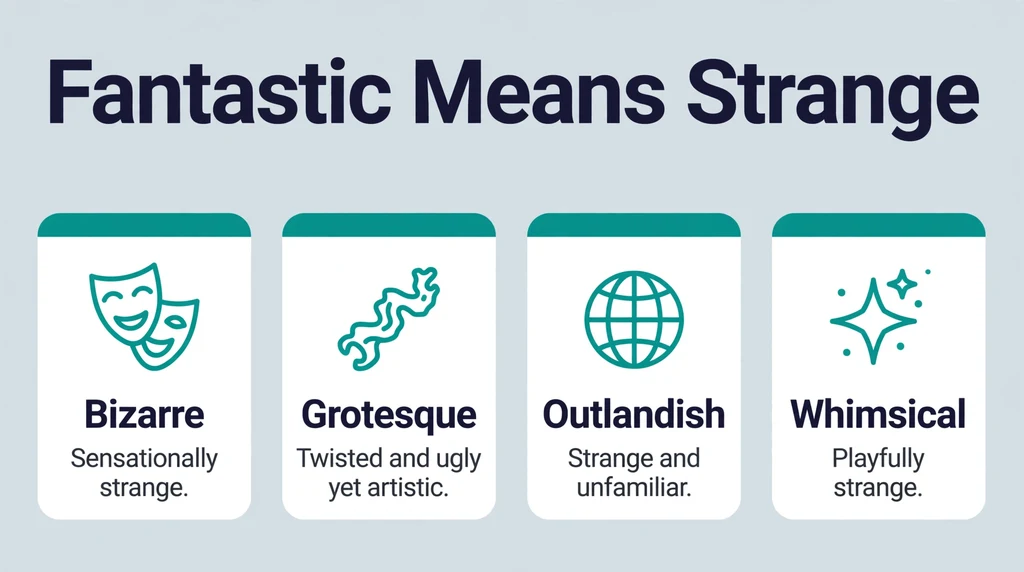
Merriam-Webster makes this sense its first one for fantastic. Its Synonym Chooser names bizarre and grotesque as the common synonyms here. All three words describe things made “without adherence to truth or reality”. Fantastic in this sense may praise the imagination, yet it never simply means excellent.
Strange sights and behaviour
Bizarre applies to the sensationally strange. Merriam-Webster notes that it implies a violent contrast or an incongruity of combination. A bizarre castle in a modern city is its classic example. Outlandish suits things that feel strange and unfamiliar. Outlandish claims, outfits, and customs all clash with what people expect.
Weird is the everyday word for this group. It covers anything strange or unnatural in casual speech. Peculiar sounds a little more formal and a little more judging. A peculiar smell or a peculiar habit invites a raised eyebrow. Odd is the mildest option. It marks something unusual without making a scene of it.
Twisted, dreamlike and playful strange
Grotesque is the darkest word here. Merriam-Webster says it may describe what is conventionally ugly but artistically effective. It can also suggest ludicrous awkwardness with sinister overtones. Grotesque statues and a grotesque attempt at a smile show both shades. Choose it only when that twisted flavour is truly meant.
Exotic takes the strange sense somewhere brighter. It describes things that feel foreign, striking, and unusual in an attractive way. Whimsical goes playful instead. A whimsical design or a whimsical sense of humour charms through its oddness. Quaint softens strangeness into old-fashioned charm. Quaint customs and quaint villages feel unusual in a pleasant, dated way.
Freakish stresses abnormality, as in freakish weather or a freakish accident. Imaginative, by contrast, praises inventive strangeness. An imaginative recipe or design bends reality in a clever direction. The same bending, pushed further, leads into the next group.
Hard to believe
Some fantastic things are strange because they strain belief. A fantastic story, in this sense, is one nobody quite trusts. Far-fetched is the standard choice for such tales and excuses. Implausible sounds more formal and analytical. It suits reports, reviews, and arguments. Unlikely is the plain middle option for events and explanations.
Absurd judges the thing as plainly unreasonable. Ridiculous adds open scorn, and comical turns the strangeness into something laughable. Extravagant fits claims and tales that go far beyond reason or proportion. Eccentric, finally, describes people and habits that stray from convention in a noticeable way. Together, these words cover the full road from merely odd to frankly unbelievable.
Example sentences with strange synonyms
Examples pin these shades down. “A bizarre rumour spread through the office” promises something sensationally odd. “The cathedral is covered in grotesque statues” uses the word in its artistic, twisted sense. “He told a far-fetched story about the delay” accuses the story, politely, of straining belief. “Her whimsical illustrations charmed the children” keeps the strangeness playful and kind. Notice how each swap changes the judgement while the basic oddness stays put.
How to Choose the Right Synonym for Fantastic
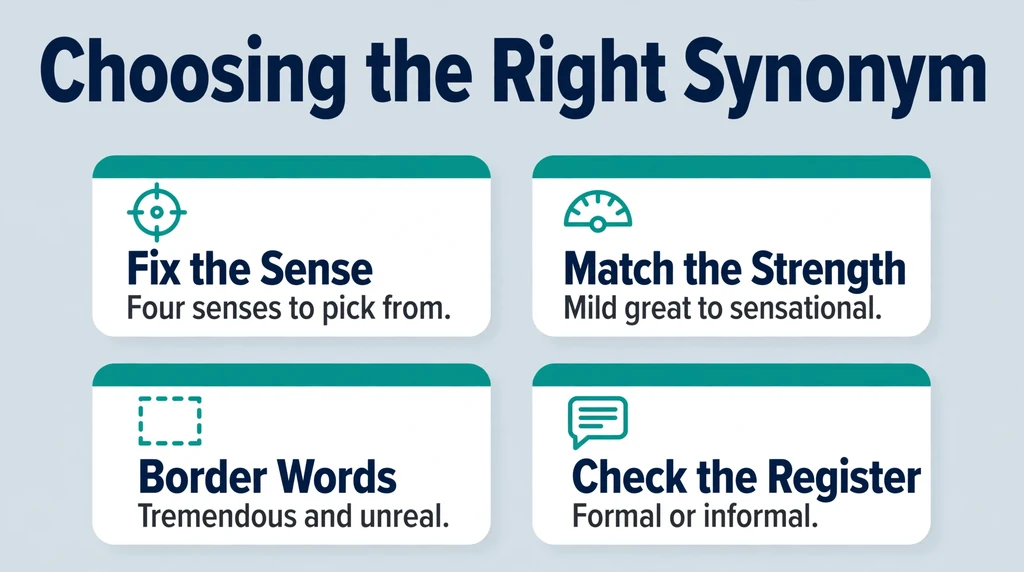
Choosing well starts with one question: which fantastic do you mean? The praise, size, imaginary, and strange senses each have their own shelf, and each shelf holds its own set of safe replacements. Once the sense is clear, tone and strength do the rest of the work for you.
Step one: fix the sense
Say “the view was fantastic” and most readers hear praise. Say “a fantastic creature” and they picture an invented beast. The noun decides the sense, so check it first. Money, amounts, and numbers point to the size group. Creatures, worlds, and tales point to the imaginary group. Behaviour, sights, and claims point to the strange group. Everything else usually wants praise.
Step two: match the strength
Praise comes in strengths, just like heat. Great and wonderful give warm, safe approval. Superb and first-rate raise the standard and sound more judged. Sensational, stupendous, and miraculous sit at the top. They promise excitement or near impossibility. Save them for moments that truly earn them, or your praise will inflate and lose its value.
Paired examples show the difference. “The hotel was wonderful” promises a lovely stay. “The hotel was miraculous” promises something close to impossible, which no stay can deliver. Likewise, “a fabulous dress” sparkles, while “an excellent dress” sounds like a tailor’s report. The facts stay similar, yet the feeling changes completely.
Step three: watch the border words
Three words cross the borders and cause most mistakes. Tremendous praises in one sentence and measures in the next. “A tremendous performance” is praise, but “a tremendous amount of paperwork” is size. Incredible can mean extraordinary or literally not believable. “An incredible offer” excites buyers, while “an incredible excuse” accuses the speaker. Unreal can praise in slang, yet the sources place it with imaginary and strange things. In clear writing, let context pin each border word down, or pick a safer synonym.
A quick checklist before you swap
Run through four checks before replacing fantastic anywhere. First, name the sense out loud: praise, size, imaginary, or strange. Second, pick from that sense’s group only. Third, set the strength, from mild great to top strength sensational. Fourth, check the register, because awesome and cracking will not survive a formal report. These four checks take seconds, and they prevent nearly every bad swap this word produces.
Fantastic in Formal and Informal Writing
Fantastic itself is an informal praise word in the Collins listing. That does not ban it from serious writing, but it does set the tone. A news report, an essay, and a reference letter usually need calmer praise.
In essays and professional writing
Choose excellent, superb, or first-rate when quality is the point. They sound judged rather than gushed. For achievements that caused real wonder, a strong word such as astonishing can work in small doses. In analysis, the strange and belief senses take over. Formal writers describe claims as implausible or far-fetched, and designs as fanciful, far more often than they praise anything as fantastic.
Size language also changes at work. Reports prefer huge or enormous only beside real figures. Better still, they give the figure alone. Precision is the formal writer’s version of emphasis.
In stories and creative writing
Fiction is where the older senses earn their keep. The imaginary group builds worlds, and the strange group colours them. A narrator can call a creature fantastical, a custom outlandish, or a statue grotesque, and each word bends the scene differently. Praise words matter less here, because showing a wonderful place beats naming it wonderful.
Dialogue follows speech, of course. Characters can say awesome, brilliant, or cracking, and those choices reveal age, place, and mood. Narration, meanwhile, usually wants the steadier words from the excellent group. If you are comparing praise words more broadly, the site’s guide to synonyms of great shows how the biggest praise family divides by strength.
Fantastic in reviews and headlines
Reviewers and headline writers bend the rules on purpose. A “sensational” debut or a “stupendous” final sells excitement, and readers accept the booster because the genre promises opinion. Even there, the older senses keep working quietly. A critic who calls a plot fantastic may mean inventive, implausible, or excellent, and skilled critics let one hint settle it. When you write reviews yourself, borrow the energy but keep the hint. Your readers should never have to guess whether the show was wonderful or merely weird.
Antonyms for Fantastic
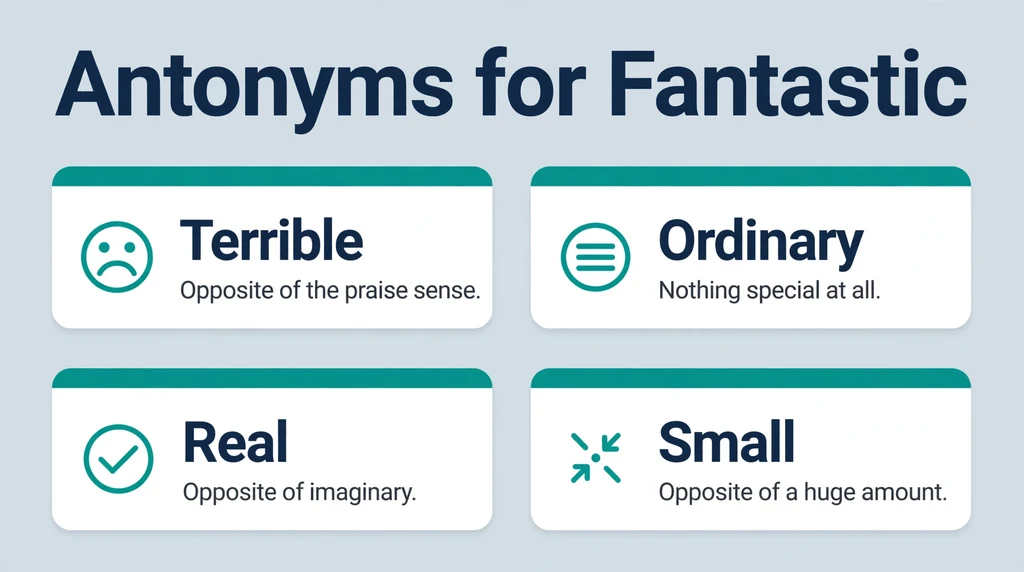
Antonyms depend on the sense, just like synonyms do. Each sense of fantastic has its own opposite shelf.
Opposites of the praise sense
Cambridge gives terrible as the direct antonym of fantastic in its praise sense. Inferior and poor cover weak quality, while bad is the plain, general opposite. Ordinary and commonplace oppose the extraordinary shine of the word. A commonplace result is not bad, exactly, it is simply nothing special. Unpleasant opposes the enjoyable side of fantastic, as in a fantastic party versus an unpleasant one.
Opposites of the other senses
For the imaginary sense, Cambridge gives real as the antonym. Believable, plausible, credible, and realistic oppose the hard-to-believe sense. A plausible story sounds like it could actually happen. For the size sense, small, tiny, and insignificant mark the far end of the scale. Normal and usual oppose the strange sense, since they describe things that follow the expected pattern.
Antonyms in sentences
Paired sentences make the opposites stick. “The meal was fantastic” turns into “the meal was terrible” with one swap. “She invented a fantastic companion” becomes plain reality with “she described a real companion”. “He earned a fantastic amount” shrinks with “he earned a small amount”. In every pair, the antonym follows the sense, not the spelling of the original word. That is the same rule the synonyms followed, run in reverse.
Words That Are Not True Synonyms for Fantastic
Some words travel with fantastic but fail as true synonyms. Knowing them protects your writing from quiet meaning shifts.
Perfect promises flawlessness, which fantastic never does. A fantastic meal can still have a slow dessert course. Strange alone is not a listed synonym in the Merriam-Webster entry. Fantastic in the strange sense adds invention or extravagance, not mere unfamiliarity. Magical implies actual magic or a magic-like spell. It belongs with the imaginary group only when the magic itself is the point.
Mythical and legendary sound like natural partners for fantastic creatures. However, none of the major thesaurus entries lists them as synonyms of fantastic. Mythical points to myths specifically, and legendary points to legends or fame. Use them for those jobs, not as general replacements. Massive is another near miss for the size sense. It stresses physical bulk and weight, while fantastic amounts stress quantity. Finally, unbelievable works in speech, yet the main entries treat incredible as the listed form for this word family. In careful writing, incredible is the safer choice.
The biggest mistake of all is swapping across senses. “She told a fantastic excuse” sounds like praise, yet the intended sense is hard to believe, so implausible or far-fetched belongs there. Likewise, “a fantastic beast” in a story names an invented animal, and calling it excellent would confuse every reader. When a swap feels funny, a crossed sense is usually the reason.
Frequently Asked Questions
What is the best synonym for fantastic?
Wonderful is the closest all-purpose synonym for the praise sense. Merriam-Webster defines that sense of fantastic as “of the very best kind”, and wonderful carries the same warm approval. For formal writing, excellent or superb often fits better.
What is a formal synonym for fantastic?
Excellent, superb, and first-rate are the safest formal choices for praise. They sound measured and judged rather than excited. In formal analysis, implausible replaces fantastic when the sense is “hard to believe”.
Does fantastic mean excellent or imaginary?
It can mean both, and context decides. The praise sense is the common one in speech, as in fantastic news. The imaginary sense is older and survives in writing about stories, creatures, and invented worlds.
What is the opposite of fantastic?
Terrible is the direct opposite of the praise sense, according to Cambridge. Real is the opposite of the imaginary sense. Ordinary, poor, and small oppose the extraordinary and size senses.
Can fantastic describe an amount of money?
Yes. Collins lists a sense meaning “very large in degree or amount” and gives “fantastic amounts of money” as the example. Huge, enormous, vast, and tremendous work as synonyms in that sense.
Is fantastic an informal word?
Yes, in its praise sense. Collins marks the “excellent” sense informal. That is why essays and reports usually swap in excellent or superb instead.
What is the difference between fantastic and fantastical?
Fantastic covers all four senses, from praise to strangeness. Fantastical belongs to the imaginary group only. It describes elaborate invented things, such as fantastical creatures, and it never simply means excellent.
Which synonym works best for a fantastic story?
It depends on the story. Choose fictional or imaginary for an invented tale. Choose far-fetched or implausible when the story sounds too strange to believe.
Final Thoughts
Fantastic rewards readers who slow down for one second. Behind the everyday praise word sits a family of older senses about imagination, strangeness, and sheer size. Pick the sense first, and the right synonym almost chooses itself. Wonderful and superb handle praise, huge and enormous handle amounts, and imaginary and bizarre handle the invented and the strange. Keep the four shelves separate in your mind, and this cheerful little word will never betray your meaning. For the full dictionary picture, the Merriam-Webster Thesaurus entry for fantastic shows all five of its senses side by side.