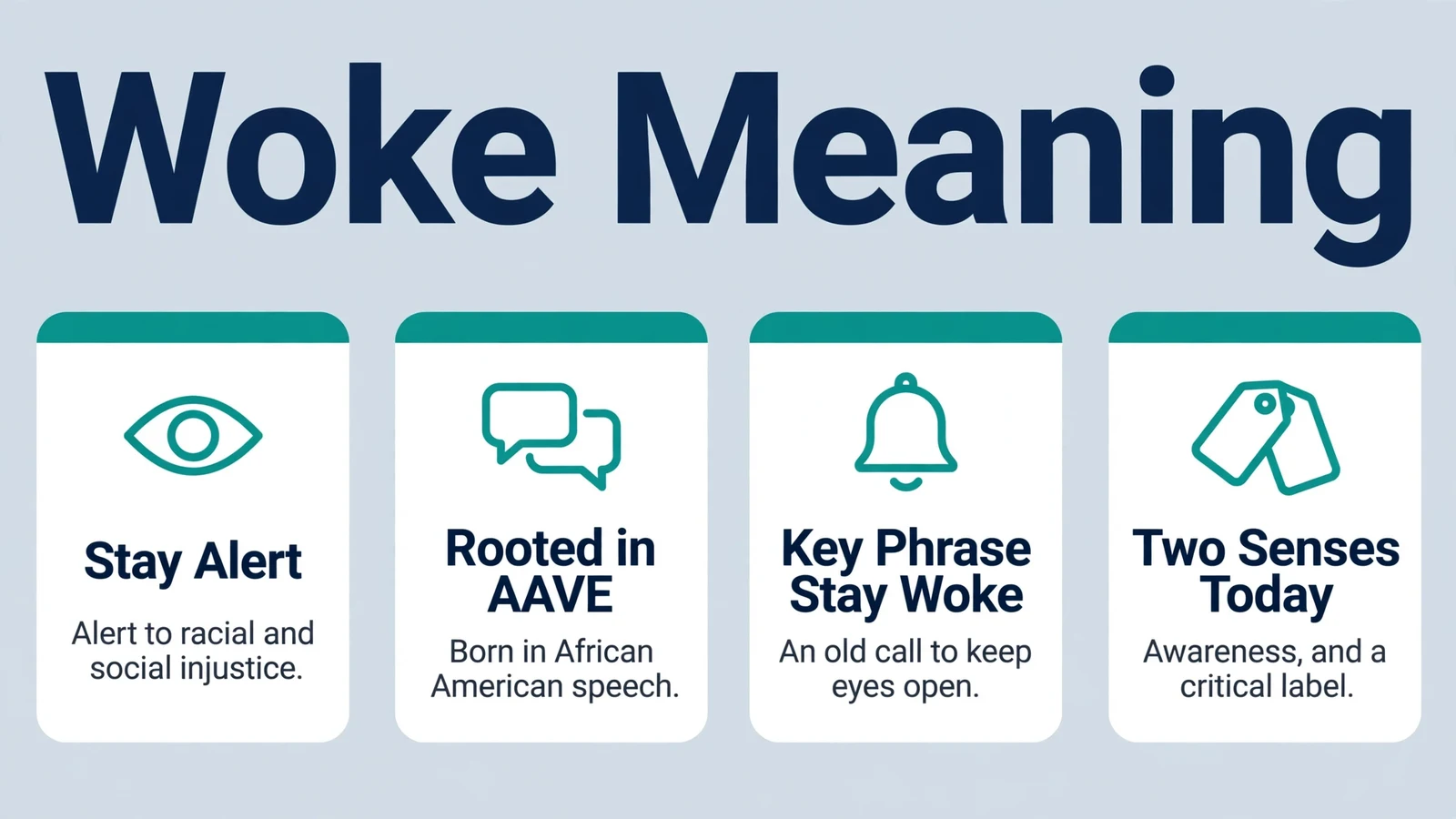
Few slang words carry as much history, or as much argument, as the word woke. In its original sense, woke is an adjective from African American Vernacular English that means alert to racial prejudice, discrimination and injustice.
A woke person, in that sense, notices unfair treatment and refuses to look away. The word travelled from Black American speech into music, then into hashtags, then into dictionaries. Along the way, its use widened, and critics of progressive politics took it up as a label of disapproval.
Because of that journey, the same word can now sound like praise in one conversation and like an insult in the next. This article explains what woke means, where it came from, and how its use changed, step by step.
What Does Woke Mean?
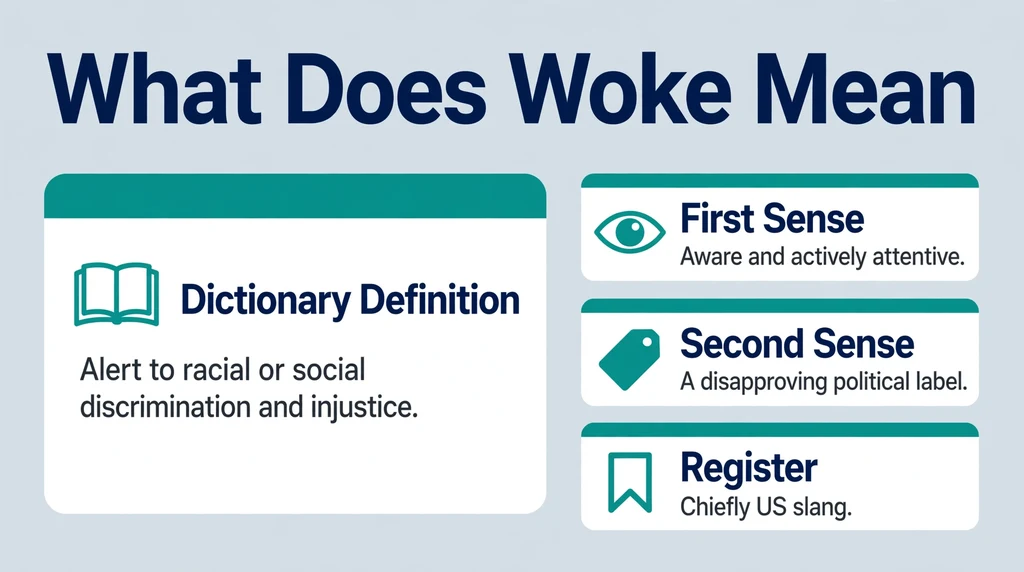
Dictionaries record the slang adjective woke with a core meaning and, in newer editions, a second critical meaning. Understanding both senses is the key to understanding the word today.
The core dictionary definition
Merriam-Webster defines woke, in its main slang sense, as “aware of and actively attentive to important societal facts and issues (especially issues of racial and social justice).” The Oxford English Dictionary puts it this way: “Originally: well-informed, up-to-date. Now chiefly: alert to racial or social discrimination and injustice.” Notice the two parts inside these definitions. First, a woke person is aware of a problem. Second, in Merriam-Webster’s wording, the person is actively attentive, which suggests paying ongoing attention rather than noticing once. The Oxford wording stresses alertness to discrimination and injustice above all. Both dictionaries tie the word most closely to race and social fairness. Neither definition mentions a political party. A person of any party could, in principle, be described this way.
The second, critical sense
Merriam-Webster also records a second sense, and it labels that sense “disapproving.” In this use, woke means “politically liberal or progressive (as in matters of racial and social justice) especially in a way that is considered unreasonable or extreme.” Britannica describes the same development in plain terms. As American politics grew more polarised in the 2010s, Britannica notes, the word was “repurposed as a pejorative synonym for liberal or left-leaning.” The second sense is therefore not a separate word. It is the same label, used by speakers who view the attitudes behind it negatively. When a headline calls a policy, a company or a syllabus “woke” in a critical tone, it is using this second sense. The dictionary disapproving label exists precisely because that use became so common.
Why the usage labels matter
Dictionaries attach small labels to senses, and those labels do quiet but important work here. Merriam-Webster labels woke “chiefly US slang” in its first sense. That tells readers the word is informal, American in its centre of gravity, and rooted in spoken usage. The second sense carries the label “disapproving,” which is the dictionary’s way of warning that the word expresses the speaker’s negative judgement. Labels like these let a dictionary stay neutral while still warning readers about tone. A reader who checks only the definition text and skips the labels can easily miss half the information. For a contested word like woke, the labels are close to a second definition: they tell you not only what the word means, but how it is likely to land when someone says it.
A quick way to tell the two senses apart
Context usually reveals which sense a speaker intends. Supporters of the original meaning use woke about awareness, vigilance and fairness. Critics use it about positions or institutions they consider excessively progressive. Tone, surrounding words and the speaker’s known views all act as signals. Later sections of this article trace how the word picked up both uses, and they compare the two senses side by side.
Core Meaning of Woke
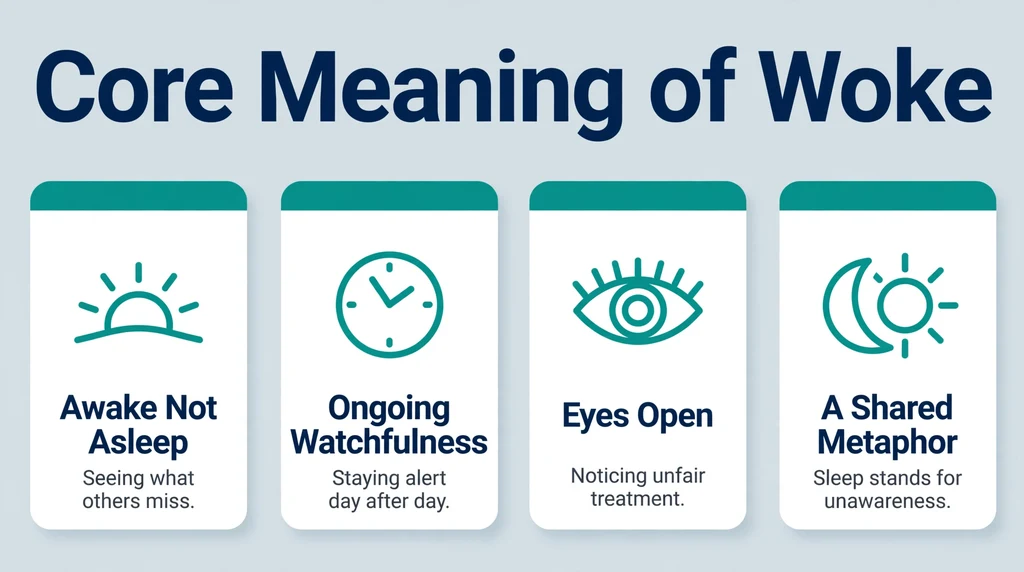
Underneath the politics sits a simple metaphor, and the metaphor explains the word’s emotional pull. That metaphor is sleep versus waking.
Sleep as a picture of unawareness
In everyday speech, sleep often stands for not noticing. People say a person was “asleep at the wheel” or “sleepwalking through life.” Woke flips that picture. To be woke is to be awake while others sleep, in the sense of seeing what is really happening. The claimed insight usually concerns unfairness that others overlook or accept as normal. This is why the word carries a note of revelation. A person who “got woke,” in the older slang framing, felt that their eyes had been opened. The metaphor also explains the word’s confidence. Someone who believes they are awake rarely doubts what they see. Critics of the term sometimes point to that confidence when they use the word critically, while supporters describe the same quality as clear-sightedness.
Alertness as an ongoing state
The core meaning is not a single moment of learning. It is a continuing state of watchfulness. That is why the word so often appears in the phrase stay woke rather than woke up. Waking up happens once. Staying woke means remaining alert afterwards, day after day. In its earliest documented uses, the alertness was practical as well as political. It meant watching for real danger, including racist violence, and not being caught off guard. Later uses kept the structure but widened the target. The watchfulness could be aimed at biased news coverage, unfair laws, workplace discrimination or coded language. The constant thread is vigilance. Whatever the topic, the woke person, in the core sense, claims to keep their eyes open.
Why the word feels like an identity
Because the metaphor divides the world into the awake and the asleep, woke can function as an identity label, not just a description. People have used it as a badge of belonging inside activist communities. Others experience the same label as an accusation when it is applied to them by opponents. Dictionaries cannot settle that social tension. They can only record that both uses exist. Keeping the metaphor in mind makes the rest of the word’s history easier to follow.
Where the Word Woke Comes From
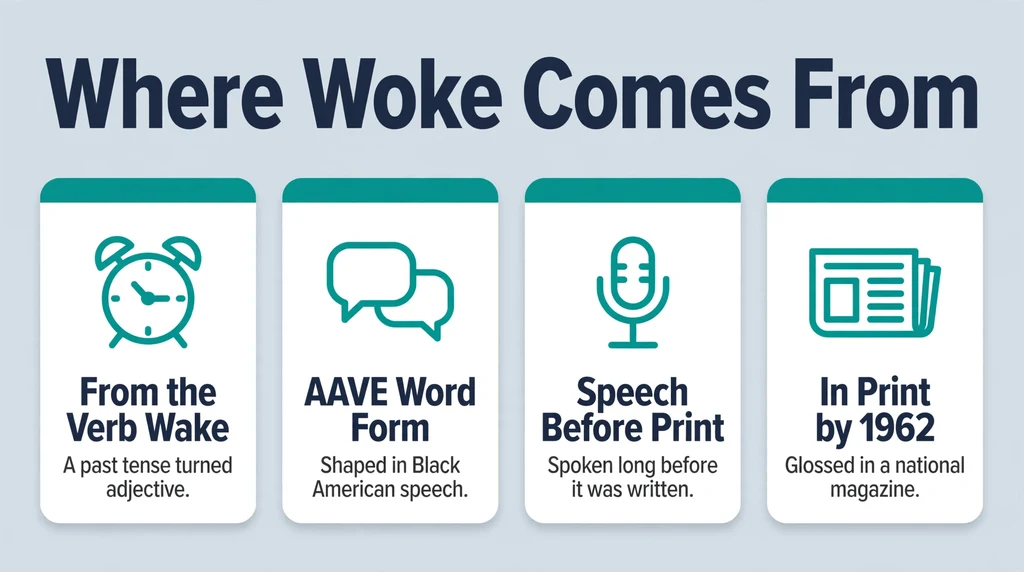
Woke did not begin as a political slogan. It began as a form of the ordinary verb wake, reshaped inside Black American speech.
From the verb wake
In standard English, woke is the past tense of wake: “She woke at dawn.” African American Vernacular English, often shortened to AAVE, developed an additional use. In AAVE, the past-tense form woke also works as an adjective meaning alert or aware. Merriam-Webster notes that the word “developed in African American English” in this attentiveness sense. The American Heritage Dictionary similarly labels it slang derived from African-American Vernacular English. This kind of reshaping is normal in dialects. A community takes a familiar word form and gives it a sharper, figurative job. Here, the job was to describe a mind that stays switched on. The adjective keeps the energy of the verb: waking is something you do, so being woke suggests active attention rather than passive knowledge.
A spoken word long before print
Slang usually lives in speech first, and print evidence arrives late. Woke is a textbook case. Language historians caution that the term circulated in Black communities before any surviving written record. The Oxford English Dictionary’s research, reported in 2017, reflects that gap. Its editors found that the word’s history in speech clearly reached back further than its paper trail. That is why responsible accounts describe early records as “the earliest documented use,” not as the moment of invention. Nobody coined woke at a desk on a known date. A community’s way of talking slowly became visible to outsiders. The next sections follow that paper trail from its first firm footprints onward.
What etymologists agree on
Across dictionaries, the agreed outline is consistent. The form comes from wake. The figurative sense, alertness, grew inside African American speech during the twentieth century. At first, that alertness centred on racial danger and discrimination. Only much later did the word enter general slang and political argument. Disagreements among sources concern dates and firsts, not this outline. With that frame in place, the documented timeline can begin.
Stay Woke: A Phrase With a Long History
The word rarely travelled alone. It travelled inside the two-word phrase stay woke, and that phrase has a documented life of its own.
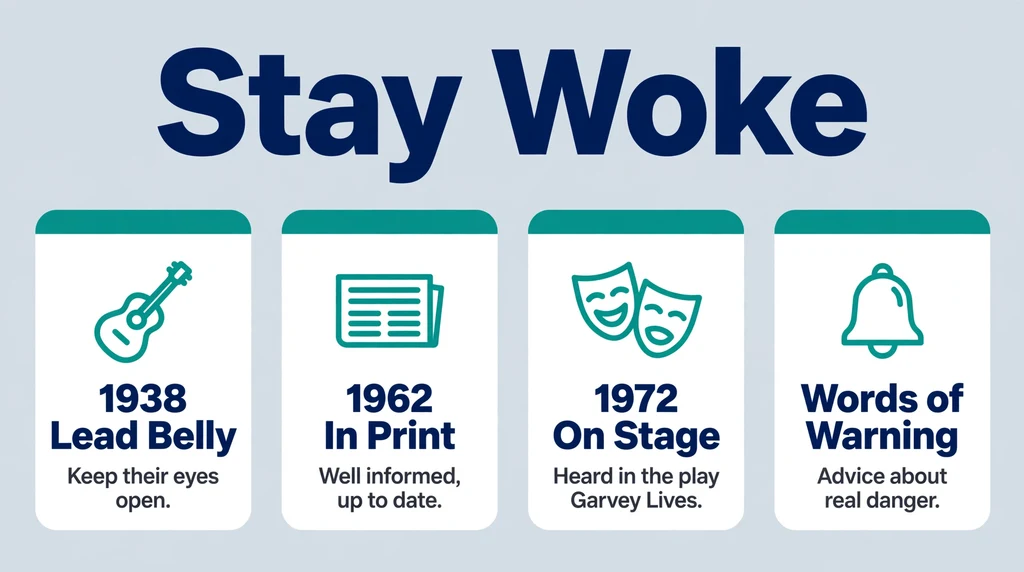
1938: Lead Belly and the Scottsboro Boys
One of the earliest firm records is a piece of recorded sound. In 1938, the blues singer Huddie Ledbetter, known as Lead Belly, recorded his song “Scottsboro Boys.” The song tells the story of nine Black teenagers and young men who had been accused of raping two white women in Alabama in 1931. The case became a byword for racist injustice in the courts of the Jim Crow South. After the song, Lead Belly added a spoken afterword. He described meeting the young men’s lawyer, then offered direct advice to his listeners. He said he advised everybody to be a little careful going through that part of Alabama: “best stay woke, keep their eyes open.” NPR and other histories describe this as possibly the earliest audio recording of the phrase. The meaning there is plain. Stay woke meant stay alert, because danger was real.
1962: the phrase reaches print
The phrase surfaced in print a generation later. In May 1962, the novelist William Melvin Kelley published an article in the New York Times Magazine titled “If You’re Woke You Dig It.” The article explained Black slang terms that white beatniks had begun borrowing. Kelley’s glossary defined woke as “well-informed, up-to-date.” The Oxford English Dictionary treats this as the earliest figurative example in its records. The dictionary’s next example comes from Barry Beckham’s 1972 play Garvey Lives!, which includes the line, “I been sleeping all my life. And now that Mr. Garvey done woke me up, I’m gon stay woke.” Two things stand out in these records. The word was already established enough to need explaining to outsiders. And it still carried the sleep-versus-waking picture at its heart.
What the phrase did in the community
Between these records, the phrase did quiet cultural work. It functioned as advice passed between Black Americans about staying aware of how they were treated. It could warn about police, employers, courts or strangers. The phrase could also signal shared knowledge: saying stay woke told listeners that the speaker understood the same realities. That in-group quality matters for the word’s later story. When outsiders later adopted the phrase, some original users felt a piece of community language had been taken over. Reporters and linguists who trace the word note this tension repeatedly. The phrase was never just vocabulary. It was a small act of solidarity, repeated for decades before most Americans had heard it.
How Woke Went Mainstream
For most of the twentieth century, woke stayed inside Black American culture. Two developments carried it outward: a hit song, and then a protest movement powered by social media.
2008: Erykah Badu sings “I stay woke”
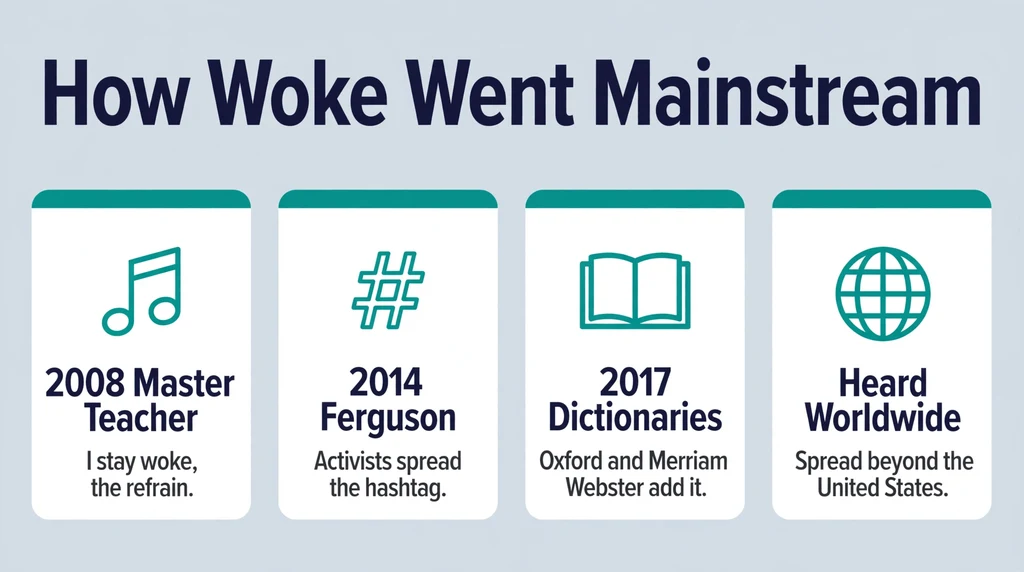
In February 2008, singer Erykah Badu released the album New Amerykah Part One (4th World War). Its track “Master Teacher” repeats the refrain “I stay woke” again and again. The song was conceived by songwriter Georgia Anne Muldrow, and Muldrow has described how the phrase passed between musicians before reaching the recording. Merriam-Webster glosses the song’s refrain as “self-aware, questioning the dominant paradigm and striving for something better.” The dictionary also credits the song with giving the phrase its later connection to racial and social justice issues. At that point, the phrase still lacked today’s political charge. It sounded spiritual and searching, a call to consciousness. But it placed stay woke in front of a national audience for the first time.
2012 to 2014: hashtags and Ferguson
On social media, the phrase shortened into a hashtag, #staywoke, and spread through Black Twitter and activist networks. Its decisive moment came in 2014. After a police officer shot and killed Michael Brown in Ferguson, Missouri, protests filled the streets, and Black Lives Matter activists used stay woke to urge vigilance about police violence and official accounts. Merriam-Webster’s usage note dates the word’s widespread use and attention from 2014, as part of the Black Lives Matter movement. The phrase now named a public stance, not only private watchfulness. Journalists began explaining it to general readers. In the same period, the phrase kept other shades too. Childish Gambino’s 2016 hit “Redbone” used “stay woke” as a warning about a partner’s faithfulness, a reminder that slang words often run several meanings at once.
The word crosses borders
The word did not stay American. As the hashtag spread online, readers in Britain, Canada, Australia and beyond met the term through news coverage of American protests and politics. Reference works note that the word’s use spread well beyond the United States during the 2010s. In some countries it arrived with its awareness sense first, through activist and student networks. In others, many speakers first met the word in its critical sense, through commentary about American culture wars. That uneven arrival explains a common confusion in international English. Two speakers in the same city may honestly picture different meanings, because they met the word through different doors. The history in this article, which begins in AAVE, is the shared root both doors lead back to.
2017: the dictionaries arrive
Mainstream status became official in 2017. In June of that year, the Oxford English Dictionary added the new sense in its quarterly update: “alert to racial or social discrimination and injustice.” Merriam-Webster added the slang sense the same year, defining it around awareness of racial and social justice issues. Dictionary additions do not invent meanings. They certify that a meaning is widespread and durable enough to record. By 2017, woke met that test easily. The word now had three overlapping audiences: the Black communities where it began, a broad public that had met it through activism, and a growing set of critics who disliked what they believed it stood for. That third audience would soon change the word again.
The Shift in the Meaning of Woke
The most important fact about woke today is that its meaning depends heavily on who is speaking. Language writers describe a widening first, and then a reversal of tone.
The widening: from race to many causes
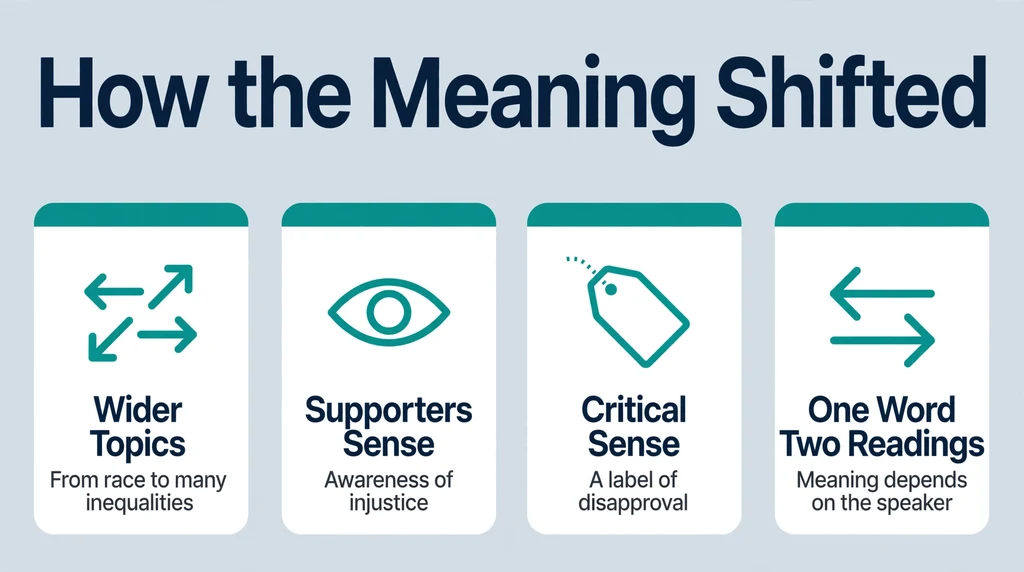
As the word spread after 2014, its scope stretched. It came to describe awareness of many kinds of inequality, not only racial discrimination. Sexism, LGBTQ rights and other social issues entered its orbit. It also became shorthand for a loose set of progressive positions on identity and social justice, such as discussions of white privilege or reparations, as reference works summarise the usage. For some speakers, this widening was natural growth: one word for a general alertness to unfairness. For others, including some early users, the widening diluted the word’s specific racial meaning. Both reactions are documented parts of the word’s history. The widening also made the word useful as a label for institutions. People began describing films, curricula, companies and adverts as woke, in either praise or complaint.
The reversal: woke as a critical label
The bigger shift was tonal. Britannica summarises it directly: as American politics polarised, the word was repurposed as a pejorative synonym for liberal or left-leaning. Politicians and commentators who oppose progressive policies adopted woke as their preferred label for them. Fixed phrases multiplied, such as “woke mob” and “woke ideology,” used by critics to group together positions they reject. Merriam-Webster responded the way dictionaries do: it recorded the new use as a separate sense and labelled it disapproving. The word’s supporters often object to this use, arguing that it mocks the original idea of alertness to injustice. The word’s critics reply that the term fairly describes views they consider extreme. A dictionary article can only note that both positions exist, and both are now baked into usage.
When a governor’s lawyer had to define it
The contest over the word once reached a courtroom. In December 2022, during a federal trial in Florida, lawyers asked officials from Governor Ron DeSantis’s administration what woke means. His general counsel, Ryan Newman, answered that it means “the belief there are systemic injustices in American society and the need to address them.” The exchange drew wide coverage because DeSantis had built policies, including the 2022 law promoted as the Stop WOKE Act, around opposing what he calls woke ideology. For language watchers, the moment was revealing. A slang word born in community speech had become important enough that a government lawyer had to define it under oath. The definition he gave matched the dictionary’s core sense closely, even as the administration’s public use of the word remained critical.
Why the shift matters for readers
For everyday readers, the shift has a practical consequence: you cannot decode the word from a dictionary alone. The dictionary gives you the menu of recorded senses. Only the sentence, the speaker and the setting tell you which item on the menu was served. This is unusual for a common adjective, and it explains many public misunderstandings. A headline written in the critical sense can be quoted by a supporter as if it used the awareness sense, and argument follows. Writers who want to be understood precisely often swap woke for exact phrases: alert to racism, progressive, socially conscious, or excessively progressive, depending on their meaning. The word survives because it is short, vivid and loaded. Its history, from a blues recording to a courtroom, shows exactly how it gathered that load.
Derivatives: wokeness and wokery
Word families record tone as well. The neutral noun wokeness simply names the state of being woke. By contrast, the Oxford English Dictionary records wokery, from 2016, as a disparaging label for progressive or left-wing attitudes and practices. English often grows a mocking derivative when a term becomes contested, and this family followed that pattern. Superlative forms appeared too, in joking or boastful use: Merriam-Webster’s examples include “the wokest man in Hollywood.” These offshoots show a word fully absorbed into everyday argument, far from its quiet beginnings.
Woke vs Politically Correct
Commentators often compare woke with an older label: politically correct. The comparison is useful, because the two terms travelled a similar road, though they started in different places.
A shared pattern
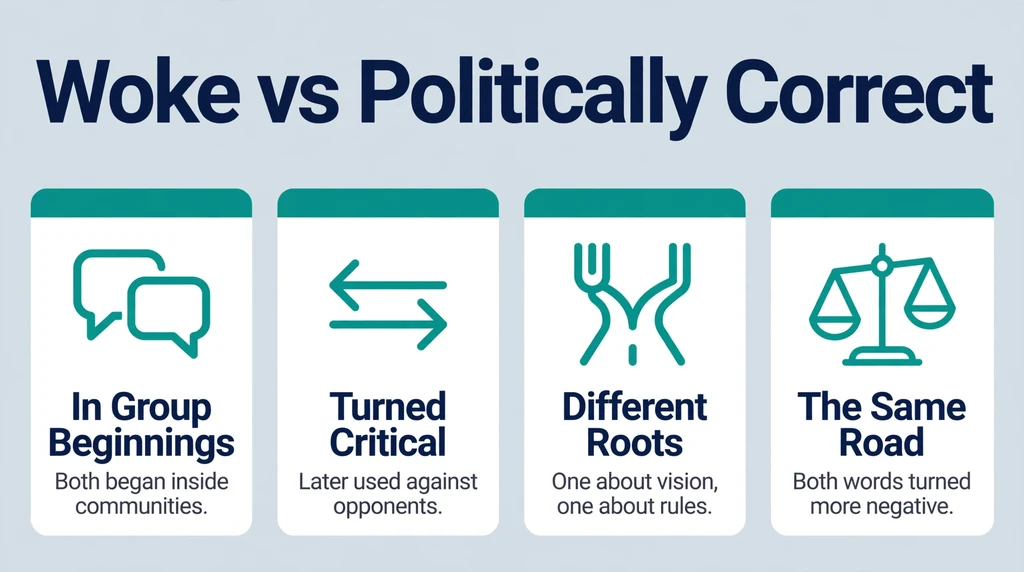
Language writers, including the editors at Daily Writing Tips, note the parallel explicitly. Political correctness began as a term used inside left-wing circles, sometimes self-critically, before becoming a favourite criticism from outside them. Woke began inside Black American communities as sincere advice about vigilance. Each term then crossed over into general use. Each acquired a sarcastic, critical use that eventually rivalled or eclipsed the original. In both cases, the critical use became so dominant in some media that younger speakers may meet the insult before they meet the original meaning. The pattern has a name among linguists: pejoration, the process by which a word’s associations turn negative over time.
Where the two differ
The differences matter as much as the parallel. Politically correct is an adjective phrase about language and behaviour rules, and its history runs through twentieth-century politics. Woke is a single slang adjective rooted in AAVE, and its core image is perception, not rules: seeing injustice clearly. Politically correct usually describes speech or conduct that someone considers excessively careful. Woke, even in critical use, usually describes beliefs, policies or institutions, not manners. Another difference is self-description. Many activists once happily called themselves woke, in the awareness sense. Far fewer people ever proudly called themselves politically correct. That pride in the original sense helps explain why the word’s shift provokes stronger feelings than a typical slang change.
How to handle the comparison as a reader
When a writer today reaches for either word, ask which job it is doing. Is it describing awareness, or is it labelling an opponent? The woke vs politically correct comparison cannot answer that for a specific sentence. Only the writer’s context can. Readers who know both words’ histories are better placed to spot when a label is being used as an argument in itself.
Woke the Verb: Grammar and Word Forms
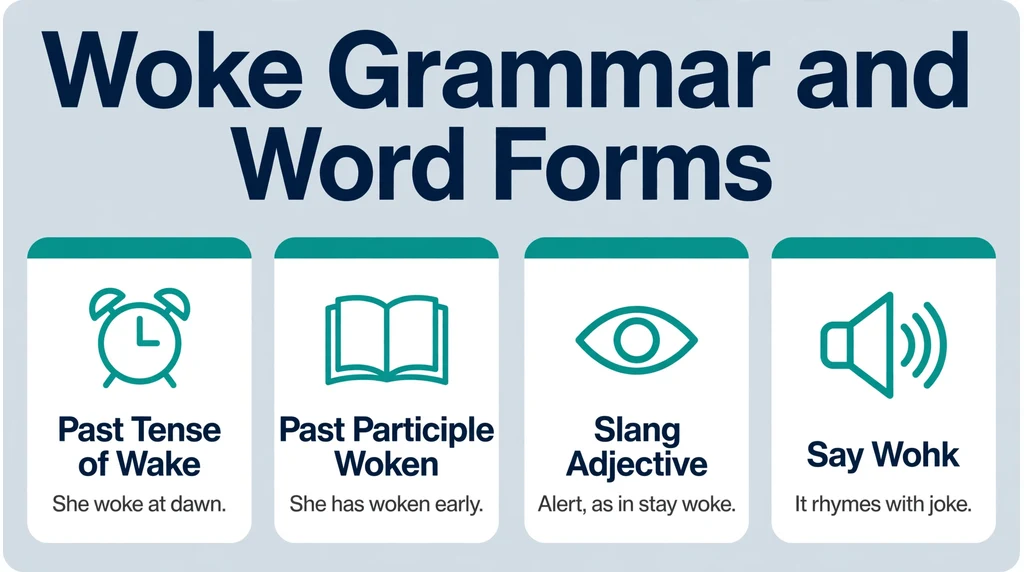
Part of the confusion around woke is grammatical. The same spelling does two different jobs in English, and keeping them separate clears up most misunderstandings.
The ordinary verb
As a verb, woke is simply the past tense of wake. “The alarm woke the house.” “He woke before sunrise.” The standard past participle is woken, as in “She has woken early all week.” Writers sometimes use woke as a participle in informal English (“I had woke up late”), but woken is the form style guides recommend. This verb is centuries old, neutral, and completely separate from the slang debate. Nobody objects to this woke. It appears in weather reports, novels and medical notes alike, and it will outlast every argument in this article.
The slang adjective
The adjective looks identical but behaves differently. It grew from the AAVE use of the past-tense form, much as some dialects say “I’m done” with a form grammar books file elsewhere. As an adjective, woke sits before nouns or after linking verbs: “a woke reader,” “she stayed woke.” It takes comparison forms in playful or emphatic use, woker and especially wokest, which dictionaries quote from real examples. It also spawned nouns, wokeness for the state and wokery for the disparaging label discussed earlier. Pronunciation stays the same for both jobs: woke sounds like “wohk,” rhyming with joke. If you can hear which job the word is doing, verb or adjective, most example sentences sort themselves out quickly.
Quick reference
A short summary helps fix the forms. Wake, woke, woken: verb forms, about sleep and rising. Woke the adjective: slang, about alertness, from AAVE. Stay woke: the fixed phrase, an exhortation to remain alert. With those three boxes in mind, the word’s timeline and its arguments both become easier to follow.
Common Misconceptions About Woke
Because the word changed fast, several mistaken beliefs about it circulate widely. Each one collapses against the documented record.
“Woke was invented around 2014”
The word felt new in 2014 because mainstream media met it then. The record runs far deeper. A blues recording used stay woke in 1938. In 1962, a national magazine glossed the word. A stage play used it in 1972. Then a hit song carried it in 2008. What happened around 2014 was mainstreaming, not invention. Confusing the two dates erases the Black American communities that developed the term over generations.
“Woke only ever means one side’s insult”
The insult use is real, and dictionaries record it, but it arrived second. The awareness sense came first, by decades, and remains in active use. Plenty of speakers still use woke sincerely to mean alert to injustice. Other speakers use it only critically. Many use it ironically, in quotation marks. A single-sentence definition that ignores either major sense will mislead readers about how the word actually behaves.
“The dictionaries took a side by adding it”
Dictionaries describe usage; they do not endorse it. The OED and Merriam-Webster added woke in 2017 because evidence of widespread use met their thresholds. Later, Merriam-Webster added the disapproving sense for the same reason: usage demanded it. Recording a word that a reader dislikes is a lexicographer’s job, not a political act. The usage labels, such as “slang” and “disapproving,” are the dictionary’s way of staying neutral while staying accurate.
“Woke and awake are interchangeable slang”
They are not, in this figurative sense. Awake can describe literal wakefulness or general spiritual alertness, but the specific social meaning belongs to woke. Swapping in awake changes the reference and loses the phrase stay woke entirely. Writers quoting historical material should keep the original word, because the form itself carries the history.
How to Use Woke in a Sentence
Examples make the senses concrete. Each sentence below is labelled by the use it shows, so the contrast stays clear.
In the original awareness sense
- “After the workshop, the managers said they wanted to stay woke about bias in hiring.” Here the word means alert to discrimination, used approvingly by the speakers themselves.
- “Her grandmother told her to stay woke whenever she travelled alone in a new town.” This echoes the oldest sense: practical vigilance about safety.
- “The columnist urged readers to stay woke about changes to voting rules.” The word urges continued attention to a fairness issue.
In the broadened descriptive sense
- “The festival programme has a woke streak, with panels on pay equity and access.” The word labels a progressive orientation, without obvious praise or blame.
- “He describes himself as woke on environmental questions.” Here the scope has widened beyond race to another social cause.
In the critical sense
- “The governor attacked the curriculum as woke ideology.” The label is applied by a critic to a policy he opposes.
- “Commentators called the advert a piece of woke marketing.” The word functions as a complaint about a company’s perceived politics.
Reading the surrounding verbs, attacked, urged, describes, usually tells you which sense is active. When the sense matters and context is thin, careful writers rephrase with precise words such as “alert to racism” or “progressive,” so no reader has to guess.
Frequently Asked Questions
What does woke mean in simple words?
In simple words, woke means alert to unfair treatment, especially racism and other discrimination, and determined to stay alert. That is the original slang sense from African American Vernacular English. In much current political writing, the word is also used critically to label progressive views the writer considers extreme. Context tells you which meaning a speaker intends.
What does stay woke mean?
Stay woke means remain alert and do not stop paying attention. The phrase appears in a 1938 Lead Belly recording, where it advised Black listeners to keep their eyes open in the segregated South. Erykah Badu’s 2008 song “Master Teacher” later carried it to a wide audience, and activists spread it further after 2014.
Who first used the word woke?
No single inventor is documented. The phrase stay woke appears in Lead Belly’s 1938 recording, one of the earliest surviving records. The novelist William Melvin Kelley gave the adjective an early print record in the New York Times Magazine in 1962, defining it as “well-informed, up-to-date.” The word clearly circulated in Black American speech before either record.
Is woke a positive or a negative word?
It depends on the speaker. In its original sense it is positive or neutral: praise for awareness of injustice. In its newer critical sense it is negative: a label for views the speaker considers unreasonably progressive. Dictionaries record both, and Merriam-Webster marks the second sense “disapproving” for exactly this reason.
When was woke added to the dictionary?
The Oxford English Dictionary added the alertness sense in its June 2017 update, defining it as “alert to racial or social discrimination and injustice.” Merriam-Webster added its slang entry the same year. Both additions followed the word’s spread during the Ferguson protests of 2014 and the Black Lives Matter movement.
Is woke the same as politically correct?
Not exactly, though commentators compare them. Both terms began inside communities and later gained sarcastic, critical uses. But politically correct describes careful speech and behaviour, while woke describes awareness of injustice, from AAVE roots. The comparison explains the word’s tonal shift, not its core meaning.
What is the difference between woke the verb and woke the adjective?
Woke the verb is the past tense of wake: “She woke early.” Its past participle is woken. Woke the adjective is the slang term for alertness to injustice, formed in AAVE from that same past-tense shape. The spelling and sound match, but the grammar and meaning are separate.
What does woke mean when people say it today?
Today the word usually signals the speaker’s stance. Supporters use it for genuine awareness of racism and unfairness. Critics use it for progressive positions, policies or institutions they oppose. Because both uses are common, careful readers check tone and context before deciding what a given sentence means.
Final Thoughts
Woke has lived several lives in less than a century. It began as community advice inside African American speech: stay alert, because the world is not always fair or safe. Music carried it outward, first on a 1938 blues recording and again in a 2008 refrain. Protest and social media then made it a household word, and dictionaries recorded it in 2017. Success changed it. The widened word became a banner for some speakers and a target for others, and dictionaries now record both the awareness sense and the disapproving sense. Knowing this history does not end arguments about the word. It does something more useful: it lets you hear which meaning a speaker is using. For a fuller reference treatment of the term and its cultural history, see the Encyclopaedia Britannica entry on woke.