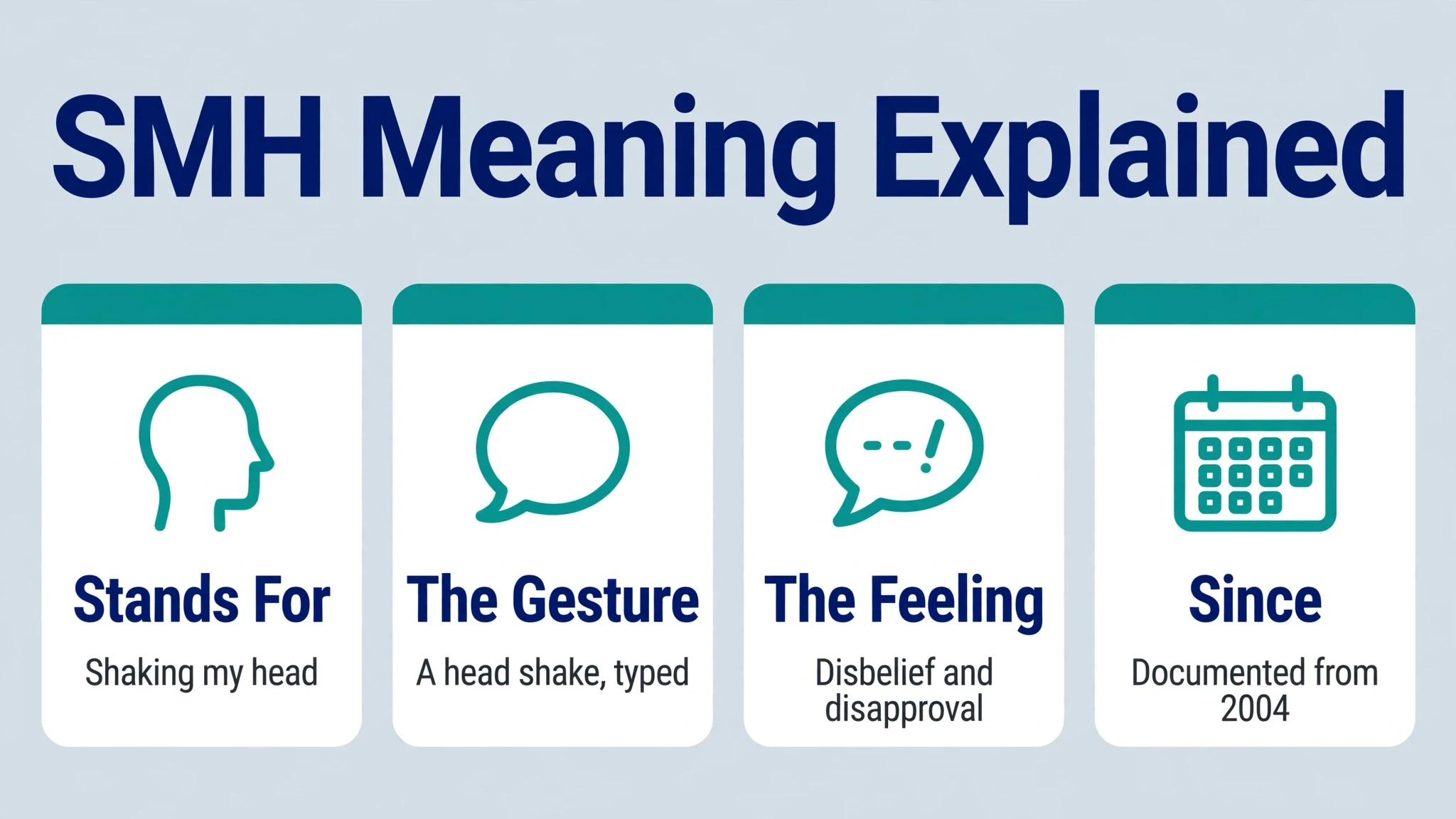
Your friend texts you a screenshot of a headline so absurd it barely seems real. Underneath, three letters: “smh”. Or a reply comes back to your own story, some minor disaster you caused yourself. And it reads “smh” and nothing else. If you are decoding it now, here is the answer: SMH stands for “shaking my head”. It is what you type when something is so foolish. So frustrating or so unbelievable that words feel inadequate and only the gesture will do.
Dictionaries agree on this one. Merriam-Webster defines SMH as “shaking my head”, used to express disapproval, dismay or disbelief. And that definition has held steady for over twenty years of internet use.
This guide was built from the dictionary record and the documented history. What SMH means, the four ways it is used in messages, its stronger cousins SMDH and SMFH, the real head shake behind it. And the 2004 post where the trail begins.
What Does SMH Mean?
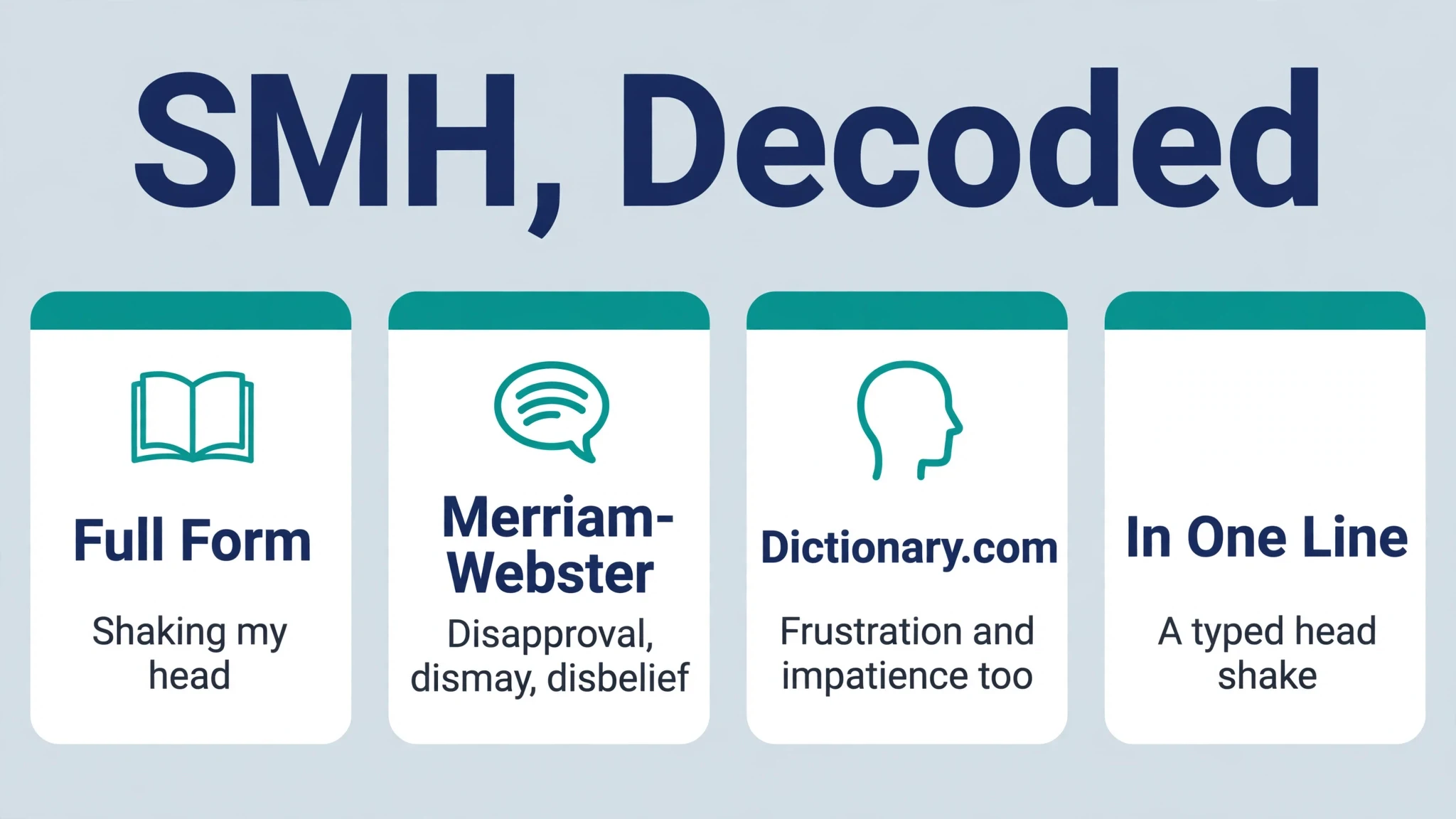
SMH is an initialism, a phrase compressed into its first letters: Shaking My Head. Unlike most slang, which drifts and mutates until even its users disagree, SMH has meant the same thing for its entire life. The dictionaries line up behind one core gesture and a small family of feelings.
Merriam-Webster’s entry gives the core: “shaking my head”, used to express disapproval, dismay or disbelief. Dictionary.com, whose entry is filed under “SMH or SMDH”, widens the emotional range slightly. SMH is “variously used to convey disappointment, disapproval, frustration, or impatience”. Cambridge defines it as an abbreviation for “shaking my head”, used on social media and in text messages when you do not believe something or do not agree with it.
Put those together and the working definition is this: SMH is a typed head shake. You send it when something strikes you as foolish, disappointing, frustrating or too absurd to take seriously. And you want the other person to see you shaking your head about it.
Three qualities explain why this particular initialism survived when thousands of others died:
Why SMH Works
It pictures something. Most texting abbreviations compress a phrase. SMH compresses a body movement. Reading it, you see the person. That small act of imagination is the whole effect. A text message with a face in it, before emoji were good at faces.
It is a verdict, not a reply. SMH does not answer a question or continue a conversation. It judges one. Something has been shown or told, and SMH is the response of a spectator who has seen enough.
Its target does the work. SMH can be aimed at a news story, a stranger’s behaviour, a friend’s decision, a football result, or the sender’s own past self. The letters never change; the context supplies the entire meaning. This is why three letters can carry a paragraph of feeling.
One more usage deserves naming because learners miss it. SMH can be aimed at nothing in particular, as pure punctuation for the mood of a post. A photo of a flooded kitchen captioned “monday. smh.” is not accusing anyone. The letters are the sound of a person giving up elegantly.
How SMH Is Used in Texting
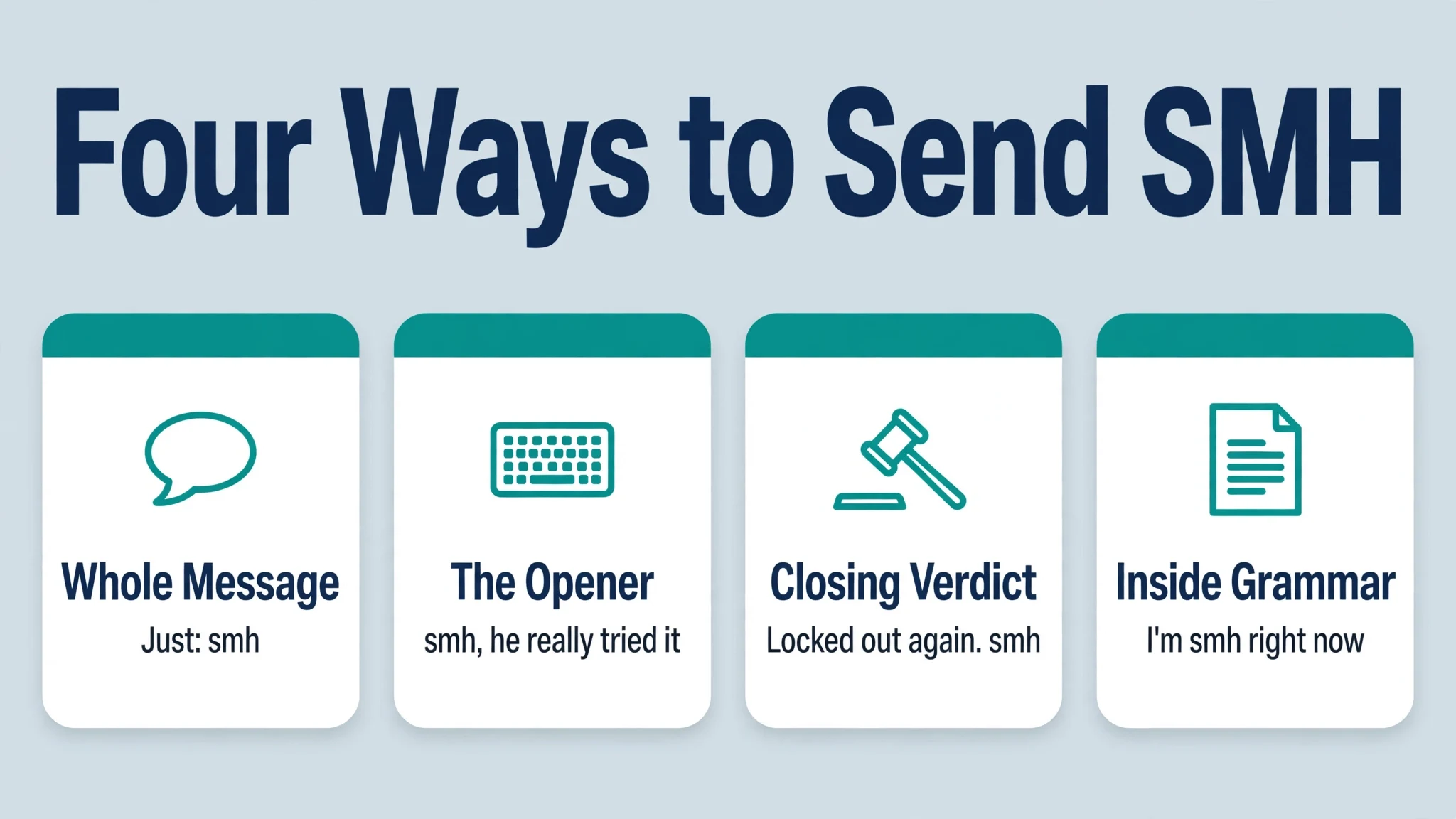
SMH is unusually flexible for a slang term. It appears in four distinct positions in real messages, and each position carries a slightly different flavour.
As the whole message. The purest form. Something arrives in the chat, a link, a screenshot, a confession, and the reply is simply “smh”. Nothing else is needed because nothing else is meant: the head shake is the complete statement. This is the usage that makes SMH the texting equivalent of a long pause followed by a slow shake of the head across a table.
As an opener. “smh this man really tried to return a half eaten pizza.” Leading with SMH frames everything after it as evidence. It tells the reader how to feel before they read a word of the story, the way a headline tells you how to take an article.
SMH as a Closing Verdict
As a closing verdict. “He locked his keys in the car. Again. With the engine running. smh” Ending with SMH lands like a gavel. The story is told, the judgement is delivered, and the conversation can move on knowing exactly where everyone stands.
Inside the grammar. The most advanced form treats SMH as a verb or a state. “I’m smh right now”, “got me smh over here”. Here the initialism has escaped its origins and become a piece of living grammar, something you can be doing. Linguists would call this the final stage of an abbreviation’s life, the point where nobody expands the letters anymore because the letters themselves are the word.
Capitalisation carries a little tone. Lowercase “smh” is the default, weary and casual. All caps “SMH” raises the volume, closer to disbelief shouted than sighed. “Smh” at the start of a sentence is just grammar doing its job. None of these change the meaning; they tune the intensity, like the speed of the actual shake.
SMH With Punctuation and Emoji
Small decorations change SMH’s volume, and fluent readers hear them automatically. A trailing full stop, “smh.”, reads as the driest form: judgement delivered flat, without energy wasted. An ellipsis, “smh…”, lets the shake trail off into exhausted silence, as if the sender is still shaking it while typing. Repeated letters of effort do not exist for SMH the way they do for “nooo” or “lolol”. So intensity is borrowed from partners instead.
The commonest partner is the facepalm emoji, which adds the blunder flavour to SMH’s disbelief. “smh 🤦” is aimed at a spectacle dumb enough to need two gestures. The laughing crying emoji softens it into affection, “smh 😂” being the standard reply to a friend’s harmless disaster, judgement and amusement in equal halves. The upside down face or a simple eye roll emoji push toward exasperation. And the shaking face emoji, which arrived in recent Unicode releases, finally gives the gesture itself a face. Pairing it with SMH is technically redundant and extremely common, the emoji era’s version of saying the quiet part twice for emphasis.
Punctuation, partners and position together form a complete little grammar. This is why three letters can be sighed, snapped or laughed depending on what a sender wraps around them.
The Feelings Behind SMH
One reason SMH confuses learners is that it covers several neighbouring emotions. And dictionaries list them like a menu: disbelief, disapproval, disappointment, frustration, impatience, dismay. These are not five different meanings. They are one physical reaction applied to five kinds of provocation, and it helps to see the mapping.
When the provocation is foolishness, SMH means disapproval: someone has done something daft and the shake says it. When the provocation is an absurd claim or event, SMH means disbelief. The shake says this cannot be real, and yet here it is. When the provocation is a letdown, a cancelled plan, a missed deadline, a team conceding in the last minute, SMH means disappointment. The shake is slower and sadder. When the provocation is the same failure repeated, SMH means frustration and impatience, the shake of someone who has watched this exact thing happen before and warned everyone it would.
The context always tells you which one is loaded. A single “smh” under a video of a man trying to open a door marked pull by pushing it for a full minute is disapproval laughing at itself. The same three letters under an announcement that a promised service has been cancelled again are disappointment with no laughter in it at all.
What SMH almost never carries is genuine fury. It sits low on the anger scale, closer to the sigh than the shout. People who are truly angry type sentences. SMH is for the large middle territory of daily life where things are annoying, unbelievable or self inflicted. And a head shake is the proportionate response.
Where Did SMH Come From?
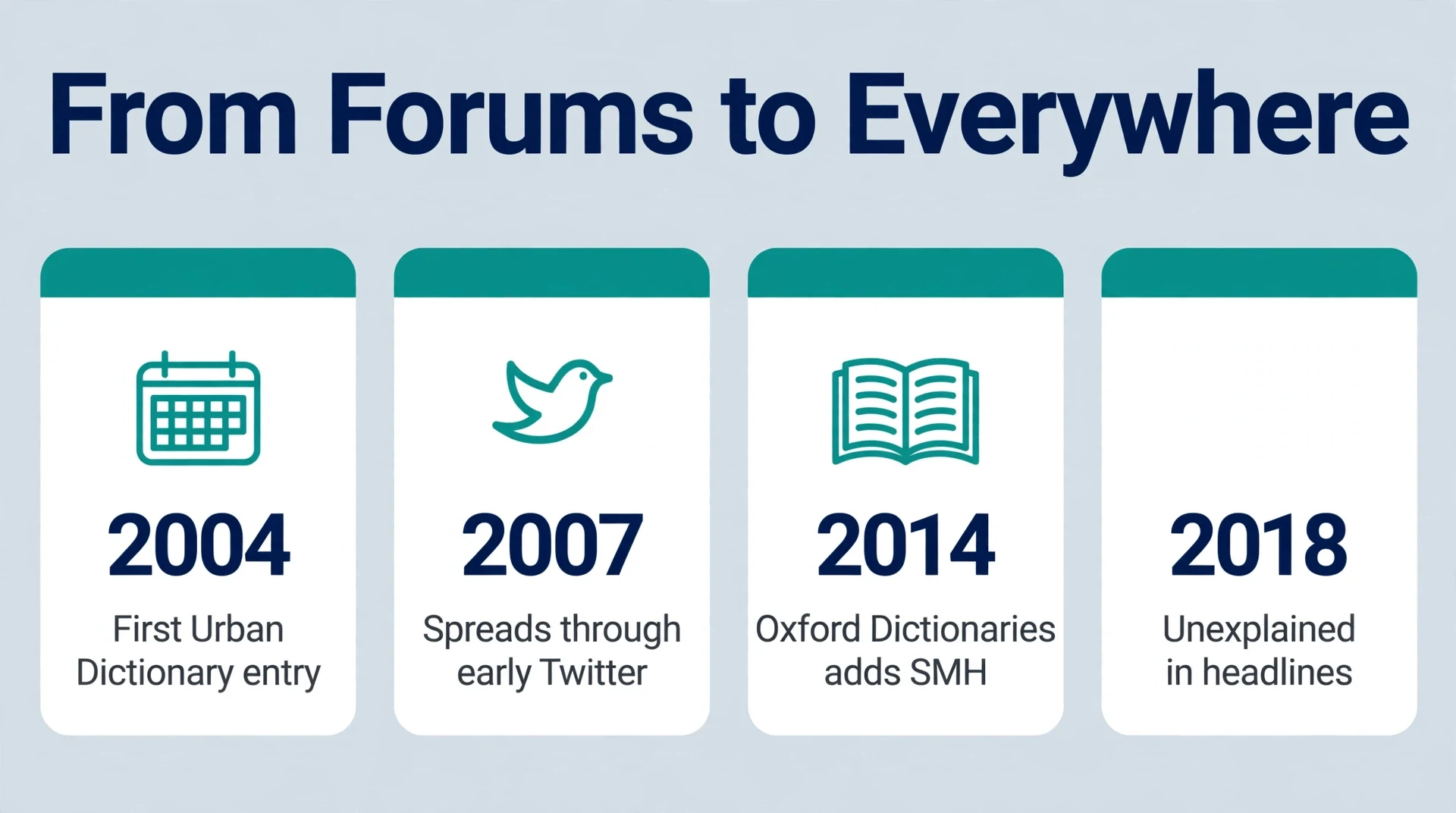
SMH has something most slang never gets: a dated first trace. The earliest documented appearance researchers have found is an Urban Dictionary entry dated 14 February 2004, submitted by a user calling themselves trickologist. This defined SMH as an abbreviation for “shaking my head”, explaining that people use it when “something is so stupid, no words can do it justice”. Know Your Meme’s research, Dictionary.com’s own history of the term and other trackers converge on the same entry. Two honest caveats belong with that date. Urban Dictionary entries can be edited after the fact. And the true first use in some unarchived chat room or forum is unknowable. What 2004 gives us is the documented floor, the moment the term surfaces in the record, already fully formed.
There is no inventor to profile, and any guide that names one is inventing. Dictionary.com is candid that the origin is unclear. The term reads like an organic product of the early 2000s messaging era, when character limits, slow connections and forum culture rewarded compressing everything, including gestures, into the fewest possible letters. Trackers have suggested it may be an innovation of Black internet users, a community responsible for a large share of the era’s durable slang. But the claim is an attribution of probability, not a documented fact. And the honest record simply starts in 2004.
From Forums to Twitter
From the forums, the spread followed the platforms. SMH was moving through early Twitter by around 2007, the year its stronger sibling SMDH entered Urban Dictionary (22 June 2007). Twitter’s short format was a perfect habitat: a reaction that costs three characters and lands like a paragraph. By the early 2010s, slang dictionaries were cataloguing the term. And Vice was explaining it to readers in 2013, the classic sign that a piece of slang has crossed from its home community into the general population.
The institutional seal arrived in August 2014, when Oxford Dictionaries Online added SMH in a quarterly update that also admitted FML, YOLO and ICYMI. That detail needs one clarification, because the internet routinely muddles it. Oxford Dictionaries Online was the Oxford brand’s website for contemporary usage, not the historical Oxford English Dictionary itself. Being added there meant working lexicographers judged SMH standard contemporary English. This is a genuine milestone, just a different one from the OED.
After 2014 the term’s story is not growth but settlement. Dictionary.com published its entry in 2018, the year trackers also noted the entertainment outlet BET using SMH unexplained in headlines, slang’s final mainstreaming test. The moment editors stop glossing a term is the moment they assume every reader already owns it. SMH has been unglossed ever since. It appears in sports headlines, political tweets, customer complaints and family group chats with no italics and no apology, a two decade old piece of internet shorthand that simply became English.
The SMH Timeline
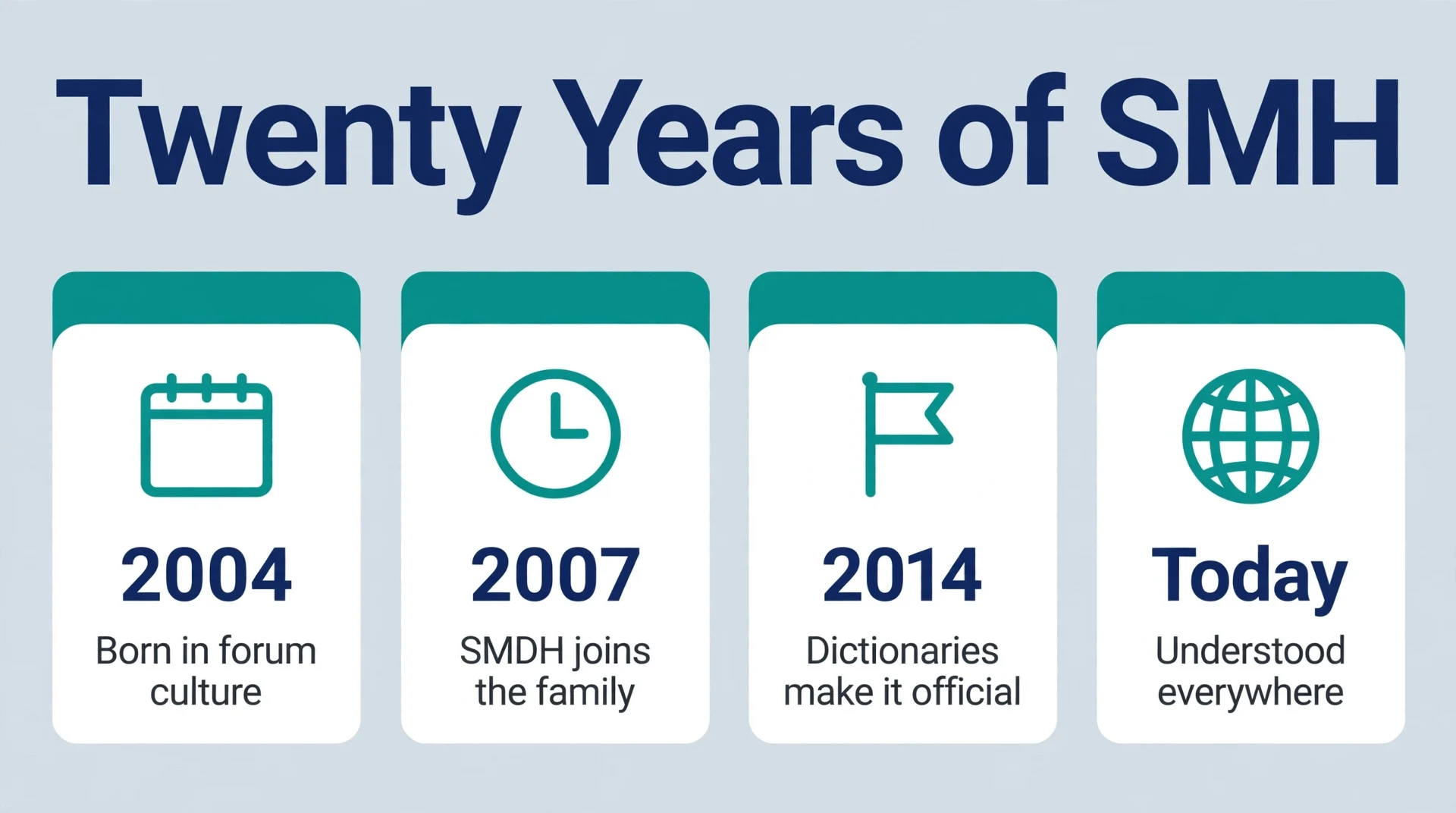
- 14 February 2004: The earliest documented entry appears on Urban Dictionary, defining SMH as “shaking my head”, for when something is so stupid no words can do it justice.
- Around 2007: SMH spreads through early Twitter, whose short posts reward a three character reaction.
- 22 June 2007: The stronger SMDH is entered in Urban Dictionary, three years after the base form.
- Early 2010s: Slang dictionaries catalogue the term and mainstream explainers begin defining it for general readers. Vice runs its explainer in 2013.
- August 2014: Oxford Dictionaries Online adds SMH in a quarterly update alongside FML, YOLO and ICYMI.
- 2015: SMHMeansWhat, a site devoted to decoding the term, is live, a marker of how far the term has travelled beyond its home communities.
- 2018: Dictionary.com publishes its entry, and records show entertainment outlets using SMH unexplained in headlines.
- 2020s: SMH is simply English: unglossed in sports, politics and everyday reporting, and understood across generations of phone users.
SMDH, SMFH and the Escalation Ladder
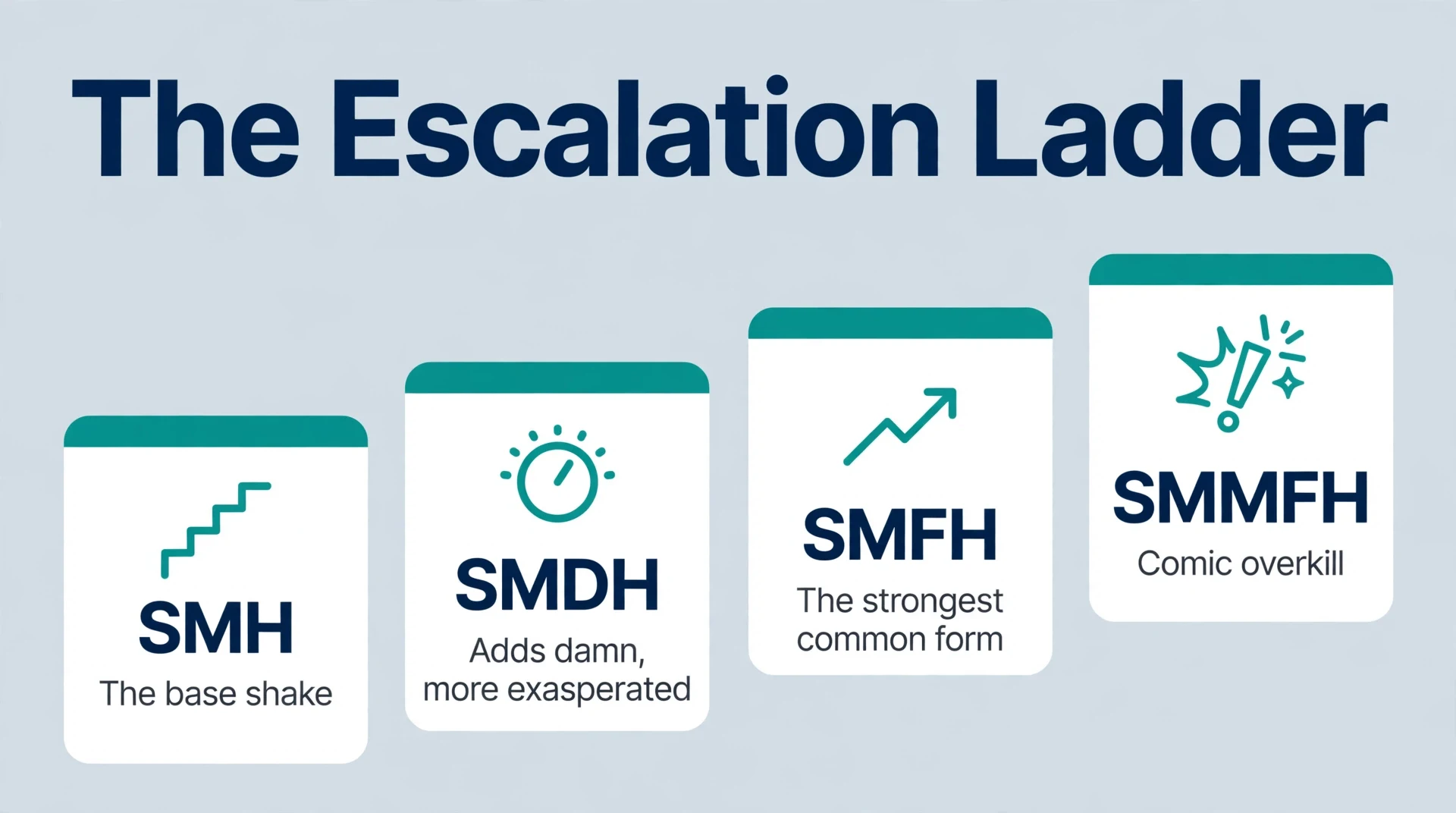
Every community that uses SMH eventually needs a bigger one. And the language obliged with an escalation ladder, each rung adding intensity and, from the second rung up, profanity.
SMDH is “shaking my damn head”. The “damn” does what it does everywhere in English: it turns a reaction into an exasperated reaction. SMDH is for the second offence, the repeat failure, the news you predicted and dreaded. It entered Urban Dictionary on 22 June 2007, only three years after SMH itself. This tells you how quickly the base form stopped being strong enough for the internet’s supply of foolishness. Dictionary.com files the two terms together, treating SMDH as the recognised first upgrade.
SMFH: The Top of the Ladder
SMFH is “shaking my f***ing head”, the profanity censored here the way most publications censor it. This is the top of the common ladder: the provocation is no longer a mistake but a spectacle. And the sender wants the shake to register as genuine astonishment. A still longer form, SMMFH, exists in the record as the maximal joke version, used mostly for comic overkill.
Two things are worth understanding about the ladder. First, the rungs are used ironically as often as sincerely. Among friends, deploying SMFH over a trivial offence, a dropped chip, a bad pun, is itself the joke. The theatrical excess is the humour. Second, the ladder reveals something real about how slang families grow. Speakers rarely invent a new term when an old one wears smooth; they bolt intensifiers onto the one everyone knows. SMH stayed the load bearing term for twenty years while the ladder grew above it. And the base form remains by far the most common of the family in ordinary texting.
A pair of minority readings deserve a footnote, because learners occasionally meet them. People have rarely expanded SMH as “so much hate”, and occasionally guessed as “scratching my head”. Neither is the standard meaning, neither appears in the major dictionaries, and context nearly always resolves them. If a message reads as a reaction to foolishness or bad news, it is shaking, every time.
The Gesture Behind the Letters
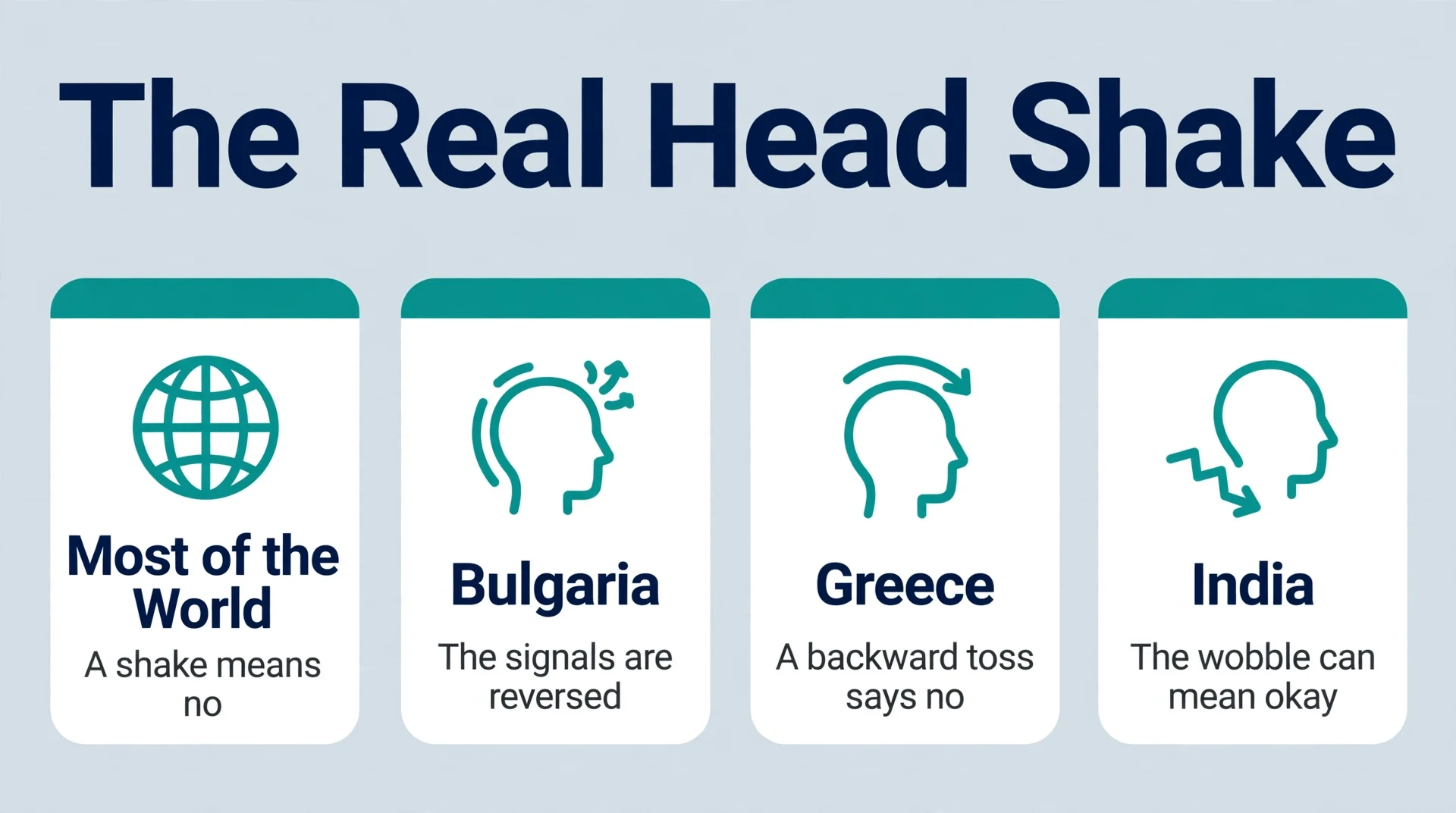
SMH is one of the few pieces of texting slang that names a physical act. And the act it names is older than writing itself. The side to side head shake is one of the most widespread signals in human communication. Across most of the world, shaking the head means no, or something adjacent to no: disbelief, refusal, disapproval, sorrow. Darwin treated it in his work on emotional expression as one of the near universal gestures. And whatever its deep origins, a child on any continent understands a slow head shake from a parent without a word being spoken.
That universality is exactly what made the gesture worth typing. The typed version inherits the real one’s emotional grammar. A shake is slower and sadder than a shout, more final than an argument. You shake your head at things you cannot fix and would not have done. Written SMH works because every reader has performed the gesture and felt its precise weight.
Where the Gesture Means Something Else
The map has famous exceptions, and they matter for anyone using the real gesture while travelling. In Bulgaria, the traditional signals are reversed: the head movement that looks like a shake can signal yes. And a nod can signal no, a swap that has confused visitors for centuries. In Greece, a sharp backward toss of the head, sometimes with a tongue click, is a common way to say no, while a side movement can be misread by outsiders entirely. In India, the side to side head wobble is a flexible signal that can convey acknowledgment, agreement or “okay”, depending on context and speed. And is not the disapproving shake at all. The typed SMH, interestingly, suffers none of this ambiguity: online, on every continent, it means the disapproving shake. The internet standardised what geography never did.
One popular origin story must be filed correctly. You will sometimes read that the shake means no because of a confusion of signals dating to Ottoman times in the Balkans, or that it descends from a baby refusing food by turning its head, an idea Darwin himself floated for the gesture’s origin. These are best treated as folklore and early speculation respectively: charming, widely repeated, and not established fact. What is established is simpler. The gesture is ancient, near universal in its disapproving sense. And so readable that three letters can stand in for it perfectly.
SMH vs Facepalm, LOL and the Rest of the Family
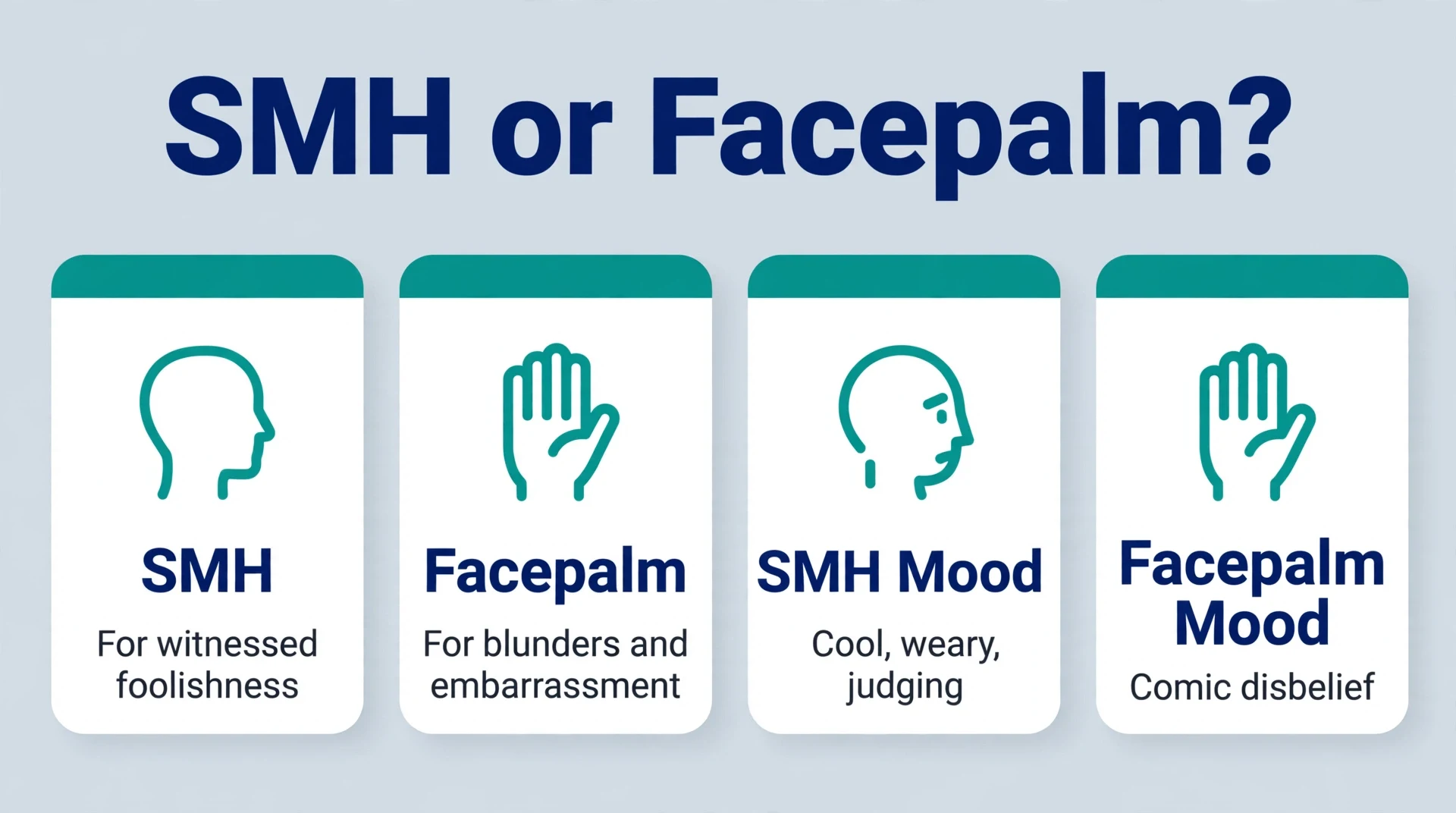
Lives in a crowded neighbourhood of reaction slang, and learners use it better once the boundaries are drawn.
SMH vs facepalm. These are the closest relatives and the most commonly confused. Facepalm, the hand meeting the forehead, reacts to embarrassment, your own or someone else’s. And carries a strong comic flavour. It is the gesture of a person who cannot believe what they just did or watched. It travelled from image culture, the famous Star Trek still of Captain Picard among its great carriers. And into the emoji set as the facepalm emoji (approved in Unicode 9.0 in 2016). SMH is the quieter, wearier sibling. Facepalm says “I cannot believe that just happened” with its hand over its eyes. SMH says “I saw it, I judged it, I am still shaking my head”. Foolishness you witness gets SMH; blunders, especially your own, attract facepalm.
SMH vs LOL
SMH vs LOL. LOL reacts with laughter, SMH with judgement, and the same event can earn either depending on the reactor’s mood. The dropped ice cream cone is LOL from the friend filming it and SMH from the person holding the empty cone. Many messages use both in sequence, “lol smh”, a combination that reads as laughing while judging, the official emotional register of much of the internet.
SMH vs FML. An older ladder mate from the same Oxford update era, FML (“f*** my life”) is self directed despair played for comedy, about your own disaster. Senders usually direct SMH outward, at a world or a person supplying the disaster. Your flooded kitchen is FML in your caption and SMH in your sister’s reply.
The pattern to remember is that reaction slang divides by target and temperature. SMH’s niche, the cool, outward, judgemental shake, has never faced a successful challenge from any rival term. This is why it is still here while most of its 2004 cohort is not.
SMH Across Platforms
The letters stayed the same for twenty years, but each platform bent them slightly to its own shape. And tracing the bends is tracing how people argued online in each era.
On the forums and instant messengers of the early 2000s, SMH belonged to the fast back and forth of threads and chat windows, where typing a reaction in full cost time and character limits made brevity a skill. It was gamer and forum furniture first: quick, dry, aimed at a screenshot or a claim.
Twitter gave it a second life and its widest audience. A platform built on brevity and public reaction turned SMH into a headline instrument. A quote tweet plus “smh” is an entire opinion column in four characters. This is why sports and politics Twitter adopted it so completely. The tweet that is nothing but a link and “smh” remains one of the platform’s most recognisable forms of commentary.
On Facebook and in comment sections, SMH settled into a slightly older, more exasperated register, the reaction of relatives to headlines and of neighbours to local news. In private group chats, WhatsApp, iMessage and their kin, it completed its journey home. The intimate, teasing shake aimed at a sibling’s cooking, a friend’s parking, a partner’s fantasy football trade. The same three letters read as public scorn in one habitat and as affection in another. And fluent users switch registers without thinking, the way they always have with the real gesture.
Is SMH Rude? Register and Etiquette
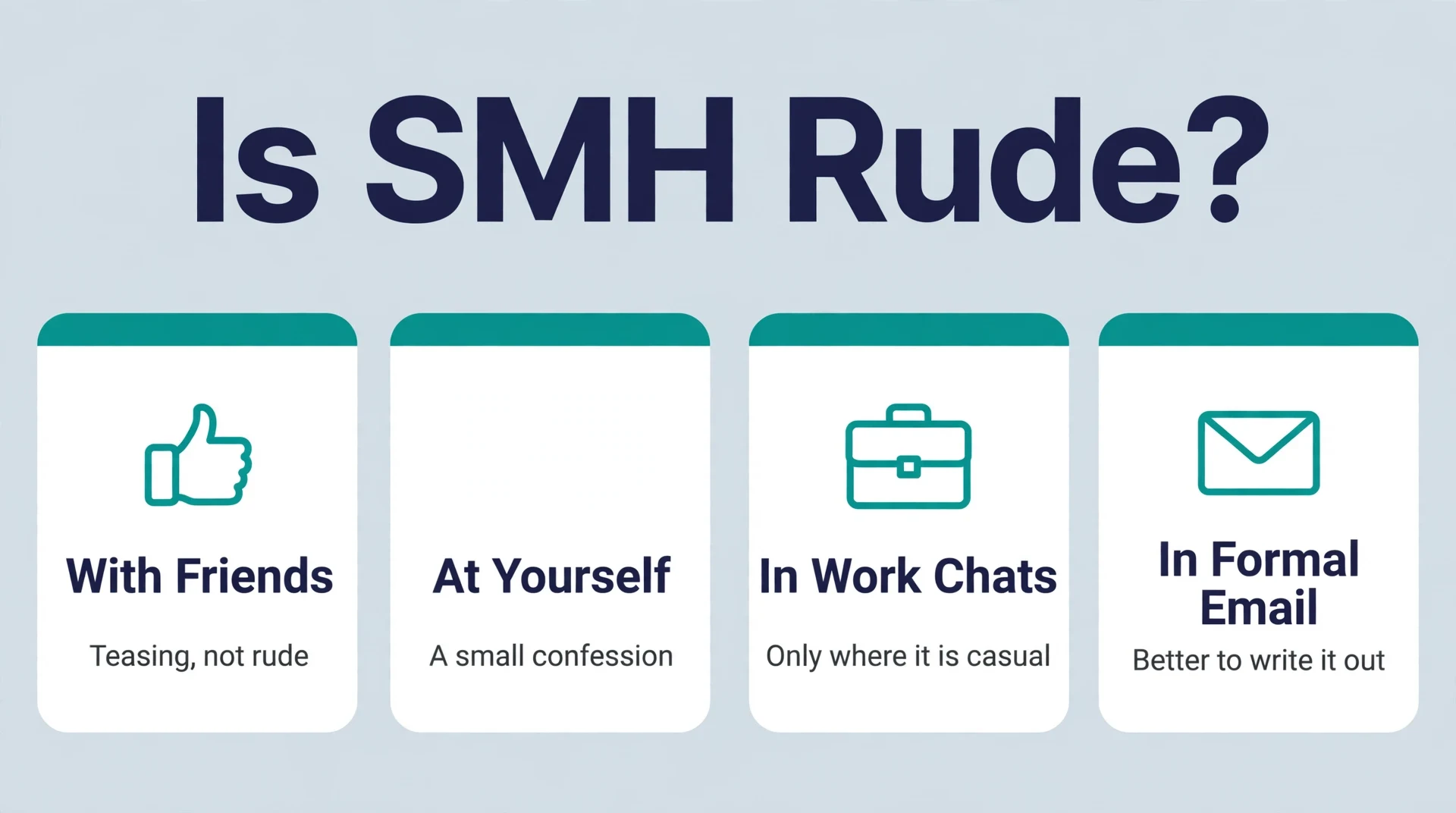
Learners ask this more than almost anything else. And the honest answer is: it depends entirely on where you send it, because SMH is a tone. And tones have addresses where they belong.
Between friends, SMH is not rude at all. It is affectionate judgement, part of the teasing fabric of any close chat. It is routinely sent about the sender’s own behaviour, “left my umbrella at home. smh”, which no one does with a genuinely hostile phrase. Teasing a friend with SMH is so normal that the absence of any reaction would feel colder.
SMH at Work
At work, the calibration changes. In a casual team chat among colleagues who message informally, a light “smh” about a shared annoyance, a printer, a platform outage, is common and harmless. In email, in client facing messages. And anywhere up the hierarchy, SMH is a poor choice, not because it is profane, it is not. But because it is a judgement with no face attached. A written head shake at a colleague’s work reads colder than the sender intends, the way any text slang does when the relationship cannot absorb it. The rule of thumb: SMH needs an existing warmth to land in. Where there is no warmth, write the sentence out.
In public posts, SMH carries one more consideration: it judges without arguing. Posting “smh” about a public figure, a policy or a stranger’s behaviour signals your verdict to your audience while giving the target nothing to answer. That is precisely its appeal and its limit. Among friends it starts conversations; in public it often ends them. This is worth knowing before you aim it at anything you might later want to discuss seriously.
None of this makes SMH a word to fear. It is among the mildest reactions in the slang vocabulary, profanity free in its base form. And understood by effectively everyone under sixty who uses a phone. Used where informal judgement is welcome, it is not rude. It is fluent.
How to Reply When Someone Sends You SMH
Decoding SMH is half the skill. Answering it is the other half, and the right reply depends on who the sender aims the shake at.
If the shake is aimed at a third party, a headline, a video, a public figure, the sender is inviting agreement. The natural replies are a matching reaction (“right??”, “unreal”), a laughing emoji, or your own “smh” returned like a handshake. You are not being asked for analysis. You are being asked to stand next to the sender and shake your head too.
If the shake is aimed at you, read it as teasing first and accusation last, especially from friends. The graceful answers are self deprecating: “I know, I know”, a facepalm emoji, or laughing at yourself in the reply. Getting defensive over an SMH is the one response that reliably makes things worse, because it treats a sigh as an attack. The rare exception is a professional context, where an SMH from a client or manager deserves a calm, complete sentence in reply, never slang back.
If the shake is aimed at the sender themselves, “smh at myself”, they are confessing a small disaster and fishing for absolution. Give it: a laugh, a “we have all been there”, or the rescue detail they need. Answering self directed SMH with comfort rather than judgement is one of the small kindnesses the term exists to organise.
SMH in the Wild: Headlines, Humour and One Australian Problem
The surest measure of SMH’s settlement into English is where it turns up uninvited. News and entertainment headlines use it as a complete editorial comment, a practice trackers documented years ago when BET was already running it unexplained by 2018. Sports desks reach for it after collapses and own goals. Political reporters quote tweets built on it. A dedicated explainer site, SMHMeansWhat, existed by 2015 purely to decode the term for the uninitiated, a small monument to the exact moment a slang term is famous enough to confuse people at scale.
It has also developed its own humour. The deliberate error “smh my head”, saying “shaking my head my head”, became a running joke in its own right, part of a family of playful mistakes (like “RIP in peace”) that fluent users deploy to signal they are in on the redundancy. Nobody who types “smh my head” is confused. The doubled word is the joke, and recognising it is a small shibboleth of internet fluency.
The term’s one genuine collision is geographic. In Australia, SMH is also the long standing abbreviation of the Sydney Morning Herald, one of the country’s major newspapers, founded in the nineteenth century and initialled SMH in links, citations and conversation long before texting existed. Australian readers therefore live with a permanent double meaning. An “smh” headline can be a newspaper discussing something, or a person shaking their head at it. And local readers resolve it by context so automatically that the ambiguity has itself become a running local joke. If an Australian sends you a link “from SMH”, they mean the newspaper. If they send you “smh” after your message, they mean the head shake, and you probably earned it.
SMH in Sentences
- “The email said the meeting was moved to yesterday. smh”
- “smh my brother really thought the group chat was his search bar again.”
- “Fourth delay this week. I am honestly just smh at this point.”
- “He reversed into the post he had just finished painting. SMH.”
- “Lost my keys inside the house I am locked out of. smh at myself.”
- “smh, the update deleted the save file from 200 hours in.”
- “They scheduled the outdoor event for the one day with a storm warning, smh.”
- “Reading last year’s predictions like smh, we really believed that.”
Frequently Asked Questions
What does SMH mean?
SMH stands for “shaking my head”. It is a texting and social media initialism used to express disbelief, disapproval, disappointment or frustration when something is foolish or absurd. Merriam-Webster defines it as “shaking my head”, used to express disapproval, dismay or disbelief.
What does SMH mean in texting?
In texting, SMH is a typed head shake sent as a reaction. To bad news, a foolish decision, an absurd headline or the sender’s own mistake. It can be the whole message, open a message as a warning of the tone, close one as a verdict, or appear inside a sentence, as in “I’m smh right now”.
Who invented SMH?
Nobody is credited with inventing it. And the honest record starts with its earliest documented appearance: an Urban Dictionary entry dated 14 February 2004. Dictionary.com notes the origin is unclear. The term appears to be an organic product of early 2000s forum and messaging culture rather than one person’s coinage.
What is the difference between SMH and SMDH?
SMDH adds one word and a measure of intensity: “shaking my damn head”. It is the stronger, more exasperated upgrade of SMH, used for repeat offences and worse provocations. SMDH appears in Urban Dictionary from 2007, and Dictionary.com files the two terms in a single entry.
Is SMH rude?
Not inherently. Between friends it is mild, teasing judgement, and people aim it at themselves as often as at anyone else. In formal or professional writing it reads cold and dismissive. So it belongs in informal chats, not emails or client messages. The base form contains no profanity.
When did SMH become popular?
It is documented from 2004, spread through forums and early Twitter by about 2007, was being explained by mainstream outlets in the early 2010s. And was added by Oxford Dictionaries Online in August 2014 alongside FML, YOLO and ICYMI. By 2018, outlets were using it in headlines without explanation.
What does “smh my head” mean?
It is a deliberate joke. “Smh my head” expands to “shaking my head my head”, a playful redundancy in the same family as “RIP in peace”. Fluent users write it ironically to exaggerate a reaction; it is not a misunderstanding of the abbreviation.
Is SMH the same as facepalm?
They are cousins, not twins. Facepalm, hand to forehead, reacts mainly to embarrassment and blunders, including your own, and carries a comic flavour. SMH is the cooler, wearier reaction: witnessed foolishness, disbelief and disappointment. The same event can draw a facepalm from the person involved and SMH from everyone watching.
What does SMH mean in Australia?
Usually the head shake, exactly as elsewhere in texting. But in Australia SMH is also the traditional abbreviation of the Sydney Morning Herald, a major newspaper. So an Australian “SMH link” is a news article while an Australian “smh” sent after your message is the head shake. Context separates them effortlessly for locals.
Conclusion
Most slang is built to expire. SMH was built, by nobody in particular, out of one of the oldest signals humans have. And it has outlived nearly everything coined alongside it. Twenty years from a 2004 Urban Dictionary entry to unexplained newspaper headlines, with its meaning unchanged the whole way. That stability is the story. The letters work because the gesture works, on every continent, across every language barrier that three letters might be expected to fail at. Something foolish happens, words feel insufficient or excessive. And the head shake, typed or real, delivers the entire judgement in a single movement. As long as people keep doing things worth shaking a head at. And they show no sign of stopping, SMH will be there in the replies. Three letters, one gesture, no explanation required.