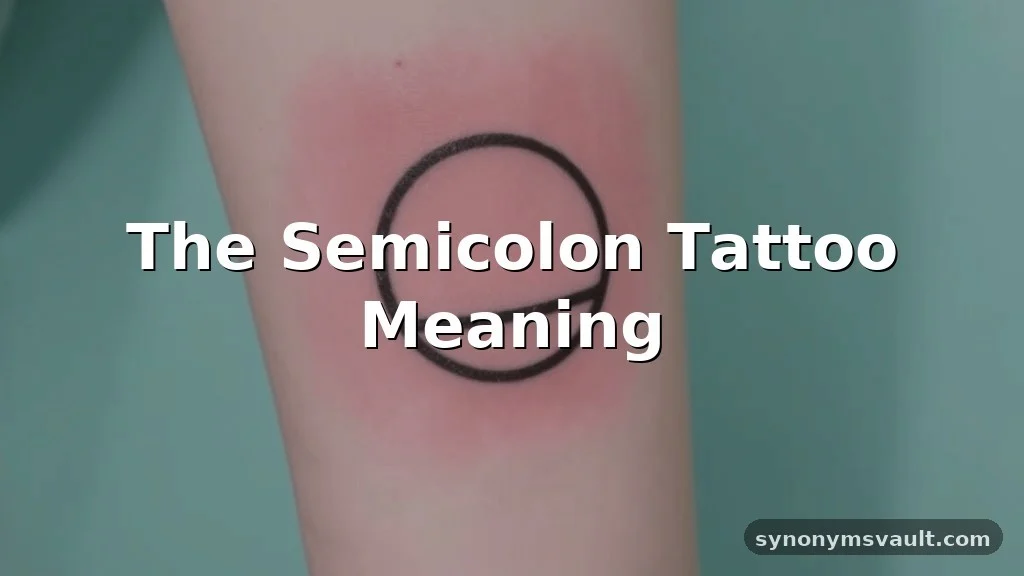
You have likely seen a small, simple mark inked onto someone’s wrist, ankle, or behind their ear. It is just a tiny dot sitting above a comma, yet it carries a weight that far exceeds its size. If you are reading this, you might be curious about why so many people choose to wear this specific punctuation mark on their skin.
Perhaps you have seen a friend or a stranger with one and wondered about the story behind it. This article is written for anyone seeking to understand the deep, personal significance of this symbol.
Whether you are considering getting one yourself or simply want to be more informed about the mental health awareness movement it represents, we will explore the history, the emotional weight, and the cultural impact of this powerful choice. Understanding these symbols helps us connect better with the people around us.
What is the Semicolon Tattoo Meaning
At its core, a semicolon tattoo is a symbol of endurance, hope, and survival. In grammar, a semicolon is used when an author could have chosen to end their sentence but decided to continue it instead. When applied to the human experience, this becomes a profound metaphor for mental health.
The person who gets this tattoo is effectively saying that their story did not end when they were at their lowest point. It represents a conscious choice to keep living, to keep writing the chapters of one’s life, and to push through the darkest moments of depression or suicidal ideation.
People who choose this design often do so as a permanent reminder of their own strength. It is not just a trend; for many, it is a badge of honor. Signals that the wearer has faced significant health issues or personal struggles and chose to stay.
It is a quiet way to show solidarity with others who are fighting similar battles. When you see someone with this mark, you are seeing someone who made a promise to themselves to keep going. It is a symbol of resilience that transcends language and culture, turning a simple punctuation mark into a beacon of hope for those who feel lost.
Background and Evolution of the Symbol
The movement began in 2013 with a non-profit organization known as Project Semicolon. The founder, Amy Bleuel, wanted to honor her father who she lost to suicide. She encouraged people to draw or tattoo a semicolon on their bodies to represent the idea that their story was not over.
The message went viral almost instantly. What started as a small campaign quickly turned into a global phenomenon. People from all walks of life began sharing their personal stories of mental health struggles, using the semicolon as a visual anchor for their journey.
Over the years, the meaning has evolved. While it remains deeply rooted in suicide prevention and depression awareness, it has expanded to represent any form of struggle that a person has overcome. It is no longer just about one specific condition.
It has become a broader symbol for anyone who has survived a traumatic event, a long-term illness, or a period of profound grief. The evolution of the symbol shows how society’s conversation around mental health has changed. We are more open today about discussing our vulnerabilities, and this tattoo serves as a silent conversation starter that breaks down the stigma surrounding these topics.
Usage in Various Contexts
The semicolon is used in many ways today. You might see it on social media profiles, in the bios of dating apps, or as a small piece of art on someone’s forearm. It is common to see people posting pictures of their new ink with captions explaining what they have survived.
In gaming communities, players often use the semicolon to show support for fellow gamers who might be struggling with isolation or social anxiety. It acts as a bridge, helping people find community in digital spaces that can sometimes feel cold or disconnected.
Consider a dialogue between two friends who notice the tattoo:
“I noticed your wrist tattoo. Is that a semicolon?”
“Yeah, it is. It helps me remember that I chose to keep going even when things felt impossible.”
“That is really powerful. I have been through some tough times too, so I understand why you would want a reminder like that.”
This dialogue happens every day
This dialogue happens every day. Because the symbol is so recognizable, it creates an immediate sense of safety and understanding. It tells the other person that they are in a space where they can be honest about their feelings without fear of judgment.
Common Misconceptions and Clarifications
One common misconception is that the semicolon tattoo is only for people who have attempted suicide. While it is certainly a powerful symbol for that specific group, it is not limited to it. Some people get it to show support for a loved one who has struggled.
Others get it because they have navigated a difficult divorce, a job loss, or a chronic illness. The beauty of the symbol is that the meaning is deeply personal. You do not need to explain your trauma to justify wearing it.
Another misunderstanding is that the tattoo is meant to be a permanent mark of sadness. On the contrary, it is a mark of victory. It is not meant to memorialize the pain; it is meant to celebrate the survival.
Some people worry that getting the tattoo will make people look at them with pity. However, most people who have one report that it actually invites deeper, more authentic conversations.
It is a way to reclaim one’s narrative and move forward with a sense of pride rather than shame. It is a symbol of life, not a monument to death.
Similar Terms and Alternatives
While the semicolon is the most recognizable symbol for mental health, there are other ways people express their journeys. Some choose to pair the semicolon with a butterfly, which symbolizes transformation and new beginnings.
Others might choose a small heart or a wave, which represents the ups and downs of life. The semicolon is unique, however, because of its grammatical origin, which provides a specific intellectual depth that other symbols might lack.
| Symbol | Primary Meaning |
|---|---|
| Semicolon | Choosing to continue your life story |
| Butterfly | Transformation and personal growth |
| Heart | Love for self and others |
| Wave | Navigating the tides of mental health |
| Anchor | Staying grounded during a storm |
These alternatives are often used in conjunction with the semicolon. A person might have a semicolon that transitions into the wings of a butterfly.
This design choice emphasizes the transition from a moment of stagnation to a moment of growth. It is all about how the individual chooses to tell their unique story.
How to Respond to This Tattoo
If someone shares their semicolon tattoo with you, the best response is one of empathy and listening. You do not need to have a profound speech ready. Often, a simple acknowledgment of their strength is enough.
If you are close to the person, you might say, “That is a beautiful reminder of your strength.” If you are just getting to know them, you can simply say, “I really like the meaning behind that.” Avoid asking prying questions about their past unless they volunteer that information.
If you are a professional, you should maintain a supportive but boundary-conscious demeanor. You do not need to treat the person differently, but you can acknowledge the symbol if it comes up naturally. If someone is showing you their tattoo in a casual setting, feel free to ask them what it means to them personally.
Most people are happy to share their story because they want to spread awareness. The key is to listen with your heart and respect the vulnerability they are showing you.
Regional and Cultural Differences
The semicolon tattoo is a global symbol, but its reception can vary by culture. In Western societies, it is widely recognized as a symbol for mental health awareness.
In other parts of the world, it might be viewed simply as a piece of punctuation. This does not make the tattoo any less meaningful to the person wearing it, but it does mean that the wearer may have to explain its significance more often in certain regions.
Language barriers can also play a role. In cultures where mental health is still heavily stigmatized, the symbol might be seen as controversial. However, the internet has helped bridge these gaps.
Even in conservative regions, younger generations are increasingly adopting the semicolon as a way to challenge traditional views on mental health. It is becoming a universal language of sorts, allowing people to connect across borders through a shared understanding of human struggle and the desire for a better, healthier future.
Usage in Online Communities and Dating Apps
On platforms like Twitter or Instagram, the semicolon is often used in bios to signal that the user is a safe person to talk to about mental health. It acts as a digital flag.
On dating apps like Tinder or Hinge, seeing a semicolon can be a green flag for many people. It suggests that the person is self-aware, has done some work on their own healing, and is likely to be empathetic toward others.
When you see this on a profile, it is a good idea to approach the conversation with kindness. If you are going to mention it, do so in a way that shows you value their openness. For example, “I noticed the semicolon in your bio, and I think it is a really beautiful way to show resilience.”
This opens the door for a meaningful conversation rather than just a shallow exchange. It sets a tone of depth and mutual respect right from the start of the interaction.
Hidden or Offensive Meanings
It is important to clarify that the semicolon tattoo is generally a positive and supportive symbol. However, as with any tattoo, context is everything. Some people may misinterpret it as a religious symbol or a reference to obscure literature.
There are no widely recognized offensive meanings associated with the standard semicolon tattoo. It is a symbol of peace and endurance.
That said, if you are considering getting one, think about the placement. Some people choose hidden spots, like the inside of the wrist, so they can see it when they need a reminder but can also cover it easily if they are in a professional environment where they prefer to keep their personal life private. The placement is entirely up to you.
Whether it is on your finger, your shoulder, or your ankle, the meaning remains the same. You are the author of your own story, and you get to decide how and where you display your milestones. You can learn more about how to support those around you at the National Institute of Mental Health website.
Suitability for Professional Communication
In most modern workplaces, a small tattoo like a semicolon is perfectly acceptable. The days of tattoos being considered strictly unprofessional are fading, especially when the tattoo holds a positive, advocacy-based meaning. However, if you work in a very conservative industry, you might want to consider a placement that is easily covered by professional attire.
If you do choose to show it, you might find that it actually helps you connect with colleagues. It humanizes you and shows that you are a person with depth and experience. If a client or coworker asks about it, you are under no obligation to share your full life story.
You can simply say, “It is a symbol of mental health awareness that means a lot to me.” That is a perfectly professional and honest answer. It maintains your boundaries while still acknowledging the importance of the topic.
FAQs
1. Does a semicolon tattoo mean self-harm?
It represents the choice to stop self-harming and to keep living. It is a symbol of recovery, not the act itself.
2. Why do people get the semicolon tattoo on their wrist?
The wrist is a common placement because it is easily visible to the wearer, serving as a constant reminder to keep going.
3. Is the semicolon tattoo only for women?
No, it is for everyone. Many men get it to show that it is okay to be vulnerable and to seek help for mental health struggles.
4. Can I get a semicolon tattoo if I have not struggled with mental health?
Many people get it to show solidarity and support for friends or family members who have. It is a symbol of empathy.
5. Does the design have to be black?
Not at all.
You can get it in any color, style, or font. Some people incorporate flowers, stars, or other elements.
6. Is it offensive to get a semicolon tattoo?
It is widely considered a positive and supportive symbol. It is not meant to offend anyone.
7. How do I decide where to put it?
Think about whether you want it to be a private reminder or a public statement. Placement is entirely your choice.
conclusion
The semicolon tattoo is a testament to the power of the human spirit. It serves as a reminder that while our stories may have difficult chapters, we always have the power to keep writing. It is a symbol of love, hope, and the courage to face our health issues head-on.
Whether you are a survivor, a supporter, or simply someone who appreciates the beauty of the design, this small mark holds a universe of meaning. It teaches us that our struggles do not define us, but our ability to overcome them certainly does.
By wearing this symbol, we contribute to a world where mental health is talked about with compassion and where no one feels like their story has to end prematurely. Keep writing your story, and remember that you are never alone in your journey.