Most people can name the moment attraction switched on for them. A person, a pull, a feeling they did not choose. An asexual person is someone for whom that switch largely stays off. Asexuality is a sexual orientation defined by experiencing little or no sexual attraction to other people. Not a decision, a phase, a medical verdict or a fear of intimacy. But a description of how attraction does or does not arrive.
The Asexual Visibility and Education Network (AVEN), the community’s main organisation since 2001, puts it as plainly as anyone. An asexual person is a person who does not experience sexual attraction.
This guide explains the term from the definitions and the record. How asexuality differs from celibacy and low libido, the spectrum from asexual through gray-asexual to demisexual, romantic attraction, the flag, the history, and the questions people actually ask.
What Does Asexual Mean?
Start with the word’s centre: attraction, meaning sexual attraction specifically, the instinctive pull toward another person as a sexual partner. Asexuality is defined by the absence or near absence of that pull. GLAAD’s reference guidance describes asexual people as those who experience little to no sexual attraction. The major dictionaries (Merriam-Webster, Cambridge, Dictionary.com) carry matching definitions, and the shorthand inside the community is simply “ace”.
Three consequences of the definition are constantly misunderstood, so they belong at the front:
It is about attraction, not behaviour. An asexual person is defined by what they do not feel, not by what they do or refuse to do. Behaviour enters the picture separately, which is the celibacy distinction below.
It is a spectrum, not a switch. “Little or no” is doing real work in the definition. Some aces experience no sexual attraction at all; others experience it rarely, weakly or only under specific conditions. The community’s umbrella term for the whole range is the ace spectrum. And its named positions have their own section below.
It says nothing by itself about romance, affection or libido. Asexual people may or may not want romantic relationships, may or may not have a sex drive in the body’s mechanical sense. And differ from each other on all of it. Asexuality answers one question, the attraction question. And a full picture of any individual ace person needs the other answers too.
What asexuality is not, the record is equally clear on: it is not a disorder in itself. The DSM-5, psychiatry’s diagnostic manual, includes an explicit note that a woman’s self identification as asexual rules out a diagnosis of female sexual interest/arousal disorder in her case. Lack of attraction, in the manual’s own framing, is an orientation to be recorded, not a symptom to be explained away.
Asexual vs Celibacy vs Low Libido
These three distinctions retire most of the confusion around the term. And each one turns on separating things everyday language tangles together.
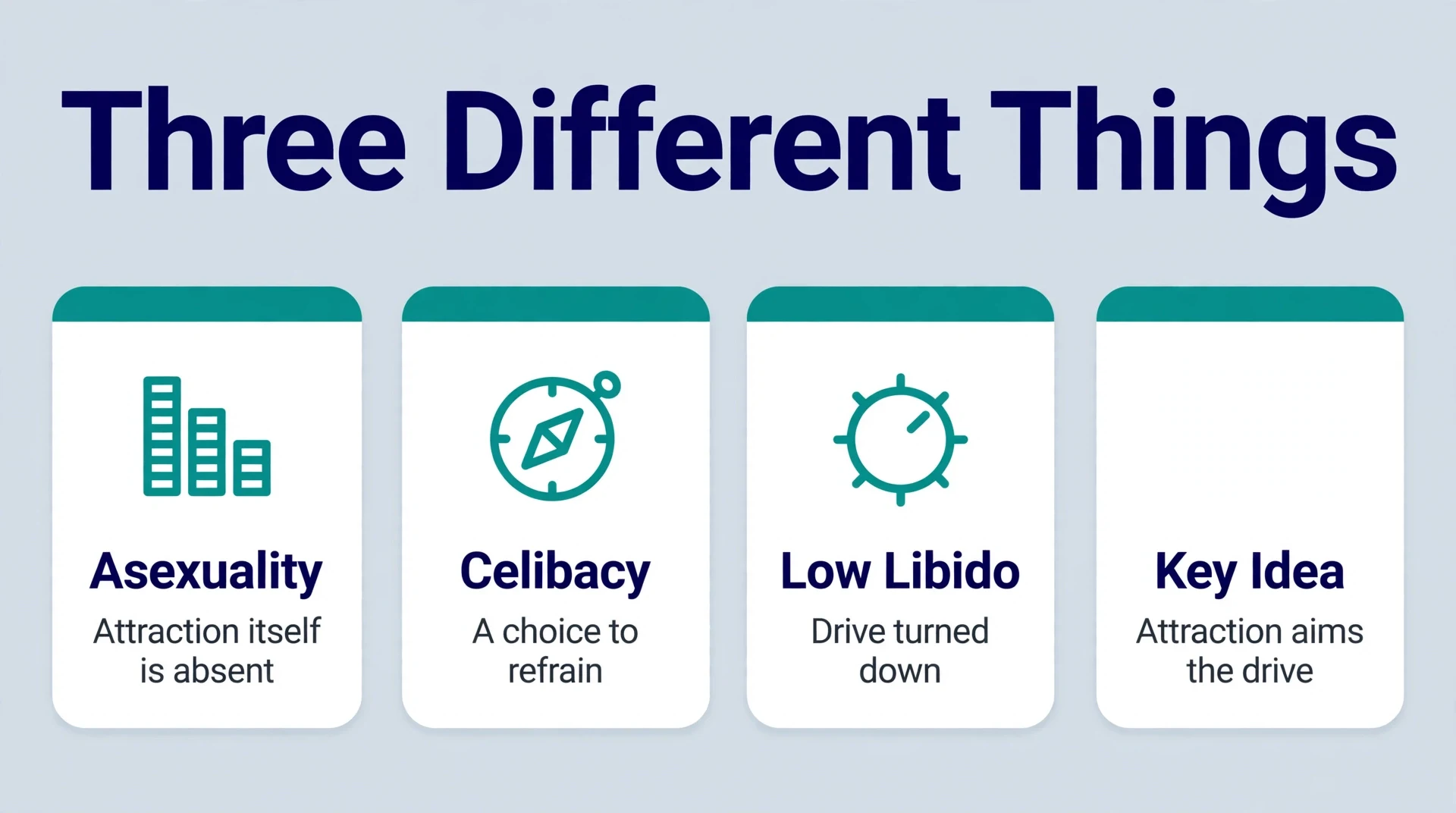
Asexuality vs celibacy. Celibacy and abstinence are behaviours: choices to refrain from sexual activity, usually for religious, practical or personal reasons, made by people who experience attraction and set it aside. Asexuality is not a choice and not a restraint; there is, in the typical ace account, nothing being restrained. The comparison that circulates in the community makes it vivid: celibacy is declining food you want. Asexuality is the appetite itself being absent or faint. An asexual person may also be celibate. And a sexual person may be celibate for decades, because behaviour and orientation are separate axes entirely.
Asexuality vs low libido. Libido is drive, the body’s general appetite. This rises and falls with health, stress, medication, age and circumstance in people of every orientation. Attraction is directional: it aims the drive at a person. The distinction the ace community draws is between a drive with no target and a drive turned down. An asexual person can have a libido with nobody it points at. A person with low libido still experiences attraction when the drive is present. Sudden changes in either are worth a medical conversation. This is a different matter from an orientation someone has had their whole life.
Asexuality vs a phase or a problem to fix. The research and clinical record treats lifelong patterns of low or absent attraction, without distress about the absence itself, as a variation of human sexuality rather than a malfunction. Distress, where it exists in ace people’s accounts, usually concerns other people’s incomprehension. This is a social problem with a social address.
The Split Attraction Model: Sexual vs Romantic
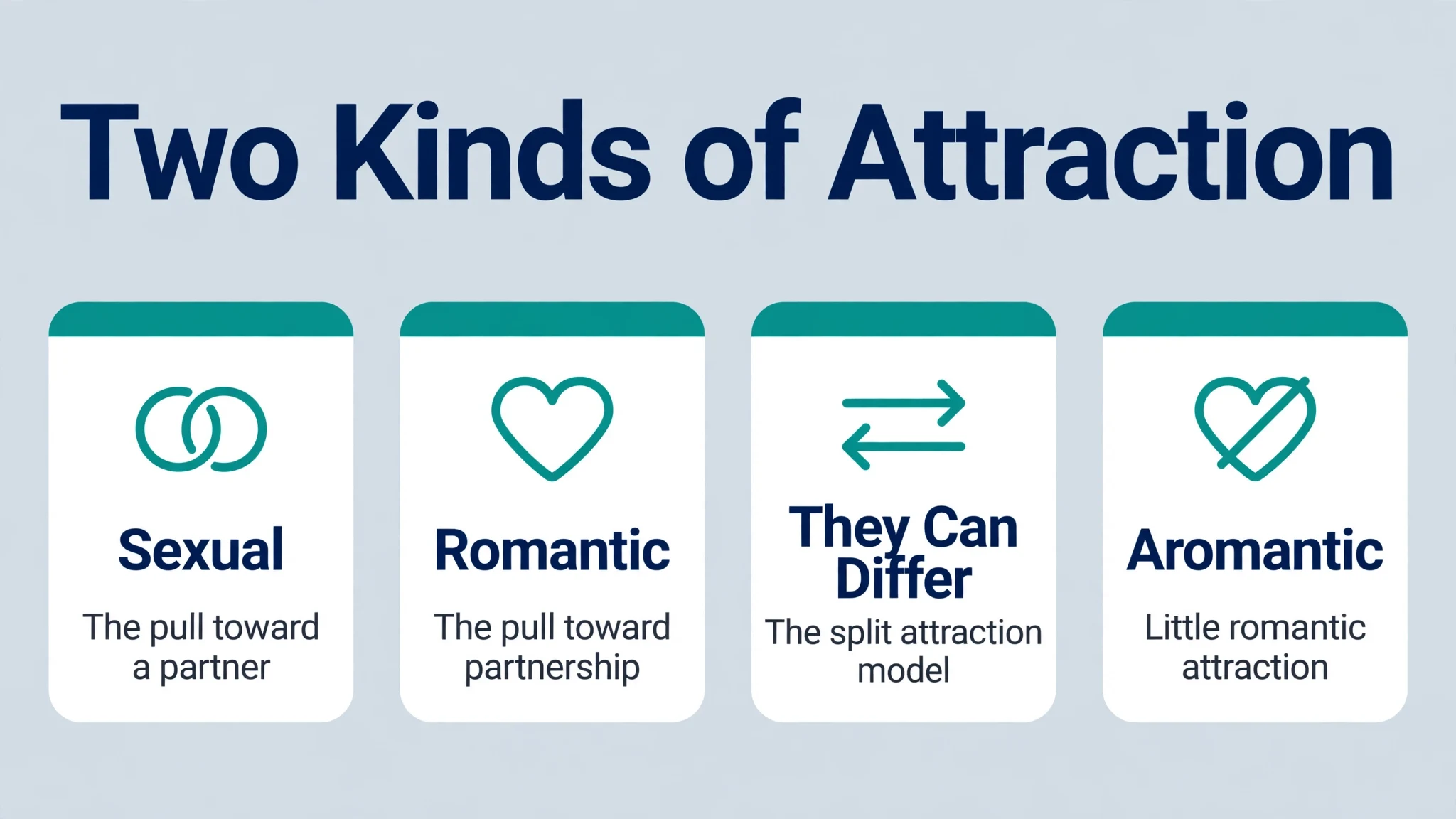
The single most useful idea in this whole guide comes from the ace community itself. The split attraction model, the observation that “attraction” is not one thing. A person can be romantically drawn to someone, wanting partnership, closeness, dates, a shared life, without the sexual component. And the two systems can point in different directions or run at different strengths.
Under this model, every person has (at least) a sexual orientation and a romantic orientation. Most people’s align, so they never notice the seam. Asexual people’s often do not, which is why the ace vocabulary pairs the two. An asexual person may be heteroromantic (romantically drawn to another gender), homoromantic, biromantic, panromantic, or aromantic, the last of these being its own orientation, experiencing little or no romantic attraction either.
Aromantic deserves its own sentence because the two terms are confused constantly, including by search engines. Asexual concerns sexual attraction; aromantic concerns romantic attraction. An aromantic person may experience sexual attraction without romantic pull. An asexual romantic may want everything about a relationship except its sexual dimension. And some people are both, “aroace” in the community’s compact coinage. The orientations are siblings, neighbours, and frequently house mates, but they are not the same address.
This model also explains the answer to the commonest question about asexuality, whether ace people fall in love. Most do, in the romantic register, and describe it in the same vocabulary as anyone else. What is absent is a specific component, not the capacity for attachment, devotion or heartbreak.
The Ace Spectrum: Gray-Asexual and Demisexual
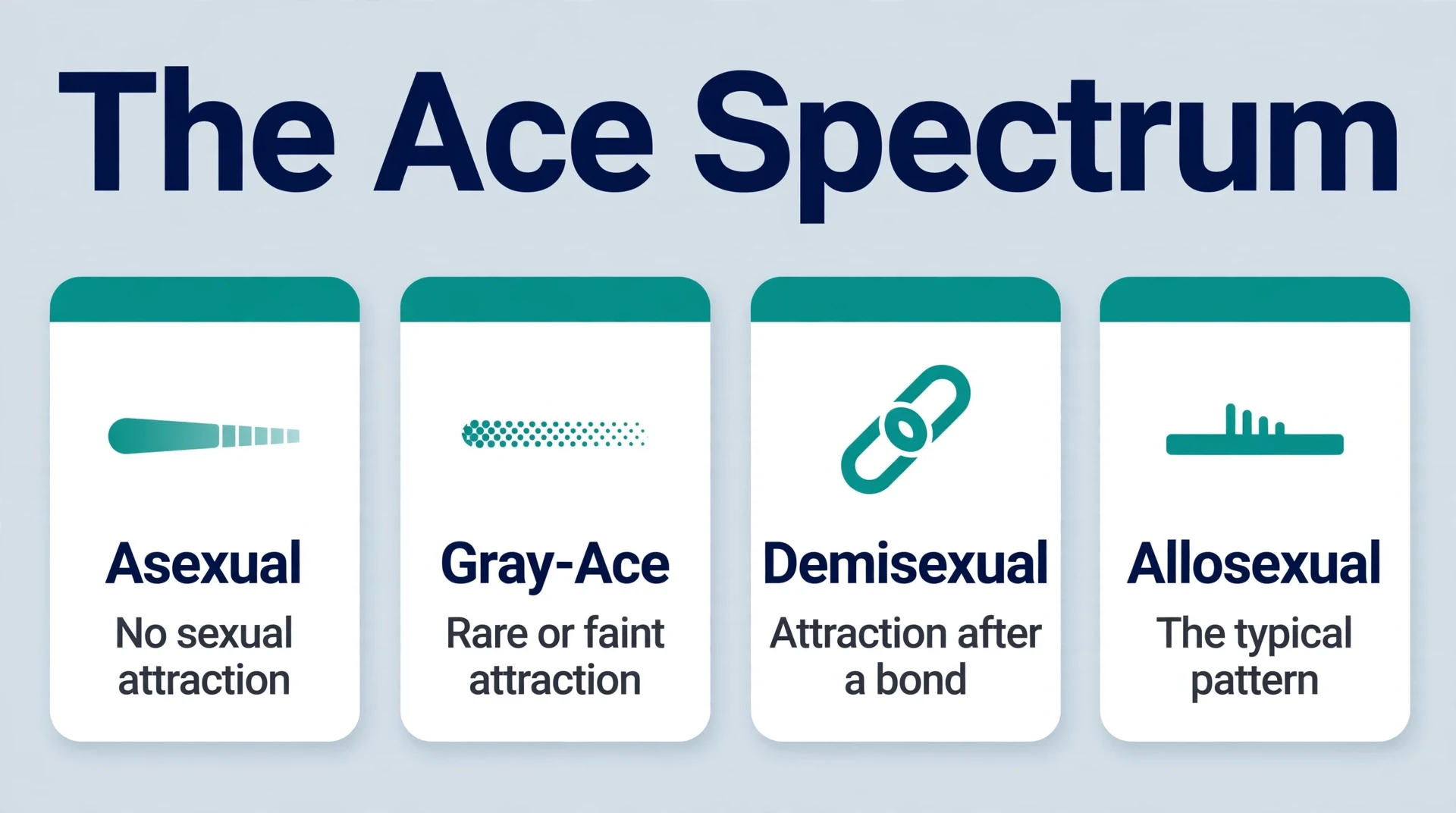
Because the definition says “little or no”, the asexual umbrella covers a range. And two positions on it have names of their own that generate a large share of all searches on this topic.
Gray-asexual (also grey-asexual, gray-ace) describes the in between territory. Sexual attraction experienced rarely, at low intensity, or only in specific circumstances that do not add up to the typical pattern. Gray-aces often report that attraction has happened a handful of times in a life, or arrives so faintly it barely registers as the thing other people describe. The term exists because a binary switch failed to describe real people’s experience. And the spectrum needed a word for its middle band.
Demisexual: Attraction After a Bond
Demisexual describes a specific condition on attraction: it develops only after a strong emotional bond exists. A demisexual person does not experience primary attraction to strangers, celebrities or new acquaintances at all. Attraction, when it comes, grows out of deep familiarity and trust, toward a friend, over time. The term was coined in February 2006 on the AVEN forums, entered general use through the 2010s. And received an Oxford English Dictionary entry in March 2022, a fair measure of how far the community’s vocabulary has travelled. Demisexuality is usually filed under the ace umbrella because its default state matches asexuality’s, with attraction as the rare, conditional exception.
Smaller terms fill out the spectrum’s edges, among them aegosexual (a disconnect between oneself and the object of arousal, attraction experienced at a remove, like watching a film one is not in) and aceflux (attraction that fluctuates over time). Not every ace person uses a micro label. And the community debates their usefulness cheerfully. But the main architecture is stable and simple: asexual at one end, demisexual and gray-asexual in the conditional middle. And allosexual, the community’s word for people who experience attraction in the typical way, at the other end.
Attitudes to Sex Itself: Repulsed, Indifferent, Favourable
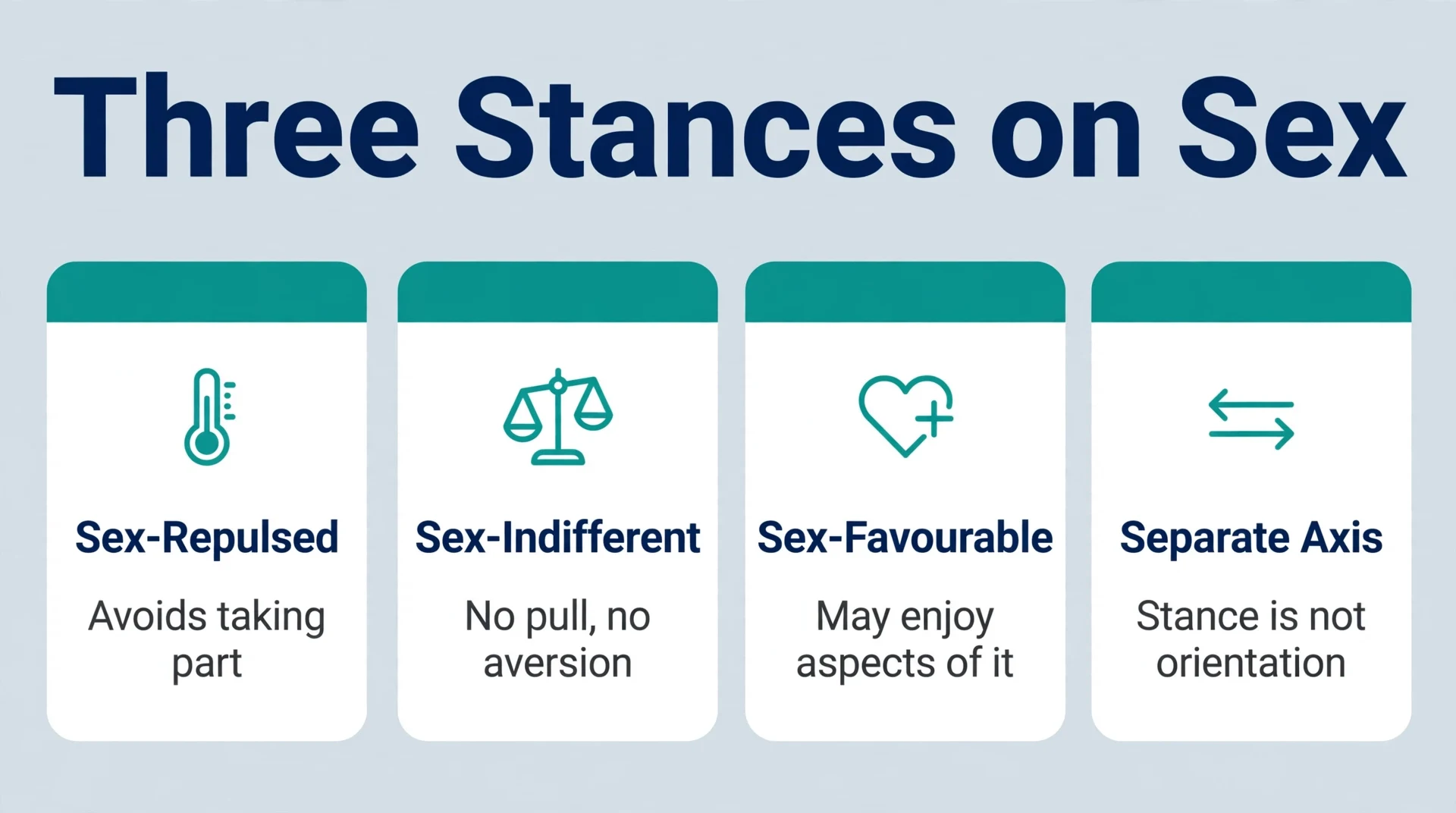
Separate from attraction, ace people describe personal stances toward participating in sex. And the community’s three terms for them prevent a common misreading (that all asexual people are disgusted by sex, or that none are).
Sex-repulsed aces find the idea of participating in sex distressing or revolting, and avoid it. Sex-indifferent aces have no pull toward it but no strong aversion either. Some in relationships choose to participate for a partner’s sake, the way a person might watch a sport they do not follow, for the company. Sex-favourable aces may enjoy aspects of sex, seek it for reasons like closeness or pleasure, while still not experiencing sexual attraction to anyone. Behaviour, again, on its own axis, independent of the attraction that defines the orientation.
These stances are personal, can shift across a life, and apply only to one’s own participation. They are not judgments about anyone else’s choices. The reason they matter for a definition guide is that they explain how two people can share one orientation and live visibly different lives. This confuses observers who expected the label to predict more than it does.
Asexual People and Relationships
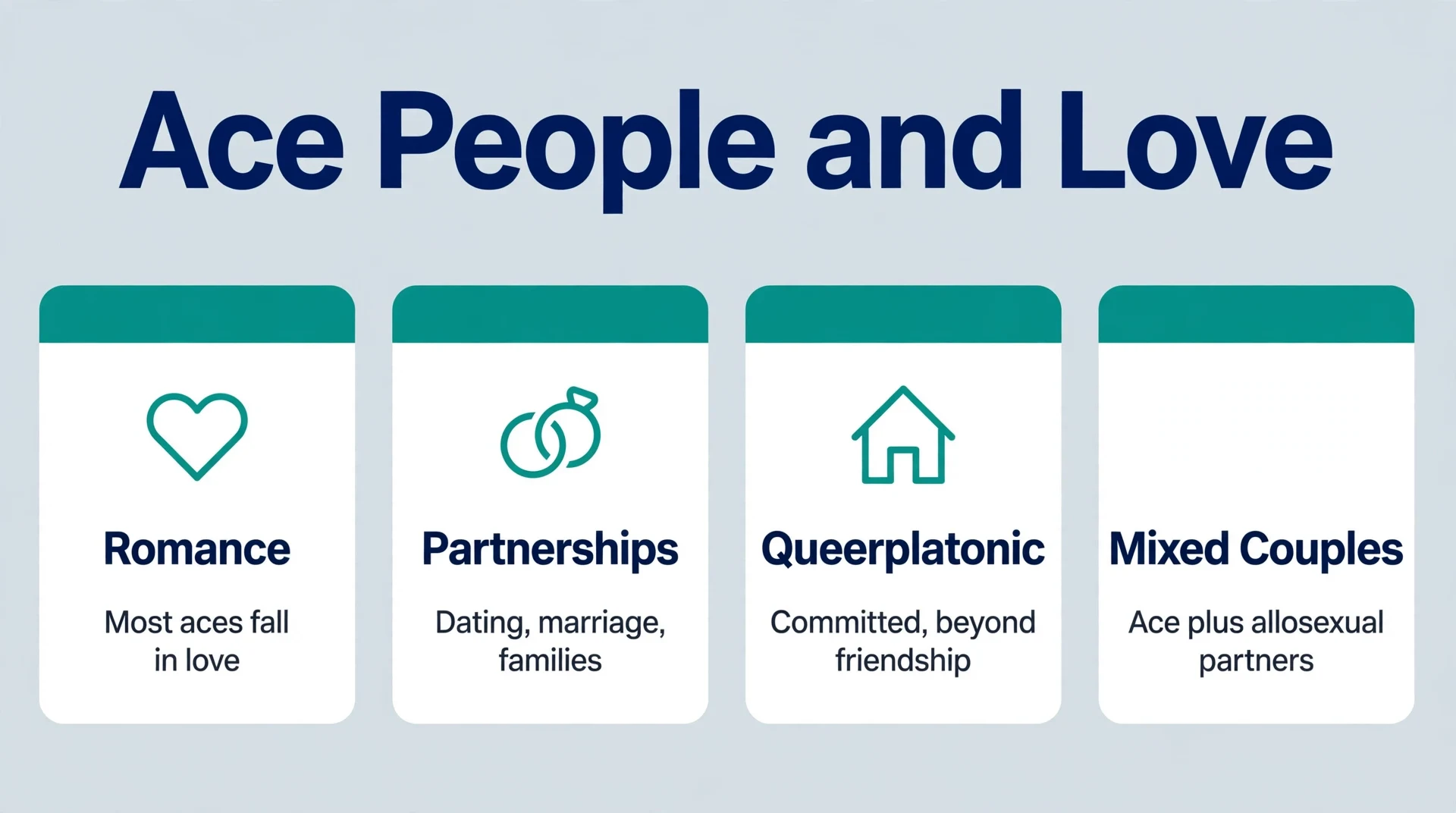
The relationship picture follows from everything above. Romantic aces date, partner, marry and raise families, negotiating the sexual dimension of the relationship as every couple negotiates every dimension where their defaults differ: by talking. Mixed orientation couples (an ace person and an allosexual partner) exist across the full range of outcomes. And ace communities host long, practical literatures on compromise, boundaries and honesty that differ from standard relationship advice mainly in starting from the difference rather than discovering it.
The ace vocabulary also contains a term for a bond the standard vocabulary lacks. A queerplatonic relationship, an intense committed partnership that is not romantic in structure but exceeds what “friendship” usually names, sometimes described by the community with deliberate humour as a “zucchini”, a placeholder word for the relationship English forgot to name. Its existence in the vocabulary is evidence for the guide’s opening point. Where the standard map of attraction leaves blanks, the people who live in those blanks draw their own. And their drawings keep turning out to be useful to everyone else.
Many ace people also become parents, by birth, adoption or partnership, a fact that surprises only those who confused the orientation with an entire biography. Attraction, behaviour, partnership and parenthood are four separate threads in every life in this guide’s model. And aces arrange them in the same variety of patterns as everyone else. This is the least surprising finding in the whole field once the definitions are kept straight.
And some aces, aromantic ones especially, build their central lives around friendship, family and community rather than a partner of any kind. This the record treats as a configuration of a life, not the absence of one.
The Other Meaning: Asexual in Biology
One search intent must be separated cleanly, because the same word does a second, older job in science. In biology, “asexual” describes reproduction without the fusion of gametes. asexual reproduction, in which a single organism produces offspring genetically identical (or nearly so) to itself. Bacteria dividing, strawberry plants sending runners, starfish regenerating, aphids cloning themselves through a summer: all asexual reproduction. And none of it has anything to do with the human orientation this article defines.
The shared word is not an accident, exactly. Both senses use the prefix to mean “without sex”, one about a reproductive mechanism and one about an attraction pattern. Context separates them effortlessly in practice: a page about parthenogenesis is not about orientation. And a page about the ace spectrum is not about starfish. Students searching the biology sense want the mechanisms (binary fission, budding, fragmentation, vegetative propagation, parthenogenesis). Readers of this guide want the orientation, and each group is one clear definition away from its answer.
Asexuality in Everyday Life
For an orientation defined by an absence, asexuality has a surprisingly practical daily texture. And the accounts collected by AVEN and ace writers return to the same few scenes.
Dating is the obvious one. Ace people who date navigate a disclosure question allosexual people rarely face. When to explain an orientation most dates have never encountered, knowing the explanation itself (attraction, behaviour, the spectrum) takes longer than a profile allows. Ace-specific and ace-friendly dating spaces exist precisely because the mainstream apps presume the very attraction the orientation lacks. Inside relationships, the recurring work is translation. Making a partner understand that absent attraction is not absent love, a sentence easy to write and, by ace accounts, genuinely hard to land. This is why the community’s relationship literature is so long and so practical.
Representation on Screen
Representation is the second scene. For most of television history the orientation simply did not exist on screen. Characters without romantic or sexual plotlines were written as robots, villains, children or jokes. The documented landmark in ace communities is Todd Chavez in the animated series BoJack Horseman, who comes out as asexual in the show’s fourth season (2017) and whose storylines treat the orientation as an ordinary fact of a character’s life, widely cited by ace writers as the first mainstream portrayal that felt researched from inside the community. Visibility of that kind matters disproportionately for an orientation people still discover in themselves late, often after years of assuming they were simply broken at a task everyone else found automatic.
Discovery is the third scene, and the one AVEN was built for. The typical ace account involves a long pre history of confusion (crushes performed rather than felt, attraction vocabulary mimicked from friends), then an encounter with the word itself, in a forum post, a video, a friend’s aside, followed by the distinctive relief of a description that fits. Researchers call asexuality an “invisible orientation” for a reason. Without the word, there is nothing to see, including in the mirror.
Labels, Questioning and Time
Because asexuality is defined by an absence, it has a distinctive relationship with self knowledge. There is no event to point to, no first attraction to date it from, only a pattern recognised in retrospect. The community’s guidance for people mid question is correspondingly patient. And it is worth recording because a large share of this article’s readers arrive mid question.
The first principle is that the label is a tool, not a verdict. AVEN’s materials treat “asexual” as available to anyone the description currently fits, with no examination, no minimum duration and no penalty for later revision. The second is that uncertainty is a stable position too: the spectrum vocabulary includes questioning itself. And the gray labels exist partly to house people whose pattern is genuinely unclear to them, possibly permanently. The third is that other people’s timelines are not evidence about yours. Attraction arriving at thirty for one person says nothing about its arrival for another. And the community’s settled position, hardened by decades of members’ testimony, is that the person living the pattern is its best witness.
This patience is not vagueness; it is the logical consequence of the definition. An orientation known only from the inside, measured against a lifetime, cannot be diagnosed from outside or disproved by a deadline. What the community offers instead of tests is company. Forums full of pattern matching, where the relief reported most often is not certainty but the end of solitude about the question.
A Short History of Asexuality
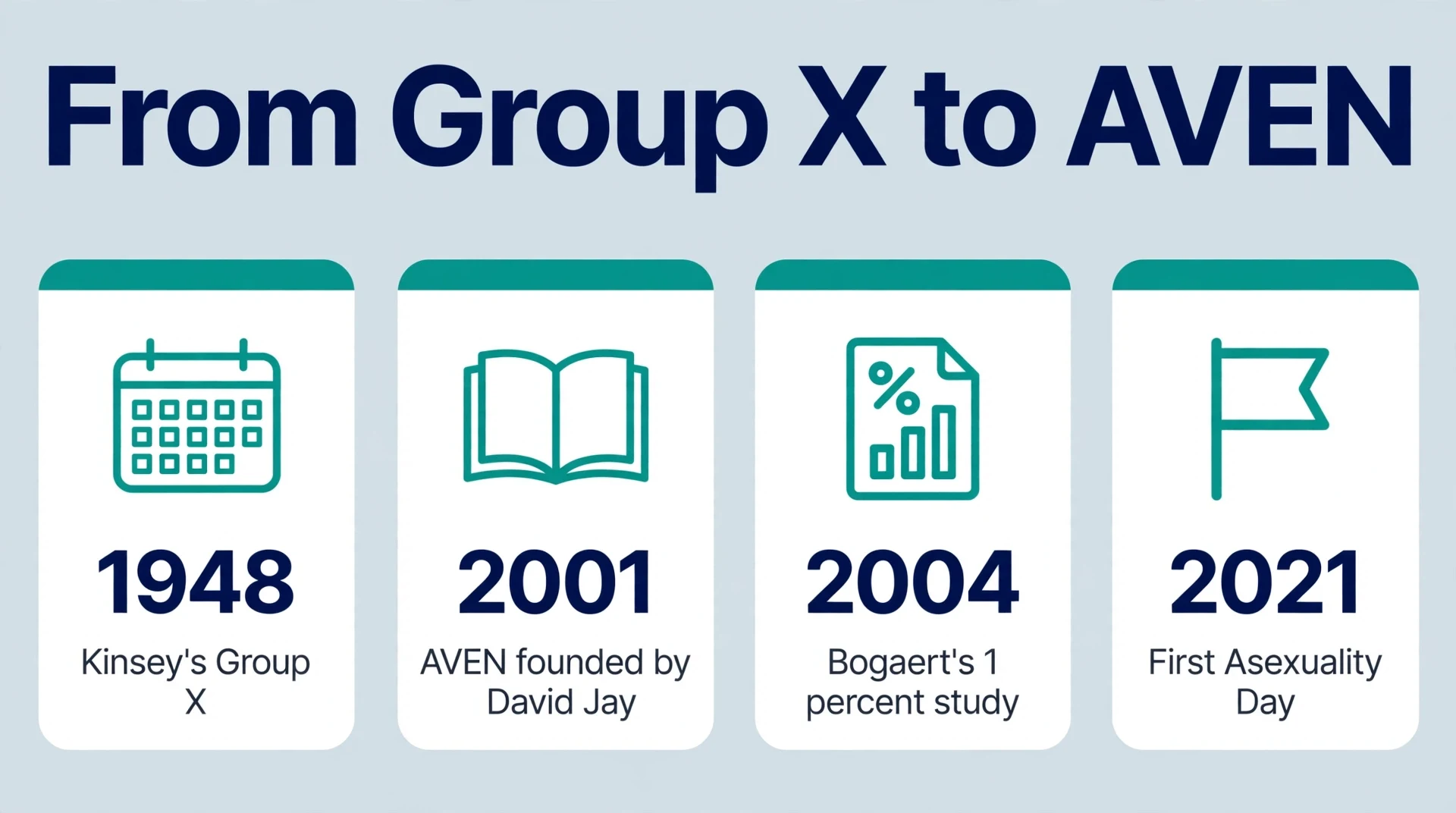
The orientation is old; its paperwork is young, and the gap between the two is the story.
1948 and 1953. Alfred Kinsey’s landmark studies of human sexuality rated people on a scale from 0 to 6. And quietly included a category off the scale’s end: Group X, for people with “no socio-sexual contacts or reactions”. The category sat in the literature for decades, an observed fact without a community attached.
1980. Researcher Michael Storms proposes a two dimensional model of attraction that gives asexuality a formal coordinate, low attraction on both axes, one of the first academic placements of the orientation as a position rather than an omission.
2001. David Jay, then a teenager, founds the Asexual Visibility and Education Network (AVEN), giving the scattered Group X of the world an address, a forum and a shared vocabulary. Nearly everything in this guide’s terminology, the spectrum language, demisexual’s coinage on AVEN’s forums in 2006, the flag, traces back through this community’s first two decades.
Bogaert’s 2004 Study
2004. Psychologist Anthony Bogaert analyses data from a large British probability survey (NATSAL-I, over 18,000 respondents) and finds that 1.05 percent answered that they had never felt sexually attracted to anyone at all. The figure is the most cited prevalence estimate in the field. And it needs its documented caveats: it measures an attraction response, not an identity label. And a later reanalysis against another survey wave put a comparable figure nearer 0.5 percent. “Around one percent or fewer” is the honest summary. And Bogaert’s own later book, Understanding Asexuality (2012), remains the standard scholarly introduction.
2010. The community creates its flag (below) and launches Asexual Awareness Week, now Ace Week, held in the last full week of October.
2013. The DSM-5 includes its self identification carve out, the clinical milestone described earlier.
2021. First held on 6 April, International Asexuality Day is now an annual fixture organised across countries.
The pattern across the timeline is a community naming itself first and institutions, dictionaries, clinicians, researchers, catching up afterwards, in that order, at roughly a decade’s lag.
The Ace Flag
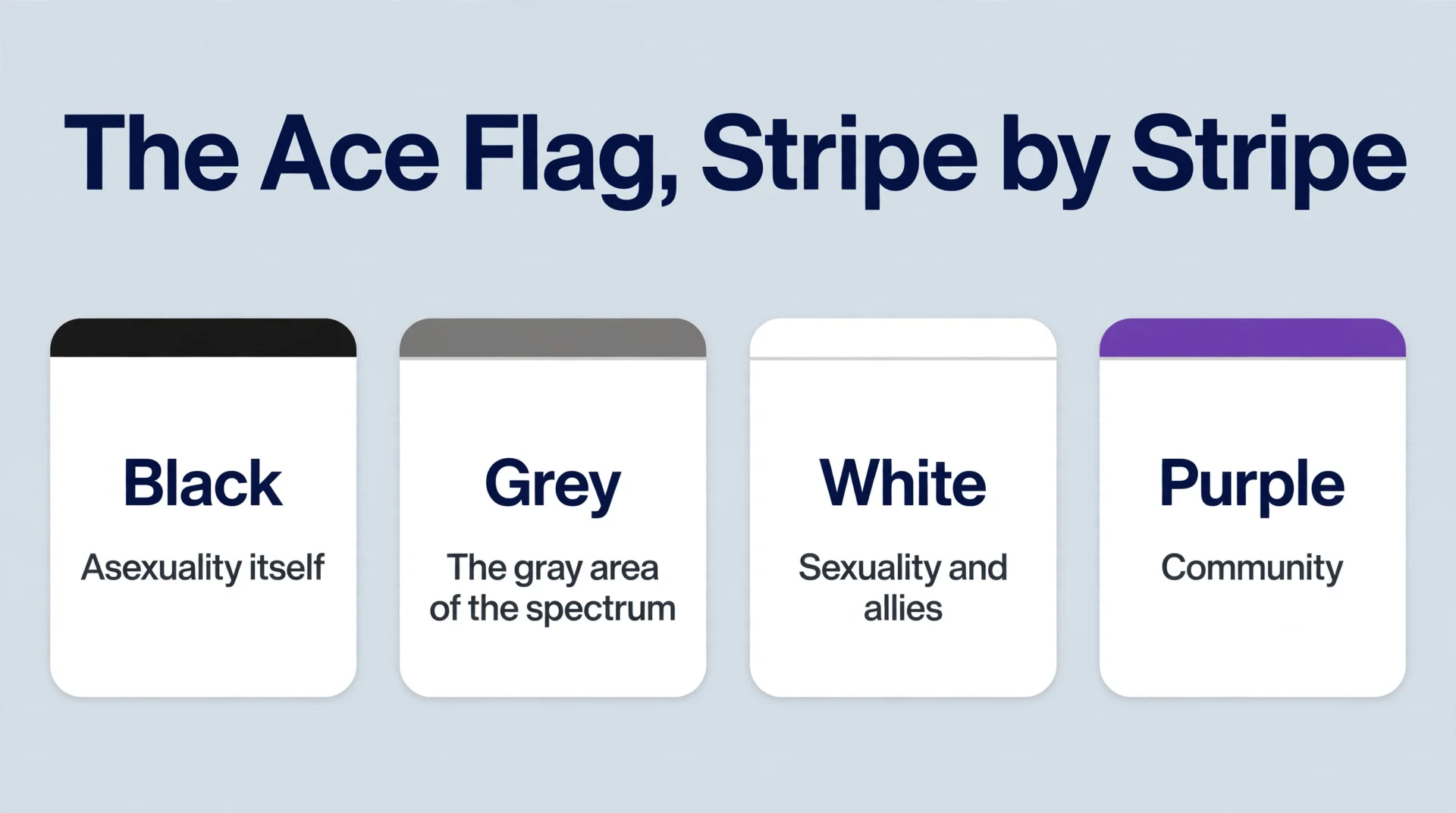
The asexual pride flag was created in 2010 through a community design process organised via AVEN, with the winning design credited to the AVEN user “standup”. It has four horizontal stripes, and the community’s standard reading of them is:
- Black: asexuality itself.
- Grey: the gray area of the spectrum, gray-asexuality and demisexuality.
- White: sexuality, and in some tellings the allosexual allies and partners in ace people’s lives (the stripe’s wording varies slightly between community sources).
- Purple: community, the colour AVEN itself had long used.
The flag flies at pride events, appears in the emoji era’s flag sets informally. And gives the spectrum a visible rallying point, which was precisely its purpose. An orientation defined by an absence is hard to march behind until it has a banner. Alongside it, the community uses smaller symbols playfully and seriously, including the ace of spades playing card (a pun on “ace”), a black ring worn on the right middle finger as a quiet identifier among those who know. And a running fondness for cake, from the community’s founding era joke that, given a choice, one would rather have cake.
Visibility: Days, Weeks and Public Figures
Two fixtures structure the community’s calendar. Ace Week, founded in 2010 by Sara Beth Brooks as Asexual Awareness Week and held in the last full week of October. And International Asexuality Day, held on 6 April since 2021. Both mix celebration with the original AVEN mission, education, since the orientation’s main public problem remains simple unfamiliarity rather than organised hostility.
Public identification has come from a small number of figures who have described themselves in their own words on the record, among them model and activist Yasmin Benoit, a prominent British voice on asexuality. Designer and television personality Tim Gunn, who has spoken about his decades of celibacy and identification with the orientation. And comedians Paula Poundstone and Janeane Garofalo, both of whom have described themselves as asexual in interviews. Guides that attach the label to historical figures or to people who never used it are speculating. The living record above is the documented one, and it grows by self description only.
Common Misconceptions About Asexuality
“It is just a late bloomer phase.” Some people’s attraction arrives late, and some people’s never arrives. Both experiences are real, and only time distinguishes them. This is why the community’s own advice runs against gatekeeping in both directions. A person who identifies as ace at twenty and differently at thirty was not lying at twenty. Labels describe; they do not swear oaths.
“Something must have happened to them.” The assumption that absent attraction must be trauma’s fingerprint is not supported by the research record. Studies comparing ace and non ace populations do not find the simple causal story the assumption needs. And the orientation appears in people with every kind of personal history, including unremarkable ones. Individual ace people may have individual histories, as everyone does; the orientation is not explained by them.
“It is a hormone problem or an illness.” The clinical record, capped by the DSM-5’s self identification carve out, treats asexuality as an orientation rather than a disorder. Genuine medical changes (a sudden shift in desire, new medication effects) deserve medical attention on their own terms. But they are distinguished precisely by being changes, departures from a person’s baseline, not a lifelong pattern lived without distress.
The Prudish Myth
“Ace people are all prudes or afraid of intimacy.” The stances section above retires this one. Aces divide into repulsed, indifferent and favourable on participation. And romantic aces pursue intimacy in every register but one. Judgments about other people’s sexual choices, in any direction, are not part of the orientation’s content.
“You just have not met the right person.” The community’s most quoted dismissal. And the one its members report hearing most. It assumes the conclusion it argues for, that attraction is universal and only awaiting its object, against the testimony of adults who have met, by any reasonable count, enough people. The polite version of the truth is that orientations are known from the inside. And the inside report is the data.
“Am I asexual?” This guide cannot answer for any individual, and distrust any page that offers a quiz verdict. What the record offers is the definitional material above. If the description of little or no sexual attraction matches your long term pattern, the label exists for you to use for exactly as long as it fits. And AVEN’s community resources are the standard next stop for people working the question through.
The Word Itself
“Asexual” is built from the Greek prefix a-, meaning without. And “sexual”, and its two careers in English map neatly onto this article’s two subjects. The word served biology first, describing reproduction without sex from the nineteenth century onward. And was applied to human sexuality only occasionally in early sexological writing before AVEN’s founding generation adopted it as their banner in 2001. Before that adoption, people matching the description had no shared public name at all, only Kinsey’s letter X. This may be the neatest demonstration in this whole guide of what a word does. The orientation existed, the population existed. And the community could not form until the label gave it a handle.
The community’s own short form carries a happy accident. “Ace” was already English slang for excellent. And for the highest card in the deck. This handed the orientation a nickname with built in dignity and a ready symbol in the ace of spades. Few orientations get a compliment for a name. The ace community took the gift. And the card, the ring and the cake jokes followed, building the small cheerful iconography that pride flags usually have to manufacture from nothing.
How Asexuality Is Studied
Asexuality is a young research field, and its methods explain its headline numbers, including why they disagree with each other.
The field’s anchor studies measure attraction, because surveys can ask it directly. The NATSAL analyses behind the “around one percent” figure asked respondents whether they had ever felt sexually attracted to anyone, a question with a clean yes or no that identity questions lack. Studies measuring identity instead, asking people whether they call themselves asexual, reliably return lower figures, because they capture only those who both match the pattern and know and use the word. The gap between the two measures is itself a finding. It is the size of the population the visibility project exists to reach.
Beyond surveys, the field leans on the community it studies. Much qualitative research recruits through AVEN and ace organisations. This produces rich accounts of lived experience at the price of self selection. The aces easiest to study are the connected, identified ones, likely more certain and more community minded than the average. Researchers note this limitation openly, and Bogaert’s survey based work is valued partly because it escapes it, catching respondents who had never heard the term they matched.
The field also studies the neighbours. How asexuality differs from desire disorders in clinical samples, how aromanticism distributes within and beyond the ace population. And how ace people fare in relationships and wellbeing measures. The results so far support the orientation framing, similar wellbeing once stigma is accounted for, distinct patterns from clinical low desire. But a careful guide ends where the researchers do: the field is two decades old, its samples are imperfect. And its central estimates should be quoted with their caveats attached, as this guide has tried to do.
Frequently Asked Questions
What does asexual mean?
Asexual describes a sexual orientation in which a person experiences little or no sexual attraction to other people. AVEN, the main community organisation, defines an asexual person as a person who does not experience sexual attraction. The short form is “ace”, and the term covers a spectrum that includes gray-asexual and demisexual people.
Can asexual people fall in love?
Yes. Asexuality concerns sexual attraction, not romantic attraction. Under the split attraction model used by the community, many asexual people are romantically attracted to others, date, form partnerships and marry. Asexual people who experience little or no romantic attraction either are called aromantic; some people are both, shortened to aroace.
What is the difference between asexual and aromantic?
Asexual is about sexual attraction; aromantic is about romantic attraction. An asexual person may still want romantic relationships, and an aromantic person may experience sexual attraction without romantic pull. They are separate orientations that can occur independently or together.
What does demisexual mean?
Demisexual describes someone who experiences sexual attraction only after forming a strong emotional bond with a person. Attraction to strangers or new acquaintances is absent; it can develop within deep familiarity. The term was coined on the AVEN forums in 2006 and is considered part of the ace spectrum.
Is asexuality the same as celibacy?
No. Celibacy is a behaviour, a choice to refrain from sex, usually made by people who experience sexual attraction. Asexuality is an orientation, the absence or near absence of the attraction itself. This is not chosen and involves no restraint. A person of any orientation can be celibate, and an asexual person may or may not be.
How many people are asexual?
The most cited research estimate comes from Bogaert’s 2004 analysis of a British survey of over 18,000 people, in which 1.05 percent said they had never felt sexually attracted to anyone. The figure measures an attraction response rather than an identity. And later analysis suggests a comparable figure nearer 0.5 percent, so “around one percent or fewer” is the careful summary.
What do the ace flag colours mean?
The flag, created in 2010 through a community process on AVEN, has four stripes. Black for asexuality, grey for the gray area of the spectrum including gray-asexuality and demisexuality, white for sexuality and allies, and purple for community.
Is asexuality a disorder?
No. Psychiatry’s diagnostic manual, the DSM-5, explicitly notes that self identification as asexual rules out a diagnosis of sexual interest or arousal disorder in that case. Asexuality is recorded as an orientation. Sudden changes in attraction or desire are a separate matter and worth discussing with a doctor on their own terms.
What is an allosexual person?
Allosexual is the ace community’s term for someone who experiences sexual attraction in the typical way, the counterpart word to asexual, coined so that the majority pattern has a name too rather than being simply called “normal”. “Allo” is its common short form.
Conclusion
Asexual is a small word carrying a precise claim. That sexual attraction, a near universal experience most people never think to question, is for some people faint, rare, conditional or simply absent. And that this is an orientation rather than a failure, a fear or a choice. The vocabulary the ace community built around that claim, the spectrum, the split attraction model, demisexual and aromantic and the rest, has proved useful far beyond its origin, giving everyone a finer set of instruments for describing how attraction actually varies. That may be the orientation’s largest public gift: not only visibility for the roughly one percent who live it. But a better map of the territory for the ninety nine percent who had never needed one. The definitions in this guide are the map’s legend. The territory, as always, belongs to the people in it.