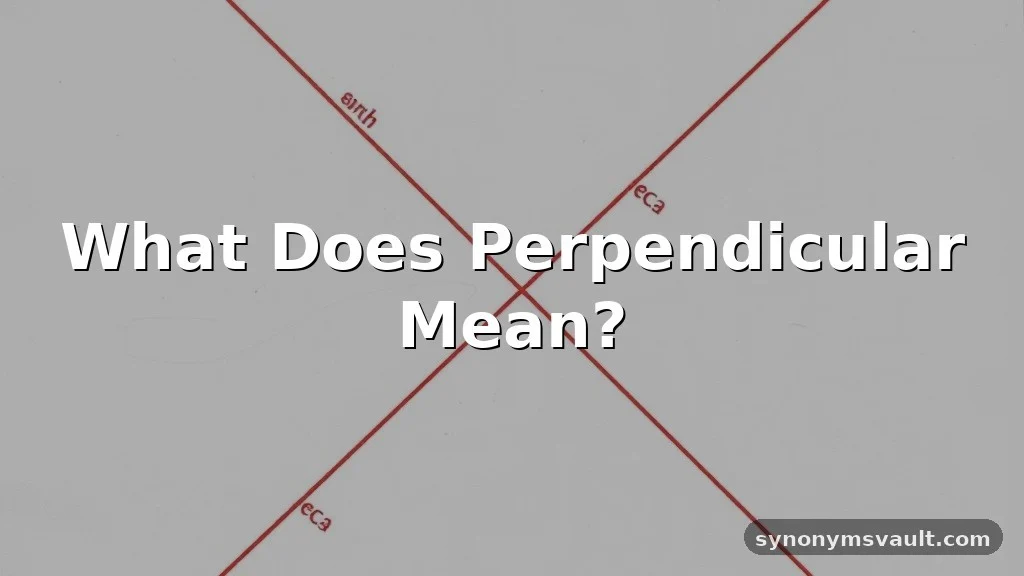
Geometry can sound complicated when you see words like perpendicular. But the idea is much easier than it looks. So, what does perpendicular mean? In simple terms, perpendicular describes two lines, rays, or surfaces that meet at a 90-degree angle. That angle is called a right angle.
You see perpendicular lines in everyday life. Think about the corner of a book, the edge of a wall and floor, or the lines on graph paper. These examples help make the concept easier to picture.
In mathematics, perpendicularity is a specific geometric relationship. It is not simply about two lines crossing. They must cross or meet to form a 90° angle. This simple rule is used in geometry, construction, engineering, design, maps, and technical drawings.
This guide explains the meaning of perpendicular in plain English. You’ll also learn its definition, examples, and whether “perpendicular” has a full form.
Definition & Meaning
Perpendicular means two lines, line segments, rays, or surfaces meet at a 90-degree angle.
A 90-degree angle is known as a right angle. When two lines form this angle where they meet, they are called perpendicular lines.
Simple Example
Imagine two straight lines forming a perfect L shape. One line goes up and down. The other goes left and right. If they meet at exactly 90°, they are perpendicular.
Example:
- A vertical wall and a level floor meet at a right angle.
- The horizontal and vertical axes on a coordinate grid are perpendicular.
Easy Definition
Perpendicular means meeting or intersecting at a 90-degree right angle.
It can be written using the ⊥ symbol. For example:
AB ⊥ CD
This means line AB is perpendicular to line CD.
Full Form and Meaning
Perpendicular does not have a full form. It is a regular mathematical and geometric term, not an acronym or abbreviation.
The word perpendicular refers to a relationship in which two lines, surfaces, or directions meet at a right angle of 90°.
So, there is no official “full form” such as separate words for each letter.
In Simple Words
Perpendicular = forming a 90° angle = meeting at a right angle.
The easiest way to remember it is:
Perpendicular → 90° → Right Angle
Defining the Geometric Relationship
At its simplest level, the term describes a specific relationship between two geometric objects. When we talk about this in a formal sense, we are usually referring to two lines that meet at a precise ninety-degree angle. This angle is famously known as a right angle.
Imagine the corner of a piece of notebook paper. If you place one line along the bottom edge and another line along the side edge, those two lines are perpendicular to each other.
They do not lean or tilt. They meet with absolute precision, creating a square corner that is the hallmark of structural stability.
In the world of geometry, this relationship is not just about how things look. It is a mathematical certainty. When two lines intersect in this manner, they divide the space around the intersection point into four equal quadrants.
Each quadrant measures exactly ninety degrees. If the lines were tilted even slightly, the angles would change, and the relationship would no longer be considered perpendicular. This concept is essential in fields like architecture and engineering because it allows builders to create structures that are stable and balanced.
Without the ability to define and measure this relationship, our houses would be crooked, our tables would wobble, and our roads would be difficult to navigate. It is the language of alignment and order in a world that often feels chaotic.
Historical Context and Evolution
The study of lines that cross at right angles dates back to ancient civilizations. The ancient Egyptians were masters of this concept, using it to survey land after the annual flooding of the Nile. They needed to ensure that property boundaries were accurate and that their massive monuments were built with perfect alignment.
To achieve this, they used a simple tool involving a rope with knots at specific intervals. By stretching the rope into a triangle with specific side lengths, they could create a perfect right angle on the ground. This technique, which predates the formalization of geometry by the Greeks, shows just how practical this knowledge has always been.
As time progressed, the Greek mathematician Euclid formalized these ideas in his famous work, The Elements. He provided the logical framework that we still use in classrooms today. He defined the properties of these intersections and proved theorems that govern how lines behave in a two-dimensional plane.
Over the centuries, this concept moved from the realm of pure philosophy and math into the heart of the Industrial Revolution. As we began to build more complex machines and skyscrapers, the reliance on perfectly square joints became even more critical. Today, the concept is embedded in our digital world as well.
Every pixel on your screen is part of a grid, and every line of code that draws a window or a button on your computer relies on the same geometric principles defined thousands of years ago. You can learn more about these foundational geometric concepts at the Britannica entry on geometry.
Usage in Daily Conversations and Texting
You might be surprised to find that people use this term in casual conversation more often than they realize. While it is a technical term, it has become a shorthand for describing things that are straight, upright, or completely at odds with something else.
For example, if you are working on a woodworking project with a friend, you might say, “Make sure that board is perpendicular to the base, or the whole shelf will lean.” In this context, it is a clear instruction to ensure stability.
In texting or social media, the term is sometimes used metaphorically. If someone says their schedule is perpendicular to yours, they mean that your plans are completely incompatible or that you are never in the same place at the same time.
It implies a lack of intersection. Here is how that might look in a real-life text exchange:
“Hey, are you free for coffee at noon?”
“No, my shift at work is totally perpendicular to your lunch break. I start exactly when you finish.”
In gaming, players often use the term when discussing map layouts or character movement. If you are playing a tactical shooter game, you might tell your teammate, “Hold the hallway that is perpendicular to the main entrance.”
This gives them a clear mental image of where they need to stand to cover an angle effectively. It is a precise way to communicate positioning without needing to draw a map.
Common Misconceptions and Clarifications
One of the most common mistakes people make is confusing the term with the word vertical. While a vertical line can be perpendicular to a horizontal floor, the two words are not synonyms. Vertical refers to an orientation relative to gravity, specifically standing straight up and down.
Perpendicular refers to a relationship between two things. You can have two lines that are perpendicular to each other while both are tilted at a forty-five-degree angle relative to the floor. As long as they meet at ninety degrees, they are still perpendicular.
Another misconception is that the lines must be perfectly straight. While we usually talk about straight lines, the concept can apply to curves as well. In calculus, we often talk about a line that is perpendicular to a curve at a specific point.
This is called a normal line. It touches the curve at a right angle relative to the tangent line. This is a bit more advanced, but it shows that the concept is flexible.
People also sometimes assume that the lines must touch or intersect. In geometry, we say two lines are perpendicular if they would form a right angle if they were extended to meet. Even if they are just segments floating in space, if their orientation forms a right angle, the relationship holds true.
Similar Terms and Alternatives
When you are trying to describe this relationship, you might find yourself reaching for other words. Depending on the context, some of these alternatives might be more appropriate.
For instance, the word orthogonal is a fancy, technical synonym used often in engineering, computer science, and linear algebra. It sounds more academic than the common term.
Then there is the word plumb. This term is used almost exclusively in construction. If a wall is perfectly vertical, a builder will say it is plumb.
It comes from the use of a plumb bob, which is a weight on a string used to find a true vertical line. While perpendicular describes the relationship between two things, plumb describes the relationship between an object and the center of the earth.
Here is a quick breakdown of how these terms compare:
| Term | Usage Context | Meaning |
|---|---|---|
| Perpendicular | Geometry, General | Meeting at a 90-degree angle |
| Orthogonal | Math, Engineering | Often used for perpendicular vectors |
| Plumb | Construction | Perfectly vertical to the ground |
| Square | Carpentry, DIY | Having a 90-degree corner |
| Right-angled | Education | Having an angle of 90 degrees |
Using the right word helps you sound more precise. If you are talking to a carpenter, use square.
If you are talking to a mathematician, use orthogonal. If you are talking to a general audience, stick with the most recognizable term.
How to Respond to This Term
If someone uses this term in conversation, your response should depend on the setting. If you are in a casual setting, you do not need to overthink it.
A simple acknowledgement that you understand the alignment is usually enough. If you are in a professional setting, like a design meeting, you should be precise.
If a colleague says, “We need to ensure the new wall is perpendicular to the existing partition,” you might respond in a few different ways:
Casual: “Got it, I will make sure the corner is perfectly square.”
Professional: “Understood. I will verify the angle to ensure it meets our structural requirements.”
Funny: “I will make sure it is perfectly ninety degrees, unless we are going for the artistic ‘leaning tower’ look!”
If you are unsure if someone is using the term correctly, it is perfectly fine to ask for clarification. You could say, “Just to be clear, are you looking for a ninety-degree angle there?”
This shows that you are paying attention to the details and want to ensure the final result is correct. Never feel embarrassed about asking for clarification, as technical terms can often be used loosely in casual speech.
Regional and Cultural Differences
The term itself is quite universal because it is rooted in mathematics, which is a global language. However, the slang or common ways to describe this relationship can vary.
In some regions, people might use local terms for a square tool or a specific measurement device. For example, in some parts of the world, a “try square” is the standard tool for checking this relationship, and people might refer to the act of checking an angle as “squaring up.”
In languages other than English, the equivalent terms often share the same Latin or Greek roots. For instance, in many Romance languages, the word is very similar to the English version. This makes it easier to communicate technical concepts across borders.
However, in cultures where traditional building methods differ, the focus might be on different types of alignment. For example, in regions where structures were traditionally circular or irregular, the concept of a ninety-degree angle might be less central to daily life than in cultures that rely heavily on grid-based architecture.
Regardless of the culture, the underlying math remains the same. The laws of geometry do not change based on where you are on the planet.
Usage in Online Communities and Dating Apps
In the world of online dating, you might see people describe themselves as being “perpendicular” to the status quo or having a “perpendicular” personality. This is usually a creative way of saying they are unconventional, quirky, or someone who stands out from the crowd. It is a clever, if slightly nerdy, way to signal intelligence or a unique perspective.
On platforms like Twitter or Reddit, the term might appear in memes or discussions about design. You might see someone post a photo of a poorly built house with a caption like, “Clearly, they did not know what perpendicular meant.” It is a classic way to point out a mistake in construction or design.
In gaming communities, particularly those focused on building games like Minecraft, players are constantly dealing with this concept. Building a house that is not square is a common rookie mistake.
Veteran players often give advice on how to use grids to ensure everything stays aligned, frequently using the term to describe how walls should meet. If you are interacting in these spaces, knowing the term helps you participate in the conversation and understand the feedback you are getting from others.
Hidden or Offensive Meanings
It is important to note that this term is generally very safe and neutral. It does not have any hidden, offensive, or slang meanings that would be considered inappropriate in polite conversation.
It is a purely descriptive, geometric term. Because it is so tethered to math and physical structure, it lacks the ambiguity that some other slang terms have.
However, context is always king. If you use the term in a way that implies someone is “out of alignment” or “not fitting in,” it could potentially be interpreted as a slight against their personality or their way of doing things. For example, telling a coworker that their ideas are “perpendicular to the team’s goals” is a polite way of saying they are completely disagreeing with everyone else.
While not offensive in the traditional sense, it is a strong statement that suggests a lack of cooperation. Always be mindful of your tone when using it to describe people or ideas rather than physical objects.
Suitability for Professional Communication
In a professional setting, this word is perfectly acceptable and often encouraged. It is a precise, accurate term that leaves little room for misunderstanding.
Whether you are in architecture, engineering, graphic design, or project management, using correct terminology is a sign of professionalism. It shows that you care about the quality of your work and that you understand the technical requirements of your field.
If you are writing a report, a contract, or a design specification, use the term clearly. Avoid using vague descriptions like “the corner should be straight” when you mean “the corner should be perpendicular.” Precision matters in professional writing.
If you are worried about sounding too technical, you can always include a brief explanation, but in most professional environments, this term is standard vocabulary. It is far better to be accurate and clear than to be vague and risk a mistake in your project.
FAQs
1. Does perpendicular mean straight?
Not necessarily.
A line can be straight but not perpendicular to anything else. It only becomes perpendicular when it forms a right angle with another line.
2. How do you explain this to kids?
Use a piece of paper.
Show them the corner where two edges meet. Tell them that when two lines meet to form a perfect “L” shape like that corner, they are perpendicular.
3. What does it mean if a wall is perpendicular to the floor?
It means the wall is standing perfectly upright at a ninety-degree angle to the floor. It is not leaning forward or backward.
4. Are all intersecting lines perpendicular?
No.
Many lines intersect at angles other than ninety degrees. They only qualify as perpendicular if they meet at exactly ninety degrees.
5. Can you use this term in physics?
Yes, it is often used to describe forces. For example, a normal force is a force that acts perpendicular to a surface.
6. Is there a simple way to draw it?
Yes, you can use a protractor to measure a ninety-degree angle or use the corner of a square object like a book or a ruler to trace the angle.
7. Why is this concept important in math?
It is the foundation for understanding coordinates, slopes, and the properties of shapes like squares and rectangles, which are essential for advanced math.
Conclusion
Understanding this geometric concept is a useful tool for anyone. It helps you build things, solve problems, and communicate with precision. Whether you are measuring a room, writing a technical report, or just trying to understand the world around you, this relationship between lines is a constant.
It provides a framework for order and stability in our physical environment. By mastering this term, you gain a better grasp of how we measure, design, and interact with the space we occupy every single day.
Remember that precision is the key to both good design and clear communication. The next time you see a perfect square corner, you will know exactly what to call it.
7 thoughts on “What Does Perpendicular Mean | The Easy Way to Understand Right Angles Without the Geometry Headache 2026”